




Abstract
Recent decades have seen an increase in the frequency of ‘scandalization’ in political news, a practice in which journalists try to persuade the public that there is a scandal, sometimes by exaggerating the importance of minor mistakes or improprieties. At the moment, little is known about the effects of this practice on news consumers. In this study, we investigated the effects of scandalization on news consumers’ evaluations of the politician involved in the scandal, as well as the news message itself. We expected that such responses would be contingent on the perceived severity of the alleged transgression. We conducted an experiment in which we randomized participants (128 undergraduate students at a Dutch university) into a 2(mild versus severe transgression) X 2(scandalization versus control) between participants design. The results showed that, in the mild transgression condition, a scandalizing message caused participants to perceive the alleged events as less serious than a control message, and that scandalization resulted in lower levels of perceived message appropriateness and message trust. No effects of scandalization were found in the severe transgression condition. We conclude that scandalization does not inevitably lead to lower levels of political trust and increased political cynicism. It can, however, lead to lower levels of trust in news reporting when the transgression is seen as mild.
Keywords
On 23 September 2014, then US President Barack Obama descended from Marine One and saluted two marines flanking him, while holding a cup of coffee in his hand. A number of media personalities rushed to criticize the move as disrespectful and insensitive. Some of them suggested that it was indicative of President Obama’s low regard for the military. Latte Gate was born (Lamothe, 2014).
It is widely recognized that political scandals are a staple of news reporting (Bowler and Karp, 2004; Von Sikorski, 2017). It has also been noted that journalists sometimes try to persuade the public that there is a scandal. Following Geiß (2017), we refer to this practice as ‘scandalization’. According to Geiß (2017), scandalization refers to ‘a communication process in which alleged transgressions or failures of public figures, groups, organizations, or institutions are denounced with the aim of eliciting public outrage’ (p. 1). As such, it does not entail the reporting of a scandal per se, but an attempt to report events in such a way that a scandal is created. Of course, scandalization may be wholly warranted when grave transgressions have occurred. However, as Latte Gate shows, there is an increasing tendency among news outlets to escalate non-scandals into scandals. Sobieraj and Berry (2011) call this ‘conflagration’, and note that it occurs ‘through speech that overstates or dramatizes the importance or implications of minor gaffes, oversights, or improprieties’ (p. 41).
Several studies have focused on the frequency of scandalization in present-day political news, with results generally suggesting that scandalization is on the rise (Sobieraj and Berry, 2011; Von Sikorski, 2017). A review by Von Sikorski (2017), based on the examination of 20 relevant quantitative studies, demonstrated that the scandalization of news messages became more frequent in recent years, especially in Western countries. Little is known, however, about the effects of scandalization on news consumers. A recent meta-analysis concluded that reporting on scandals has the potential to result in negative evaluations of politicians and the political process (Von Sikorski, 2018). But scandalization as such, in contrast to scandals per se, has received very little research attention. To our knowledge, there is at present no research on how scandalization affects the perception of news consumers.
In this study, we investigated the effects of scandalization on news consumers’ evaluations of the politician involved in the scandal, as well as the news message itself. We expected that such responses would be contingent on the perceived severity of the alleged transgression. Specifically, we expected that scandalization would ‘work’, and result in perceptions of the incident as more severe and the actor involved as less trustworthy when the alleged transgression is severe. When the alleged transgression is not severe, however, we expected scandalization to backfire, and result in perceptions of the news message as inappropriate and untrustworthy. Contrary to our expectations, the results showed no evidence that scandalization works in the event of a severe alleged transgression. In line with our expectations, however, there was clear evidence that scandalization can backfire in the event of a mild alleged transgression.
Scandals
Scandals are usually conceptualized as the occurrence of public disapproval as a result of the disclosure of a violation of values, norms or moral codes (Apostolidis and Williams, 2004; Thompson, 2000). More specifically, according to Thompson (2000), scandals have five characteristics, which are as follows: (1) the violation of widely held moral or ethical norms, (2) an initial secrecy surrounding the alleged scandalous behavior, (3) at least some in the wider public who disapprove of the scandalous behavior, (4) the public (and often media-driven) expression of that disapproval, and (5) the real risk that revelations surrounding the scandal may damage participants’ reputations.
There is a substantial literature showing that scandals, conceptualized in this way, can negatively affect the politicians who are involved. For instance, Peters and Welch (1980) showed that between 1968 and 1978 accusations of corruption aimed at incumbents generally produced a decline in vote share of between 6 percent and 11 percent. In a follow-up study on data from the period 1982–1990, Welch and Hibbing (1997) find that the decline in vote share for incumbents charged with corruption was 10 percent on average. In cases where a scandal involves many politicians, research shows that most of them suffer. The revelation in 1992 that hundreds of US House members had regularly overdrawn their checking accounts with the House bank without penalty resulted in an unusually high turnover of House seats in the election of that year (Jacobson and Dimock, 1994). More recently, in 2009, the British public was shocked when Members of Parliament expenses claims were published, revealing claims that were considered frivolous by many. In this case, the effects on voting behavior were relatively muted, though it should be noted that the election took place a full year later and that many MPs with the most questionable expenses claims had left parliament voluntarily (Pattie and Johnston, 2012).
Overall, the picture that emerges from the literature is that scandals have a negative impact on voters’ perceptions of those involved in the scandalous behavior (Clarke et al., 1998; Lanoue and Headrick, 1994; McAllister, 2000; Von Sikorski, 2018). But whereas the effects of the reporting of scandals seem clear, the effects of the journalistic practice of ‘scandalization’ are not known. For this reason, this study aimed to investigate whether the negative effects of scandal reporting can be generalized to scandalization; we ask whether scandalization can result in negative perceptions of the politician involved in the alleged scandal.
Scandalization
As mentioned above, the first characteristic of a scandal as conceptualized by Thompson (2000) is that a widely held moral or ethical norm has been violated. Thompson has also made clear however, that not all violations of all norms are scandalous. Sometimes the norm that has been violated is held only by a small group, or it is simply not a very important norm. Violation of social conventions in terms of clothing or demeanor is more likely to be considered a gaffe than a scandal (Thompson, 2000). However, Nyhan (2015) points out that whether or not a violation has occurred, and whether or not it is sufficiently severe, is often contested, both among the public and among journalists. He introduces the term ‘media scandal’, referring to a situation where there is at least widespread consensus in the mainstream media that a certain behavior constitutes a scandal. But it should be noted that even such limited consensus is often elusive. In the case of Latte Gate, some media commentators were incensed, while others dismissed the outrage as ridiculous (Whitney, 2014).
In this gray area of incidents that may or may not constitute severe transgressions, scandalization – that is, the reporting of events in order to create a scandal – plays a potentially important role. As noted above, scandalization has been conceptualized as a communication process in which alleged transgressions are denounced with the aim of eliciting public outrage. The crucial difference between the reporting of a scandal and scandalization, then, is the persuasive quality of scandalization. When employing scandalization, journalists are not primarily concerned with informing the public, but rather with persuading the public that a severe, and indeed scandalous, transgression has occurred. Such persuading often co-occurs with forceful and emotional language (Sobieraj and Berry, 2011).
Seen through the lens of Thompson’s (2000) five characteristics of scandals, scandalization can be seen as a situation in which the fourth characteristic is present (the media-driven expression of disapproval), while it is not clear whether this is the case for the other four characteristics. As such, the possible consequences of scandalization are much less straightforward than the consequences of scandals. A first likely outcome may be that scandalization has negative effects for the politicians who are implicated, as is generally the case with actual scandals (e.g. Clarke et al., 1998; Jacobson and Dimock, 1994; Lanoue and Headrick, 1994; McAllister, 2000; Pattie and Johnston, 2012; Peters and Welch, 1980; Welch and Hibbing, 1997). On the other hand, a deliberate effort to persuade the reader that scandalous behavior has taken place may be perceived as flouting the journalistic norm of objectivity. A second likely outcome therefore is that the public disapproves of journalists who take such an explicit stance. Scandalization, in other words, may reduce trust in the news message.
Trust in news media
A modicum of trust in news media is of essential importance for any well-functioning society. As Coleman (2012) has noted, ‘not everyone can be everywhere, and [. . .] we need to be able to rely upon the reputation of mediated accounts without having to check and recheck every report that is given to us’ (p. 36). Without this, the idea of a general public that has a basic subset of shared assumptions of the world, as well as the idea of a general public that is generally well-informed, seem untenable (Coleman, 2012; Tsfati and Cohen, 2005).
But when people put their trust in news media, they take a certain risk. For one thing, there is the risk that journalists’ selection of news facts over other facts is biased. For another, there is the risk that journalists do not depict the facts in an accurate way (Kohring and Matthes, 2007). Therefore, when people trust news media, they trust in the specific selection that is made and they trust that the facts are depicted truthfully (Kohring and Matthes, 2007). If news consumers are expected to put their faith in journalists, it is important that they perceive the news media as objective (Neuman et al., 1992; Schudson, 2001). A recent study showed that the perception of objectivity was an important predictor of both journalists’ and news consumers’ evaluation of news messages (Mothes, 2017). When the news message is perceived as too explicitly taking a stance, consumers may perceive it as lacking in objectivity (Cramer and Eisenhart, 2014), and therefore evaluate it negatively.
Unfortunately, there is ample evidence that trust in the news media has declined in recent decades (e.g. Donsbach et al., 2009; Gronke and Cook, 2007; Ladd, 2012). A part of this decline may be explained by poor performance on the part of journalists (Coleman, 2012). Indeed, research shows that journalistic practices can impact trust in news messages and in news media more generally. For example, strategic framing of political issues results in lower trust in news media (Hopmann et al., 2015), while sensationalist reporting has a negative impact on appreciation and perceived newsworthiness (Burgers and De Graaf, 2013), as well as on believability and informativeness (Grabe et al., 2000). Scandalization may play a similar role. A deliberate effort to persuade the reader that scandalous behavior has taken place may be perceived as flouting the norm of objectivity. As such, the reported increase in scandalization in news reporting may be one factor that drives the reduced trust in news media.
In sum, one possible consequence of scandalization could be that the described events will be seen as a scandal, and the actors involved will be judged negatively. In other words, the scandalization may ‘work’. However, there is also the possibility that scandalization will not work as intended and will in fact result in negative perceptions of the news message itself. This study was conducted to investigate which of these consequences is more likely.
Consequences of scandalization
Whether scandalization works or not can be expected to depend on news consumers’ perceptions of the severity of the transgression. Support for this notion comes from recent social psychological research on reprimanding norm violators (Eriksson et al., 2017). In this work, participants’ responses to someone who angrily reprimands a norm violator depended on the severity of the norm violation. In general, showing anger when reprimanding a norm violator was perceived as inappropriate, but the negative effect of showing anger disappeared when the norm violation was sufficiently severe. In the context of news and scandalization, we expected that forcefully denouncing a norm violator is perceived as inappropriate when the norm violation is mild, but is considered appropriate, and persuasive, when the norm violation is severe. Thus, in this study, we hypothesized that the severity of the transgression moderates the effect of scandalization. In this reasoning, news consumers who perceived President Obama’s salute as a severe transgression would have been most likely to be susceptible to the scandalization of this incident and judge the President negatively, whereas news consumers who perceived the salute as innocent or meaningless would have been most likely to find the media attention for this incident rather ridiculous, and have negative attitudes toward such reporting.
To investigate these notions, we conducted an experiment in which we randomized participants into a scandalization condition and a control condition. In the scandalization condition, participants were exposed to a fictional news article in which an incident was scandalized; in the control condition, the same incident was reported in a factual manner. Simultaneously, participants were randomized into a mild and severe transgression condition. In the mild transgression condition, the incident involved an alleged parking violation, something that can be perceived as a relatively minor incident (Thompson, 2000). In the severe transgression condition, the incident involved an alleged hit-and-run resulting in serious injury. We expected scandalization to ‘work’ in the severe transgression condition, but we expected scandalization to be perceived as inappropriate in the mild transgression condition. Given the potentially important effects of scandalization on trust in politicians and trust in journalism, we investigated these effects in this study.
Specifically, we expected that:
Hypothesis 1: In the severe transgression condition, a scandalizing news article will result in perceptions of the incident as more serious (H1a), the actor as more guilty (H1b), and less trustworthy (H1c) as compared to a neutral news article, whereas scandalization will not affect these perceptions in the mild transgression condition.
Hypothesis 2: In the mild transgression condition, scandalization will result in perceptions of the news article as less appropriate (H2a), and less trustworthy (H2b) as compared to a neutral news article, whereas scandalization will not affect these perceptions in the severe transgression condition.
Method
Design and participants
The study had a 2(mild versus severe transgression) X 2(scandalization versus control) between participants design. Each participant was randomly assigned to read one of four news articles. A total of 131 undergraduate students at a Dutch university participated in the study, of which three did not finish the study, leaving a total of 128 participants for the analyses. Of these 128 participants, 77.3 percent were female, 53.9 percent were Dutch nationals, 19.5 percent were German, while the other 26.6 percent were international students with backgrounds ranging from American to Peruvian. Age ranged between 18 and 34 years old (M = 22.29; SD = 3.14). There were no significant differences between conditions in terms of gender, χ2(3) = 2.10, p = .72, age, F(3, 126) = .20, p = .94, ηp2 = .006, or any other variable assessed at baseline, ps > .17. The study was preregistered at: https://osf.io/qjkfs/.
Procedure
Participants were invited to participate in the study online, through the University’s online system for research participation. They were offered a reward of €5 for participating in the study. Upon indicating agreement to participate on an online informed consent form, they were redirected to the survey, which included the experimental manipulation. The survey questions and experiment were programmed using the online survey service Qualtrics. Participants answered questions on demographics and personality, were exposed to a fabricated news article about either a severe or mild transgression by a government official, which was manipulated to either include scandalization or consist of a non-scandalized control article. The post-test questionnaire assessed the perceived severity of the reported event, the perceived guilt and (un)trustworthiness of the government official involved, the perceived appropriateness of the news article, and trust in the article. After taking part in the study, participants were thanked and debriefed. Finally, participants were asked to schedule an appointment with the researchers to collect their €5 reward. Before conducting the research, a pilot study among 15 people was performed to guarantee that all questions as well as the scenarios were clear and understandable.
Stimulus materials
The fabricated news article featured a report of an alleged transgression by ‘Hendrik Daugaard’ the (fictional) European Union Commissioner for Mobility and Transport. This transgression either constituted a mild transgression or a severe transgression, depending on the condition. In the mild transgression condition, the article explained that Mr. Daugaard’s car was allegedly involved in a parking violation, ‘[. . .] parked on the sidewalk instead of the empty parking lot next to it, blocking the way for pedestrians and tourists’. The article stressed the negative consequences of the transgression, but these were minor: ‘traffic on the street was interrupted, which finally lead to the removal of the car by the police’. In the severe transgression condition, the article explained that Mr. Daugaard’s car was allegedly involved in a hit-and-run, ‘[colliding] with a cyclist, Frédéric Deramaut, a young law student’ and ‘gravely injuring’ him, before driving away. Again, the negative consequences of the transgression were stressed, but in this case these were severe: ‘[Mr. Deramaut] is now at the hospital but his condition is not critical according to his doctors’.
The scandalization manipulation was based on the definition from Geiß (2017): the scandalizing news articles included the two key elements of scandalization – denouncement of the event and aim at eliciting public outrage. The control news articles were instead a merely informative news presentation, without these two elements. Thus, the control news articles provided a factual account of events, while the scandalized news articles stressed that ‘needless to say that this behavior is unacceptable’ (denouncing the event), and suggested that ‘EU officials abuse their power and risk the safety of normal citizens for the sake of their own privilege and comfort?’ (eliciting public outrage). The articles had similar length (180–195 words) and were presented in the same way.
Outcome measures
Perceived severity of the event
Perceived severity was assessed with one item taken from previous research (Kepplinger et al., 2012) asking participants to indicate the extent to which they thought the depicted event was highly damaging, and a newly created item asking participants to indicate the extent to which it constituted a severe misbehavior, on a 7-point scale (1 = not at all; 7 = very much). These items were highly correlated, r = .64, p < .001, and were therefore averaged into a single perceived severity score, with higher scores indicating greater perceived severity (M = 4.45; SD = 1.41).
Perceived guilt
Following previous research (Kepplinger et al., 2012), we assessed the extent to which participants thought the actor involved, Commissioner Daugaard, was guilty of the event. On a 7-point scale, ranging from 1 (totally disagree) to 7 (totally agree), participants indicated the extent to which they agreed with the four statements ‘Mr. Daugaard is fully responsible for what happened’, ‘Mr. Daugaard had selfish goals’, ‘Mr. Daugaard had complete freedom of action in the event’, and ‘Mr. Daugaard deserves severe punishment for what happened’. In a factor analysis (KMO = .77), the Scree test yielded a single factor, explaining 63.24 percent of variance. Therefore, all items were averaged into an attitude index, with higher scores indicating greater perceived guilt (M = 3.98; SD = 1.29; Cronbach’s α = .80).
Perceived untrustworthiness
To assess perceived untrustworthiness, three items asked participants to indicate, on a 7-point scale ranging from 1 (totally disagree) to 7 (totally agree), their agreement with the statements ‘As a politician, Mr. Daugaard generally has bad intentions’, ‘As a politician, Mr. Daugaard does not deserve much respect’, and ‘As a politician, Mr. Daugaard can be trusted to do what is right’. These questions were adopted from previous research (Mutz and Reeves, 2005). Unfortunately, the third item did not correlate strongly with the first two, resulting in a low factor loading in the factor analysis (KMO = .51) and a poor internal consistency, α = .56. Therefore, this item was dropped from the scale, and a composite distrust score, with higher scores indicating lower levels of trust, was calculated using the average of the first two items, (M = 2.47; SD = 1.31; r = .74).
Perceived appropriateness of the news article
Perceived appropriateness was assessed with four items taken from previous research (Van ’t Riet et al., 2018, 2019) asking participants to indicate the extent to which they thought the tone of the news article was appropriate, the extent to which they thought it fitted the topic at hand, and the extent to which they thought it was suitable for a news article, all on a 7-point scale (1 = not at all; 7 = very much). In a factor analysis (KMO = .73), the Scree test yielded a single factor, explaining 77.79 percent of variance. Therefore, a single perceived appropriateness score was calculated by averaging all three items, with higher scores indicating higher levels of perceived appropriateness (M = 3.95; SD = 1.32; α = .86).
Trust in the news article
We assessed participants’ trust in the news article using four items from previous research (Kohring and Matthes, 2007) which asked participants to use a 7-point scale (1 = strongly disagree; 7 = strongly agree) to indicate agreement with the statements ‘Criticism was expressed in an adequate manner by the journalist’, ‘The journalist’s opinions were well-founded’, ‘The commentary regarding the described event consists of well reflected conclusions’, and ‘I feel that the journalistic report of the described event was useful to have an informed opinion’. In a factor analysis (KMO = .84), the Scree test yielded a single factor, explaining 81.98% of variance. Therefore, a mean score was calculated, with higher scores indicating greater trust in the message (M = 3.22; SD = 1.44; α = .93).
Data analyses
We used 2X2 ANOVAs to investigate the effects of transgression severity, scandalization, and the interaction between transgression severity and scandalization on perceived severity, perceived guilt of the actor, distrust toward the actor, perceived appropriateness of the news message, and trust in the message. Partial eta squared was used as the effect size measure. Power calculations using GPower (Erdfelder et al., 1996) revealed that, given a medium-sized effect for the interaction between the two factors of Cohen’s f = .25, a sample of N = 128 would result in a power of β = .80. In addition to the variables mentioned above, we assessed a limited number of other variables at pre-test. Analyses pertaining to those variables are not described here for reasons of brevity. All data for the study as well as the complete stimulus materials can be found at: https://osf.io/qjkfs/.
Results
Perceived severity, guilt, and distrust
Hypothesis 1 stated that scandalization would result in perceptions of the incident as more serious, and the actor as more guilty and less trustworthy, but only in the severe transgression condition. The analyses for perceived severity revealed a non-significant main effect of scandalization, F(1, 123) = 1.13, p = .289, ηp2 = .009, as well as a significant and large main effect for the severity manipulation, F(1, 123) = 92.49, p < .001, ηp2 = .429, with higher perceived severity in the severe transgression condition (M = 5.35, SD = .94) than in the mild transgression condition (M = 3.53, SD = 1.21). In addition, there was a significant interaction between transgression severity and scandalization, F(1, 123) = 5.32, p = .023, ηp2 = .041. Simple slope analyses revealed that, in the mild transgression condition, scandalization significantly affected the perceived severity of the event, F(1, 61) = 4.60, p = .036, ηp2 = .070, with higher perceived severity in the control condition (M = 3.85, SD = 1.10) than in the scandalization condition (M = 3.22, SD = 1.25). In the severe transgression condition, however, there was no difference between the scandalization and control condition in terms of perceived severity, F(1, 62) = 1.00, p = .321, ηp2 = .016 (see Table 1).
Means and standard deviations for perceived severity, guilt, distrust, perceived appropriateness, trustworthiness of the message for the four conditions.
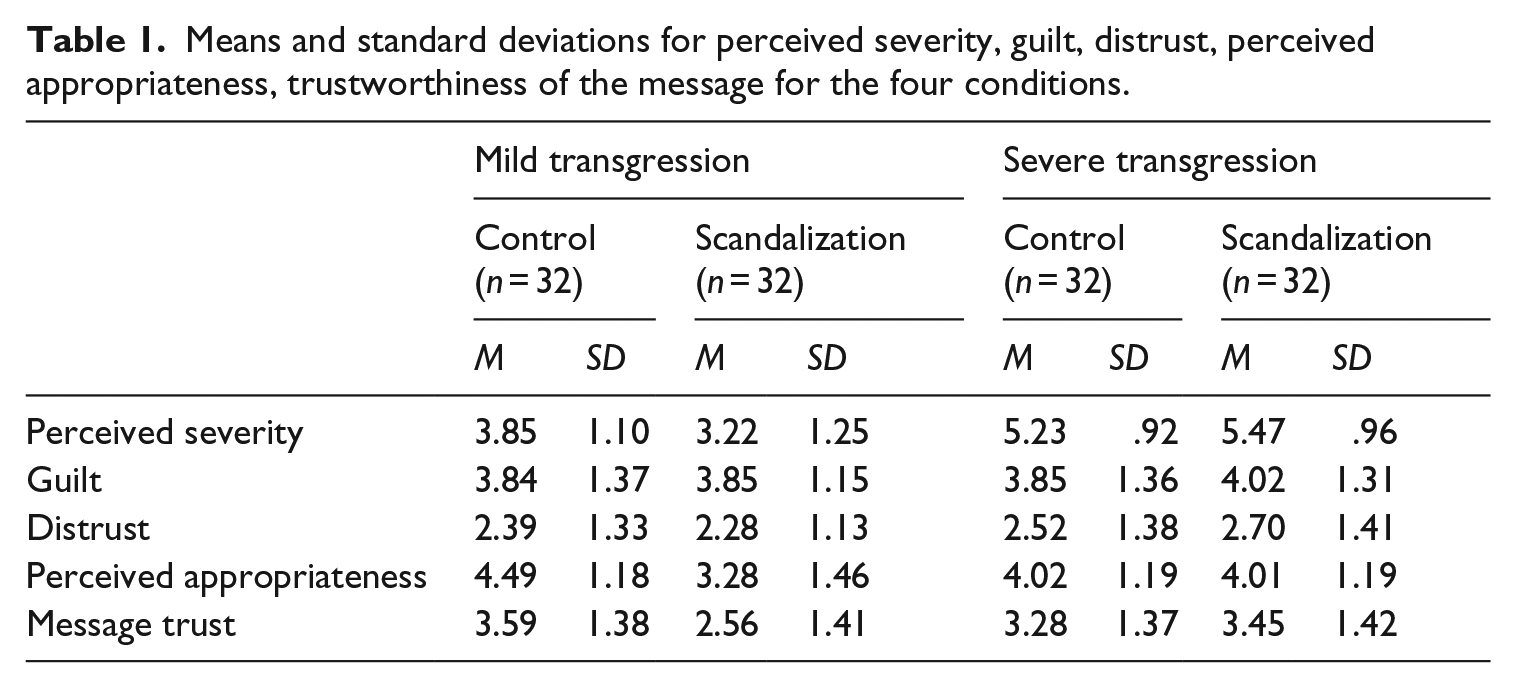
With regard to guilt, the interaction between severity and scandalization was not significant, F(1, 124) = .12, p = .735, ηp2 = .001, nor were the main effects of severity, F(1, 124) = .14, p = .709, ηp2 = .001, and scandalization, F(1, 124) = .14, p = .709, ηp2 = .001. Similar results were found for distrust, with a non-significant interaction between severity and scandalization, F(1, 124) = .41, p = .525, ηp2 = .003, and non-significant main effects for severity, F(1, 124) = 1.38, p = .242, ηp2 = .011, and scandalization, F(1, 124) = .03, p = .867, ηp2 = .000. As mentioned in the Method section, one trust item was dropped from the trust scale because of small correlations with the other two items. Including this item in the scale or using it in a separate analysis yielded similar results and identical conclusions. In the analysis that used the third item separately, a non-significant interaction between severity and scandalization was found, F(1, 124) = .07, p = .796, ηp2 = .001, as well as non-significant main effects for severity, F(1, 124) = 1.07, p = .302, ηp2 = .009, and scandalization, F(1, 124) = .42, p = .519, ηp2 = .003.
All in all, Hypothesis 1 was not supported. No interaction effects were found for perceived guilt and perceived distrust. While the results showed a significant interaction effect of severity and scandalization for the outcome of perceived severity, it played out differently than expected: instead of a positive effect of scandalization on perceived severity in the severe transgression condition, the analyses revealed a negative effect of scandalization on perceived severity in the mild transgression condition, indicating that scandalization results in lower perceived severity when the transgression is mild.
Appropriateness and trust in the news message
Hypothesis 2 stated that scandalization would result in perceptions of the news article as less appropriate and less trustworthy, but only in the mild transgression condition. The analyses for perceived appropriateness revealed a non-significant main effect of the severity manipulation, F(1, 124) = .34, p = .560, ηp2 = .003, and a significant main effect for the scandalization manipulation, F(1, 124) = 7.46, p = .007, ηp2 = .057. Perceived appropriateness was higher in the control condition (M = 4.26, SD = 1.20) than in the scandalization condition (M = 3.65, SD = 1.37). This main effect of scandalization was qualified by a significant interaction between transgression severity and scandalization, F(1, 123) = 7.21, p = .008, ηp2 = .055. Simple slope analyses revealed that, in the mild transgression condition, scandalization significantly affected perceived appropriateness, F(1, 62) = 13.22, p = .001, ηp2 = .176, with higher perceived appropriateness in the control condition (M = 4.49, SD = 1.18) than in the scandalization condition (M = 3.28, SD = 1.46). In the severe transgression condition, however, there was no difference between the scandalization and control condition in terms of perceived appropriateness, F(1, 62) = .00, p = .972, ηp2 = .000 (see Table 1).
For trust in the news message, similar results were found. Although neither the main effect of the severity manipulation, F(1, 124) = 1.41, p = .238, ηp2 = .011, or the main effect for the scandalization manipulation, F(1, 124) = 2.97, p = .087, ηp2 = .023, was significant, there was a significant interaction between transgression severity and scandalization, F(1, 124) = 5.86, p = .017, ηp2 = .045. Simple slope analyses revealed that, in the mild transgression condition, scandalization significantly affected trust in the message, F(1, 62) = 8.57, p = .005, ηp2 = .121, with higher trust in the control condition (M = 3.59, SD = 1.38) than in the scandalization condition (M = 2.56, SD = 1.41). In the severe transgression condition, however, there was no difference between the scandalization and control condition in terms of perceived severity, F(1, 62) = .24, p = .624, ηp2 = .004. In all, Hypothesis 2 was supported, with evidence that scandalization leads to lower levels of perceived appropriateness and trust in the news message, but only in the mild transgression condition.
Discussion
Recent decades have seen a rise in journalists’ use of scandalization, a reporting style in which alleged transgressions are denounced with the aim of eliciting public outrage (Von Sikorski, 2017). Scandalization may of course be legitimate if genuine wrong-doing has occurred, but some scholars are worried that gratuitous scandalization will lead to an uncalled-for decline in trust in political actors and public figures (e.g. Sobieraj and Berry, 2011). In this study, the effects of scandalization were therefore investigated.
We had two expectations. First, we expected scandalization to ‘work’, that is, to result in perceptions of the incident as more severe, and the actor as more guilty and less trustworthy, when the alleged transgression was severe (Hypothesis 1). The data did not lend support to this conclusion, however. In fact, a different pattern emerged with regard to perceptions of severity: in the severe transgression condition, scandalization did not affect perceptions of severity, but in the mild transgression condition, a scandalizing message actually resulted in lower perceptions of severity than a control message. In effect, then, the scandalization backfired; instead of getting recipients to perceive a minor transgression as severe, the minor transgression was perceived as even less serious when scandalized than when presented in a neutral way.
Second, we expected that scandalization would backfire, that is, result in perceptions of lower message appropriateness and message trust, when the alleged transgression was mild (Hypothesis 2). This expectation was borne out: in the mild transgression condition, a scandalizing message resulted in lower perceived appropriateness and lower trust in the message than a control message.
What seems most clear from this study, then, is the potential for negative scandalization effects: in the mild transgression condition, the scandalizing message was perceived as less appropriate and less trustworthy than the neutral message. Unexpectedly, the scandalizing message also resulted in perceptions of lower severity in the mild transgression condition. Most likely, our participants read the messages with expectations of at least some level of objectivity and scandalization violated these expectations, at least in the mild transgression condition. Future research could test the effects of scandalization in other contexts.
Why wasn’t there a positive effect of scandalization on perceptions of severity, guilt, and distrust in the severe transgression condition? Why didn’t scandalization ‘work’? One possible reason is that it takes more than a severe transgression for scandalization to be persuasive. In the case of Latte Gate, it is likely that the outrage that resulted from the coffee cup salute did not just stem from perceptions of the incident as severe, but had to do with a dislike and distrust of President Obama more generally. Indeed, some were quick to point out that the conservative commentators who were angry about the coffee cup salute had failed to express similar outrage when, a few years previously, President George W. Bush saluted marines while holding his dog (Whitney, 2014). As such, attitudes toward the actor involved are potentially just as important, or perhaps more important, than perceptions of the incident itself. Had we manipulated dislike of the actor, for instance by providing information about serious character flaws, we might have found that scandalization would have resulted in perceptions of increased severity, guilt, and distrust for disliked politicians.
For many people, liking and disliking individual politicians is heavily influenced by partisanship. Especially in American politics, research shows that the average difference in self-placement between Democrats and Republicans along an ideological progressive-conservative continuum has increased tremendously from the 1970s until now (Abramowitz and Saunders, 2008). More worryingly, the data show an increase in affective polarization, ‘the tendency to dislike members of the opposing political party’ (Iyengar et al., 2012). In this context, one could expect that scandalization is most likely to be successful when focused on a politician from the other side. In line with this hypothesis, one study found that an individual’s evaluation of politicians involved in scandals depended on those individuals’ partisanship, with less negative reactions to scandals concerning same-party politicians and more negative reactions to scandals concerning different-party politicians (Bhatti et al., 2013). Future research could further pursue the role that prior attitudes toward the actor and partisanship play in shaping the effects of scandalization.
But progressives and conservatives may not only be differently affected by the partisan affiliation of the actor involved; they may also have different judgments with regard to the nature of the transgression itself. Moral Foundations Theory (Haidt, 2012; Haidt and Joseph, 2007) identifies six dichotomies that it considers the foundations of morality: Care/harm, Fairness/cheating, Loyalty/betrayal, Authority/subversion, Sanctity/degradation, and Liberty/oppression. It has been argued that liberals primarily base their moral judgments on the foundations of Care/harm, Fairness/cheating, and Liberty/oppression, whereas conservatives generally also consider Loyalty/betrayal, Authority/subversion, and Sanctity/degradation (Haidt, 2012). As such, moral transgressions in these latter areas will be more likely to anger conservatives than liberals. It follows that scandalization in these circumstances may work for conservatives, but not for liberals. Latte Gate may again provide a hint of this. President Obama’s salute was seen by some as disrespectful to the military, a judgment following directly from the moral foundation of Authority/subversion, which can be expected to be more important to conservatives than liberals. Future research should investigate the effects of scandalization in the context of (severe) transgressions in other moral domains. Perhaps it will be found that participants’ reactions to scandalization will depend jointly on ideological differences between participants and the moral domain of the transgression.
If future research can identify circumstances in which scandalization reduces trust in individual politicians, perhaps this reduced trust may generalize to the political system as a whole. In the literature on political scandals, a common finding is that scandals do not only affect the perceptions of those involved in the scandalous behavior, but also being aware of the scandalous behavior by individual politicians negatively impacts trust in the government as a whole and political institutions more generally. In one study it was found that voters of the US House Bank Scandal mentioned in the Introduction section did not only affect evaluations of the Members of Congress who were involved, but also lowered trust in Congress more generally (Bowler and Karp, 2004). Another study found trust in government in the United States to be related to scandals associated with Congress, among other things (Chanley et al., 1998).
These findings are highly pertinent. Although the use of news media is generally associated with higher levels of civic and political engagement and political trust (Romer et al., 2009; Shah et al., 2005), recent developments in journalistic practices may be detrimental to engagement and trust. For instance, journalists’ increased reliance on ‘strategy frames’ or ‘game frames’ in political reporting fosters the public’s distrust with regard to politics and politicians (Cappella and Jamieson, 1997; Pedersen, 2012). Likewise, reported incivility in political exchanges also decreases political trust (Mutz and Reeves, 2005). An increase in scandalization may have a similar effect (Von Sikorski, 2017). To date, however, no study has investigated the effects of scandalization, rather than scandal reporting, on generalized political trust. In this study, we did not find evidence that scandalization affected trust in politicians. As such, a large effect of scandalization on generalized political trust is perhaps not to be expected. But it is important to note that we live in an era of a well-documented decline in trust in government (Foa and Mounk, 2016, 2017; Nye et al., 1997). As such, future research should continue to investigate the effects of journalistic practices, including scandalization, on trust in government.
Based on the present results, however, a more pressing concern is the potential effect of scandalization on perceptions of news messages. In the mild transgression condition, there was clear evidence that scandalization backfired and resulted in lower message trust and perceived appropriateness. It is worth investigating in future research whether this effect spills over to perceptions of the news media system as a whole. Research has shown that trust in the news media has declined in recent decades (e.g. Donsbach et al., 2009; Gronke and Cook, 2007; Ladd, 2012). It is likely that a part of this decline is fuelled by journalistic practices, such as strategic framing of political issues (Hopmann et al., 2015) and sensationalist reporting (Burgers and De Graaf, 2013; Grabe et al., 2000). Based on the results of this study, it is also possible that scandalization is a culprit. When audiences are exposed to news messages that seem more focused on eliciting outrage than on informing the public, their trust in news reporting may decline. In this study, scandalization was shown to decrease trust in the specific news message. Future research should investigate whether this distrust can generalize to the larger news media system, as well as investigate what happens when news consumers are repeatedly exposed to scandalizing messages.
As with all research, the results of this study should be seen in light of its limitations. One limitation of this research was the use of undergraduate students as participants. Future research should investigate the effects of scandalization employing a more diverse sample. It should also be noted that most participants were Europeans and that all were enrolled at a Dutch university. These highly educated, mostly European young people may not have been avid consumers of scandalizing news. As such, the fact that scandalization backfired in the mild transgression condition may have been due to participants’ unfamiliarity with this kind of journalism. As such, the context of our study may have resulted in an overestimation of the extent to which scandalization backfired. However, it is notable that the negative effects of scandalization on perceived appropriateness and trust of the message were limited to the mild transgression condition. In the severe transgression condition, the scandalizing message was seen as equally appropriate and trustworthy as the neutral message. It seems that our participants did not have a problem with scandalization per se, as long as the transgression was severe.
Another limitation of the study was the failure to assess long-term outcomes and to investigate the effects of repeated exposure. From the results of this study, it is not clear whether repeated exposure to scandalization over the long run can result in increasing resistance to this journalistic practice or whether, as news consumers become used to scandalization, it is gradually seen as normal and ceases to affect perceived appropriateness and trust in the message. Future research should assess long-term effects and use a more diverse sample. In addition, future research may address the role of attitudes toward the actor involved in the scandalized incident, partisan affiliations, and moral foundations, as well as try to replicate our findings in a Television or video context.
Several scholars expressed their concern regarding the increase in scandalizing news in the last two decades and their co-occurrence with decreasing political trust and increasing political cynicism (Von Sikorski, 2017). This study was the first to investigate the effects of scandalization on news consumers. The results suggest that scandalization does not inevitably lead to lower levels of trust with regard to the politicians involved. We did not find evidence that scandalization ‘worked’, but we did find evidence that scandalization can backfire when the alleged scandal is perceived as mild, at least to the extent that it results in perceptions of lower trust and appropriateness toward the news message. In the context of scandal reporting, Kumlin and Esaiasson (2012) have already concluded that scandals are unlikely to affect voter attitudes toward the politicians involved when the ‘accusations are perceived as unfounded, irrelevant, or exaggerated’ (pp. 263–264). This study adds to the literature by showing that, when an alleged scandal is perceived as mild, a scandalizing reporting style can backfire, resulting in lower trust of the news message and lower perceived appropriateness. Journalists should therefore be cautious when choosing a scandalizing reporting style.
Footnotes
Declaration of conflicting interests
The author(s) declared no potential conflicts of interest with respect to the research, authorship, and/or publication of this article.
Funding
The author(s) received no financial support for the research, authorship, and/or publication of this article.
