




Abstract
Since news circulation increasingly takes place online, the public has gained the capacity to influence the salience of topics on the agenda, especially when it comes to social media. Considering increased scrutiny about organizations, this study aims to understand what causes heightened activity to organization-related topics among Twitter users. We explore the extent to which news value theory, news coverage, and influential actors can explain peaks in Twitter activity about organizations. Based on a dataset of 1.8 million tweets about 18 organizations, the findings show that the news values social impact, geographical closeness, facticity, as well as certain influential actors, can explain the intensity of online activities. Moreover, the results advocate for a more nuanced understanding of the relation between news media and social media users, as indications of reversed agenda-setting patterns were observed.
Introduction
In today’s evolving media landscape, social media have become a global phenomenon (Hermida et al., 2012) and can be considered a revolution to the news environment, as users can create their own content and curate the flow of information (e.g. Zúñiga et al., 2018). Accordingly, social media have extended beyond everyday interpersonal communication and ‘lifesharing’ to the (quasi-journalistic) gathering and sharing of news information (Bruns and Burgess, 2012). The ease with which information is published and shared challenges the long-established connection between the press and society, with journalists playing a mediating role as gatekeepers (Hladík and Štětka, 2017). In addition, the possibility to comment, like, share, and follow news has increased audience involvement with the news (Thurman, 2008). Accordingly, people, especially younger generations, increasingly get their news through social media (Gottfried and Shearer, 2016), and social media interactions have become a source of gatekeeping influence for audiences (García-Perdomo et al., 2018).
As news circulation increasingly takes place through social media like Twitter, online sharing and discussing can create widespread awareness for certain issues or actors. When news spreads across social media, this increases attention to the story, ultimately influencing the (online and offline) public agenda (Bruns and Burgess, 2012). Mainstream news media also frequently respond to trending social media topics, which often make the news (Hladík and Štětka, 2017). Correspondingly, journalism practices are influenced by trends on these platforms, with social media content providing an interesting alternative to conventional vox pops (Lasorsa et al., 2012). Considering how social media allow users to react to, discuss, and potentially propose new topics that might influence not only the public but also the media agenda, it becomes important to understand which factors influence engagement in online activities, resulting in trends or peaks in activity regarding a given subject on an aggregate level.
With the increasing salience and societal impact of (large) corporations in today’s society (Boggs, 2001; Pallas and Ihlen, 2014), it is especially worthwhile to investigate how social media users communicate about organizations. The focus on these online dissemination practices provides new insights into the dynamic processes of communication about organizations in contemporary society, especially as this information nowadays can bypass traditional forms of mediation and gatekeeping. This study extends extant research by using observational social media data, with over 1.8 million tweets collected during approximately 1 year, to investigate the factors influencing peaks in user activity about organization-related topics.
In an effort to understand why Twitter users engage with organization-related topics, this study explores the applicability of news value theory in the context of user activity on Twitter. So far, news values have mainly been used to explain the visibility of news items in the zero-sum traditional media environment (Galtung and Ruge, 1965). News value theory is often assumed to be a general process that applies to all news media and contexts. Therefore, these journalistic norms and values, related to audience’s desires, might also explain public’s attention in the context of limitless online possibilities.
Studying users’ behavior on social media, a recent research stream has provided valuable insights into how news values, news topics, and frames can explain how often the specific articles from news outlets are shared or liked online using aggregate data collected via Application Programming Interface (APIs) and/or monitoring databases (García-Perdomo et al., 2018; Kilgo et al., 2016, 2017; Trilling et al., 2017; Valenzuela et al., 2017). The present study contributes to current research by investigating user activity related to organizations directly on Twitter, including not only the instances in which Twitter users share news articles (by adding links to news articles in their tweets) but also user-generated content in general. In addition, information shared from other actors, such as the organizations themselves, politicians, or other influential actors, including news organizations and journalists, is brought into the equation. In doing so, this study aims to obtain a more complete understanding of the Twitter sphere and therewith the public online debate about organization-related topics. In sum, the present study advances current research by investigating the extent to which news values, influential actors, and media coverage are able to explain the salience of specific organization-related topics in today’s social media landscape, in which online users are the ones who decide to post or to share a given item.
Theory
The psychological process of news value theory
To explore why online attention for specific topics suddenly increases, this article uses the journalistic notion of newsworthiness and news value theory as a starting point. The basic assumption is that topics that are considered more relevant or interesting from a journalistic point of view also result in more public activity online. In general, the theory of newsworthiness or news value theory (Galtung and Ruge, 1965) provides a comprehensive set of news characteristics. Traditional news outlets have always faced limited carrying capacity (Hilgartner and Bosk, 1988). The restricted space and time force journalists to make decisions on what to include and what not in their news reporting. News values play an essential role in the journalistic process of deciding what should be considered news, being explained by a set of psychological processes such as the need for social validation and preservation of one’s own predispositions (Donsbach, 2004). Thus, it is suggested that certain inherent factors of a news item determine its newsworthiness and likelihood of passing through the journalistic gates.
The mechanism behind this process is assumed to be grounded in the conceptualization of news factors as collective relevance indicators (Eilders, 2006; Shoemaker and Cohen, 2012; Weber, 2014). News factors are considered to influence the allocation of cognitive resources or focal attention. Accordingly, news values are assumed to stem from deviance and social significance (Eilders, 2006; Wendelin et al., 2017). First, assigning relevance to an item has become an automatic process. A threatening nature makes certain items more newsworthy, explaining the relevance of items associated with factual consequences, novelty, conflict, and negativism. Second, based on the notion of socialization, relevance is assigned to an item that is associated with social identity and the relevance for society, explaining the newsworthiness of items that are related to the own national or social group or powerful persons or institutions.
Journalistic studies on news production have identified a variety of news factors that could explain which topics journalists include in their news coverage. As a result, in today’s literature, there have been several differentiations of the taxonomy of news values adhering to the core concepts defined in early work. The landmark study of Galtung and Ruge (1965) often serves as a starting point for more recent news value studies or taxonomies. They proposed 12 news values, among them frequency (temporal structure of an event), meaningfulness (as indicated by the proximity and impact of a news event), unexpectedness, continuity (the relation of an event to established issues), power and influence, reference to (often prominent) persons, and negativity, as indicated by damage or conflict. Over the years, this taxonomy has been altered and criticized for its incompleteness, vague or broad operationalization of factors, and narrow focus on one specific context. Among many other authors (e.g. Eilders, 2006), Harcup and O’Neill (2001), in their well-cited study, revised the list of news factors with the aim of better predicting which items would be included in the news. Nevertheless, some kind of consensus is reached on how news values can be divided into two reoccurring categories as discussed in the previous paragraph (Eilders, 2006; Wendelin et al., 2017).
Despite the ongoing debate on how many and which news factors can be distinguished, the concept of news values has been proven empirically successful to explain the inclusion of news items by journalists (O’Neill and Harcup, 2009). As this theory of news values is based on general principles of the psychology of perception (Galtung and Ruge, 1965), it can be argued that news factors guide not only journalistic decisions but also how users on social media might select and pay attention to certain topics. Additional research is needed to understand the applicability of news value theory in the context of social media and why social media users initiate certain topics online.
News values and social media
With the increasing popularity of social media, society is witnessing an increase in user-generated content in online news that supplements professionally generated journalistic content (Weber, 2014). News consumption and sharing via social media have become central to audiences’ news experience, as users nowadays are more likely to learn about what is going on in the world via online interactions than from journalists or news outlets (Hermida et al., 2012). The public-initiated discussion and attention for specific topics on online platforms relates to how online technologies enable a public sphere of rational communication and public opinion formation free from restrictions (Dahlberg, 2001). These developments give rise to a ‘hybrid news system’ (Chadwick, 2013), where information and news sources circulate between traditional news media and new media. Social media have created a novel news environment for the creation and dissemination of information, which gains importance especially in exceptional circumstances (Hladík and Štětka, 2017) and on economic- and financial-related topics. Moreover, the ease with which information can spread online makes online communication highly influential. For example, in the context of Twitter, a handful of hops in a retweet chain is enough to reach a substantial audience and saturation is usually reached within 1 day (Kwak et al., 2010). The democratic function and potentially far-reaching consequences of online communication make it essential to understand what topics result in increased activities among social media users.
Beyond its original focus on journalistic processes, news value research has shown that media users apply similar selection criteria (Ziegele et al., 2014). In an effort to make sense of the overloading flow of information, audiences seem to apply comparable schemas as employed by journalists to determine the relevance of information (García-Perdomo et al., 2018). Accordingly, some empirical research has shown how news values are not only journalistic selection criteria but also guide users’ information selection processes (Eilders, 2006). For example, news values play an important role when choosing between different news items and when talking about them in interpersonal communication (Galtung and Ruge, 1965; Shoemaker and Cohen, 2012). These findings trigger the question whether news factors are universal relevant indicators that result in cognitive and behavioral responses of both journalists and media users. The key news factors might be part of a general human selection criterion, a psychological process employed also by audiences to select information (Eilders, 2006). Therefore, news value theory provides a promising theoretical starting point for understanding heightened activities online for certain topics.
Especially when it comes to news consumption online, it is well argued that news value theory extends beyond the journalists’ news selection, also covering how news is selected by the public. Indeed, recent social media research showed how information characteristics like news values, news topics, and frames 1 can explain the likelihood that articles from news outlets are shared or liked online (García-Perdomo et al., 2018; Kilgo et al., 2016, 2017; Trilling et al., 2017; Valenzuela et al., 2017). For example, news value theory could be used to explain public engagement with online news, predicting comments on news articles (Weber, 2014), the amount of interaction among commenters (Ziegele et al., 2014), and the likelihood that articles are shared online (García-Perdomo et al., 2018; Harcup & O’Neill, 2001; Trilling et al., 2017).
Regarding news values, previous empirical findings show how news values trigger more audience responses, in terms of sharing news items from media outlets on Facebook and Twitter. Trilling et al. (2017) concluded that mainly proximity, but also conflict and human interest, proved relevant values when testing shareworthiness in the Netherlands. In addition, García-Perdomo et al. (2018) found that the news values human interest, conflict, and controversy appear to be the key news values influencing Facebook and Twitter users to share news articles. News items with impact and prominence, useful, and unusual news values resulted in more Facebook shares; however, these values did not prove to be significant when it comes to Twitter shares. Moreover, some news values – for example, positivity and negativity – have also been shown to influence the extent to which social media users engage in electronic word-of-mouth (Hornik et al., 2015). These findings suggest that news factors can increase a user’s involvement with the news, which in turn can be linked to an increased willingness to express an opinion (Weber, 2014). Yet, it is important to note that most research focuses on the diffusion of, or engagement with, news articles – which have arguably already been through the gatekeeping processes by journalists, thus being associated with news values. The current study takes a different approach. By focusing on content about large organizations on Twitter, we explore the extent to which news value theory, as well as certain influential actors and media coverage, might be able to explain peaks in user activity, that is, when users create new tweets, reply to, or retweet tweets about organizations. This extends earlier research, as the relevance of news value theory is not only investigated for its potential to influence the sharing of news items by users but also for its ability to influence user activity in a broader sense (i.e. creating, replying to, or retweeting content about organizations). Moreover, this study contrasts the importance of different actors in this environment, as well as the effects of and on media coverage.
News values and online communication about organizations
News value theory is often considered to apply across the board. Hence, these news values might provide helpful insights into the possible nature of factors that drive activities online about topics related to organizations. In today’s society, the societal influence and powerful role to impact the public sphere and politics of (large) organizations have increased (Boggs, 2001; Pallas and Ihlen, 2014). Organizations are increasingly intertwined with our daily lives and can directly impact important issue of current society like the financial system, economic growth, climate change, or privacy (Crane and Matten, 2016). Therefore, it is worthwhile to investigate when social media users communicate about an organization. In general, news is the most important information source for the general public on corporations and their conduct (Carroll, 2011). In addition, an increase in media coverage of organization and media visibility in general can be observed for the past decades, indicating the growing significance of organizations and their salience on the media and public agenda.
Besides the increased newsworthiness of organizations, the advent of social media has empowered social media users to influence how certain organizations appear on the media and public agenda and ultimately influence the societal evaluation of organizations (Neuman et al., 2014). In addition, corporations can communicate directly to its audiences, bypassing traditional forms of journalistic mediation. Yet, it remains unclear whether the crucial factors explaining social media activities are congruent with the news values that have been found to be valid for the selection of news items by journalists (Ziegele et al., 2014).
At this moment, we can only speculate whether social media users apply the same news values as journalists in the selection of organization-related topics. Several news values would logically increase online attention for an organization. As a starting point, this study primarily relies on the validated news values as listed by Eilders (2006). Thus, this study explores the presence of the following news values (some are added or left out as they are or are not deemed applicable in the context of organization-related topics): valence (i.e. whether the topics have a positive or negative load), personification (i.e. highlighting the ‘human face’ of an event), controversy (e.g. a conflict an organization is undergoing), geographical closeness (e.g. is it a national topic?), facticity (i.e. mentioning of concrete facts as suggested by Caple and Bednarek, 2016), and economic and social impact.
The current study, thus, explores the presence of news values in peak activities on Twitter, and thereby provides further insights into public attention for and activity about organizations and organization-related events, leading to the first exploratory research question:
RQ1. How frequently are news values (i.e. valence, personification, controversy, geographical closeness, facticity, and economic and social impact) present in peaks in Twitter user activity related to organizations?
Besides the presence or salience of news values in online communication about organizations, it is also important to understand the extent to which news values can actually explain increase in organization-related activity. In other words, can certain news values explain the intensity of a peak in social media users’ activities? Certain news values would arguably be more important than others. For example, based on the assumption that significant events are considered more newsworthy, it can be expected that news values have a significant effect on the amount of communication online. To understand the extent to which specific news values increase user activity, this study poses the following research question:
RQ2. To what extent can single news values explain the intensity of peaks in Twitter user activity regarding organization-related topics?
Influential actors and online attention
As this study focuses on content about organizations produced by online users, it is essential to understand how these peaks in activity originate. As most members of the online public will not directly experience organization-related events, heightened attention for organizations online might be based not only on news values but also on information created or shared by specific actors. Up until now, the effect of influential actors or information sources on salience of topics has predominantly been addressed in the context of traditional news-making processes. In general, literature recognizes the importance of multiple actors in the formation of news content as it fulfills several functions such as the verification and credibility of information (Dimitrova and Stromback, 2011). Because sources have a strong influence on the interpretations of the issue at hand, these influential actors might play a decisive role in what is on the agenda and which topic becomes salient in the news (Archetti, 2010).
Arguably, influential actors play an important role in determining whether the online public talks about a certain topic. Users have a wide variety of information from multiple actors at their disposal, which are easily obtained and shared, using, for example, retweets (Chung et al., 2012). As there are no traditional forms of gatekeeping online, the validation function of influential actors might be an essential element for explaining whether an organizational topic is picked up by multiple users or just fades away quietly. For example, previous research has shown how actors like news media, organizations, and other members of the public can determine how the Twitter sphere understands and talks about certain issues (Van der Meer, 2018). Moreover, earlier research shows that top Twitter users – which often overlap with offline categories such as news organizations, celebrities, or politicians – hold a disproportionate amount of influence on Twitter (e.g. Cha et al., 2010). When it comes to organizations, earlier experimental (e.g. Jin and Phua, 2014), and content and network analysis (e.g. Araujo et al., 2017) research shows that these top influential actors are also associated with increased levels of sharing of content created by or about brands, mostly in a consumer context. Therefore, it is likely that certain types of influential actors play a significant role in determining the salience of certain organization-related topics on the public agenda, especially when they are the ones tweeting about organizations. We therefore ask the following research question:
RQ3. To what extent can activity by influential actors explain the intensity of peaks in Twitter user activity regarding organization-related topics?
(Reversed) agenda setting
Besides the potential explanatory power of news values and influential actors for the communicative activities online, salience in news media is commonly shown to influence the public (online) agenda. Agenda-setting theory, originating from the domain of political communication (McCombs and Shaw, 1972), is currently among the most applied frameworks in communication research and journalism to explain media effects and public attention. This theory posits that issue salience transfers from the media to the public agenda (McCombs and Shaw, 1972). Scholars have also acknowledged the value of this theory in the context of organizational communication (Carroll and McCombs, 2003; Kiousis et al., 2014). However, the directionality of the agenda-setting influence of traditional media on the public has become less self-evident as social media provide the public with a specific environment for production and dissemination of information. This hybrid news system (Chadwick, 2013) suggests that the flow of the agenda can, in fact, be at times reversed. The emergence of social media has renewed the attention to the possibilities of reversed agenda and/or frame setting (Neuman et al., 2014). This so-called reversed pattern suggests that the correlation between the agenda and frames of news media and publics could also represent causation in the reversed direction (McCombs and Shaw, 1972). News media and journalists may be responding to public interest and thus build upon the public agenda. Indeed, studies demonstrated that online public agendas can dictate media agendas (Neuman et al., 2014; Zhou and Moy, 2007), with online attention by the public preceding the media agenda, thus impacting media coverage and the broader public opinion. This leads to the final research question of this study:
RQ4. How are the attention for an organizational topic in the news media and online Twitter activities regarding the same topic associated?
Methods
Sample
This study focused on 18 of the most valuable publicly listed companies in the Netherlands according to the Amsterdam Exchange index. The Netherlands was selected due to its high level of Internet and social media usage, with over 60 percent of its total population using social media (eMarketer, 2016). Tweets posted about each company were collected for approximately 1 year (27 February 2015 until 20 February 2016) from the Twitter API using the Twitter Capture and Analysis Toolset (Borra and Rieder, 2014). The company name and username on Twitter were the primary search queries. 2 Only tweets in Dutch (according to Twitter’s language classification) were included in the sample, to aim for a focus on one country (The Netherlands) and comparability across companies and across peaks. The final sample contained 1,801,971 tweets, with 16.1 percent of these tweets being retweets and 32.6 percent replies.
Measures
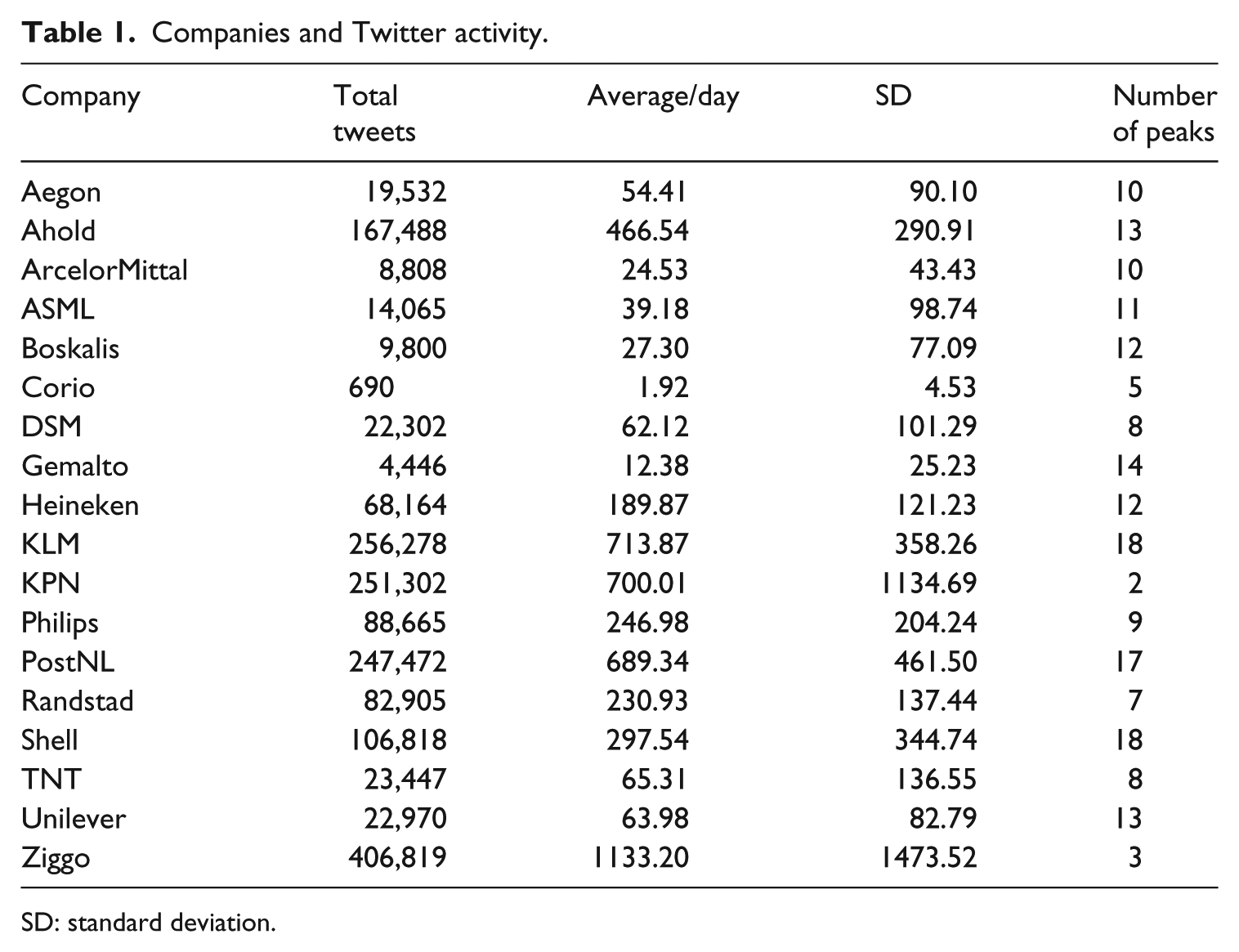
To answer the research questions, the first step was to identify the peaks in activity. Because of the wide range of tweets about each company (Table 1), we defined a peak in activity as being a day with a volume of tweets higher than 2 SDs (standard deviations) above the average number of tweets for the whole year for that company, leading to 197 potential peaks. The second step was to examine each potential peak and determine (1) whether it referred to the company and (2) what topic(s) were being discussed. Together, both authors confirmed that 190 peaks contained tweets referring to the companies in scope and formulated topic(s) for each peak by inspecting the most retweeted tweets, as well as the words used most frequently. After the topics were determined, each peak was individually coded to determine whether, in line with the research questions of this study, and earlier validated news value lists (e.g. Caple and Bednarek, 2016; Eilders, 2006), the following news values were present: personification, controversy, economic impact, social impact, facticity, positive valence, negative valence, and geographic closeness. The operationalization of the news values is based on previous research in the field of journalism (Eilders, 2006; Maier et al., 2009; Maier and Strömbäck, 2008). It needs to be noted that the news values range and surprise were dropped from the analysis as no satisfactory intercoder reliability was reached.
Companies and Twitter activity.
SD: standard deviation.
Influential actors
We explored the presence of influential actors by reviewing users retweeted during the peaks. More specifically, we automatically collected, from each tweet in each peak day, whether the tweet was a retweet and, if so, the user being retweeted. Data from the Twitter API were collected to get additional details about these users, including whether they were verified, their description, and number of followers. A total of 8270 unique users were retweeted for the days with peaks in the sample. We categorized all users with verified profiles or with above average number of followers (N = 540) as media outlets (N = 117), personal profiles of journalists (N = 85), politicians and/or political parties (N = 36). We also used the organizational users that were part of the search queries to identify organizations being retweeted (N = 24, out of which 9 appeared in the list of 540 users). Finally, all users with verified status and/or above average number of followers not in the previous categories were set as other influentials (N = 293).
Media coverage
We measured how often national Dutch newspapers covered each company in the same time period using the same search string as applied to collect the Twitter data for the newspaper database LexisNexis. The total number of news items per day was used as a proxy for media attention for organizations.
Intercoder reliability
News values
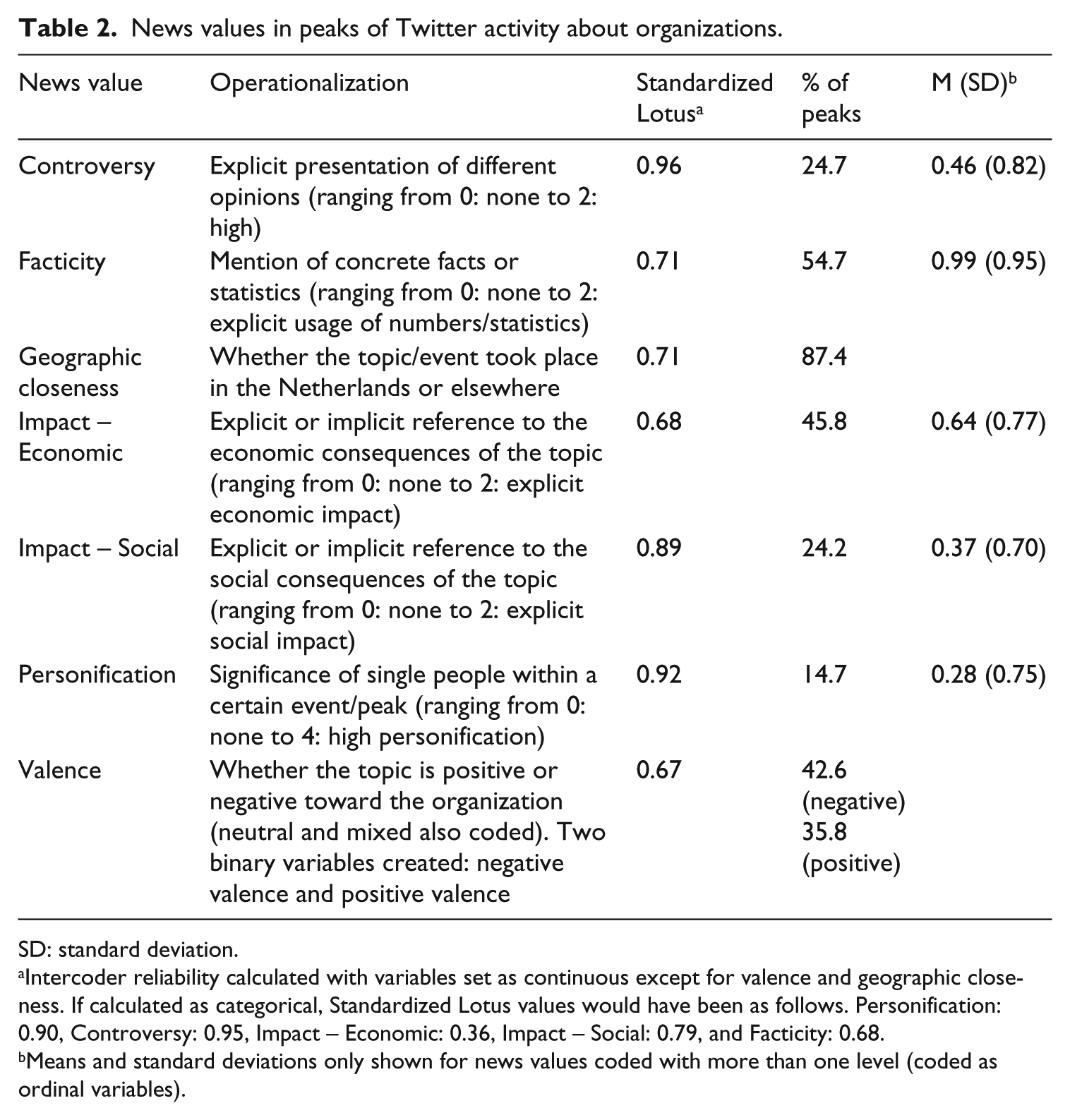
Approximately 15 percent of the sample (28 peaks) were coded independently by both authors. As some of the news values had very little variation (either because they occurred very often or very seldom), and considering that Krippendorff’s alpha can be considered too conservative in the case of highly skewed variables and too sensitive to occasional variations in the coding (Aaldering and Vliegenthart, 2016), reliability was assessed with the Standardized Lotus coefficient (Fretwurst, 2015) which takes into consideration how variables are distributed (thus not punishing skewed distributions) while also correcting for chance agreements. Standardized Lotus was therefore used as the reliability metric, also in line with earlier research (Aaldering and Vliegenthart, 2016). Reliability (see Table 2) for most news values was considered adequate (above 0.8 for personification, controversy, and social impact, and above 0.67 for facticity, valence, economic impact, and geographical closeness).
News values in peaks of Twitter activity about organizations.
SD: standard deviation.
Intercoder reliability calculated with variables set as continuous except for valence and geographic closeness. If calculated as categorical, Standardized Lotus values would have been as follows. Personification: 0.90, Controversy: 0.95, Impact – Economic: 0.36, Impact – Social: 0.79, and Facticity: 0.68.
Means and standard deviations only shown for news values coded with more than one level (coded as ordinal variables).
Influential actors
Approximately 10 percent of the 540 users with verified profiles and/or above average number of followers were coded independently by both authors (N = 59). Reliability levels, also using Standardized Lotus Coefficient for consistency, were considered acceptable for media outlets (0.80), journalists (0.83), and politicians (0.97). Intercoder reliability was not calculated for other influentials (by definition any user not included in the other categories) or for organizational users (derived from the original search queries).
Results
News value presence on Twitter peaks
A total of 190 peaks were considered as being about the organizations in scope. Figure 1 shows an example of the Twitter activity for two of these organizations (Shell and Unilever).
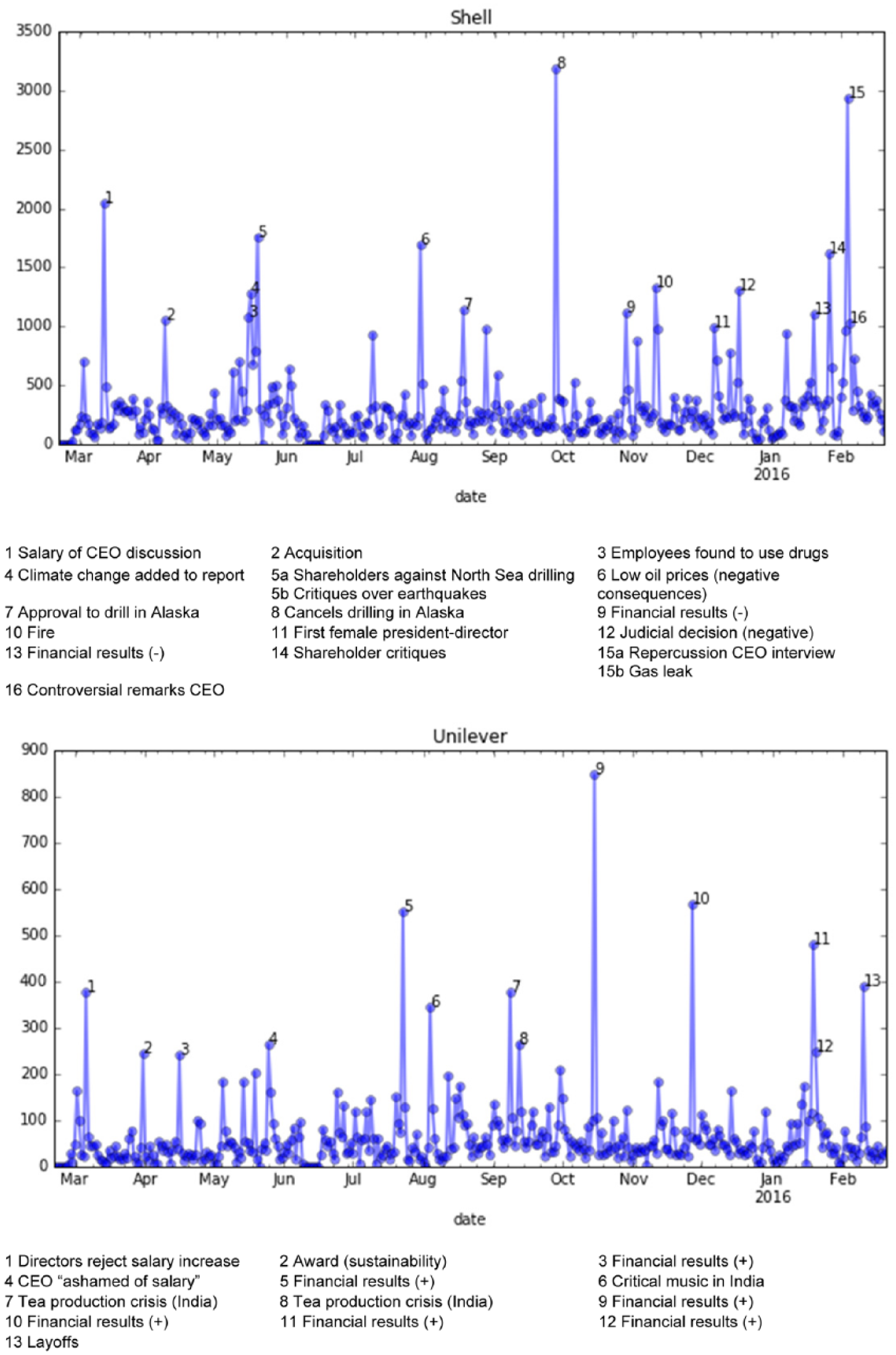
Examples of Twitter activity and key peaks.
All but one peak in the sample could be categorized with at least one news value (RQ1), and the average number of news values per peak being 3.30 (SD = 1.46). Table 2 provides an overview of how frequently news values were present in peaks of Twitter activity about organizations.
News value association with peak intensity
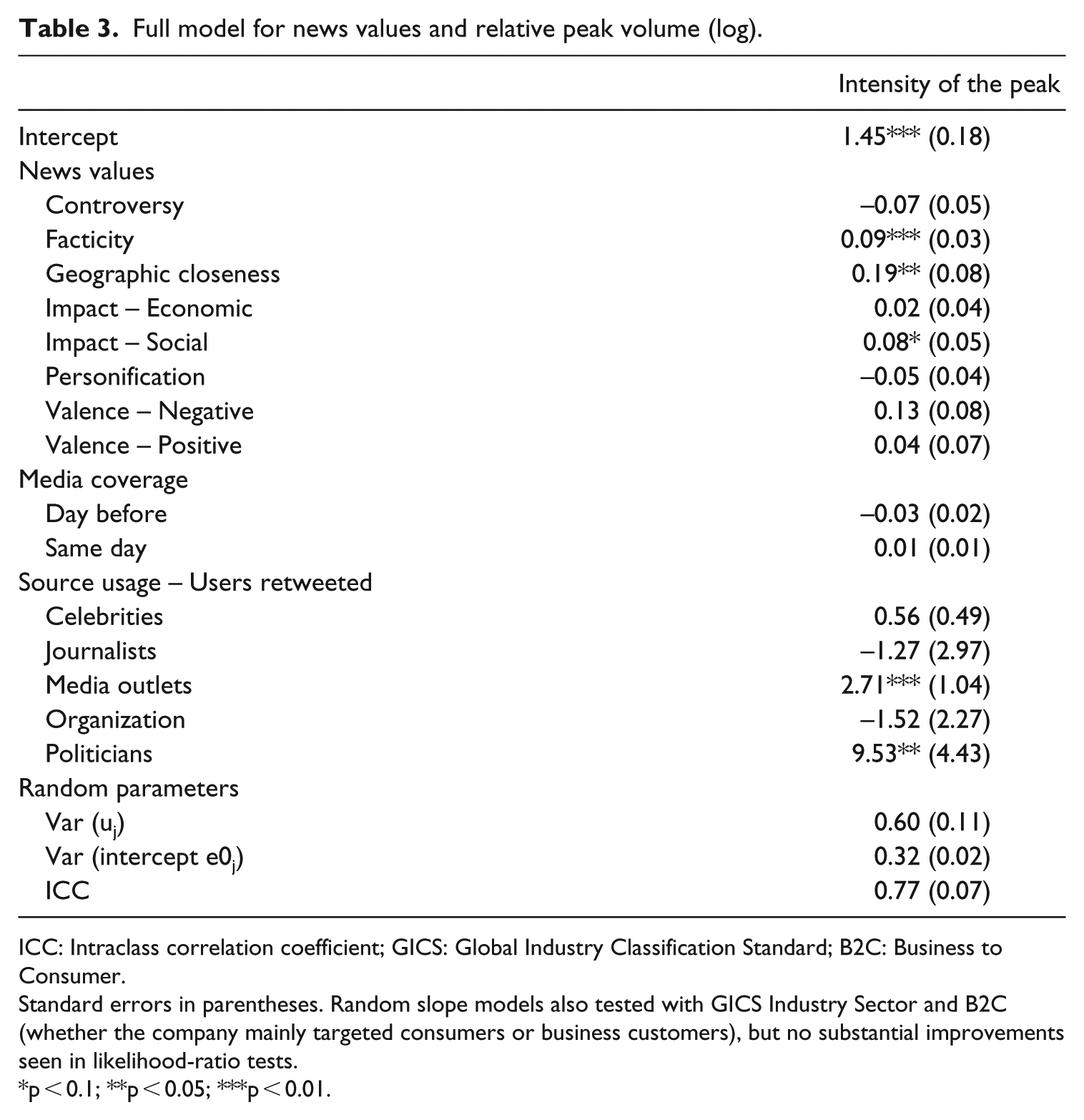
The next step investigated if and how certain news values were associated with the intensity of the peaks (RQ2). We used multilevel models with random intercept with the organization as the contextual level to control for individual–organizational differences. News values, influential actors, and media coverage were the main variables. The intraclass coefficients indicate that a considerable portion of the variance was explained on the second level, that is, was organization-specific. The dependent variable was the relative size of the peak (defined as the number of tweets during the peak divided by the average number of tweets per day that the organization received in general), log-transformed to improve fit. The results (Table 3) show that facticity and geographical closeness (i.e. being in the Netherlands) are associated with significantly higher levels of peak intensity, whereas for social impact, the results are marginally significant.
Full model for news values and relative peak volume (log).
ICC: Intraclass correlation coefficient; GICS: Global Industry Classification Standard; B2C: Business to Consumer.
Standard errors in parentheses. Random slope models also tested with GICS Industry Sector and B2C (whether the company mainly targeted consumers or business customers), but no substantial improvements seen in likelihood-ratio tests.
p < 0.1; **p < 0.05; ***p < 0.01.
Influential actors and online attention
We explored the extent to which specific online actors – namely, journalists, media outlets, politicians, other influential, and the organizations in the sample – were associated with peak intensity when being retweeted by users on Twitter (RQ3). The number of retweets from each of these users (relative to the total amount of tweets in the day) was used as a measure and included in the same model to investigate news values (RQ2). The results (Table 3) indicate that only media outlets and politicians are associated with significantly higher levels of intensity.
(Reversed) agenda setting
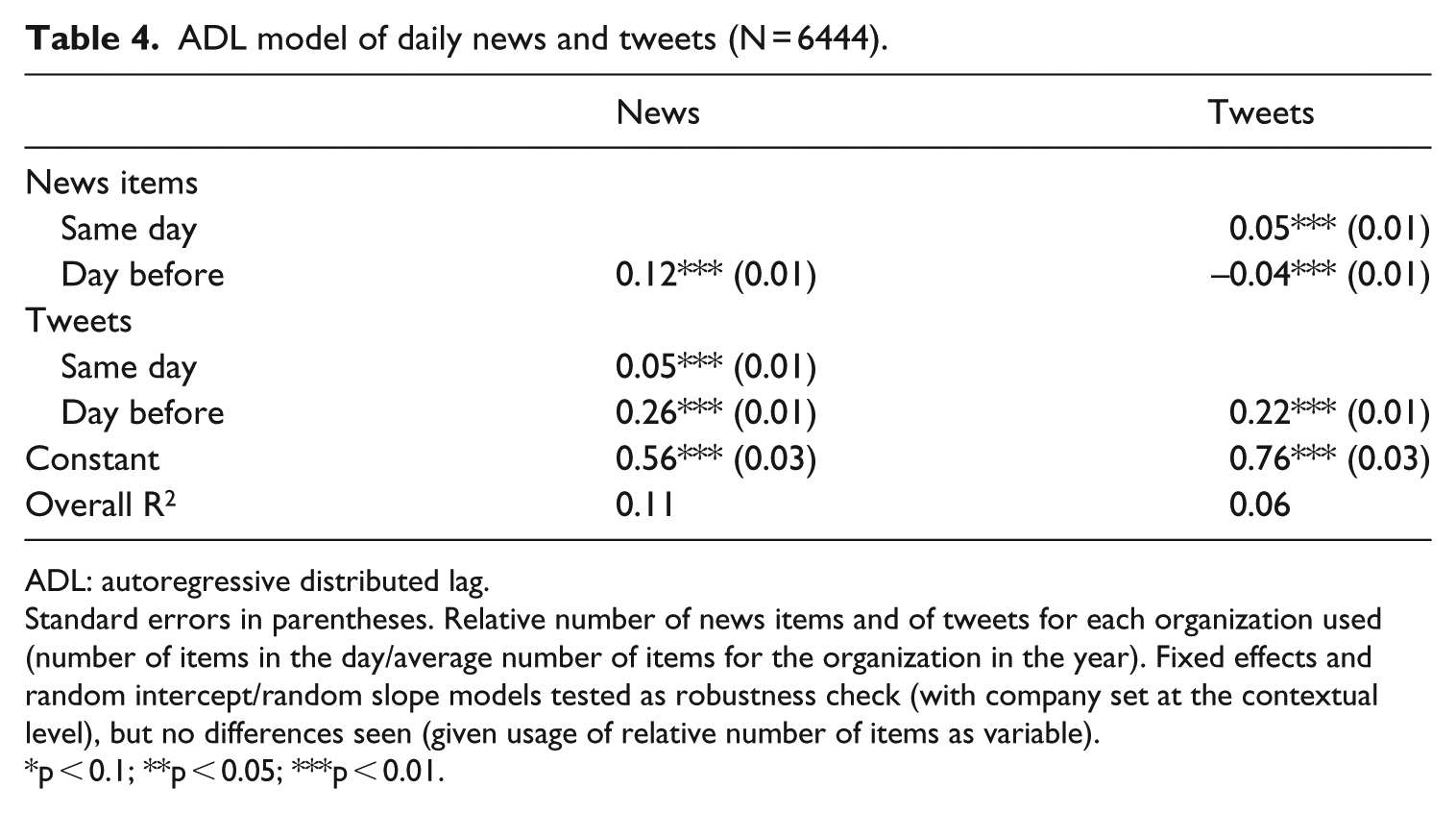
Finally, we checked how media coverage and Twitter activity about organizations were related to each other (RQ4) using partial adjustment (Koyck) autoregressive distributed lag (ADL) analyses with the relative number of tweets and of news items at daily level for each of the companies as the variables. Unlike the other research questions focusing on peaks (N = 190 peaks), these time-series analyses were done with all days in the sample (358 days per company, 6444 observations), with lagged variables on a daily level.
The results (Table 4) indicate that the volume of media coverage about an organization in a given day (relative volume of news items) has a positive association with media coverage about the organization in the prior day and, importantly, with the volume of Twitter activity about the organization (relative volume of tweets) in the same and in the prior day. Twitter activity about an organization also has a significant, positive association with the relative number of tweets in the prior day. Media coverage in the same day shows a positive relationship with the number of tweets; however, the relative number of news in the prior day is negatively associated with Twitter activity.
ADL model of daily news and tweets (N = 6444).
ADL: autoregressive distributed lag.
Standard errors in parentheses. Relative number of news items and of tweets for each organization used (number of items in the day/average number of items for the organization in the year). Fixed effects and random intercept/random slope models tested as robustness check (with company set at the contextual level), but no differences seen (given usage of relative number of items as variable).
p < 0.1; **p < 0.05; ***p < 0.01.
Discussion
This study explored the applicability of the traditional news value theory to social media users’ engagement with organization-related topics on Twitter. First, we investigated the characteristics of organization-related activity peaks on Twitter and their association with news values. Most news values were, to a certain extent, present in the heightened online communication about organizations. Apparently, Twitter users are often interested in factual elements of an organizational topic and a certain level of controversy (e.g. an organization’s judicial conflicts). This seems to advocate that the theory of news values can be translated to understand what increases heightened activities for organization-related topics online.
This study also investigated which characteristics predict the intensity of an online peak in activities. We provide tentative results indicating that (some) news values can influence user behavior online. In particular, the most valuable predictors of the intensity of a peak in activities seem to be social impact, geographical closeness, and facticity, all associated with increased levels of activity. Taken together, these values suggest that mainly topics that highlight the social consequences of the organizational events, related to the national context, and with factual information seem to cause the highest levels of organization-related activities on Twitter. This reinforces the notion of news factors as collective relevance indicators (Eilders, 2006; Shoemaker and Cohen, 2012; Weber, 2014), with social media users allocating focal attention (and activities) to topics associated with deviance and social significance as journalists do when deciding what’s news (Eilders, 2006; Wendelin et al., 2017). We interpret our findings as encouragement to further refine the application of news value theory in the context of organizational communication.
Not only news values but also influential users and news media attention explain heightened activities among users online. Content created by politicians and political parties, for example, is associated with the intensity of peaks. Media influence was also clear in the results: content posted by media outlets (yet not by individual journalists) was associated with peaks in Twitter activity about organizations, as was media coverage, with the time-series results indicating that increase of news coverage about an organization is associated with increased levels of activity on Twitter in the same day.
Moreover, recent studies have questioned the directionality of the agenda-setting influence, where news media are traditionally assumed to be able to set the public agenda (Neuman et al., 2014). Accordingly, the findings suggest that the current hybrid news system results in a reversed agenda-setting pattern, and a fast news cycle, given that media coverage influenced Twitter activity positively in the same day, while having a negative influence in the following day, potentially because news might be outdated after a day for Twitter users. Twitter activity about organizations, however, had a positive influence on media coverage in the same and in the next day. This should not be interpreted as opposing traditional agenda-setting theory, as social media are, of course, a faster platform for the dissemination of new events. Yet, the findings advocate for a more nuanced understanding of the relation between news and social media, characterizing this interrelation as a dynamic interplay rather than a mechanical causal linkage. Thus, it could be argued that, in today’s ‘hybrid news system’ (Chadwick, 2013), the flow of agendas is less straightforward. Information and the source of news seem to circulate between traditional news media and social media, with the latter gaining a prominent position in determining whether certain information becomes news and if it ends up on the media and public agenda.
A number of limitations need to be acknowledged. First, the data collection relied on the Twitter Streaming API, which limits the number of tweets that can be gathered at any point in time, and focused only on the name of the companies, meaning that tweets about the company but referring to it in another manner would not have been collected. Moreover, the focus was solely on Twitter. Although Twitter is one of the leading social networks, and, as a consequence, some of the findings might be generalizable beyond Twitter, earlier studies already indicate that news values are portrayed differently depending on the social platform (García-Perdomo et al., 2018), highlighting the need for additional comparative research to extend our findings.
Second, the news values addressed in this study are not all news values proposed in earlier studies. Besides Eilders (2006), multiple other scholars have provided valuable taxonomies of influential news values (Strömbäck et al., 2012; Wendelin et al., 2017). However, decisions had to be made regarding the selection of which news values should be included in the research design, with certain factors not being included for commonly being seen as too open for interpretation or not relevant for organization-related topics. Moreover, not all news factors we intended to include in the analysis reached satisfactory levels of intercoder reliability, despite usage of codebooks and concepts from earlier research, and multiple rounds of coder training. Range and surprise had to be removed from the analysis, which can partially be attributed to the potential subjectivity in coding these concepts in ordinal scales, and the difficulty in contextualizing topics derived from a collection of short texts. Future research should also continue to extend the concept of news values, and the methods to code them, toward the (shorter and more informal) texts used in social media.
These limitations notwithstanding, this study provides insightful and novel findings on the presence of news values online and how these factors can determine the intensity in activities.
Footnotes
Acknowledgements
This work was carried out on the Dutch national e-infrastructure (HPC Cloud) with the support of SURF Foundation. T.A. and T.G.L.A.v.d.M. contributed equally.
Funding
The author(s) received no financial support for the research, authorship, and/or publication of this article.