




Abstract
This article analyzes the way different types of news organizations address collaboration in innovation. A qualitative analysis of 31 expert interviews in the Dutch news field shows that especially incumbents are perceived internally oriented when it comes to organizing their innovation processes. Although they might acknowledge that the challenges are demanding and the stakes are high, they speak of innovation mainly in terms of competition, and are therefore still subject to a traditional bounded rationality. Also, in the Dutch context, the tensions between commercial news organizations and publicly financed news organizations are mentioned as obstacles to a more open approach to innovation. Newcomers and smaller organizations speak more in terms of synergy and describe the added value of opening up and working together to be able to face the future with confidence. In this article, this rather stereotypical conceptualization of collaboration in innovation is put in a critical perspective.
Introduction
New technologies are often important drivers of change in the media (Boczkowski, 2004; Küng, 2008, 2015; Pavlik, 2000, 2013). They both enable and constrain certain developments in the field. For example, while struggling to find a sustainable business model, existing companies try to renew and further develop their product portfolio, work habits, and distribution processes. Meanwhile, newcomers jump on the opportunities of new media technologies by providing novel ways of producing, aggregating, curating, or selling the news. This has opened up an exciting era in which the production and consumption of news is finding new shapes and forms (Beckett and Deuze, 2016; Deuze, 2007; Lowrey, 2011).
Also in the Netherlands, innovation is on top of the agenda since the introduction of the Internet, and especially after the economic crisis of 2008. In 2009, the Minister of Education, Culture, and Science asked a committee of experts to provide advice on innovation and on the future of the Dutch press. In their report, the committee established that also in the Netherlands, the news sector was struggling with the economic downturn and declining readership. They recommended the government of the Netherlands to find ways to stimulate innovation in the sector, primarily in the fields of exploitation and distribution, content, and the connection between journalism and society (Tijdelijke Commissie Innovatie en Toekomst Pers, 2009). In the years that followed, supported by funding, many innovative journalism projects started. News platform Blendle, long-form journalism website De Correspondent, and freelance organization De Cooperatie are the more successful examples of this development (Swart and Broersma, 2016). Although these initiatives show the creativity of companies in the field, many challenges for news organizations remain. Especially, incumbents seem to struggle with innovation (Küng, 2008; Tandoc and Jenkins, 2017).
One specific way to address the topic of innovation is by looking at it from a collaboration and sharing perspective. In an increasingly networked journalistic landscape (Beckett, 2010; Deuze and Witschge, 2017), it would seem logical that also innovation is organized in a networked way – that organizations in the journalism field work together in innovative projects and that they share their ideas in an attempt to shape the future together. The development toward start-up journalism (Küng, 2015) suggests that it is, but practice shows that there are still many hurdles to take for organizations to cross boundaries and share innovative ideas – may these boundaries be cultural, organizational, or regulatory.
Because innovation, collaboration, and sharing might mean different things in different organizational and national contexts (Gynnild, 2013), it will be insightful to explore how the concept of collaborative innovation is perceived and used in the field of journalism in the Netherlands. Generating more insights in this area might help to gain an understanding of collaborative innovation from the inside out, and can serve as a starting point to map these boundaries in an attempt to improve collaboration in the future. The main research question that will be answered in this study is: How do different players in the Dutch news field address collaborative innovations?
The next section addresses various viewpoints concerned with the struggles of news organizations to innovate, collaborate, and adapt to changing technological circumstances (e.g. DiMaggio and Powell, 1983; Gade, 2004; Küng, 2008; Lowrey, 2011; Nguyen, 2008; Steensen, 2009). After a definition of innovation and a specific explanation about the collaborative and networked aspect of innovation, field theory will be discussed as it provides a useful viewpoint to study the discursive practices surrounding collaborative innovation in the field. In addition, research on the strategic context of news organizations will provide a useful background to interpret the way in which, for example, incumbent news organizations might speak of collaborative innovation. After this section, the method will be further discussed. The empirical body of this article comprises a qualitative, thematic, content analysis of 31 interviews in the Dutch journalism field. Subsequently, the results of this analysis will be shared and the article ends with a conclusion and discussion.
Literature review
The importance of innovation in the news sector has been underlined by various authors (e.g. Boczkowski, 2004; Bor, 2014; Leurdijk et al., 2012; Nordfors et al., 2006; Pavlik, 2013). But what exactly is it? Pavlik (2013) defines innovation in news media as follows: ‘the process of taking new approaches to media practices and forms while maintaining a commitment to quality and high ethical standards’ (p. 183). In addition, he argues that innovation in news media can be found in at least four domains: (1) the creation and publication of (quality) content, (2) engaging the audience, (3) employing new methods for reporting – digital and networked, and (4) new management and organizational strategies in a networked environment. This last organizational domain is the focus area of this research.
The specific focus of this study is how collaborative innovation is addressed from an organizational perspective. Collaborative innovation means direct collaboration in innovative projects or the sharing of innovative ideas among various players in the field. These innovations are often enabled by technological change. In this respect the study leans on the idea that innovation is not an outcome by itself, but a process (Steensen, 2009) or a practice (Tuomi, 2002). Recent developments in technology have enabled a more networked environment for value creation, and this has opened the door for easier collaboration in innovative projects and more opportunities for sharing. As Deuze and Witschge (2017) argue, also the journalistic landscape is increasingly networked. However, it remains to be seen whether players in the field embrace these opportunities for collaboration and sharing. Therefore, this study will address this specific take on innovation.
The context of journalism: Field theory
In this research the term ‘organizational field’ is used. Dimaggio and Powell (1983) define a field as ‘those organizations that, in the aggregate, constitute a recognized area of institutional life’ (p. 148). Loosely borrowing this term from organizational sociology allows for the inclusion of various relevant actors that all contribute to an understanding of innovation in journalism. In the scope of this research, for example, also (applied) universities and journalism funds are taken along. This conception of the field theory can be perceived as similar to (but not as the same as) the idea of field theory as used by, for example, Barnard (2016) and Tandoc and Jenkins (2017), who base their work on Bourdieu (1993). Both approaches study changes in fields and assume that organizations are influenced by internal and external dynamics. In the particular articulation of field theory by DiMaggio and Powell (1983), more emphasis is placed on actors and their personal tendencies than on power relations (see for a comprehensible explanation of field theory Kluttz and Fligstein, 2016). This is a suitable approach when various actors in a field are asked to reflect on innovation processes, collaboration, and sharing. This is also in line with the contextualized field approach to innovation, as proposed by Wijngaarden et al. (2016).
The context of the field under study is important while addressing change. Ryfe (2016), for example, roughly positions the field of journalism in the United States on the crossroads of the state, civil society, and the market. He argues that in journalism, especially the specific national and innovation context is relevant to understand its change – resulting in the United States in a more market-oriented paradigm. The Dutch field of journalism can be characterized by a strong and highly concentrated national and regional print sector, both public and commercial broadcasters, and a number of online news websites and journalism initiatives (Swart and Broersma, 2016). As opposed to, for example, the United States, the print sector has always relied more on subscriptions than on advertising. Also, the public broadcasting system has been an important player in news production. News Broadcasts on Dutch public television have always been among the most popular programs on Dutch television. In addition, in a country where more than 96 percent of the population has Internet access, digital subscriptions are increasing and subsequently the Netherlands is an interesting market for online-only start-ups and digital journalism (Swart and Broersma, 2016). Commercialism in the news sector is present, and news providers have felt the decrease of advertising income. But the sector as a whole can be characterized as less market-oriented than the United States, and the Dutch government has invested in innovation in journalism by supporting the Dutch Journalism Fund with a donation of roughly €2 million per year.
The strategic context of news organizations
The literature shows that not only the field and national context, but also the strategic context of an organization is an important factor to take into account when analyzing the way organizations think about (collaborative) innovation, and how they make decisions (e.g. DiMaggio and Powell, 1983; Lowrey, 2011; Mitchelstein and Boczkowski, 2009; Nguyen, 2008). The organizational culture and the position of a company within the field might be of importance when it comes to innovative practices and processes. Mitchelstein and Boczkowski (2009) argue that a tension exists between tradition and change in the news sector. Incumbents are often still influenced by past practices and invested interests, and are incapable of reinventing themselves (Küng, 2008). Innovation in this part of the field might be more often driven by the fear to become irrelevant than the drive to innovate and cooperate because there are exciting new developments to explore (Nguyen, 2008). Meanwhile, newcomers seize the affordances of new technologies to innovate in a more radical way.
On a more in-depth account, also Lowrey (2011) states that many incumbents fail to adjust to changes. To come to an understanding of the major factors that hinder innovation, Lowrey (2011) turns to theories of organizations and social change, and especially new institutionalism (DiMaggio and Powell, 1983). He indicates that incumbents experience a ‘boundedness’ in their decision-making (bounded rationality). In behavioral economics, the term bounded rationality is originally used to explain ‘the limits upon the ability of human beings to adapt optimally, or even satisfactorily, to complex environments’ (Simon, 1991: 24). In changed circumstances (complex environments), organizations need individuals (e.g. managers) to make choices on new directions – for example by innovating. These decisions are usually not optimal because of various constraints – be it not all information is available, or the limited analytical skills of decision-makers, but also the position of an organization in society might be of influence. In new institutionalism – which takes a more sociological perspective of the matter – the term is used to partly explain how especially managers will make decisions that are not necessarily an answer to immediate market circumstances, but rather reflect a pursuit for legitimacy and stability.
It is in this, sometimes unconscious, search for legitimacy that existing news organizations tend to fall prey to isomorphism (DiMaggio and Powell, 1983; Lowrey, 2011). By mirroring existing practices in other likeminded organizations, by exchanging knowledge between professionals and through certain policies put in place by organizations or governments, companies in a field tend to develop in similar ways. They have a certain idea of how they are supposed to behave, and avoid uncertainties as much as possible. In their discussion on what makes organizations similar, Dimaggio and Powell (1983: 149) distinguish two forms of isomorphism – competitive and institutional. In the context of journalism, competitive isomorphism could be described mainly in terms of competition with other players in the field, while institutional isomorphism includes the more political context of news organizations and their search for institutional and social legitimacy.
The need for radical innovation
Although new institutionalism is sometimes critiqued for lacking an adequate explanation of change (Kluttz and Fligstein, 2016), authors such as Lowrey (2011) and Steensen (2009) do acknowledge that there are many factors that might influence the way organizations address innovation: the pluralism of the community an organization interacts with, the size of an organization, the nature of ownership, and the relationship news organizations have with their audiences are just a few (Lowrey, 2011; Steensen, 2009). Lowrey (2011) adequately argues that news organizations experience contradictory logics: on one hand they seek for certainty, while on the other hand they need to survive in a changing field. It is especially in tumultuous times that organizations might actually (try to) jump on the bandwagon of technological change and innovate in a more radical way (Lowrey, 2011; Nguyen, 2008), but following the bounded rationality discourse, the decision-making process might not be optimal and influenced by many factors. In the context of decision-making in news organizations, an optimal decision can be understood as a strategical resolution that not only furthers the sustainability of the business model, but also complies with the demands of the environment and social needs within a broader context. It is thus more than just profit-maximization.
In general, technological change seems to benefit newcomers more than incumbents. This is, for example, shown by Robinson et al. (2015) in their analysis of innovation and journalism start-ups. It is easier to build something from scratch than to reform an existing organization. Entrepreneurs are considered to be drivers for change (Carlson and Usher, 2015; Pavlik, 2013). Because start-ups are smaller and struggle with similar problems, they also tend to reach out to other organizations more easily to find and share solutions (Robinson et al., 2015). It is in this context that the concept of creative destruction can be used to analyze the changes forced upon the field by newcomers, changes that Schumpeter (1975) describes as ‘industrial mutation’. New challengers tend to change the field from the inside-out. Coates Nee (2013) uses the concept to analyze the practices of digital native news organizations and concludes that they feel they have more freedom to experiment than they would have in traditional news organizations. They see technology more as an opportunity and they formulate the relationships with other organizations more in complimentary terms than in terms associated with competition.
To sum up, this article considers technological change an important driver for innovation. Instead of looking at the actual innovations, the way organizations in the news field address collaborative innovation is analyzed. In this analysis, it is assumed that the national context of the Dutch journalism field, but also the strategical context of organizations, plays a role in the way collaborative innovation is perceived. Although the field of journalism is in flux and might demand for radical innovation, based on the literature, we would assume that incumbents will be more likely to seek stability and hang on to old practices than newcomers. The latter might be more open to innovation projects that require entrepreneurialism, radical change, and cooperation. The data will tell if this is really the case. In the next section, the methodology will be further explained.
Method: Qualitative thematic analysis
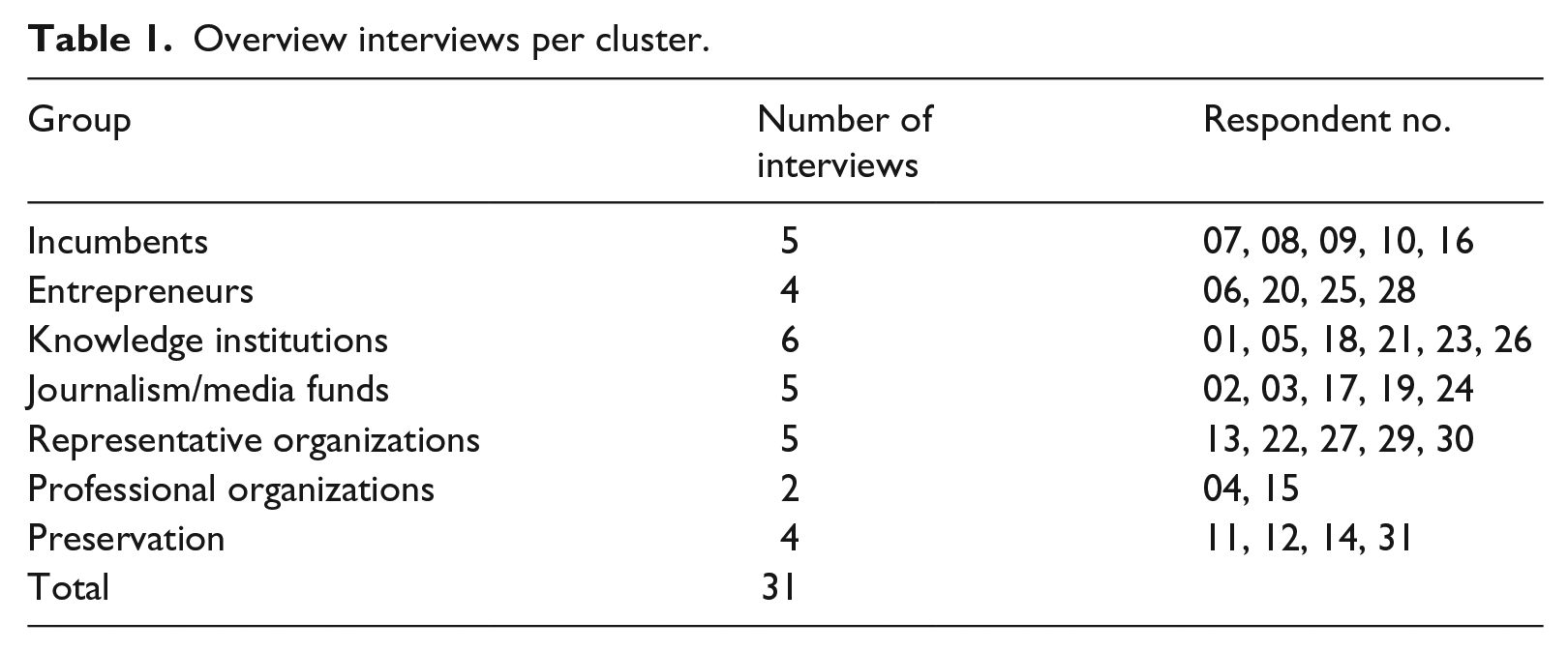
The methodology used to answer the research question is a qualitative thematic analysis of 29 semi-structured expert interviews with 31 people working in the news field. By applying purposive sampling, a diverse range of respondents from various organizations was selected, all representing a part of the journalism field in the Netherlands: (1) managers of incumbent news organizations (both publicly funded and commercial newspapers and broadcasters – also referred to as legacy media organizations), (2) entrepreneurs (new players in the field), (3) journalism researchers working in knowledge institutions (universities and applied universities), (4) directors of funds that invest in media and/or journalism innovation, (5) representative organizations (both trade unions of journalists and publishers, and organizations that represent specific groups of journalists – e.g. freelancers or investigative journalists), (6) professional organizations in the field of journalism (expertise centers, organizations that further journalism), and (7) organizations that work on preservation of media or journalism-related work (e.g. museums) – all based in the Netherlands. See Table 1 for an overview.
Overview interviews per cluster.
The data were gathered during a research project commissioned by the Dutch Journalism Fund (www.svdj.nl). The research topic was a feasibility study of an initiative to establish a house of journalism. For the purpose of this article, the data were analyzed a second time, with a specific focus on cooperative innovation. In the approaches distinguished by Hsieh and Shannon (2005), this would qualify as a conventional content analysis, aiming at describing a phenomenon – in this case the way collaborative innovation is addressed.
The interviews followed a semi-structured pattern, lasted for an average of 52 minutes, and were recorded, transcribed, and analyzed following the three steps of qualitative content analysis as proposed by Boeije (2014): (1) open coding, (2) axial coding, and (3) selective coding. During the first step, a data-driven analysis was used to decompose and code the interview transcriptions. All relevant passages that linked in some way to innovation, change, and the organization of it (including remarks on cooperation and knowledge sharing) were organized under descriptive headings. They were further translated into 147 codes under 12 headings. During the second step of the analysis, the codes were ordered and placed in relationship to each other. This resulted in nine main headings and a large number of subcodes. In the third step of the analysis, selective coding was used to link the codes back to the research question and the literature, and translated into themes.
The analysis of the data is the product of the personal interpretation of the author, and has been peer-reviewed by two research assistants who were familiar with the data set.
Results
The first theme, A transitional field with a shared interest in innovation, sketches the context within which organizations address the circumstances in their field, and how (in general wording) the organizations address the need for innovation. The second theme, No shared vision on organizing collaborative innovation, zooms in on the way the players in the field discuss how they organize innovation. Although there is a felt necessity for (collaborative) innovation, many players in the field indicate that real innovative and collaborative practices are limited and they discuss thresholds for innovative projects. The results show that strategic context is indeed important when it comes to the way innovation is addressed. While incumbents are mainly characterized as inward oriented (introvert) and many organizations in the field doubt their innovative potential, start-ups are perceived to be more extravert and naturally more willing to share (theme three, Stereotypical ideas about introvert incumbents and extravert start-ups).
Theme 1: A transitional field with a shared interest in innovation
Over the past 10 years, the Dutch field of journalism has witnessed a steady decline of income. This has led to reorganizations (layoffs) in legacy media organizations, tighter budgets, and a further concentration of ownership in incumbent print companies; Belgian publishing house De Persgroep now owns 45 percent of the Dutch newspaper market (Swart and Broersma, 2016). As a result of the economic downturn, the number of freelance journalists in the Netherlands rose by more than 30 percent between 2011 and 2016 (Kivits, 2016). The sector has to make ends meet, and is in search of new revenue models to finance journalism. Meanwhile, new journalism initiatives are being deployed, and some have proven to be successful.
Declining revenues as the main driver for innovation
It seems that the pressure of declining revenue is witnessed in all organizations that operate in the journalism field. Most interviewees address the situation in more general terms, such as: ‘The news sector finds itself in a transitional phase’ (Respondent 31, preservation organization). Creative destruction is acknowledged by some respondents. One director of a fund that invests in media and/or journalism innovation states: ‘I don’t think that journalism is able to reinvent itself in time, which is a problem’ (Respondent 24). Especially entrepreneurs seem to be aware of this, but seem to consider this the natural way for things to go: ‘All the fuss is about those traditional print companies who disappear. Well, I am sorry, but big companies simply disappear sometimes’ (Respondent 20).
Whereas most organizations in the field see the critical situation of Dutch journalism in broader terms, the incumbents speak about the financial situation primarily in terms of their own operation. Respondent 09, for example, states: ‘We are happy if we still exist in a few years, and that is the reality for the majority of news organizations’. The incumbents also state that innovation is necessary, but they approach it from a different angle. They stress the fact that new revenue models and business models need to be developed, to be able to survive in the changed media landscape. As one incumbent explains: ‘We can think of ways to make a website attractive, or introduce an app (…) but the business models, and how we will finance journalism, that is quite unclear because online, people are less willing to pay for content’ (Respondent 07). This is connected to their pragmatic and fear-driven idea about innovation, and in line with the academic literature in this area.
The importance of innovation and collaboration
Although the concept of innovation is difficult to grasp, many interviewees indicate that innovation, cooperation, and knowledge sharing are important in journalism. In that respect, all organizations, except the incumbents, seem to closely connect the concepts of innovation to collaboration. Instead of focusing solely on product innovation or technology or storytelling, they all refer to the importance of making connections with other (types of) organizations. First, they seem to endorse the idea of innovating together. Opening up to new initiatives is seen as refreshing and helps companies to look forward. One respondent mentions:
We need to expose ourselves to people who think differently, to criticism, to young people who have refreshing ideas, who think more in terms of collective sharing, (…) because if we need to do it ourselves, we know we are stuck. (Respondent 15, professional organization)
And another, who is experimenting with giving free office space to start-ups, explains: ‘I do this with a reason; to be sure we build connections with new knowledge. (…) It is a great way to help yourself look forward’ (Respondent 11, representative organization). They believe that when new and existing initiatives mix, synergy is most likely to happen.
On a more personal level, journalists feel a lot of pressure to stay updated. This can be seen in light of the growth in freelancers in the Dutch field of journalism. Especially, young journalists and freelancers indicate they have a lot on their plate. This goes beyond dealing with deadlines. One interviewee from a knowledge institution illustrates this by saying: ‘The stress level among journalists is very high. Young journalists who just start (…) enter the journalistic profession with lots of uncertainties and need a network that they can learn from’ (Respondent 26). In addition, journalists also need to keep up with new technological developments. As an entrepreneur indicates: ‘One of the challenges in journalism is to stay updated with all technological developments: all new forms of journalism that somebody should master to be able to proceed in their profession’ (Respondent 25). This illustrates that there is a constant need for knowledge sharing and seeking connections with others that are working in similar or adjacent fields such as technology development.
This aspect becomes visible in the way multidisciplinarity is addressed in the interviews. Many interviewees stress that the current technological development in journalism asks for multidisciplinary teams in innovative projects. An interviewee explains it as follows: ‘Real innovation takes place in those places where journalists are together with other media makers, or maybe not even media makers, but people who do something completely different’ (Respondent 26, knowledge institution). Especially the role of tech and design are mentioned. ‘We know a lot about journalism and content, but not that much about design and technique, so the moment you want to develop something, these people are needed’ (Respondent 23, knowledge institution), as another interviewee indicates. Once more this is a take on innovation that clearly incorporates a collaborative aspect – in this age it is perceived as almost impossible to innovate when you do not have multiple skills combined. Collaboration is, therefore, a necessity when it comes to innovation.
While the need for innovation seems to be felt throughout the journalism field in the Netherlands, and most organizations are looking toward cooperation and exchange to achieve this, the incumbents seem to be on a different path. They connect the decline in income mainly to their ability to invest in new initiatives: ‘We need to work very hard to keep our exploitation and the exploitation of our partners healthy. That means we have less time for ‘fun’’ (Respondent 07, incumbent). The incumbents describe themselves as in survival mode. They are confronted with lower margins than they were used to, and are cautious with investing time and money in innovation. A respondent from a knowledge institution explains that this financial pressure resonates in the way knowledge is shared and organizations work together: ‘I really think that the poverty right now is the fact that growing and learning from each other is no longer possible’ (Respondent 26).
Theme 2: No shared vision on organizing collaborative innovation
Although the previous theme showed that there is a shared feeling of necessity when it comes to collaborative innovation, many respondents indicate that the practice of innovating together is still underdeveloped. In light of the literature of bounded rationality (Lowrey, 2011), this is not a surprising finding. Nonetheless, it is valuable to understand in more detail how the field itself is addressing this lack of cooperation in innovation. Within this theme, the reasons for this underdevelopment are analyzed. The main subthemes that are mentioned by the respondents are that the cooperation with knowledge institutions is organized in an ad hoc way, there is a lack of good financing, the field is fragmented, and the respondents think the characteristics of the sector prevent cooperation.
Innovating together – but how?
It seems that collaborative innovation is, on one hand, hindered by preconceived ideas that reside in the field determining what good innovation is, and the role of collaboration therein. The idea of the inventor as a driven individual who needs to suffer to come to something really innovative, seems prevalent especially among the entrepreneurs. Innovation should not take place in a ‘warm’ environment, close to incumbents. An entrepreneur formulates it as follows:
Innovation works best when you are against something. (…) In that case, you should not be in a traditional environment. I think that if you want to innovate, you need to do this in an attic, or in a warehouse, where you really feel that you are swimming against the current. (Respondent 25)
The entrepreneurs are therefore ambivalent toward efforts to organize the innovative process. Although they highlight the fact that especially combining knowledge and networking would be valuable for innovation (primarily start-ups), they also think that failing might be a good way to learn better and faster.
Especially funds that are working to stimulate innovation seem to prefer more directive ways of fostering innovation. They want to spend their money effectively, and would like to monitor their projects more closely. One interviewee states: ‘I think that we could translate innovation in a working space, for example an incubator or accelerator’ (Respondent 03). Another respondent provides the reason:
Often we witness that projects do not prosper. (…) We see very good plans (…), and people who start with a lot of enthusiasm, but who fail, because they are journalists in the first place, and not necessarily good business people’. (Respondent 24, Funds)
Somebody with a good idea for innovation is thus not necessarily a skilled entrepreneur.
Again, although the idea of collaboration seems prevalent and deemed important, there does not seem to be a common understanding in the field on how this collaboration in innovation should be organized. While newcomers (entrepreneurs) express the idea that innovation is something you should do without being too much embedded into an existing organization, journalism funds seem to be perceiving this in a different manner. But what are the main thresholds for innovating together?
Thresholds for innovating together
Although there are interesting cooperative projects in the Netherlands, and innovation is stimulated by a number of funds and organizations, the respondents indicate that joint innovation is not yet common practice. The most mentioned thresholds for innovating can be divided into pragmatic and more ideological reasons.
The pragmatic reason for a perceived lack of joint innovation is financing. This can be explained by the decline in revenue in the field, but also because (especially) start-ups do not know where to ask for financing. ‘There needs to be more attention for and help with finding funding. Money is the main issue in journalism’ (Respondent 06). An interviewee from a knowledge institution indicates that money issues are even more prevalent, because many initiatives will not be able to survive without public funding: ‘It is very nice to motivate journalists to start their own start-up, but it is also wrong, because we know that a large part of journalism cannot survive by itself’ (Respondent 26). As indicated in the previous theme as well, the incumbents also play the finance card when it comes to joint projects. They indicate that since budgets are tight, there is less money for experimentation.
What seems to be an underlying and more fundamental and ideological issue is that the interviewees all agree that the field of journalism in the Netherlands is fragmented and every organization is mainly focused on their own interests. Respondents from different relevant sections of the field formulate it in various ways: ‘Journalism does not have a natural cohesion that makes this (innovating together, red.) a done deal’ (Respondent 25, entrepreneur). This is further illustrated by Respondent 19 (Media/journalism Funds): ‘When I attend debates about the future of journalism, I hear many different and conflicting interests’. This character trait of the field hinders joint innovation projects, as is explained by a respondent from a knowledge institution: ‘When people are mainly concerned with their own organization, (…) it is very difficult to develop a shared vision’ (Respondent 21). Identity and independence is a forte in journalism, but can become a threshold when innovation requires people from different organizations with different interests to work together.
Putting this theme in perspective, the underlying character of the journalism field in the Netherlands is one in which the players are all mostly focusing on their own practice. Many organizations have their own constituency, and have an established position in the field. They try to survive and remain financially stable in a challenging environment. This makes them focus on their own practices, and while some organizations try to open up and seek cooperation, at the end of the day they have their own interests to defend.
Theme 3: Stereotypical ideas about introvert incumbents and extravert start-ups
In the previous theme, it became apparent that players in the field of journalism in the Netherlands seem to have strong ideas about how certain organizations (should) behave. Especially when it comes to incumbents and start-ups, the respondents were clear in their perceptions. This last theme explores these perceptions in more detail by reflecting on the way outsiders look at the roles of incumbents and start-ups in the Netherlands, and the way they address innovation themselves.
Internally oriented
Incumbents are perceived as internally oriented when it comes to innovation. They do not feel the need to innovate with others, partly because they have enough financial and manpower to organize it internally. As an entrepreneur simply puts: ‘I think that big companies that innovate on a professional level will not seek innovative projects outside of their organization’ (Respondent 20). They have people on their payroll who work on innovative projects, as is firmly stated by an incumbent: ‘We have a couple of people on our pay roll who are innovating – it’s their job’ (Respondent 09). And if they do not have enough manpower to work on innovation, they can hire them on project basis: ‘I would go to a big company, give them one grand, and organize two days in which you put people together to see what you can harvest from their ideas. That way, you keep control of the process’ (Respondent 16). Thus, control is an important aspect for incumbents.
Innovation as a competition
The inwardness of incumbents can be partly explained by the fact that they perceive other players in the field mainly in terms of competition. Although the interviewees acknowledge that innovative projects with other parties could be beneficial, they indicate that competition is a problem: ‘On the one hand I think it would be good if we would develop new things together. But on the other hand there is the element of competition, which makes it complicated’ (Respondent 07). Respondent 09 formulates it more boldly: ‘I am still in the old-fashioned mode, because I perceive other organizations as competitors, not as fellow warriors’. This incumbent thus seems to realize that his point of view when it comes to innovation can be perceived as old-fashioned. But he seems trapped by his old habits.
Even if there is a need for cooperation, it might not always be possible in the Dutch context. The incumbents all mention cooperation between public and private players as a problem. Dutch media law is strict when it comes to the cooperation between publicly financed media and their commercial counterparts. One incumbent who works for a publicly financed news organization addresses the problem as follows: ‘I would not want to do it (innovate, red.) to benefit my commercial competitor. I would not even be allowed by law to do it’ (Respondent 16). This is felt by incumbents from both sides: ‘Media law does not make cooperation with public news organizations easy. We got into trouble with that a few times in the past’ (Respondent 07). Public–private partnerships exist in the Netherlands, but parties are careful and sometimes hesitant. The organizations that are not perceived as competitors in the field are knowledge institutions. But the interview data also show that cooperation between news organizations and knowledge institutions such as (applied) universities is primarily organized in an ad hoc way.
Extravert start-ups
Opposite to the way incumbents are perceived, organizations in the field of journalism have a positive perception of the innovative potential of start-ups. They are commended for having an open attitude. Respondent 11 (Preservation organization) says:
The current generation of start-ups has a certain self-evidence when it comes to sharing. It does not interest them when somebody can see what they are doing. As a matter of fact – they try to make connections to work as functionally and fast as possible.
Or as another respondent says: ‘Those young people who work with ICT, they share everything – or almost everything’ (Respondent 09, incumbent). Especially the open production spaces that start-ups often use are mentioned in this respect, but also the fact that most start-ups are facing similar challenges.
Nonetheless, the respondents do not bring many examples of this openness to the table. Although there are some examples of cooperation in the Dutch journalism field, most start-ups are working on their own projects – and as has been explained before – they are not always very successful according to the analysis of funding organizations. One of the interviewees, who is managing one of the more successful journalism start-ups in the Netherlands, even indicates that he is not sure that cooperation would work for start-ups: ‘Synergy is difficult […]. I thought working on my own start-up was difficult enough, and I am not going to discuss things with other people at the coffee machine. I am focused on my own project’.
Conclusion and discussion
As in many other countries, the journalism field in the Netherlands can be characterized as a field in survival mode. Incumbents fight for the financial sustainability of their business model, entrepreneurs for finding the support to build upon their innovative ideas, freelancers for their weekly income, and representative and professional organizations for the rights of the people they represent (journalists, or news companies, freelancers or investigative journalists). While innovation is almost used as a magical term that could take away all of the worries, and the field perceives innovation as necessary, there seem to be different perceptions of how innovation and collaboration should be organized.
This article explored the way different players in the Dutch news field address collaboration and innovation. The analysis showed that all organizations in the field of journalism use the concept of collaborative innovation and deem it important because they find themselves in a time of transit. Most respondents display a pragmatic view though; they feel a pressure to innovate, and do it because they have to. It can be concluded that the way they address innovation is limited, and mainly reflects the literature that is available on this subject (Boczkowski, 2004; Bor, 2014; Leurdijk et al., 2012; Nordfors et al., 2006). By speaking about innovation and collaboration, they seem to use the concept in a way that shows the structure of the field, while at the same time delimiting the relationship they have with other players in this field.
In this perspective, it is worth noting that the contradictory logic as described by Lowrey (2011) is very visible in Dutch journalism. While all organizations stress that the need for innovation is very high, the actual practices of joint innovation are indicated to be lagging behind. Several reasons were brought forward, and all organizations approach the problem based on their own context: while incumbents stress the competition involved in innovative cooperation, entrepreneurs seem to be more concerned with funding and practical issues such as finding office space and guidance. By stressing the fact that revenue models are their main concern, especially incumbents seem to have a limited view on innovative practices. Nguyen (2008) has labeled this a fear-driven innovation culture. In their search for stability, legacy media direct their innovative efforts mainly internally. It is in this respect that the strategic context is especially visible between the incumbents and the rest of the organizations in the field. Start-ups on the other hand seem to be perceived as the most open to collaborative innovation.
But what do these perceptions of introvert or extravert characteristics in innovative and collaborative practices ultimately tell us about the field? When the analysis is put in a more critical perspective, one can argue that all organizations experience this boundedness in the way they approach innovation and cooperation. The organizations that give examples of joint innovation, mainly speak about the way they integrate outsiders into their own organizational environment. Many respondents indicate that cooperation in innovative projects is not happening very often. And even the players that are perceived to be the most open when it comes to innovation, start-ups, express their doubts whether they would actually actively seek collaboration in their innovative endeavors. Maybe the only thing they truly share is being a start-up and struggling with similar pragmatic problems such as finding a workspace, acquiring funding, and writing a solid business plan. Bounded rationality and subsequently isomorphism are thus not only present in the way incumbents address themselves and other organizations perceive them when it comes to innovation.
The concept of collaborative innovation is thus mainly used as a way to position organizations in the field, to draw lines, and make the distinction between various organizations clear. All players in the Dutch field of journalism show conditioned reflexes when it comes to speaking about their field. The main threshold for innovation seems to be inextricably linked to the character of the Dutch journalism field. The field consists of professionals who are independent and critical. Their job is complicated by the need to present stories fast, and in a changed media landscape they feel heavy competition for the ears and eyeballs, or clicks, of the audience. It is not surprising that they do not naturally seek cooperation outside of their organization’s boundaries. And it is in these reflexes that the boundedness of their decision-making and subsequently innovative ambitions really take shape. The analysis thus makes clear that speaking about collaborative innovation shows more a discursive practice than a practical ambition.
Nonetheless, it is interesting that the current situation of journalism is not a driver to seek those boundaries and cross them more often. By reasoning in ‘old-fashioned’ ways, in terms of competition and by looking only at the needs of their own organization, the potential of the field will never fully be realized. The field of journalism would benefit from stepping away from the hollow concept of innovation. Innovation will most probably not bring a new business model that will transport the field back to its original income level, and innovation should therefore not be perceived as the one route out of the current crisis in journalism (Creech and Nadler, 2017). A stronger focus on real problems – for example, the increased dependency of news organizations on technology and (social media) platforms, or the low-levels of trust that audience members have in journalism, should be more central in the endeavors to bring parties in the field closer together.
The last remarks of this article address some suggestions for follow-up research. First, the data that are used for this analysis are drawn from a broader and more applied research project. Some of the themes that are found in this analysis would benefit from a more in-depth and specific inquiry; for example, the perceived openness of start-ups in the field, or the characteristics of cooperative innovation between various public news organizations (e.g. radio and television) and the specific challenges for innovative projects with knowledge institutions. Second, since this article was based on interviews, it is only possible to address the way players speak about their innovative practices themselves, and how they perceive other organizations. More ethnographic and case-study-based research is necessary to also incorporate knowledge about their actual innovative projects. Third, although the field approach was useful, future research needs to take into account that within relevant groups, organizations are diverse and might even represent different viewpoints and values – especially when it comes to publicly financed and commercially operated news organizations. In this article the nuances are stressed where possible. And finally, it will be relevant to compare the research results of the Netherlands with other countries, since this might shed a different light on the way collaborative innovation is defined and addressed in other countries.
Footnotes
Acknowledgements
The author acknowledges the valuable assistance of Cato de Beer and Job Zomerplaag in the data collection process and is grateful for their helpful comments on the concept version of this article. The article has also benefited greatly from the suggestions of the anonymous reviewers.
Funding
The author(s) disclosed receipt of the following financial support for the research, authorship, and/or publication of this article: This work was supported by the Dutch Journalism Fund (Stimuleringsfonds voor de Journalistiek).