



Abstract
This article addresses practices of constructive journalism in the local, postcolonial context of St. Maarten, an autonomous Dutch Caribbean island. Building on extensive fieldwork at print and online news media outlets on the island and 14 in-depth interviews with reporters, editors, and news bloggers, this article shows that constructive journalism practices are widespread in St. Maarten. These are based on ideals of contributing to economic development, engagement and belonging, and social stability. The fieldwork, however, also revealed skepticism toward constructive journalism practices because of local political, economic, and socio-cultural constraints. This skepticism parallels broader critiques on active and involved forms of journalism, throwing up questions about the meaning and feasibility of a ‘constructive’ role of journalists in young, postcolonial democracies. This article argues that local constraints on St. Maarten journalism undermine the normative underpinnings of constructive journalism and calls for more disruptive journalism to serve the local community.
Introduction
In reaction to debates on the role of news media in today’s world, constructive journalism is an emerging form of the profession based on the philosophy that journalists can and should constructively participate in enhancing societal well-being through the creation of more productive and engaging stories (Gyldensted, 2015; McIntyre, 2015). In this article, I explore how constructive journalism is practiced, adjusted, and contested in the local journalism context of St. Maarten, 1 part of a binational Dutch and French Caribbean island that attained an autonomous country status in the Kingdom of the Netherlands in 2010. Drawing on participatory observation and interview material collected during 10 months of fieldwork on the role of newspapers, news websites, and social media 2 in the island communities of St. Maarten (and Curaçao) in 2015 and 2016, this article provides insights into how and why constructive journalism is practised in this local Caribbean community. Moreover, by taking the local political, economic, and socio-cultural context into account, this article aims to contribute to more contextualized and localized knowledge about the potentials and problems of constructive journalism practices.
St. Maarten represents a pertinent case study of constructive journalism in a local media context. Similar to those of other small Caribbean islands, St. Maarten’s media landscape is deeply connected to the community and, thereby, experiences the vulnerabilities that might result from personal involvements, such as political affiliation and self-censorship (De Wit, 2015; Lent, 1990; Storr, 2016), as well as the possibilities emerging from current local journalism realities to alter journalistic practices and to rethink the traditional watchdog role of journalism in local communities (Firmstone, 2016; Nielsen, 2015).
Research on constructive journalism has primarily been located in and focused on North-Western European and the US media landscapes and traditions (an exception is McIntyre and Sobel, 2017). To venture beyond this, we urgently need to study constructive journalism in other parts of the world, especially in young democracies that continuously struggle with political and socio-cultural realities inherited from a colonial past, such as in the case on St. Maarten. In these postcolonial contexts, similar forms of journalism – such as community, civic, and development journalism – have been developed, practiced, and criticized. This article takes perceptions on and practices of these more active and involved journalistic approaches into account, and thus responds to McIntyre and Sobel’s (2017) call ‘that more work needs to be done to precisely define and measure the concept [of constructive journalism] and distinguish it from similar forms of journalism’ (p. 6).
Building on the theory of and critical responses to constructive journalism in relation to other active, involved approaches to journalism, the following questions are posed: how and why did St. Maarten journalists in 2015 and 2016 practice constructive journalism? and how can these practices be critically understood in the local, postcolonial context of St. Maarten?
Constructive journalism in an international context
Constructive journalism has been defined as ‘an emerging form of journalism that involves applying positive psychology techniques to news work in an effort to create more productive, engaging stories while holding true to journalism’s core functions’ (McIntyre, 2015: 9). In addition to its watchdog role, constructive journalism ‘can hold power to account (…) by fostering conversation, collaboration, consensus building and challenging power to be proactive in providing solutions’ (Constructive Journalism Project, 2017). Whereas constructive journalism is unique in applying specific positive psychology techniques to news stories, such as inclusion of positive emotion and information about potential solutions (McIntyre, 2015: 19), its aim to actively participate in enhancing societal well-being (Gyldensted, 2015) builds on a tradition of more active and involved approaches to journalism, such as ‘community journalism’ or ‘civic journalism’ (McIntyre, 2015: 12).
Concerns about constructive journalism have primarily been directed toward the active, involved approach these forms of journalism share and the possible news bias resulting from a close association with communities. Critique on civic and community journalism included their presumed lack of ‘objectivity, accuracy and ability to shape a shared public consciousness’ (Romano, 2010: 22). Similar concerns have been expressed that constructive journalism ‘risks watering down news and undercutting the accountability role of journalists’ (World Editors Forum, 2016). This would be a risk, ‘especially in contexts like new democracies (…), where governments often make demands for the media to support rather than criticise them’ (World Editors Forum, 2014).
This particular concern has also been expressed in reaction to the emergence of ‘development journalism’ among developing nations in Asia, Africa, and the Americas in the late 1960s. Influenced by processes of decolonization, development journalism emerged as a new journalistic approach aiming at ‘counteracting the dependency relationship of colonialism and promoting (…) institutions supporting the new nation state’ (Domatob and Hall, 1983: 9). According to Xiaoge (2009), development journalism includes a focus on socio-economic development, providing constructive critique on governments, and solution-oriented reporting (pp. 358–362). Despite its popularity, researchers have stressed the dangers when governments use development journalism to either restrict news (Storr, 2016: 18) or use the media for own political goals. Postcolonial democracies have been particularly vulnerable to the latter, as local elites have used development journalism to consolidate and perpetuate their power reproducing ‘the same motivations that governed the colonial powers’ (Domatob and Hall, 1983: 19).
Despite similar key components and techniques to development journalism, constructive journalism’s proponents stress that it is not ‘government influenced development journalism’ (Constructive Journalism Project, 2017). Constructive journalism stays true to journalism’s core functions, including holding government accountable and monitoring the ones in power. Yet, critics raise concerns that constructive journalism ‘avoids politically controversial stories’ (Yanqiu and Matingwina, 2016: 94) and is at risk of being exploited by local elites (Wasserman, 2017: 196). In their recently published research on constructive journalism in Rwanda, McIntyre and Sobel (2018) do not counter these concerns. They argue that in particular contexts the aim of constructive journalism supersedes serving as a watchdog: journalists (…) pointed to the difficulty in playing the watchdog role in Rwanda, and even a journalist at the most independent news outlet in the country considered the idea that perhaps unity is a more important goal given the country’s history. (McIntyre and Sobel, 2018: 18)
However, as previous research on development journalism shows, constructive journalism’s aims of enhancing ‘societal well-being’, ‘unity’, and ‘development’ may be used to restrict and repress news media, especially in young postcolonial democracies, such as St. Maarten, to which I now turn.
St. Maarten’s media landscape: Cultural and historical crossroads
Together with the French collectivity of Saint Martin in the north, the southern part of St. Maarten forms an island located in the North-Eastern Caribbean. Its binational status reflects the colonial history of the island. In 2010, St. Maarten seceded from the ‘Netherlands Antilles’, governed by a central government in Curaçao, to become an autonomous country within the Kingdom of the Netherlands. The island has since faced ongoing political instability, reflected in governmental crises, six different cabinets, and accompanied by issues of political corruption. In 2010, governmental institutions were not yet in place and remain weak today. The Netherlands continues to be responsible for good governance and financial affairs in the non-sovereign country. In 30 years, St. Maarten’s official population has grown from 4000 to 40,535 people (STAT, 2017). This number increases significantly when unregistered people living on the island are considered (US State Department, 2014). Almost two million (mostly US) cruise and yacht tourists pass the island every year, attracting tens of thousands of regional migrants (Alberts, 2016). This has caused a rapid growth not only in the number but also in the diversity of the population of the island (De Wit, 2015). This is reflected in the local press. The official languages of St. Maarten are Dutch and English, 3 of which the latter is dominant in society as well as in the media.
St. Maarten’s main newspaper, 4 The Daily Herald, also called The Herald, was established in 1994 by Roger Snow, who then was director of the oldest contemporary newspaper of the Dutch Caribbean founded by the Roman Catholic Church in Curaçao in 1883 (Lent, 1990: 212). The Herald has since cooperated with the Curaçaoan press, traditionally the biggest and most influential in the Dutch Caribbean. Although current reporters at The Herald have different backgrounds (see Method), the newspaper represents the historical White Dutch/Antillean establishment on the island. As a family business with more than 80 employees, The Herald distributes around 7000 to 8000 newspapers a day and is considered to be the leading news outlet on the island. Its printing office is responsible for printing most of the weeklies and magazines in the region.
Digitalization of news is reflected in the growing blogosphere and social media use on St. Maarten. 5 Current news websites, such as SMN-News, SXMIslandtime, 721 News, and Soualiga News, are mainly one-person businesses that have up to 30,000 unique viewers a month. Most news websites attract visitors from all over the world. Some have alliances with media outlets throughout the Caribbean, as well as in the United States and in Europe. St. Maarten’s press also has online outlets and social media pages – primarily on Facebook. Foreign administered news websites that include news on St. Maarten, such as Caribbean News Now, are available; ‘however, their impact is less significant than that of the (…) local newspapers’ (De Wit, 2015: 114).
News media in St. Maarten is thoroughly intertwined with the press in the other countries within the Kingdom of the Netherlands. The cooperation between The Herald and the Curaçaoan press is one example. Another is the multilingual Caribisch Netwerk, which is part of the Dutch Public Broadcaster for Information, Education and Culture (NTR). Caribisch Netwerk is the online successor of Radio Netherlands Worldwide and works with freelance journalists throughout the Dutch Caribbean. Many journalists working on St. Maarten have obtained their education in the Netherlands or the United States. Dutch news coverage highly influences St. Maarten news and its people. Regional perceptions still ‘depend upon images and representations that are produced and distributed through North American and European structures’ (Pertierra and Horst, 2009: 104). The proximity of the United States is reflected in the impact of US media and culture in the Caribbean, and news media on the island tend to follow American news models that strictly separate news from opinion.
In addition, and due to immigration from the region, St. Maarten’s media landscape reflects a Caribbean media culture, which is influenced by the small scale of the communities living on Caribbean islands, local ‘word-of-mouth’ traditions (i.e. Jeffry, 2003) that are deeply embedded in Caribbean oral cultures (Storr, 2016: 78), and a colonial history that is reproduced in an authoritative culture of secrecy and silence (Storr, 2016: 134). ‘In these small, secretive societies, media systems are plagued by partisan politics, which presents itself in a variety of ways and influences the performances of journalists’ (Storr, 2016: 167). This statement expresses a sentiment that is shared by local journalists and that has been independently verified by the recently conducted Transparency International – National Integrity Assessment in St. Maarten. Despite the absence of restrictive laws, the assessment concludes that ‘[t]he small scale of St. Maarten society gives rise to a culture of self-censorship on the part of its journalists and makes it difficult to develop a critical media culture’ (De Wit, 2015: 114).
Global commercialization has deeply impacted St. Maarten’s local journalism. All news outlets in St. Maarten are privately owned and dependent on advertisements from business and political elites on the island, who are often closely connected in the island’s community (Guadeloupe, 2008; Roitman and Veenendaal, 2016). It is difficult to detail affiliations and ownerships, as local ‘media outlets do not provide disclosure of relevant information on their ownership, staff, and reporting and editing policies’ (De Wit, 2015).
Thus, St. Maarten’s local journalism is at the crossroads of Caribbean, European, and North- and South-American media cultures. And local journalism can only be understood in light of the historical and global mediascape.
Method
This article draws on my broader research into how St. Maarten (and Curaçaoan) online and print news media practice and interpret journalism. Building on news anthropology (i.e. Bird, 2010), I did 10 months of fieldwork on both islands in 2015 and 2016. In St. Maarten, I was a participant-observer at the main newspaper, The Herald, and with the growing group of news bloggers on the island. For 3 months, I had my own desk at the newsroom of The Herald, participating in editorial meetings, and joining journalists and news bloggers to press conferences and other public events. Moreover, I wrote pieces for the newspaper in order to better understand the news production process. I also conducted in-depth interviews of 80 minutes on average with 14 journalists, editors, and news bloggers (see Table 1), covering most of the journalists working in St. Maarten’s small print and online media landscape.
Interviews, occupation, news genre(s), and geographical background.
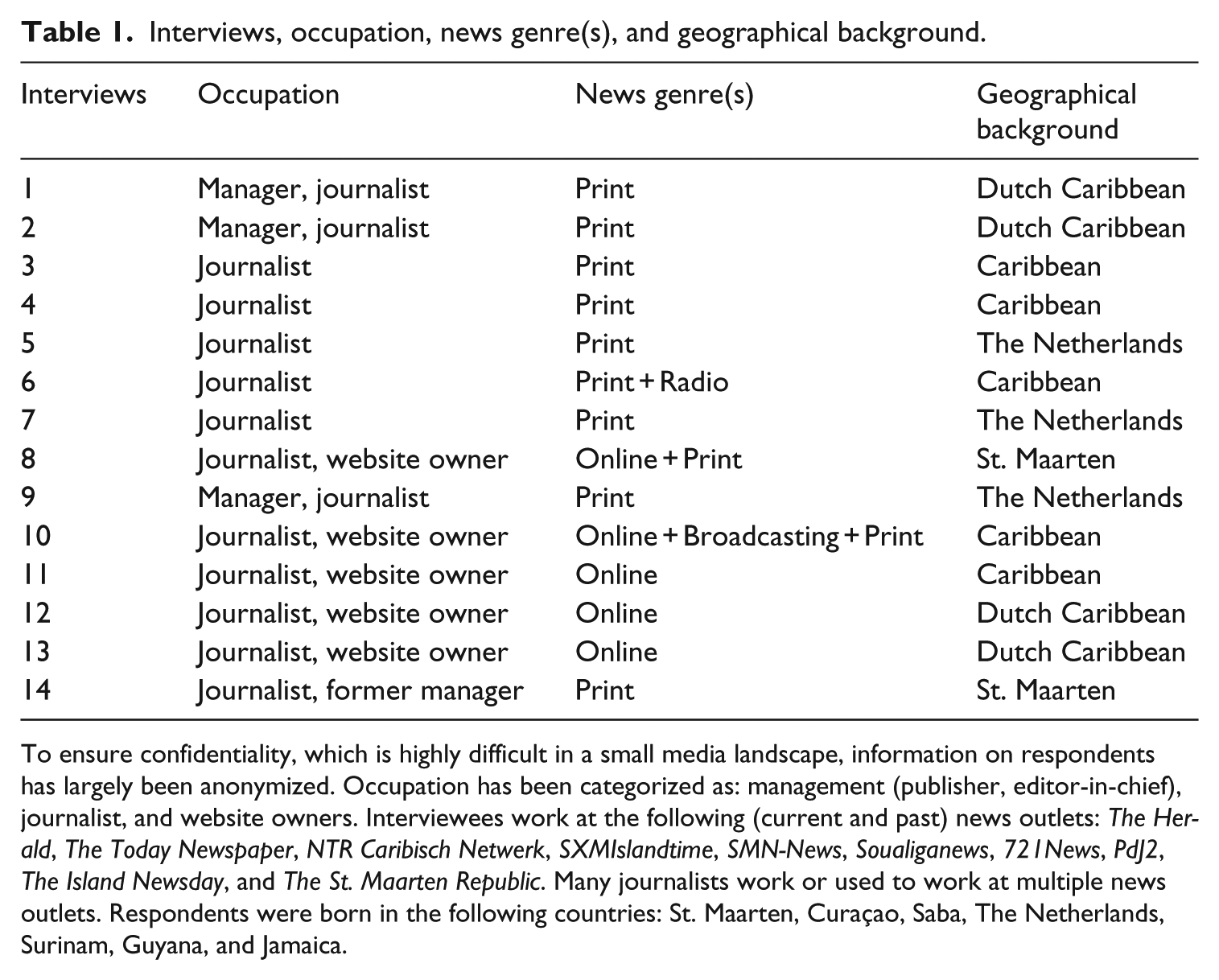
To ensure confidentiality, which is highly difficult in a small media landscape, information on respondents has largely been anonymized. Occupation has been categorized as: management (publisher, editor-in-chief), journalist, and website owners. Interviewees work at the following (current and past) news outlets: The Herald, The Today Newspaper, NTR Caribisch Netwerk, SXMIslandtime, SMN-News, Soualiganews, 721News, PdJ2, The Island Newsday, and The St. Maarten Republic. Many journalists work or used to work at multiple news outlets. Respondents were born in the following countries: St. Maarten, Curaçao, Saba, The Netherlands, Surinam, Guyana, and Jamaica.
Interviews were conducted between January and April 2016. Depending on the preferences of the interviewees, interviews were conducted in English (total of nine) or in Dutch (total of five). The interviews were semi-structured, with a list of topics that included personal background, reflection upon the role of journalism, ideals, practices, and the challenges local journalists face. All interviews were audio recorded and verbatim transcribed, and, if necessary, translated to English. Together with detailed field notes (Crang and Cook, 2007), I analyzed the transcripts following an iterative qualitative analysis approach of open, selective, and axial coding (Boeije, 2010) to categorize, sort, reorganize, and structure the material in light of the posed research questions of this particular study. Codes such as ‘watchdog’ and ‘community builder’ exemplifying various understandings of the role of journalism on the island, and ‘economic development’ and ‘social stability’ illustrating journalists’ ideals, have formed the basis for the three overall patterns of constructive journalism described below.
Findings
The concept of constructive journalism was never mentioned by the journalists as such. However, I observed that most local journalists use constructive techniques in their practices. Analyzing interview material and field notes, I related these observations to the ideals of local journalists. I ended up distinguishing three intertwined patterns of practices of and motives for constructive journalism in St. Maarten: to enhance local economic development, to promote engagement and belonging, and to foster social stability. Journalists, however, also pointed to the local political, economic, and socio-cultural constraints of local journalism. Below I will describe the three patterns of constructive journalism practices in relation to these constraints. In the ‘Discussion and conclusion’ section, I will further reflect on the implications of constraints for the meaning and feasibility of constructive journalism in young postcolonial democracies.
Constructive journalism to enhance economic development
‘I focus on business-oriented news (…) because that creates the opportunities for society to move forward. Economic development is basically the key to any country in order for the people to move forward’ (Interview 12). This journalist recently decided to start a news website focusing on business news. The ideals expressed in this interview – to contribute to economic development and progress – are shared by many journalists and news outlets on the island and motivate them to use constructive journalism techniques.
The journalistic focus on local economic growth can be traced back to the time the first daily newspapers were set up in St. Maarten. The daily press came into being during the second half of the past century, when American investors caught wind of St. Maarten and local political leaders capitalized on these opportunities (Guadeloupe, 2008: 16–17). Most successful in this was St. Maarten politician Claude Wathey who was elected in 1951 and governed St. Maarten for four decades (Badejo, 1989; Roitman and Veenendaal, 2016). His policies led to the ‘rapid development of the tourist market’ in St. Maarten and the ‘massive influx of workers’ from the region (Johnson, 1987: 103).
As the management The Herald recalls, Wathey approached Snow to start a daily newspaper on St. Maarten. Wathey was interested in investing in daily news media that would help him with the economic development of the island – reflecting the popularity of development journalism in the Caribbean in the 1970s and 1980s (Storr, 2016: 16). At the beginning of the 1990s, however, the opposition to Wathey’s policies grew, which was reflected in the news coverage, and Snow left the Wathey-financed newspaper to start his own newspaper.
Although Wathey died in 1998, the effects of his policies are a daily reality on the island, and reflected in journalism practices directed toward enhancing economic development of the island, which is primarily based on tourism. The competition for tourists in the region has increased immensely during the past decades. And many St. Maarten journalists aim to promote tourism and local business in order to compete and economically survive. One of the managers of The Herald explains, We have to brand ourselves better. (…) Lately, Arke [Airline] said that they wanted to help us with that, but only if St. Maarten’s government also contributes. (…) By publishing articles we can put pressure (…) in a positive manner, by making substantiated comparisons to other islands. (…) Stories like these help society to progress because money keeps a society going. And our main source of income is the tourist market. (Interview 2)
Looking up the archives, The Herald indeed has published multiple articles about Arke Airlines. On 4 March 2015, for example, one of the headlines on the front page said, ‘Arke Airline returns to St. Maarten November’ (see Figure 1).

Example of front-page headline: ‘Arke Airline returns to St. Maarten November’ – 4 March 2015 (www.thedailyherald.sx).
The article is accompanied by an editorial on page 2 with the title ‘Reassuring’ (see Figure 2), which reflects the above quote of the editor about the need to put pressure in a positive manner (‘obviously good news’), and by making comparisons to other islands (‘compared to the ABC-islands’). The editorial also shows how the newspaper constructively frames its articles; not everything is positively formulated (‘Still, a word of caution is in order’), but the article ends with an uplifting message (‘it’s reassuring to read in today’s paper that the matter is being given highest priority’).
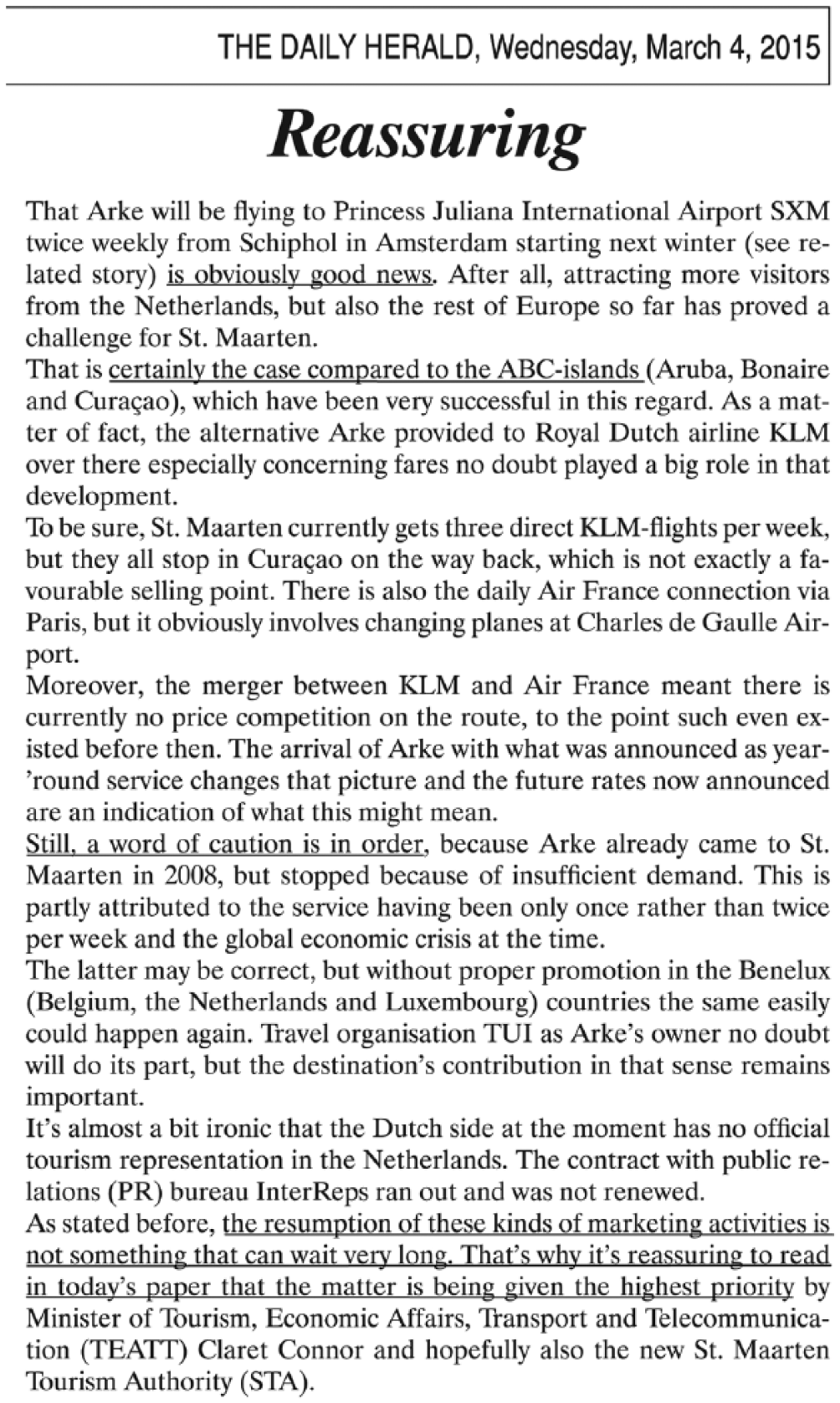
Example of constructive message. Editorial: ‘Reassuring’ – 4 March 2015 (www.thedailyherald.sx).
Local journalists believe it is vital for St. Maarten’s survival to promote tourism and business. This motive for using constructive journalism techniques, however, can be questioned from the perspective of what anthropologist Guadeloupe (2008) has described as St. Maarten’s ‘money tie system, the notion that all relationships are somewhere along the line based on a quest for more money and power’ (p. 39). Together with news commercialization and the (in)direct impact of advertisers (Storr, 2016: 140), it is difficult to distinguish economic development ideals from market-led motives. Often, journalists are well aware of the idealistic ambiguity underlying their constructive journalism practices toward economic development. According to a newspaper manager, One very important function of journalism is control, but the other is being an intermediary of course. (…) Look, for example, at this article in yesterday’s edition: ‘Divico now officially exclusive distributor for [supermarket] Intermarché’. I have to put up with this article, because it actually is promotion. But on the other hand, Intermarché is a very important company, and publishing about it [stimulates] the economy – so, in a certain way, also this is news. (Interview 1)
The aim to stimulate St. Maarten’s economy by functioning as an intermediary for local business ties in with the constructive journalism’s philosophy that journalists can and should participate in enhancing societal well-being. However, considering the island’s money tie system in relation to the commercialization of news, functioning as an intermediary obscures the underlying motives for publishing about tourism, business, and economic growth. Hence, promotion and news become inseparable.
Constructive journalism to promote engagement and belonging
As a result of the rapid growth of the tourism industry, St. Maarten has attracted many migrants from the region and beyond. In order to create more inclusive belonging among members of St. Maarten’s diverse and transnational community, many journalists – and especially those having a migrant background themselves (see Table 1) – use constructive journalism techniques in their journalistic practices.
Having an international audience, the owners of news websites focus above all on engaging St. Maarten’s transnational community. A journalist explains why engaging students who go study abroad was an important reason to start her news website: Home becomes a strange place or a place of the past. Because there is no interaction. So it’s not encouraging for them to come back, because they don’t basically know what’s happening. (…) One of my goals is to let the people from St. Maarten, mostly our students, get day to day information. Because, they are from here. They just leave temporarily. (Interview 10)
Many journalists related that having an immigrant background makes them not only more aware of the transnational character of the local community but also more sensitive to the issues affecting immigrants, as well as to how immigrants perceive the news. One of them explained that many migrants are not involved as ‘they don’t feel part of the community’ and ‘they’re told they are not part of the community’. She, however, aims to change this: ‘I want to make an impact to tell them: this affects you’ (Interview 3). This aim is reflected in her journalistic practice: Every single time the word ‘citizen’ comes up, I change it to ‘resident’. (…) I know it’s only a small definition, but it makes an impact. When somebody says ‘I’m a citizen of St. Maarten’, automatically [people think]: ‘Oh that person has a Dutch nationality’. That’s the mindset. But when you say: ‘I’m a resident’, then the question comes up: ‘Oh where the hell did you came [from]? You live here’. Right away there is a different mindset, so I changed it. I said: that’s my little revolution by itself. (…) I use words that work to bring about an inclusive mindset. (Interview 3)
This journalist hopes that by using the word ‘resident’ instead of ‘citizen’, more people will identify with the news. In this way, she aims to provide more inclusive news that resonates with people so that they take action. Following this, she also decided to focus on people as having strengths and to stop using the word victim. Thus, by using ‘words that work’, this journalist aims to constructively promote the active contribution of people living on St. Maarten.
And she is not the only one. The government also uses the word ‘residents’ on its website, and in official documents, which local journalists then publish about. News media are connected to other institutions in local communities, and produce and reproduce national ideologies (Blommaert, 1999: 427). The use of ‘residents’ in St. Maarten news media may, therefore, not only be the result of individual journalistic efforts to create an inclusive mind-set but also the result of the nation-building strategies of local politicians, whose ‘affiliation may be antagonistic and ambivalent; solidarity may be only situational and strategic: commonality is often negotiated through the “contingency” of social interests and political claims’ (Bhabha, 1996: 59).
Simultaneously, journalists showed how they use constructive journalism practices to challenge local policies. A journalist who migrated to the island 17 years ago explains that she used to write in-depth, more investigative stories to comprehensively inform the community and force authorities to act on migration-related problems. She gives the following example: I was actually shocked when I moved here and I realized that immigrant kids without papers didn’t have access to the regular education system. I was like: how is that even possible? And I wrote about it, I did a series and what not. It even ended up with the authorities in The Netherlands. (…) I think that public pressure; continuously asking the questions and bringing out the stories of the actual kids, forced our authorities. In 2009 something was finally done, they started a first implementation of compulsory education. (Interview 4)
According to her, media coverage in the form of in-depth features ‘is lacking a lot in the media in St. Maarten’. This is a view shared by many local journalists, who all expressed their frustrations about the lack of human resources, money, and time for conducting more investigative journalism.
But local journalists – especially those with a work permit – are also said to be cautious about going in-depth. According to a newspaper manager, I have to be careful how I formulate this, but I think that some journalists have been afraid to ask certain questions over the years. There have been many journalists from other islands, who are dependent on a work permit. (Interview 2)
A journalist who used to be dependent on a work permit, but now has the Dutch nationality, confirms that: There were a lot of issues about you being an immigrant. Because the government needed to approve your permit. So if you weren’t ‘good’, they’d say: ‘Well, you have to go back to your country, because I’m not going to issue your permit’. (Interview 3)
Many journalists on the island are indeed dependent on the authorities for their working permits, which leads to situations where ‘they do not want to be too critical and take the risk of repercussions’ (De Wit, 2015: 120).
The threats to immigrant reporters result in the repression of aspects of the news in manifold ways. They lead to self-censorship among immigrant journalists as well as to a lack of in-depth stories that expose migration-related problems. The use of constructive journalism techniques that focus on words of inclusion, without critically addressing exclusion in practice, is counterproductive. And worse, it risks giving local elites free rein to serve their own interests under the banner of nation-building.
Constructive journalism to foster social stability
At this moment it is important that one constructively contributes to this society – we are in an important period-, that one objectively brings information, but also that we think constructively about how we can progress (…) For example by writing a statement in an editorial. But also, by writing stories in which positive ideas are brought forward and people can think: ‘ok, this takes us further’. (Interview 2)
Most local journalists share the view expressed by this newspaper manager that the political instability since 2010 has hindered the community from moving forward. In addition, the political instability and related issues of integrity and corruption have been extensively detailed in the Dutch press and by Dutch politicians writing letters to news media in St. Maarten. This has led to overall negative news coverage of St. Maarten on a local and international level, which has not only impacted the local tourism sector but also the relationship with the Netherlands. Most local journalists see it as an important task for themselves to maintain good relations with the Netherlands. One of the managers of The Herald explains, Considering the relationship with The Netherlands, you have to be careful in what you cover, and how you cover topics. You should not make things worse. This is a society in transition. (…) And that’s a process of growth that is going to take decades. And, you have to be careful in how you accompany this process. Also, as a newspaper. (Interview 2)
Based on the idea that the main newspaper on the island can easily make or break persons living in the small community, journalists working for The Herald feel a responsibility to foster social stability in the local community and to bring news that is fair. One of the managers says about this: Real corruption should be handled, and flat out. However, one should also realize what happens with society when everyone is locked behind bars. It is – I would almost say – a devilish equation one has to make. (…) There are still some politicians that has to be caught, but you should take into account that you won’t disrupt the stability of society (…) It is very important that we maintain a stable society. (Interview 2)
Because of the focus on stability, The Herald is often criticized for self-censorship by journalists on the island.
They sugarcoat everything. Everyone has to be treated fairly. You can’t step on anybody’s toes? [But] if you’re a newspaper and you don’t piss some people off, [it] means you can never actually write a piece that matters in a sense, you know? (Interview 8)
While stressing that they never censor themselves, some journalists working at The Herald acknowledge this critique, admitting that the management often puts (too much) emphasis on the journalistic principle of fair hearing. This leads to situations in which reporters have to go back and forth between different parties before their articles are finally published.
Some journalists take their critique one step further, like this news website owner: Their entire newspaper is politically affiliated. Ninety percent of the companies are – I am probably exaggerating a bit – but a lot of the companies on the Dutch side [St. Maarten] are owned by certain politicians and their families, and they advertise with The Daily Herald. If they go write things about them, they’d risk losing the advertising. (Interview 10)
Another journalist adds, ‘because it is a small town, you can’t piss off business, because that means you can’t pay your journalists’ (Interview 8). According to a journalist of an older generation, who used to have several small newspapers and magazines, ‘We had the typical problem St. Martin journalism has, namely that we could not get the advertisements that we needed. It’s not like Today, or The Herald. (…) Our position always clashed with the establishment’ (Interview 14).
Indeed, the need for advertisements does stimulate journalists not only to write positively about business but also to avoid reporting negatively about them. News websites, typically run by lone individuals, are susceptible to advertisers’ influence in the same way. Website owners have to not only write pieces about advertisers but also maintain relationships with their ‘clients’. One of them says, Let’s say you have a client, and let’s say that client becomes the news. What do you do? You have to do the news, right? You have to report that story. But perhaps, how you write the story may not do too much harm to your client. So, you know, you have to be tactical. (Interview 12)
In addition to market-driven principles, some local journalists argue that these careful, tactical journalistic approaches reflect the overall ‘sugarcoated society’ of St. Maarten ‘where nobody feels completely comfortable with being outspoken’ (Interview 8). This ties in with what Storr (2016) has described as local Caribbean cultures of secrecy and silence inherited from a colonial past (pp. 95–108). Storr (2016) states that in some cases, these cultures may require a more radical role of local journalism in criticizing local political and economic elites (p. 97). Since the 1950s, local news initiatives have been active in opposing the establishment on the island (Johnson, 1987: 75). Based on ‘a philosophy of advocacy journalism’, local journalists have started news outlets with the aim of ‘helping to improve the social, economic, educational, and political conditions’ of St. Maarten ‘by advocating against the causes of Injustice and Oppression’ (Reiph, 2009). Today, only some journalists take this more radical approach. One of them states, ‘I do a lot of investigative journalism. It takes a lot of courage in a small island, where everybody knows everybody, to take the risk that I take. I go after [Dutch] prosecutors if I have to’ (Interview 10).
Thus, the majority of (the main) news media take a tactical, cautious approach to enhance social stability, which ties in constructive journalism’s ideal to hold power to account by fostering conversation, collaboration, and consensus building. But in the local, postcolonial context of St. Maarten, this approach risks reflecting and strengthening a culture of secrecy and silence. As long as the fear of being outspoken persists in the local culture, a focus on social stability could simply play into the hands of those in power in St. Maarten and beyond; something I will further reflect upon in the discussion.
Discussion and conclusion
In this article, I showed that many St. Maarten journalists practice constructive journalism based on ideals of constructively contributing to economic development, engagement and belonging, and social stability of the island. Local constructive journalism includes positively reporting about local businesses and putting pressure on the government to support economic growth. Moreover, constructive journalistic practices seek to engage with the highly diverse population on St. Maarten and to develop a sense of belonging among St. Maarteners. In light of St. Maarten’s ongoing relationship with the Netherlands and the political crises the island has been confronted with, constructive journalism is practiced to foster social stability, which, according to some, supersedes the watchdog function of local media.
At the same time, I contended that local journalists deeply struggle with local political, economic, and socio-cultural constraints. Local journalism is dependent on commerce and lacks human resources. Moreover, St. Maarten is home to a culture in which people fear outspokenness. This is likely a reflection of the colonial past and is reinforced by the small community setting in which many people are related to one another. These constraints undercut the meaning and feasibility of constructive journalism, as critics of this approach and similar forms of journalism have previously stressed.
Every journalist wants to write ‘words that work’. But for whom and for what purpose? In St. Maarten, news stories about local business that seek to foster economic development risk to becoming promotion. Local journalistic initiatives to use words of inclusion in news stories, while local journalists do not have the capacity or the courage to address ongoing policies of exclusion, are counterproductive. And a journalistic focus on social stability in St. Maarten reproduces the local ‘sugarcoated’ community and the benefits political and economic elites have of this culture of fear.
So, practicing constructive journalism under St. Maarten’s restricted political, economic, and socio-cultural conditions not only risks reflecting the status quo but also may play into the hands of the ones in power. This undermines the normative underpinnings of constructive journalism and the ideals of local journalists willing to foster development, engagement, and societal well-being. For constructive journalism to flourish and to realize its normative potential, the local culture of fear has to change as well as the entrenched political and economic power structures. St. Maarten news media can play an important role in overcoming these problems. However, rather than constructive, this role should be disruptive, unsettling, and deconstructing of the hegemonic power dynamics in St. Maarten’s community. Therefore, indeed, ‘[i]n the small countries of the English-speaking Caribbean, where the dynamics of producing news are different, the journalist’s role must also include advocacy and radicalism’ (Storr, 2016: 189).
The dynamics of news production in St. Maarten differ from those in the United States and overseas Dutch journalism contexts. They are formed in a culture that reflects colonial legacies and the globalized reality of today. This local, postcolonial context is not unique to St. Maarten. Further research should be done on whether the problems and risks of constructive journalism in St. Maarten, and the need for more disruptive journalism, also apply to other small postcolonial democracies around the world.
Footnotes
Funding
The author(s) received no financial support for the research, authorship, and/or publication of this article.
Notes
Author biography
 .
.