




Abstract
Given the importance of news in preparing children for their role as active citizens in society, insight into how negative news can be delivered to children most optimally is warranted. In this regard, this study examined the usefulness of constructive news reporting (i.e. solution-based news stories including positive emotions). An experiment (N = 281 children, 9–13 years old) was conducted to investigate how constructive, compared to nonconstructive, news reporting affected recall of television news, and whether negative emotions elicited by this news mediated this relation. Analyses of covariance revealed that children in the constructive condition displayed a lower recall of the general information about the event. In contrast, their recall of constructive stories was better compared to the recall of comparable, but nonconstructive, stories by children in the nonconstructive condition. Fear and sadness elicited by the news did not mediate the relation between news reporting style and recall. Instead, constructive reporting directly induced smaller increases in fear and sadness than nonconstructive reporting. To conclude, the negative aspects of the news event were less prominently available in memory of children exposed to constructive news.
Children’s cognitive responses to constructive television news
The rapidly increasing research attention for constructive news reporting over the past years has primarily focused on the production and effects of this form of news for adults (Gyldensted, 2011; McIntyre, 2015; McIntyre et al., 2016; McIntyre and Sobel, 2017). This is surprising, because children are becoming increasingly important as a target group for news (cf. Papathanassopoulos et al., 2013; Van Der Molen and De Vries, 2003). In particular, insight into how journalists can better serve the young news audience is warranted, because news has an important role in preparing children for their current and future role as active citizens in society (Alon-Tirosh and Lemish, 2014; Carter, 2013; Kaziaj and Van Bauwel, 2017; Van Deth et al., 2011). Constructive journalism might be a very suitable way to make news more appropriate for children. Therefore, this study aims to explore the usefulness of constructive news reporting in this regard.
Children are defined as target group for news when they reach the age of approximately 8 years old (Van Der Molen and De Vries, 2003). Based on insights from developmental psychology, children of this age are increasingly able to distinguish between fantasy and reality (Valkenburg and Piotrowski, 2017). In addition, they develop the ability to empathize with others (Eisenberg, 1992; Valkenburg and Piotrowski, 2017). Both are important prerequisites to be able to follow and understand news. However, it also implies that children from 8 years on may become more responsive to negative elements in news. In particular, because children are able to draw inferences from what they see in the news, they may realize that they are also vulnerable to what is presented (Smith and Wilson, 2000). Therefore, producers of news for children struggle with the oftentimes contrasting aims to prevent their child audience from getting too upset from the news versus the aim to inform them about topics with a high news value, which are predominantly negative in nature (Van Der Molen and De Vries, 2003).
Because constructive journalism aims to bring stories of high importance in a more positive and solution-based way while still adhering to the core functions of news (cf. Gyldensted, 2015; McIntyre, 2015), one might expect that constructive news reporting has the potential to meet both the emotion-related versus cognitive goal of those news producers. Two studies have already investigated the effects of constructive television news reporting (print and audio) on children’s emotions (Kleemans et al., 2017a, 2017b), confirming that a constructive style of news reporting can weaken the increase in children’s negative emotional responses upon exposure to negative news. This study aims to build further upon these initial findings by investigating children’s cognitive responses, that is, children’s recall of constructive, compared to nonconstructive, television news.
Cognitive responses to constructive news are important to investigate because informing the audience about what is happening in the world is a core function of news (cf. Skovsgaard et al., 2013). To evaluate the usefulness of constructive journalism, it is important to identify how constructive news affects memory of what is presented in the news compared to a more mainstream, nonconstructive, style of news reporting. This study is the first that investigates cognitive effects of constructive news reporting. Drawing on information processing theory, this study, therefore, not only contributes to the field of children and news but also to the domain of journalism in general. By conducting an experiment, we aim to enhance the theoretical understanding of constructive journalism and to provide insights into concrete strategies that journalists can apply when serving the (child) audience.
Constructive news for children
A number of countries, particularly in Western Europe (e.g. the United Kingdom, the Netherlands, Germany, and Austria), broadcast specific news programs for children (Alon-Tirosh and Lemish, 2014). There are, however, numerous countries that do not have children’s news programs (cf. Kaziaj and Van Bauwel, 2017). In addition to competitive, financial, and commercial factors (Carter, 2013; Steemers and D’Arma, 2012), the presence or absence of children’s news outlets may stem from different perspectives on children as news consumers. To be more specific, scholars debate whether children are cognitively and emotionally mature enough to consume news. Some argue that children should be shielded from negative news, while others emphasize that children should be exposed to it in order to empower them as citizens in society (cf. (Alon-Tirosh and Lemish, 2014; Carter, 2013; Kaziaj and Van Bauwel, 2017; Kleemans et al., 2017a).
Regardless of the existence of news specifically tailored to children in a specific country, the role of news is becoming more and more prominent in the lives of children worldwide. Due to changes in the news media landscape, such as the rise of the Internet, children are more frequently exposed to news than ever before (Buijzen et al., 2007; Davies, 2008; Lemish and Alony, 2014). For instance, they regularly watch child or adults news programs or are confronted with news while looking for other media content or when their parents consume news (Alon-Tirosh and Lemish, 2014; Buijzen et al., 2007; Kaziaj and Van Bauwel, 2017). Children critically evaluate the news to which they are exposed. In particular, children indicate that they prefer news that presents events in a more positive way than news media generally do (Alon-Tirosh and Lemish, 2014). Constructive journalism might be suitable in this regard, because it aims to take distance from the dominant negativity bias in news by fostering a more positive perspective on news events. In particular, two constructive elements are discerned in the literature on constructive journalism: including positive emotions and solution-based – rather than problem-based – news reporting (Gyldensted, 2015; McIntyre, 2015).
Regarding the first element, the field of constructive journalism obtained insights from Fredrickson’s broaden-and-build theory (Fredrickson, 1998, 2001). This theory explains that the experience of positive emotions broadens a person’s thought-action repertoire leading to a more positive, broadened mindset. In the context of negative news, the experience of positive emotions can be accomplished by, for instance, focusing on survivors who are relieved or by including elements of hope, such as providing information about what is done to help people who were affected (cf. Kleemans et al., 2017a; McIntyre, 2015).
The second element, solution-based news reporting, is inspired by Pals’ (2006) notion of coherent positive resolution. The basic idea behind this is that it is important to construct a coherent and complete story of a difficult event that ends positively, because giving people a sense of narrative completion may diminish the negative impact of a story. Providing potential solutions in a news story is a way to facilitate narrative completion (McIntyre, 2015).
Cognitive responses to constructive news
As mentioned before, cognitive responses to constructive news reporting have not yet been investigated among children or adults. Although one of the main aims of constructive journalism is to disseminate important information in order to create an informed audience (Gyldensted, 2015: 14), it is unclear whether and how constructive news reporting may actually contribute to this. To be more specific, theoretical contributions on constructive journalism do not specify how constructive elements may influence information processing (cf. Gyldensted, 2015; Haagerup, 2014; McIntyre, 2015). In addition, past studies on constructive news reporting defined affect, attitudes, engagement levels, and prosocial intentions and behaviors as key outcomes (Kleemans et al., 2017a, 2017b; McIntyre, 2015), but did not include cognitive measures. Therefore, we need to build upon a general information processing theory when investigating children’s cognitive responses to constructive news.
A theoretical model that is frequently applied in studies on the information processing of audiovisual news is Lang’s (2000) Limited Capacity Model of Mediated Message Processing (LCM). This model states that information processing is a complex process involving various subprocesses (i.e. encoding, storage, and retrieval) that each require mental resources. However, people’s capacity to process information is limited, implying that not all information in audiovisual messages can be processed thoroughly. The amount of resources allocated to the task of information processing influences this. Allocation of resources can occur both controlled and automatically. Controlled allocation means that viewers intentionally pay attention to (aspects of) a message, for instance, because they have a high interest in the topic. They thus allocate more mental resources to the message, which improves information processing.
Automatic allocation of resources is induced by specific message characteristics, namely those eliciting attention or arousal responses in viewers. In particular, emotional content (e.g. negative story topics, dramatic pictures) triggers the automatic allocation of mental resources to message processing, because such information contains survival value (Lang, 2000). People are evolutionary predisposed to scan their environment for things that pose potential treats (such as negative events) and, therefore, automatically pay attention to media content that includes such information (cf. Shoemaker, 1996). Negative news thus activates automatic resource allocation and can consequently enhance information processing (Lang et al., 1996).
Following the LCM, it is difficult to predict whether children will benefit from constructive news reporting – compared to nonconstructive reporting – in terms of cognitive responses, because constructive news may particularly activate controlled resource allocation, whereas nonconstructive news is more likely to trigger automatic allocation of resources. Specifically, constructive news typically includes positive emotions and solution-based elements (McIntyre, 2015). Therewith, constructive reporting better suits children’s desires with regard to the presentation of negative news, making it more personally relevant and interesting for them (cf. Alon-Tirosh and Lemish, 2014). Consequently, it is more likely that children intentionally pay attention (i.e. allocate mental resources in a controlled manner) to constructive news reporting than to nonconstructive news reporting. This implies that their news memory will surpass that of children watching news in a nonconstructive reporting style.
However, as argued before, the LCM (Lang, 2000) states that negative news content will activate the automatic allocation of mental resources to process a message. Because news reported in a nonconstructive style includes more negative elements than constructive news reporting, children’s memory performance may benefit from the increased automatic resource allocation in this regard. This suggests that children exposed to nonconstructive news reporting may display better memory than children who watch news in a constructive reporting style.
Considering this, it is important to recall one of the major assumptions of the LCM, that is, that mental resources are limited (Lang, 2000). Due to the higher amount of negative information in nonconstructive news, the processing of this news reporting style is expected to require higher amounts of (automatically allocated) mental resources than constructive news. In the case that the resources required to process a message thoroughly exceed the resources allocated, cognitive overload occurs. This leads to distorted memory. Thus, compared to constructive news reporting, nonconstructive news reporting either may improve memory or may induce cognitive overload resulting in poorer memory performance.
To shed more light on children’s cognitive processing of news reported in a constructive versus a nonconstructive style, a free recall measure was used in this study. Free recall is considered an indicator of how well people are able to retrieve information that was previously encoded and stored in memory (cf. Lang, 2000). This measure provides more detailed information about what children memorize from the news and how well they process it compared to recognition and cued recall measures, and is, therefore, relevant to study. In all, we question:
RQ1: What is the difference between children exposed to a constructive versus nonconstructive style of news reporting in recall of negative news?
The mediating role of emotions
Based on the theoretical foundations of constructive journalism, one might expect that a constructive style of news reporting elicits smaller increases in negative emotional responses and smaller decreases in positive emotional responses than nonconstructive news reporting. Previous research already provided support for this assumption (Kleemans et al., 2017a, 2017b). It is conceivable that changes in emotional responses mediate the effect of the style of news reporting on recall. Research in the realm of the broaden-and-build theory suggests that positive emotions may trigger upward spirals toward a broad range of outcomes, including a broadened scope of attention (Fredrickson, 1998, 2001). In contrast, negative emotions have been shown to narrow the scope of attention toward what is threatening and harmful (cf. Garland et al., 2010). Thus, positive emotions elicited by constructive news reporting may prevent cognitive narrowing to negative elements in the news. In contrast, nonconstructive news reporting elicits negative emotional responses, which may narrow the scope of attention to negative elements (cf. Lang, 2000).
In sum, there is reason to expect that cognitive processing of constructive versus nonconstructive news is mediated by emotions elicited by this news, which may in turn affect recall. Because children are exposed to a report about a negative news event in this study, all children are likely to experience negative emotions. To investigate the mediating role of emotions on recall, we therefore, focus on changes in negative emotions (i.e. fear and sadness). We question:
RQ2: Is the effect of style of news reporting on recall of news mediated by the levels of fear and sadness elicited in children due to exposure to either constructive or nonconstructive news?
Method
A between-subjects experiment was conducted to investigate how constructive versus nonconstructive news reporting affected children’s recall of news about the 2011 tsunami in Japan. Before exposure to the newscast, children answered questions regarding their demographics and indicated their emotional state at that moment. After watching the news, they were again asked about their emotions and were asked to write down what they remembered from the newscast.
Stimulus materials
The stimulus materials of this study were previously used and extensively described in a study by Kleemans et al. (2017b). To summarize, together with the NOS Jeugdjournaal – the children’s TV news program in the Netherlands – two short, professionally looking newscasts about the 2011 tsunami nearby Sendai in Japan were created: a constructive and a nonconstructive one. Only footage that was previously broadcast by the NOS Jeugdjournaal was used. The choice for the tsunami in Japan was made because previous studies showed that a natural disaster is a news topic that often frightens children (Cantor and Nathanson, 1996; Riddle et al., 2012). We purposefully selected a topic that happened more than 5 years ago to prevent that the children in our study had living memories of the event.
Both the constructive and nonconstructive version of the newscast started with a tune that marked the beginning of the program, followed by a 1-minute opening item that contained general factual information about what happened. As described in Table 1, the audio information in this part of the newscast was exactly the same for both the conditions. The opening item aimed to present the magnitude of the event in the same way in both the constructive and nonconstructive report. It therefore provided the most important information about the tsunami based on the traditional five Ws and an H (who, what, when, where, why, and how; cf. Singer, 2008). The video information in this part of newscast was also the same in both the conditions. It predominantly contained pictures of the havoc in Japan.
Overview of the content of the constructive versus the nonconstructive newscast.
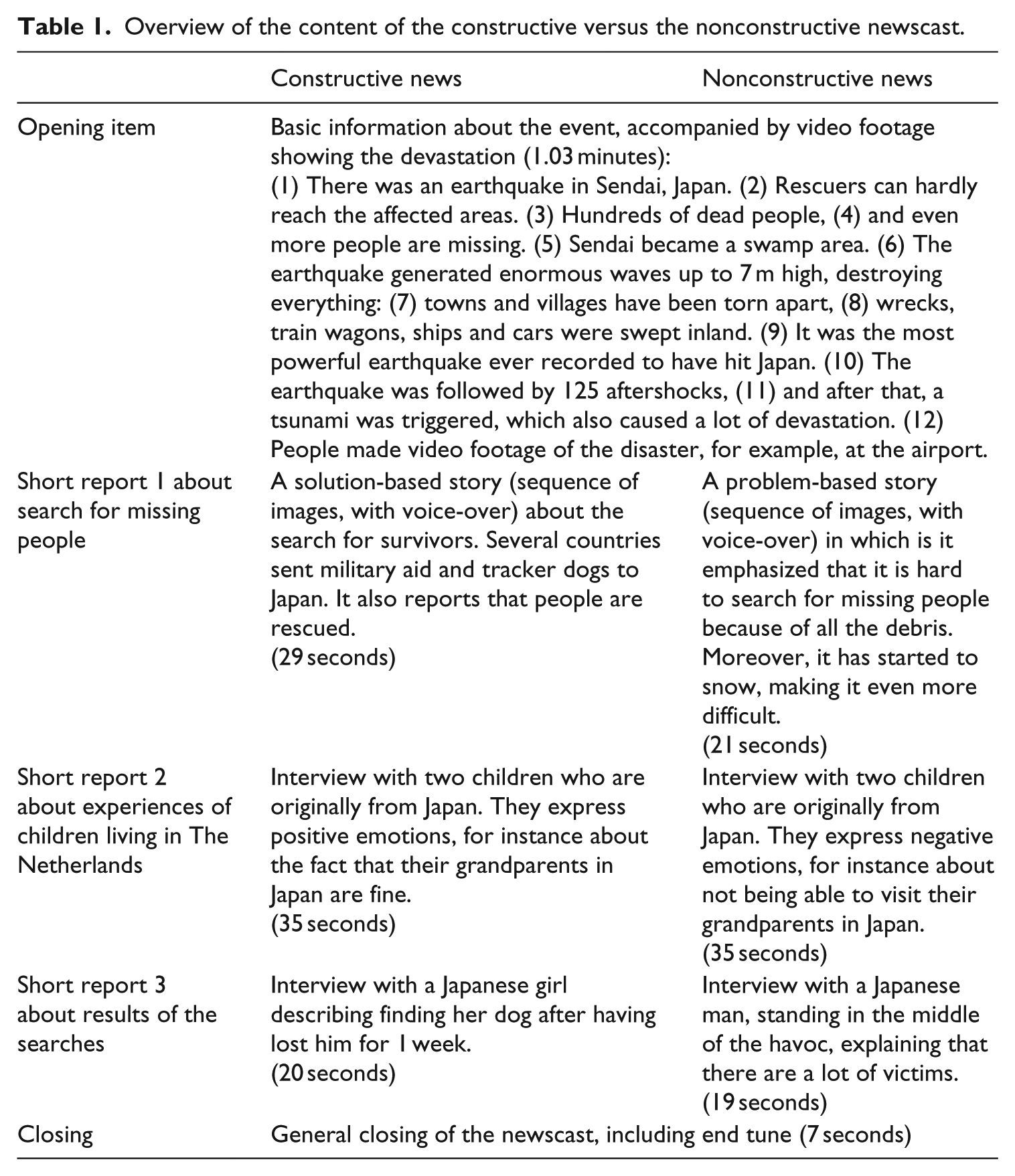
The opening item was followed by three short items that differed between the two conditions. The constructive newscast included stories in which positive emotions and solution-based information were present (cf. Gyldensted, 2015; McIntyre, 2015). As described in Table 1, the first item reported about the search for survivors and what kind of help was sent. The second item included an interview with two Japanese boys who live in The Netherlands and told about their grandparents in Japan who survived. The last item reported about a Japanese girl who found her dog back after having lost him in the tsunami. In the nonconstructive version, the first item was about how difficult it was to search for survivors. The second item again featured the two Japanese boys, but now expressing their sorrow and sadness about their grandparents in Japan. The final item reported about high numbers of dead people and that many people were still missing. Both versions ended with a closing sentence and the end tune of the program.
Participants and procedure
Participants were recruited at grade 4 to 6 of seven primary schools in The Netherlands. After obtaining active consent from the head of each school, an information letter was sent to the parents in which we provided information about the study. Parents were asked to give passive consent (opt-out) for participation of their child(ren). Only a few parents (n = 3) did not give consent. At the start of the experiment, children themselves were also asked whether they would like to participate or not. All children were willing to take part in the study. A total number of 284 children started the experiment. However, for reasons unknown to us, three of them did not fill in the post-questionnaire. Because they, consequently, did not have scores on crucial variables, they were excluded from the study data. The actual sample size thus consisted of 281 children (46.6% boys; 95.0% natives). Their age ranged between 9 and 13 years old (M = 10.78, standard deviation (SD) = .99).
A total number of 11 classes participated in the experiment. The entire class was randomly assigned to either the constructive (n = 136 children; 50.0% boys, Mage = 10.64, SDage = 1.09) or the nonconstructive (n = 145 children; 43.4% boys, Mage = 10.92, SDage = .86) condition. A randomization check showed that the two conditions did not significantly differ with regard to sex (F(1,253) = .620, p = .432), age (F(4,253) = .926, p = .449), class level (F(2,253) = .251, p = .778), and ethnicity (F(1,253) = .125, p = .724).
The experiment started with a short introduction to the study by one of the researchers. In addition, the children practiced the use of visual analog scales (VAS) to ensure that they understood the principle behind it and were able to answer the questions in which such scales were used. After that, children received the pre-exposure questionnaire on paper. After filling out the questionnaire individually in the classroom, children watched the newscast together. At the end of the newscast, children were asked to fill out the post-exposure questionnaire. Children were debriefed and thanked for their participation after the experiment.
Measures
Recall
We used a free recall measure (cf. Lang, 2000) to indicate what children memorized from the news. Because there was a high correspondence between what was presented in the video and what was told in the audio, we could not make a distinction between audio and video recall. To be more specific, some information was presented in the audio only, but there was no clear information presented in the video that was not introduced in the audio. After exposure, children were asked to write down what they remembered from the newscast they just saw. Their answers were coded in order to create two different recall measures that together shed light on what and how well children recalled the news.
First, we coded all answers related to the general information in the newscast. To this end, we used a list of information presented in the first minute of the newscast. As described in Table 1, 12 different pieces of information were presented in the opening item. We assigned one point for each element that was mentioned (e.g. that there was a tsunami, that people died). As a reliability check of the codings, we randomly selected the answers of approximately 10 percent of the participants (n = 30). Two of the researchers double-coded these answers. Krippendorff’s alpha (α = .91) indicated that both coders largely agreed on the points assigned to each answer and thus that the codings were reliable. Subsequently, one of the researchers coded the remaining answers following the same instructions. This resulted in a variable representing recall of general information (M = 2.23, SD = 1.29; the maximum score obtained was 7).
Second, we coded whether children remembered the three specific stories that followed the general introduction, which differed between the constructive and the nonconstructive conditions (see Table 1). For each short report that was mentioned, one point was assigned. Again, the answers of 30 participants were randomly selected and double-coded. Krippendorff’s alpha indicated that the codings were reliable (α = .99). Therefore, one of the researchers coded all the remaining answers, resulting in the variable recall of specific items (M = 1.08, SD = .84, range: 0–3). Descriptive statistics showed that recall was the highest for the constructive version of item 1 (51.47%), whereas the recall of the nonconstructive version was much lower (30.31%). Differences in recall for the other two items were smaller. Item 2 was recalled by, respectively, 29.41% versus 26.90% of the children. For item 3, recall of the constructive version (40.44%) was slightly higher compared to the nonconstructive version (38.62%).
Emotional responses
Fear and sadness were defined as potential mediators. Fear was measured with two items that were questioned both before and immediately after exposure to the news. Children were asked to indicate on two separate 100-mm VAS (cf. Kleemans et al., 2017a, 2017b): how frightened and anxious they felt. Children provided their specific emotional feelings by marking a position along a continuous line on the right endpoint with a frightened or anxious emoticon and on the left endpoint with the same emoticon, but with a red cross through it. For the analysis, we first calculated the mean scores in millimeters for frightened (M = 4.80, SD = 9.78) and anxious (M = 4.41, SD = 9.71) responses before exposure together (r = .476, p < .001), leading to a variable indicating feelings of fear before exposure. Second, we did the same for feelings of fright (M = 10.07, SD = 17.06) and anxiety (M = 9.27, SD = 16.92) after exposure (r = .756, p < .001) to indicate their overall feelings of fear immediately after exposure to the news. Finally, we constructed a difference score (level of fear after exposure – level of fear before exposure), indicating the change in feelings of fear due to news exposure to use as mediating variable in the analyses (M = 5.07, SD = 14.78).
To measure sadness, two VAS were used to measure how sad and sorrowful children felt. The same procedure as described for fear was followed, resulting in mean scores for sad (M = 5.49, SD = 12.82) and sorrow responses (M = 5.38, SD = 12.37) before exposure (r = .573, p < .001) and after exposure (sad: M = 13.37, SD = 18.67; sorrow: M = 12.39, SD = 19.73; r = .798, p < .001), which together thus indicate the level of sadness before exposure and afterwards. Again, we constructed a difference score, indicating the change in feelings of sadness due to news exposure to use as mediating variable in the analyses (M = 7.44, SD = 17.18).
Analysis procedure
RQ1 was analyzed with two one-way ANCOVAs, one for each recall variable, in which condition (constructive versus nonconstructive) was defined as between-subjects variable. Sex (male, female) and class level (grade 4, 5, or 6) were included as covariates, because exploratory analyses showed that these variables significantly correlated with the dependent variables. RQ2 was investigated using Hayes’ PROCESS macro for mediation models (Hayes, 2013). Ordinary least squares (OLS) regression and bootstrapping (5000 bootstrap samples, 95% bias-corrected confidence intervals (CIs)) were used to estimate the effects of style of news reporting via negative emotions on free recall of general information and the specific items.
Results
Effects of news reporting style on recall
To investigate how constructive versus nonconstructive news reporting affected children’s recall (RQ1), we first analyzed whether children watching constructive news reporting recalled the general information about the tsunami in Japan differently than children watching nonconstructive news reporting. Findings showed that children who watched the constructive newscast remembered slightly less of the basic information about the tsunami (M = 2.07, standard error (SE) = .11) than children who watched the nonconstructive newscast (M = 2.38, SE = .11), F(1,277) = 4.064, p = .045, η2 p = .01. Second, we analyzed the recall of the specific news items about the event. Recall of the three stories that followed the general information was significantly higher among children in the constructive condition (M = 1.26, SE = .07) than among those in the nonconstructive condition (M = .92, SE = .07), F(1,277) = 11.580, p = .001, η2 p = .04. In all, the shared information that was presented in both versions of the newscast was recalled better by children exposed to nonconstructive condition. In contrast, the recall of the distinctive information was better among children in the constructive condition.
The mediating role of fear and sadness
RQ2 questioned whether fear and sadness elicited by either constructive or nonconstructive news reporting mediated the relation between style of reporting and recall. For recall of general information, the results showed a direct effect of news reporting style on fear (t = −2.728, p = .007, CI (−.72, −.12)), but the indirect effect of fear was not significant (effect = −.001, boot SE = .018, CI (−.05, .03)). Comparable results were found for sadness. There was a direct effect of style of news reporting on sadness (t = −2.792, p = .006, CI (−.72, −.13)), but no indirect effect (effect = −.007, boot SE = .014, CI (−.01, .05)). These results indicate that nonconstructive news reporting elicited a higher increase in feelings of fear and sadness than constructive news reporting, but that these levels of fear and sadness did not mediate the effect of news reporting style on recall of general information.
For recall of specific information, results again showed direct effects of news reporting style on fear (t = 2.590, p = .010, CI (.06, .46)) and sadness (t = 2.589, p = .010, CI (.06, .46)). The indirect effect of constructive versus nonconstructive news reporting via either fear (effect = −.005, boot SE = .011, CI (−.04, .01)) or sadness (effect = −.004, boot SE = .009, CI (–.04, .01)) was not significant. Thus, fear and sadness also did not function as mediators in this regard.
Discussion
This study is the first in the emerging field of constructive journalism that investigated how constructive news reporting, compared to nonconstructive news reporting, affects cognitive processing. Following studies on how constructive news reporting influences children’s emotional responses, engagement, and prosocial intentions (Kleemans et al., 2017a, 2017b), this study examined whether constructive news reporting in stories tailored to children succeeds in journalisms’ core function to inform the audience. Our findings suggest that the effects of constructive news are mixed. Children exposed to constructive news were less likely to recall the basic facts about the negative news event than children exposed to nonconstructive news. In contrast, their recall of constructive stories was better compared to the recall of comparable, but nonconstructive, stories by children in the nonconstructive condition. In other words, these findings imply that for children exposed to constructive news reporting (1) negative elements of the news were less prominently available in memory and (2) that they, instead, recalled more of the parts of the newscast in which constructive elements were present.
From a journalistic perspective, one might question whether this is a desirable outcome. The most important information about the natural disaster in Japan was presented in the opening of the newscast, and especially for this part recall was lower among children in the constructive condition. This result seems to indicate that constructive news reporting dispelled the attention toward negative information. Because constructive reporting elicited lower levels of negative emotions (i.e. fear and sadness) compared to nonconstructive news, this should have prevented the children from having a narrowed scope of attention to the negative event (cf. Fredrickson, 1998, 2001; Garland et al., 2010). However, because we did not find support for this mediating role of negative emotions, questions regarding possible explanations for the study findings remain. Factors such as the exact content of the news item, the level of identification with specific parts of the newscast (and consequently paying more attention to these parts), or differences in news appeal between the constructive and nonconstructive stories in the newscast may have influenced recall. Further research should investigate this, to get more insight into how differences in recall between constructive versus nonconstructive news can be explained.
It is important to note in this regard that recall scores in both conditions were low and that the differences in recall among children exposed to constructive versus nonconstructive news were quite small. Thus, children watching constructive news reporting were not dramatically less informed because neither of the groups performed very well. The low scores might be explained by the measure we used. Free recall indicates how well information could be retrieved from children’s memory. According to the LCM, this requires complete processing of information, depending on how much information was encoded, how well this was stored, and how much could be retrieved (Lang, 2000). It could be that children encoded and stored more information, but could not retrieve it immediately in the experimental setting. Future research should therefore take the subprocesses of encoding and storage also into account. Lang (2000) argues that recognition (for encoding) and cued recall (for storage) tests are useful in this regard.
The results of the study may indicate that different processes of resource allocation (i.e. controlled and automatic allocation) were activated. However, due to the contrasting findings for recall of general information versus recall of specific stories, it remains unclear how the controlled and automatic allocation of resources came into play exactly. Future research is needed to provide more insight. In particular, the use of psycho-physiological measurement techniques (e.g. eye tracking, fMRI scanning technology, heart rate, and skin conductance) may be helpful in this regard. For example, eye-tracking resources can provide more insight into what elements of the message were noticed and, thus, whether automatic resource allocation may be activated or hindered. In addition, the use of secondary task reaction times can be encouraged. When asking participants to pay attention to the story (the primary task), but also ask them to perform a secondary task (e.g. push a button when hearing a specific signal), variations in resource allocation can be disentangled (cf. Lang, 2000). Specifically, when the time to respond to the signal becomes longer, this indicates that there are less mental resources available and, thus, that the majority is already allocated to the primary task. This can provide more insight into the specific aspects in newscasts that invoke resource allocation, which may inform news producers about where in the story they should include constructive elements.
Another recommendation for future research concerns attention for a wider range of elements from news that can be recalled. For example, future studies may investigate the recall of visual versus audio information separately. The dual-coding theory (Paivio, 1969) predicts that audiovisual information is stored in both verbal and visual memory codes, implying that two rather than one mental code can be used when recalling information. Whether constructive news reporting taps into one of these codes specifically is worth exploring, because it may shed more light on the elements in news (i.e. audio, video, or both) that drive information processing and, thus, where constructive elements should be included to optimize their effects. Current theoretical notions on constructive journalism (Gyldensted, 2015; Haagerup, 2014; McIntyre, 2015) do not explicitly refer to possibilities of adapting video information, although it seems to be quite feasible to make video elements more constructive (e.g. by showing people who express positive emotions or who help other people). In this study, it was hard to distinguish between audio and video, because the video information was also explicitly mentioned in audio. Nevertheless, some of the open answers of children indicated that the video information in the newscasts made a deep impression on them. For example, they explicitly mentioned that they saw negative pictures (e.g. floating cars, boats on the street). This underlines the importance to investigate the application and effects of constructive elements in both audio and video.
To conclude, the fact that constructive news reporting differentially affected children’s recall of news compared to nonconstructive news reporting opens doors for follow-up investigations among both child and adult audiences. Because children have other preferences with regard to news than adults (cf. Alon-Tirosh and Lemish, 2014), it might be particularly interesting to examine whether differences in controlled allocation of mental resources exists in this regard and how this affects memory for constructive versus nonconstructive news. The results of this study supports previous findings (Kleemans et al., 2017a, 2017b) that constructive news show great promise in reducing negative effects on children’s emotions. This implies that the inclusion of constructive elements in news makes news emotionally more appropriate for children. However, care should be taken that those elements do not distract too much attention from the basic information about the news event. It is a challenge for future research to look for the optimal balance in this regard, in order to make news attractive and simultaneously informative for children and, therewith, contribute to their active citizenship in society.
Footnotes
Funding
The author(s) received no financial support for the research, authorship, and/or publication of this article.