




Abstract
Reports of flooding are becoming more frequent in the UK media, and evidence from the UK Environment Agency indicates that ‘living with flooding’ will become commonplace rather than exceptional. This study is the first to adopt a critical discourse analysis approach to compare UK newspaper reporting of floods in the developed and developing world. We present our analysis of major flood incidents in Northern England and Chennai, India, in 2015. Our findings identify that UK newspapers not only give greater prominence to flooding events that are local but also frame differently those affected. Reports of floods in Northern England reinforced similarities and shared values between victims and assumed readers by drawing upon personal stories, emotions and suffering. By contrast, reports about floods in Chennai portrayed victims as anonymous ‘distant Others’, emphasising the drama of the incident rather than the plight of individuals. We argue that the newspapers’ approach to covering flooding reveals how the Western-dominated global media continue to emphasise difference rather than similarity between people in the developed and developing world, presenting flooding in the United Kingdom as exceptional and flooding in India as normalised. We believe these findings have important implications in the context of globalisation and increasing migration.
Introduction
Evidence suggests incidents of flooding are likely to increase owing to the effects of climate change. Although not all parts of the world will be affected, rising river levels and coastal erosion are expected to make flooding more common. In 2017, for example, flooding in Florida and Texas in the United States and in northern India and parts of Nepal and Bangladesh showed the power of extreme weather conditions to destroy lives and communities and damage property.
In the United Kingdom, recent analyses by the Met Office suggest that record-breaking winter rainfall is increasingly likely in the coming decade (McGrath, 2017). Lord Deben, chair of the UK Committee on Climate Change, described severe flooding across parts of England and Scotland in July 2015 as
a timely reminder that climate change is expected to increase the frequency and magnitude of severe flooding across the UK. Rainfall records have been broken again, with more than a foot of rain falling in 24 hours in some areas […] Defences that might historically have provided protection against a 1 in 100 year flood will, with climate change, provide a much lower level of protection and be overtopped more frequently. The latest projections suggest periods of intense rainfall could increase in frequency by a factor of five this century as global temperatures rise.
Along with other natural disasters such as earthquakes, storms and wildfires, media organisations devote considerable space and time to floods and victims. Nevertheless, there is evidence that the severity of a natural disaster, measured by loss of life and/or damage to property, may be a relatively unimportant factor in determining whether the disaster is covered by the media. Rather, it is the identity of the victims and their relationship to readers that carry more weight.
In their classic work, Galtung and Ruge (1965) attempted to explain the news judgement process, identifying 20 wide-ranging criteria for selecting news. Subsequent work by Harcup and O’Neill (2001, 2017) has refined this process to take account of developments in journalism and the creation of digital media channels.
Yet an equally important question is how the process of story selection affects the way events and victims are presented. One of their most striking findings is the extent to which news judgement relates to the relationship of events to the ‘home’ nation. Although international news organisations claim to report the most important events across the globe, a wealth of studies suggest decisions are heavily predicated on national interest such as the home state’s relationship with the country where the disaster is happening (Joye, 2014; Walter et al., 2016). This approach extends to natural disasters such as floods, and there is often an only minor correlation between the number of deaths in a disaster and the amount of coverage awarded to it (Adams, 1986; Joye, 2014). As Cottle (2009a, 2011) points out, national outlook remains a significant element in global reporting, whether through processes of story selection and salience or editorial frames and story inflections.
UK newspaper editors have admitted that the presence of UK nationals among the victims is one of four key reasons to judge an event as newsworthy (Bennett and Daniel, 2002). Media audiences are believed to care more about victims if they are closer culturally (Galtung and Ruge, 1965; Harcup and O’Neill, 2001, 2017; Joye, 2010; Moeller, 2006; Walter et al., 2016; Yell, 2012). From a news judgement point of view, that means considering whether the location of a disaster is familiar to readers, whether readers are likely to have relatives there, do business there or travel there on holiday (Cottle, 2009b: 47).
News organisations thus remain focused overwhelmingly on national or domestic issues, with decisions about covering disasters inherently grounded in the nation state and its position within global geopolitical relations (Lee et al., 2000; Pantti et al., 2012). Pantti et al. (2012) argue that domestic focus does not mean journalists ‘engage in the deliberate advancement of national and nationalist interests’ (p. 49). Yet a recent comparison of coverage of the Bhopal gas leak in India in 1984 and the BP oil spill in the Gulf of Mexico in 2010 revealed that US newspapers played down the role of US company Union Carbide in the Indian disaster but emphasised faults of UK-based BP (Lou et al., 2016). Similarly, nations with greater economic and/or military power are found consistently to be more likely to attract news coverage.
What, then, does this apparent bias in selecting stories mean for the view of natural disasters as they are presented to media consumers?
As many have argued, almost everything most of us know about disasters that take place in distant locations is determined by what we read, see or hear in the media (e.g. Joye, 2014; Lowrey et al., 2007; Moeller, 2006; Pantti et al., 2012: 1). Furthermore, the global media landscape is dominated by Western, mostly English-speaking nations (Hachten and Scotton, 2012: 108). If media organisations prioritise coverage of natural disasters that affect Western people or nations deemed important to the West, do such judgements promote a discourse in which natural disasters in the West or affecting ‘us’ Westerners predominantly are presented as more important? Does reporting characterise disaster victims in the developing world as of less importance or as ‘Other’?
These are the central questions underpinning our study, and we contribute to research by investigating and comparing UK newspapers’ reporting of two floods: one in the developed world and one in the developing world. Using critical discourse analysis (CDA), we seek to explore some of the differences and potential similarities in how events and victims from the developed and developing world are presented.
We begin by examining key debates concerning media coverage of floods and other natural disasters, before reporting the findings of our research and discussing these in the broader context of debates about media portrayal of people and countries from the developing world.
The ‘calculus of death’ and presentation of suffering
Cottle (2009a, 2009b: 45) labels the process by which routine professional judgements are made about the relative newsworthiness of death, destruction and human suffering as the ‘calculus of death’. An important study of this process was the CARMA Report (CARMA International, 2006), which compared media coverage of six natural disasters: the humanitarian crisis in Darfur, Sudan (from February 2003); the earthquake in Bam, Iran (December 2003); the Indian Ocean earthquake and tsunami (December 2004); the earthquake in Pakistani Kashmir (October 2005); Hurricane Stanley in central America (October 2005); and Hurricane Katrina in the United States (August 2005).
A central finding was that there appeared to be no link between the scale of a disaster and media interest in the story and that Western self-interest was the prerequisite for significant coverage of a humanitarian crisis (CARMA International, 2006). The Kashmir earthquake, for example, ‘attracted similar media interest to Bam while suffering 3.5 times as many deaths (90,000)’ (CARMA International, 2006). Of all the disasters, Hurricane Stanley and Hurricane Katrina resulted in the fewest deaths, while Katrina also had one of the lowest population displacement rates. Yet Katrina, whose main impact was in the United States, received far more attention in global media than any other disaster that the study authors reviewed (CARMA International, 2006). Furthermore, the fact that many Western visitors were killed in the Indian Ocean tsunami meant that ‘around 40 per cent of all the coverage on the effects of the tsunami focused on the Westerners who made up less than 1 per cent of the victims’ (Franks, 2006).
Although there is evidence that the domestic focus of natural disaster coverage is not the exclusive preserve of Western news organisations (Gyawali, 2015), there seems little doubt that many events in the developed world are ignored by Western-focused news organisations. Yet the variation in reporting goes much deeper than selecting which disaster to report. Joye’s (2009) analysis of television news coverage of natural disasters in Australia, Indonesia, Pakistan and the United States found marked differences in portrayal of suffering of disaster victims. Events in Australia and the United States were presented as incomprehensible and close to the spectator, who could identify with the sufferers, whereas coverage of Pakistan and Indonesia portrayed victims as ‘distant Others’, with sufferers in Indonesia in particular described in terms that suggested there was no cause for concern or action (Joye, 2009).
According to Joye (2014), who has done extensive work on media presentation of disasters, ‘a certain relationship of involvement between the (Western) spectator and the (distant) sufferer … is a key consideration in the journalistic practice of gatekeeping’. He also argues that the media’s approach to representing overseas cultures and events is frequently determined by stereotypes rooted in colonial history (Joye, 2009). In Western media imagery, people from the developing world are often described as ‘exotic Other and characterised negatively as helpless or inferior to Western cultures’ (Joye, 2009). By contrast, coverage of disasters in Western countries offers many opportunities for victims to be framed as familiar to a Western media’s readership, with similar lifestyles and experiences. As a result, natural disasters are seen through the lens of Western interests, Western cultural reference-points and Western ideas and political attitudes. In other words, Western news organisations ‘mainly reproduce a Euro-American centred world order’ (Joye, 2010).
Discourses about disasters that take place in the developing world frequently focus on apparent government ineptitude or corruption, war, disease and famine, further accentuating the differences between the victims from the developed and developing world. So while media coverage of natural disasters in the developing world may proclaim a form of international solidarity and extend boundaries of collective compassion, its approach can encode relations of national hierarchy and power (Cottle, 2009a).
This phenomenon is also highlighted in Joye’s (2009) study, which showed that disasters in Australia and the United States were dense with local agents as benefactors and emergency services, while authorities in Indonesia were cited only as sources of numbers of victims and there was no indication of the presence of relief workers or indeed any action taken. Yell (2012) provides evidence that the structure and rhetoric of news coverage encourage audiences to feel differently about local and distant disasters, adopting an empathetic approach to the plight of local victims but having little understanding of those in distant countries.
Another criticism levelled at disaster coverage is that it often exaggerates events and suffering in the effort to provide dramatic stories. Disaster management experts and public health officials have complained that news stories focus on details and events that are irrelevant, unimportant or unhelpful and that stories are often shallow or fail to provide contextual information (Lowrey et al., 2007). In some natural disasters, media discourses have been found to undermine the recovery process and promote hierarchies that suppress the voices of women (Cox et al., 2008).
Returning to the example of Hurricane Katrina, one core theme adopted by the media during reporting of Katrina and its aftermath was lawlessness, with disaster victims framed in ways that greatly exaggerated the incidence and severity of looting (Constable, 2008; Garfield, 2007; Stock, 2007; Tierney et al., 2006). Some have argued that both media reporting and official discourse over Katrina upheld the mythical notion that disasters result in social breakdown, and the media presented highly oversimplified and distorted characterisations of the human response to the catastrophe (Tierney et al., 2006).
US print media were found to have employed racial and class connotations to construct Hurricane Katrina victims and survivors – many of whom were Black – as both irresponsible and a threat to society (Davis and French, 2008). Indeed, race appeared to play a significant role in the media’s choice of language to describe Katrina victims and specifically the use of the term ‘refugee’ (Sommers et al., 2006).
If Hurricane Katrina provides a case study in how media exaggeration can lead to inaccuracy, another trend that has the potential to compromise the accuracy of stories about natural disasters is the increasing emphasis on emotions and the individual. In such reporting, emotion and personalisation can displace journalism that offers contextual, fact-based information about what has happened and why, even obscuring critical discussion of serious social issues (Fowler, 1991: 16; Pantti et al., 2012: 65; Yell, 2012). Even in so-called ‘serious’ journalism, there is growing use of ‘a ritual of emotionality’ – an institutionalised practice of journalists infusing their reporting with emotion (Wahl-Jorgensen, 2013).
It can be argued that disaster reporting is one of the few legitimate places for emotional expression in news journalism, while recent ethical assessments of disaster coverage describe reason and emotion as intrinsically linked (Pantti et al., 2012: 64–65). Some suggest that emotional images of suffering people are the most effective way of capturing media consumers’ attention and perhaps mobilising public action through donations, volunteering and triggering public debates (Joye, 2015; Pantti et al., 2012: 66; Yell, 2012). Chouliaraki (2008a, 2008b) argues that media representations may help foster forms of engagement, solidarity and action towards distant Others.
Yet emotional stories also stem from commercial imperatives. To put it bluntly, dramatic stories sell. Moeller (2006) argues that the media can rarely resist breaking news of an unexpected, cataclysmic event, and Cooper (2011) refers to the ‘disaster porn’ used in reporting the Haiti earthquake.
The question we address in our research is how media reporting of floods presents events and those affected. Although some work has been done around the portrayal of disaster victims across the world, we seek to focus on flood victims, comparing specifically the portrayal of those in the developed world with their counterparts in the developing world.
Method
We adopted a CDA approach to our data. Developed in the 1980s through the work of Fairclough, van Dijk and Wodak, CDA is founded on the principle that all language is a social practice, not only communicating ideas but also helping to define society (Fairclough, 2001). CDA pays close attention to how language ‘promotes ideologies that are not overtly stated’ (Machin and Mayr, 2012: 104) and, for this reason, is frequently employed by those who wish to take an active approach to uneven power relations (Machin and Mayr, 2012: 207–208). Richardson (2007), for example, used CDA to examine newspaper coverage of politics and war. We believe that CDA is an ideal method to probe news reports that describe the human suffering inherent in natural disasters.
Our main research objective was to examine coverage of floods from the developed and the developing world, thus facilitating direct comparison. While CDA has been used to study media coverage of natural disasters including floods (see, for example, Escobar and Demeritt, 2014; Gavin et al., 2011; Smith et al., 2017), we believe our work is the first time the methodology has been applied to compare the way in which the UK press covers domestic and international floods.
We began by using the EM-DAT International Disaster Database (www.emdat.be) to produce a list of global floods during 2015. Searching for those disasters on the Nexis media database (www.nexis.com) allowed us to assess which events had attracted wide coverage in UK newspapers. We aimed to find two floods that had taken place in the developed and developing world around the same time in order to contrast how they had been tackled within our media sample. Our final choices of case study were floods in Chennai, India, which began on 8 November, and the floods in Northern England on 26 December.
For our media sample, we selected five UK newspapers: popular tabloid newspapers The Sun and The Mirror, broadsheet ‘quality’ newspapers The Times and The Guardian, and the mid-market tabloid Daily Mail. 1 This sample allowed for differences across the political spectrum and diversity of readership in terms of their socio-demographic background. The texts were drawn from both printed and online versions, published between 16 November and 30 December 2015. The date range spanned the period when both the Northern England and Chennai floods were being covered in the media.
Our CDA examined newspaper reports in two ways. First, headlines of 33 articles were reviewed. As Richardson (2007) says, ‘an examination of the content of the headline is a useful first approach to the analysis of newspaper outputs’. Headlines present the crux of a newspaper story and its relevance to readers, containing presupposition about actors and events, encapsulating the newspaper’s ideology, which ‘biases readers to one particular reading’ (Teo, 2000). They are an effective gauge of a newspaper’s approach to a story and its ideological position.
In addition, following a CDA approach taken by researchers such as Teo (2000), we subjected five reports – one from each newspaper –to more detailed textual analysis. To select the reports, we reviewed the content of our media sample and selected articles that we felt best exemplified the newspapers’ discourse and ideology on flooding. In these text analyses, our CDA examined a wide range of factors, including naming and referencing of actors, use of synonyms, representation of actions, lexical absence and over-lexicalisation, use of dramatic verbs, presupposition, metaphors and rhetorical tropes.
Results
First, we present findings about the frequency and volume of coverage of the Chennai and Northern England floods. Next, we examine the results of our CDA of the headlines and detailed texts, grouping our findings under three headings: framing disasters, focus on individuals and familiar experiences, and normalising versus sensationalising disaster.
Frequency and volume of coverage
Our analysis supports the findings of other studies that have identified how Western media organisations report natural disasters in the West more frequently than those in the developing world. There were substantially more reports about the Northern England flood than about the disaster in Chennai. For example, there were 710 news reports about the Northern England floods in just 1 week (26 December 2015 to 3 January 2016) compared with 57 news reports about the Chennai floods over the course of 6 weeks (16 November to 30 December 2015).
It is perhaps unsurprising that a UK newspaper should devote substantial space to a domestic story, given the points made by Galtung and Ruge (1965) and Harcup and O’Neill (2001, 2017) about the news value of cultural similarity between victims and readers. Furthermore, Harcup and O’Neill (2001, 2017) emphasise the importance of ‘bad news’ (such as injury, death and loss) and events that are extreme or unusual as key factors in determining news value. The Northern England flood contained all of these elements.
Nevertheless, the disparity in the volume of coverage between Northern England and Chennai was striking, especially in the context of the scale of the two disasters. Judged by death toll, Chennai was the world’s worst flood of 2015, with 325 people killed. In addition, 1.8 million people were affected and economic damage was estimated at US$2.2 billion (EM-DAT, 2016). By contrast, although the Northern England flood was the worst flood in Europe during 2015 in terms of economic damage, no lives were lost in the disaster. A total of 48,000 people were affected and the cost was estimated at US$1.2 billion (EM-DAT, 2016). Furthermore, none of the news items we analysed made any attempt to put the scale of the UK disaster in a global context. It seems clear that the domestic nature of the story outweighed all other considerations in the news judgement process, including level of damage and loss of life.
Interestingly, our media analysis also revealed that the tabloids covered the Chennai disaster more frequently than the ‘quality’ broadsheet press. Among the reports in our media sample, The Guardian made a single reference to the Chennai flooding – in a broader story about climate change – and The Times did not cover the story at all.
Framing disasters
The headlines in our media sample framed the Chennai floods in highly dramatic ways (see Table 1) 2 : for example, ‘Watch Good Samaritans form human chain to save man trapped in raging floodwaters from drowning’ (The Mirror, 2 December 2015), ‘Is this the best husband ever?’ (The Mirror, 24 November 2015), ‘Now that’s teamwork!’ (Daily Mail, 3 December 2015) and ‘Everyday heroes risk their lives in Chennai’ (Daily Mail, 4 December 2015).
UK news headlines of flooding in Chennai.
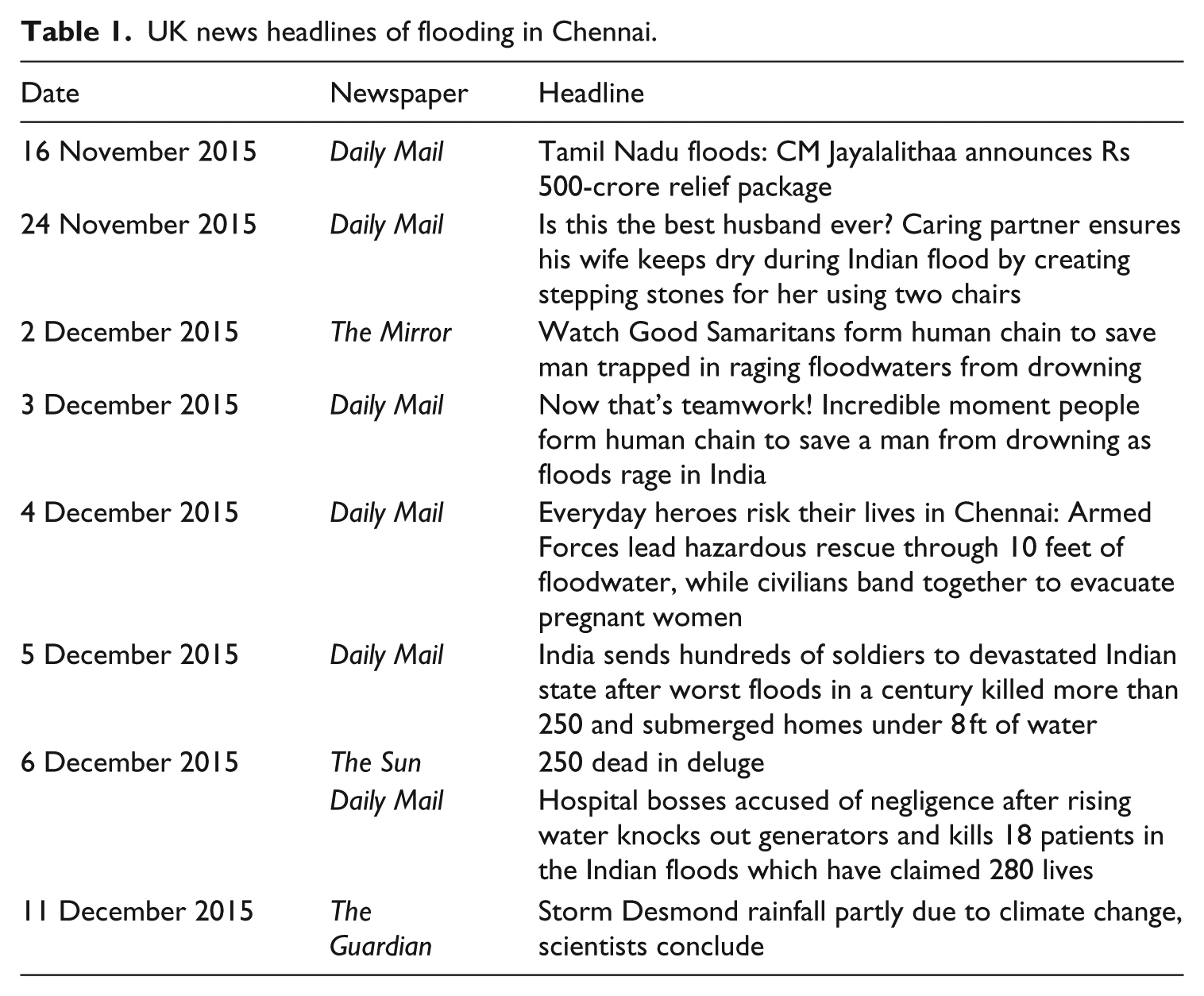
Although the headlines were dramatic, there was limited information about individual victims. Examples include ‘Tamil Nadu floods: CM Jayalalithaa announces Rs 500-crore relief package’ (Daily Mail, 16 November 2015), ‘India sends hundreds of soldiers to devastated Indian state after worst floods in a century killed more than 250 and submerged homes under 8 ft of water’ (Daily Mail, 5 December 2015) and ‘250 dead in deluge’ (The Sun, 6 December 2015).
One news item did include additional detail concerning the individuals affected: ‘Hospital bosses accused of negligence after rising water knocks out generators and kills 18 patients in the Indian floods which have claimed 280 lives’ (Daily Mail, 6 December 2015). We discuss this report in greater detail below.
Overall, though, the actors and processes described in the Chennai tabloid headlines suggested that UK readers were spectators of distant events that appeared to reference popular cinema and television drama with vivid imagery that described heroes, becoming trapped in raging floodwaters, a human chain and soldiers threatened by snakes and scorpions.
This contrasted sharply with the coverage of the Northern England floods (see Table 2). Here, the headlines framed events in familiar terms for readers, with references to local sights being destroyed and upheaval caused to everyday life. For example, ‘Clothes shop that ended up waist-deep and the garden that went downstream’ (Daily Mail, 28 December 2015), ‘Day York’s streets turned in to rivers’ (Daily Mail, 28 December 2015), ‘First flooded, then looted, and there’s more misery to come’ (The Times, 30 December 2015) and ‘My first Christmas with son is ruined’ (The Mirror, 28 December 2015).
UK news headlines of flooding in Northern England.
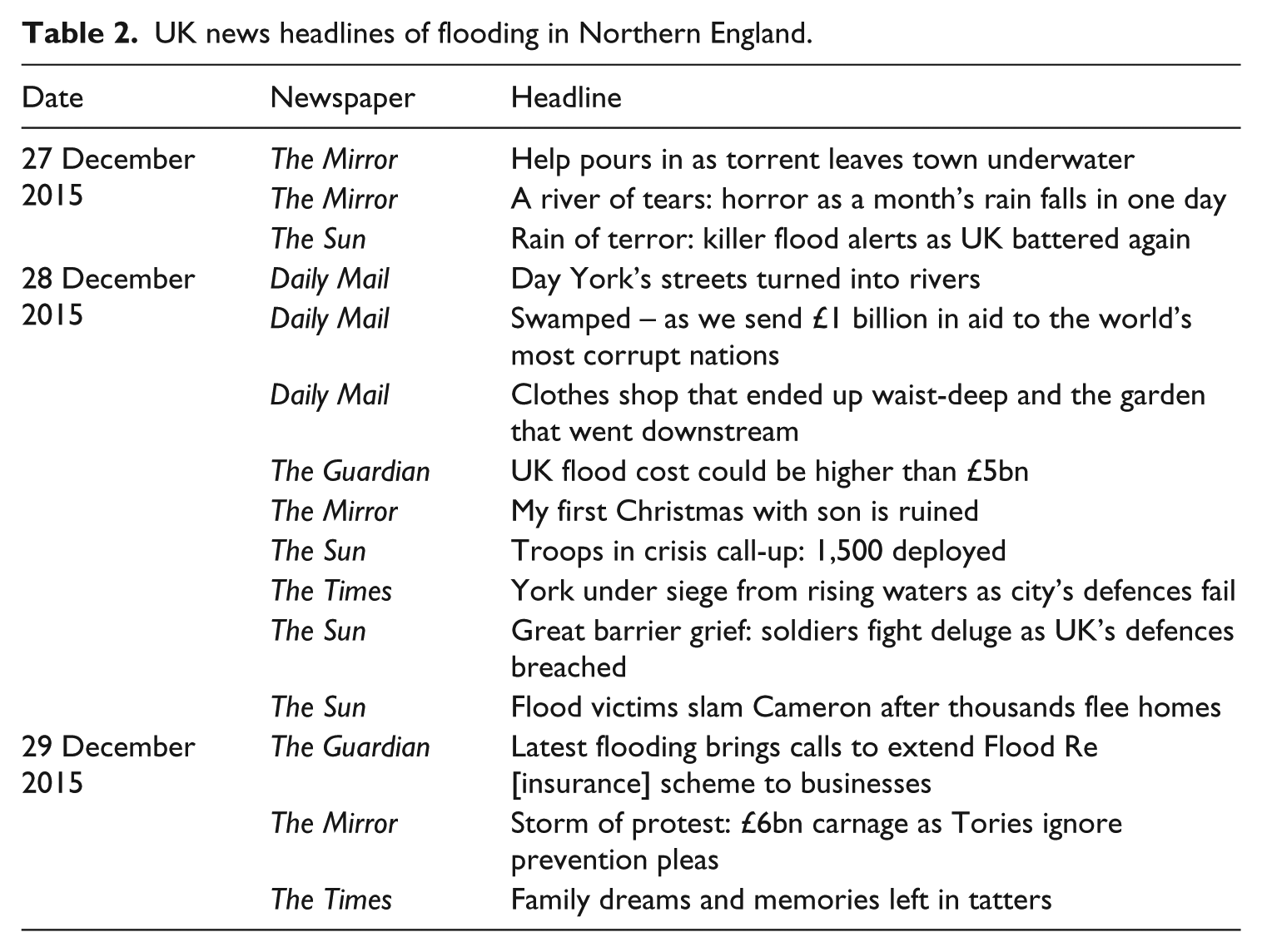
Political ideologies were also evident in the way in which stories were framed. In its article headlined ‘Swamped – as we send £1 billion in aid to the world’s most corrupt nations’ (28 December 2015), the Daily Mail used references to spending on overseas aid to imply that the flooding was somehow connected or even the result of government decisions to fund relief efforts in the developing world. This discourse was emphasised further in its article ‘Put suffering Britons first, PM’ (Daily Mail, 29 December 2015). As Escobar and Demeritt (2014) show, flooding has become increasingly politicised and news coverage in the United Kingdom considers questions of blame and responsibility.
The Sun, The Mirror and the Daily Mail attempted to direct blame for the flooding on government decisions and individuals. Examples include ‘Storm of protest: £6bn carnage as Tories ignore prevention pleas’ (The Mirror, 29 December 2015), ‘Soaking up the sun while Britain drowns’ (Daily Mail, 30 December, 2015) and ‘Flood victims slam Cameron after thousand flee homes’ (The Sun, 28 December 2015). The Sun’s ‘Troops in crisis call-up: 1,500 deployed’ (28 December 2015) and ‘Great barrier grief: soldiers fight deluge as UK’s defences breached’ (28 December 2015) also revealed the paper’s positive stance about the UK military and use of trademark puns.
The Guardian article, ‘Syrian refugees fight against floods in Rochdale’ (30 December 2015), framed the story quite differently, possibly to highlight the positive integration with the local community and solidarity with the flood victims. Thus, despite being labelled as ‘refugees’, this story served to reinforce the Syrians’ position as ‘some of us’ rather than as Others.
Focus on individuals and familiar experiences
We also identified distinct differences in how individuals and their experiences were presented, finding striking variations in approach. Coverage of the Northern England flood made extensive use of personal stories to reinforce that those people affected were ‘like us’; the Chennai coverage, on the other hand, made far less use of such details.
Headlines from The Times and The Guardian included extensive personalisation and detail. For example, ‘Floods ruined our business – we now need to rebuild it from scratch’ (The Guardian, 30 December 2015), ‘Garden dinghy dug out of retirement to save pensioner’ (The Times, 29 December 2015) and ‘Family dreams and memories left in tatters’ (The Times, 29 December 2015). Our more detailed analysis of The Times and The Guardian news reports also revealed the papers’ use of clearly described characters, including names, ages and job titles, to suggest a connection between victims and readers: for example, Harry Stephenson, resident of a ‘forgotten’ village in Northern England, and Mark Taylor, a 33 year-old engineer, and his partner Lisa Holdsworth, a 28 year-old nursery nurse (The Times, 29 December 2015). The Sun reported on the Northern England floods as a story of disruption, creating disorder to familiar routines – for example, motorists facing ‘nightmare’ queues, towns cut off and homes without power. The approach seemed designed to help readers identify with the victims – an effect that Yell (2012) characterises as inviting readers to feel ‘with’ them rather than ‘for’ them.
Clearly, proximity to the Northern England floods would have made it easier for UK-based journalists to include personal details. Yet there appeared to be no attempt to include personalisation in the coverage of Chennai, where victims were consistently depicted in an impersonal manner, mostly as distant, nameless groups. 3 Overall, there was little attempt to make the reader feel a connection with the plight of Chennai victims. Indeed, the newspapers’ use of amateur video footage as a basis of stories from Chennai added to the sense that the identity of the victims was less important than the drama of the situation, which seemed to be presented as a form of entertainment. As an extension to this, the Daily Mail story anchored around amateur footage of a human chain of people rescuing victims from the floodwaters might also symbolise the more general ‘hollowing out’ of news organisations and reflect online newspapers’ increasing reliance on ‘clickbait’ stories with dramatic footage.
Certainly, one explanation for this difference in approach to the victims in Northern England as compared with Chennai could be the source of the stories. As Sambrook (2010) notes, Western news organisations have cut the number of overseas-based correspondents in recent years in the face of economic pressures. The result is that large numbers of foreign stories in UK newspapers are now drawn from wire services. Yet the decision to cut foreign correspondents can be seen to provide further evidence of a Western-dominated media bias towards its own nationals and interests. Furthermore, the spread of digital mobile communications and social media has made sourcing stories from remote locations much easier in recent years. Arguably, the decision to concentrate more on flood victims in Northern England could thus stem more from a conscious editorial policy rather than simply reporting limitations.
The discourse of the Northern England flood coverage was one of identifying with the personal struggles of the victims, coupled with a sense of incredulity that people in the United Kingdom should face such inconvenience and suffering. This theme was absent entirely from the Chennai coverage, which seemed to portray developing-world victims as less important Others, emphasising the drama of their situation rather than their personal stories and identities.
Normalising versus sensationalising disaster
The reporting of events in Chennai and Northern England was in stark contrast, and the writing style of the articles showed clear differences in the use of emotion and drama to convey a sense of pace to the story.
Among the reports about the Chennai flood there was evidence of what might be termed the vocabulary of developing-world stereotypes. The Daily Mail (6 December 2015), for example, referred to thousands of people ‘living in state-run relief camps’ and suggested the government had shown signs of incompetence (opening reservoirs without warning) and even dishonesty (releasing a ‘doctored’ photograph purporting to show the prime minister inspecting flood damage).
The reporting lacked the sense of incredulity or outrage that was present in stories concerning Northern England. For example, the Daily Mail story reported that 18 people had died in hospital when floodwaters cut the power to ventilators. But the paper made no attempt to identify the victims, even by age or sex, or present them as individuals. Rather, it presented them simply as a statistic to support a discourse about government failures. Having established the number of deaths, the story moved on to the broader context, reporting criticisms of the chief minister, transport disruption and concerns about the spread of disease. The overall impression was that the deaths and property damage were to be expected. This was reinforced by a paragraph suggesting that the events were almost ‘routine’, given that heavy rainfall occurred every year in Chennai between October and December.
Taken together with the headlines, the newspapers’ coverage of the Northern England flood also emphasised a desire to find the cause of the disaster and even to apportion blame for the plight of the victims. As discussed above, the Daily Mail went so far as to try to link the government’s decision to protect the development aid budget at Department for International Development with cutting budgets for flood defence in England. 4
The urgency to find a cause and thus to look at solutions remained largely absent from the coverage of the Chennai floods.
This lack of detail about those who were affected in terms of survivors and the impact on their lives becomes more striking if we consider how emotion was mobilised within reporting. The Chennai reports were characterised by emotional neutrality. Both the Daily Mail and The Mirror reported the events in Chennai with an air of detachment, inviting the readers to remain distant observers to dramatic acts, including ‘rescuers forming a human chain’ (The Mirror, 2 December 2015) and ‘tens of thousands of people forced out of their homes’ (Daily Mail, 6 December 2015).
This contrasted with reporting on the Northern England floods, with all newspapers, including The Guardian and The Times, drawing extensively on emotive imagery and language to report the suffering of victims. Northern England victims were described as being ‘in tears’, and the feelings of residents were explored and underlined by highlighting loss:
The kids had been so excited, we all had. We’ve lost everything we’ve been working for and towards. (The Times, 29 December 2015)
The Times article was typical of the highly personalised approach taken by the UK press to the Northern England flood. The piece included vivid accounts of individual experiences that were highly emotional in content, with detailed presentations of flood victims, their property and possessions serving to make connections between those affected and the newspaper readership.
It is important to acknowledge that these articles exemplify what Pantti et al. (2012) refer to as ‘journalistic witnessing’ that provides ‘an injunction to care’. Advocates of emotional reporting argue that, at its best, this form of journalism paints a vivid picture and invites media consumers to understand the plight of the victims. It is frequently used in natural disaster reporting and clearly evident in the Northern England reports. Yet our analysis reveals that this was notably absent from the newspaper texts about the Chennai flood which lacked similar empathy.
Reporting of Chennai tended to be descriptive, and the sense of emotional neutrality discussed above underlined that point. However, reports concerning the Northern England floods were more opinionated, even to the extent of making compromises that may have affected the overall accuracy of the information presented. For example, a news story in The Guardian, ‘Business people call for flood reinsurance scheme after flood damage in Northern England’ (29 December 2015), lacked balance and was hugely sympathetic to those demanding that the UK Flood Re insurance fund be extended to cover businesses. It is worth examining this article in greater detail.
First, analysing the actors in the story, of the seven individuals or organisations quoted, five supported the idea of extending the Flood Re scheme and one (accountancy firm KPMG) was neutral, simply offering an expert context to the issue of flood insurance. The only dissenting voice was ‘a spokesman’ for the Association of British Insurers. This emphasis on opinion from one side of the argument seemed to suggest that The Guardian was convinced that the Flood Re scheme should be extended. The newspaper’s omission of the name and title of the ABI spokesman added to the sense that the organisation’s opinion was being discredited, especially as the descriptions of the other actors quoted were far more detailed, implying credibility and transparency.
The Guardian article also included unsubstantiated statements emphasising the cost to local businesses, including quotations for insurance (prohibitively expensive) and promoting the Flood Re scheme as offering ‘affordable cover’. This reflects the increasingly politicised context of flooding and insurance, which was noted by Escobar and Demeritt (2014) who saw the volume and frequency of insurance-related stories increase significantly after the autumn 2000 floods resulted in £1.2 billion in insured losses. The insurance industry challenged the terms of the Gentleman’s Agreement under which it was underwriting these risks as unlike other European countries, governments in the United Kingdom are not involved in directly compensating for flood disaster victims, but rather this is left to commercial insurance.
The Times’ writing style, meanwhile, echoed tropes identified in studies of coverage of Hurricane Katrina – that natural disasters lead to social breakdown. The headline ‘First flooded then looted, and there’s more misery to come’ (30 December 2015) was striking. Indeed, it is not clear that there was evidence of looting in the wake of the Northern England floods, and other media reports did not identify it as a widespread problem. Similarly, the headline in The Sun ‘Rain of terror: killer flood alerts as UK battered again’ (27 December 2015) also emphasised drama over accuracy particularly as no lives were lost in this case.
Conclusion
We examined the coverage of the Northern England and Chennai floods of 2015 in five UK newspapers to address crucial questions concerning the nature of media coverage of disasters in developed and developing countries. Using CDA, we investigated whether such reports represented a discourse in which the Western flood and Western victims were presented differently in comparison with people living in South Asia. Although work has been conducted on the nature and content of natural disaster reporting, to our knowledge this was the first study to use CDA to compare UK newspaper reports about flooding in the United Kingdom and overseas.
Our research revealed a striking imbalance in the volume of coverage devoted to the two floods, with considerably more reports devoted to the Northern England flood even though the Chennai flood was more severe and resulted in greater loss of life. The Northern England disaster was described in terms that brought the experiences of those affected victims close to the reader, using emotional and vivid reporting and providing personal information about individuals. Reports concerning Chennai adopted a more detached and dispassionate approach, with victims portrayed as distant, their lives and experiences viewed as remote and as having little in common with readers.
To a certain extent, the disparity between the reporting of the Northern England and Chennai floods may appear unsurprising given the proximity of Northern England to UK journalists and UK news organisations. However, there are clearly opportunities provided by the digital revolution to source personal and detailed accounts of disasters from even the most remote of locations using social media.
Our findings support other studies (e.g. Lee et al., 2000; Pantti et al., 2012) that have identified the ways in which news organisations are biased towards covering domestic disasters and/or events that affect people from their home nations. We also found evidence that developing world disasters and victims are often described by the media in terms that treated victims as Others who are culturally distant (see also CARMA International, 2006; Joye, 2009; Moeller, 2006).
Such issues raise important questions about embedded inequality and racism in the media and have significant implications for governments and policymakers. Debates about immigration and migration are a key political battleground across many parts of the world (Balch and Balabanova, 2016), and there is a strong argument that media coverage of immigration, asylum seekers and refugees promotes Western mistrust of people from the developing world (Philo et al., 2013).
We believe the way in which the media report victims of floods and other natural disasters in non-Western countries does little to dispel this mistrust. Government attempts to tackle racism and religious and cultural intolerance can only be undermined further if media continue to portray disaster victims in the developing world as less important than those in the West.
One limitation of our research methodology is the inability to shed light on the underlying intentions of media organisations and owners in the news decision-making process. The image of the media mogul, with the power and inclination to push a personal political agenda, remains dominant in the media sector. However, whatever discursive trends can be revealed by CDA, the methodology cannot establish whether these stem from the conscious policies of media owner or senior executives, or whether they can be attributed to tacit journalistic practices and traditions that are ‘taken for granted’.
Indeed, there is considerable scope for further research into whether disaster victims’ access to the media is shaped by demographics and media production processes. For example, there is evidence in the United Kingdom that social class is linked to both flood awareness and the ability to cope with flood events (Fielding, 2012). In our research, coverage of the Northern England floods appeared to concentrate on middle-class victims and owners of small businesses, suggesting there may be variations in coverage that are socially and racially patterned.
There is also evidence that production processes and gendered perceptions of social norms mean that broadcasters feature men significantly more often than women as expert guests on television and radio news programmes (Howell and Singer, 2016). Is a similar bias reflected in those who are selected for interview as victims of natural disaster? To what extent is flood coverage gendered?
There is much scope for further study of disaster coverage in different types of media. Our research focused on UK newspapers, but further work is needed to uncover how reporting by digital news channels and user-generated content affects our perceptions of floods and other natural disasters. Indeed, news organisations now rely heavily on social media as sources of information for disaster stories (Cooper, 2011). There is also growing evidence that online news organisations are using data analytics in the news judgement process to help decide which stories to include and follow-up (Welbers et al., 2016). We believe it is vital to investigate the broader impact of these developments and processes.
Footnotes
Funding
The author(s) received no financial support for the research, authorship and/or publication of this article.
