




Abstract
This study investigates to what extent audiovisual infotainment features can be found in the narrative structure of television news in three European countries. Content analysis included a sample of 639 news reports aired in the first 3 weeks of September 2013, in six prime-time TV news broadcasts of Ireland, Spain, and the Netherlands. It was found that Spain and Ireland included more technical features of infotainment in television news compared to the Netherlands. Also, the use of infotainment techniques is more often present in commercial, than in public broadcasting. Finally, the findings indicate no clear pattern of the use of infotainment techniques across news topics as coded in this study.
Introduction
Due to transformations in the media landscape, patterns of news content production have undergone significant changes during the past decades. The commercialization of news and strong economic pressures to generate profits are regarded as key factors in pushing television news broadcasters to infotainment news formatting (Patterson, 2000). Several authors have defined infotainment formats as audiovisual techniques and production styles that emphasize dramatic structures, personalization, and human-interest approaches in television news stories. Examples of such techniques are eye-catching visuals, camera shots, movements and transitions, music background, montage techniques, and so on (Graber, 1994; Schudson, 2003; Vettehen et al., 2011). Because the main goal of infotainment consists of making news and politics engaging and emotionally rich (Thussu, 2007), this form of news presentation has become a successful way to increase public attachment to news coverage (Hamilton, 2004; Nguyen, 2012).
Although infotainment has often been referred to as a synonym of soft news, its hybrid style is not confined to deal with a closed list of topics. A number of scholars have emphasized that the mode of presentation of the news is also decisive in regard to what can be seen as infotainment (Grabe et al., 2001; Graber, 1994; Thussu, 2007). Drawing on this framework, this study will move beyond the topic dimension by focusing on the aspects concerning the visual stylistic devices and audiovisual editing techniques. It analyses the presence of infotainment in hard news and soft news stories and examines to what extent infotainment news formatting has taken place in the construction of social, economic, political, and cultural reality in European television news.
Previous research has shown that television broadcasters experienced a gradual increase in the development of infotainment formats in the narrative of television news stories of both American and European countries (Gonzalo et al., 2014; Grabe et al., 2001, 2003; Graber, 1994; Prior, 2003; Vettehen et al., 2011). An important predictor for this increase can be found in media commercialization. Specifically, in Europe, the majority of studies have addressed infotainment from a marketing perspective by asserting that media commercialization makes a difference in infotainment news content and formatting on different television stations (Gonzalo et al., 2014). Although results show that the effects of media commercialization for the European television market can still be seen in the amount of infotainment news employed by both public and private channels (Vettehen et al., 2011), the evidence for this relationship is insufficient. The current study adds to a more general understanding of the penetration of infotainment in the production of TV news across Europe by examining the influences of market forces and media policy changes on the degree to which current European TV news is relying on stylistic elements of infotainment to narrate news topics. More specifically, this study will focus on the television news market in the Netherlands, Spain, and Ireland; three European countries that present similarities regarding the economic structures of the media market for private television channels, but differences when it comes to government policies regulating public media broadcasting services in the three countries.
Conceptualization, origins, and operationalization of infotainment
The term infotainment refers to the merging of current affairs, news, and entertainment programming, and reflects modern trends in journalism (Thussu, 2007). In television news, infotainment is characterized by the use of several dramatic structures, such as conflicts, personalization, interpersonal interactions, and a variety of audiovisual effects to enhance emotions in the story (Baym, 2005; Brants, 1998; Graber, 1994). Studies of infotainment point out that consensus cannot be reached regarding the conceptualization and origins of the term (García Avilés, 2007; Stark, 1997). Some authors argue that infotainment dates back to 1960s and 1970s in the local news broadcasts of the United States (Gonzalo et al., 2014; Stark, 1997). Elements of narrative structures characteristic of fictional genres were adapted and used in local news programs as a new commercial strategy to attract the audience and later on, it spread across American national TV channels (Gonzalo et al., 2014).
Yet, interestingly, some scholars provide evidence to support the claim that infotainment has actually emerged between the late 1980s and early 1990s, when the phenomenon was largely spread in Western television channels (Prado, 2007; Vettehen et al., 2011). They note that the increasing popularity of commercial broadcasts against public networks explains the emanation of infotainment. In fact, one of the main reasons for the blurring of fact and fiction, news and drama, popular culture and reality, is rooted in the proliferation of cable channels and Internet sites that led to long-term transformations of the business and production models operated by news organizations (Bennett, 2005). Also, a shift in journalism standards towards the construction of dramatic sociopolitical scenarios is another intermediate factor that reinforces the use of infotainment in the narrative of the news (Altheide, 2004; Bennett, 2005). Bennett (2005) points out that the presentation of TV news stories to viewers offers similar characteristics of emotionally compelling narratives, such as television series and soap operas.
As a consequence, this topic has raised concerns about the quality of news media both in public and academic spheres, arguing that infotainment trivializes news and current affairs resulting in serious implications for factual political knowledge and opinion forming (Baum, 2003; Moy et al., 2005). Infotainment has often been connected to pejorative terms, such as tabloidization and sensationalism (Baym, 2005; Grabe et al., 2001; Schudson, 2003), contributing to a decrease in political knowledge conveyed by the media. The problem allegedly is that infotainment in television news complies with narratives that banalize even the most serious subjects by promoting entertaining televisual spectacles and dramatic storylines (Altheide, 2004; Graber, 1994).
From this viewpoint, infotainment news has negative effects on how viewers process the news. However, a number of studies have demonstrated that infotainment news characteristics have some beneficial effects on message comprehension and recall, given the potential of its features to convey narrative patterns that evoke high levels of emotions among viewers (Vettehen et al., 2011). Früh and Wirth (as cited in Machill et al., 2007) have analyzed the effects of various degrees of infotainment on the retention of television contents. The authors argue that the moderate use of certain infotainment features, such as cut frequency, camera movement, movement of objects, use of music background and special effects, results in the perception of quality information and the increase of retention performances. Instead, the negative use of these elements affects the perceived quality of information leading to a decrease in retention levels. For instance, a combination of multiple infotainment characteristics may lead to poor outcomes in terms of recall performance among viewers (Grabe et al., 2003; Lang et al., 2000).
It is not, however, difficult to foresee that the increasing penetration of technical infotainment features in the narrative of the news plays a crucial role in shaping the implications of the phenomenon for audience processing of public information, as well as for democratic discourses. Recently, scholars have devoted greater attention to empirical analysis of formal features of television news, arguing that a focus on topics/events is insufficient to assess narrative patterns that influence the way infotainment is actually framed in the news (Grabe et al., 2001, 2003; Machill et al., 2007).
Narrative structure of television infotainment news
The structure of audiovisual narration in television infotainment news consists of organizing and articulating the various technical elements and editing techniques that provoke sensory and emotional reactions among viewers. Various audiovisual techniques defining infotainment news have been explored in studies conducted in both American and European TV news programs (Djerf-Pierre, 2000; Gonzalo et al., 2014; Grabe et al., 2003; Machill et al., 2007; Vettehen et al., 2011). These include the use and frequency of close-ups, camera movements, frequency of camera shots and transitions, post-production techniques, and audio manipulations. This study examines the various formal production feature categories that are characteristics of infotainment, but also to integrate new structural techniques deriving from fictional narratives that actually have the potential to include infotainment in the story. This section presents the first conceptual phase of the research by providing a detailed description of the audiovisual features used to identify the presence of infotainment in our sample. In this study, the audiovisual narrative techniques fall into six categories (see Table 1 for an overview).
Overview of the narrative features.
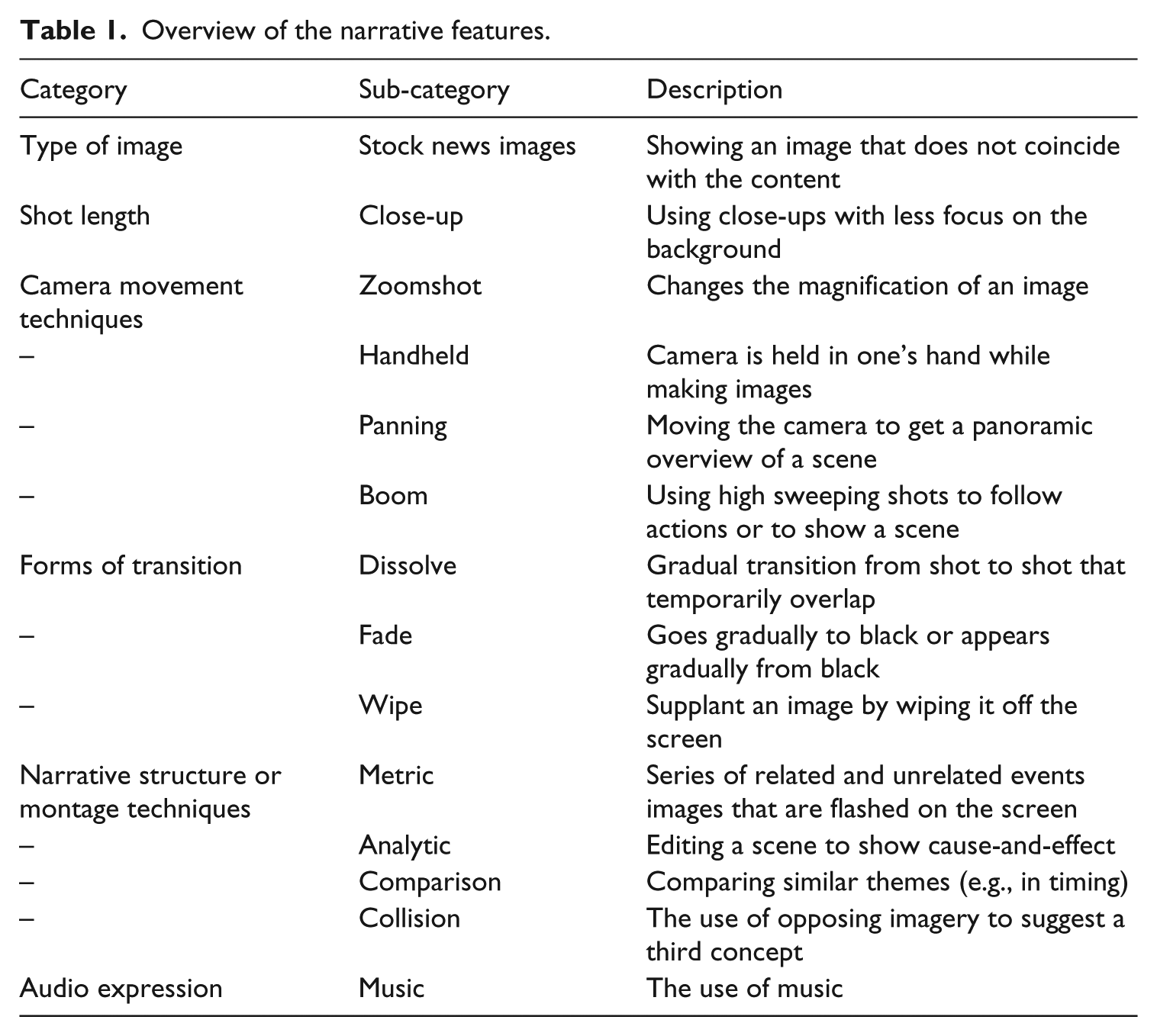
The type of image category refers to the organization of infotainment news according to its visual expression. In this study, this category concerns the use of stock news images where the image does not coincide with the content (Brosius, 1993). This genre often favors a choice of visuals that impacts viewers and promotes the spectacle of news and the integration of dramatic elements in the production of television news (Lester and Cottle, 2009). The shot length category refers to the use of close-ups. This shows very little background, and concentrates on either a face, or a specific detail of mise-en-scène.
The third audiovisual narrative category refers to camera movement techniques. They have the potential to generate greater emotional involvement when exploring techniques that feature more movement. In this study, there are four basic techniques that are often used to engage audiences: zoomshots, handheld, panning, boom (Gonzalo et al., 2014: 90). Zoom lens contains a mechanism that changes the magnification of an image and gives the impression of movement and excitement in a scene where it does not exist. As to content analyses, Grabe et al. (2001: 641) analyzed the presence of zoom camera lenses in US TV newsmagazines. The results show that a ‘generous use of zoom movements indicates a sensational production style’ (Grabe et al., 2001: 647). In what refers to handheld camera movements, they can make the audience feel as if they are part of a scene, rather than viewing it from a detached, frozen position. Because handheld camera is used to heighten tension and give realism to events, this technique is included as a potentially infotainment feature. Panning is another structural feature that gives the shot a feeling of movement and speed. It is used to give the viewer a panoramic view of a set. This can be used to establish a scene. Aerial drones give a bird’s eye view (boom). This works and looks similar to a construction crane. It is used for high sweeping shots or to follow the action of a subject (García Jiménez, 2003).
The forms of transition category illustrate the relationship between shots and how they work together to form narrative meanings. Transition forms are editing techniques used to escalate the visual sequence with the purpose to draw and hold the viewer’s attention to the issues (Zettl, 2006). These types of visual resources can improve viewer’s understanding and increase emotions as they provide more visually attractive news stories that can enhance news consumer engagement (Baym, 2005; Grabe et al., 2001; Schaefer, 2001). Schudson (2003) warned that the increasing production of news that focuses on sensationalism can limit the quality of journalism, and therefore, the ability of the public to make informed social and political decisions. Zaller (2003) counters this claim by calling for a change in new standards for news quality. Zaller argues that the use of entertaining editing techniques and ‘engaging displays’ in news items helps focus the public’s attention on important issues. Based on Grabe et al. (2001), this study identifies three stylized transitions that are often present in infotainment news packages: dissolves, fades, and wipes. The image dissolves’ technique features a gradual transition from shot to shot in which the two images temporarily overlap (Smith, 1991; Zettl, 2006). In the case of ‘fades’ or ‘dips’, the picture either goes gradually to black (fade-out) or appears gradually on the screen from black (fade-in), signifying, much like a theater curtain, a definite beginning or end of sequence (Zettl, 2006). Wipe appears to supplant an image by wiping it off the screen (Smith, 1991; Zettl, 2006); it is a technique that draws attention to itself and acts as a clear marker of change.
The montage editing category is defined as a series of processes that impose into the package the news worker’s interpretation of the event (Zettl, 1999: 292). Infotainment narratives tend to explore more editing styles in news production. Zettl (1999) indicates four main types of montage techniques in news package. First is the (1) metric montage, which according to Zettl (1999) features a series of related and unrelated events images that are flashed on the screen at more or less equally spaced intervals; the scene is viewed as occurring faster. The fast cutting of images is used to convey higher tension and it is adapted to the rhythm of the music, emulating the style of video clip; (2) analytical montage means editing a scene to show cause-and-effect; this technique usually promotes engagement and learning by requiring the viewer to fill in the blanks; (3) comparison montage compares similar themes as expressed in dissimilar events; this technique depicts a conflict or similarity between two subjects by presenting two points in time within one sequence; (4) collision montage uses opposing imagery to suggest a third concept. In his longitudinal study, Schaefer (2001) has identified an increase over the past three decades in the number of montage editing techniques in television news. His study assumes that hard news – often associated with the use of more realistic/dry accounts featured by low levels of montage techniques – are developing narrative modes that further explore infotainment resources and put more emphasis on dramatic elements (conflict, emotion, and personalization).
Finally, the audio expression category was defined by the use of music in news items. It is a crucial technical component in the articulation of infotainment and part of the editing process. Studies show that music contributes to give rise to emotions, drama, and humor experienced by viewers (Seidman, 1981). Grabe et al. (2001) and Vettehen et al. (2011) have also measured the frequency and duration of music occurrences in their studies.
The television news market in the Netherlands, Spain, and Ireland
In the early 1990s, the liberalization and deregulation of the media in most European countries had opened the doors for unprecedented competition between public television broadcasters and the newly arrived domestic and foreign commercial rivals with their popular and entertaining programming (García Avilés, 2007). In what concerns the Dutch case, the year of 1989 was marked by the end of the monopoly of public service broadcasting with the rise of commercial broadcasts (Vettehen et al., 2011: 100). RTL Nieuws was the first TV news program to compete with NOS Journaal, covering both domestic and international news. In 1990, three commercial broadcast channels were launched in Spain: Tele-5, Antena 3, and Canal Plus. As a result, the public broadcaster RTVE (Radiotelevisión Española) experienced a decline in audience numbers (Medina and Ojer, 2010). The Irish broadcasting landscape also experienced dynamic changes over the past years. National competition in television news market has been attributed to national economic growth, with the launch of TV3 in 1998, which is privately owned by a British private-equity group (Rafter et al., 2014). Until then, the public broadcast channel RTÉ had the full benefit of the available domestic advertising and its audience competition was limited to the UK services (i.e. BBC, UTV/ITV, and Channel 4).
As a result of the multiplication of the number of TV broadcasting stations in the three countries, public broadcasting services started responding more and more to production patterns that clash with the public mission to serve democratic values and increase citizen knowledge about public affairs (Blumler, 1992). The intense competition for time and attention of audiences has gradually led public broadcasters to provide new formats and reporting styles featuring infotainment characteristics that were most commonly used in the new private channels (Hamilton, 2004).
More recently, the studies of Vettehen et al. (2011) and Gonzalo et al. (2014) have examined the penetration of audiovisual infotainment features in public and commercial television news broadcasts in the Netherlands and Spain, respectively. Their research indicates that the level of infotainment features have increased in Dutch and Spanish television news and that existing programs, such as the case of public TV news programs, have reacted to new programs by increasing the amount of infotainment in their news stories. Since 2012, the Dutch public broadcaster NOS has launched a new format for the NOS Journaal, which prioritizes stories that are relevant to viewers in detriment of the significance of facts (Gelauff, 2012). In the actual Spain’s media landscape, infotainment has been consolidated in mainstream television channels with slight differences across public and private networks (Gonzalo et al., 2014). Studies on the tabloidization of the Irish media show two factors that can explain the demand for ‘tabloidization’ in the Irish media sphere (Barrett, 2000). The first concerns the influence of British newspapers on the style of the Irish press. The close relationship between Ireland and the United Kingdom ensures that many Irish people were regularly reading British newspapers (Barrett, 2000). The second refers to the competitive Irish newspaper sphere, with the increase of the number of news media in the country. In this regard, it is important to mention that the majority of households had easy access to UK and other international channels, contributing to a highly competitive television market for domestic stations (Rafter et al., 2014).
Consequently, the penetration of infotainment is the result of increasing market pressures and can impact differently on varying media markets (Esser, 1999). In this sense, the political context is an important predictor of media dependence on economic forces. As Strömbäck (2008) puts it, ‘the political system sets the institutional and regulatory boundaries for the markets within which the media are required to operate’ (p. 241). Increasing independence from politics is thus strongly correlated with an increase in media commercialization. In Spain, both public and private broadcasting no longer operate under the same political and economic models, which might influence the production of news. Since 2009, public media organizations in Spain do not convey advertising contents, and, as a consequence, these do not constitute one of its sources of funding (Medina and Ojer, 2010). To some extent, different broadcast ownership in the Netherlands and Ireland fall under the same economic and political regulations (Rafter et al., 2014; Vettehen et al., 2011). Overall, public and commercial broadcasts in both countries became more dependent on market funds, whereas in Spain, broadcast ownership fairs equally in terms of public and private funding (public broadcasting services depend on the State while commercial stations depend on the market). So, in sum, it could be suggested that differences across countries can also be explained by policy changes in public broadcast services of the three nations. The first research hypothesis follows from this:
H1. Irish and Dutch television news broadcasts will use more audiovisual infotainment features compared to Spanish television news programs.
As noted above, the new conditions imposed by the market in the search for the highest audience ratings determine the new situation with television channels in the three comparative nations. From the 1990s onwards, the time devoted to advertising has increased considerably (Prado, 2007; Vettehen et al., 2011). Increased revenues and economic growth for both private and public television have taken place in the Netherlands and Ireland. The funding of public broadcast services in both countries has been provided by both commercial and public sources, while commercial television channels depended heavily on advertising and sponsoring. 1 After the elimination of advertising as a source of revenue for public media corporations in Spain, competition for the marketing share has increased among commercial broadcasting services (Medina and Ojer, 2010). Given this background, private broadcasts in the three countries may be more vulnerable to infotainment. This leads to the second research hypothesis:
H2. Commercial news broadcasts will use more audiovisual infotainment techniques in their stories than public news broadcasts.
Typically, the formal characteristics of infotainment news are more likely to be found in the structure of soft news than that of hard news stories. The latter is characterized by the use of a more formal structure, while soft news features storytelling forms and editing techniques to hook viewers, and to reel them in (Graber, 1994). In this light, it is argued that the narrative found in ‘soft news’ resembles the characteristics defining infotainment (Patterson, 2000). This study does not aim to quantify the thematic selection of infotainment in television news programs of the three countries, but the extent to which formal infotainment features are present in the narrative form of hard news and soft news. In other words, this study examines whether a better fit exists between soft news topics and infotainments features compared to hard news topics and infotainments features. The third research hypothesis follows from this:
H3. The use of audiovisual narrative features in soft news is greater than in hard news topics.
Method
Design and sampling method
Our content analysis included a sample of 639 news reports aired in the first 3 weeks of September 2013, in six prime-time TV news broadcasts of Ireland, Spain, and the Netherlands, one public and one commercial TV news broadcast in each country. Our selection of public broadcasting channels included Nine o’clock news (Ireland), Telediario 2 (Spain), and NOS Journaal (Netherlands). On the side of commercial TV news, we analyzed TV3 News (Ireland), Noticias 2 (Spain), and RTL Nieuws (Netherlands). Because our analysis is concerned with the presence of infotainment elements rather than focused on a specific topic or period, three full weeks of analysis of each news outlet were used to answer our research questions and test the hypotheses proposed. No major event occurred in the period of analysis, such as elections, holidays, or important sports events that could potentially affect the study results.
News reports were selected as unit of analysis due to the high visibility of technical components in this type of format. For being a self-contained story, a news report format facilitates the operation of infotainment narratives and the description of their constituent elements. Beyond this, the selection of the news report content and format as unit of analysis is chosen for being directly related to television news production in the framework of the so-called News Industry (Pew Research Center’s Journalism Project, 2014). In this sense, news report is one of the media products that need to provide information in a manner that is profitable and in compliance with the needs of shareholders and viewers.
The coders were trained and supervised during a week of coding meetings at the University of Amsterdam. Intercoder reliability was calculated based on a subsample of 14 and 15 − in two coder sessions – TV news items using pairwise percentage agreement. We found that this was continually above 64.4 percent and thus indicated that the measurements were reliable.
Measurements
In order to examine the narrative elements characterizing infotainment in the news items from the six television news programs, this article has focused on the narrative structural variables that indicate the use of infotainment in the piece. We take into account the topics of a given news item as well as its format and audiovisual narrative elements.
Independent variables
The variable type of news broadcasts was defined as public and commercial television news programs, including one type of news outlet per country (0 = ‘public’ and 1 = ‘commercial’, M = 0.43, standard deviation (SD) = 0.50). This code allowed for the assessment of possible differences regarding the use of infotainment in countries that have a public as well as commercial broadcasting. The variable country was a nominal variable (1 = ‘Spain’, 32.8%; 2 = ‘Ireland’, 34.9%; 3 = ‘The Netherlands’, 32.3%). The thematic selection of infotainment is often linked with issues that are most likely to impact viewers and increase visual spectacle (Stark, 1997). Our study is concerned with assessing the treatment of infotainment in both hard news and soft news topics. Most studies tend to classify hard news as news that contains information on public policy while soft news is often connected to news that are ‘more sensational, personality-centered, less time-bound and more incident based than other news’ (Patterson, 2000: 4). For hard and soft news topics, we use eight different news sections conveyed in our TV news sample. Hard news topics include categories of ‘foreign news’ (32.1%), ‘business/economic news’ (13.0%), and ‘politics’ (17.1%). The category of foreign news consists of news on politics and economy of foreign countries. Soft news topics include ‘society/culture/arts’ (15.6%), ‘accidents/catastrophes/crime’ (15.2%), ‘war news/protests’ (1.1%), ‘Sports’ (5.5%), and ‘Weather’ (0.5%). Table 2 presents the number of news stories of the six TV news programs during the period analyzed.
Number of news stories by country and broadcasting type.
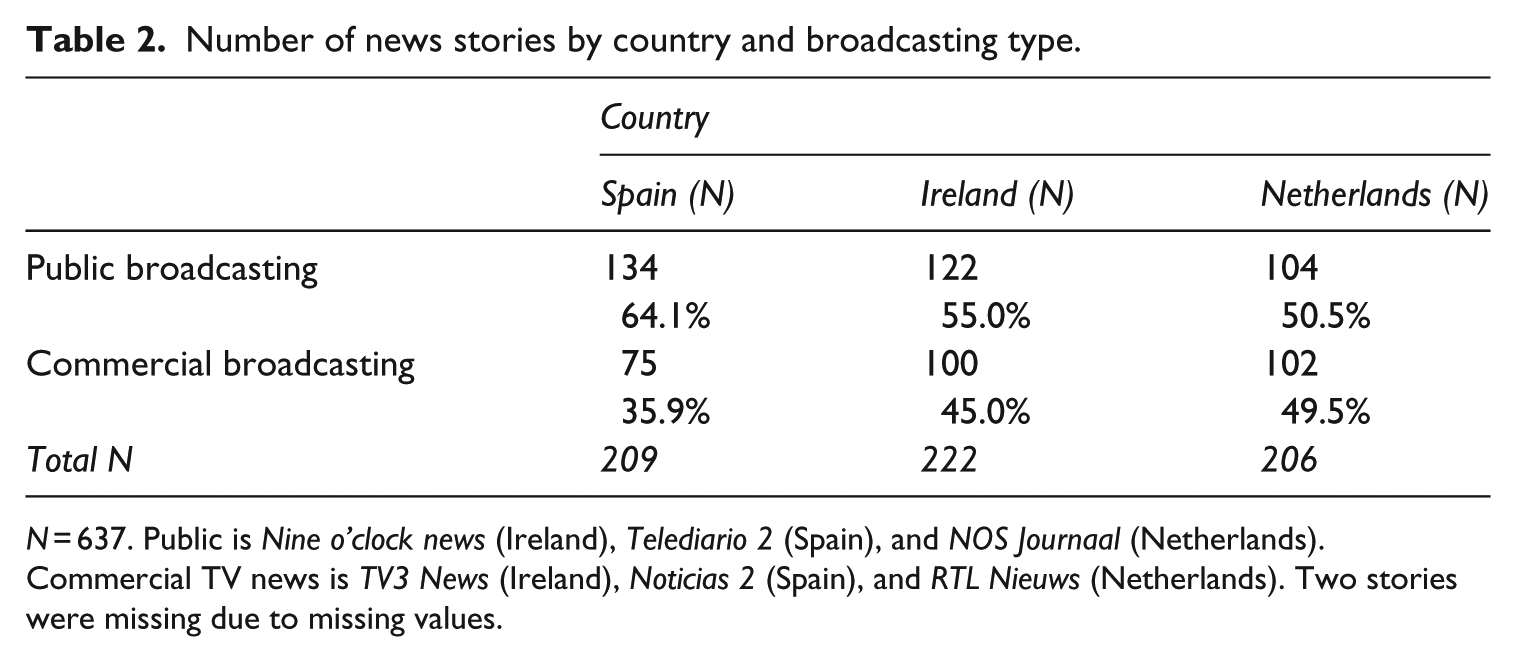
N = 637. Public is Nine o’clock news (Ireland), Telediario 2 (Spain), and NOS Journaal (Netherlands). Commercial TV news is TV3 News (Ireland), Noticias 2 (Spain), and RTL Nieuws (Netherlands). Two stories were missing due to missing values.
Dependent variables
The audiovisual narrative categories proposed in our analysis were derived from the theoretical framework mentioned before. They were operationalized to examine the technical characteristics of infotainment in television news (Gonzalo et al., 2014). Following others, we pay special attention to audiovisual effects in TV news production and define the different resources that contribute to the spectacularization of information. Among these technical features, the most relevant ones for our topic of inquiry refer to recoding styles that privilege movement, the use of music, camera shots, post-production effects, editing of images, and profusion of transitions. Following these studies, we coded six distinctive technical elements that indicate the use of infotainment.
Type of image
It was defined by the presence of stock news images (M = 0.04, SD = 0.20; pairwise agreement = 91.1%).
Shot length
This variable was measured as the number of close-ups (M = 0.65, SD = 0.48; pairwise agreement = 90.5%) in the news package.
Camera movement techniques
These variables were defined by the presence of zoomshots (M = 0.42, SD = 0.49; pairwise agreement = 82.2%), handheld (M = 0.63, SD = 0.48; pairwise agreement = 86.7%), panning (M = 0.71, SD = 0.45; pairwise agreement = 64.4%), and boom (M = 0.16, SD = 0.37; pairwise agreement = 95.6%).
Forms of transition
The number of transitions were counted, which were measured by the number of dissolves (M = 0.36, SD = 0.48; pairwise agreement = 81.0%), fades (M = 0.04, SD = 0.20; pairwise agreement = 100.0%), and wipes (M = 0.02, SD = 0.14; pairwise agreement = 95.2%).
Narrative structure or montage techniques
Montages techniques were defined by the presence of (1) metric montage (M = 0.17, SD = 0.37; pairwise agreement = 91.1%), (2) analytical montage (M = 0.91, SD = 0.28; pairwise agreement = 82.2%), (3) comparison montage (M = 0.60, SD = 0.49; pairwise agreement = 64.4%), and (4) collision montage (M = 0.14, SD = 0.35; pairwise agreement = 68.9%).
Audio expression
Audio expression was defined by the presence of music (M = 0.08, SD = 0.28; pairwise agreement = 95.2%).
Control variables
It is very likely that the amount of technical characteristics of infotainment is higher in longer news reports, than in shorter news reports (i.e. as we count the amount of technical features, in long news reports, the likelihood the program uses different technical features is higher, because there is simply more time to use them). For that reason, in our analysis, by using the variable time, we will control for the length of the news items in seconds (M = 137.57, SD = 81.19).
Results
First, we examined the extent to which there are differences in technical characteristics of infotainment in television news across countries and between public and commercial broadcasting programs using descriptive analyses. Results show that some features were frequently present, for instance the use of analytics (91.4%) and pannings (71.0%) were on average very popular. Other features were less popular, for instance the use of wipes (1.9%), stock (4.1%), and fades (4.1%). This indicates that the use of technical characteristics of infotainment generally differs. Some features are overly present in the news programs that we included, while other technical features are not often included (see Table 3 for more detailed description per country and broadcasting system).
Technical characteristics of infotainment in television news.
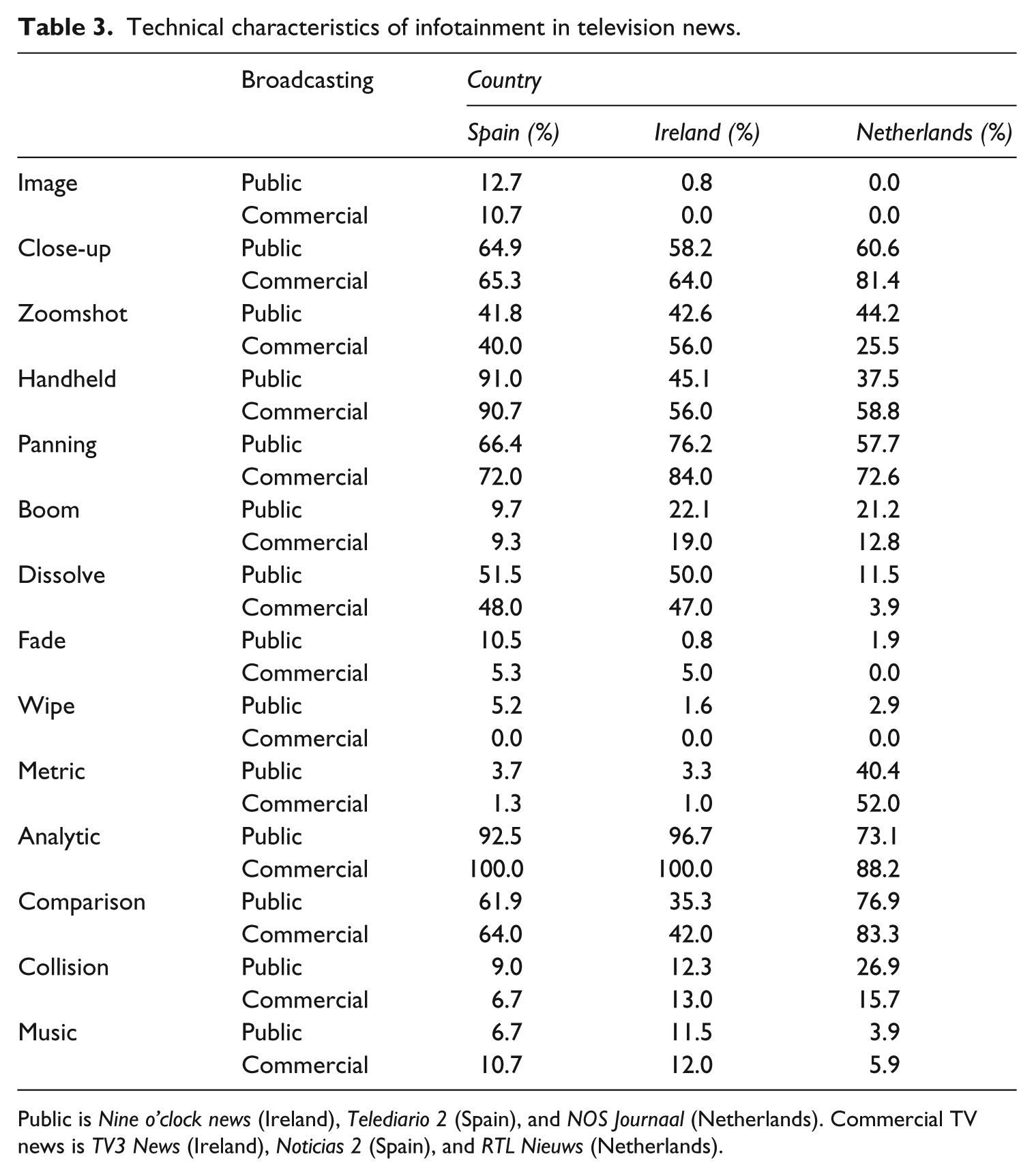
Public is Nine o’clock news (Ireland), Telediario 2 (Spain), and NOS Journaal (Netherlands). Commercial TV news is TV3 News (Ireland), Noticias 2 (Spain), and RTL Nieuws (Netherlands).
Interestingly, following our expectations, we found differences across countries. We want to refer to a few interesting findings. By using analysis of variance (ANOVA) with Bonferroni post-hoc tests, we found that, in general, the handheld and stock images features were more often present in Spain than in Ireland (both p < .01) and the Netherlands (both p < .01). In addition, the use of dissolves was less often present in the Netherlands than in Spain (p < .01) and Ireland (p < .01). The use of metrics was more often present in the Netherlands than in Spain (p < .01) and Ireland (p < .01). Also the use of comparison was more often present in the Netherlands and the least present in Ireland (all p < .01). Because these descriptive analyses show that more differences were found for the Netherlands compared to the two other countries, we will use the Netherlands as our general reference category in the next analyses.
To examine the use of technical features that characterize infotainment accurately, we conducted a logistic regression analysis with the technological features as dependent variables. Country dummies, a public/private broadcasting variable, and the news section were used as predictor variables. Additionally, we include the length of the news items as a control variable (see Table 4). In regards to our first hypothesis, we found that the programs in the Netherlands contained less technical infotainment features than those in Ireland and Spain. More precisely, we found that zoomshots, handhelds, pannings, dissolves, analytics, and music were more often present in Ireland and Spain, than in the Netherlands (all p < .05). In addition, fades were also more often present in Spanish and Irish news (respectively, p < .01 and p = .06), than in Dutch news. Stock news images were more often included in Spanish news than in Irish news (p < .01). Surprisingly, we found that some narrative structure or montage techniques were not often present in the Netherlands compared to Spain and Ireland. Especially the use of metrics was less popular in Spain and Ireland, in contrast to the Netherlands (all p < .01). The use of comparison was less often present in Ireland (p < .01) and the use of collision was not often included in Spain (p < .05), compared to the Netherlands. When we used Spain as a reference category in the logistic analyses, we found that Spanish news contained significantly more technical infotainment features compared to the other countries (e.g. handheld, fades, and wipes). This means that we found no clear evidence for hypothesis 1.
Predicting technical characteristics of infotainment in television news using a logistic regression analysis.
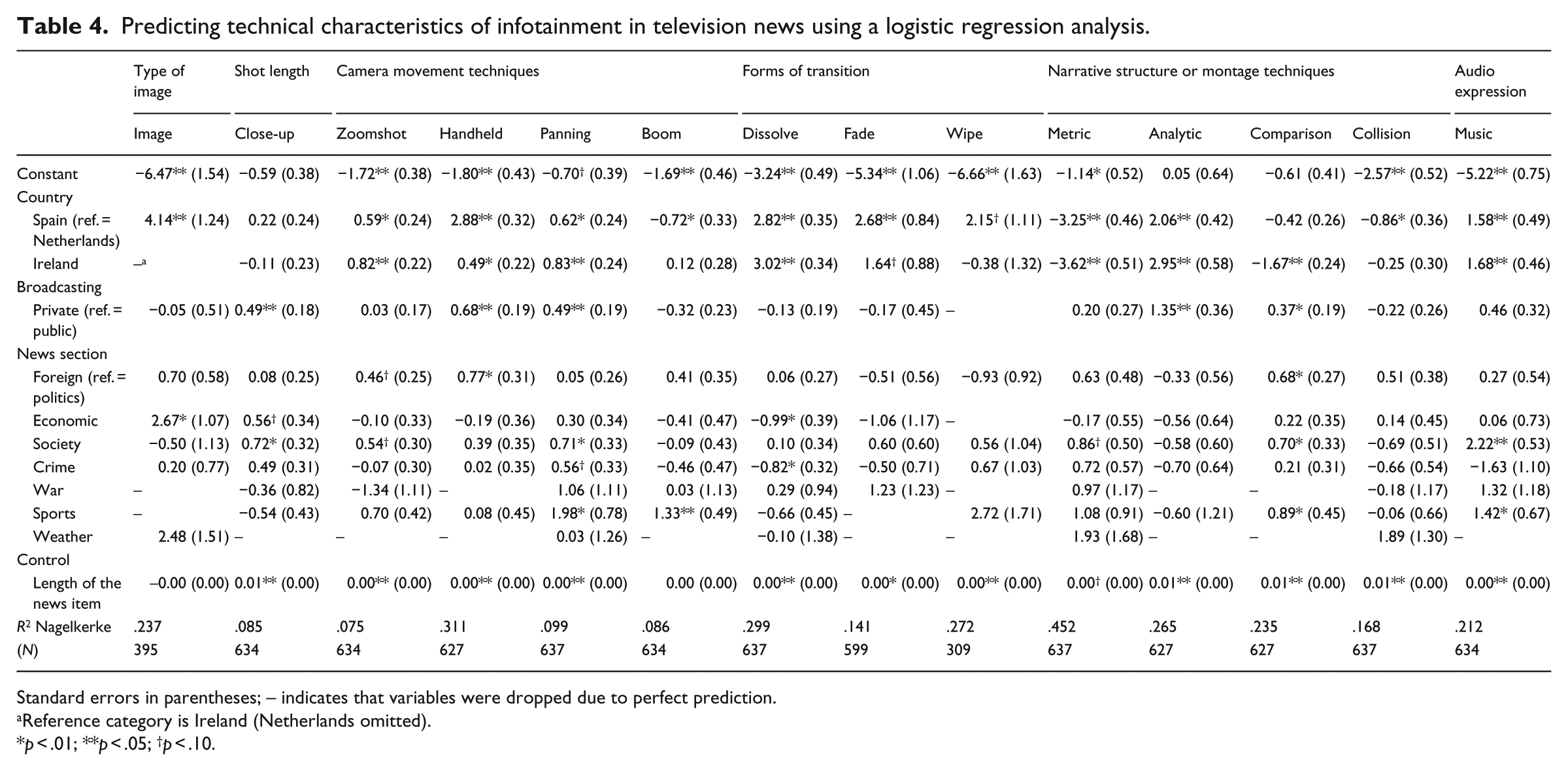
Standard errors in parentheses; – indicates that variables were dropped due to perfect prediction.
Reference category is Ireland (Netherlands omitted).
p < .01; **p < .05; †p < .10.
Furthermore, we examined the role of public and commercial broadcasting in the use of technical infotainment features. Following our expectations, we found that commercial news broadcasts use more audiovisual infotainment techniques in their stories than public news broadcasts in the three countries. More precisely, close-ups, handhelds, panning, analytics, and comparisons were more often used in commercial than in public broadcasting programs (all p < .05). Thus, we found support for hypothesis 2.
Finally, we examined the role of news section in explaining why some technological features were used more often in one section, compared to another. In general, we found that the use of technical characteristics of infotainment in specific news sections is difficult to predict (see Table 4). The evidence is less clear-cut then for the countries and broadcasting type. For foreign news, handhelds (p = .01) and comparisons (p = .01) are more often used compared to political news. Economic news included less dissolves (p = .01), but more stock news images (p = .01) compared to political news. Societal news contained more close-ups, pannings, comparisons, and music (all p < .05) in contrast to political news. Crime news contains less dissolves (p = .01) than political news. Finally, sports news contained more pannings, cranes (booms), comparisons, and music than political news (all p < .05). These findings indicate that in hard news sections (such as political news, foreign and economic news), technical features of infotainment are used, but evidence is not clear-cut, as some features are overly present while others are not. Therefore, we do not find support for hypothesis 3.
Conclusion
The current study draws on a vast and relevant literature on infotainment research to assess the presence of different audiovisual techniques, previously used as indicators of the phenomenon in private and public news broadcasts of Spain, the Netherlands, and Ireland. By using extensive content analyses of television news in the three different countries, we expected to find more infotainment in the Dutch and Irish broadcast sample as they are driven by a stronger inclination towards market funds. However, we found that Spain and Ireland included much more technical features or characteristics of infotainment in television news compared to the Netherlands. There are two very likely explanations for these results. First, the strong economic crisis in Spain and Ireland – between 2008 and 2009 − had an impact on media, and broadcasting in particular, with a decrease of advertising revenues (Medina and Ojer, 2010). The severe consequences of the economic downturn for media organizations in the two countries may justify the increment of more infotainment features in their news programming, mainly in commercial broadcasts.
Second, many scholars argue that the presence of a strong public broadcasting service is a factor that affects the dominance of market forces (Cushion, 2012; Rafter et al., 2014). In the case of RTVE in Spain, the identity of the public broadcasting system is not so strong, and that was one of the main reasons why the Spanish government decided to nationalize the public system (Medina and Ojer, 2010). Although public news broadcasts in Spain are entirely funded by the government, it is still possible to see significant traces of infotainment in their TV news items, as they want to follow their commercial counterparts and provide the same attractive news styles mixed with entertainment (Gonzalo et al., 2014).
Consequently, as we expected, we found that the use of infotainment techniques is more often present in commercial (or private) broadcasting, than in public broadcasting. Differences between both types of television stations can therefore be explained not only by economic factors but also by political forces regulating different broadcast ownership in each nation. Aside from the economic–financial crisis, a shift in the governance of public corporation has generated more competition for advertisement among commercial media organizations and foreign commercial channels in Spain. This policy change suggests one possible explanation for the increasing integration of infotainment features in the news contents of private domestic television news editions in Spain.
In the Netherlands and Ireland, the fact that commercial broadcasting services compete directly with public broadcasting for adverting as their sole source of income is closely related with greater use of infotainment techniques in their news programming (Vettehen et al., 2011). Due to the competitive market of television channels in Ireland and the Netherlands, the presence of infotainment in public service broadcasts does not fall short when compared to private channels in the two countries. This finding corroborates with others (Vettehen et al., 2011) who argue that Dutch public broadcasts have invested in the creation of attractive news offers that could compete with that of the private networks, by increasing the amount of infotainment characteristics in their stories.
Finally, we expected a greater use of audiovisual narrative features in soft news than in hard news topics. The results point, however, to other findings. Although we found that some technical features of infotainment were more present in soft news topics, such as societal news, crime news, and sports news, the evidence is less clear-cut, as our findings indicate that in some cases economic news can also contain more technical infotainment features than political news. Thus, the findings indicate no clear pattern of the use of infotainment techniques across news topics as coded in this study. The findings are largely in line with a multi-dimensional approach to defining the different types of news (Baum, 2003; Graber, 1994), in which the topic dimension is not sufficient to conceptualize hard and soft news and a focus on the style dimensions can help shape relevant changes of the structure of news with the introduction of infotainment. Future studies should look for ways to develop a more integrated approach to the analysis of formal features in television news in order to assess how different types of news are incorporating these features.
One of the main contributions of this study relies on the comparative approach to the analysis of infotainment features in television news of three European countries. Although infotainment was generally present in TV news broadcasts of the sampling countries, the results of our analysis showed specific patterns regarding the presence of indicators of infotainment in each country. Another important contribution concerns the development of a narrative approach to the analysis of infotainment, by exploring various codes that have not been systematically explored in content analysis of television news. The use of audiovisual narrative features in the news has increased and its impact on news reporting about matters of political and social significance raises questions about the quality of the news both from the perspective of who consumes and who produces the news.
Some limitations of this study need to be highlighted. First, further studies should be able to extend the sample period. The analysis of longer periods allows for investigating the evolution of infotainment news in mainstream TV news channels of the three countries. Investigating the use of different infotainment features in European news over time can offer rich insights into the impact of the phenomenon on political knowledge and public opinion. Second, this study is limited to the analysis of infotainment narratives in prime-time television news programs. Therefore, future studies should include a larger sample of news broadcast to examine the extent to which infotainment trends can be confirmed across program types and media platforms.
Despite these limitations, the methodological approach of the current study proposed has taken a step forward to cross-cultural approaches to the analysis of infotainment features in European television news. Moreover, a cross-national comparative analysis can open new avenues for this line of research by assessing whether infotainment features continue to exert great influence on production patterns that characterize modern news broadcasts in Europe.
Footnotes
Funding
The author(s) disclosed receipt of the following financial support for the research, authorship, and/or publication of this article: This research received a grant from the European Commission in the framework of Marie Curie Actions (FP7 Call). Grant number: 327228 (TVNPI - Television News for Promoting Interculturalism: A Novel Step towards Immigrant Integration).