




Abstract
This article critically examines how non-academic women of colour experience inclusion within UK higher education institutions. Drawing on narrative and semi-structured interviews, it reveals that inclusion is often choreographed through surface-level gestures that legitimise universities without redistributing power. The analysis develops three conceptual tools – curated inclusion, institutional affective discipline and progression ambiguity – to theorise how diversity initiatives function as containment strategies rather than mechanisms for transformation. Informed by Black feminist, critical race and decolonial theories, the study exposes how emotional labour, strategic silences and conditional belonging operate as everyday technologies of racialised governance. By centring the voices of women in non-academic roles, the article extends existing debates on institutional whiteness and performative inclusion, arguing for a structural reimagining of equity work grounded in decolonial praxis and epistemic justice.
Keywords
Introduction
Discussions of race, gender and inequality in higher education have typically focused on academic staff, particularly the under-representation of women of colour in faculty and leadership positions (Bhopal and Brown, 2016). While such work has been critical in exposing barriers to advancement, it has tended to overlook the experiences of non-academic women of colour – those employed in professional services, administration, student support and other roles that sustain the daily operations of universities. This omission is striking given that these women keep institutions running, yet their gendered and role-based labour remains undervalued and largely invisible in research and policy. This article addresses that gap by examining the lived experiences of non-academic women of colour in UK universities. ‘Non-academic’ here refers to staff in professional and support roles outside teaching and research, including administration, human resources, finance, student services and libraries. These positions, often perceived as peripheral to the academic project, are essential to the university's functioning. The women who occupy them face a paradox: hyper-visible as the front-facing representatives of institutional processes, yet simultaneously invisible in recognition, promotion and decision making.
Their experiences reveal the wider logics of inclusion and exclusion shaping higher education. Concepts such as cultural taxation (Padilla, 1994) and the invisibility of women's work (Acker, 1990) are particularly relevant. Non-academic women of colour are disproportionately tasked with diversity, emotional and administrative labour without recognition, while also navigating racialised and gendered barriers to progression. Although academic women face similar demands, this discussion centres on non-academic staff. Their experiences illuminate how diversity, equity and inclusion (DEI) agendas, though rhetorically expansive, often remain materially exclusionary. A historical lens reinforces this invisibility. Since the post-war expansion of UK higher education, Black and Asian women have frequently been recruited into lower-status clerical and administrative roles while being excluded from leadership pathways (Tate and Bagguley, 2017). Their labour has sustained the administrative machinery of mass higher education but been erased from accounts of institutional progress. These dynamics persist today: women of colour remain clustered in mid- and lower-level non-academic positions with limited opportunities for advancement.
While this study is located in the UK, it resonates globally. Research from the United States highlights the marginalisation of Black women in staff and administrative roles (Settles et al., 2020), while South African scholarship links racialised gender hierarchies to colonial legacies (Nkomo and Ngambi, 2009). Placing the UK within this international frame underscores both the distinctiveness and commonality of exclusionary practices across higher education systems. This research is guided by an intersectional theoretical framework (Crenshaw, 1989), with particular attention to intersectional invisibility (Purdie-Vaughns and Eibach, 2008). These perspectives foreground how women of colour in non-academic roles experience both hypervisibility as racialised and gendered subjects and invisibility as contributors to the intellectual and organisational life of the academy. In doing so, the article extends debates on coloniality in higher education (Bhambra et al., 2018; Stein, 2020) beyond academic staff to the hidden labour of those who make universities function. Drawing on thirty five interviews with non-academic women of colour across seven UK universities, the article makes three contributions: it expands the scope of equity research to include non-academic staff; it demonstrates how race, gender and institutional hierarchies intersect to structure inequality; and it highlights how women of colour resist marginalisation through acts of refusal, solidarity and everyday leadership, offering vital insights for rethinking DEI and institutional change.
Literature review
The discourse of DEI in higher education has become not only institutional orthodoxy but also a site of critical scholarly inquiry. What began as a response to systemic exclusions has often been subsumed into managerial logics that reproduce, rather than unsettle, institutional power. Existing literature increasingly recognises that DEI, far from being neutral or inherently progressive, is shaped by the very structures it purports to challenge (Ahmed, 2012; Bhopal, 2022). Yet much mainstream work still frames inclusion as a matter of numbers or ‘feel-good’ belonging rather than structural transformation. Global scholarship also shows that inclusion rhetoric can obscure colonial hierarchies (Chilisa, 2020). Sara Ahmed's (2012) concept of the non-performative shows how institutions commit to diversity in words without enacting its goals, using the proliferation of diversity policies and committees as proof of progress when change is absent. In such cases, the language of inclusion becomes a shield against accountability. Universities celebrate the existence of a diversity policy as though that were itself an accomplishment, often using it to deflect criticism (‘Look, we have a diversity officer, so the problem must be being handled’). Bhopal (2022) shows how elite universities practise selective inclusion, inviting minoritised staff into structures only to contain their presence. DEI thus becomes a reputational economy, accruing prestige through performative progress while reinforcing whiteness as the institution's normative architecture. Recent work by Wright (2024) and Mngomezulu and Hadebe (2018) supports this view, showing that inclusion discourse in both the UK and South Africa often becomes a form of ‘institutional storytelling’ that recentres white virtue while marginalising Black epistemologies.
This critique is amplified by decolonial scholars who argue that DEI, in its current form, is structurally incapable of addressing the colonial histories and power relations embedded in British higher education (Bhambra et al., 2018; Ikeke, 2016). Rather than unsettling colonial power, DEI often reinscribes it by incorporating difference only insofar as it can be made legible to the institution's existing norms. Inclusion becomes a civilising project – extending conditional recognition while disciplining critique and affect; without decolonisation, such inclusion merely contains the ‘Other’. Comparable global critiques (Shahjahan and Edwards, 2022) show how universities translate diversity into bureaucratic comfort, a pattern mirrored in the UK. In other words, universities may welcome people of colour but expect them to conform to the pre-existing culture, which remains defined by whiteness and Eurocentric knowledge. Tuck and Yang's (2012: 3) reminder that ‘decolonisation is not a metaphor’ is relevant here: the symbolic inclusion of marginalised people cannot be a substitute for the redistribution of power or epistemic authority. Thus, inclusion without decolonisation becomes containment; the ‘Other’ is brought in just enough to enhance optics but not enough to disturb the foundation. These dynamics are especially salient when considering professional and institutional hierarchies. The limited literature on non-academic staff reveals how they are not only structurally excluded from leadership and influence but also epistemically erased in conceptions of who ‘matters’ in the university (Puwar, 2004). While a robust body of research and first-person scholarship has documented the experiences of academic women of colour (Rollock, 2019), highlighting issues like the ‘ivy ceiling’, their non-academic counterparts remain largely outside scholarly attention. This gap is not merely empirical but epistemological: it reflects a tendency in higher-education studies to treat academic roles as the default locus of policy concern, whereas administrative or support roles are seen as peripheral. Comparative studies in the United States (Patton, 2016) and Canada (Henry et al., 2017) reveal similar hierarchies in which staff of colour sustain the everyday running of institutions but are rarely theorised as knowledge holders or policy actors. My study, therefore, intervenes by positioning non-academic women of colour as theoretical subjects whose experiences reveal how power and belonging operate beyond the professorial ranks.
Intersectional critiques further reveal how DEI frameworks often privilege singular axes of identity, most notably gender or race, in ways that erase those at the intersections (Crenshaw, 1989; Purdie-Vaughns and Eibach, 2008). In the UK, initiatives such as Athena SWAN (focused on gender equality) have advanced women but largely centre white, middle-class, academic women as the normative subject. Similarly, the Race Equality Charter ostensibly addresses race but struggles to tackle intersectional issues or the distinct context of professional staff. As a result, individuals who occupy multiple marginalised identities (e.g. a Black woman who is a secretary) can find themselves doubly invisible as their challenges do not fit neatly into single-issue frameworks. This is the essence of intersectional invisibility: one's experience of marginalisation is overlooked because it does not align with the dominant framing of either category alone. Research on double and triple oppression (Beale, 1970; Mama, 1995) shows how layered exclusions persist across institutional cultures, underscoring the global relevance of this analytic lens. Black feminist scholars have long argued that mere recognition within existing frameworks is insufficient. Representation without redistribution leaves structural racism and sexism intact (hooks, 1989). What is needed is not just inclusion into existing systems but a rethinking of the systems themselves. This includes interrogating what counts as merit or professionalism notions often coded in whiteness and masculinity. For non-academic staff, whose contributions are rarely framed as intellectual or strategic, the pressure to conform to institutional whiteness can be intense. Recent work by Craddock (2023) extends this critique, showing how ‘professionalism’ discourses regulate racialised women's speech, dress and comportment in subtle yet coercive ways. Flores and Rosa's (2015) concept of raciolinguistic ideologies similarly shows how workplace language norms penalise those who speak or behave outside the white middle-class ideal. In our context, that means that a woman of colour might be judged for being too ‘blunt’ or not ‘polished’, where such judgements carry racial and cultural bias.
Another critical body of literature examines the affective economies of organisations. Ahmed (2012) describes how the figure of the feminist or antiracist killjoy, the one who complains about injustice, is constructed as a problem by institutions that want to maintain smooth surfaces. Emotional labour (Hochschild, 1983) is extracted from women of colour (e.g. the expectation that they will smile and be resilient), while their honest emotions of anger, sadness or frustration are often invalidated. As Mirza (2015) argues, the hypervisibility of women of colour in education functions as both a token and a tether: they are showcased as symbols of progress while being hyper-audited for emotional or professional missteps. This creates what she calls an ‘emotional apprenticeship’: women of colour learn that to survive, they must manage not just their work but the feelings of others (often white colleagues) and the image of the institution. Parallel analyses by Moodley and Adam (2000) in South Africa and Ahmed and Swan (2006) in the UK show that such affective regulation is transnational, a mechanism through which universities sustain whiteness under the banner of civility.
Despite these insights, there remains a paucity of research focusing on non-academic women of colour as institutional actors with their own voices. The experiences of an administrative officer or a laboratory technician who is a woman of colour might seem anecdotal to some but, as I will show, they reflect systemic patterns. By listening to these narratives, I gain a clearer picture of how inclusion fails not in theory but in practice in meetings, promotion rounds and everyday interactions. These ‘small’ arenas are where climates of inclusion or exclusion are lived. As scholars such as Ahmed (2012) and Bhambra et al. (2018) argue, the everyday is the institutional; the micro is the structural. Thus, this study enters a relatively underdeveloped area of the literature, aiming to amplify these voices and to argue for their centrality in any genuine attempt to decolonise and democratise the university. Performative inclusion often stands at odds with genuine institutional transformation. Whiteness operates through seemingly race-neutral criteria – ‘fit’, ‘merit’ and ‘professionalism’ – which perpetuate inequality. Women of colour, especially in support roles, face the paradox of being celebrated as symbols while being constrained in substance. By drawing together global, decolonial and intersectional literatures, this study extends existing scholarship in three ways: it centres non-academic women of colour as knowledge holders; it conceptualises inclusion as an affective as well as a structural process; and it reframes DEI as a colonial performance rather than a progressive project. I now turn to the methodological design that underpins this inquiry, before presenting the findings that illuminate the architecture of performed inclusion in UK higher education.
Methodology
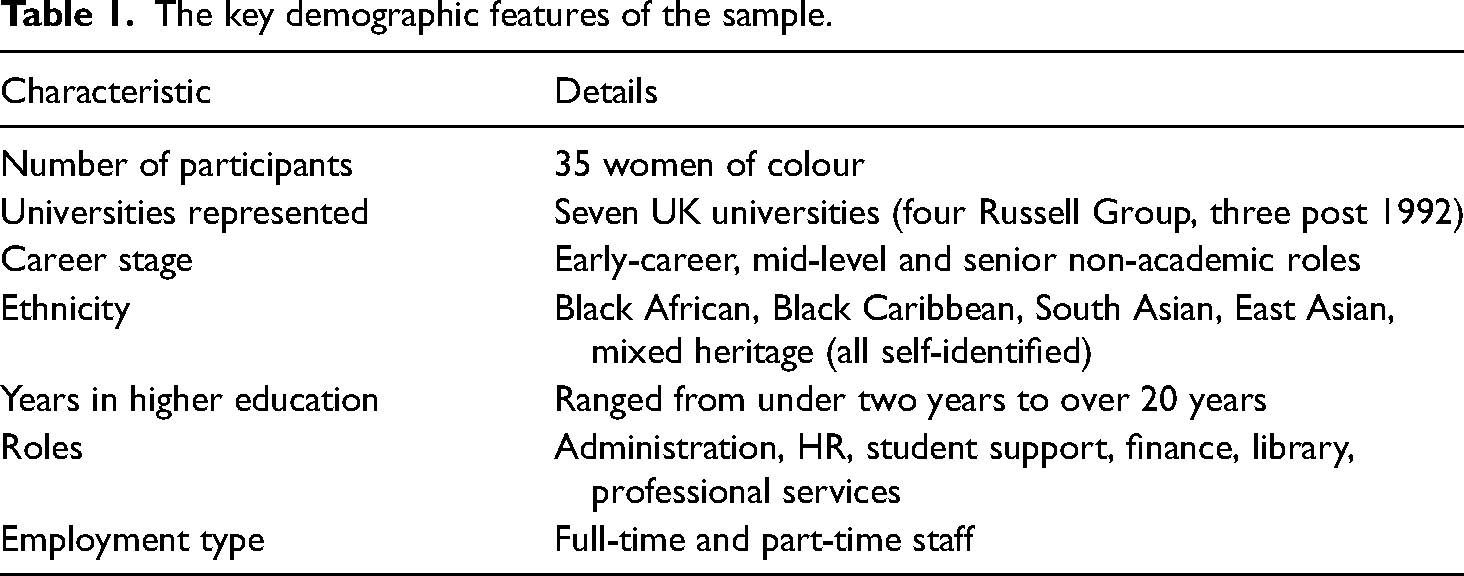
This study adopts a qualitative, critical methodology grounded in Black feminist epistemology and decolonial praxis. Research was approached as a collaborative, politicised process (Collins, 2000; Smith, 2012). The goal was to validate and theorise those experiences in ways that challenge dominant narratives about inclusion in higher education. I conducted semi-structured, in-depth interviews with 35 women of colour in non-academic roles across seven UK universities. These institutions included a range of types, from elite Russell Group universities to post-1992 universities. Within each university, I focused on professional services and support departments, including administration, student services and HR. Participants’ job titles ranged from junior administrative assistants to mid-level managers (e.g. faculty administrators, student advisors, project coordinators, support services managers). Purposive sampling ensured diversity in racial/ethnic backgrounds, national origins and job roles. Initial participants were recruited via professional networks and affinity groups (for example, a network for BME staff in higher education). Snowball sampling then helped reach others who might not be in formal networks but who were recommended by colleagues aware of the study. The final sample intentionally included a mix of Black African, Black Caribbean, South Asian, East/Southeast Asian, Middle Eastern and mixed-heritage women, spanning ages from early 20 s to mid-50 s, and including both UK-born and migrant individuals. While not statistically representative, this sample was epistemically rich: it brought together a breadth of perspectives to illuminate structural patterns and nuances (Table 1).
The key demographic features of the sample.
Each participant took part in a one-on-one interview lasting sixty to ninety minutes. Interviews were conducted in a conversational, semi-structured format. An interview guide ensured that key topics were covered, such as their understanding of ‘inclusion’ at work, experiences with diversity or equality initiatives, moments of inclusion or exclusion, career progression or roadblocks and the emotional dimensions of their work life. Participants were encouraged to ‘story’ their experiences in their own way, and many interviews became deeply personal narratives. This narrative approach aligns with Black feminist methodology, which values personal storytelling as a site of knowledge (hooks, 1989; Pillow, 2003). As a Black woman researcher with prior experience in a non-academic university role, I positioned myself as a co-witness and co-learner rather than a detached investigator. This insider positionality helped build rapport and trust; participants often expressed relief at ‘not having to explain everything’ about context. At the same time, being an insider carries risks of over-identification, so reflexivity was essential. Interviews were conducted mostly via video call or phone (given the geographical spread of participants), with a few in-person interviews when feasible. Interviews were recorded and later transcribed. Participants chose pseudonyms, and identifying details (names of colleagues, specific departments, etc.) were generalised or altered to protect confidentiality. Ethical approval was obtained through Oxford Brookes University's ethics board. Consent was an ongoing, relational process: after transcription, participants had the option to review their transcript and clarify or retract statements. Only a few made minor clarifications; most expressed that they were happy to have ‘finally voiced’ these issues.
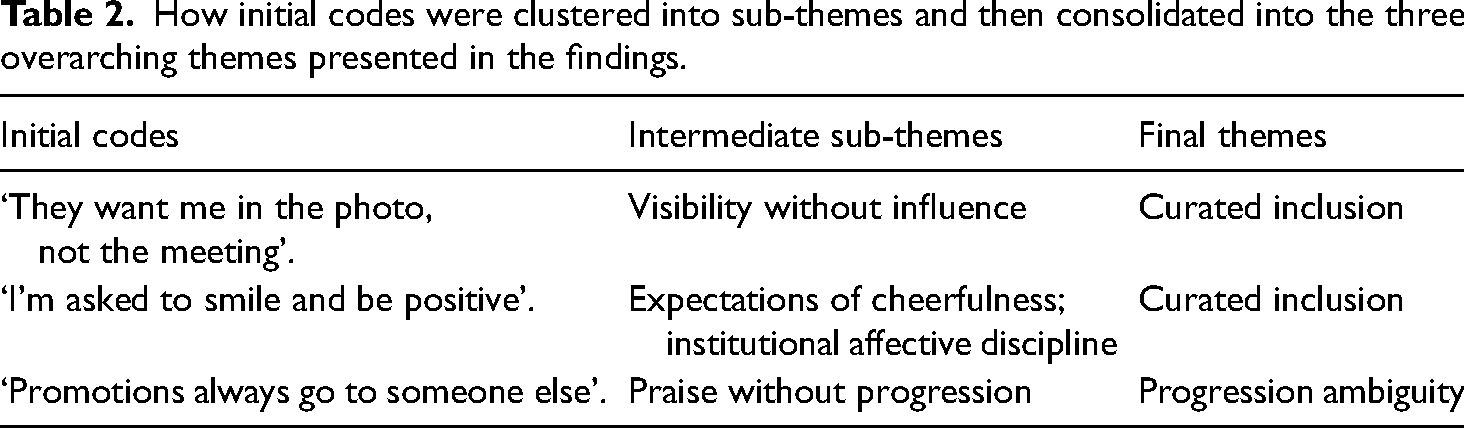
The analysis was iterative and grounded in both the data and the theoretical framework. I employed a form of thematic analysis influenced by constructivist grounded theory (Charmaz, 2006). The process began with multiple close readings of transcripts, alongside field notes and reflexive memos. Initial open coding captured significant ideas or incidents. Using constant comparison, I grouped codes into tentative categories reflecting recurring patterns. Negative cases and contradictions were also retained as analytically important. Over time, sub-themes emerged and were clustered into broader categories. This process was both inductive (emerging from participants’ words) and deductive (in dialogue with theory). While many accounts clustered clearly around the three themes, I also retained contradictory or divergent narratives. For example, a small number of participants described unusually positive experiences of inclusion, often linked to supportive managers or working in already diverse teams. Similarly, while most spoke of affective pressure to remain cheerful or grateful, a few noted contexts in which they could occasionally express dissent without repercussions. A handful of participants also progressed in their careers but they often attributed this to exceptional mentoring or to chance rather than to transparent structures. These counter-stories were not dismissed as anomalies; instead, they provided valuable nuance, highlighting the specific conditions under which women of colour might experience institutions differently. Attending to such variation reflects a critical, feminist commitment to embracing complexity rather than producing overly neat narratives (Table 2).
How initial codes were clustered into sub-themes and then consolidated into the three overarching themes presented in the findings.
Trustworthiness was enhanced through multiple strategies:
Analyst triangulation: Two additional researchers independently reviewed a subset of transcripts and provided coding impressions. This process helped to check for potential biases and to refine the codebook for consistency. Reflexive memos: Maintained throughout data collection and analysis, these memos documented assumptions, emotional responses and interpretive tensions. They informed both the analytical process and the ethical care of participants’ narratives. Member reflections: A follow-up workshop was conducted with six participants to review the preliminary themes. Participants largely affirmed the findings and added nuance; for example, refining the concept of progression ambiguity by linking it to forms of institutional obfuscation.
This collaborative and reflexive approach foregrounded meaning rather than breadth or generalisability, enacting a methodology attuned to power, ethics and epistemic resistance. The analysis of thirty five interviews with non-academic women of colour revealed three interlocking themes that characterise how inclusion is experienced in UK higher education. These are curated inclusion, institutional affective discipline and progression ambiguity. Together, they show that inclusion is less a pathway to equity than a mechanism of containment. In what follows, I present each theme with narrative evidence from participants and interpretive commentary, situating their accounts within the existing literature. These themes are not only descriptive categories but also form part of a developing theoretical framework. The term curated inclusion, introduced in this article, recurs across sections to trace its conceptual evolution from empirical grounding in participants’ narratives to its articulation as a broader theory of institutional performance.
Curated inclusion
Participants described a form of conditional, carefully managed visibility that I call curated inclusion. Women of colour were frequently asked to appear in university marketing, on diversity panels or in public-facing roles, yet this visibility rarely translated into influence or power. Their presence served optics; their voices were marginalised when decisions were made. Amina, a Black British administrative manager, captured this tension: ‘They want us at the table, but only if we don’t rearrange the furniture’. She was often invited to committees to showcase diversity, but when she raised why certain policies had unequal racial impacts, her concerns were ignored. At the same time, a glossy university newsletter profiled her as a ‘successful woman behind the scenes’. The contrast between the smiling photo and the lived exclusion exemplifies choreographed inclusion. Priya, a student services officer, echoed this: ‘I’m constantly being showcased on posters and panels, but when it comes to making actual decisions, I’m invisible’. She explained that her story was repeatedly solicited for events as a sign of ‘progress’, but she herself noted wryly: ‘I haven’t actually progressed that far, I’m just visible’. This is the paradox of hypervisibility and invisibility: women of colour are endlessly seen as diverse yet unheard as contributors (Purdie-Vaughns and Eibach, 2008).
Participants described a ‘pedestal periphery’: elevated for display, sidelined in practice. This echoes Puwar's (2004) ‘space invaders’: allowed entry, closely monitored, expected to conform. In universities, women of colour were repeatedly ‘used’ as proof of inclusion, while their critiques were suppressed. As another participant put it: ‘My face is on the prospectus cover, but my ideas are not in the meeting minutes’. Curated inclusion is also emotional labour: performing gratitude and loyalty while living exclusion. Farah, a coordinator, was asked to speak on ‘women in leadership’. When she prepared candid remarks, she was told to ‘focus on the positives’. ‘They wanted a happy success story’, she said. She left feeling ‘polished and displayed’, not heard. This pattern highlights how inclusion operates as conditional belonging: women of colour are permitted to be seen, but only on the condition that they do not disrupt institutional comfort or challenge existing power relations. Their visibility is carefully managed, welcomed as representation yet constrained from becoming critique ensuring that inclusion remains symbolic rather than transformative, and that power is neither shared nor redistributed. Curated inclusion brands the university as diverse while neutralising the political force of difference. In this choreography, women's bodies and faces are transformed into aesthetic labour signifiers of progress that enhance institutional legitimacy without redistributing power. What appears as visibility is, in fact, a carefully managed hypervisibility that conceals enduring exclusion. Curated inclusion exposes diversity management as a display strategy rather than a transformative practice. It marks the first layer of performed inclusion: institutions are eager to showcase women of colour, yet only within boundaries that keep whiteness and authority intact, where hypervisibility substitutes for genuine participation.
While curated inclusion controls who is seen, the next section explores how institutions also control how those seen are allowed to feel.
Institutional affective discipline
Institutional affective discipline captures how women of colour regulate emotion to maintain institutional comfort, the choreography sustaining the curated facade. Participants learned to perform gratitude, patience and composure even amid microaggressions and inequity, knowing that their emotions would be read through racialised and gendered lenses. Tendai, a British Zimbabwean coordinator, said: ‘You learn not to say everything. I smile a lot more than I want to’. After she raised racial disparities in promotions, her manager called her ‘negative’. As she reflected, ‘When a white colleague gets upset, she's passionate. If I do it, I’m angry’. This policing of Black women's expression, noted elsewhere in British research (Sobande, 2020), shows how authenticity becomes a risky and exhausting routine. The constant modulation of tone, word choice and even body language becomes a silent tax, a cost of existing in spaces where authenticity is risky. A similar pattern emerged around gratitude. Sophia, a British Caribbean executive assistant, said: ‘Whenever I raise a concern, I’m reminded how lucky I am to have this job. So I start every sentence with “thank you so much”, otherwise they think I’m being rude’. Her experience captures how women of colour must overcompensate with politeness, revealing a structure where tone, not argument, defines professionalism. Emotional management became a precondition for being heard. Many described ‘smiling through it’, a mechanism of self-protection. Nadia, a Middle Eastern administrative officer, said: ‘Professional here means never letting them see you upset. I’ve seen white colleagues snap or cry; it's stress. If I raise my voice, it's “calm down”. So I’ve mastered the calm smile’. Her story captures how affect is racialised and classed: the same emotion seen as passion in white colleagues reads as aggression in women of colour. As Ahmed (2012: 66–67) notes, institutions prefer ‘happy diversity’, expecting optimism over discomfort. For many, the calm smile was both armour and constraint, a means of survival that rendered authenticity unsafe. Even positive emotions were policed. Linh, a British Vietnamese data officer, recalled being told to ‘tone it down’ after showing enthusiasm for a new project: ‘It's like there's a narrow band of emotion I’m allowed; enthusiastic but not too much, concerned but not angry, confident but not assertive’. This hyper-calibration of affect shows how professional norms remain tethered to whiteness. As Flores and Rosa (2015) note, raciolinguistic ideologies link expression and emotion to racialised ideas of civility and intellect. In universities that prize ‘rationality’ and ‘neutrality’, women of colour are often cast as too emotional or disruptive when they stray from these norms. Over time, several participants said, this self-monitoring became habitual. Aisha, a South Asian administrator, reflected: ‘I used to think I was just being polite. Then I realised I was shrinking myself every day’. Her words capture the psychic toll of affective discipline, a form of containment that seeps into identity, producing burnout, anxiety and the sense of being ‘performers in a play’ that one did not write.
This echoes Hochschild's (1983) concept of emotional labour, but with a racialised inflection: women of colour must not only manage others’ feelings but also pre-empt and neutralise racial discomfort. The institution demands continual reassurance, a silent pledge that their presence will not unsettle the status quo. Some resisted through what might be called strategic affect, choosing when and where to express emotion. Informal affinity groups and trusted colleagues became spaces of honesty and care. Tendai described a WhatsApp group of Black women who ‘vent, laugh, and hype each other up’ during the workday, counter-publics of release beyond the institutional gaze. Others used strategic silence to maintain agency; as Nadia explained, ‘Sometimes silence is the only control you have. It's not surrender; it's strategy’. Such micro-acts of resistance show that women of colour are not passive subjects of affective control but that they navigate and sometimes weaponise emotion for survival and critique. Yet these acts are exhausting: the institution gains harmony, while the emotional cost remains theirs alone. As one participant put it, ‘They get my calm; I get the headache’. The expectation of gratitude and compliance also extended into performance evaluations. Several women received feedback framing their emotional self-management as both a virtue and a flaw. Being ‘too quiet’ or ‘not assertive enough’ was used to justify stalled promotions, even when that quietness was a learned strategy to avoid being seen as confrontational. The very discipline that ensured survival thus constrained progression, linking this theme directly to progression ambiguity. In this way, affective discipline functions not only as a cultural norm but also as an evaluative mechanism that shapes who is deemed ‘leadership material’. While these accounts emerge from the UK context, they resonate with international patterns in which women of colour navigate similar affective scripts. Yet here, such dynamics take on distinctly British inflections: mediated by politeness culture, accent hierarchies and the veneer of liberal civility that frames dissent as incivility. As several participants noted, ‘It's not that they shout you down; it's that they smile you into silence’. Institutional affective discipline thus reveals the emotional infrastructure of inclusion. Control is maintained not through explicit exclusion but through affective governance, rewarding composure, punishing disruption and disciplining feeling itself. This regime ensures that diversity remains palatable, sanitised and non-threatening, exposing the colonial underside of professional affect: the demand that racialised women must remain safe, composed and grateful to belong. As Ahmed (2017) observes, institutions ‘manage feeling’ to manage dissent. In this light, affective discipline becomes structural containment, a continuation of colonial civility adapted to the neoliberal university. For the women in this study, survival often meant playing along with this emotional choreography at significant personal cost. The institution gains harmony; the individual absorbs the dissonance. If curated inclusion is about controlling who is seen, institutional affective discipline is about controlling how those seen are allowed to feel. Together, they build the emotional architecture of performed inclusion: a system that celebrates presence while constraining authenticity.
Progression ambiguity
This theme captures how non-academic women of colour experienced advancement as uncertain, informal and often dependent on unspoken criteria. Participants felt valued but not promoted, praised for reliability while contained in the same role. Many called it being stuck: produced not by overt exclusion but by unclear expectations and subjective judgements. Linh, a British Vietnamese data officer, explained: ‘Every time I ask about a step up, I get told how great I’m doing where I am. That's not the same thing’. Despite strong appraisals, promotions were deferred with comments about timing or ‘fit’. Several others echoed this, saying they were told they were indispensable in their current roles – praise that disguised immobility. As one participant said: ‘They compliment you into staying put’. Grace, of mixed white and Black African heritage, recounted acting as departmental manager for six months while her supervisor was on leave. She received an internal award, but when the post was advertised she was bypassed. No critique was offered; others ‘had more experience’. Grace reflected: ‘I did the job, proved I could do it and they still didn’t see me that way’. This sense of being trusted but not promoted created emotional fatigue. Many women described waiting years for an opportunity that never materialised or being told they ‘weren’t ready yet’ without clear feedback on what readiness meant. ‘Fit’, ‘timing’ and ‘chemistry’ became soft barriers that consistently disadvantaged them. Informal decision making compounded this. Maria, a UK-born Latina administrator, called it ‘friendly exclusion’. She described missing out on opportunities discussed casually in networks that she was not part of: ‘They like me well enough, but the real decisions happen over drinks or in WhatsApp groups I’m not in’. Others used similar imagery of closed circles, ‘inner rings’ or ‘corridor promotions’. Advancement seemed to depend less on formal appraisals than on being socially familiar to those already in power.
Several noted they lacked the social ease, schools, accents and hobbies that bonded others with senior managers. The absence of these affinities subtly marked them as not quite fitting. For Nadia, a Middle Eastern British officer, the barrier was compounded by expectations of gratitude: ‘Whenever I ask about promotion, I’m told how much they value me where I am. It's flattering and infuriating at once’. She described a cycle of additional responsibility without recognition – ‘more work, same title’. Participants distinguished between fair-looking policies and invisible everyday practices that decided advancement. Some referred to ‘acting up without acknowledgement’, others to ‘doing the job but not having the title’. Over time, this produced disillusionment. A few had begun exploring careers outside of academia, explaining that they could no longer ‘wait for permission to move’. Women who were migrants or who spoke with accented English felt that they had to prove cultural as well as professional competence before being considered for promotion. Older participants felt written off as dependable but static; younger ones were perceived as inexperienced or ‘still learning’. Those from working-class backgrounds noticed that colleagues who shared social or educational similarities with leadership advanced faster. The emotional toll was significant. Several women described lowered confidence and questioning their worth despite knowing they performed well. One said: ‘It messes with your head; you start thinking maybe they’re right, maybe I’m not ready, when really they just don’t see you’. Others described exhaustion from constant striving without recognition. The pattern was one of containment: even when women of colour fulfilled every written expectation, invisible norms determined their ceiling.
The architecture of performed inclusion
Taken together, these three themes – curated inclusion, institutional affective discipline and progression ambiguity – map the architecture of performed inclusion in UK higher education. I situate these patterns within wider theoretical debates on institutional performativity, racialised affect and career containment to explore how diversity becomes a mode of control rather than liberation. These findings – curated inclusion, affective discipline and progression ambiguity are not isolated. They are interconnected cogs in what I term the architecture of performed inclusion in higher education institutions. Together, they show how universities appear inclusive while maintaining whiteness and existing power relations.
Curated inclusion as institutional showcase
The theme of curated inclusion reveals that universities often treat diversity as an asset to be displayed, not a mandate to redistribute power. Women of colour are included in controlled ways that benefit the institution's image (boosting a university's credibility in claiming inclusivity), yet those women have little agency to influence institutional practices. This recalls Ahmed's (2012) observation that institutions ‘show what they have done’ to deflect questioning. Our participants’ experiences amplify this insight: being used in marketing or one-off events served as proof that the institution is ‘doing well’ on inclusion, which then deflected or dampened criticism of ongoing inequities. This symbolic inclusion inoculates against deeper change. Indeed, by curating when and how women of colour appear, the institution maintains narrative control. It can claim the moral high ground of diversity while leaving its decision-making circles and resource allocations virtually unchanged. This resonates with critiques by Bell and Hartman (2007) that diversity is often embraced in a celebratory, consumable form (benign multicultural imagery) rather than as a structural imperative (addressing racism's roots). The concept of curated inclusion adds specificity: it's not just that diversity is commodified, it's that the very roles and contexts in which diversity is allowed to manifest are tightly managed (and often superficial).
Comparable research in the United States (Patton, 2016) and South Africa (Mngomezulu and Hadebe, 2018) similarly finds that institutional performances of inclusion often mask entrenched racial hierarchies. The parallels across national contexts suggest that the performative use of diversity has become a globalised academic aesthetic, not a uniquely British issue. This connects to literature on aesthetic labour, where women's bodies and appearances become institutional assets. In higher education, that labour is racialised and gendered: women of colour must embody the image of an inclusive, progressive institution, performing diversity as hypervisible proof of legitimacy. Yet, as we saw, behind the scenes the institution has not legitimised them in terms of authority or voice. This contributes to recent decolonial readings of the academy (Bhambra et al., 2018; Nayak, 2020), extending Ahmed's analysis by showing how colonial display logics persist not only in knowledge hierarchies but also in representational labour. Curated inclusion is a subtle coloniality: spectacle without ceding knowledge or power. It is a containment strategy that says: ‘I will put you on our stage but remember that the script is ours’. In decolonial terms, it is inclusion without decolonisation; difference displayed without altering the core.
Institutional affective discipline and emotional governance
The second theme highlights how emotional norms enforce inclusion's limits. Women of colour are tacitly required to be docile bodies (to invoke Foucault) in emotional terms – pleasant, acquiescent and perpetually ‘resilient’ – to be acceptable insiders. If curated inclusion is about visual representation, affective discipline is about emotional representation: showcasing only the smiles and gratitude, never the tears or raised voices. This echoes Ahmed's (2012) feminist killjoy: the one who expresses anger at injustice is framed as disrupting the happiness of the institution, and thus as a problem. In our data, women of colour learned that to complain about inequity was to risk being seen essentially as unprofessional or ungrateful, as not playing the part that the institution had assigned them. The concept of emotional labour (Hochschild, 1983) is clearly applicable but our findings push it further by demonstrating its racialised dimension. The expectation that women of colour perform a cheerful loyalty – ‘smiling a lot more than I want to’, as Tendai said – is a form of what I call affective discipline. It's enforced through subtle feedback (raised eyebrows at a display of anger, comments about one's tone, etc.) and through the observed outcomes (who gets tagged as a ‘team player’ vs who is labelled ‘difficult’). Over time, this creates an internal policing mechanism: women pre-emptively constrain their emotional range to avoid sanctions. Similar findings have been reported in US and Australian higher education contexts (Griffin, 2019), where Black and racialised women in student affairs and administration described needing to modulate tone, body language and emotion to maintain institutional comfort.
The cross-context similarity underscores a transnational racial economy of feeling, one that ties emotional comportment to employability and belonging. This extends the work of Ahmed and Hochschild by theorising what might be termed ‘institutional emotional governance’, wherein the institution's affective norms become a disciplinary mechanism sustaining whiteness as comfort (Ahmed, 2007). The ‘angry Black woman’ trope (Collins, 2000) and the stereotype of the ‘hot-headed’ South Asian function as controlling images that pre-emptively invalidate certain emotions from certain bodies. Consequently, as Nadia and others noted, white colleagues could display a breadth of emotions with fewer consequences (their anger might be seen as passion, their tears as deserving of sympathy), whereas women of colour felt that one misstep could brand them permanently. These findings also relate to what Williams (2020) called ‘pet to threat’ dynamics. Institutional affective discipline is the process by which women are kept in the ‘pet’ zone. They are rewarded for traits like agreeableness, calmness and deference, and punished for traits like assertiveness or open discontent, even though the latter in a man or a white person might be seen as leadership qualities. By articulating this as a disciplinary rather than an individualised process, my analysis contributes to feminist organisational theory by showing that emotion itself functions as a governance tool in the maintenance of racial hierarchies.
Progression ambiguity and the myth of meritocracy
The third theme, progression ambiguity, exposes how structural racism and sexism hide behind ambiguity and informality. Even without explicit barriers, hidden criteria and exclusive networks reproduce inequality. The women in our study encountered a pattern where they were praised but not promoted – a classic bad faith manoeuvre by institutions to keep people content enough not to revolt, yet firmly in their place. This resonates with the concept of micro-inequities (Rowe, 1990) and with more recent analyses of racialised stagnation in universities (Wright, 2024). One can link this to Bourdieu's (1986) ideas of cultural capital and habitus. If leadership roles have an implicit image (often white and male), then women of colour – especially those who don’t share the background of the leadership clique – will be seen as not quite ‘fitting in’, even if they excel on paper. The notion of ‘fit’ surfaced often and is a known cover for unconscious bias. Committees often favour social likeness (‘fit’). Kanter's (1977) homosocial reproduction theory is vividly illustrated by Maria's story: decisions happening on the golf course or pub, where she literally cannot be one of the guys (or one of the white women).
This mirrors findings from South Africa and the United States, where women of colour administrators are similarly excluded from informal career-building spaces (Henry et al., 2017). The convergence across contexts reinforces the global pattern of what Morley and Lugg (2009) call ‘glass labyrinths’ – fluid, shifting obstacles that trap women of colour in mid-level posts. Progression ambiguity extends the ‘glass labyrinth’ by naming the racialised mechanisms beneath it. Crucially, this theme underlines that meritocracy in academia often applies only up to a point. A woman of colour might be hired (especially at lower grades, given equal opportunity pushes), but advancing her is another matter. Institutions often lack structured pathways for professional staff advancement, and where they exist they can be subverted by managerial discretion. This finding aligns with international research showing that institutional whiteness is maintained through discretion and informality rather than overt discrimination (Ahmed, 2012; Opara et al., 2020). This dynamic sustains whiteness as a gatekeeping mechanism that restricts advancement for non-academic women of colour.
Interlocking mechanisms and theoretical implications
These three mechanisms reinforce one another. Curated inclusion puts women of colour in visible roles that often lack power, setting them up as symbolic representatives rather than as decision makers. Affective discipline then pressures them to behave in those roles in non-threatening ways, limiting their capacity to advocate for change or to call out problems (which might otherwise signal leadership potential). Progression ambiguity ensures that even the ‘model’ inclusivity actors – those who are visible, pleasant and hardworking – are kept in place, often through empty praise that masks stagnation. Whereas prior studies (e.g. Bhopal, 2018) have focused on academic women, this article theorises the containment of non-academic women of colour through three distinct but interlocking logics – visual, affective and procedural. Together, they constitute what I term ‘performed inclusion’. In effect, performed inclusion is a carousel – women of colour circulate in and out of diversity events and mid-level roles, they fuel the diversity narrative and do much of the ground-level work, but few move up to shape policies or hold institutional power. This cyclical visibility without mobility is the mechanism by which institutional whiteness reproduces itself, even under the banner of DEI.
Recognising this architecture is the first step to dismantling it. We should understand inclusion not as linear (hire → retain → promote) but as a system with control points (visibility, affect, networks). To combat curated inclusion, universities should examine who sits on decision-making committees and ensure that staff diversity is reflected not only in marketing but also in budget and policy forums. To address affective discipline, leadership must explicitly value critical and honest input from staff of colour and signal that raising issues will not harm one's career. This aligns with feminist organisational reforms proposed by Acker (2012) and Benschop (2019), which frame emotion and discomfort as sites of institutional learning rather than of disruption. To break progression ambiguity, formalising pathways is key. This includes transparency about promotion criteria, open postings for opportunities (instead of tap-on-the-shoulder appointments) and sponsorship programmes that pair women of colour with senior mentors who will actively champion their advancement. These align with successful models in the United States and Australia that have improved career progression for minoritised administrators (see Jackson, 2022). From a decolonial perspective, these reforms are necessary but not sufficient. As Bhambra et al. (2018) argue, decolonising the university requires unsettling its foundational epistemologies, not just its HR practices. Inclusion without epistemic or structural change risks reproducing colonial hierarchies under a progressive veneer. By naming curated inclusion, affective discipline and progression ambiguity, I show how inclusion in UK universities is often an aesthetic and emotional performance that sustains rather than subverts structural inequity. This study therefore extends existing frameworks by foregrounding the experiences of non-academic women of colour – a group rarely theorised yet central to the functioning of universities. The architecture of performed inclusion invites scholars and practitioners alike to ask: what kind of diversity work keeps institutions comfortable, and what kind might finally make them change?
Conclusion: From performed inclusion to structural transformation
What would it mean to decolonise inclusion in practical terms? It requires moving from an add-and-stir model inviting people of colour into existing systems to a reconstructive model where marginalised groups co-design structures and share power. This section translates these insights into practice.
Redistribute power
Inclusion cannot be achieved without redistributing authority. Women of colour must hold genuine decision-making power. This could include dedicated seats for professional staff on key governance committees, co-creation councils and equal participation in planning and budgets. Decolonising inclusion means allowing those historically excluded to shape the institutional terms of inclusion itself.
Value lived expertise
Institutions must treat lived experience as legitimate expertise. Listening sessions and participatory feedback must inform policy as embedded accountability, not one-off consultation. When bias is reported, leaders should respond transparently. Listening becomes performative only when it is not followed by action.
Redefine merit and ‘fit’
Merit and professionalism are often coded through whiteness, class and gendered expectations. Institutions must audit how such values are constructed. Panels need bias training, structured rubrics and diverse assessors. The question ‘Who fits?’ must be replaced by ‘Whose norms define fit?’. Reverse mentoring and transparent progression frameworks can help dismantle affinity bias and reframe what institutional excellence looks like.
Transform affective culture
If institutional affective discipline silences dissent, decoloniality requires legitimising discomfort. Universities must normalise anger, frustration and exhaustion as signs of care, not insubordination. Leaders should respond to critique with reflection, not defensiveness. Training on emotional literacy and inclusive communication can cultivate spaces where truth telling is not punished. Safe affinity groups should exist within work hours, but emotional labour cannot remain the burden of the marginalised alone; majority-group leaders must share responsibility for cultural transformation.
Ensure transparency and accountability
Transparency is the architecture of trust. Institutions should publish disaggregated data on recruitment, pay equity, promotion and turnover by race, gender and role type. Where exclusion persists, leaders must set measurable goals. Inclusion metrics should carry the same weight as financial results.
Prioritise retention and care
Retention efforts must go beyond wellbeing slogans. This includes sponsorships linking women of colour to senior allies, confidential reporting and trauma-informed mental-health support. Exit interviews should address race and gender and inform reform. A university that retains and nurtures marginalised staff signals that it values justice over optics.
Decolonising inclusion means shifting from diversity-as-presence to diversity-as-praxis. It requires courage to confront complicity and unlearn habits of comfort. As Tuck and Yang (2012) remind us, decolonisation is not a metaphor; it entails redistribution, disruption and repair. Likewise, authentic inclusion cannot be decorative; it must reconfigure how power, emotion and knowledge circulate within the academy. The women of colour in this study expose the difference between performing inclusion and practising it. Performing inclusion polishes the facade of posters, events and strategies while leaving the structures intact. Practising inclusion, by contrast, demands remodelling the architecture itself: widening doorways, redistributing space and reinforcing foundations with equity and accountability. True inclusion will not be measured by how well marginalised women adapt to the institution but by how far the institution adapts to them. Their stories and refusals form blueprints for change. The challenge now lies with leadership to listen, to act and to ensure that the next generation of non-academic women of colour no longer have to perform resilience just to belong.
Footnotes
Declaration of conflicting interests
The author(s) declared no potential conflicts of interest with respect to the research, authorship, and/or publication of this article.
Funding
The author(s) received no financial support for the research, authorship, and/or publication of this article.
