




Abstract
This qualitative study examines the rise of South Asian Australian women in stand-up comedy within the past decade, a bold departure from culturally prescribed paths. Drawing on feminist theory and humour studies, the research analyses in-depth interviews with seven comedians, illuminating how they wield humour to challenge patriarchal norms and redefine South Asian womanhood within the Australian context. Central to their practice is a strategic reclamation of the term ‘besharam’ (shameless). Once a tool of social control, these women transform ‘besharam’ into a badge of defiance and audacity, critiquing restrictive expectations regarding ambition, marriage, and motherhood. Through self-deprecating humour and social commentary, they expose societal double standards, ridicule harmful stereotypes and spark critical dialogue on taboo topics like mental health, body image and sexuality. Integral to this process is the creation of strong support networks, exemplified by a dedicated WhatsApp group. This platform serves as a vital space for sharing experiences, navigating challenges and fostering a sense of community. The stage becomes a space for unveiling their authentic selves, fostering connection with audiences and empowering others to embrace their ‘funny, weird side’. This study demonstrates the multifaceted power of humour as not merely entertainment but as a vehicle for resistance, social critique and the forging of transnational communities of solidarity. By highlighting the groundbreaking work of these comedians, this research contributes to a more nuanced understanding of how humour intersects with gender, culture and social change in the globalised world.
Introduction
Humour has long been recognised as a potent cultural force, capable of reflecting societal norms, subverting power structures and sparking social change (Huber, 2022). Within patriarchal societies, humour often serves as a tool to reinforce gendered expectations, with women frequently relegated to the role of objects of humour rather than creators of it (Gupta et al., 2023; Kotthoff, 2022). However, feminist scholarship has increasingly recognised humour's transformative potential as a potent tool for subverting power structures and challenging oppressive systems. Humour's role in feminist resistance is multifaceted, ranging from individual acts of agency to collective expressions of defiance. As highlighted in Hansen (2023), feminists strategically employ defiant humour to critique and push back against patriarchal norms, showcasing the diverse ways that laughter can become a form of political action. Building on this notion, Marvin (2022) delves into the feminist philosophy of humour, emphasising its capacity to address systemic oppression and foster social connections through shared experiences of instability, power struggles and resistance.
Humour's pivotal role in feminist activism and empowerment is further illuminated by Walters (2022), who demonstrates how it can channel anger into productive networks, fostering solidarity and resistance among women. Furthermore, research illustrates how feminist humour, as employed by public figures, has the potential to galvanise communities, challenge social inequalities and ignite visions of a more equitable world (Obbard, 2021). The evolving landscape of humour's appropriation by women is evident in the scholarship of Kotthoff (2022), who notes significant shifts over the past five decades. This trajectory underscores a growing recognition of humour as a powerful communicative tool that women can utilise to dismantle traditional gender roles and foster social change.
This study examines the phenomenon of South Asian Australian women comedians, whose bold entry into a traditionally male-dominated arena disrupts gendered norms within the comedy industry and societal expectations placed upon women within their cultural communities. It is important to acknowledge that ‘South Asian’ encompasses diverse cultures, languages, religions and socioeconomic backgrounds across the eight countries of the Indian subcontinent: Afghanistan, Bangladesh, Bhutan, India, Maldives, Nepal, Pakistan and Sri Lanka (Shaw, 2023; Xiao et al., 2023), making generalisations impossible. The experiences of individuals from these diverse communities are shaped by a multitude of factors, including their specific cultural heritage, religious beliefs, socioeconomic status and individual circumstances. Therefore, this study focuses on the shared experiences of a specific group of these women comedians while acknowledging the inherent diversity within this broad category. While pinpointing an exact timeframe for their emergence is challenging, this study situates the rise of South Asian Australian women in comedy within the broader context of increased South Asian migration to Australia, particularly after the year 2000 (Department of Foreign Affairs and Trade, 2022; Hugo, 2005), coupled with the growing visibility of diverse voices in Australian media and the rise of digital platforms. The relaxation of the ‘White Australia’ policy in the 1970s paved the way for increased migration from South Asia, a trend that continued in subsequent decades (McDonald, 2019). However, the establishment of a significant South Asian presence in the Australian cultural landscape, particularly in the entertainment industry, is a more recent phenomenon. The emergence of these comedians can be linked to the increasing presence of South Asian diaspora communities in Australia and the growing recognition of multiculturalism in Australian society (Khatun, 2019). Furthermore, the advent of social media and online platforms has provided new avenues for marginalised voices to gain visibility and build audiences (Salamon and Saunders, 2024). This aligns with a broader trend of diverse comedians utilising digital platforms to bypass traditional gatekeepers and establish their presence in the comedy scene (Crigler, 2024). The establishment of South Asian communities in Australia, compared to countries like the USA, where there is a longer history of South Asian immigration and representation, further contributes to this timeline (Australian Bureau of Statistics, 2022; Quraishi, 2024). Therefore, this study argues that the emergence of these women in comedy is a relatively recent phenomenon, gaining significant momentum in the past decade. A key element of this emergence is the creation of strong support networks. For instance, the participants in this study maintain a dedicated WhatsApp group, which serves as a vital platform for sharing experiences, navigating challenges unique to their positionality and fostering a sense of community within the often-isolating world of stand-up comedy.
Contemporary South Asian communities are undergoing rapid change, particularly in urban landscapes and amongst transnational diasporas; however, traditional patriarchal structures continue to shape women's lives and aspirations. Cultural ideals of ‘sharam’ (shame) and ‘izzat’ (honour) often emphasise women's modesty and obedience and prioritise marriage and motherhood as a woman's primary goals (Mansoor, 2015). These restrictive norms can profoundly impact a woman's personal autonomy, sense of self and the opportunities she feels entitled to pursue. Hence, this study centres on the experiences of these comedians, exploring the following key questions:
How does comedy function as a tool of subversion and resistance for South Asian Australian women? In what ways do these comedians challenge traditional notions of ‘sharam’ (shame) and ‘izzat’ (honour) through their work? How do they navigate the complexities of their identities as members of the Australian diaspora as they disrupt cultural paradigms of acceptable behaviour for South Asian women?
Contextualising the emergence of South Asian women comedians in Australia
The emergence of South Asian women in Australian stand-up comedy signifies a transformative shift within the Australian comedy landscape and broader cultural paradigms. Much like its broader media landscape, Australia's comedy scene, reflecting the country's history as a settler colonial state (Aria, 2020), has historically been dominated by Anglo-Celtic perspectives. This dominance is further compounded by the traditional gatekeepers of fine arts and theatre, predominantly white and upper-middle class, thus influencing the type of content produced and consumed (Haugh and Weinglass, 2020). Against this backdrop, these women utilise humour as a powerful tool for challenging, subverting and redefining the boundaries imposed upon them by their cultural heritage and mainstream Australian society. Their presence on stages across Australia, coupled with their burgeoning online presence, serves as a potent act of reclamation, demonstrating a defiant embrace of ambition and creative expression often discouraged within their communities. This shift is particularly notable in the context of the South Asian diaspora in Australia, where women have historically navigated bifurcated identities and dislocated experiences, often feeling caught between two cultures and histories (Winarnita et al., 2020). Unlike the more established South Asian communities in the USA, where figures like Hasan Minhaj and Aziz Ansari have achieved widespread recognition, South Asian Australians are still actively shaping their cultural presence and identity within the broader Australian society (Mahdawi, 2017). This distinction arises from a confluence of factors, including historical migration patterns, the ongoing process of cultural production and identity formation and the relative underrepresentation of South Asian Australians in mainstream media compared to their US counterparts. The emergence of these women comedians thus signifies not only a challenge to traditional gender norms but also a powerful assertion of a distinct South Asian Australian identity, carving out a space for their voices and experiences within the Australian cultural landscape. The burgeoning presence of these women, especially in digital platforms, exemplifies a powerful reclamation of agency and self-expression. This movement aligns with broader trends of feminist activism and digital feminism, where women use online platforms to challenge sexist norms and practices, as seen in India and other parts of South Asia (Lakshmi Nair and Vinayakaselvi, 2023; Nazneen and Okech, 2021).
Navigating cultural heritage and challenging limitations
These comedians’ performances address various topics, from personal anecdotes about navigating cultural expectations and family dynamics to biting social commentary on gender inequality, racism and the immigrant experience in Australia. By doing so, they challenge audiences to confront uncomfortable truths and question long-held assumptions about gender roles, cultural identity and the meaning of success within the Australian context (Varney, 2012). This study seeks to delve into the multifaceted experiences of these trailblazing women. It aims to understand how they navigate the delicate balance between honouring their cultural heritage and challenging its limitations. By exploring their work's thematic focus, strategies and impact on their communities, this research will shed light on the transformative power of humour as a tool for resistance, empowerment and cultural evolution. It will examine how they confront restrictive expectations, reclaim the narrative around shame and build alternative support networks that foster solidarity and mentorship within the comedy landscape. In doing so, this study will contribute to a deeper understanding of how these women are redefining their identities, reclaiming their voices and carving out new spaces for themselves in the world of comedy.
Theoretical framework
This study primarily draws upon feminist post-structuralist theory to explore how these comedians disrupt and reshape dominant discourses surrounding gender, culture and identity (Friedman, 1991). Post-structuralism, as a philosophical approach, challenges fixed meanings and essentialised identities (Friedman, 1991). Feminist post-structuralism applies this critique to gender, arguing that womanhood is not a singular, universal experience but rather a complex construct shaped by a multitude of factors, including race, class, sexuality and cultural context (Simmons, 2020). This theoretical lens allows me to examine how these comedians, through their comedic performances, deconstruct and re-articulate what it means to be a ‘South Asian woman’ in ways that challenge stereotypes, subvert expectations and create space for diverse expressions of identity.
Building upon this post-structuralist foundation, the study also engages with third-wave feminism, which emphasises intersectionality, diversity and individual agency (Budgeon, 2011). Third-wave feminism recognises the importance of personal narratives and lived experiences in understanding the complexities of gendered oppression (Yu, 2011). This approach is particularly relevant for analysing the comedic work of these women, as their jokes often delve into the intersections of gender, race, ethnicity and diaspora, challenging monolithic notions of ‘womanhood’ and offering more nuanced perspectives. This study specifically explores how these comedians use humour to confront and reclaim narratives surrounding ‘sharam’ (shame) and ‘izzat’ (honour). These cultural concepts, while deeply rooted in South Asian traditions, also take on new meanings and complexities within the context of the diaspora. This study will examine how these comedians navigate the interplay of shame and honour within their families and communities but also in relation to their countries of origin and the broader Australian society.
Additionally, the study draws upon media studies scholarship to examine the significance of representation and visibility. It explores how these comedians leverage platforms like stand-up stages and social media to counter stereotypical portrayals of South Asian women in mainstream media and create more authentic, empowering representations (Ahmad et al., 2022; Punathambekar et al., 2022). Furthermore, the study considers the role of diaspora studies in understanding the transnational nature of their comedic communities. It examines how social media facilitates connections across borders, fostering a sense of solidarity and shared experience among these women globally (Montaha et al., 2023). By weaving together these theoretical threads, this study aims to offer a comprehensive understanding of how these comedians utilise humour as a powerful tool for personal and collective empowerment.
Methodology
This study employs a qualitative research design guided by a feminist epistemology and a social constructionist ontology. A feminist epistemology prioritises the lived experiences of women as sources of knowledge (Hesse-Biber, 2012), allowing for a rich understanding of how these comedians navigate patriarchal structures and employ humour as a tool for resistance. Further, a social constructionist ontology posits that social realities, including gender norms and cultural expectations, are constructed through social interaction rather than being fixed or immutable (Burr and Dick, 2017). This aligns with the study's aim to explore how these comedians actively challenge and redefine cultural paradigms through their work.
Research approach
The study adopts a narrative inquiry methodology. This approach centres on collecting and analysing individuals’ stories, offering a nuanced lens to understand complex social phenomena (Clandinin and Connelly, 2000). Narrative inquiry is particularly well-suited to explore how these women understand and construct their identities within the social world. This methodology provides a powerful tool for giving voice to these women's unique journeys, motivations and strategies as they navigate the intersections of gender, culture and comedy.
Data collection
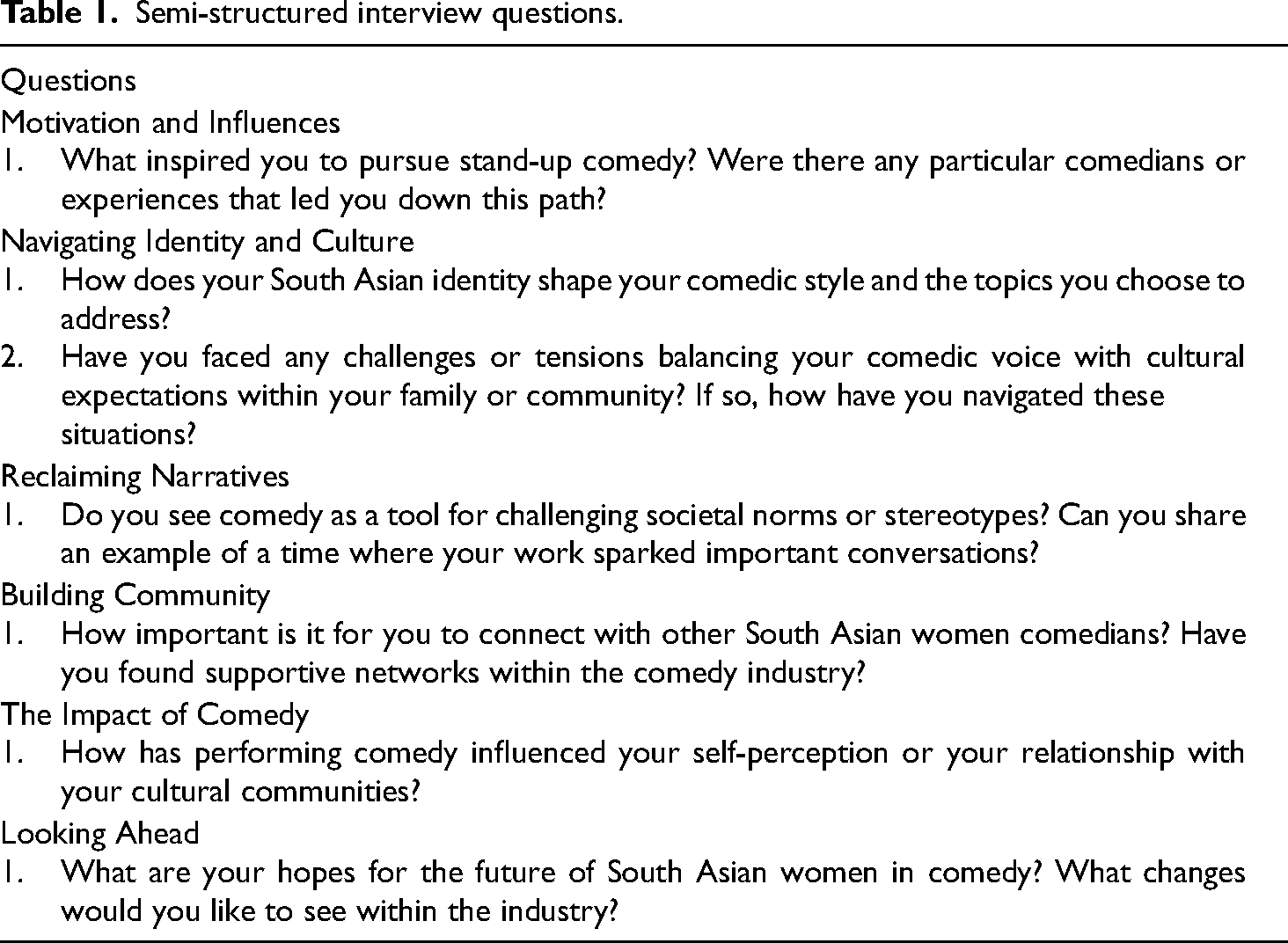
Data was collected through in-depth, semi-structured interviews with seven self-identified South Asian women comedians. Semi-structured interviews provide flexibility while ensuring a focus on key themes related to the research questions (Jamshed, 2014). The questions explored their motivations for choosing comedy, their experiences navigating cultural expectations, how they use humour to challenge norms and the impact of their work on themselves and their communities (Table 1).
Semi-structured interview questions.
Participants
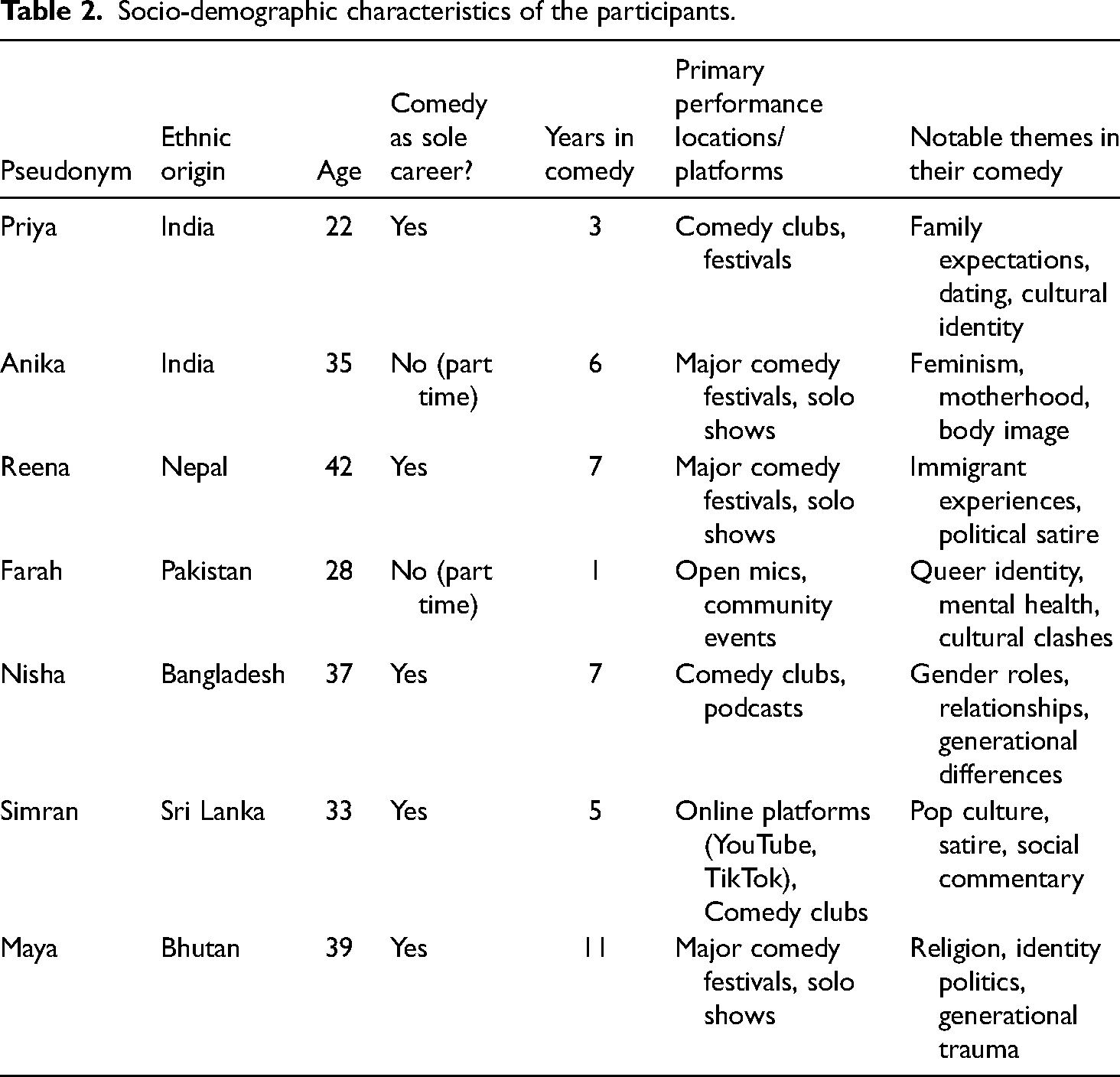
Seven South Asian women stand-up comedians based in Melbourne and Sydney, Australia, participated in this study. Participants were recruited through purposive and snowball sampling. Initial contact was made with these comedians via social media pages. Interested individuals registered their interest via a QR code, providing their contact details. These initial participants then provided referrals to other potential participants, allowing access to diverse voices within this niche field. The participants varied in age (ranging from early 20s to late 30s) and experience levels (emerging to established), capturing the diverse landscape of these women in Australian comedy. Their comedic styles ranged from observational humour and satire to personal anecdotes and political commentary. This diverse group allowed for a rich exploration of the multifaceted experiences of these women navigating the comedy industry and challenging societal expectations through humour (Table 2).
Socio-demographic characteristics of the participants.
Data analysis
Data analysis was conducted using a thematic analysis approach, consistent with narrative inquiry methodology (Braun and Clarke, 2006). Interview transcripts were reviewed to identify recurring themes and patterns within and across participants’ narratives. This involved open coding to pinpoint key concepts and experiences, followed by categorising and refining these codes into overarching themes (Boyatzis, 1998; Hox and Boeije, 2005). Rather than imposing pre-determined categories, I allowed themes to emerge organically from the data, ensuring that nuanced aspects of the participants’ experiences were not overlooked. The analysis was guided by a feminist post-structuralist framework, particularly how participants construct their identities, challenge cultural norms and employ humour as a tool for subversion and resistance. Through this iterative process of coding, categorising and refining, the analysis aimed to uncover both manifest and latent themes within the data, offering a comprehensive understanding of the multifaceted experiences of these comedians in Australia.
Ethical considerations
The study received ethics approval (42770) from the Monash University Human Research Ethics Committee (MUHREC). Informed consent was secured, emphasising participants’ right to withdraw at any point. Measures were taken to maintain confidentiality and anonymity when reporting findings.
Reflexivity
As a researcher, I recognise the importance of reflexivity (Olmos-Vega et al., 2023). Throughout the study, my own background and assumptions were critically examined to mitigate potential bias and ensure sensitivity in interpreting participants’ narratives. As a South Asian migrant myself, I am deeply familiar with many of the cultural norms, familial expectations and societal pressures that the participants discussed. This insider perspective allowed for a nuanced understanding of their experiences. However, I also acknowledge that my positionality as a male South Asian migrant involved in diasporic community activities introduces complexities to this ‘insider‘ perspective. My gender, in particular, may create blind spots regarding the specific challenges faced by women navigating patriarchal structures within both South Asian communities and the male-dominated field of comedy. While I share a cultural background with the participants, I have not experienced the same gendered expectations and limitations that they have encountered. Furthermore, my involvement in South Asian diasporic community activities, while providing valuable insights, might also predispose me to certain perspectives or assumptions about cultural norms and values. It is important to note that my own experiences as a migrant, while potentially offering some understanding of the challenges of navigating a new cultural landscape, may differ significantly from those of the participants, particularly regarding gender dynamics and the specific pressures faced by women in the entertainment industry.
To address these potential biases, I engaged in ongoing critical self-reflection throughout the research process. This involved questioning my interpretations of the data, considering alternative perspectives and actively seeking feedback from colleagues with diverse backgrounds. I also acknowledge that my specific positionality might influence the research process itself, potentially shaping the way participants interact with me and the narratives they choose to share. Recognising these limitations, this study prioritises the participants’ voices and experiences, allowing their narratives to take centre stage. While my background provides a valuable lens through which to understand the cultural context, I have strived to remain aware of the limitations of my perspective and to prioritise the participants’ lived experiences. This qualitative study prioritises depth over generalisability. The findings reflect the experiences of the specific participants involved. Future research with a larger sample size could broaden the scope of analysis and identify potential variations in experiences based on comedians’ differing locations, countries, cultural backgrounds and other intersecting identities.
Findings and discussion
Three core themes emerged from the data. The first theme, ‘Challenging Expectations: How Comedy Confronts Prescribed Paths’, examines how comedians disrupt socially imposed trajectories and negotiate creative autonomy, and its sub-theme, ‘Expanding the Repertoire: Redefining Success and Navigating Resistance’, explores the ongoing tensions involved. The second theme, ‘Reclaiming Shame: Comedy as a Tool to Overturn Negative Associations with Women's Ambition and Audacity’, reveals how humour subverts patriarchal norms by reframing shame as a source of resilience. Finally, ‘Creating Community: Building Solidarity and Alternative Support Systems’, alongside its sub-theme ‘Beyond the Punchline: Solidarity and Social Change’, explores how collective comedic engagement fosters support networks and drives broader social transformation.
Challenging expectations: how comedy confronts prescribed paths
Honestly, I was a good student. I could have easily followed the conventional path, pursuing a career in medicine, law or engineering, as expected within my community. But that path felt stifling, devoid of the creative spark I craved. There was this persistent itch within me to break free from the mould, to forge my own path. Comedy, with its potential for social critique and unapologetic self-expression, felt like the ultimate rebellion. It was a way to challenge not only societal expectations but also my own internalised limitations.
This sense of rebellion against a prescribed path expands into a critique of the broader social expectations placed upon South Asian women. Nisha, 37, identifying with her Bangladeshi identity and taking gender roles as her prominent comic theme, highlights this: ‘I poke fun at the constant questions […] you graduate, then “when is the wedding?”, after marriage “when are the babies?”. It's like a factory conveyor belt, and God forbid you ever step off’.
Nisha's frustration with the relentless scrutiny and focus on a woman's marital and reproductive status resonates strongly with existing critiques of patriarchal structures within South Asian cultures (Chaudhuri et al., 2014). The metaphor of the ‘factory conveyor belt’ vividly illustrates how women's lives are often reduced to a rigid sequence of milestones, with little room for individual desires, ambitions or deviations from tradition. By turning these expectations into comedic material, Nisha not only expresses her own resistance but also invites the audience to question these deeply ingrained norms. This form of humour echoes feminist theories of resistance, which argue that laughter can be a powerful tool for undermining oppressive power structures and giving voice to marginalised perspectives (Kotthoff, 2022). The participant's words also evoke the concept of heteronormativity. Nisha's comedy confronts the assumption that all women aspire to the same path of heterosexual marriage and childbearing (Deutsch et al., 2007). By implicitly challenging this expectation, she highlights the potential for humour to disrupt dominant scripts about women sexuality and life trajectories.
These comedians strategically use humour to address issues of gender, family dynamics and cultural pressures in a way that aligns with scholarship examining humour as a form of social commentary and a potential tool for sparking change (Takovski, 2020). By packaging critiques of societal expectations within relatable jokes and anecdotes, these comedians make their audiences laugh while raising awareness of how traditional gender roles can be restrictive and limiting. The very act of these women occupying the stage and using humour to speak their truths disrupts patriarchal assumptions about who should have a voice and whose stories are deemed worthy of attention. Their presence and performances challenge the status quo, offering a powerful counter-narrative to the dominant discourse about South Asian womanhood. Pursuing comedy in defiance of expectations can be seen as an embodiment of feminist subversion (Kotthoff, 2022). It disrupts dominant narratives that seek to confine women to specific roles. However, this disruption was rarely without personal cost. Many comedians discussed familial disapproval and strained relationships as consequences of their choices.
Expanding the repertoire: redefining success and navigating resistance
A recurring theme in the interviews was the complex interplay between the comedians’ desires for individual expression and the expectations of their families. Reena, 42, who takes immigrant experiences and politics as her comic theme, offers a poignant reflection encapsulating this tension: My grandmother, bless her soul, would occasionally watch my comedy clips. She’d say, with a mix of bewilderment and concern, ‘You’re such a smart girl, so funny […] why waste your talents on this? You should focus on finding a good husband, settling down’. Her words stung, a reminder of the deeply ingrained expectations placed upon women in our culture. But they also ignited a fire within me. Comedy became my way of proving to her, and to myself, that I wouldn’t be confined by anyone else's script for my life.
While comedy may initially exacerbate familial tensions, participants expressed hope that their work might lead to greater understanding and acceptance over time. Despite being critical, the grandmother's observance of her granddaughter's video clips indicates curiosity and a willingness to participate, albeit with some hesitancy. This exposure to her granddaughter's chosen path holds a certain power to potentially reshape her views, even if full approval remains elusive, which aligns with scholarship on humour's ability to navigate difficult conversations and facilitate cross-generational communication (Norrick, 2009). Laughter can sometimes soften rigid stances, making space for challenging conversations and, at times, shifting attitudes, even within seemingly conservative familial structures (Billig, 2005).
The participants’ use of humour extended beyond personal experiences to critique the narrow definitions of success imposed upon these women. Reena's witty observation highlights this: ‘Doctor, lawyer, engineer or disappointment – those seem to be the options on the menu!’. This humorous quip reveals a frustrating reality faced by many women in the diaspora, where familial and societal pressures push them towards a limited set of traditionally ‘acceptable’ professions (Jafree and Rahman, 2020). By exposing this restrictive framework through comedy, the participant invites audiences to question its underlying assumptions and limitations. The framing of these choices as a ‘menu’ draws attention to how individual aspirations can be reduced to a pre-determined set of options, with deviation met with disapproval or even shame. The word ‘disappointment’ underscores the emotional weight placed upon young women, where choosing a non-traditional path is equated with failing to live up to expectations. This critique encapsulates the feminist scholarship examining the intersection of gender, race and the pressure to conform to dominant narratives of success (Davis, 2008).
For these women, such narratives are often shaped by both patriarchal expectations and the immigrant experience, where the focus on achieving financial stability and maintaining respectability can limit explorations of alternative paths (Syed, 2023). These pressures, while amplified within South Asian communities, also resonate with broader patriarchal constraints faced by women globally (Setyorini et al., 2024; United Nations, 2024). The expectation to prioritise certain careers, conform to traditional gender roles and seek validation through marriage and motherhood is prevalent across many cultures (Delgado-Herrera et al., 2024; Kim et al., 2024).
By using humour to challenge these narrow definitions of success, these comedians engage in acts of resistance and self-empowerment. They refuse to be constrained by restrictive societal scripts, instead using their platforms to create space for broader conceptions of what it means to be a successful and fulfilled woman. Their acts of defiance, however, carry a distinct cultural weight within South Asian communities, where challenging traditional norms and expectations can be met with greater resistance or repercussions compared to more liberal contexts (Vinita, 2024).
However, the act of resistance through comedy is not without its challenges. These comedians must navigate external pressures from family and community and internal conflicts and doubts. While they express defiance and determination, their narratives also reveal moments of vulnerability and self-questioning. Reena, for instance, while describing her grandmother's disapproval, also acknowledges the emotional toll it takes: ‘Her words stung […] It made me question if I was doing the right thing, if I was letting down my family’. This internal struggle highlights the complex nature of resistance, where challenging deeply ingrained cultural norms can evoke feelings of guilt and uncertainty alongside empowerment. Furthermore, the comedians’ experiences underscore that resistance is not always a linear or straightforward process. While some participants described feeling empowered and liberated by their comedy, others spoke of facing backlash or encountering resistance within their communities.
Simran, 33, whose comedy focuses on pop culture, satire and social commentary, shares an experience where a joke about arranged marriage was met with criticism from some audience members: I thought it was a funny observation about the pressures we face, but some people took it as an attack on our culture. It made me realise that resistance can be a delicate balancing act. You want to push boundaries and challenge norms, but you also don’t want to alienate your community.
Moreover, it's crucial to acknowledge that the success of these women's resistance through comedy is not always guaranteed. While these comedians utilise humour to spark conversations and challenge perspectives, they also recognise the limitations of comedy as a tool for social change. Maya reflects: ‘I hope my comedy makes people think, but I also know it's not going to magically change the world. Real change requires more than just laughter. It needs dialogue, education and action’. This acknowledgement of the limitations of humour adds another layer of complexity to the analysis of resistance. These comedians are not simply seeking to provoke or entertain; they are engaged in a nuanced and multifaceted process of challenging norms, sparking dialogue and contributing to broader social change.
Reclaiming shame: comedy as a tool to overturn negative associations with women's ambition and audacity
Within South Asian cultures, women are often socialised to avoid behaviour deemed too bold, assertive or outspoken, with ‘sharam’ being used to control and police their self-expression (Sangar and Howe, 2021). However, it's important to recognise that the concept of ‘sharam’ and the degree of restriction on women's freedom of expression can vary significantly across different South Asian countries and communities. For instance, research suggests that women in Afghanistan face significantly more restrictions on their freedom of movement and expression compared to women in India (Hasan, 2024; Rasuli, 2024). This diversity of experience within South Asia is crucial to acknowledge.
The participants’ narratives highlight how comedy functions as a direct confrontation of culturally embedded restrictions placed upon women from the South Asian diaspora. The very act of taking the stage embodies a defiance of shame-based expectations. Priya, 22, the youngest participant, whose comedy explores themes of family expectations, dating and cultural identity, exemplifies this transformation: Growing up, the women in my family were expected to be seen, not heard. We were taught to be quiet, to blend into the background, to let the men take centre stage. So, the very act of grabbing the microphone and stepping into the spotlight felt like a radical act of defiance, a shattering of a lifetime of ingrained rules and expectations. The first few times I performed, I was paralysed by fear, my heart pounding in my chest. But then, something incredible happened. A shift occurred within me. I realised that standing on that stage, speaking my truth and making people laugh was the most empowering, the least shameful position I could possibly occupy.
This transformation connects to the concept of reclaiming the word ‘besharam’. In traditional South Asian contexts, this term is frequently used as a weapon to control women's behaviours and aspirations (Hall and Taylor, 2023). However, these women reappropriate the label through their comedy, turning it into a badge of defiance and audacity. Their use of humour not only combats internalised shame but also challenges society's tendency to label ambitious, outspoken women negatively. This act of reappropriation aligns with feminist scholarship exploring how marginalised groups can use humour to subvert dominant meanings and reclaim terms used to denigrate them (Marvin, 2022).
Participants often used self-deprecating humour as a tactical approach. By playfully poking fun at themselves and their flaws, they disarm potential criticism while subtly challenging the expectation of feminine perfection. Priya explained: ‘I’ll get up on stage and talk about my awkwardness, my dating disasters, anything that's not “ladylike”. But by owning it and laughing about it, I take away the power of anyone else to use those things against me’. Furthermore, the comedians deliberately targeted the way the term ‘besharam’ is weaponised against women who dare to defy convention. They sought to reclaim and transform this label into a badge of honour. Anika, 35, whose comedy often centres on feminism, motherhood and body image, daringly stated: ‘They call me shameless? Absolutely! I’m shameless in owning my desires, shameless in speaking my mind. It's my superpower’. This reframing of ‘besharam’ is potent. It disassociates the term from negativity, linking it instead to boldness, agency and a rejection of oppressive social codes. Through this act of linguistic reclamation, these comedians demonstrate their agency in shaping their own narratives and resisting the power of language to define them (Coles, 2016).
The reclaiming of shame and audacity through comedy extends beyond individual empowerment to encompass a broader challenge to patriarchal norms and expectations. While these power struggles are not unique to South Asian women, their manifestations within South Asian communities carry specific cultural and social weight (Kushal and Manickam, 2014). By boldly occupying the stage and challenging restrictive norms, these women become role models, demonstrating the power of resistance and offering diverse and evolving narratives of what it means to be a South Asian woman (Kumar and Dutta, 2024). Their visibility undermines traditional narratives that seek to confine women to silence and submission. As they fearlessly tackle topics deemed taboo within traditional spheres, they model a form of audacity that can inspire young women witnessing them. This representation holds immense potential to chip away at internalised shame and spark aspirations that girls might otherwise have suppressed.
Importantly, the act of reclaiming shame extends beyond personal struggles. Anika's words underscore how her comedy aims to hold a mirror up to those who perpetuate harmful judgements: My comedy isn’t simply about sharing personal anecdotes or poking fun at my own dating mishaps. It's about holding a mirror up to our community, challenging those who perpetuate harmful judgements and perpetuate a culture of shame. I’m calling out the aunties who scrutinise every young woman's body, the uncles who feel entitled to comment on what we wear, the relatives who gossip and spread rumours. It's about shifting the narrative, turning the tables and placing the shame back where it belongs – on those who weaponise it to control and silence women.
These comedians also confront and dismantle harmful stereotypes often perpetuated about their communities, particularly within Western media. Farah, 28, whose comedy explores themes of queer identity, mental health and cultural clashes, explains her strategy: ‘I talk about the stereotypes – the timid, submissive brown girl, the spicy temptress […] they’re all so narrow. By playing with those tropes, exaggerating them, I ridicule them, and show there's so much more to us’.
Crucially, Farah's words emphasise that her comedy doesn’t simply stop at deconstructing stereotypes. The phrase ‘show there's so much more to us’ indicates a proactive reclaiming of the narrative surrounding South Asian womanhood. By rejecting the ‘timid, submissive’ image or the ‘spicy temptress’ trope, she clears space for a multiplicity of identities and experiences. This form of resistance aligns with the concept of ‘counter-storytelling’, where marginalised groups challenge dominant narratives by offering alternative representations grounded in their own lived realities (Wagaman et al., 2018). The comedy stage becomes a platform for asserting a complex, authentic, self-defined South Asian women's identity that defies reductionist stereotypes. The participants’ strategy of using humour to dismantle stereotypes connects to postcolonial scholarship that highlights the power of representation in shaping perceptions and power relations (Barthold et al., 2022). By seizing control of their own narratives and resisting dehumanising depictions, these comedians engage in an act of resistance against the ongoing legacy of colonial representations.
This approach, however, requires skilful navigation to avoid the pitfall of reinforcing the very stereotypes being challenged. The effectiveness of such comedic strategies lies in a nuanced understanding of audience reception and the ability to subvert expectations without perpetuating harmful tropes. Through their performances, these comedians walk a fine line, requiring them to be both savvy about the stereotypes they confront and deeply authentic in their self-representation. Their use of humour allows them to engage in this complex act of resistance in a way that is disarming, accessible and potentially transformative for both South Asian and mainstream audiences.
Creating community: building solidarity and alternative support systems
A recurring sentiment among the participants was the profound sense of community and support they found through their involvement in comedy. This finding contrasts the historical isolation that women have often experienced in these male-dominated spheres (Blanch, 2013). Their experience mirrors feminist scholarship emphasising how spaces created by and for women provide crucial support for navigating traditionally marginalised fields (Kotthoff, 2022). These comedians interviewed described a conscious effort to create spaces where they could collaborate, uplift and learn from one another.
Simran's vibrant description of their WhatsApp group provides a tangible example of this alternative support: We have this WhatsApp group, a vibrant network of all the South Asian women in comedy I know. It's more than just a chat group; it's a lifeline, a safe haven in an industry that can often feel isolating. We exchange advice, share gig opportunities and celebrate each other's successes. But most importantly, it's a space where we find validation and understanding. We navigate unique challenges that our white female counterparts or even South Asian male comedians might not fully grasp – the cultural expectations, the familial pressures, the subtle biases we encounter. In this group, we find solidarity and support, a reminder that we’re not alone in this journey.
The emphasis on support and collaboration stands in contrast to the often-perceived culture of cutthroat competition within the comedy industry (Trusolino and Ships, 2023). These women consciously build a network rooted in mutual empowerment and a rising-tide-lifts-all-boats mentality, which supports feminist scholarship advocating for collaborative models that dismantle power structures and foster collective success (Rajeshwari et al., 2022). By actively working to create spaces of mentorship, feedback and encouragement, these women challenge traditionally male-dominated industry norms and redefine success as a shared endeavour. This sense of community provides a buffer against the harsh criticisms, rejections and isolation that can be particularly demoralising for women pursuing unconventional careers.
Beyond the punchline: solidarity and social change
The significance of this community lies in its emphasis on shared experience. It highlights a crucial aspect of marginalised group members carving out space for themselves within broader cultural and professional contexts. For these women navigating a niche field, having a community of peers who understand their path's unique challenges and triumphs fosters a sense of belonging and breaks down potential isolation. This support system is vital considering the complexities they navigate both in the comedy industry and within their own communities. Participants also described a sense of responsibility to pave the way for the next generation. Several participants mentioned offering mentorship or workshops for young women interested in comedy. Maya stated: ‘When I started, there was no blueprint. Now, if I can make it a little bit easier for the girls coming after me, that means everything’.
The participants’ commitment to mentoring and community building reflects a powerful feminist ethos. They understand that their presence in the comedy scene, while groundbreaking, is only the first step. By actively working to pave the way for the next generation, they participate in dismantling systemic barriers and creating sustainable change within the industry. This approach reflects a ‘pass the torch mentality’ – a desire to ensure that their hard-won success translates into expanded opportunities for those who follow (Wang et al., 2020). The focus on mentorship is consistent with feminist scholarship addressing the importance of creating support networks for women across diverse professions and generations (Harris, 2022). The ripple effects of their work extend beyond individual careers to fostering a broader sense of community and possibility for South Asian girls and women. Maya's touching anecdote reveals the deep impact of her visibility: A young girl wrote to me, saying she always felt like she had to hide her funny, weird side because it wasn’t what was expected of her. Seeing me on stage made her feel like she could just be herself. That's everything.
This message illustrates the psychological and emotional impact of representation. It underscores a core principle of feminist media studies: seeing oneself reflected in popular culture has the power to break down internalised limitations and expand the realm of the possible (Sharp, 2022; Stang, 2020). For South Asian girls navigating complex intersections of cultural expectations and personal aspirations, witnessing a woman who shares their background boldly expressing humour and ‘weirdness’ offers validation they may not find elsewhere. These comedians become more than entertainers; they become role models for self-acceptance and unapologetic authenticity. Their success highlights multiple ways to be a South Asian woman. Their visibility normalises self-expression, ambition and non-conformity, providing an alternative script for young women navigating restrictive expectations. This form of mentorship, even at a distance through the power of the stage, can nurture a sense of confidence and resilience in the face of potential criticism or resistance to their unconventional choices.
The interviews further revealed that these comedians see their work as extending far beyond entertainment. They strategically use humour as a tool to spark important conversations about traditionally taboo topics, challenging audiences to think critically about social issues and prevailing norms. Farah's perspective exemplifies this activist aspect of their comedy: For me, comedy isn’t simply about delivering punchlines and getting laughs. It's about using humour as a tool to spark meaningful conversations and challenge the status quo. I tackle topics that are often considered taboo within our communities – mental health stigma, LGBTQI + rights, the oppressive practice of dowry and the importance of body positivity. By infusing humour into these discussions, I create a space where people are more receptive to listening and engaging with these critical issues. It's not about providing easy answers but about planting seeds of change, encouraging reflection and hopefully, over time, contributing to a shift in attitudes and perspectives.
The participant's aim of ‘starting conversations’ reflects an understanding that humour is not necessarily a solution but can be a catalyst for change. By opening up dialogue around issues like mental health, LGBTQI + rights, dowry and body positivity, Farah fosters a space for reflection, questioning and potentially shifting attitudes within her audiences. The form of activism described supports feminist media studies, which underscore the potential of popular culture to raise awareness and shape public discourse on social issues (Scharff, 2023). While the long-term impact might be difficult to measure, the very act of placing these topics on a public stage challenges their ‘taboo’ status and contributes to normalising critical discussions around them.
Farah suggests that through comedy, ‘maybe, just maybe, things start to shift’. Such a phrase expresses both hope and patience about the potential for change, and it highlights a realistic understanding of social change as a gradual and multifaceted process rather than an immediate outcome of her comedy sets. Importantly, this approach using humour can function as a bridge between generations and transcends geographical boundaries (Mullan and Béal, 2021). Younger audiences might be more receptive to progressive messages delivered via comedy than lectures from parents or traditional authority figures (Lobo and Shivshankar Bhat, 2022). By addressing issues relevant to young South Asians, these comedians create a space for intergenerational conversations, leading to a greater understanding and potential evolution of cultural attitudes. The use of social media to transcend geographical boundaries and create virtual communities is a striking aspect of modern women's comedy. Simran's comment illuminates this phenomenon: ‘It's incredible! I get messages from South Asian women in London, Dubai, New York, Johannesburg […], saying my work resonates with them. It's like a virtual community united by shared experiences and laughter’.
Her excitement and sense of wonder are palpable in the phrase ‘It's incredible!’. The diverse locations highlight a global South Asian diaspora, interconnected by shared cultural references and experiences of navigating womanhood within various cultural contexts. The emphasis on ‘resonance’ suggests deep recognition and shared understanding. The power of laughter serves as a unifying force, promoting a sense of belonging and solidarity transcending geographical boundaries.
Conclusion
This study illuminates the multifaceted ways in which South Asian Australian women comedians act as both entertainers and agents of social change. Their bold entry into a traditionally male-dominated field signifies a disruption of patriarchal structures within the comedy industry and their cultural communities. Using humour, they challenge restrictive expectations, expose double standards and satirise harmful traditions. In doing so, they reclaim the power to define their own identities, defying societal pressure to conform to prescribed roles. The themes of ‘Besharam to Bold’ encapsulate this transformative journey. These comedians strategically weaponise humour to turn traditionally negative associations with audacity and ambition into sources of strength and empowerment. Their work creates space for marginalised voices and experiences, offering a vital counter-narrative to dominant cultural scripts that seek to control and silence women.
Crucially, this impact extends beyond individual stages. The forging of strong, supportive communities amongst these comedians fosters mentorship, collaboration and a determination to expand opportunities for the next generation. Additionally, the global reach enabled by social media creates transnational communities of solidarity and shared understanding, demonstrating the power of laughter to transcend borders. This research has implications beyond the realm of comedy. It invites a deeper interrogation of humour's role in dismantling oppressive systems and sparking social transformation.
The work of these comedians carries implications far beyond the realm of entertainment. Their acts challenge dominant cultural narratives that limit women's potential and confine them to specific roles. By publicly defying these norms, they expand the space for their own lives and model diverse and evolving possibilities for women within their communities, inspiring others to break free from conventional paths. Furthermore, this study highlights the power of humour as a tool for social change. By satirising harmful expectations, inequalities and stereotypes, these women create spaces for critical dialogue and reflection. Their work subtly challenges audiences to question deeply ingrained norms, opening possibilities for a more equitable and inclusive society.
Notably, the findings underscore the need to acknowledge the diverse experiences of these women. While this study focused on shared experiences and common struggles among South Asian women comedians in Australia, it is crucial to recognise that ‘South Asian’ and ‘women’ are not monolithic categories. The participants in this study, while identifying with these broad labels, demonstrated a range of perspectives and experiences shaped by their individual backgrounds, cultural contexts and personal beliefs. Their shared identity as South Asian women in comedy provided a common ground for connection and solidarity but did not erase their individual nuances and differences. This focus on shared struggle and collective empowerment, while acknowledging individual differences, highlights their commitment to building a supportive community and advocating for greater representation and inclusivity within the comedy landscape. It also underscores the complexities of the patriarchal norms and expectations they challenge. While some of these norms, such as restrictions on women's freedom of expression and pressures to conform to traditional gender roles, are prevalent across many societies, their manifestations and consequences within South Asian communities carry a specific cultural and social weight. Furthermore, it is important to acknowledge that this study represents a specific snapshot of a particular group of women comedians in Australia. Their experiences and perspectives, while valuable, should not be generalised to represent all South Asian women or all feminist perspectives.
This study offers fertile ground for further research. A comparative analysis of South Asian women comedians across different geographic locations could illuminate how their work responds to varying cultural contexts within the broader South Asian diaspora. Additionally, a longitudinal study tracking the careers of these early pioneers would shed light on how their comedic acts and strategies for navigating resistance evolve over time. Furthermore, examining audience reception would offer valuable insights. Exploring the intersectional experiences such as class, sexuality and religion of these comedians promises to be a rich field of inquiry that shapes their work and the challenges they face. Understanding these complexities will offer a more nuanced picture of their transformative role in both the entertainment industry and South Asian society. Finally, this study provides a glimpse into a burgeoning movement of South Asian women boldly claiming their space in the world of comedy. Their laughter carries the force of a revolution – one that champions individual expression, challenges cultural restrictions and lays the foundation for a future where South Asian women have the freedom to pursue their passions without compromise.
Footnotes
Declaration of conflicting interests
The author(s) declared no potential conflicts of interest with respect to the research, authorship, and/or publication of this article.
Funding
This research received no specific grant from any funding agency in the public, commercial or not-for-profit sectors.
