




Abstract
How was Barbie discussed on social media after the film's release in July 2023? While a great deal of media and academic commentary offers presumptive answers, to our knowledge no study has sought to address such a question empirically. We examine all posts on Meta's Facebook and Instagram platforms that mentioned Barbie during the month of the movie's premiere. Using soft clustering of large language model embeddings, we offer an informed answer to that question. Barbie was discussed in an impressively wide variety of contexts: from co-opting Barbie as a means of boosting sales or one's online following; to celebratory expressions of gratitude and excitement; gendered frames of the movie as feminine success; thoughtful discussions of gender, motherhood and broader questions about who has ‘Kenergy’ and what constitutes being ‘Kenough’. Importantly, these discourses cast doubt on the assumption that criticisms of the movie commanded the public's primary attention online.
Research on Barbie has largely focused on how exposure to Barbie dolls has a negative impact on body image (Dittmar et al., 2006; Jellinek et al., 2016; Rice et al., 2016; Harriger et al., 2019; Boothroyd et al., 2021; Webb et al., 2023) and career aspirations (Sherman and Zurbriggen, 2014; Fulcher et al., 2023). In general, research to date suggests that these negative impacts are consistent and typically immune to mitigation efforts. Mattel's 2016 Fashionista and Made-to-Move lines represent some of these mitigation efforts. For example, the Fashionista line introduced dolls covering a range of body types, such as curvy, tall, etc. Similarly, the Made-to-Move line consisted of Barbie dolls with improved articulation, with the idea that increased (joint) flexibility allowed Barbie to do a greater range of activities. Despite these efforts, Jennifer Harriger et al. (2019) demonstrated that three- to ten-year-old girls showed more negative attitudes towards the curvy dolls in the Fashionista line. Such negative effects are not limited by age either, with Jennifer Webb et al. (2023) revealing that exposure to Made-to-Move Barbie decreased body appreciation and increased appearance comparison in college-age women. To some, Barbie's recent blockbuster movie (2023) only reinforces these problematic negative effects. Virgie Tovar (2023) notes that Barbie does nothing to challenge the long-held detrimental relationship between Barbie and negative body image, while Suzie Gibson et al. (2023) claim that the movie reinforces old gender constructions, with a ‘heterosexist and patriarchal construction of gender and sexuality that locks Barbie and Ken, and by extension women and men within a limited dynamic that ultimately undercuts identity and agency’. Much like the releases of the Fashionista and Made-to-Move lines, the movie, Lauren Gurrieri (2023) suggests, is just another attempt to ‘revitalise and redefine a brand with a contested position and history’. Although not exhaustive, these examples from popular media outlets highlight quite a negative response to the film.
Yet, Barbie has also proved to be incredibly popular amongst a diverse range of audiences, to the point of drawing the ire of right-wing commentators such as Ben Shapiro (Yang, 2023). Indeed, some feminist scholars celebrate the movie as a triumph, with Rebecca Stringer noting that the film is ‘funny, and engaging, gorgeous all at the same time. So the film is a resounding success’ (1News, 2023). While much of this positivity, for example, applauds the film for its portrayal of women (e.g. ‘paradigm-shifting in how it elevates femininity’, according to Babiak, 2023), many argue that this should not restrict its audience: ‘[w]hile the film obviously appeals to women, it is men who really need to watch it’ (Fletcher, 2023). In turn, the movie operates as a flashpoint for online debate. To some, this discussion represents a ‘swirling controversy’ about (perceived) ‘unnecessary wokeness’ (Economic Times, 2023) that ‘sparks’ (Pearcy 2023) and ‘ignites’ (Coyne, 2023) social media debate. However, the evidence for these accusations is less conclusive than such inflammatory language would suggest. Typically, such justifications consist of a mere handful of social media posts. That limitation – amid seemingly widespread public acceptance – highlights a valuable research gap. We map the varying ways that Barbie was discussed during the month after the film's release on Meta's Facebook and Instagram platforms. Across approximately 321,000 posts, we show that Barbie was mentioned in a wide variety of contexts: from co-opting it as a means of boosting sales or one's online following; to celebratory expressions of gratitude and excitement; gendered frames of the movie as feminine success; thoughtful discussions of gender, motherhood and broader questions about who has ‘Kenergy’ and what constitutes being ‘Kenough’. While the data offers a far more nuanced picture of how social media responded to Barbie, it also casts doubt on the assumption that criticisms of the movie commanded the public's primary attention online. We draw no conclusions on whether these results are promising or concerning, though. Instead, we invite colleagues to use our findings as an empirical basis for informed, ongoing discussion. Such an unusual approach requires that we diverge from the traditional structure of an academic article: the next section briefly outlines the methods used to produce our data and our general research questions, before we finish with a brief discussion of our results and a summary designed to invite responses to these findings.
Methods, research and results
We collected all posts on Meta's Facebook and Instagram platforms that mentioned the (case-insensitive) keyword ‘barbie’ during the first month of the movie's release (22 July, the day after the premiere, to 22 August). The data was extracted via CrowdTangle, Meta's approved API. This produced approximately 220,000 Facebook and 101,000 Instagram posts. To examine these approximately 321,000 posts, we followed a slightly modified version of Grootendorst's (2022) popular Bidirectional Encoder Representations from Transformers (BERTopic) neural topic modelling programme. Unlike traditional topic modelling, BERTopic aids understanding by processing sequences of text and the relationship between words. We identified (over) 600,000 unique sentences from these posts and used a large language model (all-MiniLM-L6-v2) to embed these sentences into 384 dimensions. This embedding space was then reduced to five dimensions (via UMAP), and finally two (via t-SNE). The additional dimension reduction step capitalised on t-SNE's tendency to produce ‘clumpy’ clusters, which is useful with more refined datasets. Finally, we utilised HDBSCAN to ‘soft’ cluster these sentences into topics and discarded irrelevant topics (i.e. noise and non-English categories). All code used to produce these findings can be found in an Open Science Framework repository (see our data availability statement). Moving beyond the jargon, this method uses machine-learning technology to categorise sentences from our Barbie-specific posts.
The result is a topic model explaining all the (sentence-level) ways that Barbie was discussed. This topic model served as the foundation for our first research question: RQ1: How was Barbie discussed (i.e. topics) on Facebook and Instagram after the movie's release? The CrowdTangle data also includes standard social media metrics, including total engagements (e.g. likes, reactions, comments, shares) and potential audience reach (e.g. total followers at posting). These metrics can prove useful in determining which topics were more popular than others, which informed our next research question: RQ2: Which of these Barbie topics were most popular on Meta platforms? Having determined the ways that Barbie was discussed (i.e. topics) and identified how the public responded to these discourses (i.e. popularity), we then had an informed foundation from which to pose some thoughts for future research in the spirit of producing an interchange with experts in the field: RQ3: What might these findings offer for expert discussion going forward?
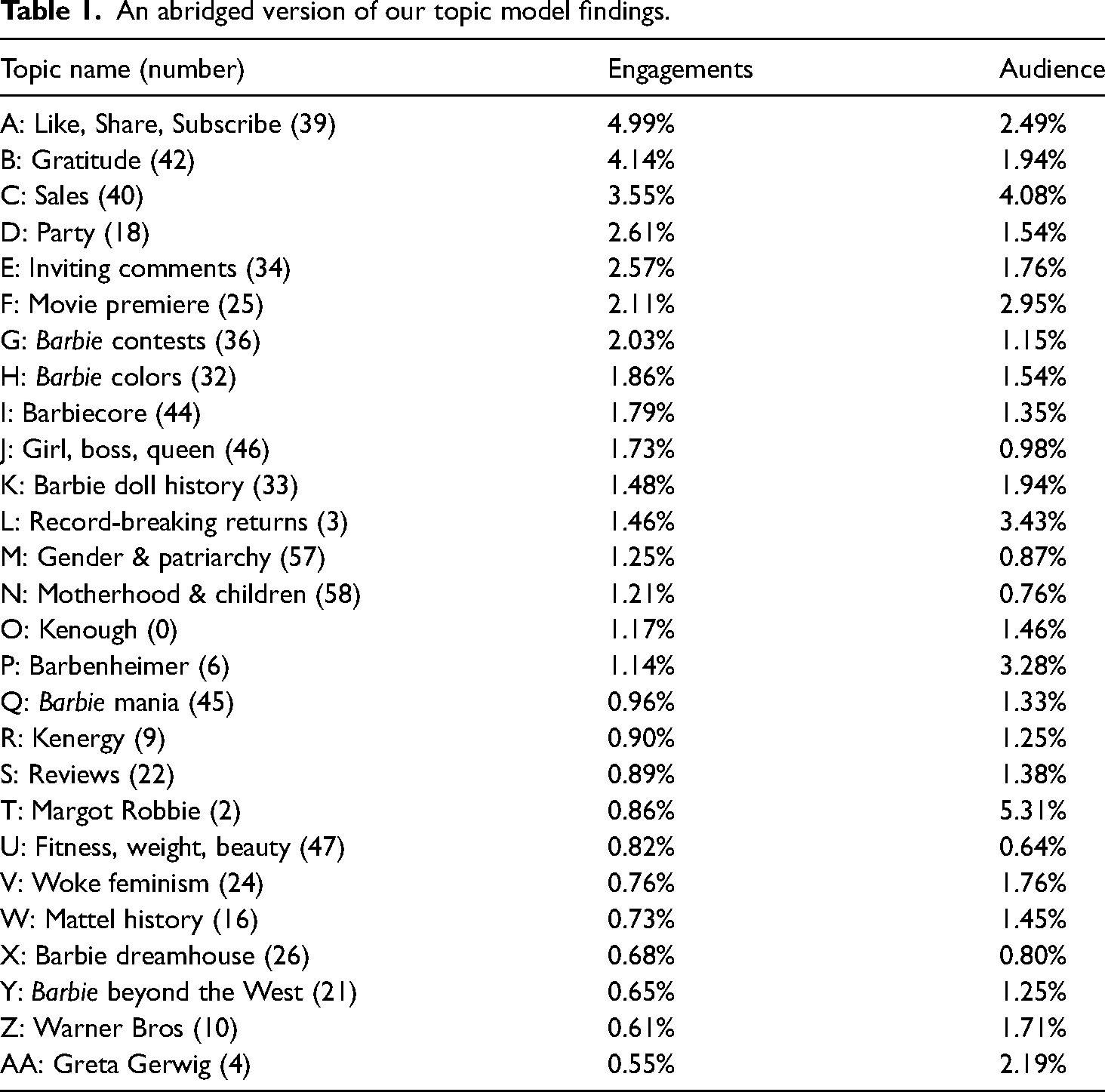
The results in Table 1 offer an abridged version of our topic model findings. Specifically, we list twenty-seven topics from our model, selected for their overall popularity, audience reach and potential interest to readers of the current study. Our Online Supplement (see data availability statement) contains the full results (i.e. all fifty-nine topics), with the corresponding representative words and sentences used to produce the (more descriptive) topic names in Table 1.
An abridged version of our topic model findings.
Our Online Supplement provides a temporal picture of how these twenty-seven topics were discussed over time. The most immediate finding from the timelines shows that all topics declined (in frequency) over the data collection period. In other words, the topics saw a spike when the movie was released, and then a decline over the next thirty days. This suggests that our method successfully captured Barbie discourse.
A qualitative assessment of the topics confirms this, with movie-specific discussions about the actors (e.g. T: Margot Robbie); the director (i.e. AA: Greta Gerwig); the film's release (F: Movie premiere); its film studio (Z: Warner Bros.); and its competition (P: Barbenheimer):
‘BARBIE was directed by Greta Gerwig, starring MARGOT ROBBIE as BARBIE, and RYAN GOSLING as KEN’ ‘Whether you are Team Barbie or Team Oppenheimer, the world has been overtaken with Barbenheimer fever!’ ‘As [Barbie] reaches the magical $1 Billion mark this weekend, Universal and Sonys [sic] loss is Warner Bros biggest hit of the year’ ‘LIKE this post FOLLOW & TAG a friend in the comments!’ ‘Get the look now for 40 percent off before your next movie night!’ ‘The lucky winner will be announced on our story and will be contacted via DM’ ‘… Just a reminder we still have a Barbie raffle going on …’ ‘Since sweeping our screens, Barbie mania has made a cultural impact’ ‘… The idea that we are not enough no matter what we do is crazy, and I encourage you, if you take nothing else out of this post or Barbie movie is to see your ENOUGHNESS!’ ‘wine tasting dinner at our fave spot Barbie movie Carmel Valley fiesta time spent together = priceless’ ‘… I cant listen to Billie Eilishs [sic] track from the Barbie movie without instantly BURSTING into tears’ ‘Pink is the hot color to wear right now, thanks to Barbie the Movie’ ‘Barbie trend 2023 Barbiecore is a fashion trend inspired by the iconic Barbie doll’ ‘How to Rent the Real-Life Barbie Malibu Dreamhouse on Airbnb’ ‘Greta Gerwig Makes Box Office History As Barbie Becomes Biggest Debut Ever For Female Director’ ‘Greta Gerwig becomes first female solo director to top $1 billion box office ticket sales’
A casual survey of these selected topics reveals the wide variety of contexts in which Barbie was discussed. For example, the movie appeared prominently in invitations to engage online (e.g. A: Like, Share, Subscribe; E: Inviting comments), and similarly was promotionally deployed in marketing (G: Barbie contests) and sales (Topic C) contexts. Considering Barbie – and its brand – as a product to be sold is instructive. These discourses speak to Helen King's (2024) ‘commodity feminism’, as discussed elsewhere in this Special Issue.
Barbie also prompted genuine emotional responses, from discussions of self-love (B: Gratitude) and excitement (D: Party), to empowerment (J: Girl, boss, queen) and proclamations that ‘Barbie mania is taking the world by storm!’ (Q).
The visual aesthetic of Barbie also featured clearly in the data: from discussing Barbie's colours (H), to celebrating ‘Barbiecore’ fashion (I), and even requests to rent the movie's real-life Barbie Dreamhouse (X):
Moving to more gender-specific topics, the data shows several notable discourses. For example, some topics tend to frame the movie's financial success as a female-specific record-breaking phenomenon (i.e. Topic L), a notable contrast with the Warner Bros. (Z) success frame noted above:
Together, the topics covered above demonstrate a positive response to the surface-level content of Barbie, including the actors involved, the visual aesthetic and the box office success. Amongst this is evidence of people using this positive response for their own ends, such as marketing and self-promotion.
Debates over gender and the patriarchy (M), criticism of the movie as ‘woke’ (V) and discussions of motherhood and children (N) all offer relevant discourses that are thoroughly interrogated within this Special Issue and elsewhere.
‘I thought feminism was about equality … Why does empowering women have to be about trashing men?’ ‘Barbie Movie is a Nuclear Level Woke Feminist Fantasy That HATES Men’ ‘Fans have had conflicting feelings about this quote from the new #Barbie movie [‘We mothers stand still so our daughters can look back to see how far they have come’]. While mothers sacrifice so much for their kids, it's important to remember that you don’t have to stand still. You’re still a person in your own right, you still have dreams too’
Some of this language embodies the heated debate seemingly surrounding the film. Yet what goes unconsidered elsewhere is how comparatively unpopular these specific discourses were, most generally commanding around 1 per cent (or less) of all social media engagement (Table 1). In fact, the ‘woke’ topic, somewhat unusually, produced fewer engagements (0.76 per cent) than its audience reach (1.76 per cent), suggesting that audiences were less interested in responding to these criticisms than other categories. Importantly, Barbie's non-Western adoption (Y) also shows instances of celebration and rejection of the movie (and the doll) outside the Global North. Here, discussions arise from Africa, India and Latin America, offering questions like, ‘What will it take for Latina girls to find themselves reflected in their favorite toys?’ and ‘who would ‘make the perfect Ken if the movie Barbie was to be made in Bollywood?’. Javaria Farooqui's (2024) analysis of reactions to Barbie in Pakistan offers much insight along these lines.
Finally, from the male perspective, Barbie's portrayal of men offered two notable responses: on the one hand the movie's well-known ‘Kenough’ (O) scene prompted much discussion, including celebration as a cultural meme: ‘… why we are all Kenough I was surprised after watching Barbie that I actually felt more moved by Kens story arc, because of the current climate of masculinity clashes we are seeing in the (sadly) real world today.’
‘Hi Im Barbie and this is Workout Ken hes going to beach you off real good’
‘We dont have to be empowered or girl power or girl boss (I wonder if they guys praising Ryan Goslings Ken realise that Kenergy is probably a satire of girl power. Feeling it now?) to be allowed to exist’
Overall, discussion of gender and the patriarchy, criticism of the movie as ‘woke’ and conversations of motherhood and children were less frequent than discussions of the actors involved, the visual aesthetic and the box office success. However, although less frequent, such topics have nevertheless guided much of the popular discussion around the movie.
Summary and conclusion
We used state-of-the-art natural language-processing tools to explore how Barbie was discussed on Facebook and Instagram during the month of the movie's premiere. Our goal was to provide some empirical evidence for further expert analysis. We now turn to answering our three research questions. RQ1: How was Barbie discussed (i.e. topics) on Facebook and Instagram after the movie's release?
Barbie was clearly discussed in a wide variety of ways online. Table 1 shows that Barbie was discussed from a financial, emotional and political perspective. The Online Supplement shows an even wider application, ranging from politics, and baking, to fashion, photography, music and beyond. RQ2: Which of these Barbie topics were most popular on Meta platforms?
The most popular topics indicate that the movie was co-opted by many as a means of increasing their following and reach (e.g. Topic A: Like, Share, Subscribe), or to boost sales (C: Sales) with contests (G: Barbie contests). It is also important to note that emotional celebrations of the movie (B: Gratitude; D: Party), its potential for empowerment (J: Girl, boss, queen), an exploration of the doll's social and political history (K) and discussion of Barbie's colours (H) and fashion (I: Barbiecore) were also popular discourses. While there is some area for disagreement, these too appear largely positive, popular responses. RQ3: What might these findings offer for expert discussion going forward?
Several of these findings, in our view, require further scrutiny. Most obviously, the assumption that online discourse was awash with aggressive debate after the film's release is inaccurate, according to our data. Of fifty-nine topics, Barbie as ‘woke feminism’ (V) was the fortieth most popular topic, and its audience size outmatched its engagements – suggesting even that those following these critiques were less interested in engaging with them. Where debate did take place, discussions of gender and patriarchy (M) and motherhood (N) appeared to overmatch much of the public conflict narrative (e.g. calling the movie ‘woke’). Researchers looking to explore how the public engaged with these concepts can use these empirical results to ground their theoretical discussion. We offer some basic perspectives on the content of these topics, with the hope that they will form the starting point for further discussion. Regardless of the eventual direction, we welcome and look forward to that conversation.
