




Abstract
The growing popularity of intersectionality theory, the critiques levelled against it and its use in gender and development (GAD) warrant a critical reflection by feminists, especially those working with less affluent women. This article examines the stretching of intersectionality in GAD research, policymaking and practice, and shows how it has been depoliticised into becoming a ‘catch-all’ term that can be used by all feminists as a shorthand for explaining differences within the category of ‘women’. The particular focus here is on the gender analytical frameworks that are generally based on a binary understanding of gender and used in the development industry, generally by liberal feminists. Finally, and as a corrective, the article explores the possibilities of an ‘intersectionality-informed’ approach to gender analyses.
New tracks for a travelling theory
The dual consciousness of strength and the symbolism of victimisation and bondage, as well as the racist oppression of women enabled by colonialism, is extensively documented in the literature. Race – besides sex, class, skin colour, sexual orientation, age, religion, creed and disability – has for generations ‘determine[d] the female destiny’ (hooks, 2000: 11). Moving away from seeing only one wire of what feminist philosopher Marilyn Frye describes as the ‘birdcage’ (1983: 2–7) of systematically related wires, Sherryl Kleinman suggests taking ‘a macroscopic view of the whole cage’ (2007: 6) to understand each of these wires. These wires, by their relation to each other, confine women to ‘the solid walls of a dungeon [of oppression]’ (Kleinman, 2007: 6). The concept of intersectionality sums up how all these wires of the birdcage multiply to produce extreme disadvantages (McKittrick, 2006: xxviii). Black American feminist and legal scholar Kimberlé Crenshaw formally introduced the term ‘intersectionality’ in a series of articles between 1989 and 1991; intersectionality is ‘one of the greatest gifts of black women's studies to social theory’ (Belkhir, 2009: 303). Today, it is ‘unimaginable that a women's studies programme would only focus on gender’ and not on the cross-sectional interactions ‘between gender, race, and other categories of difference in individual lives, social practices, institutional arrangements, and cultural ideologies and the outcomes of these interactions in terms of power’ (Davis, 2008: 68). Olena Hankivsky (2014: 2) argues that intersectionality promotes an understanding of human beings as shaped by the interaction of different social locations that occur within a context of connected systems and structures of power, thus creating interdependent forms of privilege and oppression.
In recent years, intersectionality has left the academic and activist domains to mark interesting trajectories in development and organisational gender mainstreaming policy and practice spheres (Riley, 2004), leading to a problem. My experience is first hand, both as a person of colour representing diversity policymaking in a majority white academy and as a gender and development (GAD) practitioner. When my university, the Australian National University (ANU), initiated measures to mainstream gender in policies and practices, it created a subgroup on intersectionality, inviting me – a woman of colour – to be a representative of the Culturally and Linguistically Diverse group (as it is called in Australia). The implication was that all women of colour are, by virtue of their being non-White, intersectional. I am not alone in this experience. Looking at the use of intersectionality in the US university system, Nash comments that it is in ‘academic feminism that intersectionality's institutional life has taken shape’ (2019: 2). This institutionalisation has occurred not only through academic research but also through an ‘official desire’ to integrate diversity (Ahmed, 2017: 96). Practitioners in organisational or other contexts have adopted intersectionality in their inclusion and diversity work (Gedalof, 2013). Symptomatic of this spread of intersectionality is the flourishing of a whole range of books that are written by gender and diversity consultants and are targeted at corporations aiming to fulfil their diversity quotas (for example, DiAngelo, 2021), and that have been criticised as ‘anti-racist self-help’ (Senna, 2021). In social movement studies, intersectionality has come to represent how different races imagine a decolonised future (Daniel and Miller, 2022). In legal scholarship, identity-driven progressive masculinities have emerged as ‘post-intersectional’, which is ‘positioned over and against intersectionality’ (Cho, 2013: 385). In the field of GAD, there are scholar-practitioners (like Kagal and Latchford, 2020) who have also embraced intersectionality. Clearly, in this fluid situation, intersectionality has moved easily across disciplines and fields (of both practice and research) to metamorphose into a ‘travelling’ theory (Salem, 2018: 404) that warrants ‘us as feminists to pause and reflect on the trajectory the concept has taken and on the ways in which it has travelled through time and space’. Sara Salem further notes that the ‘concerns about the obliteration of intersectionality's radical beginnings, the stretching of intersectionality so that it becomes a ‘catch-all’ feminist theory that can be used by all feminists and the sanitising of intersectionality by liberal feminism’ (2018: 404) leaves out the use of the concept by the development industry.
I investigate here the reason for the sudden surge in the application of intersectionality and the meanings of its ‘use’: how it is being used in real life and by whom, and how a theoretical lens of intersectionality could be employed in GAD. Feminist praxis has pushed development planners, policymakers and donors to pay greater attention to gender equity in their development projects and initiatives. Consequently, the early, simplistic ‘women in development’ approaches that focused on incorporating women into existing development projects have evolved into the current GAD paradigm that emphasises understanding how these projects affect gender roles and relations, augment women's material well-being and productivity and empower them through their own volition. Development planners, organisations and practitioners now speak the language of empowerment rather than efficiency, take responsibility for inequities, integrate gender into policies and institutional structures, deploy and support gender specialists and internal capacity-building and conduct gender analyses of their operating environment (as noted by Chant, 2003; March et al., 2003; Cornwall, 2016). This has ushered in a need for, and the subsequent development of, gender analytical frameworks (GAFs), which are deployed to explain the complexities of the gendered sociocultural environment in the conception, planning, as well as monitoring and evaluation stages of development interventions (for example, see: Onzere et al., 2015; Kagal and Latchford, 2020). I argue that such use must not turn intersectionality into a simple instrument to be imported from its roots, relieved of its theoretical, conceptual and methodological nuances and transplanted into contexts where it does not necessarily fit. To build this argument, I first show the increasing popularity of the term in academic literature, then lay out the critiques of intersectionality as well as its depoliticisation. I discuss feminist approaches to the study of difference, intersectional research strategy and design and types of data and data collection methods, before concluding with some critical insights for further research.
The ‘use’ of intersectionality
As a researcher on gender, I have found intersectionality everywhere: in research outputs that I read, in reviewers’ comments urging me to use ‘an intersectional lens’ and in requests from international development donors to develop a framework or a tool for practical use by workers in the field. This encouraged me to dissect the academic application of intersectionality in published material. To do so, I have used Scopus, the largest database of peer-reviewed literature. A bibliometric review 1 using this database reveals that as of 30 June 2024, the term ‘intersectionality’ or ‘intersectional’ is reflected in the title, abstract or keywords of 11,063 documents; the number would surely increase if articles, book chapters, books, reviews, conference papers and others were included in the scope of the study. Between 1994 and 2018, there was a proliferation in the use of the term ‘intersectionality’ or ‘intersectional’ in academic work, as seen in Figure 1. Until roughly 2010, the number of academic studies with this term appearing annually was less than 300, which rapidly increased from the early 2010s.
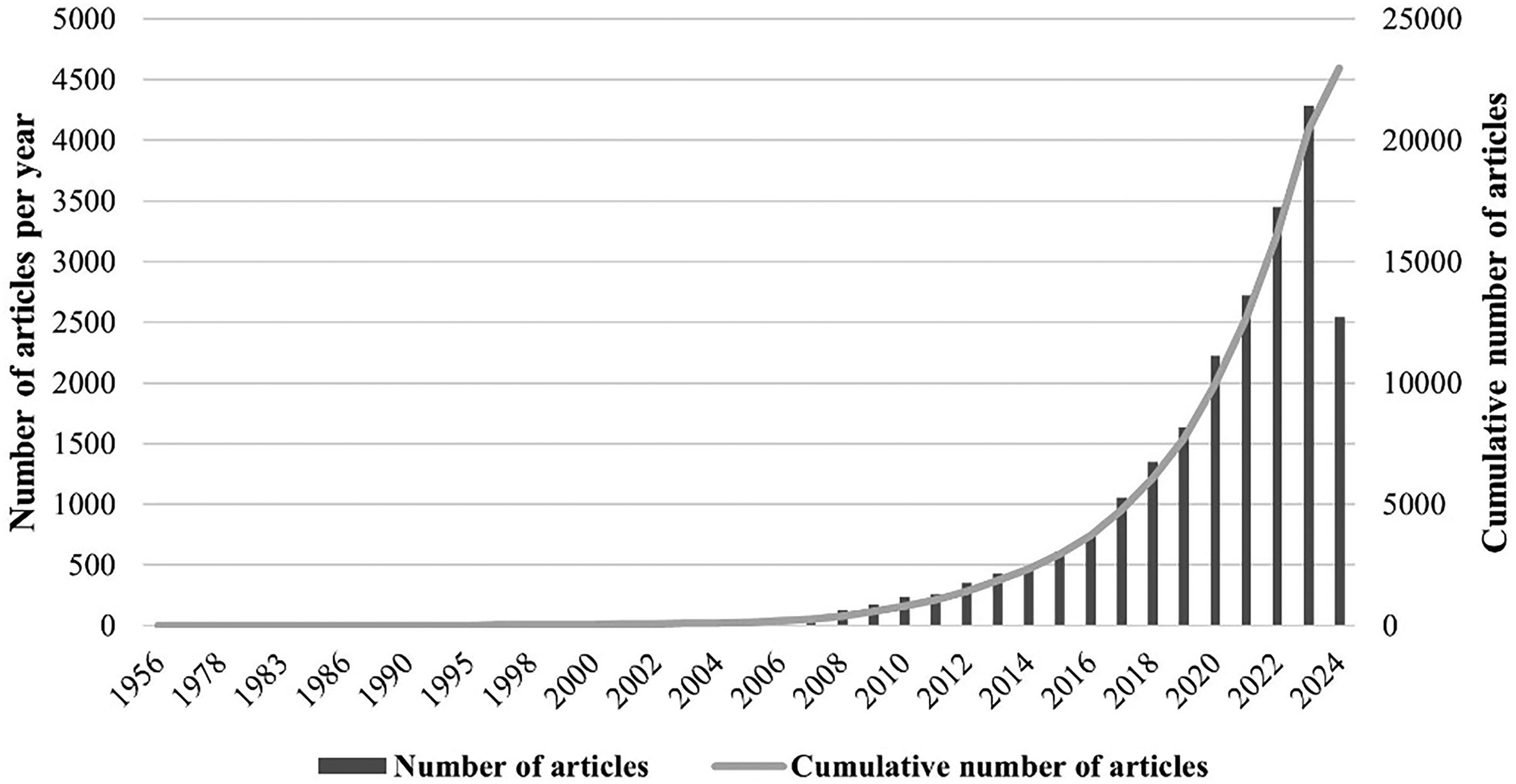
Cumulative number of Scopus documents mentioning intersectionality (by year).
The number of new papers in 2018 was almost 1443, ten times higher than in the previous decade, and since then over 1000 documents have been published annually. The graph in Figure 2 gives the cumulative number, incorporating all data up to the present. We can see that over 20,027 documents were published from 2016 to mid-2024, accounting for over three-quarters of the total number of publications.
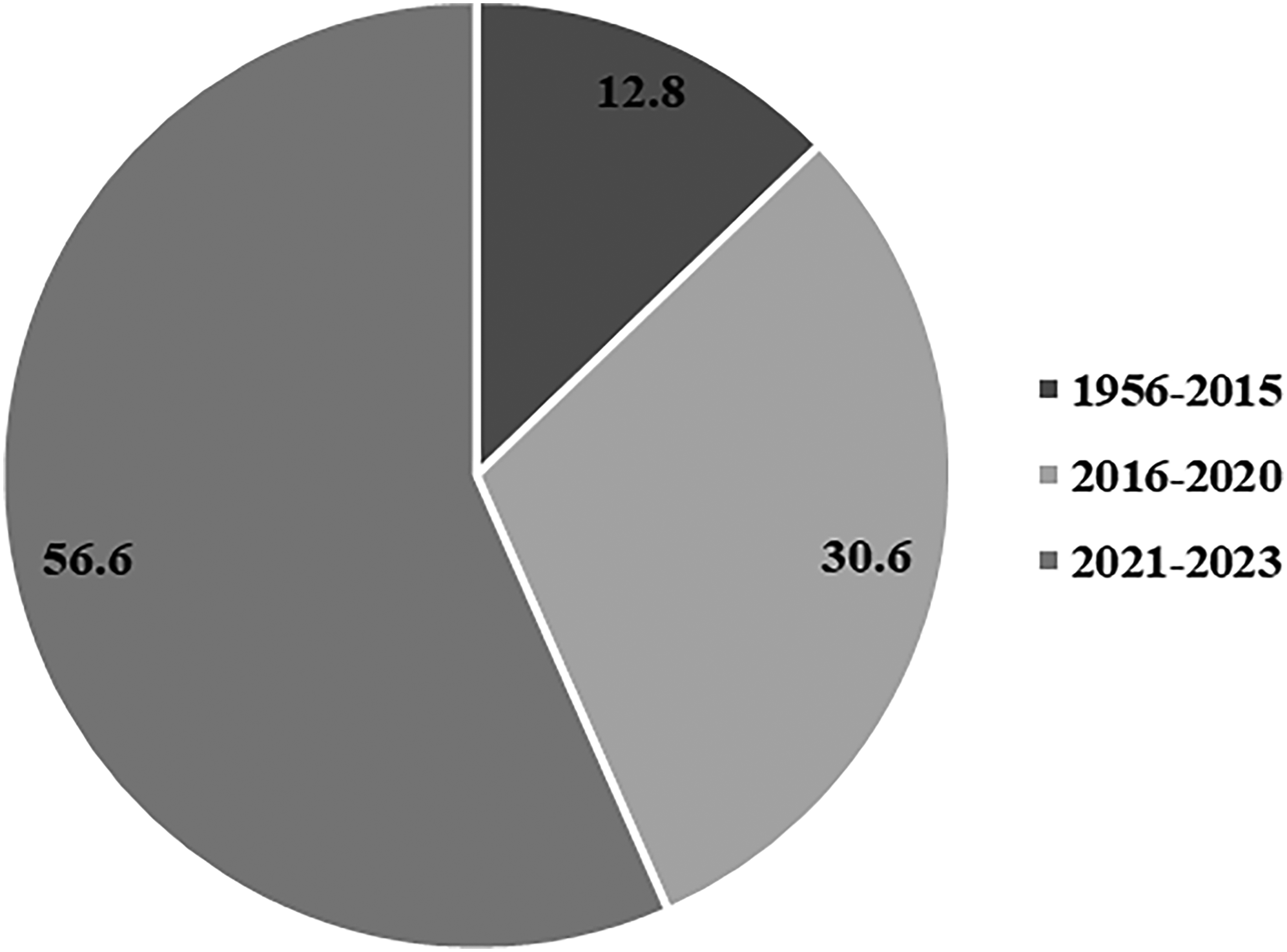
All recent publications on intersectionality.
The numbers are different when we consider only the social sciences: there were 8883 publications during 2021 to mid-2024, 5384 during 2016–2020 and 2415 during 1977–2015, totalling 16,682 documents. At about 70 per cent, articles account for the dominant share of all publications. Book chapters and reviews rank second and third, with a modest proportion of 15 per cent and 6 per cent, respectively. Documents cover a wide range of research areas. The concept of intersectionality has been applied extensively to the social sciences, accounting for 49 per cent of the total number of documents, followed by the arts and humanities (15 per cent), health and medicine (12 per cent) and psychology (10 per cent).
I carried out a detailed review of how the authors present their gender by studying the data available on their workplace websites. From this, it is clear that intersectionality is a preferred topic for researchers who identify as women. Figure 3 shows that out of the 201 ‘leading’ authors – those with at least five publications – 162 were women (80 per cent). However, what is of interest is that most authors writing on this theme, irrespective of their gender, were based in the more affluent countries of the Global North, such as the USA, the UK and Canada. These authors published in about 2500 journals run by roughly 500 global publishers.
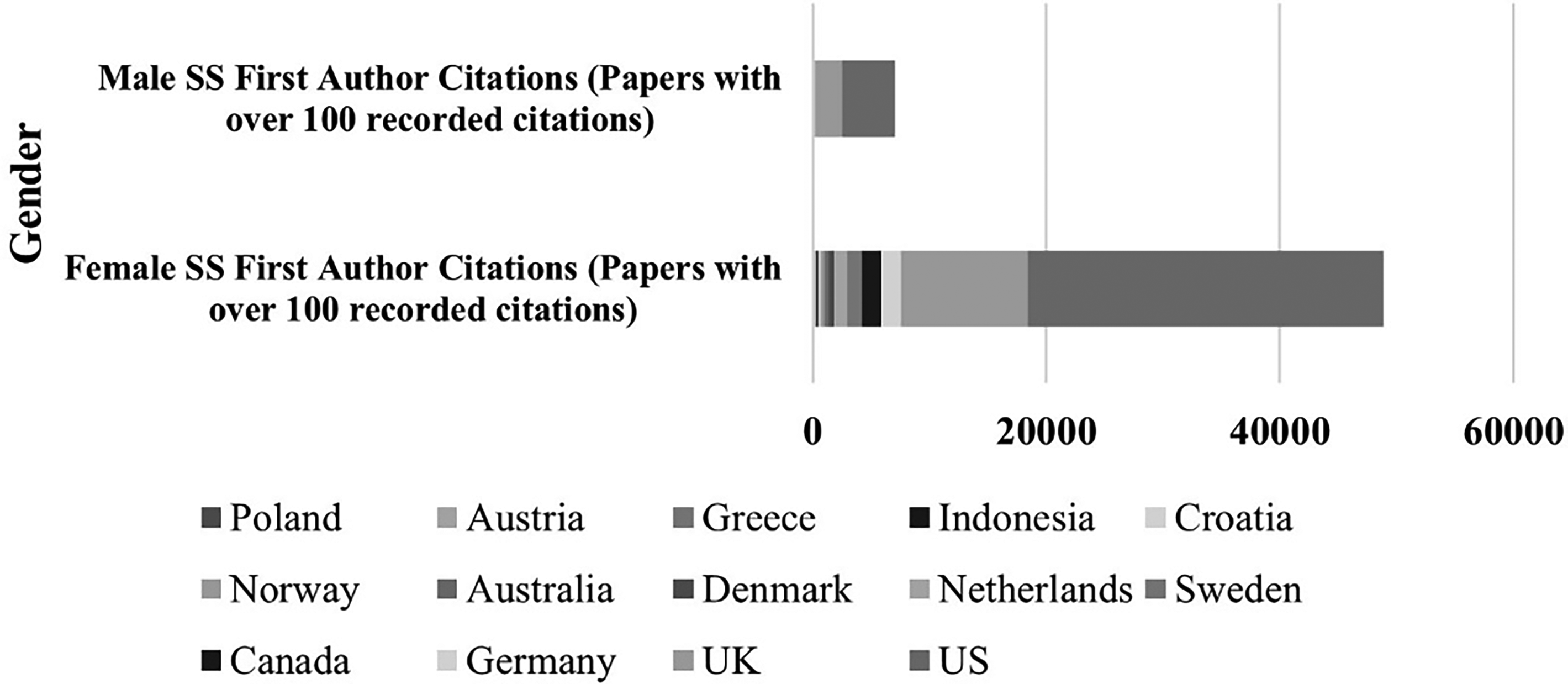
Leading social sciences publications by gender and country of origin.
The data suggests that intersectionality is strongly related to the social and gender concerns of the countries of the Global North. The link to GAD practice becomes obvious from the data – the knowledge transfer to render the subaltern powerful by the development experts, the tokenism of their practices and the lack of engagement with post- or de-colonised knowledges. The review underlines the point made by Carastathis (2008) that this widespread use of intersectionality illicitly imports the very model it purports to overcome, that is, the unitary model of identity.
Intersectionality addresses one of the most pressing problems facing contemporary feminism, that is, the long and painful legacy of its exclusions and theoretical erasures (such as race from feminist theory and gender from anti-racist theory). Intersectional work is intrinsically political and transformational, as it focuses on social justice and equality, and encourages reflexivity. In this sense, it closely aligns with the original political intentions behind the integration of gender into development planning and programmes. It also emphasises the indivisibility of identities, meaning that the salience of one aspect of an individual's life cannot be predetermined and that the power of relationships across and between categories changes with time and place (Bowleg, 2012). Crenshaw (1991) defines intersectionality in three ways: structural, which describes the experience of oppression at the intersections of different dimensions of identity (as a woman, a Black person, a person with a disability); political, where organisations fighting for women's rights tend to experience marginalisation within a political group; and representational, in that women of colour are marginalised because their images reflect prevalent narratives of gender and race. However, Jennifer Nash (2011) laments that intersectionality's institutionalisation has changed its meaning and practice. As intersectionality ‘traversed disciplinary borders and developed institutional legitimacy’ (Nash, 2011: 447), Black feminism's relationship with theory-making changed to an exclusive focus on the intersection of race and gender, leaving out other intimate relationships, such as class and sexuality. Karen Hanna (2019) argues that instead of Nash's (2008) narrow meaning, intersectionality has come to represent all kinds of real and perceived disadvantage. Intersectionality has grown into a field of studies by itself, representing three loosely defined sets of engagement (Cho et al., 2013). The first is the application of intersectional frameworks, the second represents the discursive debates about the scope and content of intersectionality as a theoretical and methodological paradigm and the third is the political interventions employing an intersectional lens. While my interest and focus are on the first, I acknowledge that these three are not necessarily separate from each other.
What allows intersectionality to move the minds of feminist scholars, compelling them to enter theoretical debates and use the concept in their own inquiries? Drawing on the sociology of science, Kathy Davis (2008: 69, 81) says that ‘successful theories thrive on ambiguity and incompleteness’, suggesting that the ‘vagueness [and] open-endedness’ of intersectionality may be the secret to its success. This vagueness can be observed in the suite of articles published in the European Journal of Women's Studies in 2006. Commenting on the diversity of the views on intersectionality in these papers, Ann Phoenix (2006a: 187) in the Introduction suggests that making visible the multiple positioning that constitutes everyday life and power relations that are central to it is the crucial factor in the extraordinary reach of intersectionality. Tanja Bastia (2014: 243) grouped the critiques of intersectionality into four categories – methodology, scale, the perceived binary between structure and identity and conceptualisations of power – and concluded that whilst intersectionality represents an exciting and innovative way of looking at social inequality, it is uncertain to what extent the approach might be useful for a development context. Strong arguments against intersectionality have been put forth by Marxist feminists (see, for example: Cassell, 2017). They argue that it did not emerge directly from women's movements but from the decline of revolutionary waves during the 1960s and 1970s, followed by a defeat in the 1980s that culminated with the collapse of the Soviet Union and China's shift to neoliberalism. The context of the neoliberal academy plays a major role in the ways in which intersectionality has lost much of its critical potential in some of its usage (Garnham, 2021).
Sirma Bilge notes that the question of Blackness in the USA as a condition of ontological death rather than a cultural identity, as well as intersectionality, therefore cannot be used as ‘an empty shell onto which scholars of all stripes can conveniently project their own concerns and feel completely legitimate to do so’ (2020: 2298). There are arguments that despite its widespread use as an analytical and a practical tool, the true nature of intersectionality remains unclear, whether it is a concept or a theory or an idea. Salem (2018) argues that the ‘travelling’ nature of intersectionality as a theory allows for several critiques to be contextualised and addressed. Rarely debated are the three ways to define it: structural (the experience of oppression at the intersections between the different dimensions of identity), political (fighting for women's rights or Black people's rights, but with conflicting aims, thereby marginalising some groups who might have originally been marginalised within a political group) and representational (images of women of colour reflecting prevalent narratives of gender and race).
A number of scholars working on development (such as Lempert, 2014 and McEwan, 2001) have noted the deep enmeshment of development studies in the ‘Eurocentric, modernist and/or neo-colonial mindset’ (Sharp and Briggs, 2006: 6). The very idea of development has been contested, and the paucity of theorising ‘Otherness’ in development praxis noted (see, for example: McLaren 2017). It is well known that women in less affluent countries are perceived to be sources of data, not theory-makers, which is usually the realm of a small minority (Dogra, 2011; Mansoor, 2016; Chatterjee, 2020). Based on her experiences, Lori Adelman (2020: 1) demands a ‘long overdue’ reckoning around race in GAD. In today's globalised world, decolonising development praxis is essential for a productive conversation between feminists based in the Global North who act as the experts and Global South scholars who produce the work as local consultants. Patricia Richards (2014) argues that feminist knowledge and praxis needs to be built from below, that is, from research participants. Such ‘studying up’ proposes a standpoint-based methodology that the development industry has yet to reconcile with. This disjuncture can be discerned from four broad lines of argument on the vast and growing feminist literature on GAD debates. The first of these critiques was posed by Naila Kabeer (1999: 3), who invoked gender advocates’ recognition for simplification, synthesisation and systematisation of feminist theories if they are to play a major role in informing policy design and influencing its outcomes. Remembering this commentary is crucial to avoid past mistakes of making gender-blind development policies that originate from, and lead to, the depoliticisation of GAD in the way that questions of power remain unaddressed. The second strand of argument is put forth by Gulzar Charania, whose focus is on the radical feminist purpose in critically engaging with development that aims to remove inequities and injustices, to consider ‘the global as a theoretical and political concept and place it within specific material and historical relations’ (2011: 365), that is, to contemplate the multiple vectors of race, class, gender and Northern or more affluent status along which subjects are constituted. This prism makes transparent the inequities that are inherent in seeing racialised white, Northern women as holders of development knowledge who can intervene to usher in social justice. The third perspective is based on power analysis of feminist and development discourses. Lata Narayanaswamy (2016) argues that the transformation into transnational discourse of what started as subversive feminist politics consequently generated its own elite elements. Therefore, ‘efforts to create spaces for subaltern voices are constrained by the disciplining effects of professionalised global and neoliberal, as well as Southern, local […] elite feminist priorities for gender and/or feminist development discourse and practice’ (Narayanaswamy, 2016: 2157). The fourth argument is raised by David Lempert (2014), who focuses attention back onto feminists themselves who, in becoming institutionalised in both the development profession and the university, might have agreed to sign on to the agenda of globalisation and neo-colonialism. Therefore, without demanding any changes at all in the structures of globalisation, and without confronting the male hierarchy that had promoted it, contemporary feminists were simply promoting their own interests in the field of development, therefore depoliticising the feminist project to replace it simply with opportunity for women.
Others have offered critiques that point to the power imbalance and the extractive ways of engaging with disadvantaged populations. Drawing on her research on refugees and humanitarian workers in Jordan, Michelle Lokot (2019) criticises the emphasis placed on generating evidence, resulting in more transactional and less relational engagement with refugees. In the drive to gather numerical or qualitative data within a short time, relationships with the community become clinical. These critiques show that GAD has turned into a depoliticised daughter of white liberal feminists or local elite women (Lahiri-Dutt, 2017). When used uncritically as a tool for mainstreaming diversity and difference in the category of women, it loses its sharp edge under the pressure of producing measurable results (Dhamoon, 2010). Indeed, gender mainstreaming and analysis face extensive criticism for these reasons (Milward et al., 2015). Since GAD has not yet explicitly engaged with, or acknowledged, identity politics and the privileged position of its implementers, or even the male dominance that has led to unacceptable public behaviours (Lahiri-Dutt, 2018), one can expect serious perils in incorporating intersectionality into one of the key tools of liberal feminist GAD: GAFs. These analytical frameworks generally emerged from practical work such as gender training given to grassroots people or development workers by GAD practitioners and became popular as the first step in development planning. From the early focus on the different gender roles of women and men, there has indeed been an innovative shift towards gender relations in late 1990s and early 2000s. However, most of them still rely heavily on a woman–man binary in an imagined nuclear household setting. Following feminist theoretical developments that illuminate the socially constructed nature and fluidity of gender, GAD scholars (such as Cornwall, 2007) argue that gender has overtaken woman or women as the subject of feminist theory and praxis. A group of scholars within GAD has questioned the supremacy of this concept and contended that the term ‘gender’ can expropriate feminist languages of analysis and resistance while removing women from the conceptual frame, and can thus depoliticise feminist activism (Baden and Goetz, 1997; Pursley, 2016). Lena Gunnarsson believes that whilst gender is a useful concept, it dilutes the message of ‘women [being] oppressed/exploited/discriminated/excluded by virtue of their being women’ (2011: 24). The focus on ‘women’ as a category suggests essentialism, a homogeneity and a binary – all concerns for contemporary intersectional feminist thinking where such homogeneity is considered to be an impossible theoretical or practical assumption because individuals are the products of layered identities, and where to distil a broad range of women into a singular category is not only problematic but fairly impossible. Yet, Gunnarsson (2011) argues that a fear of assumptions of homogeneity is not enough to justify a complete dismissal of the term. Although in GAD the term ‘gender’ is implied as seeing women and men as binary categories, recent feminist thought also emphasises a return to the body and bodily functions (Haslenger, 2018; see also: Bobel, 2019). Sally Haslenger (2018: 161) counters the claim that the meaning of gender (or other categories) as socially constructed is controversial and often unclear, and sketches how components of political, social and moral meanings are quite literally incorporated into women's very physiological being. It can thus be concluded that intersectionality thinking is impossible without considering race, which is inscribed on the body.
Approaches to the study of difference
Feminists are aware that any mention of ‘difference’ among women invariably brings on board women of non-White ethnicity, where ‘ethnic’ or colour stands for the ‘Other’. At the political and academic levels ‘ethnicity’ becomes contradictory – on the one hand, ‘the construction of culturally essentialised groups becomes a tool to produce and reconstitute relationships of dominance and subordination’, and, on the other, such an identity ‘can also permit a view of the ways […] which may help to constitute emancipatory strategies’ (Gamman et al., 2005: 2). Ange-Marie Hancock (2007) argues that the entry point into ‘difference’ in intersectionality can be used in either of the three approaches: unitary, which emphasises a single category as the most relevant or explanatory; multiple, which recognises different categories as equally important but conceptually independent; and intersectional, which recognises the significance of multiple categories but does not predetermine the categories of investigation. Studies conducted with an intersectional approach vary widely, and other typologies closely align with it. These are important, as the use of one will determine what information is acquired and who is made visible in the research process. We know that intersectionality implies that disadvantages caused by race and gender are not additive, but how they are constituted mutually is a question of methodology. Ivy Ken and Allison Helmuth (2021) analyse the term ‘mutual constitution’ and its interpretation by a wide range of scholars to show the disagreement over whether it is synonymous to intersectionality or not. Leslie McCall (2005) proposed three analytical streams: anti-categorical (considering that life is too complex to be reduced to one category, this challenges and fractures the completeness or homogeneity of categories), inter-categorical (this acknowledges the existence of unequal relationships between social groups, and centres the analysis of these relationships and their changing nature) and intra-categorical (this examines a single social group at a neglected point of intersection within a category – historically, women of colour). Of these, only the anti-categorical approach offers a methodology with sufficient complexity, although intra-categorical and anti-categorical complexity approaches are deployed most commonly. The anti-categorical approach claims that social life is too complex to reduce to a mere categorisation, as any form of categorisation leads to exclusion and inequality. Specific research tools deployed for the anti-categorical approach include genealogy, literature deconstruction and new ethnography. In contrast, the origins of intersectional-type analyses are rooted in intra-categorical complexity. Tools such as case studies, narrative essays and single group analyses are used to elicit in-depth information from previously unnamed social groups. The intersection here is that of a single dimension of multiple traditional categories which are used, dissected, diversified and compared to more stable and traditional social categorisations (McCall, 2005). Such complexity of methodology, if followed, would impose unique methodological demands on researchers, causing them to retreat to intra-categorical analysis of socially marginalised groups at ‘specific spatial and temporal moments’ (Valentine, 2007: 18). However, intra-categorical complexity has been critiqued for reinforcing and replicating unitary approaches, homogenising comparison groups, failing to critique the imagined normality of the stable reference categories and neglecting social processes (see: McCall, 2005; Warren, 2007; Christensen and Jensen, 2012). Intersectional approaches tend to neglect the ways in which privilege and oppression intersect and have turned Black women into prototypical intersectional subjects while treating them as monolithic. They also cast only hyper-marginalised subjects as intersectional, lack clarity on whether intersectionality constitutes a general theory of identity, are ambiguous in definition, concept and application and vary in methodological implementation. Acknowledging and addressing these critiques of both typology and intersectionality is important, as assumptions, deficiencies and gaps need to be mitigated when translated into a GAD praxis.
Intersectional research strategy and design
There is a consensus that conducting empirical intersectional studies is underpinned by an ‘intersectionality-informed stance’ (Bowleg, 2012: 1270). 2 Hankivsky (2014) and Gemma Hunting (2014) identify the following as key principles of such a stance: a) multi-dimensionality and complexity of categories of difference and the inability to prioritise or rank categories; b) multi-level analysis for recognising structural and institutional systems of oppression; c) recognising that individuals can simultaneously experience power and powerlessness, and that power privileges certain types of knowledge; d) situating knowledge in time and space; e) inclusion of the views of those typically excluded from knowledge production; and f) an emphasis on social justice, equity of outcomes and resistance and resilience against oppressive norms. Qualitative research strategies suit these parameters because they meet the demand for social complexity and experience-based epistemologies that can privilege the voice of participants and multi-level analyses. Additionally, qualitative research is more compatible with the principles and tenets of feminism (Burns and Walker, 2005; Bryman, 2012). McCall (2005) suggests that case studies are the most effective design for intersectional work. This aligns with the majority of intra-categorical case study work in the literature, yet it appears that cross-sectional, longitudinal and comparative designs could be tailored towards an intersectional approach when informed by intersectional principles and epistemologies. Contemporary feminist researchers make use of both qualitative and quantitative strategies and adopt methods as they relate to the research questions, but Lisa Bowleg (2008) argues that none of the quantitative options for measuring intersectionality are ideal since these are inherently additive and position social inequality with each additional marginalised identity. This assumes identities to be separable, independent, summative and rankable. Also of concern is the fact that quantitative strategies are based on positivism, imposing a defined meaning system of linearity and uni-dimensionality upon data (McGrath and Johnson, 2003). In considering the increasing complexity in the scholarship of identity and difference, this simplicity is at odds with an intersectional approach. Prior to data collection, the intersectional typology (for example, anti-categorical complexity) needs to be determined. Leah R. Warner (2008) and Hunting (2014) suggest that an a priori choice also needs to be made to determine the categories required for a clear decision-making process. This makes intersectionality workable in the face of unlimited divisions of categories of difference. The choice of category requires identification of the relevant intersection of participants based on the time, place and issues under consideration (Phoenix, 2006b). The information on which this is based can be drawn from a bottom-up consultation as well as top-down strategic choices offered by interdisciplinary scholarship (Warner, 2008). Without critical attention to illuminating categories that typically remain invisible, such a gender analysis process will be incomplete. However, identifying categories beforehand is contrary to intersectional principles because researchers might make top-down decisions based on their knowledge and the salience of categories. Warner (2008) suggests that when researchers do not have the relevant categories, they should consider probing participants towards certain identities. However, participants may not be able to recognise social categories within their own lives, and even if they can, answers to such questions can often be additive (Bowleg, 2008).
Types of data and collection methods
The most favoured methods for collecting intersectional-type data are those that allow subjects to represent themselves in their own voice. In-depth interviewing, ethnography and participatory action research are considered the most compatible (Cuadraz and Uttal, 1999; Carroll, 2004; McCall, 2005; Hunting, 2014). The sampling method should reflect intersectionality's emphasis on experience-based epistemologies and provide a comprehensive understanding of the sample population. According to Hunting (2014: 10), samples should be ‘as representative as possible with respect to a community or population of interest, while being heterogeneous enough to allow for inductive explorations’. In this usage, the term ‘representative’ is somewhat misplaced, due to its association with quantitative methods and implicit suggestion of large sample sizes and randomised sampling. It should be noted that large sample sizes may provide false justification of validity, while simultaneously increasing time, cost and energy expenditure. Thus, smaller, non-random samples with a focus on understanding participants’ experiences and processes provide potential for understanding social processes (Cuadraz and Uttal, 1999). The research design must be shaped by the fundamental aspects of mutually constituted intersecting identities, and interlocking structures and systems of power and oppression. In constructing interview schedules, researchers should abstain from asking respondents explicitly additive questions (related to race, sexual orientation, gender, etc.) or to separate their experiences or identities; 3 the focus should be on the experiential nexus of individual identities (Bowleg, 2008).
Analysis as the critical point in intersectional research
How researchers interpret their data is equally important to the methodological choices they make. Researchers do not recognise the world in the same way as participants: participants will often not articulate all categories of difference or processes of differentiation that affect their lives. It is difficult to delineate what counts as data, and researchers must determine how far they can take their interpretation (Bilge, 2009). It is thus difficult for researchers to use an intersectional approach without forcing categories upon data.
For their relevance to practical development work and clear methodological guidelines, I outline three approaches to intersectional analysis. In the first, Gloria H. Cuadraz and Lynet Uttal (1999) advocate a two-stage method to coding where individual accounts are coded as reflecting individual experience, not group membership, and then common accounts across experiences are identified. In the second approach, Bowleg (2008: 313) uses three stages of coding: (a) open, using multiple and, often, overlapping codes like ‘heterosexism’, ‘violence’ and/or ‘sexism’; (b) axial, using distinct codes like ‘intersections of sexism of heterosexism’ and ‘intersections of sexism and racism’; and (c) selective, where codes are refined to reflect dimensions of intersectional experience like ‘Black lesbians’ experiences of violence reflected in racism, sexism and heterosexism’. Finally, Bilge (2009) applies a two-step hybrid approach. Line-by-line open coding is used first, followed by second-level axial coding. Bilge's axial coding makes connections from codes that emerge from open coding. Like the previous approaches, Bilge does not treat individual accounts as representative of pre-defined social categories at this stage and focuses instead on thematic analysis. In the second step, however, a theory-orientated deductive approach is applied. Narratives reinterpreted through a defined template relate individual data to broader social context and structures.
Each of these analytical approaches strategically engages with categories as a way of managing complexity and potentially endless categorical possibilities. This entails pre-selecting categories as starting points for analysis (McCall, 2005; Phoenix, 2006b; Yuval-Davis, 2006; Christensen and Jensen, 2012). Working with categories in this manner ‘requires a conscious effort to avoid subsuming or privileging one dimension over another’ (Cuadraz and Uttal 1999: 181). One must be careful to treat different categories of difference with different logic (for example, gender functions across classes), and to analyse power relations, contradictions and tensions without separating dimensions into unitary strands (Christensen and Jensen, 2012). Choo and Ferree (2010) warn that in placing individual accounts within context, the power of the narrative must not be lost from these complex social structures. If a process-orientated approach is taken, comparative analysis is also important for revealing social structures of power, adding depth to analysis and disputing the stability of reference categories. In translating intersectional analysis across GAD work, it is important to heed these cautions. In this way, we may produce a representation of reality that truthfully represents and reflects the voice of participants in our analysis and produces what Bev Skeggs (1997: 2) describes as ‘responsible knowledge’.
Intersectionality and gender analysis frameworks
In practice, gender analyses and GAFs are predicated on a gender binary and tend to homogenise women's experiences (Carr and Thompson, 2014). There may be a tacit acknowledgement that women are incredibly diverse, but this often gets lost in the application of GAD in the field (AWID, 2004). Lucy Ferguson (2010) argues that the meaning of ‘gender’ in development policy and practice remains far removed from the original aims of feminists fighting for a commitment to more equal gendered power relations and social justice. Joan Wallach Scott laments that for some people gender has become ‘a polite way to referring to anything that had to do with sex, while sex [as a term] was reserved for physical acts of love-making and/or copulation’ (2010: 8). Consequently, most of the existing frameworks go beyond the woman–man binary to consider other vectors of identity and social inequality, which are added to analyses based primarily on sex, class and ethnicity. We are aware that intersectionality ‘is not exclusively or even primarily preoccupied with categories, identities, and subjectivities [but instead] emphasizes political and structural inequalities’ (Cho et al., 2013: 797), and the additive way of incorporating intersectionality undermines its theoretical edge. Even during multi-level analysis, power is not addressed in a meaningful or dynamic manner. Similarly, while some situate the analyses in social and historical contexts, others continue to focus on roles and responsibilities. There also appears to be an inherent trade-off between bottom-up epistemology and complexity. Complex frameworks align with intersectional principles but cannot be deployed anticipatorily. The social relations approach, proposed by Kabeer (1999), appears to offer the most in terms of complexity and the ability to graft in an intersectional perspective. Gender analysis aligns methodologically with the intersectional desire to give a voice to the voiceless by using participatory methods. Yet, the frameworks sacrifice too much by failing to address structure, being ahistorical and emphasising unitary, dichotomous strands of sex comparison. These deficiencies are replicated in quantitative approaches to gender analysis. Contemporary development work is rooted essentially in the empiricist pre-eminence of quantifiable indicators of progress (Merry, 2011). Indicators, however, overlook the context and ignore the history, create categories of difference through aggregation and bury the inherent messiness of social life. Sex-disaggregated data reflects this homogenising effect and creates oppositional binaries between simplistic delimiters. Even though intersectional quantitative approaches are insufficient, quantitative gender analysis needs to consciously include other factors, such as – at a minimum – race, sex, ethnicity, citizenship status, disability and sexuality. The effectiveness of contemporary GAD research, policymaking and practices depends on the ability of analyses to capture difference and contextual complexities. Using simplified matrices to homogenise women and men obscures the complexities of social life. The rigidity of any matrix format often translates into restrictive and prescriptive thinking, and into a mechanical ‘tick-box’ approach to difference (Warren, 2007: 188), as current approaches to intersectional quantitative work do. If gender analyses continue in this manner, assessments will not elicit the full dimensions of vulnerability, capacity and experience, and will result in development interventions that exclude those most in need.
The limitations of gender analysis and its frameworks are reflective of the current state of GAD research, policymaking and practices. Despite feminist theory having moved from dichotomous approaches to the understanding of power, these frameworks have remained static in many ways and are predicated on a gender binary, homogenising the experiences of women and men (Carr and Thompson, 2014). Often, while it is acknowledged that women are diverse, this is lost in application. Mainstreaming intersectionality into gender analysis could bring a richer approach (Levon, 2015). It could emphasise the relational and positional and make power more visible (Dhamoon, 2010). Indeed, because of the interlocking nature of structures of oppression, ‘it is ultimately futile to attempt to disrupt one system without simultaneously disrupting others’ (Fellows and Razack, 1997: 336). Intersectionality can be incorporated into gender analysis for development in any of the three ways: by mainstreaming intersectionality into existing frameworks, by adapting intersectional frameworks from other sectors and by creating new intersectional frameworks. Mainstreaming could occur by interweaving questions in the applied framework. The only intersectional framework from another sector, albeit only at the policy level, identified by this article is that of Hankivsky et al. (2014). It is unclear if such analyses are sufficient or translatable into the micro- and structural analyses that are required in development planning. The remaining option is to create new and clearly defined intersectional frameworks based on intersectional epistemology and ontology, which would make its associated assumptions explicit. Intersectionality-informed feminist research would apply multi-scale analyses that ask different research questions and use different tools at every scale, and value diverse knowledges, social justice and equity. Research methods would be derived from the voices of the beneficiaries, through in-depth ethnography or participatory action research, and the information would be conveyed to participants. The new framework would focus on processes, relationships, reflexivity and power, and situate analysis within an interdisciplinary context.
To disrupt the primacy of sex or gender in analysis, not only would the research approach explicitly include men and boys as gendered beings, but most importantly would incorporate change over time through longitudinal and/or iterative approaches to data collection and incorporate different levels of social analysis – at a minimum, ‘the level of personal biography; the group or community level of the cultural context created by race, class, and gender; and the systemic level of social institutions’ (Collins, 1990: 227). The framework would address internal organisational commitment as well as beneficiaries. It would have high methodological demands, require substantial investment in analysis and be deployed by a specialist with intersectional research experience or by an interdisciplinary team. Reflexivity would be incorporated throughout implementation. If this occurs, approaches to intersectionality in development would effectively take one of these two streams: intersectional analysis or intersectional gender analysis. Pure intersectional analysis would use a framework similar to that mentioned above, and expressly adhere to intersectional principles. It would start from a blank slate, where categories of difference are revealed inductively through the research and analytical process, as in grounded theory. Gender would not be presupposed as the primary category of analysis or point of departure, unlike in intersectional gender analysis where the interaction of gender with other categories will be examined. In principle, intersectional analysis would appear to be the best way forward, but since it requires so much investment in time and skill, new conceptual understanding and reflexivity in application, an easy way out is integrating intersectionality in existing gender analysis. This is the most deployed approach, although it risks becoming additive and depoliticising intersectionality. Such intersectional analysis would likely be assigned to gender officers/specialists to deploy, who would inherently bring bias towards gender as the primary form of oppression. Instances of intersectional analytical frameworks deployed in place of GAFs are rare. Mara Bolis and Christine Hughes (2015) provide practitioners’ guidance on an intersectional approach to examine the interaction between women's economic empowerment and domestic violence at a macro level. Clara Fischer (2012) explores a programme targeting visually impaired and blind women in Pakistan through Sightsavers, an organisation that focuses on disability among women and men, rather than seeking to mainstream disability into existing operations. The US Agency for International Development has carried out a pilot study (Onzere et al., 2015) to understand the current state of gendered forest and land use and climate change adaptation in rural Malawi in East Africa using intersectional gender analysis. Other examples include an ‘intersectionality-informed’ framework used recently by Kuntala Lahiri-Dutt et al. (2022) that emphasises the participation of those usually marginalised and transparency in the process of research that explores issues of power, implicit and explicit gendered rules, values and norms including ideologies, beliefs and perceptions and how values are defined and by whom, in addition to institutional constraints and opportunities that shape men's and women's lives.
Moving forward
While it is possible to integrate intersectionality into gender analytical frameworks in development, I want to bring to the fore the significant conceptual and methodological challenges. Current norms in development favour survey-based tools that can generate quantitative data as evidence, but these tools are rooted in positivism that intersectionality theory critiques. Therefore, these tools, developed essentially to deal with a man–woman binary ‘add on’ what they consider as intersectionality when exploring ‘difference’ within the category of women, and fail to provide the nuanced gender analysis that the intersectional methodology requires. Time and funding constraints also add pressure to user-established methods, leading to practitioners and policymakers suffering from what Hankivsky (2014) calls the ‘lens fatigue’.
My discussions in this article show that if we pay attention to the research methodologies suggested by feminists, such as standpoint theory, two major yet overlapping conceptual difficulties become visible. The first is the social and gender justice origins of intersectionality that are at odds with the positivism inherent within GAFs as they are currently used. The second is the inherent nature of the development industry itself that pushes development researchers and practitioners to consider racialised Northern women as gender experts, or the holders of development knowledge who can intervene to bring about social justice. As the Scopus review showed, the rapid growth in the popularity of intersectionality can then be interpreted as a simplistic way to use intersectionality essentially as an easy rhetoric to address the study of difference. The significant conceptual gap that is formed as a result leads to the dilution of a complex theory for use in GAFs by those who continue to wield more power than those who are the subjects of these analyses. Bilge (2020: 2298) describes this as equivalent to a violent academic extractivism: the ‘fungibility of Black women's bodies and knowledges within current academic dealings with intersectionality’. This brutal scavenging removes Black women and Black feminism from intersectionality and turns it into a tool for use not by the oppressed and the poor but by the masters themselves. Without Black women, intersectionality remains incomplete, simplified and instrumental, not much better than any other tool in the oppressors’ hand. By extending this line of argument, the rampant ‘use’ shown in the publication data review, presented at the beginning of this article, becomes visible.
Perhaps the nascent state of the practical application of the concept of intersectionality in development presents itself in the trouble that development actors are still facing in integrating critical feminist theories in GAD. We know that all women do not always act in the interests of other women, and unitary representations of women obscure the most vulnerable (Cornwall and Edwards, 2015). But the hierarchies ingrained in ‘doing development’ then preclude the ability of GAFs to be honest in recognising the privileges of the ‘do-ers’ and turn them into blunt-edged tools. Yes, to be useful, gender analyses must be informed by the full range of identities and categories of difference and integrated with a situated analysis of differentiation processes and domination systems. That is why I suggested that we can at best call it ‘intersectionality-informed’, not ‘intersectional’ analysis. A major concern is the depoliticisation of GAD's agenda-setting approach to women's empowerment through instrumentalisation. Intersectionality requires methodological robustness that time-strapped GAD practitioners are ill able to afford. A casual approach to intersectional analysis in gender mainstreaming could risk depoliticising intersectionality and, in the process, displace or obscure gender/race as important categories of analysis. Intersectionality may be resisted by those who are not open to social justice approaches to development, or even for its purposeful shift away from prioritising certain categories (for example, women), or because it is interpreted as a further weakening of the feminist political intent behind GAD research, policymaking and practice. If intersectionality is to be mainstreamed, it is most likely to occur through intersectionality-informed gender analysis, as gender specialists and development planners find it palatable. The problem of bridging the gap between development processes and policies, and contemporary feminist, critical race, anti-colonialist, queer and indigenous theories becomes evident here. As feminists, what we could probably do is to carry out intersectionality-informed analysis from the ground up, based on feminist principles and epistemologies to make them more relevant and contemporary. These would then deploy intersectional qualitative methods, use complex analyses and move towards analysing processes, relationships and systems of power.
The need, thus, is for development planners and practitioners to be mindful of translating local complexities through a contemporary, global conceptual tool that is also informed by critical race theory. To make it robust, an intersectionality-informed practical gender analytical tool must be combined with a sound understanding and awareness of the theory and ideology of intersectionality with a fine-tuned perspective of social justice. If it is seen as only a technical skill, it will not be applied correctly and hence will remain ineffective. The application of intersectionality requires highly skilled staff who are trained in interdisciplinary methods and expertise as well as being reflexive practitioners who can take up the challenge of incorporating the information acquired into logical frameworks, project plans and monitoring and evaluation processes.
Footnotes
Acknowledgements
Like all other feminist work, this article is the result of years of conversations with my students about the practicalities of integrating intersectionality in GAD, collaborations with colleagues on its theoretical contributions and my personal, lived experiences as a woman of colour in a predominantly White academia in Australia. I thank Shane Harrison and Nisa Anggina for their research assistance, Mausam Gupta for the Scopus review and many other students who went on to intellectually engage with the concept. Colleagues such as Fiona Jenkins, Margaret Jolly and Sally Moyle, as well as Raewyn Connell's thoughtful comments, were critical in making this article conceptually stronger than before. A version of this article was presented at the ‘Thinking Intersectionality in Critical Feminist Development Studies’ session that I organised in the Institute of Australian Geographers’ Annual Conference in 2019. A slightly more reconsidered version was presented at the ANU Gender Institute's Signature Event on ‘Intersectionality in Critical Feminist Research and Practice’ led by me in 2021.
