




Abstract
Menstruators perceive and experience their menstruation in diverse ways, influencing their choice of menstrual products and impacting both body literacy and the environment. This article investigates Israeli menstruators who use reusable menstrual products (RMPs), a practice viewed through the lens of ecofeminism, within the context of menstrual concealment culture and its role in perpetuating oppression. This article's objective is to reveal the extent of this ecofeminist practice and to understand the motivations and choices behind it as well as the meaning of menstruation for Israeli RMP users. An analysis of forty semi-structured interviews revealed that the participants exercise cognitive, emotional and sociocultural agency. Environmental and physical factors strongly motivated participants to use RMPs, producing predominantly positive experiences. The use of RMPs promotes novel perceptions and management strategies for menstruation, facilitating acceptance of menstrual blood and challenging prevalent narratives of shame and pollution. Finally, many participants expressed a desire to engage in legitimised conversations about menstruation and to resist the dominant discourse. This highlights the transformative potential of the ecofeminist practice of using RMPs, which can disrupt capitalist-consumer culture, challenge menstrual stigma and foster sustainable alternatives. The present study promotes knowledge and equality in education about menstrual management, concealment, products, stigma and environmental factors.
Introduction
A routine of menstruation management is often established early in a menstruator's life. Society's norms, menstrual taboos and stigma guide this process, steering individuals towards disposable menstrual products (DMPs) (Johnston-Robledo and Chrisler, 2013). DMPs are offered, frequently through advertisements, as a way to control and conceal the menstruating body (Wood, 2020), creating a ‘culture of concealment’ (Houppert, 1999). Thus, menstruators learn early in life to handle their menstruation using DMPs and to hide it, which can lead to physical and emotional disconnection from their cycle (Lamont et al., 2019). The cultural significance of menstruation varies: in some societies, the onset of menstruation is a reason for celebration (Chauhan, 2022); in some, it marks the beginning of social restrictions (Laws and Campling, 1990). This research took place within Israel, where menstruation is considered taboo, shrouded in shame, secrecy and boundaries. Some menstruators live under the influence of religious contexts such as Jewish Niddah laws and Islamic laws and traditions. Niddah laws consider menstruators impure and forbidden during their menstruation, and that they carry a risk of contaminating their husbands (Tan et al., 2017). Islamic law and traditions also impose restrictions on the actions of menstruators during menstruation, including forbidding intercourse and limiting faith practices such as ritual prayer and washing (Campbell et al., 2021). Advertisements for feminine hygiene products also shame and disempower menstruators, avoiding explicitly menstrual terms and even the colour red (they use blue to represent menstrual blood) (Rom and Noy, 2017). Reusable menstrual products (RMPs), despite gaining some popularity, are still an unconventional choice, making the decision to use them complex, as it challenges established consumer culture and the societal representation of menstruation. Therefore, it is essential to examine how RMP users articulate their experience and position themselves as subjects.
We propose that RMP use can be considered an ecofeminist practice, even if not consciously pursued as such by the user. This assertion is based on two key premises. First, using RMPs is an ecological practice: they can be used for extended periods, reduce waste and consumption and positively impact the environment (Tu et al., 2021). Second, using RMPs is a feminist practice: their use necessitates a direct engagement with menstrual blood, inherently confronting and challenging the societal stigma associated with menstruation. Such an act of resistance aligns with feminist principles that challenge patriarchal norms (Johnston-Robledo and Chrisler, 2013; Lee and Sasser-Coen, 2015). While motivations for using RMPs are diverse and not all inherently feminist, the act itself is feminist by its deeply empowering nature, allowing individuals to make choices that align with their values and needs, not societal expectations. In embracing RMPs, individuals participate in a form of bodily autonomy that is central to feminist ideals. Therefore, in this article, we suggest that using RMPs is an ecofeminist practice, which may disrupt the existing societal perception of menstruation. Drawing on ecofeminist scholars (Warren, 2000; Mallory, 2006), we extend this claim of disruption: RMP use combines ecofeminist theory with practice; the two reinforce each other, revealing how ideas and perceptions can become practices, aligned with other ecofeminist ideologies and practices, and form a basis for social change. We conclude by exploring how ecofeminism enriches discussions of menstrual management. This article's objective is to understand the motivations and choices behind this ecofeminist practice and the meaning of menstruation for Israeli RMP users, as well as to reveal the extent of this practice, against the sociocultural background of menstrual stigma.
Western patriarchal-capitalist thought is built on hierarchically organised structures of domination that assign value through dualisms (e.g. reason/emotion, mind/body, culture/nature, human/nature, man/woman) and constitute a platform for exploiting women and natural resources. Ecofeminism links feminism and environmentalism (Allison, 2017) to combat these conceptual structures of Western thinking, striving to break down these barriers in order to understand, examine and improve conditions for women and nature (Warren, 2000). This perspective explains how patriarchal capitalist-consumer culture, which favours DMPs, works: the dichotomous patriarchal framework treats purportedly feminine qualities, such as connection to nature or the body, as inferior to supposedly masculine features, such as rationality, intellect and culture (Warren, 2000; Plumwood, 2003). This world view considers menstrual blood and, by affiliation, the menstruator as contaminated and contemptible (Young, 2005), cementing menstruators’ inferior position. Advertisements frequently represent menstruation as a hygiene crisis (Erchull, 2013), offering DMPs as a solution allowing menstruators to continue to appear active and attractive (Grose and Grabe, 2014; Crann et al., 2017). Many studies have shown how capitalist-consumer culture and DMP marketing encourage menstrual concealment (Barrington et al., 2021; Liu et al., 2021), emphasising convenience and physical detachment (Campbell et al., 2021). DMP use embodies an element of silence regarding both menstruation itself (Bobel, 2019) and the environmental effects of disposable products (Dobscha and Ozanne, 2001). RMPs, on the other hand, which are underrepresented in the media, require active engagement. Using RMPs requires handling menstrual blood, which positively influences body literacy and thus can potentially disrupt, or at least diminish, concealment culture (Wood, 2020). Exposure to menstrual blood through the use of a reusable menstrual cup, for instance, can alter the menstrual experience, provoking new feelings and thoughts about menstruation (Owen, 2022). Furthermore, RMP use aligns with socially responsible behaviours, potentially contributing to broadscale environmental change and challenging global menstrual stigma (Trudel et al., 2016; Zero Waste Scotland, 2019). RMP users perform a political and social action in resisting capitalist-patriarchal culture, the silence surrounding menstruation and consumption in the feminine hygiene industry.
Suppressing menstruation maintains the capitalist culture that promotes disposable products. Ecofeminism helps us uncover the power dynamics behind this mechanism. Intersectionality in ecofeminist analysis can promote a holistic approach to related issues, including equality in education and menstrual management (Kings, 2017). However, research focused on menstrual management has yet to take an ecofeminist perspective. Qualitative studies of long-term RMP users are rare; those that do exist focus mainly on users’ narratives, and none had yet been conducted in Israel. The many potential advantages of RMPs – including consumption reduction, environmental impact mitigation and menstrual stigma alleviation – make it essential to research this issue. Ecofeminists draw on women's experiences as a starting point (Sachs, 1992; Gaard and Gruen, 1993); therefore, we began by conducting interviews with Israeli RMP users. There was previously no qualitative data available on Israeli RMP users. Therefore, interviews were conducted to understand the relationship between Israeli RMP users and their menstruation. We investigated what meanings RMP users give to their menstruation and menstrual blood; how they manage their menstruation; what factors influence their motivations and choices; and how and to what extent they have confronted the narrative of shame and pollution around menstrual blood, overcome menstruation taboos and resisted the influence of the dominant sociocultural discourse. This research aims to promote a positive discourse around menstruation by recognising the barriers to breaking down the narrative of shame and creating change in the currently negative mainstream attitudes towards menstruation. From an ecofeminist perspective, this study aims to help remove the division between menstruators and non-menstruators and protect the environment by promoting the reduction of waste and consumption (Tuana and Cuomo, 2014).
Since no interviews had been conducted in Israel regarding RMP use before this study, we determined that a qualitative methodology was essential to allow participants to tell their stories. Qualitative methods enable the capture of nuanced insights into how RMPs are perceived and utilised by Israeli users, facilitating a deeper understanding of practices and prioritising participants’ narratives. Through social media – mainly specific, predetermined Facebook groups, WhatsApp, Instagram and forums – we recruited forty RMP users in Israel. Within these platforms, we created posts inviting individuals to participate in a study about their menstruation and experiences with RMPs. Participants had to be over eighteen and have used RMPs for more than a year. Participants’ ages ranged from eighteen to fifty. To understand the experiences of as broad a sample as possible, we chose participants with diverse socioeconomic backgrounds, ages, countries of origin, racial/ethnic origins, cultural backgrounds and gender identities. Minority groups – based on ethnicity, religion and country of origin – were intentionally oversampled. The sample included 95 per cent Jewish participants and 5 per cent non-Jewish participants (one Christian; one Muslim). All participants identified as cisgender women, except for one, who identified as nonbinary. During the interviews, independent of the selection process, participants reported a range of socioeconomic and educational backgrounds, employment histories, relationship statuses, parental statuses, political views, religion, identification with feminism and specific RMP used (menstrual cup [MC], reusable pads [RP] or absorbent underwear).
From September to November 2020, individual semi-structured interviews were conducted with the forty participants, via Zoom, due to COVID-19 restrictions. All interviews were audio-recorded with consent; each lasted from one to one-and-a-half hours. Our interview guide used open-ended questions drawn from themes in the relevant literature. Participants were asked questions about themselves (e.g. age, gender, race/ethnicity, education, income, etc.) as well as about their menstrual history, experiences of menarche and menstruation, menstrual discourse, menstrual practices and feelings regarding their bodies. These questions were scripted but also opened up other related conversations, as follow-up questions, clarifications and probes were free-flowing. The interviews were conducted in Hebrew and professionally transcribed and then translated. Identifying data was removed; each participant was assigned a pseudonym to ensure anonymity. A thematic analysis was applied to the transcribed interviews. This technique was chosen to develop a comprehensive and clear picture of menstruation management using RMPs, against the backdrop of consumer culture and Western menstruation discourse (Braun and Clarke, 2006): all transcripts were read carefully and thoroughly to identify emergent themes, then connections were sought across emergent themes and the themes were compared to responses from other participants. The themes were refined and developed until a final list materialised. The study and interview protocol were both approved by Haifa University Humanities Institutional Review Board (approval number 459/20). Three key themes emerged from the interview data: reasons and motivations for using RMPs; menstruation management with RMPs; and resistance to the dominant Western discourse about menstruation.
My body, my choice
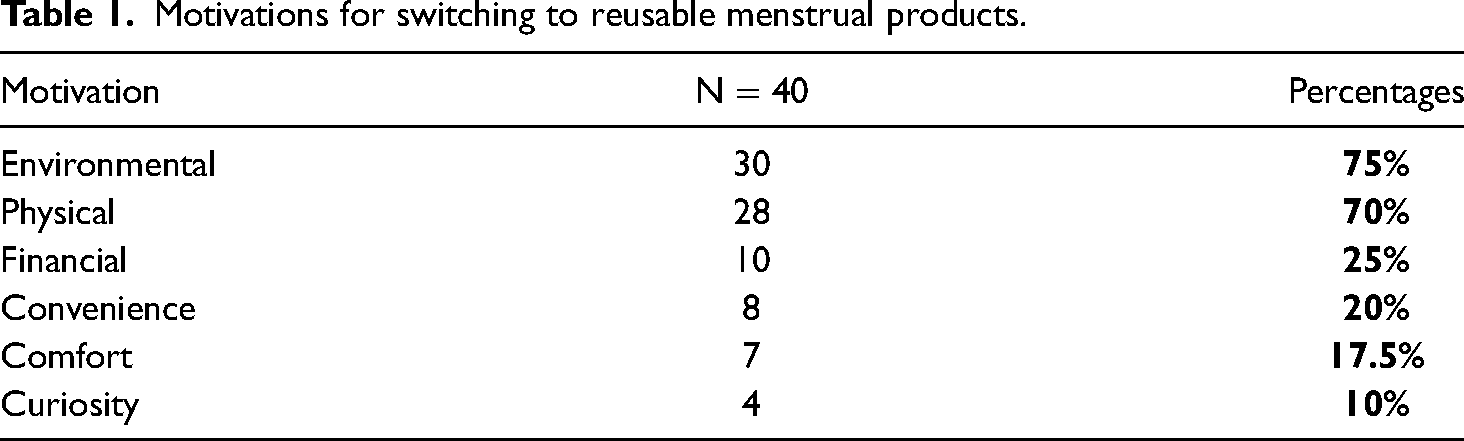
During the interviews, participants reported switching to RMPs for several main reasons, one of which was environmental. A total of 75 per cent of the participants mentioned switching to RMPs because they wanted to help the environment through waste reduction. Zohar (42, MC+RP+AU, Israeli) notes: ‘I think that first, it was environmental. It was to reduce the rubbish and the amount of plastic, the one-time use, creating a lot of trash, and the crazy pollution that was causing’. DMPs do indeed contribute significantly to consumption and waste production. One menstruator will use more than 11,000 DMPs in their lifetime (Peberdy et al., 2019). While no data is available regarding menstrual waste disposal for Israel specifically, in the UK and the USA approximately 20 billion DMPs are discarded, generating 200,000 to 240,000 tonnes of solid waste, each year (Briain et al., 2020; Fourcassier et al., 2022). Dealing with menstrual waste is often an overlooked issue among menstrual needs, but improper disposal can lead to environmental pollution and clogging of sanitation systems (Elledge et al., 2018). Additionally, the products, packaging and byproducts are often flushed down toilets, producing microplastics during their breakdown process that alter marine ecosystems and threaten ocean biomes (Harrison and Tyson, 2023). This kind of disposal of menstrual waste is another element of menstrual concealment culture; menstruators use DMPs without considering their consequences. Thus, just like the unwittingly discarded waste, menstruation is discarded from our bodies and banished from our minds.
While environmental factors were an explicit motivator for some, others discovered that waste reduction was an unintended outcome of their RMP use. For Adi (39, RP+AU, Israeli), it was a positive experience: ‘It's delightful not to have a full and smelly trash bin that needs to be emptied constantly’. Carmel (43, MC, Israeli) said: ‘It makes me very happy that I don’t produce this waste anymore’. Waste reduction in menstrual products also connected with other ecological practices for some participants; sometimes it was a starting point and sometimes the consequence of prior ecological practices. These practices include being vegan or vegetarian, recycling, buying second-hand clothes, composting, reducing use of disposable products and increasing use of reusable products, as well as waste separation. For instance, Vered (30, MC, Israeli) described how she stopped using disposable products after she started using RMPs: ‘The truth is that I started recycling after I used the cup, and I also care much more about the environment now. I used to use disposable dishes and cups; today, they don’t exist. I used to buy them for home, but today I don’t buy them’. Participants also noted that using DMPs not only generated waste but also made them perceive their menstruation itself as waste. Viewing menstruation as waste aligns with the concealment imperative and menstrual management discourses (Bobel, 2019). When they use disposable menstrual products, many menstruators begin to see their body as inferior, a source of embarrassment and shame (Lamont et al., 2019). The use ties in with society's construction of menstruation as a disgusting problem that must be distanced from the body and mind. This construction begins with Jewish Niddah laws, which forbid women and men from even touching or passing things to each other during menstruation, and continues in cultural DMP advertisements.
RMP usage similarly transforms participants’ perceptions of menstruation itself, but in the opposite direction. Using RMPs not only leads to reduced consumption but also fosters a realisation that menstrual blood has significance and is not merely waste. Maayan (34, MC, Israeli) expressed how constantly throwing away products was connected to feeling that menstruation also needed to be disposed of: ‘With menstruation, it's like society took something that is supposed to be a natural body function and made it into trash. It didn’t seem logical to me that my blood was being folded and thrown in the bin. It's unnatural, and it's not normal’. Another significant motivation for using RMPs were the physical benefits, as reported by 70 per cent of the participants. This included twelve participants who declared that they switched to RMPs because they wanted to feel a connection with their body that they did not have with DMPs and sixteen participants who said that they had health issues involving their menstruation and cycle that they wanted to solve, such as premenstrual syndrome (PMS), dysmenorrhea, pain, itching, urinary tract infections and yeast infections. Rikki (32, MC+RP, Israeli) explained that she started to gain more familiarity with her body, which led to using RMPs: ‘A little before I started using the cup, I stopped taking pills and hormonal contraceptives in general. Today, I understand that these two processes are related to each other. To deal with my body in a more natural way and not force techniques on it, simply by using the cup, I could connect much more with it’. The process that Rikki describes involves rejecting negative cultural implications. Connecting to one's menstrual cycle can work against the cultural messages that menstruation is a hazard that must be distanced from the body. Many participants described transitioning from little or no knowledge of the menstrual cycle to full comprehension and attention. They also noted that learning the ingredients of DMPs and their lack of benefit to the body led them to look for alternatives.
DMPs are made mainly from bleached cotton, nonwoven fabrics and polymer absorbers, containing up to 90 per cent plastic (Harrison and Tyson, 2023), and may cause vulvovaginal candidiasis, itching and even toxic shock syndrome (Reame, 2020). Ola (27, MC, Israeli) explained: ‘I realised that there are many substances that I don’t really want and need in my body in the disposable products’. Oxana (32, MC, Romanian) referred to how the material feels: ‘the cup feels much more natural than the material from which disposable things are made’. And Or (30, MC, Israeli) noted that concerns about product safety were why she looked for something different: I had vaginal dryness and constantly had recurring candida, which was not pleasant. I started using the cup because, from what I could research and hear, disposable products contained all kinds of smells and substances, and I was looking for a solution to my health issues. From the moment I switched to the cup, it changed. The problems went away, and, in some way, I really started to be disgusted by the pads and their smell. Using pads and tampons, I always felt dirty. I remember feeling uncomfortable during the day, all the cumbersome pads, the wet and hot feeling down there, and the smell. After I started using the cup, the smell stopped, and I realised that the smell didn’t come from my vagina or the blood but from the products. I even started to see positive things when dealing with my blood.
Menstruation management
During the interviews, participants described how they manage their menstruation and their menstruating body with RMPs, including whether using RMPs increased or decreased the overall handling required. They mentioned various aspects, from product management to daily routine and blood encounters. Several participants reported feeling that RMP use reduced handling. Hila (33, MC, Israeli), for instance, said: I moved to the cup because pads were too much handling, and it makes my life easier. The cup is always with you, so you don’t have to worry about what's in your purse, what happens if you change and where to put the used pad. I don’t feel that it's more handling than tampons, maybe even less, and definitely less than pads. I moved to the menstrual cup because the reusable pads were too much work. You’re entering a loop of washing and soaking, and I didn’t have a washing machine in my previous apartment, so I decided that I’m moving to the cup simply because it was a lot of work, and I realised that the cup is much less cumbersome.
Motivations for switching to reusable menstrual products.
DMPs force menstruators to purchase them repeatedly, change them constantly and empty the rubbish bin. RMPs, on the other hand, need to be carefully maintained so that they will last. Cups must be sanitised; reusable pads and absorbent underwear must be washed and dried. Bar (30, MC+RP, Israeli) addressed how she manages menstruation with the cup: Sometimes there's no sink at the public toilet; I usually try to find a handicapped bathroom, but it's not always working, and I had an embarrassing failure once, so I started packing a 200-millilitre bottle in my menstruation bag. I use it to wash the cup when I need it. That way, I can wash it whenever I want. It feels much more comfortable to me. My attention during these days is greater. For example, I won’t do reverse postures if I practice yoga. More awareness – it's not that I’m avoiding things. However, I’ll be gentler with my body. I’m trying not to exercise too hard; sometimes I do, but I try not to. Not to use too much effort, don’t carry heavy stuff, and don’t walk too much. The first day is a day I let myself stay in bed. I don’t have a problem going to the pool or the beach or having sex, and it never bothered me, but I’ll pay more attention to what I feel.
Resistance to the Western discourse
In Western society, there is a widespread discourse of shame and concealment around menstruation (Campbell et al., 2021), which can influence how menstruators think about their body and menstrual cycle (Chrisler et al., 1994). But the RMP-using participants’ reports often described resistance to this prevailing Western discourse. Some participants reported that using RMPs triggered new thinking about the menstrual body and its representation in society. Ruth (36, MC+RP, Israeli) noted that the discourse is so deeply rooted that it affects menstruators even among themselves: Almost nobody says ‘menstruation’ or ‘menstrual blood’. They say ‘period’, and it is easy for me to make a mistake and say it, too, but I try to be careful and use the correct terms. Moreover, when women talk about it among themselves, not around men, only women among themselves, even then, in a half-whisper, there's a lot of hiding regarding menstruation. I don’t think it should be like that, so I talk freely about it with my son. Furthermore, I believe using reusable products changed my perception of menstruation and exposed me to a different discourse. It's more of an internet acquaintance, but still, the discourse is different, the terminology is different and the openness is different. I see many misconceptions among women regarding their period. First, the lack of awareness, denial and repression in advertisements and representation of the blood colour, calling it a ‘period’ instead of menstruation, women who don’t understand the monthly cycle, hiding, distortion and making women crazy because of menstruation. I think there's a rejection instead of praising it and accepting it. When you can free yourself from this conception, you can make a move to reusable. This is what I feel happened to me.
The participants mentioned that using RMPs required touching and seeing their menstrual blood, which influenced their understanding of bodily functions and how society views menstruators as objects, expected to constantly control their body's discharge. Carmel (43, MC, Israeli) mentioned: ‘For me, it was always something external because the thoughts didn’t appear by themselves – it was the social norm, to be disgusted by your period, to feel disappointed when you get your menstruation, to be repulsed by the blood’. Oxana (32, MC, Romanian) described her conflicted feelings towards menstruation due to social norms: ‘The menses is treated as the worst thing there is, the most flawed and biggest burden, and this discourse doesn’t let us women advance. Every time I see an ad or hear this discourse, I feel it in my body, and it annoys me’. Tzlil (36, MC, Israeli) described the change from fear to acceptance: Let's just say that it helped me be less scared of the blood. When you’re on your period and using a tampon or pad, it's much stinkier, because it's on the pad, and it often starts to smell. For me, it was accompanied by guilt every time I threw those pads or tampons into the trash. Today, when I’m using my cup, I’m much calmer, nothing is being thrown into the rubbish, and I see the blood. It made me less frightened. It's OK if it gets spilled – it's blood, my blood. It changed my perception. It's a crazy change in perception. If my period was a time that I used to feel disgusted by myself and my blood, now it's not so horrible. It doesn’t disgust me anymore to see my blood, and it's such a change in perception. We got so used to disgust about our blood. Personally, it makes me feel more feminine during my period. I’m connected to myself, not being disgusted by things that are me. I’m having a real struggle with the fact that I need to be disgusted by my period, that I need to be disappointed and hide it. I think that quickly, with the use of the cup, I realised how much all the perceptions about my menstruation were wrong. It enabled me to talk about that subject more openly. Once I started doing it with more women – friends, students, my sisters – it opened a female conversation around me that I appreciate a lot. When I try to trace the origin of the transformation, it breaks the barrier regarding menstruation. Menstruation isn’t something you need to throw in the trash. It's what my body produces, what happens to me and how it relates to my nutrition, sleep and mood, and I started to notice all the changes.
In closing
The findings reveal that RMPs, as alternative menstrual management methods, often enable what is described as a positive conceptual change, in which the participants unwittingly counteract the central sociocultural discourse. These findings show how Israeli RMP users overcome the narrative of shame and pollution surrounding menstruation, an essential step in resisting the influence of capitalist-consumer culture, which highlights the value of exposure to diverse menstrual products and discourses. The ecofeminist nature of RMP use was echoed in participants’ reasons for choosing these products. For some, environmental considerations were vital, with prior engagement in ecological practices like veganism, recycling and reducing consumption aligning with their RMP usage. Most of the ecologically engaged participants used ecological terms, indicating familiarity with related theories and concepts. These participants’ actions illustrate ecofeminist theory, which asserts that women cannot be liberated without the liberation of animals and nature (Gaard, 1993). (However, although many exhibited ecofeminist behaviours in their daily routines, only one participant independently brought up the term ‘ecofeminism’.) These findings demonstrate how effectively RMP use integrates theory and practice, emphasising the mutual reinforcement between ecological and ecofeminist theory and practical implementation. Other participants were motivated by health considerations rather than environmental ideologies. But even these participants reported a shift in environmental consciousness after using RMPs, suggesting that such use can be a catalyst for broader ecological practices. These participants said that after using RMPs, they gradually became aware of their reduced menstrual waste production. This led them to question their use of disposable products more broadly, eventually causing some to discontinue their use altogether. They then also found themselves delving into and expanding their understanding of environmental sustainability. Remarkably, this transformation occurred in 80 per cent of the participants who had not previously identified as environmentalists. RMP use has the capacity to foster environmental literacy. Another critical finding was the transformation of participants’ perception of their menstrual blood. Before using RMPs, many regarded their menstrual blood as contaminated waste. Switching to RMPs prompted them to question this view, ultimately promoting an understanding of menstruation as an indicator of physical health, which led to positive feelings and anticipation that were not possible prior to RMP use. This understanding, gained through observation of and attention to their menstrual blood, deviates from the medical discourse, which often frames menstruation solely as a health issue. Since low uptake of RMPs is related to the internalisation of negative social discourses (Grose and Grabe, 2014; Lamont et al., 2019; Milne and Barnack-Tavlaris, 2019), it is essential to raise awareness and provide accurate information about these products, because that may trigger positive attitudes (Beksinska et al., 2015), help reduce stigma and allow menstruators to make informed decisions. This finding suggests that understanding menstruators’ menstrual practice has significant implications for menstrual education.
Participants reported that accepting their menstrual body often involved resisting the Western discourse about menstruation. Many identified advertisements promoting DMPs as a source of stigma and shame. This finding supports those of Ingrid Johnston-Robledo and Joan Chrisler (2013), who note that most messages about menstruation highlight only its negative impacts; this shows how important it is to offer positive messages that encourage consumers to explore alternative products for managing their menstruation. Additionally, participants testified that switching to RMPs exposed them to alternative discourse about menstruation and allowed them to legitimise conversations about menstruation with others. While there is abundant advertising for DMPs, there is very little for RMPs. Therefore, conversations among RMP users mainly occur within online channels, where menstruators can communicate more openly, share their information about and experiences of menstruation, trigger new thinking about the menstrual body and normalise handling menstrual blood, all of which can lead to questioning the dominant societal discourse of shame around menstruation.
Although this study unequivocally shows that using RMPs affects users’ daily practices during and relationship to menstruation, the extent of this impact on menstrual management requires further investigation. The practice of menstruation management differs from one user to another. Participants reported that RMP use resulted in engagement in new activities, increased confidence and greater acceptance during menstruation. The study also indicated an impact on menstrual concealment, as using RMPs contributed to less product contact throughout the day but required closer contact with menstrual blood. This inherent conflict mirrors societal taboos surrounding menstruation, suggesting that RMP users resist this taboo by making menstruation visible. As we have seen, however, some RMP users also appeared to continue to subscribe to the menstrual ‘concealment imperative’ (Wood, 2020: 320); further research is needed to investigate whether menstrual management using RMPs is more often a form of bodily empowerment or more often aligned with the concealment imperative. Ecofeminism sheds light on the intricate connection between the oppression of women and of nature, particularly in the context of menstruation management and discussions. This framework also proved instrumental in uncovering the power dynamics underlying the prevailing conversations about menstruation. Within patriarchal-capitalist culture, the exploitation of natural resources required by DMP production and use contributes to both environmental degradation and adverse impacts on women's health. These negative repercussions become evident in menstruation management, where the preference for disposable products over reusable alternatives reflects a broader disregard for environmental concerns. This demonstrates the importance of attending to ecological considerations in both feminist theory and its practical applications. Failing to acknowledge the ecological implications of menstruation inadvertently perpetuates the subordination of women. The discourse around menstruation management demonstrates the pertinence of ecofeminist theory, which stresses that women and nature are interdependent – neither can be healed without the other. The research shows that adopting RMPs is a sustainable alternative that resists both environmental pollution and the widespread societal taboos around menstruation. But ecofeminist theory's relevance does not end there; the study reveals that ideology can evolve into practice, and vice versa, forming a basis for tangible societal change. The ecofeminist practice of using RMPs would appear to hold the potential to disrupt the capitalist-consumer culture that values disposable products, but also to resist the segregation of the menstrual body; in this way, RMPs can serve as a tool for feminist resistance to patriarchal-capitalist systems as well as for behavioural corrections and social transformations that are critical to environmental relations.
