



Abstract
This article compares cultural production about 1980s working-class industrial England with that of contemporary, middle-class rural Ireland in order to identify aesthetic through lines in the portrayal of social reproductive violence across both early- and later-stage neoliberalism. It argues that, despite their differences in setting and demographic, novels by Pat Barker and Mike McCormack use peripheral political experience to show the bodies of women bearing the brunt of late capitalism's horrors. Barker's Union Street (1982) serves as an early warning of the neoliberal consensus-to-come, bringing to life the geographic peripheralisation that would accompany deindustrialisation. It portrays the conflicted dynamic between childhood and capital, also anticipating the ways in which care work would increasingly be externalised onto women in the latter half of the twentieth century and beyond. This overlaps with the 1987 film Rita, Sue and Bob Too's portrayal of childhood sexual vulnerability, as well as Letter to Brezhnev (1985) and its rendering of capitalism's consumption of women. Instead of the realism for which these films are known, Union Street uses gothic modes and the motif of vomiting in ‘irrealist’ fashion. So too, Mike McCormack's Mayo-set 2016 novel Solar Bones employs spectrality, as well as ideas of contamination, to evoke the damage wrought by a now-entrenched neoliberalism as it imperils the middle classes. The novel's recognition of female social reproductive labour is more oblique, but women are again shown to be at the coalface of neoliberal violence, their very bodies marshalled to detect and, crucially, resist gendered precarity. In this, I draw parallel with the Dundalk-set film Kissing Candice (2017), which uses gothic tropes to show rural dispossession writ large through the body of a teenage girl.
Keywords
Introduction
Set in early 1970s England and written tangentially against the backdrop of the UK miners’ strike, Pat Barker's Union Street (1982) is the first in her trilogy of working-class, female-led novels. Across its seven women and sections, it evokes the deindustrialisation that ‘radically transformed’ Northern communities (Kirk, 1999: 604). Barker can, therefore, be viewed as one of those ‘prescient observers’ whom Nancy Fraser (2016: 112) describes as discerning the emerging outlines of the new regime of financialised capital. Barker's North-East town was once the world's ‘largest manufacturer of pig iron’ (Joannou, 2000: 75) but the book's opening scene of a disintegrating home makes ‘manifest the predicament’ of those living in increasing precarity (McGlynn, 2016: 309), while its desolate landscapes illustrate the regional economic stagnation incurred by Thatcherism. The novel, therefore, makes clear the uneven effects of neoliberalisation, bringing the very notion of UK ‘union’ into question.
Ten years in development before its eventual publication in 1982 (Joannou, 2000: 75), Union Street's concerns are out of sync with British fiction of the 1970s, which often diluted portrayals of working-class life (Laing, 1986: 219–222). 1 Rather, it anticipates British theatrical and filmic trends of the 1980s, typified by plays such as Willy Russell's Educating Rita (1980), Andrea Dunbar's Rita, Sue and Bob Too (1982) and Jim Cartwright's Road (1986), or films like Alan Clarke's Road (1987) and Ken Loach's Raining Stones (1993). British cinema of this period charted working-class decline, including the unemployment associated with heavy industry's collapse, often foregrounding ‘ideologies of masculinity’ (Hill, 2000: 251–252). Yet a subset of films – Lewis Gilbert's adaptation of Educating Rita (1983), Chris Bernard's Letter to Brezhnev (1985), John McGrath's Blood Red Roses (1986) and Alan Clarke's adaptation of Rita, Sue and Bob Too (1987) – drew attention for distilling the challenges faced by women, offering ‘a new kind of […] working-class heroine’ (Shaw, 2005: 252). 2 Union Street can be understood in relation to this oeuvre. It relegates the miners’ strikes to background detail, instead predicting how working-class women and children would become ‘the “shock absorbers” of neoliberal economic policies’ (Moghadam, 2005: 39). In prioritising the ‘often contested relationship between capital and childhood’ (Bhattacharya, 2017: 8), it also demonstrates how carework began to be externalised onto families and communities while economic policies ‘simultaneously diminished their capacity to perform it’ (Fraser, 2016: 104).
Much as Barker was prophetic about the gendered impacts of neoliberalism, Union Street aligns minimally with later feminist calls to think ‘not only within borders but also across them’ (Moghadam, 2005: 18). In fact, it barely strays beyond the bounds of a few streets. 3 However, its minor allusions to the Irish Troubles do invite consideration of how distinct peripheries relate to combined and uneven globality – even those at the margins of British assertions of ‘union’. Like Barker, Mike McCormack's Irish-set Solar Bones illustrates how ‘peripheries exist both outside and within cores’ (Deckard and Shapiro 2019: 9), its fictional landscape of half-realised and failed industrial ventures making clear that Western Mayo was under-developed long before Ireland's ‘deep recession’ of the 1980s (Maher and O’Brien, 2014: 2). Rapid economic growth known as the Celtic Tiger followed in the 1990s, fuelled by foreign direct investment and a property boom. This bubble burst on 29 September 2008 when – as McCormack (2016: 8) notes early on – the government made a €64 billion bailout of the banks. The bailout in turn led to a property crash and severe economic collapse, a whiplash-inducing shift from ‘prosperity to austerity’ (Maher and O’Brien, 2014). Told in one virtuoso continual sentence by engineer Marcus Conway, Solar Bones offers an excoriating depiction of this trajectory, drawing praise for foregrounding ‘subjects often absent in Irish literary fiction: politics, economy, science’ (Deckard, 2016). If Barker is alert to an emergent neoliberalism that hollowed out England's industrial working classes, then McCormack showcases the erosion of middle-class security accompanying his nation's ignominious position as lodestar of failed European neoliberalism. Taken together, their novels reflect ‘a loosely constellated emergent form of new political experience’ in both the early and late stages of British and Irish financialised capital (Deckard and Shapiro, 2019: 44).
Despite being written and set a generation apart, both Union Street and Solar Bones use gothic tropes, including the figures of vampire and zombie, and the imagery of vomiting to explore capitalist monstrosity. Marx (1867) notoriously used gothic language to associate capitalism with vampirism and the consumption of the worker, while zombies have been viewed as a ‘fundamental symbol of alienation’ (Oloff, 2012: 31). A potent tool in amplifying Marx's outrage, gothic narratives also ‘intermittently cluster’ at key points in time with ‘each new turn of the screw’ of the ‘capitalist spiral’ (Shapiro, 2008: 30, 32), a framing consistent with the argument that Barker and McCormack each chart the introduction, then intensification, of neoliberalism. Not only is the zombie ‘a reflection of modern-day commercial society, propelled […] by its need to perpetually consume’ but nowhere is more emblematic of ‘omnipresent permeability, and insatiable hunger, than the zombie's mouth’, for this is where ‘the physical boundary between zombie and not-zombie is effaced, through its bite’ (Lauro and Embry, 2008: 99). By this measure, vomiting draws attention to ingestion and depletion conterminously. Extending such thematics, the Warwick Research Collective (WReC) demarcates an ‘irrealist vocabulary’ that intermingles the factual and fantastical – drawing on the gothic and archaic forms like fairy tales – to model ‘the seemingly incongruous conjunction of “abstract” and “scarring” modes of capitalisation’ caused by the ‘specific circumstances of combined and uneven development’ (2015: 70). Barker and McCormack's use of the gothic, including ideas of toxicity, combined with their precise rendering of deindustrialisation, neoliberal deregulation, the Miners’ Strike and the Celtic Tiger, makes for exactly this kind of irrealist critique.
Solar Bones might seem an unlikely candidate for a discussion of social reproduction, given its focus on a middle-aged male narrator. However, McCormack decries neoliberalism's gendered violence, just not so overtly as Barker, even closing on a female-led call to communal action. As such, he reflects how ‘women were hardest hit by the 2008 recession’ due to the downplaying of equality initiatives and cuts to welfare support combined (Flynn and Murphy, 2022). While Union Street sits easily against female-centred theatrical and filmic contexts, Solar Bones corresponds to a subset of 1990s and early 2000s Irish theatrical productions denouncing property speculation. Vic Merriman challenges the common idea that Celtic Tiger-era theatre demonstrated a failure of ‘ethical purpose’, instead pointing to a number of works – Pom Boyd et al.'s Boomtown! (1999); Páraic Breathnach and others’ Site: A Builder's Tale (1999); Brian Desmond and Máirtín de Cógáin's Thailand: What's Love Got to Do with It? (2007); and Tom Hall's Boss (2008) – that presented ‘direct challenges to Tiger hegemony’ (2014: 192) by using comedic and/or realist modes to puncture male, Dublin-based excess. All, with the exception of Thailand, engage with the building trade, being troubled by ‘systems of corruption’ and their own foreshadowing of ‘the spectre of collapse’ (Merriman, 2014: 192). Certainly, Solar Bones's protagonist echoes some of this in opining the lost mechanical pragmatism of yesteryear, exemplified by his father's indefatigable salvaging of a tractor. Yet such theatre offers little insight into the novel's treatment of women, or its distinct aesthetics. 4 In order to draw out McCormack's subterranean reckoning with women's economic precarity, I instead link the novel to Aoife McArdle's film Kissing Candice (2017), which sits askance from recent Irish filmic trends – being neither urban, male-focused nor straightforwardly a genre film. 5 Instead, its gothic exploration of rural decay helps to elaborate McCormack's covert narrative interests.
Capitalist monstrosity and the child victims of neoliberalisation in Union Street (1982) and Rita, Sue and Bob Too (1987)
Early in Union Street, a striking description of the town's skyline can be read as visual representation of the novel's economic periodicity. Barker writes of how: ‘[b]eyond the chemical works in the far distance the sun was setting, obscured by columns of drifting brown and yellow smoke. A brutal, bloody disc, scored by factory chimneys, it seemed to swell up until it filled half the western sky’ (1999: 64). This obscene sun, both realistic rendering and fantastical capacious mass, is a potent mix of those abstract and scarring modes identified by WReC (2015: 70). A metaphor for capitalism itself, it looms large yet obscured from clear view, ‘brutal’, ‘bloody’ and bloated with toxic waste. Enshrouding the scene, it spreads outwards across the ‘western’ sky, a directional emphasis flagging the origins of colonialist capitalism. Yet the word ‘setting’ reflects the decline of the factory system that under-‘scored’ Britain's industrial growth, in favour of an ascendent, ‘swelling’ neoliberal future ‘beyond’ in the global ‘distance’. Much as Barker is wary of this, she is also under no illusions as to the human cost of manufacturing. Her depiction of the death of sick steelworks labourer John Scaife relies on precisely that gothic language foundational to Marxist critique. Scaife's wife hears: ‘a glugging sound, like water hiccupping from a too-narrow pipe […] blood gargling from his mouth […] It was like nothing she had ever seen before: so black, so foul-smelling, it didn’t seem like blood at all’ (Barker, 1999: 150). 6 Skeletal and increasingly inhuman, Scaife's bodily fluids are transmuted into factory waste, while ‘like nothing’ evokes the world-changing impact of the industrialisation through which Scaife has been zombified, made into a ‘figure of mourning that incarnates […] the fear of the first modern industrial workers’ (Murphy, 2011: 48). Consumed and spat back out by the factory system, Scaife is also made analogous with the decline of the industrial North itself. Most distinctive about his narrative function, however, is that his plight is rendered secondary to that of young Kelly Brown, whose shocking rape both opens the book and demands readers’ emotional investment.
Kelly's depiction as a child victim of looming neoliberal forces is reliant on similar imagery, in keeping with the notion that the gothic ‘haunts the darker corners of Barker's work’ (Seaboyer, 2011: 63). Neglected child of a single mother, Kelly truants to go to the funfair. There, while retching the sweet treats of consumer culture – ‘Chips. Lolly […] Sherbet bomb, candyfloss, ice cream’ (Barker, 1999: 28) – her attacker seizes his opportunity. ‘[P]ale enough for anything’ (Barker, 1999: 21), he has ‘long fingers with […] curved nails’, ‘shoes black and highly polished, menacingly elegant’ (Barker, 1999: 20) and breath smelling of ‘decay’ (Barker, 1999: 34), while Kelly is repelled by ‘the moist, lard-whiteness of his skin’ (Barker, 1999: 36) – descriptions framing him as both higher class and vampiric. In turn, he demonstrates ‘a kind of disgusted fascination’ for the vomiting girl (Barker, 1999: 28), viewing her as not ‘one child but hundreds of children, rough, noisy, dirty children’ (Barker, 1999: 30). Even when repeating her answer that she lives by the steelworks, ‘[t]he way he said it, in that light, precise, slightly sibilant voice, it sounded as remote as the Pyramids’ (Barker, 1999: 29). This othering can be understood through Susan Ferguson's description of how children's ‘essentially playful mode of being’ poses a problem for capitalism (2017: 117), proving anxiety-provoking due to children's greater reluctance to ‘abandon the play end of the work/play continuum’ (2017: 120). This is particularly the case with ‘girls, and black, Indigenous, working-class, and poor children’ who are presumed to be the ‘most sensual and “dirty”’ (Ferguson, 2017: 127). Simultaneously engrossed and disgusted by his lower-class victim, this ‘tall thin man casting an immense shadow’ (Barker, 1999: 32) turns her into a zombified automaton. After raping her, ‘[s]he seemed […] to be turning into a machine. Her legs, pumping up and down the cold street, had the regularity and power of pistons. And her hands, dangling out of the sleeves […] were as heavy and lifeless as tools’ (Barker, 1999: 64). These words position her as the next Scaife under a new iteration of the capitalist screw. Her attacker's role as vampire, meanwhile, is instantiated when, after her introduction to ‘the real terror of the adult world’, Kelly ‘started to scream’ (Barker, 1999: 58), wording echoing Barker's earlier description of how, at the funfair Ghost Train, ‘Girls screamed’ as ‘skeletons and vampires leaped down on them’ (Barker, 1999: 25).
Although presented in a comic register, the 1987 film Rita, Sue and Bob Too also explores the sexual predation of children in the context of socio-economic decline. Set in Bradford's bleak Buttershaw estate – an area despoiled by the deindustrialisation of the textile industry (Peirse, 2016) – director Alan Clark shows teenaged Rita and Sue being preyed upon by older, married Bob, a man who also had sex with the previous babysitter (0:34:34). Bob may appear shambolic, but the unequal power dynamic between Bob and the girls is evidenced through visual cues such as his suits, comfortable home and car. As Roger Ebert (1987) points out, Rita and Sue come from a ‘culture of poverty’, against which their response to Bob's demands must be understood, such that the film ‘challenges us to disapprove of the conditions that produced Rita and Sue’. Failing to do so, those reviews in the conservative press lauding its portrayal of ‘Thatcher's Britain with her knickers down’ (Cook, 2017) gesture unwittingly towards those gendered and sexual inequalities hard-wired into the emerging political consensus.
Key to Kelly's rape – as was the case with Rita and Sue – is her association with deindustrialisation, in illustration of Manali Desai's bleak observation that: ‘The paradox of rape is that it has a long history and occurs across all countries, yet its meaning can best be grasped through an analysis of specific social, cultural and political environments’ (2016: 67). Crucially, the rapist's carefully planned attack occurs in an abandoned factory yard, again substituting worker for child-victim. Yet even before the attack, Kelly is associated with Wharfe Street, ‘the worst street in the town’ (Barker, 1999: 72–73). Its community cleared for rehousing, plans for the area have stalled, ‘not only the factory windows but those of the houses on either side were boarded up. The whole place was derelict’ (Barker, 1999: 31–32). Writerly precedent is set here for later cinema such as The Road (1987), which emphasised ‘urban industrial decline’, ‘run-down housing estates with boarded-up windows’ and factories as ‘wastelands’ (Hill, 1999: 167). Yet in contrast to these films, Barker's focus on Kelly elicits consideration of how ‘capitalist productive relations determine the terrain upon which children and childhoods are produced and reproduced’ (Ferguson, 2017: 113). After being attacked, Kelly rejects the spurious comforts of home in favour of the streets. She chops her hair into ‘jagged spikes and chunks’ (Barker, 1999: 48) and seems ‘scruffy’ (Barker, 1999: 49), wording bringing her into the area's descriptive orbit of desolation. Next, she meets a cast of characters that reflect the ‘devastation of the human habitat embedded in the obsolescent landscape of capital accumulation’ (Arrighi, 2005: 42). Of these, homeless Joan has ‘the bluest, most muculent eyes Kelly had ever seen. They seemed to have melted and flowed over’ although her cheeks were ‘furrowed and cracked almost beyond belief’ like ‘cracks in parched earth’ (Barker, 1999: 61). ‘Furrowed’, ‘cracked’ and ‘parched’ undermine the liquescent opening language, gesturing towards the ecological desecration of a neoliberal future. It is Joan who offers Kelly an overt critique of the alienation of ‘productive’ work, when she tells the child that she used to be employed at the town's cake bakery. This information is produced ‘with some surprise, as if it referred to a time in her life she could hardly now recall’ (Barker, 1999: 61), words reinforcing her distance from conventional productive activity. As Joan continues: ‘They used to think I was mad […] It was them buggers was mad, skivvying away for their three-piece suites’ (Barker, 1999: 61). If the fetishised distaste of Kelly's rapist sucked her into the zombie-worker pipeline, then Joan sees the child in her still, implicitly comprehending that, in Ferguson's words, ‘capitalist children […] are engaged in a constant negotiation between a playful, transformative relationship to the world and the more instrumental, disembodied state of alienation required to become laborers’ (2017: 114).
Kelly's forestalled childhood receives an imagistic echo when she finds the tiny body of an aborted foetus belonging to teenaged Brenda King buried in a derelict site, a discovery that can be viewed in light of the idea that the zombie is one whose ‘body is resurrected and retained’ (Lauro and Embry, 2008: 89). Making clear the family's inability to accommodate the care of another child, the baby's grandmother Iris earlier demanded of Brenda: ‘who's going to look after it while you work?’ (Barker, 1999: 186). Abandoned before its life has even begun, and remembered by Iris as ‘red as raw meat, gasping its life out’ (Barker, 1999: 201), this baby's fate suggests that the young of Union Street have little chance amidst the emerging parameters of a neoliberal future. No wonder one critic has claimed that, in re-covering the corpse, Kelly is ‘ritually re-enacting the burial of her own childhood’ (Rawlinson, 2010: 27).
Women's labour in Union Street (1982) and Letter to Brezhnev (1985)
The sense that Barker redirects attention towards the children and women at the coalface of neoliberalisation is amplified by her unusual portrayal of the Miners’ Strike. Heralded as an elegiac moment of workers’ solidarity and working-class masculinity in Tony Harrison's poem V (1985), Barry Hines’ novel The Heart of It (1994), Stephen Daldry's film Billy Elliot (2000), Jeremy Deller's mixed-media artwork The Battle of Orgreave (2001) and David Peace's novel GB84 (2004), Barker instead offers something more ambiguous. 7 Early on, she writes: ‘The miners were on strike. That didn’t affect Kelly much, except that she was sometimes sent round all the corner shops to look for paper bags full of coal’ (Barker, 1999: 63). This negation immediately signals an alternative view, one refocused towards children. Further equivocality is shown when we hear that ‘Mrs Bell was trying to economise on coal’ due to fear of a strike (Barker, 1999: 218), while a discussion between various of the town's women grants perspectives ranging from the ‘greed’ of striking, through to ‘[t]hey risk their lives’, and ‘Aye, and there’ll be a few lives risked if they go on strike. Old people’ (Barker, 1999: 220). To be clear, Union Street is far from being against industrial action – indeed, Barker explains, ‘[i]f you write in dialogue, as I do’, one must allow characters ‘to say, vividly and persuasively, things with which you profoundly disagree’ (Mackenzie, 1998: 30). Rather, the novel consistently flags the effects of male-led strike action on women and children.
The 1985 film Letter to Brezhnev offers similar redirection. Acclaimed for its portrayal of working-class women, its opening scenes cut from the traditionally male-dominated Liverpool docks to barbed wire-topped factory gates from which protagonist Teresa emerges, her hands having been ‘stuffed up chickens’ arses all day’ (Bernard, 1985: 0:06:09). 8 The city may be acclimatising to the accretive death of its port industry, but this camerawork turns the audience's attention elsewhere. Like Kelly, Teresa and her friend Elaine fend off predatory men in suits, with the women's economic disadvantage underscored by Teresa wearing her factory overalls throughout. In this case, Elaine's disgusted retort ‘I’m not a cheap piece of meat’ (0:12:19) is replicated by Teresa's agreement that ‘they wanted to buy us, two prime pieces of beef’ (0:14:11) – both comments being given added charge by Teresa's job. This exchange directly verbalises that left implicit in Barker's gothic imagery and made flesh in Brenda's aborted foetus, illustrating Marx's emphasis on capitalism's consumption of ‘the muscles, nerves, bones, and brains’ of its labourers (1990: 717). The women might escape through a shadowy underpass filmed in horror style (Bernard, 1985: 0:14:19–56), but reality offers no respite. Unemployed Elaine admits in closing that she has ‘nothing to give up’ in leaving (1:19:12), while Teresa reveals that her dreams are limited to ‘drinking vodka, getting fucked and stuffing chickens’ (1:27:51) – ‘getting fucked’ taking on wider import in the context of Thatcher's Liverpool.
Union Street similarly shows women's soul-destroying labour in low-paid, transient employment but, unlike Letter to Brezhnev, it emphasises social reproductive toil. In fact, its ‘dominant image’ is of ‘a woman struggling valiantly to bring up her children on her own’ (Joannou, 2000: 78). This is exemplified by Maureen at the cake factory who has ‘a household of kids and no husband. But still she struggled on’ (Barker, 1999: 90), an emphasis reflecting Barker's concern as stated in an interview that: [T]here was a sort of romantic view of the miner as the proletarian hero, and there's nothing wrong with that, perhaps. But also miners were very well off; miners were the aristocracy of the working class […] But that was not the world I came from. The world I came from was […] above all, single mothers, struggling on their own on an absolute pittance […] they were the people that even the labor movement was blind to (Brannigan, 2005: 372).
As Barker would have it, women's role here is spectral rather than embodied. Correcting that, she prefigures the call to shift ‘our focus from an overdetermination of waged struggles of the proletariat’ and instead recognise how waged battles are dependent on ‘the often gendered “woman's work” of “suturing” together’ (Deckard, 2022). Ironically, in cutting services and ‘privatizing the provision of basic needs’, neoliberalisation has restored ‘the centrality of the family-unit to the social production of labour – in classed ways’ (Drucker, 2011: 17). Single mothers fall outside this normative family safety net, capitalism's ‘drive to reduce the cost of socially necessary labour’ (Rosen and Newberry, 2018: 125) leading to those familial formations which ‘contradict hegemonic forms of family structures’ being made ‘monstrous’ (Rosen and Newberry, 2018: 124). Anticipating this, the other women at the factory avoid Maureen, while Lisa observes her varicose veins and missing teeth with horror; this depiction reflects the demonisation of single mothers that would intensify in decades to come.
Crossing formal and informal sectors, the women of Union Street forge a subsistence living from ‘a variety of exhausting labors: factory work, paid cleaning, domestic work, prostitution, and the constant struggle of making ends meet’ (Brophy, 2005: 24). Leaving the cake factory of an evening, its female workers ‘began to run as soon as they were released […] They were anxious to get home, to cook the dinner, to make a start on the housework’ (Barker, 1999: 68). These words confirm Mariarosa Dalla Costa and Selma James's claim that ‘[j]ust because a woman goes out to work, it doesn’t mean she stops being a housewife’ (1975: 77). Under such conditions, community becomes ‘the other half of capitalist organization […] the other, hidden, source of surplus labor’ rather than ‘an area of freedom and leisure auxiliary to the factory’ (1975: 11). This negative view of community is exemplified by Iris King, who has previously looked after Kelly (Barker, 1999: 40) and who is also the first person that Mrs Brown turns to when she discovers her daughter's rape (Barker, 1999: 39). Iris looks after Muriel Scaife's children (Barker, 1999: 151), scrubs the house clean of John Scaife's blood (Barker, 1999: 152), gives Muriel emotional support (Barker, 1999: 153) and later provides childcare to facilitate Muriel's paid work (Barker, 1999: 158). She also looks after a mentally unwell relative who ‘wasn’t fit to be out’ of state care (Barker, 1999: 199), while simultaneously aiding elderly Alice Bell; these forms of labour are indicative of the increasing social reproductive burden associated with government divestment. When, therefore, Alice's absent son suggests his mother relies on neighbours ‘too much’ (Barker, 1999: 215) – whilst also benefiting from such work – his statement serves as proxy for capitalism's ‘separation-cum-dependence-cum-disavowal’ of social reproduction (Fraser, 2016: 102). Unsurprisingly, this expenditure of labour comes at a cost to Iris, who has ‘the dull eyes and permanently grey skin of somebody who keeps going on cups of tea, cigarettes and adrenalin’ (Barker, 1999: 165), a zombified presentation that demands consideration of the alienation of social reproduction.
Such labour is evoked powerfully across Union Street's second and third chapters. The former features Joanne Wilson, who, in the cake factory, completes a ‘sequence of actions that she would perform hundreds of times that day […] it could be done almost automatically’ (Barker, 1999: 82). These words vindicate homeless Joan's querying of capitalist activity, placing Joanne in a lineage of zombification. Yet what stands out in her story is Joanne's visceral dread about her pregnancy: ‘I’m the one who's got to walk round with me belly swelling, being sick […] I’m trapped!’ (Barker, 1999: 99), vomiting again being associated with female ensnarement. The realities animating this fear are encapsulated in Lisa Goddard's section, which illuminates how motherhood proves ‘a dangerous fantasy’ for many women (Brophy, 2005: 30). Heavily pregnant, with two fractious children, ‘[t]iredness and desperation are written all over’ Lisa's face (Barker, 1999: 102), mainly because her abusive husband has been made redundant and government subsidies are not enough to sustain them (Barker, 1999: 106–108). Accordingly, and despite being at ‘breaking point’ (Barker, 1999: 103), Lisa must keep rallying to more work. Both women, then, ‘face motherhood in the context of the (post)industrial malaise of the 1970s’, finding themselves ‘on a treadmill whereby all of their labors and their determination to resist' seem ‘useless' (Brophy, 2005: 29). Even the eventual birth of Lisa's third child is infused with automatous language. Her pains are ‘mechanical’ and ‘remorseless’, making her feel like she was standing ‘too close to a furnace’ (Barker, 1999: 121), phrasing drawing equivalence between steel-factory labour and that granting life. The novel's gendered vision gets even bleaker when Lisa looks into her baby's eyes and senses that ‘somewhere in their depths was the beginning of a pain […] that mirrored her own’ (Barker, 1999: 127), this being located when she thinks about how ‘inside that tiny body was a womb like hers with eggs waiting to be released’ (Barker, 1999: 130). Across Union Street, ‘women's lives are plotted on a cycle of reproduction’ (Rawlinson, 2010: 28) as deadening as any paid labour.
If Union Street makes clear how working-class women in an emerging neoliberal Britain faced both alienating paid work and the endless burdens of social reproduction, the only figure aslant of this is homeless Joan. She not only voices concern as to the human cost of capitalist productivity, but also serves as a symbol of negated reproductivity. We see this when, despite having initially ‘bulged and waddled as if she were pregnant’, she takes off her coat to reveal ‘only wads of newspaper fastened to her body with string’ for warmth (Barker, 1999: 61). Refusing production and reproduction alike, Joan offers an alternative perspective on the structural limitations of her society. Yet this difference comes at the cost of her sobriety, sanity and security, in keeping with Barker's assertion that ‘[p]eople want to read a message of hope for the people in Britain in my books, but it isn’t there in political terms’ (Perry, 1991: 236).
Mike McCormack's Solar Bones (2016) and gendered contamination
Despite being focused on Northern English women, Union Street does make cryptic reference to Ireland. 9 This reference is primarily in relation to the Troubles, whereas McCormack tackles a later point in the Irish socio-political landscape. Solar Bones displays a compulsive globality – reflected in its oft-repeated vocabulary of ‘world’ 10 – that enfolds ‘Mayo, Ireland, Europe, the world, the solar system, the universe’ into a coherent whole (Sansom, 2016). In this, McCormack's wording corresponds to Malcolm Sen's claim that, in the wake of the Celtic Tiger, Irish literature has been concerned with the ‘telescoping of precarity – from the personal to the national, and from the national to the planetary’ (2019: 14). The novel's opening scenes juxtapose the realistic rendering of father and husband Marcus Conway, reading a newspaper in his kitchen, with the dual register of a spectral protagonist-narrator who evokes the tentacular yet sinuous grasp of twenty-first-century capital by claiming that ‘the over-realm of international finance’ (McCormack, 2016: 8) offers ‘a new cosmology, the forces and velocities of some barren, inverse world – a negative realm that, over time, will suck the life out of us’ (McCormack, 2016: 9). These fantastical words are contextualised by McCormack's later nod to Marx when he describes the Irish economy as being ‘constructed of air’ (2016: 16), an apt connection to Fredric Jameson's description of the ‘incapacity of our minds’ to comprehend the reach of late capitalism (1997: 43). The vampiric trope of sucking also anticipates the novel's mobilisation of gothic modes, which culminate in the reader's belated realisation that the narrator is, in fact, a now-dead Marcus returned (as zombie?) on All Souls Day. Reflecting obliquely on this aesthetic admixture, McCormack attests that Ireland's financial collapse was so ‘dramatic and surreal’ it seems ‘likely’ that subsequent fiction ‘would have to step outside of the bounds of the realist novel’ (Flynn, 2016), words affirming WReC's supposition of there being ‘something of an elective affinity […] between the general situation(s) of peripherality and irrealist aesthetics’ (2015: 68).
Although distilled through a male perspective, minor comments from Marcus hint at the unequal social reproductive distribution of his marriage. He remembers being unfaithful and how, during Mairead's brief retaliatory absence, the kitchen ‘succumbed to the dirt and disarray of the single man's existence’, with the extreme language of ‘filth and dishevelment’, ‘grime’ and ‘chaos’ indicative of what must have been her usual role in maintaining the home (McCormack, 2016: 165). Mairead returned only reluctantly, as ‘the child she was carrying now complicated the situation’ (McCormack, 2016: 166), a reality akin to that of various women in Union Street. So, too, in echo of Iris King, his wife ‘never took to the bed for any reason whatsoever’ (McCormack, 2016: 115). Later, meanwhile, when Marcus acknowledges ‘all the childhood and adolescent occasions to which, I have to admit, Mairead more often than I ferried the kids’ despite also working full time (McCormack, 2016: 242), the fact there even is an ‘admission’ is telling. Finally, Mairead being struck ill just as her time has become ‘exclusively her own […] without the care of kids’ (McCormack, 2016: 155) compares with Marcus's unexpected experience of a ‘new life with all its caring and cleaning’ as he looks after her (McCormack, 2016: 156).
More importantly, the failings of neoliberalism are inscribed on, and challenged through, women's bodies. When Marcus and Mairead drink contaminated tap water – linked directly to Celtic Tiger excess and the paring back of local authority oversight – she is the one to fall ill. Substantive narrative attention is paid to her vomiting, ‘a green wash into a basin […] a rinse of bitter filth sluicing up out of her as it if were being pumped from deep within’, forcing her to brace as ‘she continued to disgorge’ (McCormack, 2016: 116). Industrial in tone, this language connects to the novel's many evocations of degraded and failed mechanised endeavour. Vomiting, of course, is reminiscent of John Scaife and Kelly Brown, this being granted further significance as Mairead is roughly the same age as Kelly (albeit from a very different class positioning). Yet Mairead, too, becomes zombified when Marcus fears she ‘might be washed from her body complete, bone and soul gone, leaving nothing […] save some dry, lifeless husk’ (McCormack, 2016: 121) and she gives off ‘a stench beyond what was human’ (McCormack, 2016: 122). Further resonance accrues when considering the Irish Famine, a catastrophic series of nineteenth-century events that reflected both British colonial greed and Ireland's peripheral position in the global food economy. This period, with its ‘excess mortality of 1 million, or one in nine of the whole population’ (Ó Gráda, 2000: 41), forced the living and the dead into ‘uncomfortable proximity’ (McLean, 2004: 113), in part because the appearance of many victims ‘suggested that they belong, properly, among the dead’ (McLean, 2004: 130). 11 Such imagery can be read forward into a new moment of capitalist crisis as Mairead's illness leads to ‘all her bones […] poking through her flesh’ (McCormack, 2016: 123) and she hovers ‘in a fervid realm beyond words, near lost to the world’ (McCormack, 2016: 155). She is also related directly to the body politic of Ireland, when Marcus observes how ‘history and politics were now a severe intestinal disorder, spliced into the figure of my wife’ who suffered ‘with the stylised, beatific glow of an allegorical figure in an altarpiece’ (McCormack, 2016: 139). Made saintly in her suffering, Mairead is ‘taking the brunt of it, all its sickness and wasting’ (McCormack, 2016: 140), with ‘it’ being the failings of a society that has broken ‘the covenant of care struck between the people and the city’ (McCormack, 2016: 143). It may well not have been McCormack's intention – he says elsewhere that ‘Marcus is the beginning, middle and end of Solar Bones’ (Flynn, 2016) – but he posits women as suturing the gaps in Ireland's socio-economic body. If John Scaife revealed the physical corruption of the industrial era, then Kelly and Mairead alike demarcate the gendered deformations of coming of age under neoliberalism.
Kissing Candice (2017), Solar Bones (2016) and dissenting girls
Set in early twenty-first-century Dundalk, Kissing Candice (2017) not only focuses on a female protagonist – its director Aiofe McArdle makes clear it is ‘from the perspective of a young woman […] We’ve seen so many films from the perspective of men’ (Barry, 2018) – but also ‘brings together the Gothic, magic realism and the crime genre’ (Asava, 2022). Its seventeen-year-old protagonist, Candice experiences epileptic seizures/visions, during which she imagines kissing a young man who, strangely, then appears in reality. The film's gloomy ambience, eerie lighting in predominantly red and green and imagery of blood, knives and violence certainly reflect McArdle's desired sense of a ‘looming threat’ (Barry, 2018). Zombies and vampires abound, the tone being set by Candice's policeman father's obsession with a missing boy. In the protagonist's first vision, the mysterious Jacob staggers around ‘sleepwalking’ (McArdle, 2017: 0:05:15). 12 These visuals are repeated in real life when he lurches home after a beating (0:49:12), added valence coming through his being mixed race and the zombie a Haitian creation (Lauro and Embry, 2008). 13 The film builds to its crescendo on Halloween. In a nightclub, Candice imagines sucking blood from Jacob's finger (1:10:27), vampiric coding in line with her rebellious energy and sexual forthrightness. Yet soon she is made prey, warned by a figure in a werewolf mask – in a tightly framed shot of teeth next to her head against a pulsing red background (see Figure 1) – that a local gang are after her. Arriving anonymous in balaclavas, the gang howl like a monstrous pack (1:14:54), and the chase begins.
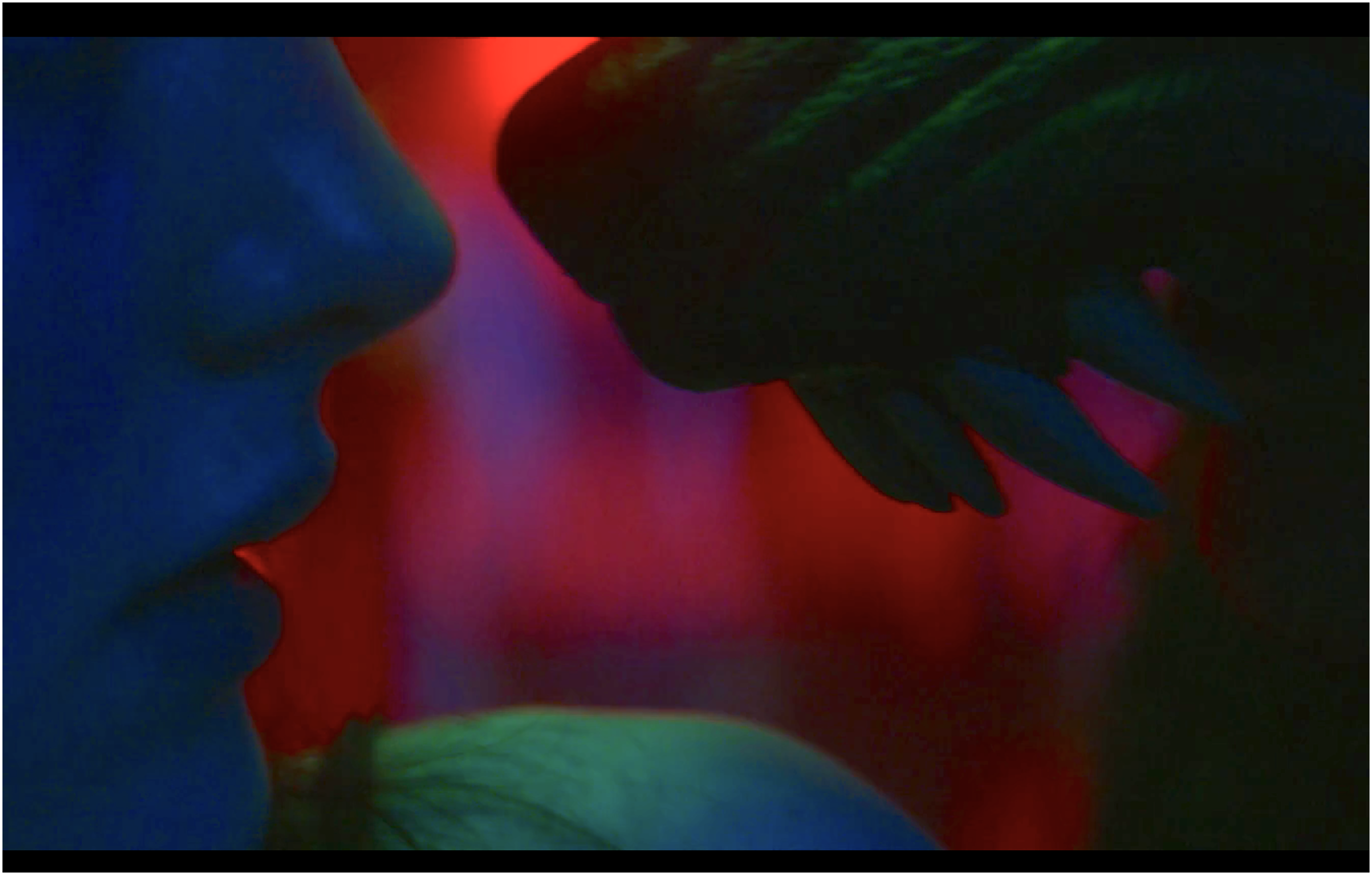
Kissing Candice (2017) Directed by Aoife McArdle. Cleveland, OH: Gravitas Ventures (1:11:02).
Stylistically, McArdle blurs the line between reality and fantasy, one reviewer describing the film as a ‘realist wonderland’ built from blending ‘realist filmmaking techniques into Candice's dream representations’ so that there is ‘a visceral sense of urgency at the film's core’ (McCausland, 2017). The reality in question includes bleak estates, derelict buildings and semi-industrial terrain – Barker's spatial imaginary updated for post-millennial Ireland. Yet the film's disenfranchised gang escape these bounds, making incursion into middle-class environs. Their threat is gendered, as when they phone Candice's father to describe how ‘all five of us’ are wondering what it would be like to kiss his ‘pretty’ daughter (1:09:02–32). Yet Candice's seizures provide escape, offering a frame of reference in excess of her surrounds. Positioned as both harbinger and seer, she attests: ‘Some dreams I have feel more real than all this’ (1:21:49). Christian imagery is also applied. Gossiping in bed with a friend, Candice's full face is lit in saintly aspect (0:08:35–0:09:44), while she is often held in the pietà position after seizures, culminating in a striking shot of Jacob cradling her in the forest (1:18:23). However, by desecrating an empty church while on the run, she signals her distinction from the previous generation of her mother, who prays ‘and clean[s], it's all she ever does’ (1:21:32). The film ends ambiguously with Candice and Jacob in a catastrophic car crash, suggesting victory to the angered, marginalised classes. But, in the film's closing moments, ‘the gaze is redirected from the gangster to the – now liberated – victim, as Candice's subconscious takes over the screen, a hyperreality rooted in egalitarian compassion’ such that a ‘more democratic, ungovernable and chaotic sublime’ is able ‘to escape the boundaries of the frame’ (Asava, 2022).
Similarly, in Solar Bones, Marcus's daughter Agnes provides emancipatory potential. Like her mother, she is an ‘exemplary sufferer’ and a ‘fully achieved study in western gothic’ (McCormack, 2016: 43). Yet Agnes reaches maturity in the full glare of neoliberal austerity, climate collapse and what Silva Federici calls an intensifying ‘war on women’ (2017). Fully aware of late capitalism's monstrosities, she mobilises vampiricism and zombification for political ends. Fulfilling what Marcus speculates are Mairead's failed dreams of being an artist, Agnes's creative practice concentrates on the ‘theme of the body as a rhetorical field’ (McCormack, 2016: 218). Her first solo exhibition consists of direct transcript from local news stories of court cases, ‘a maelstrom of voices’ in ‘relentless, surging indictment’ written in her own blood on the gallery walls (McCormack, 2016: 45), vampiric extraction being transformed into reverse offering. Viewed in the evening's waning light: [T]he script itself appeared to project from the walls into the middle of the room, the livid words and sentences themselves hanging in a light so finely emulsified that we might take it into our very pores and swell on it, so that even if the crowd broke up the continuity of the space there was no doubting that the light served to make everyone part of a unified whole […] Agnes's blood was now our common element (McCormack, 2016: 46).
‘[F]inely emulsified’ acknowledges the fragmentation of late capitalist society so terrifying her father. However, while Marcus cowered in mute incomprehension, Agnes instead offers a ‘relentless’, ‘surging’, ‘livid’ voice of protest. In contrast to the rapacious capitalist sun of Barker's novel, the ‘swelling’ we see here is a call to community, an appeal for a ‘common’, ‘unified’ and ‘continuous’ resistance to the status quo – it being no coincidence that honouring the blood of revolutionary workers was the original impetus behind socialist red.
At the end of the novel, Agnes leads a cast of the young in ghostly, carnivalesque revolt, during which ‘a company of zombies’ (McCormack, 2016: 234) are just some of those ‘drawn from some realm where the living and the dead stood shoulder to shoulder’ (McCormack, 2016: 235). Closing the procession as their representative, her dramatic, naked swan dive moulds ‘the whole spectacle into a coherent act of political protest’ (McCormack, 2016: 237), one designed to motivate ‘people to rise up and start a political and social renewal’, to ‘startle the people out of their torpor’ (McCormack, 2016: 239). This enacts the idea that, if capitalism ‘depends on ourselves as having individual consciousness to prohibit the development of a revolutionary collective’, then the zombie, one constructed only in reference to the group, provides a potential avenue by which ‘to shut down the system and the individual within it’ (Lauro and Embry, 2008: 108). In contrast to Barker's more nihilistic political vision, McCormack appears still to hold out the possibility of change. 14
Conclusion
Barker and McCormack both deploy Gothic modes and the motif of vomiting to make damning judgement of capitalism's extractive impetus. Their novels, along with the three films discussed, also make clear the devastating effects of the crisis in care for women and girls, with social reproductive feminism highlighting the extent to which neoliberalism is deeply and ambivalently reliant on gendered and sexual labour. There are, of course, hazards in reading across periods and places. However, as Deckard and Shapiro argue: There seems to be an incipient formation threading together the minoritized populations within the core nations, those falling from security under conditions of relentless precarity, and those beyond the boundaries of the capitalist cores’ supposed comfort. This is not simply a culture of discontent, but a loosely constellated emergent form of new political experience, even despite the deepening presence and renewal of neoliberal policies (2019: 44).
This article's novels and films reflect this ‘emergent form of new political experience’, first in its early then in its late stages. Whereas Barker, Clarke and Bernard appear shell-shocked by the scything out of the communities around them (offering little by way of political hope), McCormack's and McArdle's evocation of a younger generation sees no alternative but a calling to account, written in blood. Barker and McCormack specifically elucidate the state of their nation in one particular time and place, also harnessing this to global neoliberal crisis by using gothic modes and the motif of vomiting to help bridge their readers’ disjunctive experience of these shifting, but very necessary, scales.
Footnotes
Acknowledgements
Thanks to my students on ‘Twenty-First Century Fictions of Global Inequality’ and ‘Contemporary Fiction' in 2021/2 for discussion on these novels; to Brunel University for my 2022–2023 Athena Swan Research Leave; and, finally, to this article's anonymous reviewers for their perceptivecomments.
