



Abstract
In this article, I trace ‘re-membering’ as a feminist practice in the context of gendered activism under military occupation in Kashmir. Drawing on its anticolonial feminist roots, I conceptualise re-membering as practices that do not simply put together what has been severed or dismembered by coloniality but they also, in doing so, propose different frames of looking. I think through re-membering by focusing on two intertwining sites of gendered and feminist activism in Kashmir: protests that re-member the disappeared and activist representation under military occupation. A feminist analysis of these activist strategies grounded in anticolonial thinking suggests that re-membering in the specificity of its emergence under conditions of heightened control does multivalent work: it contests dominant claims and the coloniality of the Indian state, thereby exposing the continuum of violence including its carceral, psychic, discursive forms that co-constitute and perpetuate the occupation of Kashmir. As such, it insists on accounting for historical and contextual specificities as necessary conditions for imagining an expressly anticolonial feminist politics that can open possibilities of epistemic and political transformation towards knowing Kashmir and people’s struggles differently. It is here that the epistemic potential of re-membering lies: in overturning the terms of conversation as decolonial feminist scholarship has long insisted.
Introduction
On 28 October 2020, a team of officers from Indian investigation agencies along with local police officers and paramilitary soldiers raided the office of the Association of Parents of Disappeared Persons (APDP), a Kashmir-based collective against enforced disappearances (APDP, 2020a). Founded in 1994, the APDP remains invested in seeking just enquiry into the whereabouts of Kashmiri men and boys, over 8000 of whom were disappeared by state forces between 1989 and 2009 (Chatterji et al., 2009: 10). The collective also archives cases of involuntary and enforced disappearances, and has more recently documented pellet blinding and torture as among the forms of human rights violations that co-constitute Indian military occupation of the region. Alongside the APDP, investigation officers raided ten other offices and homes of human rights defenders, activists and journalists in Kashmir to ‘investigate into funding for “secessionist and separatist activities”’ (Wire, 2020). In response, co-founder and chairperson of the collective, Parveena Ahangar, issued a statement calling the raid a systematic reprisal against APDP advocates who have been seeking justice. Her statement adds: ‘APDP neither receives foreign funding, nor engages in any illegal activities. The raid conducted by the National Investigation Agency (NIA) has no basis, and only exposes the State’s desperation to deter APDP from pursuing justice for hundreds of victims of human rights violations committed by State actors in Kashmir’ (APDP, 2020a).
A day before, on 27 October 2020, Zanaan Wanaan (Kashmiri for ‘women speak’, and hereafter ZW), an independent Kashmir-based feminist collective, organised an online seminar with Stand with Kashmir, a diaspora-led transnational solidarity organisation, to launch their first biannual issue titled ‘Revisiting Dispossession and Loss in Kashmir’. On 27 October 1947 after the Partition of British-colonised India the Dogra Hindu monarch of the erstwhile Jammu and Kashmir state, notwithstanding popular resistance to his rule, had provisionally acceded to the newly formed Indian nation-state with its military landing in the region by plane (Kaul, 2017: 96, Zia, 2019: 55). In ZW’s panel discussion segment, Kashmiri scholars, activists, writers and photographers variously underlined the importance of re-visiting people’s history and documenting Kashmiri memory as a means of anticolonial knowledge production, especially as the process of dispossession from land, histories and communities has become more brazen with rapid settler colonialism from August 2019 onwards. 1 For them, documenting from their vantage creates ‘counterhistories’ against India’s military occupation of the region (Junaid, 2018: 249). These counterhistories can come to challenge, symbolically and discursively, the coloniality of a postcolonial state that seeks to liquidate Kashmiri identity and frames all political struggle in the region simply and erroneously as ‘Islamist terrorism’ (Kaul, 2018: 132). ZW’s issue opens with Kashmiri writer Misbah Haqani’s solidarity offering to Ahangar, without whom, she writes, ‘it is unimaginable to think of women’s activism in Kashmir’ (2020: 7). By way of conclusion, Haqani recounts feeling a sense of discomfort on ‘forcing’ Ahangar to narrate her story yet again, to which Ahangar responds: ‘This is also work, I have to repeat my story’ (Haqani, 2020: 8).
This article draws on transnational feminist, anti-racist and decolonial thinking and emerging Critical Kashmir Studies, a scholar-activist collective that thinks with Kashmir by centring the region’s histories and disrupting the coloniality of knowledge, which has long deployed statist, security and nation-based conceptual frameworks (see, for instance: Zia, 2013; Osuri, 2017; Bhan et al., 2018; Junaid, 2018; Kaul, 2018; Mushtaq, 2019; Zia, 2019, among others). By displacing colonialism as simply ‘a Western prerogative’, this scholarship has offered theoretical insights into how formerly colonised regions (such as India) have embarked on their own projects of colonialism (in Kashmir) that are emblematic of modern nation-state coloniality (Kaul, 2021: 115). This rich and emergent body of work also argues how dominant knowledge on Kashmir that engages with the political conflict as a bilateral or security matter between India and Pakistan elides not only Kashmiri histories, people’s conceptualisation of the Indian state’s presence as ‘military occupation’ and ongoing resistance to occupation but also Kashmiris’ long-standing demand for self-determination. Inevitably, what these dominant epistemic and political frameworks made ‘thinkable’ (Trouillot, 1995) were nation-based and nation-state political imaginaries that marginalise, if not always elide, indigenous political and epistemic claims (Pandit, 2020). This is distinctly evident in the discourse justifying the NIA raid, which was conducted to investigate ‘secessionist and separatist activities’ (Wire, 2020). In sharp contrast, Kashmiri feminist anthropologist Ather Zia contests the terminology of ‘separatism’ as it does not hold up to a critical historicising of Kashmir and its accession to India, to which people ‘never legally agreed to’ (2019: 105). That is, based on grounded histories, Kashmir’s political demands are not simply ‘caused’ by the Partition of British India and thus a ‘bilateral’ matter between newly formed nation-states, but precede it – as political mobilisations against the Dogra Hindu king’s oppressive regime from 1930 onwards indicate (Rai, 2004). 2 In this vein of disrupting (post)colonial forms and frames of knowledge, this literature has also begun to centre gender, militarism and racialisation as constitutive logics of military occupation and how they create differential socio-spatial relations for Kashmiri Muslims. Examples include women’s anti-disappearance activism visibilising them as protesting subjects in public spaces precisely when these spaces remain differentially accessible based on gendered logics of spatial militarisation (Zia, 2019); the fear of sexual and gendered forms of militarised violence that contingently shapes gender relations (Kazi, 2009); and the place of state-propelled gendered discourses that legitimise violence and sediment Indian coloniality in Kashmir (Kaul, 2018, 2021).
This article builds on this body of work alongside Black, Indigenous and anticolonial feminist thinking that centres memory work, specifically re-membering practices in gendered activism in Kashmir, and its implications for producing ‘against the grain’ counterhistories and possible epistemic and political routes. Unlike remembering, which can simply materialise as a nostalgic attachment to the past or recuperation of imagined histories, re-membering in the context of gendered activism in Kashmir emerges, I will show, as a historically constituted praxis with epistemic potentialities. In particular, I sew together the solidarity offerings that I began this article with to illustrate how for women activists living and working in occupied geographies riven with violence, a sustained emphasis on their struggles through ongoing recall opens up possibilities that challenge dominant narratives and seek to ‘produce theorised accounts of different, historically specific and located forms of worldmaking’ (Madhok, 2020: 395). By focusing on APDP and ZW’s activist work around memorialisation, I show that their memory work is not just about recalling what remains banished from dominant archives and state narratives insofar as such attempts remain limited to finding spaces or piecing together what may be missing. Rather, these historically located practices of what I conceptualise as ‘re-membering’ can emerge as epistemic interventions seeking to resist occupation and insist that we look differently. In situating these practices as re-membering, I show how it is in contingent and nuanced ways that activists at the margins deploy re-membering as a countervailing practice that brings to light the systemic violence of occupation (for example, enforced disappearances) their prolonged effects on those left behind – for instance, the gendered impact on women in the case of the APDP’s activism – and people’s ongoing resistance that together visibilise the coloniality of a postcolonial / settler colonial nation-state. As such, this article contributes to decoloniality and post/anticolonial feminist scholarship’s insistence on ‘undoing and redoing’ and ‘epistemic reconstitution’ as it remains interspersed in everyday practices and how they can enact a change in the ‘terms of the conversation’ (Mignolo and Walsh, 2018: 113–120, Vergès, 2021). In so doing, it insists on engaging with the epistemic potential of feminist strategies of protest as those which not only challenge or bring to light the material, psychic and affective violence of coloniality, but also necessitate thinking through the gendered, militarised and colonial conditions of power they are located in and practised against and the epistemic possibilities of knowing and thinking differently that they unfold.
Methodology and the politics of location
In several ways, the substance of the method of this article draws inspiration from anticolonial feminist impetus to undo and redo traditional frames of thinking that counter coloniality while attending to everyday thinking, being and epistemic frameworks (Lugones, 2007; Medina, 2013; Sium and Ritskes, 2013). If, as Mignolo and Walsh (2018; also Fanon ([1967] 2001) argue that colonialism, contemporary coloniality of power and coloniality of knowledge are underpinned by the logic of binary classification – Europe as modern and the rest as ‘backward’, or the logic of hierarchical racial division and racialisation – then decoloniality suggests an undoing of the epistemic structures, including hierarchical classifications, through which knowledge and power become concretised and understood as self-evident ‘truth’. As such, if coloniality remains an ongoing condition of our times (Mignolo, 2017), and the modern nation-state a colonial remnant (Quijano, 2000), then attention to India’s coloniality in Kashmir allows us to follow the governing logics of gender, racialisation, securitisation and state sovereignty that make the region’s occupation a possibility. Indeed, the discursive-political architecture of the Indian state relies on many such colonial hierarchies and classifications of bodies, space and time. Examples include using temporal narratives of normalcy/unrest that water down people’s continual disobedience and resistance against occupation in the form of civil strikes or closing shops as symbolic acts. These temporal markers further obfuscate conditions of military occupation as a form of ‘normalcy’ to which people’s resistance becomes ‘unrest’ – a sort of temporal break that has not existed for a long time but emerges only to undo the ‘peace, stability and normalcy’ maintained by the state in the region. Similarly, the Indian state’s framing of people’s resistance simply in terms of ‘Islamic indoctrination/terrorism’ or as ‘misguided’ renders illegible the historic demand for Kashmiri self-determination (Bhan et al., 2018). Indeed, such siloed framings elide continuity of resistance and how struggle against occupation is not an anomaly but ongoing and present.
In methodological terms, this implies that techniques of break and discontinuity that coloniality relies upon necessitate dismantling, for decolonial spaces and possibilities to emerge (Zavala, 2013). In Kashmir, while APDP women’s activism has a longer history especially as the collective came together following the enforced disappearances of Kashmiri men, ZW is a recent feminist formation in the aftermath of the August 2019 siege when the Indian state deoperationalised Jammu and Kashmir’s nominal autonomy while also bifurcating the state into two centrally governed union territories. While the APDP and ZW have distinct historico-political trajectories of activism and their advocacy and solidaristic engagements remain diverse, they nonetheless indicate continuity of gendered resistance under occupation, as opposed to state claims that perpetually victimise Kashmiri Muslim women (Mushtaq, 2019). That ZW’s inaugural issue begins with a note of feminist gratitude for Ahangar indicates these continuities. Moreover, part of the APDP and ZW’s focus is on memory work in which they seek to re-member their histories and struggles in their own terms – from creating counterhistories and narratives, archiving and documenting to embodying what has been dismembered. These re-membering practices are sustained by various bodily and spatial ways of claiming that push back against both the militarised state and its military-led occupation. Implicit to re-membering is ‘not forgetting’, clearly indicated in Ahangar’s speech act: ‘this is also work, I have to repeat my story’, which constitutes a struggle against erasure of colonial violence that undergirds contemporary post/colonial formations like nation-states or liberal democracies (Edkins, 2003: 229).
Thus, rather than think through these gendered formations as discontinuous and in silos, I read them together to trace not their commonalities but how their turn to re-membering can emerge as an exercise of epistemic reconstitution in light of coloniality. Based on my ongoing research in accounting for coloniality and occupation in Kashmir, this article draws on a range of materials: Kashmiri filmmaker Iffat Fatima’s documentary film Khoon Diy Baarav (Blood Leaves Its Trail), which serves as a visual archive of the APDP’s activism and was created in association with activists of the collective; APDP protest devices and archives that they also make available on their website; and ZW’s art and songs of protest. Why I thread these materials together is also for the analytical possibility they unfold: how coloniality of power and statist knowledge are persistently challenged across activist formations despite conditions of militarised control. I thus begin by locating the APDP protest site, also a recurring motif in Fatima’s film, as a gendered formation and unpack the registers of re-membering that animate it. In the next section, I focus on representation devices and objects such as posters, calendars, postcards, artwork and songs that engender re-membering as a process that creates counterhistories. Together, these ways of re-membering contest ‘normalcy’ narratives imposed and popularised by the Indian state and its mainstream media in relation to Kashmir, thereby exposing the continuum of violence, including its carceral, psychic, discursive forms that co-constitute and perpetuate occupation of the region. It is here that I identify an insistence on accounting for historical, political and contextual specificities as necessary conditions for imagining an expressly anticolonial feminist politics that can open up possibilities of epistemic transformation beyond dominant, colonial and statist frames of thinking.
Crucial to anticolonial feminist praxis is that we remain attentive to embodying a critical, reflexive politics of location (Rich, 1984; Madhok, 2020). As an Indian feminist researcher from central India with caste and ethnic-citizenship privilege, learning and thinking with Kashmir remains an ethical-political minefield. Here I begin with recognising what Madhok conceptualises as ‘feminist debt’: ‘an acknowledgement of the possibility of doing particular research in the first instance’ (2020: 396). Far from smoothening ethical quandaries, acknowledging feminist debt is an ongoing means for scholars and researchers to recognise the intellectual and political work that makes possible knowing and thinking about certain concepts and contexts inundated with political and epistemic violence. This is especially imperative in relation to the logic and processes of military occupation of Kashmir, also enabled by the discursive architecture of the Indian state, which frames the region as ‘integral’ to the Indian union but also a ‘law and order’ problem because of ‘suspect’ natives, especially the racialised Kashmiri Muslims in the Hindu/Indian/Brahmanical nationalist imagination (Kaul, 2018). Drawing on critiques of coloniality and from a decolonial standpoint, recent scholarship has crucially dislocated these framings by demarginalising what has long been rendered marginal. An example of this is constituting Kashmir as a case of military occupation, which becomes both a mode of analysis (Junaid, 2013; Visweswaran, 2013; Bhan, Duschinski and Zia, 2018) and a challenge to the sovereignty claims of the state. Indeed, among the key stipulations of feminist debt remains that we recognise the complex entanglements of power that shape and underpin knowledge struggles, including liberatory projects like feminisms (Madhok, 2020). In this sense, this article begins by framing the region as a case of military occupation to understand the links between coloniality and people’s ongoing resistance to it by engaging with available activist material. While questions of ethics and politics especially in relation to Indian scholars engaging with Kashmir remain urgent, complex and ongoing, with my brief account I have sought to offer how a critical politics of location shapes my analytical and methodological orientations as well as my intellectual commitments. Building on this scaffolding, the rest of this article shows how gendered and feminist activism in the context of military occupation deploys re-membering as a generative epistemic praxis that does manifold work: it becomes a resistive tool that contingently pushes back against the spatial and bodily ordering that the militarised state seeks to exert. In so doing, it brings to light and subsequently challenges dominant historical claims undergirding the coloniality of ‘postcolonies’. It is here that the epistemic potential of re-membering lies – in overturning the terms of conversation as decolonial thinking has long emphasised.
Conceptualising re-membering
Re-membering as a concept has variously been engaged by scholars in the fields of memory and memorialisation studies and Black, Indigenous and decolonial feminisms. Because I am interested in tracing the epistemic implications of re-membering, I draw on how existing literature conceptualises it as an anti/decolonial feminist political praxis. Black feminist scholar Shelley Haley (1993) understands re-membering as a form of telling that validates the existence of precisely what has been silenced or even dismembered. In thinking through Black feminism in relation to classics, Haley suggests that we devise forms of reading that acknowledge silences and follow their presence thereon. It is these forms of reading and tracing trajectories of silence that allow attending to the ways in which its remnants chip away at power and engender a form of re-membering that recollects and puts together what has been dismembered. This suggests that re-membering is not a unidimensional process but an analytical tool, a reading practice that is embodied and spatiotemporally located. Put simply, if to re-member is to reconstitute what has been dismembered, someone somewhere is embarking on the process of putting together. This suggests its embodied nature – how in putting together bodies remain implicated in processes of spatial and temporal reconstitution. As such, what is being re-membered can come to challenge existing framings of absence – a spatial motif – and propose a different temporality of presence precisely when power has made it non-existent or illegible. Altogether, it is through undoing and redoing that re-membering comes alive.
Relatedly, Kenyan literary scholar Ngũgĩ wa Thiong’o (2009) places coloniality at the centre of re-membering, which he understands as material, literary, affective and bodily practices that put together what has been dismembered by the Atlantic slave trade, European colonialism and their afterlives in Africa. Practices of re-membering can include creative imagination, devising newer languages and ways of thinking that seek to undo the historic amnesia of colonialism (wa Thiong, 2009: 108). Re-membering, thus, is also memory work: ‘it is a closure and opening to a new relationship of being’ (wa Thiong, 2009: 58). Building on wa Thiong’o, recent indigenous scholarship understands re-membering ‘as a process that pushes past the intended severings of coloniality, encouraging us to re-vision’ and lay emphasis on its methodological and pedagogical potentialities (Grande and McCarty, 2018: 166). For Grande and McCarty, re-membering then can work as an interruption, ‘a literal regrounding and antidote to the violence of colonialism’ that represents a ‘methodological and pedagogical elsewhere’ (2018: 165–166). This suggests its epistemic potential precisely as it can bring to light the violence of dominant knowledges and political paradigms while constituting newer epistemic shifts by uncovering the injustice and oppression of existing systems.
Likewise, Jeffries in relation to feminist activism of the peoples of the Occaneechi Band of the Saponi Nation argues how after state recognition, activist practices of re-membering ancestral knowledges ‘force us to look critically at our assumptions about what constitutes political action’ (2015: 165). Re-membering through workshops, cultural education, language lessons and health initiatives, among other things, displaces the state as the primary actor with which communities engage as they build on ancestral knowledges and traditions while countering ongoing racism. I read these conceptualisations as politically and theoretically generative as they allow attending to historically specific practices of re-membering that emerge and are practised in the context of women’s and feminist activism in Kashmir. Re-membering as an anticolonial praxis places coloniality and colonial relations of power – distinct in India’s relation to Kashmir (Kabir, 2009) – at the centre of analysis. As existing literature suggests, re-membering practices are simultaneously embodied and spatio-temporally located in ways that expose coloniality while insisting on epistemic change. The rest of this article engages with re-membering as an epistemic site co-constitutive of ontology (how bodies, subjects, worlds exist) in thinking through gendered activism under military occupation.
Re-membering as embodied presencing
Khoon Diy Baarav showcases an APDP protest organised on 30 August, the International Day of the Disappeared. APDP activists, largely comprising women but also men and a few children with their mothers, are gathered at a public park in Kashmir’s Srinagar. Lining the periphery of the park are a few paramilitary vehicles, with civilian vehicular traffic present as usual on the main road the park is adjacent to. APDP activists are sat in a semi-circular formation – with women of different age groups in the centre and fathers and other male kin of the disappeared persons at the two corners. In the background is a banner with a photo collage of disappeared men and boys, and a message that calls for replacing impunity with accountability. Another APDP banner demands that the Indian state ratify the International Convention for the Protection of All Persons from Enforced Disappearances. Against this backdrop, some women are clad in dupattas, others with headscarves and yet others with a protest band around their forehead as they chant ‘Stop Disappearances’. A few seconds later, Ahangar says: ‘I appeal to the Jammu and Kashmir government: If you don’t have the authority to find out about our children, let the international community resolve this issue’. As other activists join her in these demands, videographers and photojournalists hover around for soundbites and photographs. This is usually the sight at many APDP demonstrations that the collective also organises on the tenth day of each month and other significant days to mark their protest.
It was in 2016 when I interviewed Ahangar in London who was then travelling with Fatima for screenings of Khoon Diy Baarav across British universities.
3
Similar to Haqani, I recall feeling a sense of discomfort while asking Ahangar to narrate her story yet again, especially as she has recounted it many times for journalists, researchers and activists. Nevertheless, she proceeded perhaps because her struggle also charts the trajectory of the APDP’s formation. It was on 18 August 1990 that Ahangar’s seventeen-year-old son Javaid Ahmad Ahangar was picked up by soldiers of an Indian counterinsurgency force during a night raid in the Batamaloo area of downtown Srinagar (Mathur, 2016; APDP, 2020b: 10). This period marked the peak of armed insurgency in Kashmir, which was militarily repressed. After her son’s disappearance, it was particularly taxing for Ahangar, who would walk around the Srinagar streets asking strangers about her son. It was only when she visited offices of several ministers and legislators, army camps, prisons and courts in search of her son that she met other Kashmiri women whose children, husbands and brothers had similarly disappeared. Despite the emotional and mental toll this took on her and the visceral, gendered fear of being targeted by state forces, Ahangar did not relent. As she says: The army and the police troubled us a lot. They would come in the mornings and evenings, but I am not scared … I will die one day too but I will die fighting for a just cause … As I began organising, people in the cities were not scared and became a part of this movement. It was in the rural areas that I had to convince people. I went to Handwara, Kupwara and other villages, and told people that if we fight the crime of enforced disappearances individually nobody will listen to us; it is the collective struggle which will make a difference … They saw that I was a woman from Srinagar who travelled to several villages to fight against enforced disappearances and that’s when a lot of them were determined to look for our disappeared children. (Interview, London, June 2016; emphasis mine)
Zia, in her ethnography on enforced disappearances, argues that APDP mobilisation is underpinned by a form of ‘female consciousness’ (2019: 9) that is centred around gender and related social concerns of survival. It is in this form of consciousness that Zia identifies the potential for a feminist consciousness. Indeed, the APDP as a collective is a gendered formation in many ways. First, that mostly men and boys were disappeared made women – ‘half-widows’, sisters, mothers – hypervisible in public spaces and vulnerable in socio-economic terms (Zia, 2013, 2019). Second, as families came together to form the collective, it was women’s gendered experiences of vulnerability and motherly bereavement that helped the APDP gain recognition and popular support in Kashmir. This is evident in Ahangar’s acknowledgement that people saw her as a woman who was collectivising and could feel her motherly loss, which led to them working together as the APDP. In the context of Sri Lanka, De Alwis (2009: 84) notes how the Mothers’ Front insisted that they were ‘merely’ mothers looking for their children, posing a dilemma for the state which had to formulate alternative responses. However, de Alwis also cautions against the essentialising potential of motherhood and its amenability to nationalist projects. Nevertheless, women activists of the APDP, aware of the societal and gendered constraints as well as the bodily vulnerability that is increasingly magnified by enforced militarisation and its masculinist logics (Kazi, 2009; Zia, 2019), deploy facets of their gender identity in nuanced ways to carry on their work against disappearances.
APDP protest sites are also spaces of gendered performances, with women mourning disappearances as they demand information about their kin. However, of particular importance are the ways in which activists re-member and bring to life those disappeared. At the site of the APDP protest, women activists are often seen wearing an identity card. It is not theirs but that of their husband, son or brother who has been disappeared. In Kashmir, the identity card – or i-card as it is commonly known – is a crucial motif of everyday living under military occupation where its presence or absence can become a matter of life or death. In February 2021, images of Kashmiri men being asked to queue for a security check in the centre of Srinagar underlined the centrality of i-cards in shaping militarised sociality. Many interlocutors I have been engaging with over the years 4 have shared how Kashmiris carry at least a few identity cards with them whenever stepping out of their homes in case they are stopped at a checkpoint. In fact, Hajra Begum, an elderly woman from Bandipora, emphasises that her son was picked up because he had lost his identity card (Khoon Diy Baarav, 2015). An identity card or loss thereof is illustrative of the everyday experiences of repressive control that instil bodily vulnerability. Thus, by wearing the identity cards of disappeared kin, APDP activists bring to light the embodied vulnerability and violence of occupation. At other times, activists also use devices such as white headbands with the name and silhouette of their disappeared kin to drive home these myriad manifestations of occupation.
Activists’ use of devices like headbands and identity cards with the names and photographs of disappeared relatives performs a series of resistive functions. First, it insists on the existence of the disappeared person who is neither present nor dead (thus fully absent) as their body has not been found and buried, as also suggested by Longoni (2010) in her work on the visual practices of protests by the Mothers of the Plaza de Mayo in Argentina. This insistence on the unknown status of their existence particularly challenges the state which negates disappearing people as part of counterinsurgency tactics or depoliticises enforced disappearances simply as persons gone ‘missing’. In light of such statist negation and denial, which often brings into question the very presence of those disappeared, as if they did not exist, an embodied recreation of a disappeared person through their identity cards and photographs insists on their absent presence. In so doing, activists expose the forms and continuum of violence that the state and its military occupation relies on to maintain control over a dissident people. This includes direct material violence of disappearing people and their prolonged socio-economic, affective and psychic footprints on families left behind. Third, implicit in this form of protest memorialisation is the emphasis on not forgetting, which works as a resistive tool against the state that continues to claim ‘normalcy’ in Kashmir and relies on institutionalising forgetting (Misri, 2020). In sum, as activists assemble in public places, their embodied presence and protest participation is not an individual act but brings to light remnants of the void manifested by enforced disappearances that have been made part of their lives and becomes the raison d’etre of their collectivisation. By consciously attempting to memorialise the disappeared men as they wear their names and photographs, activists take on another skin. They make the disappeared re-appear; they ‘re-member’ the disappeared. In this process of re-membering, objects such as identity cards and headscarves add layers of loss to the lived subjectivities of APDP activists.
Thus, thinking of the APDP protest as a space of re-membering allows us to trace its varied potentialities: how the bodily presence of activists layered with protest objects such as identity cards, photographs and headbands with an image of the disappeared becomes a moment of memorialisation and documenting what remains banished from institutionalised archives and dominant framings (Kumar and Dar, 2015). And in doing so, they chip away at the power of coloniality that relies on violence and its tactical erasure from memory. The protest site thus becomes an epistemic moment; it brings to the fore what is continually erased, elided, negated or deemed false and propagandist by the state. It is a spatiality that can produce counter knowledges. In sum, APDP protest sites and activists intervene epistemically by making visible what remains unseen or often deliberately misrepresented by statist discourses and logics of coloniality. In thinking with Medina, these activists can be seen as ‘epistemic heroes’ whose affective-embodied protest practices that seek to visibilise disappearances ‘are neither necessary nor sufficient’ for epistemic and political change (2013: 226). Instead, the epistemic potential of their practices lies in the collective performative action they generate and the alternative conceptual frames of looking they deploy that are insistently aligned against dominant frames of thinking.
Re-presenting as re-membering
The political potential of re-membering by anti-disappearance activists is not only limited to staging demonstrations, but also comes through in the variety of representation devices, such as posters, postcards and calendars that the collective puts together. In construing India’s relationship to Kashmir as a colonising one, Kabir (2009) shows how, together with the discursive architecture of the state, forms of representation such as films, travel and journalistic photography on Kashmir fetishise the region as an object of feminised desire. While assigning an aura of normality, these representations and their fetishising gaze construe Kashmir as ‘integral’ to imaginaries of the nation. Concomitantly, spaces of representation are also where Kashmiris create counter-representation and counter-memory (Kabir, 2009; Mushtaq, 2021).
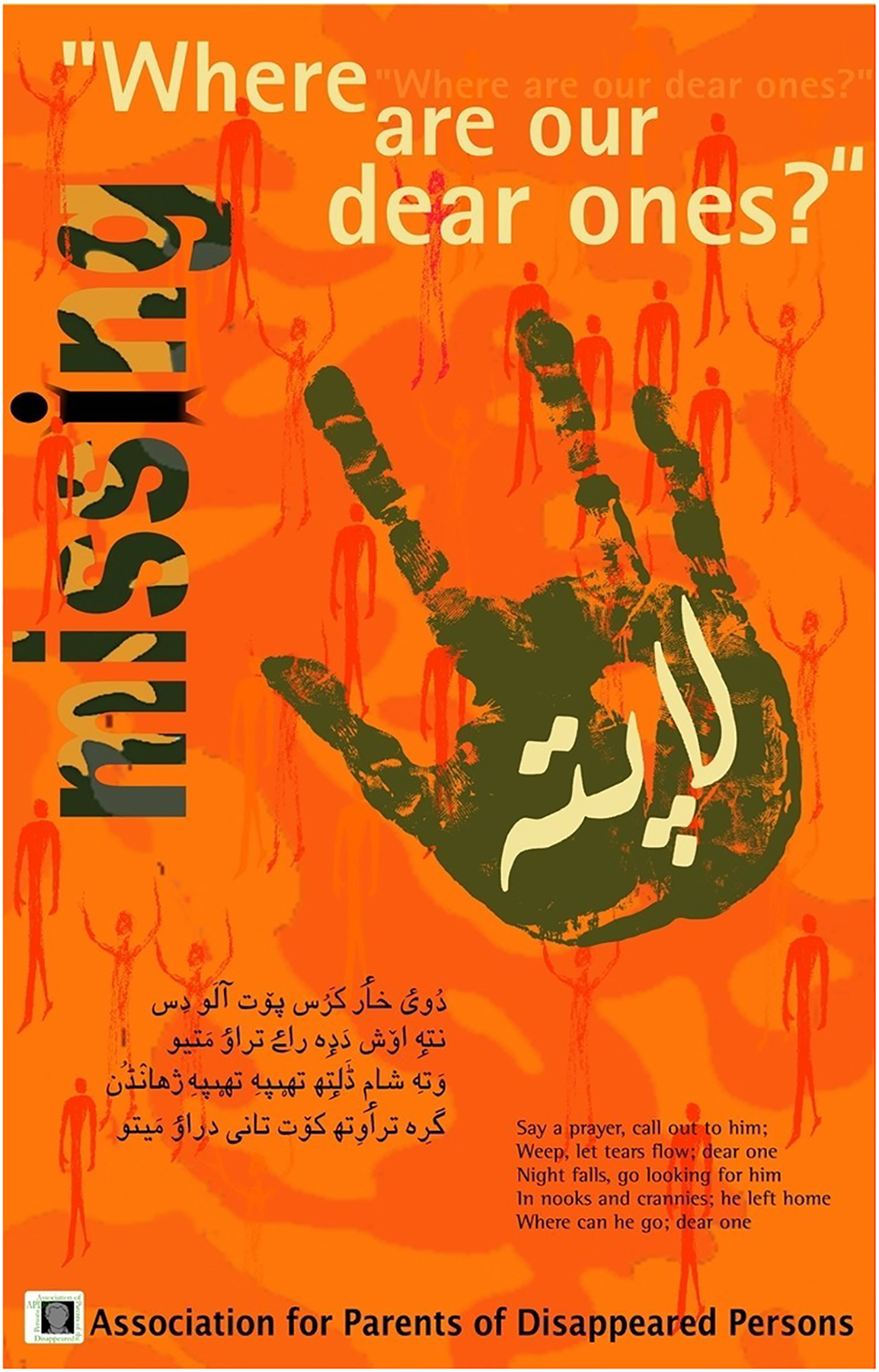
Let us consider Figure 1, one of the main posters designed by the APDP for their protests and advocacy. While a still image, it entails a lot of movement, in that it foregrounds enforced disappearances as part of the violence of military occupation and asks, rhetorically: “where are our dear ones?” A simple question that has no answer. The poster is set in shades of orange and red with silhouettes of people splashed across like blood. Upon paying closer attention, we see some silhouettes with raised hands, signifying stop and search operations by the armed forces and the process of disappearance – in which people are disappeared after being picked up by state forces. Further, the dominant motif of a dismembered palm speaks of the multitudinous forms of dismembering that a colonial occupation undertakes not simply by disappearing men but in ordering sociality through militarised control and violence. Written on the palm is laapata (missing) and next to it is the English translation in a camouflage pattern, symbolising military presence. One way of reading the broken palm would be that it spotlights the dismembering nature of Indian nationalist claims over Kashmir as integral to India, its atoot ang (unbreakable body part) and its material manifestations including military occupation. Overall, this visual representation does more than just contextualise enforced disappearances and other rights violations in Kashmir; it breaks the linearity of time. I read in the poster a distinct politics of time: one that refuses to acknowledge the present as a linear temporal progression from the past, as if the past when the disappearances occurred no longer shapes the present.
APDP poster.
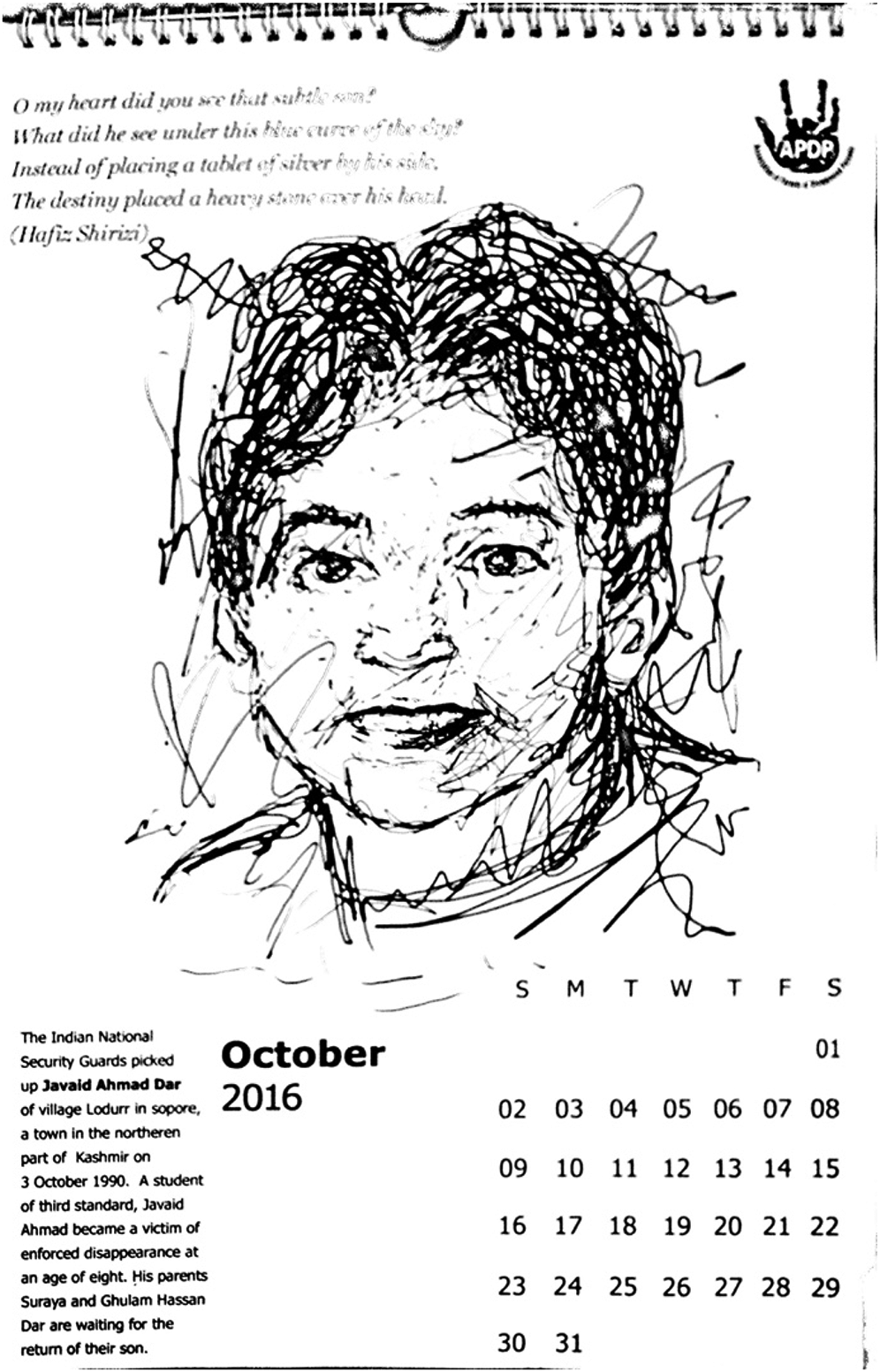
In late 2015, APDP activists and supporters of the collective printed calendars in memory of the disappeared (Figure 2). These calendars are designed as a repository of cases of enforced disappearances, with each month memorialising a person who was disappeared in that month. Every page of the calendar has names of the disappeared written in bold with details of their profession, age, family and when and where they were picked up. Most importantly, based on testimonies of kin, these calendars actively name military officers or their battalion who are thought to have picked them up. Such a form of active re-membering while insisting on the presence of those disappeared also implicates the state for its violence and lack of accountability. So doing, these calendars become embodied and affective devices that generate a particular form of knowing about Kashmir away from statist narratives. Crucially, they instil a sense of ‘affective dissonance’ by making visible ‘that which moves us, rather than that which confirms us in what we already know’ (Hemmings, 2012: 151), including questions and stories of (the lack of) state accountability, complicity and despair. Even so, these are not stories of defeat but exemplify persistence in spite of loss. For instance, each page that re-members a disappeared person also brings to life the many afterlives of disappearances – by foregrounding family members left behind who await their return. Alongside these details are poignant poems and verses by Kashmiri and Urdu poets, thus bringing together academic and literary texts with popular cultural symbols to create a discourse of solidarity and continuity (Partnoy, 2007).
APDP calendar.
Calendars are spatiotemporal devices that indicate the progression of time. Yet, the ways in which the APDP uses calendars to underscore disappearances subvert instrumentalist understandings of linear time and temporality. In other words, as calendars work to establish chronological time, juxtaposing disappearances therein challenges the linear progression of time that calendars seek to establish. In here lies a refusal to acknowledge the present as a mere progression from the past, as if the past when disappearances occurred no longer shapes the present, indicating punctuated or ‘strange temporalities’ that occupation sediments (Misri, 2020: 546). While challenging progress narratives including declarations of Kashmir as ‘finally integrated’ into the Indian union (as state discourses claimed in the aftermath of August 2019) or as ‘normal’, such devices construct a present that remains haunted by the past. Disappearances in this sense are not simply events of the past but continue to shape the lives of people left behind, as well as Kashmiri sociality. Such a refusal against linear ordering is indeed characteristic of repetition that insists on not forgetting, and a past and present that are always co-constitutive of one another. A page in the calendar spatialises both state power that orders time and bodies in linear ways, and people’s insistence on refusing this linearity through re-membering.
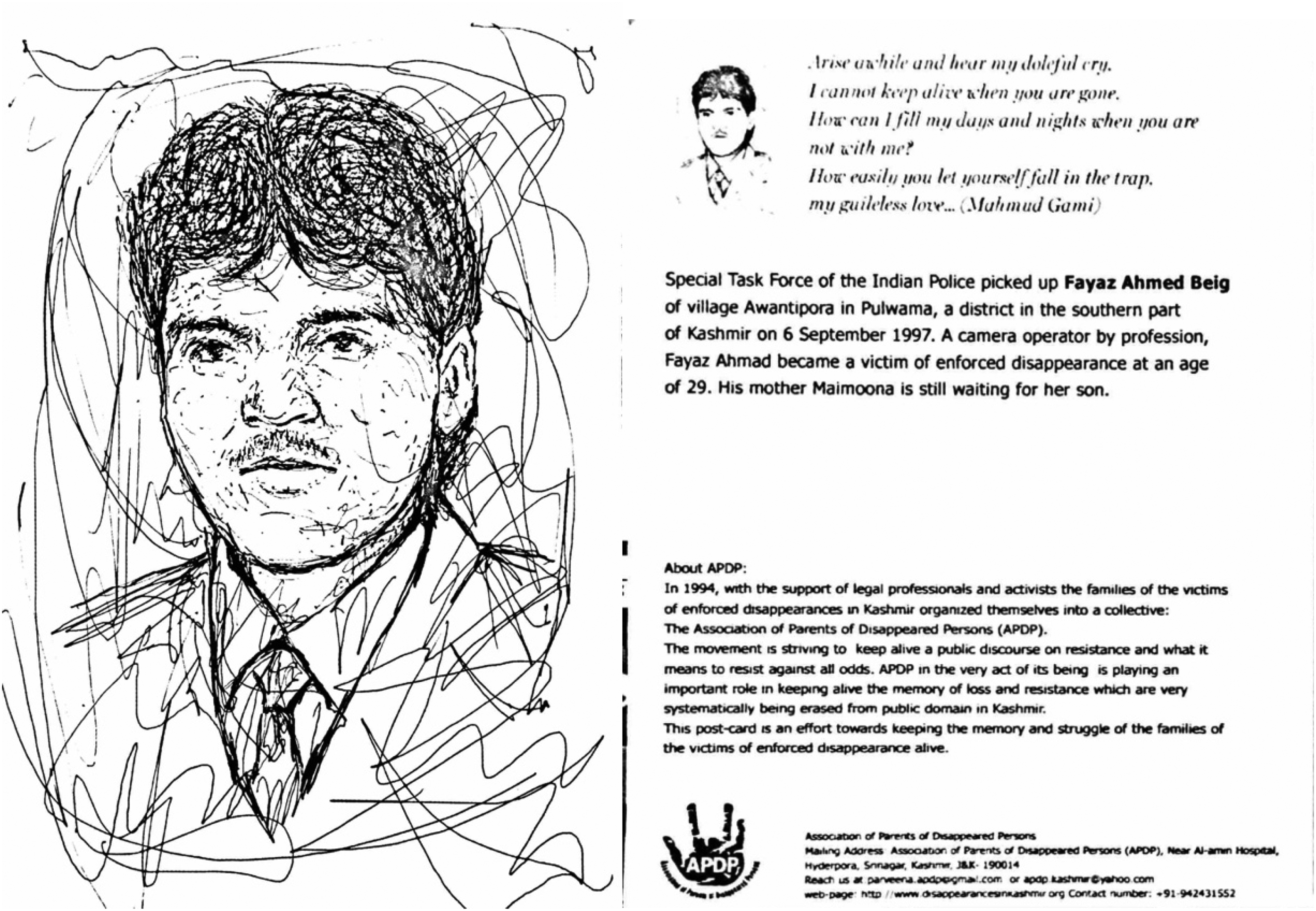
Like calendars, postcards also memorialise the disappeared, thus emerging as ‘mobile sites of memory’ (Kabir, 2009: 58). More compact than calendars, postcards serve a slightly different purpose; in their ease of mobility, they can be distributed across borders, and sent back to Kashmir as solidarity offerings to activists and families of the disappeared or to the state as testimonials that visibilise the violence of occupation (Figure 3). I am reminded of a film screening of Khoon Diy Baarav I attended in June 2016 organised by a university in London, which was followed by a conversation with Fatima and Ahangar. Outside the event venue, organisers put up a stall where APDP calendars and DVDs of the documentary were for sale. This gave attendees which comprised audiences from South Asia and other regions with diverse interests – international students, diaspora activists, scholars and academics – space to know more about Kashmir. However, unlike the calendars which were for sale, APDP postcards were strategically placed on audience seats, allowing people to either write solidarity messages to anti-disappearance activists or keep them as memorial artefacts. Many in the audience chose to write on these postcards in the hope that they would be sent back to families of the disappeared as solidarity notes. I recount this moment to trace the trajectories that protest devices can take. While both calendars and postcards are objects of memory and memorialisation, the latter in their mobility can carve spaces for knowing and engaging with Kashmir differently – a shift from narratives of coloniality – that are not spatially bound to Kashmir but cross geographical borders. These mobile objects can engender transnational connections across contexts, which remains a crucial element of the APDP’s work as the collective engages in regional and global foras, like the Asian Federation Against Involuntary Disappearances, with Ahangar receiving the 2017 Rafto Foundation Prize for her rights struggles. In her Rafto award speech, Ahangar insisted on these transnational links by recognising similar mothers’ struggles in Argentina, the Philippines and Sri Lanka (Kashmir Lit, 2017).
APDP postcard.
Similar textures of gendered embodiment and temporality inflect ZW’s work. A virtual exhibit put out by the collective on 15 July 2021 featured mixed-media artworks by Kashmiri women reflecting on the minutiae of everyday occupation and its lingering effects in shaping Kashmiri life and sociality. One of the artworks by Kashmiri Pop Art 5 is set against the map of undivided Kashmir contoured with barbed wires – an insistence on the presence of enforced militarisation that not only takes form through mandated violence but shapes space, landscape and bodies that inhabit the region. Within the map is a monotone version of a widely shared photograph of Kashmiri women protesting the excess force and violence the Indian state used on protestors. Foregrounding this is a pheran-clad Kashmiri woman holding the ends of the barbed wire – starting to undo it – that contours Kashmir. In her undoing, the woman attempts to colour Kashmir which has been rendered ‘dark’ through occupation, a persistent theme across artistic production from the region (Misri, 2020). 6 While a still art piece, it entails resilient motion: a viewer knows, and hopes, that the woman succeeds in disentangling the barbed wire, and becomes implicated through a sense of dissonance – that the state’s claims of ‘normalcy’ are also what normalise the violence of occupation. In so doing, the art piece centres myriad forms of gendered resistance under occupation – from women on the streets, to women in the home navigating militarised vulnerability that is not confined to public spaces but seeps through everyday spaces of living. As such, re-membering in this artwork emerges as multivalent: it re-members the continuity of gendered struggles and the material, affective, psychic and embodied labour of undoing the barbed wires – of undoing the dismembering logic of occupation.
Prior to their inaugural issue on dispossession and loss, ZW, which began as an anonymous collective, had launched two original songs about Kashmir. ‘Kashmiri Bella Ciao’, as the name suggests, is inspired by the Italian song ‘Bella Ciao’, predominantly sung by rural women against fascism, indicating transnational and cross-context linkages. Launched on 23 February, commemorated as Kashmiri Women’s Resistance Day and almost six months into the 2019 siege, the song works as a historical archive. It carefully historicises moments of state violence and years of mass political mobilisations that shape people’s memories; the politics of military occupation that grants unbridled impunity to soldiers to kill on suspicion; and a multifaceted deep state that relies on legalising occupation (Duschinski and Ghosh, 2017), violence and the ordering of space and everyday relations (Junaid, 2013, 2019). In an interview with a Kashmiri online journal, ZW organisers shared: This song is informed by our history and the oppression of our land and bodies by the Indian State. It must be seen as a song of collective resistance. It speaks of our fight against the colonizer. As opposed to the representation of Kashmiris in the Indian ‘mainstream’ media as the crying, wailing and mourning people, which often sees Kashmir and Kashmiris with an oriental and a patronizing eye, this song speaks of the fights that we have and continue to put up against the occupier. (Kashmir Lit, 2020)
Indeed, ZW’s focus like many recent Kashmiri digital initiatives remains, in part, on the politics of representation wherein mainstream narratives of the region downplay people’s historical resistance and political aspirations. Specifically, popular Indian narratives of Kashmir are replete with fetishising representation of the region as ‘heaven on earth’ and Kashmiri women as ‘fair-skinned’ objects of desire. These framings have only magnified after August 2019 when misogynist proclamations were made across the Indian political and cultural spectrum – from politicians to pop culture – about Indian men now being able to marry ‘beautiful’ Kashmiri women and buy land (Mushtaq, 2019). 7 The gendered logics through which coloniality takes shape in Kashmir are evident here; Kashmir becomes a feminised metonym for its women and land, which are framed as invitations for capture by the masculinist militarised state. In characterising Kashmiri women as agency-less and dehumanised subjects, such narratives constitute deep epistemic and material violence that scaffolds coloniality. In the sea of such colonial (mis)representations, ‘Kashmiri Bella Ciao’ becomes a re-membering object that visibilises precisely the multimodal logics – the carceral, discursive and spatial and symbolic – that constitute the region’s occupation, and what the state seeks to hide.
On 5 August 2020, a year since the 2019 siege, ZW launched another song titled ‘Duaekhaer-e-Inquilaab’ (in Kashmiri, duaekhaer implies benediction and inquilaab revolution). In slight contrast to their previous song which offers an insight into a socio-political history of Kashmir, ‘Duaekhaer’ is both a plea and a tribute to Kashmiri resistance. The ZW website explains: ‘In Kashmir, Duaekhaer is a blessing often bestowed by the elderly of the society. It is an utterance of hope and optimism for a better future. Duaekhaer is offered not only in times of adversaries but is a symbol of goodwill for our loved ones to prosper … Duaekhaer-e-Inquilaab is a prayer and call for revolution’ (Zanaan Wanaan, 2020). The song attests to the longer histories and spirit of resistance that predate the formation of the Indian state and continue. For Mushtaq (2021), this song opens a cross-generational conversation by invoking the figure of the bouba, a term of endearment for an elderly woman in Kashmir who has inspired its making. In bringing together Kashmiri women in an ephemeral collectivity, it symbolises ‘collective resilience, camaraderie and resistance to the Indian state’ (Mushtaq, 2021 para 5). The song resists a neat temporal segmenting of Kashmiri resistance as before 1947 or after 1989 with the onset of armed insurgency in the region, and insists on a continuity against colonial subjugation that transcends repressive monarchies and modern nation-state formation. Most importantly, it places feminist sensibility at the centre to yet again re-member not just ongoing anticolonial resistance but also women’s place and role in it as a mode of embodying feminist politics in the present. ‘Duaekhaer’ thus indicates the continuity of gendered resistance, also through art and songs that Kashmiri women have long continued (Falak, 2018).
Together, the activist work the APDP and ZW engenders re-membering that seeks to visibilise what is rendered invisible by dominant representations, frameworks and state narratives. As I have shown, protest posters, calendars, postcards, artwork and songs embody re-membering by not just recalling violent encounters with coloniality and their lingering effects but also, in so doing, seeking to recapitulate loss while contesting territorial claims made by the state and the epistemic frames of nation-state, terrorism, sovereignty and national security it relies on. Indeed, this shows an epistemic redoing – of how violence has dismembered social and spatial relations, and yet how ongoing activist articulations are geared towards exposing epistemic and political injustice. This suggests how thinking through coloniality in an occupied zone through gendered resistance has the potential to enact epistemic shifts – by outlining the ongoing effects of occupation on people’s lives and social relations; exposing how violence haunts the present; and how grounded histories negate dominant epistemic frames of ‘normalcy’. Overall, it remains pertinent to stay with the ways in which activist strategies of re-membering while constituting political resistance are also epistemic moments that seek to expose and take on dominant frames by offering alternative conceptual frames of thinking.
Conclusion
In this article, I have traced the textures and tenors of re-membering as a feminist political praxis in the context of gendered activism in Kashmir. In conceptualising re-membering, I draw on its anticolonial feminist roots as practices that do not simply put together what has been severed or dismembered by coloniality but also propose different frames of looking. Rather than a simple recall of experiences under occupation, I suggest thinking through re-membering if we are to understand the epistemic potential of gendered and feminist activism that seeks transformation. This follows from decolonial feminist scholarship that has offered conceptual tools and vocabularies to identify how dominant epistemic frameworks remain implicated in perpetuating coloniality. As such, it remains imperative to locate the potential not simply of political resistance but also of the epistemic reconstitution that activist work under conditions of occupation may do. In particular, I bring together two gendered collectives, the APDP and ZW, in conversation to understand their push to re-membering. I have focused on two intertwining sites: anti-disappearance protests that re-member bodies that have been made to disappear under state violence, and representational practices that challenge temporal linearity and progress narratives, both of which constitute the material-discursive architecture of a militarising postcolony. The concept of re-membering allows me to follow how activist practices emerge as epistemically generative sites that insist on undoing and redoing state-prescribed ways of thinking. As such, re-membering becomes a form of political resistance that in contingent and situated ways subverts the spatio-temporal and embodied ordering that military occupation seeks to exert. What I have offered here are glimpses of what I conceptualise as re-membering practices undertaken by gendered subjects, and indeed they do not remain limited to women but flow across cultural, artistic and resistance work by differently gendered subjects. In sum, the process of re-membering seeks to create counter knowledges that can challenge dominant historical claims shaping the coloniality of modern nation-states. Re-membering necessitates that we attend to the epistemic and political injustice that feminist and gendered politics under oppressive conditions seeks to address.
