




Abstract
Analysing feminist responses to the (mainstream) media coverage of the sexual assaults of New Year’s Eve 2015 in Cologne, this article shows how a theoretical concept that is used to frame feminist arguments can influence the strength of those arguments. German-speaking media extensively reported on the large number of sexual assaults against women that happened during that night in Cologne. The dominant narrative in those media reports dwells on the circumstance that the arrested suspects all had a refugee or migrant background, which assisted right-wing politics in re-creating a racist stereotype about male refugees and migrants being a threat to western women. Feminist responses to that media discourse insisted that rape culture was a cross-cultural phenomenon and that media as well as political analyses of the assaults need to take into account an understanding of intersectionality. Based on a content analysis of twenty-five feminist texts about the events of ‘Cologne’, I argue that the application of the concept of intersectionality created contradictions and argumentative voids within the – otherwise strong – feminist arguments because it conflated sexist and racist dynamics, which were both present in the context of ‘Cologne’ but not always intersecting. I further argue that these contradictions unintentionally aided the right-wing co-option of feminist demands concerning ‘Cologne’ and I suggest that the theoretical concept of femonationalism is better equipped to analyse events like ‘Cologne’.
Introduction
The multitude of sexual assaults against women during New Year’s Eve 2015 in Cologne provided German and Austrian media with material to report on for weeks, and urged feminist voices to engage with the resulting public discourse about violence against women by refugees and migrants. This turned ‘Cologne’ 1 into an interesting case to investigate feminist arguments within the current context of a European right-wing discourse about migration’s alleged dangers for European women. This article presents an analysis of feminist responses to mainstream media reports about ‘Cologne’ with a particular interest in the application of the concept 2 of intersectionality within feminist arguments.
My research interest is motivated by the increasing co-optation of feminist demands in right-wing narratives. Co-optation refers to a practice in which the co-opted agenda (e.g. feminist demands) is ‘not rejected, but its initial meaning is transformed and used […] for a different purpose’ (Stratigaki, 2004: 36). This technique has not been invented by the current European political right. The US Administration of George W. Bush, for instance, used their claim to support women’s rights to (at least partly) justify their warfare in Iraq and Afghanistan (Ferguson, 2005). In Europe, we can currently observe how the political right converges Islamophobic and racist sentiments with alleged concerns about women’s empowerment and safety, painting Muslim communities and cultures as misogynistic and a danger to European women (Weidinger and Werner, 2017). The prevalence of such pseudo-feminist arguments makes it difficult for those genuinely concerned about feminist issues to have their views heard. Thus, I am interested in how feminist arguments can be strengthened against a rising political right. ‘Cologne’ constitutes an ideal setting for this purpose. While there have been similar feminist contributions to previous discussions about, for instance, bans of the Muslim veil in western countries (e.g. Sauer and Strasser, 2008), ‘Cologne’ as a specific event offers a more contained basis for an analysis of feminist arguments.
Adopting a critical feminist perspective 3 (Ackerly and True, 2010), this study aims to identify possibilities to learn from mistakes and bolster feminist arguments for the future. It shows how theoretical concepts – intersectionality in this instance – can affect the strength of arguments and thus need to be chosen carefully. This article demonstrates that many feminist responses to the media coverage of ‘Cologne’ resulted in a call for analyses that use intersectionality as a guiding concept, and argues that such use of intersectionality weakened otherwise strong positions. While I criticise intersectionality in the context of ‘Cologne’, I do not dismiss this concept altogether. Because it has potential to support a social justice agenda (Collins and Bilge, 2016), it has rightfully become popular in feminist analyses. However, its frequent application also turned it into ‘“a must” in gender and politics scholarship’, causing academics to ‘at least mention intersectionality, even if they do not methodologically apply it’ (Kantola and Lombardo, 2017: 332). Thus, it fell ‘prey to a widespread misrepresentation, tokenization, displacement, and disarticulation’ (Bilge, 2013: 410).
The remainder of the article unfolds by explaining the events of ‘Cologne’, followed by a description of this study’s method. The identified feminist arguments are presented in the subsequent section. A brief re-visitation of the theoretical basis of intersectionality is then necessary before offering a juxtaposition of its key positions with feminist arguments found in my analysis. This is followed by a discussion of why the application of intersectionality to ‘Cologne’ was unadvisable, and I conclude by suggesting femonationalism as an alternative concept for analysing ‘Cologne’ and similar events.
‘Cologne’ and its relevance
Hark and Villa (2017: 23) called ‘Cologne’, in reference to Latour (2004), a ‘matter of concern’. By that, the authors established that ‘Cologne’ was not a stand-alone incident that can be explained by simply reporting the facts of what happened. Rather, ‘Cologne’ was situated within a specific political context and its meaning was shaped by external factors accompanying the event (e.g. media reports, social interpretations, police reports, academic analyses), all of which reciprocally influenced the political significance of ‘Cologne’.
Women 4 who had passed the area of the Cologne train station and the neighbouring cathedral square during New Year’s Eve 2015 reported a large number 5 of sexual assaults (many in combination with theft). Their narratives described how groups of men aggressively blocked their way and assaulted them while the women tried to walk through the packed public spaces (Landtag NRW, 2017). According to the reports of the police and the later parliamentary commission of inquiry, suspects were ‘mainly young men of Arab or North African descent’ (Landtag NRW, 2016: 121), and some victims described their offenders as ‘southern’ (südländisch) or ‘North African-looking’ (Ministerium für Inneres und Kommunales NRW, 2016: Anl. 2). By 21 January 2016, police had identified thirty suspects, among whom twenty-five were Algerian or Moroccan citizens (the other five were other non-Germans) and fifteen were applying for asylum at the time (Landtag NRW, 2016). The media coverage of ‘Cologne’ was delayed by a few days, because the police initially underestimated the situation’s magnitude and did not inform the public (Landtag NRW, 2017). They arguably also wanted to avoid a public outcry. Finally, on 4 January, police held a press conference. This delay was quickly compensated by the quantity of coverage in print, online and TV news. Between 4 and 20 January, the news programmes of the German TV stations ARD and ZDF reported ninety-seven times about ‘Cologne’ (Drüeke, 2016).
It was not the number of media reports that caused feminists to engage with the debate; it was the dominant framing of the narrative within those reports, which called on colonial stereotypes of the allegedly dangerous, sexually aggressive dark man (Fanon, 1986) who poses a threat to the supposedly innocent white woman (Hoch, 1979). For instance, the cover images of the German weekly magazine Focus (2016), the weekend edition of Süddeutsche Zeitung (2016) and the Austrian weekly magazine Falter (Tschaikner, 2016) all showed white female bodies – some of them naked – being harassed by black hands and ‘dark’ men. Those images had inscriptions such as ‘Many young Muslims cannot interact with the opposite sex in an unconstrained way. Those situations are always hypersexualised’ (Süddeutsche Zeitung, 2016) and ‘After the sex attacks by migrants: are we still tolerant or already blind?’ 6 (Focus, 2016). A discourse analysis by Dziuba-Kaiser and Rott (2016) of fifty-eight newspaper articles about ‘Cologne’ in Süddeutsche Zeitung and Die Welt in January 2016 identified implicitly racist narratives about ‘criminal North Africans’ and ‘hypersexualised Muslim men’ in more than half of the analysed articles. Similarly, the analysis of TV reports covering ‘Cologne’ by Drüeke (2016) attested a negative and homogenous portrayal of the offenders based on their non-German background.
Returning to ‘Cologne’ as a ‘matter of concern’, these events need to be put into political context. The assaults had occurred during the last night of 2015. In German and Austrian politics, that year was heavily shaped by immigration from war-struck Syria, Afghanistan and other (mainly) Arab and North African countries. German politics, headed by Chancellor Angela Merkel, had allowed approximately 890,000 asylum seekers into the country (Bundesministerium des Inneren, 2016); a process that could only be facilitated by temporarily relaxed mechanisms of border control, both in Germany and Austria. While the political right had criticised this practice throughout the year, they used the events of ‘Cologne’ to substantiate their arguments. From their point of view, Merkel’s so-called ‘welcome politics’ had imported ‘Muslim culture’, including its alleged leaning towards misogyny and violence, to Europe (e.g. Weiland, 2016).
The ‘2015 refugee crisis’ had a lasting impact on Germany and Austria’s immigration politics. Both countries introduced new asylum laws within six months after ‘Cologne’. In Germany, for instance, family reunifications for people with subsidiary protection were restricted (§ 104 AufenthG) and deportation processes were accelerated (§ 30a AsylG), while the procedure for allowing medical certificates that might hinder deportations due to health issues was made more complicated (§ 60 Para. 7 AufenthG). Those legislations were, of course, not solely caused by ‘Cologne’, as they mirrored the political climate of previous years. 7 Nevertheless, ‘Cologne’ was often used by right-wing politicians to legitimise an acceleration of those developments (e.g. Pressedienst der Parlamentsdirektion, 2016; Weidinger and Werner, 2017). Feminist demands also saw some political gains. Germany finally revised its sexual offence legislation in 2016 to include lack of consent as a central factor of criminal liability (§ 177 StGB). However, this reform received criticism because it was accompanied by the new criminal law clause § 184j StGB that criminalises members of a group in which at least one member becomes liable for sexual assault. This raised suspicion that its main purpose was – modelled on the experiences of ‘Cologne’ – to criminalise larger numbers of migrants and thereby facilitate deportations.
Aided by mainstream media focusing on the alleged criminal potential of refugees and migrants, ‘Cologne’ was a helpful catalyst for right-wing politics. The empirical study presented below analyses how feminist voices responded to this development.
Method
This article is based on a qualitative, thematic content analysis of twenty-five feminist texts about ‘Cologne’. All texts were published within the first seven months after New Year’s Eve 2015. Since then, the feminist literature about ‘Cologne’ has increased and feminist arguments regarding ‘Cologne’ have been further developed. Such later literature is not included in the analysis because my study is interested in the immediate debates in the aftermath of ‘Cologne’, which shaped the developing political discourse more directly.
To identify texts for my sample, I first conducted a broad online search for feminist responses to ‘Cologne’ and also searched German and Austrian feminist magazines and academic journals for texts about it. A first set of texts for the analysis was then selected from this larger pool by their accordance with at least one of three criteria: first, they were published in prominent feminist media outlets; second, they were written by established feminist journalists/academics; third, they were written by authors who increased heterogeneity among other selected authors. The first two criteria ensured that selected articles had large audiences within the feminist community, and thus played an important role in the construction of the feminist discourse and the development of feminist arguments about ‘Cologne’. This approach determined a first set of twenty texts. An additional five texts were selected in a second phase to represent feminist voices published (mainly as guest commentators) in mainstream media outlets, which I understand as having a large audience and being funded by large economic corporations (as opposed to alternative media which target small-scale niches) (Tsfati and Peri, 2006). I specifically selected opinion editorials and columns published in such weekly/daily newspapers that had been criticised by feminist voices (for instance in the first twenty texts) for their overall coverage of ‘Cologne’. The purpose of selecting those five texts was to include texts that were direct responses to the criticised mainstream media representation of ‘Cologne’.
The selection process of the twenty-five texts also aimed to increase heterogeneity concerning the authors’ characteristics – as far as they could be determined by an online search of the authors – as well as concerning publication outlets, as presented in Table 1.
The sample.
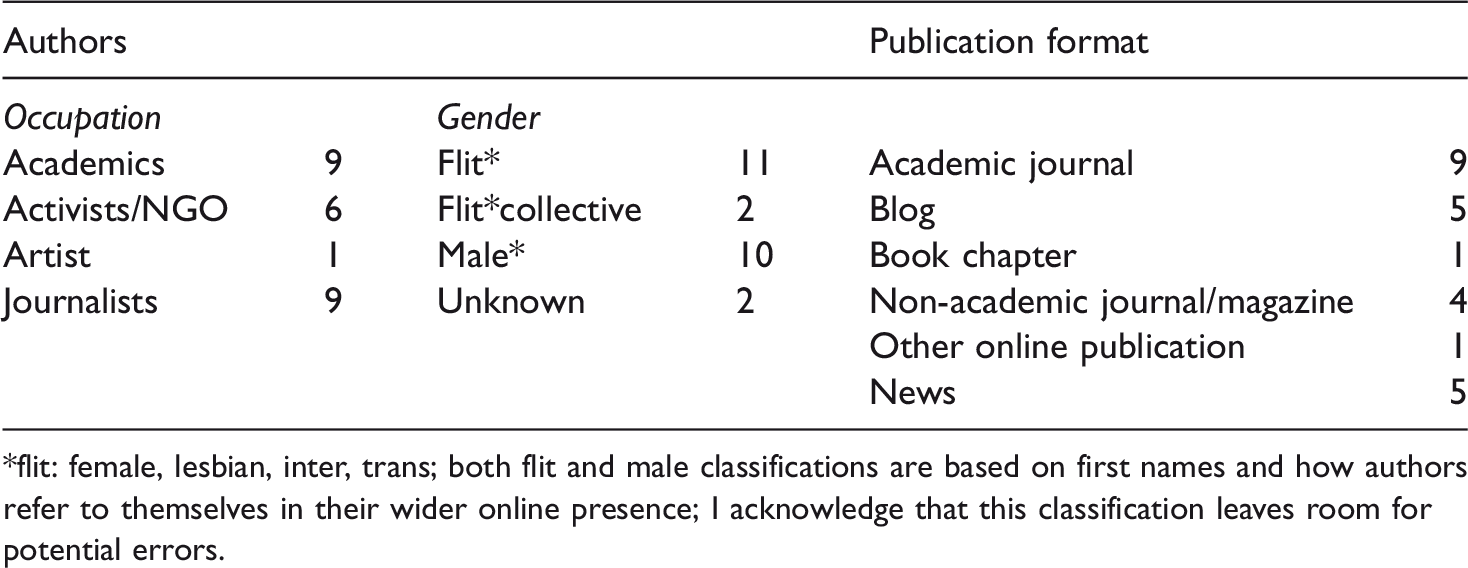
flit: female, lesbian, inter, trans; both flit and male classifications are based on first names and how authors refer to themselves in their wider online presence; I acknowledge that this classification leaves room for potential errors.
Not shown in this table are the authors’ broad range of political perspectives (e.g. liberal, radical, queer feminist), because many could not be labelled consistently or because common labels did not apply. Further, at least two authors are people of colour; most others are of white European descent. However, in particular for some blog authors using pseudonyms and others who do not offer further information than their name online, ethnic background was not verified. The sample’s leaning towards white European authors reflects white Europeans being the demographic majority in the German/Austrian feminist scenes. Among the publication/media outlets through which the texts are published, fourteen are based in Germany and eleven are based in Austria; 8 all texts are published in the German language.
The use of the word ‘intersectionality’ was no selection criterion because some authors did not use the term but employed the concept’s underlying ideas and I wanted such texts to be included. Other authors referred to intersectionality in a critical way – two of those texts are included because they met my criteria.
Selecting the sample and coding of the texts’ content (explained below) were parallel processes. This meant that the sample size (of both sets) could be determined by saturation with regards to answers to the thematic questions (listed below). In other words, when newly found texts did not offer answers to the thematic questions that required new codes, the sampling process stopped (as suggested by Guest et al., 2006). The difference in size of the two sub-sets (twenty vs. five texts) is a result of this process: since the feminist mainstream media texts responded to the mainstream media coverage of ‘Cologne’ that was not very nuanced, saturation was achieved quickly.
I used a pen-and-paper thematic coding approach – more specifically, a theoretical and constructionist approach of this method as described by Braun and Clarke (2006) – for the thematic analysis. This method was developed in the field of psychology, but it is useful for this project because its repeated and detailed exploration enables the analysis to ‘examine the underlying ideas […] that are theorized as shaping or informing the semantic content of the data’ (Braun and Clarke, 2006: 84). Thus, the influence of intersectionality on the feminist arguments could be identified. The analysis followed the first five steps 9 as described in detail by Braun and Clarke (2006). The leading thematic questions were: Which aspects of the media discourse does the text respond to? Which specific points of critique are articulated? Which solutions does the text propose? How does the text discuss issues of sexism, racism and/or intersectionality? Interesting aspects in addition to the questions’ answers were included in the data collection through a parallel open-coding approach. In the presentation of my analysis, the twenty-five texts are anonymised (and referred to as T01 to T25) because it is not my intention to single out particular authors or media outlets but to engage with the overall feminist discourse regarding ‘Cologne’.
Feminist responses to ‘Cologne’
The twenty-five analysed texts did, of course, not all share the same view and, to some extent, disagreed with each other. This article does not debate the full range of perspectives found in the texts but focuses on those issues on which many authors articulated similar opinions.
Their overarching agreement was their shared critique of how mainstream media framed ‘Cologne’. This framing was criticised for the use of stereotypes in narratives and images about the supposedly homogenous group of dark/North-African/Arab/Muslim/refugee men who allegedly posed a threat to white/European women. It was argued that the media participated in the ‘creation of an “Arab, testosterone-controlled, Islamic and backward refugee”’ 10 (T13) and deceptively reported that this ‘dangerous, young man comes from an “oriental” culture to Germany where he threatens German women’ (T09). The feminist texts further criticised those narratives for establishing a racist hierarchy in which the ‘enlightened west’ was superior to the North-African/Arab/Muslim world (T02, T03, T13, T19). They argued against the false assumption that sexual harassment was an exclusive problem of ‘other cultures’ whereas European women were supposedly fully emancipated and equal to men, who, in turn, claim to respect and never harm women (T02, T03, T05, T25).
As a major point of critique within seven of the twenty-five texts, the media focused more on dwelling on the perpetrators’ ethnic, religious and/or refugee background than on discussing the sexual assaults and the experiences of the victims. Specifically, the feminist critique stated in eleven texts that the focus on the perpetrators’ background enabled a storyline that blamed ‘the culture’ of the perpetrators for their actions. Moreover, this portrayal of events was critiqued as an example of how sexual violence against women is only discussed in the media when it is a manifestation of the ‘sexism of others’ but not when it occurs within one’s own cultural contexts (T04, T05, T12, T13, T19, T21, T24, T25). To illustrate this perspective, the feminist texts (T01, T07, T14, T15, T25) referred to examples of rape culture 11 being embedded in ‘German culture’ (e.g. at the Oktoberfest), yet media never questioned ‘whether rape is part of a Bavarian tradition’ (T01). Therefore, nine texts stated that rape culture had not been imported to Germany and Austria via the most recent wave of refugees but had existed there before. The feminist argument established that sexual violence was not a culture-specific but, on the contrary, a cross-cultural problem and it was emphasised that ‘sexual violence is definitely no unique feature of migrant men’ (T12). Two texts (T22, T25) offered a different perspective on this issue and stated that although violence against women happens in all cultures, the perpetrators’ cultural background is relevant because violence takes on different forms in different cultures. However, most texts agreed with T07, asserting ‘suddenly media is talking about rape culture – but they mean rape culture somewhere else’.
Fifteen texts concluded that the mainstream media’s narrative about ‘Cologne’, which implied that all refugees are dangerous, contributed to a moral panic regarding refugees allegedly bringing new threats to Germany and Austria. By that, the feminist texts argued, media reports aided the political right because ‘putting all refugees under suspicion legitimises restrictive, dehumanizing and existence-threatening political measures’ (T13); according to the right, the feminist texts argued, ‘the civil war refugees are dangerous for German women – the refugees have to leave again’ (T03).
The analysed texts did not only criticise the existing discourse but provided suggestions for political and media responses that should follow ‘Cologne’. I discuss more proposals below; however, the most commonly framed appeal within the twenty-five texts was for media and politics to pay attention to the intersectional entanglement of racism and sexism (thirteen texts). Those authors argued that ‘often, sexual and racist violence overlap, which makes it necessary for political and academic concepts to draw on ideas of multiple discrimination and intersectionality’ (T14) and ‘[t]o avoid similar incidents in the future, we need to change our discourse of sexual violence and that implies showing an awareness of intersectional sexism and racism’ (T04). While six feminist texts used the term ‘intersectionality’ explicitly, eight more adopted its underlying idea. Those texts said, for example, that in the events of ‘Cologne’ ‘two large interrelated discriminatory operators are acting simultaneously: racism and sexism’ (T03) and that ‘Cologne shows how deeply sexism and racism are rooted in German society and that they are often politically played off against each other instead of being understood as interwoven with each other’ (T04).
Two of the thirteen texts referring to intersectionality (T17, T20) were dismissive of this concept; however, for a different reason than mine. They rejected intersectional feminism overall and argued in the light of ‘Cologne’ that intersectional feminism failed to critique misogynistic tendencies within ‘Islamist’ cultures because it was afraid of being accused of islamophobia. Thus, these two anti-intersectionality texts demanded a feminist discussion of ‘Cologne’ that strictly focused on the harassment of women by ‘Arab men’ and not on defending refugees.
Yet, with few such exceptions, many of the analysed texts emphasised the entanglement of racism and sexism in the discourse about the events of ‘Cologne’ and called for an intersectional analysis. Before I explain my argument that this call for intersectionality was not advisable, it is necessary to briefly recapitulate the concept of intersectionality.
Intersectionality
Countless conceptualisations of intersectionality exist. Since most of the texts analysed for this study were not written for an academic audience, the authors did not clarify which particular version they applied. Thus, I explain a number of understandings of intersectionality that seem likely in the context of ‘Cologne’.
Kimberlé Crenshaw (1989, 1991) coined the term intersectionality by identifying how black women, being situated in the intersection of racism and sexism, are not seen as ‘typical’ victims of either form of discrimination and consequently are often overlooked in anti-discriminatory approaches: [T]he paradigm of sex discrimination tends to be based on the experiences of white women; the model of race discrimination tends to be based on the experiences of the most privileged Blacks. Notions of what constitutes race and sex discrimination are, as a result, narrowly tailored to embrace only a small set of circumstances, none of which include discrimination against Black women (1989: 151).
Some authors extend intersectionality to not only refer to multiply marginalised groups. Here, intersectionality no longer refers to intersections of axes of discrimination (e.g. sexism, racism) but to intersections of identity categories (e.g. gender, race/ethnicity). Ehrenreich (2002), for instance, labelled her approach ‘hybrid intersectionality’, with which she referred to the experiences of individuals who identify with at least one subordinate identity status and at least one dominant status. This understanding of intersectionality allows for analysing social power inequalities among, for example, men with different ethnic, religious, socio-economic etc. backgrounds (e.g. Hurtado and Sinha, 2008). As it focuses on singly marginalised social groups, it is, however, at odds with Crenshaw’s approach.
Another (heterogeneous) branch of intersectionality theory promotes multi-level approaches that combine the analysis of individual (e.g. identity construction), structural (e.g. power relations, institutional dimensions) and discursive (e.g. social norms and symbols) intersections (e.g. Winker and Degele, 2011; Kerner, 2012; Farris and de Jong, 2014). This aims to bridge analyses of personal experiences and social power relations.
The presented understandings of intersectionality share an analysis of how certain forms of discrimination (e.g. sexism, racism) function differently, depending on whether or not other forms of discrimination are simultaneously operating. The approaches differ in whether they focus on the micro, meso or macro level (or all of them) of these discriminatory dynamics and whether they focus on singly marginalised groups as well. This article does not discuss which approach is the ‘right’ way. Nash (2016) offered an interesting take on that debate. My point here is that ‘Cologne’ did not present a setting that can, in its entirety, be explained by any of the presented understandings of intersectionality.
Intersectionality and ‘Cologne’?
As shown above, the feminist texts had two main points of critique: first, the media discussed sexual violence as a problem specific to ‘other’ cultures but not as inherent to the autochthonic German/Austrian culture; and second, the media created a stereotype that painted all male refugees as potential offenders of sexual violence. While I agree that those points of critique address racist and sexist elements, I argue that they are not – at least not in a way that captures all elements of the critique – intersectional.
First, analyses of sexual violence can be intersectional, for instance, if violent experiences of women of different ethnicities are compared (Ehrenreich’s hybrid approach) or if they focus on experiences of female asylum seekers (Crenshaw’s approach). Freedman (2016), for example, explained the specific vulnerability of the recent migration wave’s female refugees during their journey and on arrival in Europe. However, only three of the twenty-five texts in my analysis (T3, T18, T19) briefly mentioned issues of violence against migrant women. Overall, refugee and migrant women were hardly present in the ‘Cologne’ narrative (which, ironically, is an intersectional effect according to Crenshaw). On the contrary, the feminist arguments highlighted that sexual violence is a cross-cultural problem and that ‘male violence against women was not brought to us by migrants and refugees but is an unexceptional phenomenon and exists within all social groups’ (T12), and that ‘sexual assaults are everyday experiences of all women*, whether of colour or white’ 12 (T04). This cross-cultural universality was identified on both sides of violence: women of all cultures are affected and perpetrators can be found among all cultures. This is not an intersectional argument but rather the opposite because it emphasises common, not different, experiences across social groups.
Second, the colonial stereotype of the ‘dangerous dark man’ is obviously gendered and racist. As T04 argued, ‘we can observe how gender and racism collude in the creation of a criminal profile by using the image of an aggressively hypersexualised man* of colour’. Farris (2017) refers to this practice as sexualised racism – a form of racism that relies on different stereotypes for men and women (some of which include sexual components). For instance, black men are often stereotyped as having a desire for white women, turning them into sexual predators of the latter. Still, Crenshaw’s understanding of intersectionality does not apply because the stereotype does not refer to multiply disadvantaged groups since ‘gendered’ and ‘sexist’ are not synonyms. 13 However, the hybrid approach of intersectionality that investigates experiences of singly marginalised groups is able to identify the social hierarchy of ‘white’ and ‘dark men’ implied by the discourse of ‘Cologne’. This perspective is similar to Farris’ (2017) understanding of sexualised racism. Adopting this version of intersectionality, some of the feminist texts noted that there would not have been a comparable media outcry if the perpetrators had been white men (T04, T12, T25), and that the colonial stereotype established a hierarchy among the alleged ‘threatening North-African masculinity’ and the ‘white masculinity that protects white women’ (T03, T04, T05, T19). Thus, for identifying this social hierarchy of groups of men, this use of intersectionality was, in fact, useful. Moreover, one of the theorists proposing a multi-level approach to intersectionality, Ina Kerner, stated that ‘[s]tereotypes and gender norms that, for instance, black or Muslim women might have to deal with usually differ from both those pertaining to women of other “racial”, ethnic, or religious backgrounds and from those pertaining to black or Muslim men’ (2012: 211). This analysis can be applied to the use of stereotypes in the discourse of ‘Cologne’. So again, this particular part of the ‘Cologne’ narrative can be deconstructed by certain understandings of intersectionality.
However, the feminist criticism of the colonial stereotype did not stop there, as the texts went on to argue that those stereotypes were used to sweepingly discredit and sanction all refugees and asylum seekers. Although the stereotype of a ‘dangerous dark-skinned man’ does not address women, it legitimised anti-immigration politics affecting all refugees including women. The strengthening of asylum policies in Germany and Austria following ‘Cologne’ (such as the aforementioned accelerated deportation processes) showed that this concern was justified. Such genderblind political co-optation of the colonial stereotype turned it into a racist/Islamophobic, but not an intersectional, problem. Highlighting its one intersectional aspect (i.e. the sexualised racism within the stereotype) erases all negative consequences of ‘Cologne’ as a ‘matter of concern’ for Muslim and refugee women from the discussion.
Although, as I have just shown, certain understandings of intersectionality are able to analyse isolated aspects of ‘Cologne’, I argue that an intersectional analysis of ‘Cologne’ that interprets this event in its entirety – including an analysis of violence against women, of the racist stereotype and of how they are related – will be inconsistent. It will be inconsistent, because racism and sexism mainly affected separate aspects of ‘Cologne’ which were not intersecting. While the discussion of sexism in the shape of sexual violence referred to the events of New Year’s Eve itself (i.e. experiences of the women crossing the train station area), the discussion of the stereotype referred to the media’s responses to those events. Those are different issues affecting different groups: refugees were affected by racism caused by stereotypes and women passing the train station were the targets of sexual assault. Since the media and almost all analysed feminist texts implicitly assumed all victims of sexual assault to be white/German women 14 and all perpetrators to be non-white/non-German men, 15 those two groups did not – at least not discursively – overlap.
This separation of white women and refugees as groups affected by sexism and racism is mirrored in the feminist texts’ specific proposals about what the political reaction to ‘Cologne’ should be. They commonly articulated calls for appropriate penalisations of sexual offenders (eleven texts), and for provision of support for victims (six texts). Specifically, such support should include state-funded investments in services such as women’s refuges, psychological support and helplines (five texts), and training for medical staff and members of the police to respectfully interact with victims of sexual violence and be more attentive at large events (six texts). Feminist texts further called for a reform of the German legislation that (until 2016) did not criminalise sexual assault in public places (five texts). There were also demands to undo new restrictions of asylum laws (three texts) and to include perspectives of Muslims and people of colour in the discourse (two texts). None of those demands acknowledged an intersection of racism and sexism but addressed questions of either racism or sexual violence. Only some proposals by individual texts can be interpreted as addressing intersectional issues (e.g. ending doubled penalisation of asylum-seeking perpetrators who are charged for their crime and have their application for asylum rejected, T06; and including gender-specific reasons for prosecution into UNHCR regulations, T18) but those demands were scarce. Thus, overall, the specific proposals by the feminist authors did not themselves reflect a need for intersectional solutions. So far, I have established why the concept of intersectionality does not capture the dynamics of ‘Cologne’ well. In the following, I explain why its use was counterproductive for the feminist cause.
Entangled arguments
The two main aims of the feminist analyses of ‘Cologne’ were to dispute the media’s racist stereotypes about refugees and to enhance a genuine discussion about rape culture that accepts its cross-cultural character. The call for intersectionality was counterproductive for achieving those aims because it entangled the feminist arguments in a contradiction and created argumentative voids.
The main problem concerns the discussion of the relevance of the perpetrators’ ethnic/cultural background. In order to establish the core argument of sexual violence as a cross-cultural problem and to encourage a political engagement with issues of sexual violence instead of sexual violence by refugees, it seemed crucial for the feminist authors to downplay the relevance of the offenders’ backgrounds. Thus, the feminist texts criticised ‘the media’s focus on the origin and religion of the perpetrators which moves the attention away from what is important: the ones affected [by violence] and their needs’ (T04). Similarly, T19 asked why the media was ‘almost exclusively concerned with the perpetrators instead of the needs of the ones affected’ and T09 criticised that instead of discussing issues of sexual violence, ‘the public attention is directed towards the nationality, religion or “cultural circle” of the perpetrators’. This line of argument aims to unveil racist stereotypes about refugees at the same time as it demands justice for the victims of sexual violence. This strategy of addressing both issues simultaneously seems to derive from the concept of intersectionality as an analytical lens that required an acknowledgement of the (assumed) entanglement of racism and sexism. The problem is that as a result of tackling two different, not entangled, issues at the same time – violence against women and racism against refugees – the authors conflated their two arguments. Consequently, they themselves equated refugees with perpetrators: they explicitly demanded that the media should not highlight the perpetrators’ cultural background. That is neither the same as disputing that violence is part of the refugees’ cultures nor the same as arguing that violence against women is unacceptable irrespective of the perpetrators’ backgrounds. It does not even contest that the perpetrators’ violence was caused by their culture. Thus, this particular intersectional framing does not support the main arguments of the feminist texts. Instead, the specific wordings resulting from the arguments’ conflation effectively asked for anonymity for the offenders, even if inadvertently. This is particularly problematic when taking into account that the needs of those affected by violence are tantamount here. Identifying the individual offenders in order to hold them accountable may be one of those needs. Moreover, according to the police reports, some of the affected women themselves described the perpetrators as ‘North-African looking’ (Ministerium für Inneres und Kommunales NRW, 2016: Anl. 2). By stating that the perpetrators’ background should not be addressed in the media, those victims were silenced. Although victims can also be complicit in sexualised racism, this problem needs to be carefully yet openly discussed by feminist analyses.
I argue that these effects of applying the concept of intersectionality to the feminist arguments were not intended. This is why I claim that the feminist discussion was caught up in a contradiction. Their arguments (against the racist stereotype and against rape culture) were conclusive but they got entangled by discussing sexism and racism affecting different groups of people at the same time.
Some of the analysed texts addressed this problem, but did not offer a convincing solution. They stated that perpetrators of sexual violence can be found everywhere and, therefore, also among Muslims/refugees (T05, T07, T22). One text (T12) pleaded that feminism must protect perpetrators of sexual violence due to a misunderstood anti-racist perspective and that feminism and anti-racism must prevent being played off against each other. Other texts noted that the victims of the sexual assaults need to be taken seriously but not at the expense of the victims of racist stereotypes and vice versa (T06, T13, T14). However, none of those texts explained what it entails to avoid playing feminism and racism off against each other beyond the vague notion that victims of both sexism and racism deserve justice. Thus, discussing ‘Cologne’s’ sexual violence and racist stereotypes at once caused contradictions within arguments that were not resolved. If instead, the feminist texts had stated clearly that there are two separate issues at play – sexual violence against women and racist stereotyping of refugees – their main arguments would have remained the same, but they would not have constructed a ‘rivalry of victims’ for justice (Opferkonkurrenz), as Dietze (2016) called it.
Relatedly, the feminist arguments had an explanatory gap: they did not offer a constructive analysis of ‘Cologne’s’ violence against women beyond stating that rape culture was not an imported problem. While that is an important argument, it does not address the violence that did actually happen in ‘Cologne’. The intersectional approach to ‘Cologne’ was not able to address violence against women thoroughly because, as I have argued above, its necessity to simultaneously discuss racism and sexism conflated perpetrators with refugees within the feminist argument. This made it impossible to offer a feminist/non-racist discussion of the perpetrator’s acts of violence – so there was very little meaningful engagement with this issue.
An alternative approach
Claiming that the concept of intersectionality was not the best choice to analyse ‘Cologne’ must be accompanied by a proposal for an alternative. I suggest the concept of femonationalism for this purpose. This is not a new approach to understanding ‘Cologne’ (e.g. Kulaçatan, 2016; Wilke, 2016; Hark and Villa, 2017), but it has received little prominence and not much depth in its application.
Modelled on Puar’s (2007) concept of homonationalism, 16 and building on postcolonial theorists such as Said (1978) and Fanon (1986), Farris (2012, 2017) introduced the concept of femonationalism. It situates the colonial stereotype of the alleged ‘dangerous dark man’ in a larger narrative following a biopolitical logic that maintains the hegemonic order of a Eurocentric patriarchy, and pitches the four groups – white men, white women, non-white 17 men and non-white women – against each other. Farris suggests that, from a femonationalist perspective, white women are seen as the ‘bearers of the collective’ and ‘biological reproducers of the nation’ (2017: 72). Thus, they need to be protected by white men against allegedly sexually aggressive non-white men as a means to protecting white women’s biological potential to reproduce the white nation. Non-white women are, as mothers, important for the socialisation and integration process of migrant families. Thus, femonationalists have reason to ‘divert immigrant women’s loyalty away from the non-western nation of origin and toward the western nation of destination’ (Farris, 2017: 111). Laws to ban the Muslim veil, for example, are symptomatic of such an approach. However, as Farris argues, there is not the same ‘need’ to protect non-white women from sexual violence as there is to protect white women because, from a femonationalist perspective, non-white women need to remain available for white men’s desires (Farris, 2017). Farris uses concepts of sexualised racism (as explained earlier) and racialised sexism (a form of sexism that differentiates between the cultural, ethnic or religious backgrounds of its victims) to explain those different roles assigned to the four groups by femonationalism. As indicated earlier, this identifies similar dynamics as some forms of intersectionality.
Yet, femonationalism goes beyond those concepts as it links the four roles to one narrative that also explains how the issue of violence against women gets instrumentalised. In its core, femonationalism sustains a patriarchal social order in which men are, depending on their cultural/ethnic belonging, viewed as either protectors of or threats to women. Violence against women is a mechanism intrinsic to both male roles, as those roles determine each other (protectors are only needed if there are threats). Thus, within a femonationalist agenda, there is no intrinsic interest in fighting violence against women – only an interest in blaming non-white men for it and in protecting the white nation.
Unlike intersectionality, this theoretical lens explains ‘Cologne’ in all of the aspects discussed above and links them to one narrative, without conflating them. The phenomenon that sexual violence by refugees became a main concern of the media (unlike sexual violence by Germans at the Oktoberfest) was a direct outcome of sexualised racism that supports the colonial stereotype of the ‘dangerous dark man’ and construes white men as above reproach. ‘Cologne’s’ perpetrators were a welcome excuse for the political right to brand refugees as enemies; not because they threatened women per se but because they threatened white women as the bearers of the German nation. This distinction is crucial because it shows that women’s interests are not a genuinely important factor in this scenario. Muslim women were absent from this discussion because concern about their protection from sexual violence is neither required nor desired in a femonationalist logic. Consequently, the focus of ‘Cologne’s’ discourse was on the perpetrators’ backgrounds and not on the women’s experiences.
While many of the analysed feminist texts argued that the colonial stereotype was used to vilify non-white men in the discourse of ‘Cologne’, only four authors explicitly identified that the right wing’s apparent determination to protect white women was a means to an end. None of those four texts that discussed this important aspect called for an intersectional approach – on the contrary, one of them (T24) explicitly stated that ‘Cologne’ showed that the fight against violence against women needs to be dealt with separately from the fight against racism. The majority of the texts, however, did not discuss this co-option of women’s interests. A feminist explanation of femonationalist dynamics, however, would have exposed that this claim was only a pretence to a racist, nationalist agenda devoid of a genuine concern for women and that this is why violence against women did not get enough attention in the discourse of ‘Cologne’.
Conclusion
My claim that using the intersectional concept to theorise (otherwise convincing) feminist arguments was unadvisable is based on two reasons. First, the concept is unadvisable for ‘Cologne’ because it contradicts the feminist argument that rape culture is a cross-cultural phenomenon and it explains the problem of the racist stereotypes against refugees only partially. Second, it led to gaps in the feminist analysis of ‘Cologne’ concerning the explanation of violence against women. This second aspect is particularly unfortunate, as it helped right-wingers to falsely claim that they are the only political voice that is genuinely concerned about the well-being of women and to (undisputedly) offer their racist analysis of the reasons for the sexual assaults in ‘Cologne’ to the public. In particular, they used the unfortunate feminist demand not to dwell on the perpetrators’ backgrounds, to accuse feminists of defending perpetrators of sexual violence. They scandalised the alleged feminist censorship of the free media’s right to discuss the perpetrators’ backgrounds and they claimed that feminists did not care about the women’s violent experiences. By discrediting feminist arguments, they presented themselves as the ‘real’ defenders of women’s rights, who allegedly made sure that the ‘misogyny of Arab/Muslim culture’ posed no threat to supposedly emancipated western women. For instance, Jens Spahn, a member of the Christian Democratic Union (CDU), German state secretary at the time and current Minister of Health, asked why there was no feminist outcry over ‘Cologne’ given that feminists complain about every (sexist) joke (Spahn, 2016). Herbert Kickl – former party secretary of the Austrian far-right FPÖ and Minister for the Interior from December 2017 to May 2019 – said about ‘Cologne’ that ‘hopefully, those who have not understood so far that it was a bad idea to let tens of thousands of young Arab men pass the border without controls, will understand it now. [….] Those [feminists] who remain silent [about the dangers brought by refugees] have lost all legitimacy to claim that they advocate for women’s rights’ (Freiheitlicher Parlamentsklub, 2016). Thus, the right-wing narrative not only abused ‘Cologne’ for its anti-immigration agenda, it also used the flaws in the feminist arguments to discredit feminism (Kelle, 2016; Verseck, 2016).
By no means do I suggest that swapping the concept of intersectionality for that of femonationalism would have stopped right-wing politics from co-opting the media discourse of ‘Cologne’. That would greatly exaggerate the influence of feminist discourse overall and it would neglect that even more consistent arguments can and do get co-opted. Still, we must not make it easier for the political right. Feminist responses to events like ‘Cologne’ need to articulate coherent arguments that address all problems, including violence against women, irrespective of the perpetrators’ backgrounds. This is crucial because even if they do not convince right-wingers, the publication of stronger feminist arguments provides the broader feminist community with a better toolkit to defend its causes. Given their current success in Europe, the political right will continue to have a dominant voice in the media. It is crucial for feminists to be capable of competing with that voice. Increasing clarity and comprehensiveness is (in addition to having intrinsic value) one important aspect in this context because – despite their own inconsistencies – right-wingers will use every feminist contradiction and argumentative void in their favour.
