



Abstract
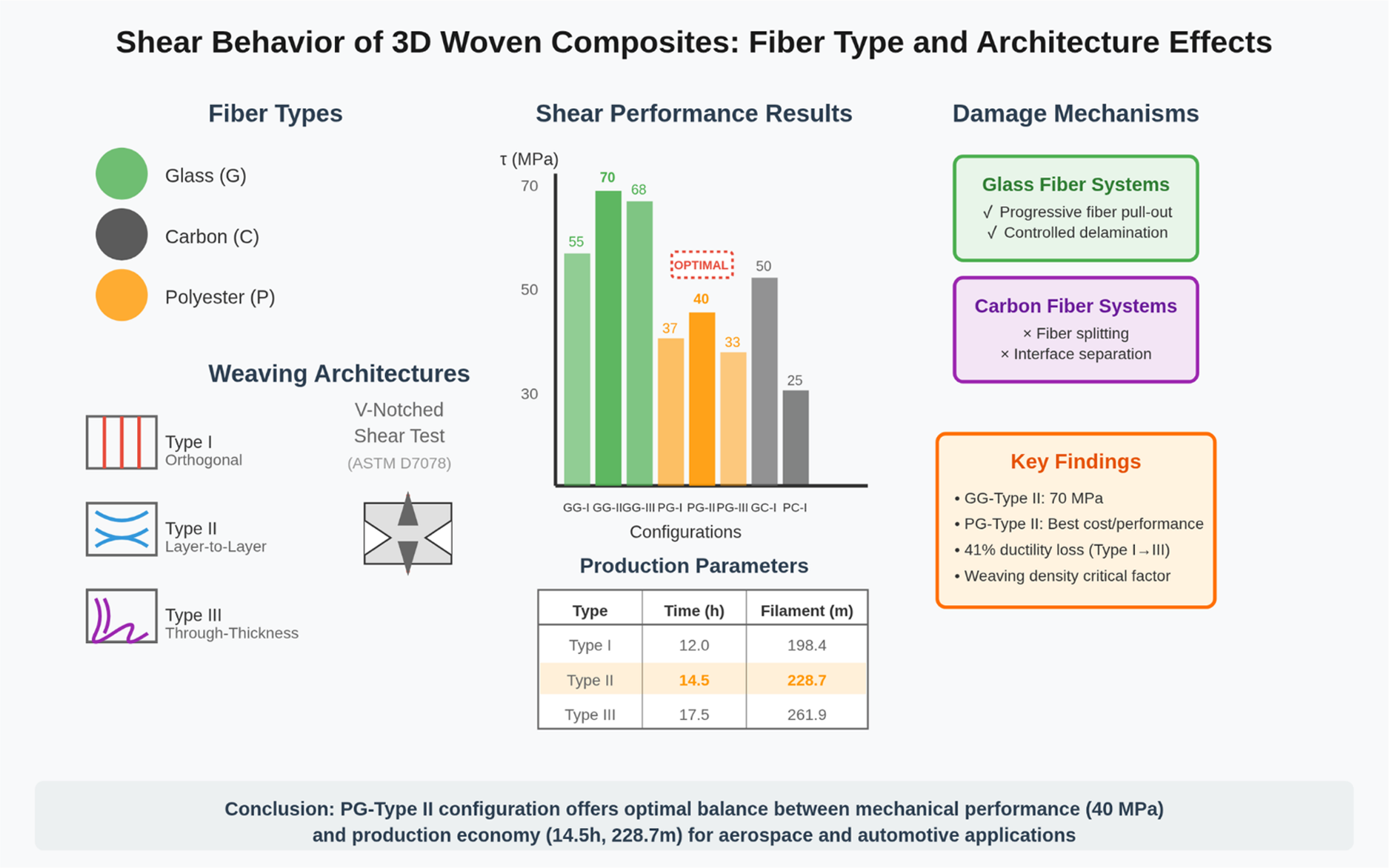
Three-dimensional woven composites eliminate the critical delamination weakness of conventional laminated composites through z-directional reinforcement, which is essential for aerospace and automotive structures where both intralaminar and interlaminar failures pose unacceptable safety risks. This study systematically investigated the shear behavior of 3D woven composites using three fiber types (glass, carbon, high-strength polyester) and three architectures (Type I: orthogonal, Type II: layer-to-layer angle interlock, Type III: through-thickness angle interlock). V-notched shear tests following the ASTM D7078 standard revealed that GG (glass warp-glass weft filament) homogeneous composites achieved the highest shear strength across all architectures, with GG-Type II demonstrating optimum performance (70 ± 3 MPa) compared to GG-Type I (55 ± 3 MPa) and GG-Type III (68 ± 2.5 MPa). Carbon fiber systems showed inferior performance due to weak fiber-matrix adhesion, while glass fiber systems exhibited 50% higher ductility. Increased weaving density reduced deformation capacity by 41%. Microscopic analyses revealed controlled fiber pull-out and progressive damage in glass systems, contrasting with widespread fiber splitting and premature interfacial separation in carbon systems. Production evaluation showed Type I (vertical weaving) to be the most economical (12 h, 198.4 m filament) compared to Type III (17.5 h, 261.9 m filament). The PG-Type II (polyester warp-glass weft filament) combination proved optimal for aerospace/automotive applications when considering cost-performance trade-offs. The developed structure-property relationships provide universal design guidelines for 3D woven composite optimization.
Keywords
Get full access to this article
View all access options for this article.
References
Supplementary Material
Please find the following supplemental material available below.
For Open Access articles published under a Creative Commons License, all supplemental material carries the same license as the article it is associated with.
For non-Open Access articles published, all supplemental material carries a non-exclusive license, and permission requests for re-use of supplemental material or any part of supplemental material shall be sent directly to the copyright owner as specified in the copyright notice associated with the article.
