



Abstract
Prior to the fabrication and implementation processes, it is imperative to accurately predict the mechanical strength of the textile composite. The major goal of this work is to develop a three-dimensional finite element method to estimate the mechanical response of a woven fabric hybrid natural textile composite under compression. A mesoscale finite element model for a plain-woven fabric unit cell has been developed and analysed for its mechanical characteristics. For their mechanical robustness, six natural fibre plain-woven patterns viz. flax plain, jute plain, basalt plain, inter-yarn hybrid basalt-flax plain, and jute-flax plain were compared and thoroughly examined. These patterns’ mechanical properties were modelled and critically contrasted using matrix materials like thermoset epoxy and thermoplastic polypropylene. The basalt-flax plain with epoxy as the matrix material has excellent mechanical properties among the numerous analysed patterns. Thus, it was concluded that transverse-longitudinal shear characteristics and yarn cross-sectional stiffness have the greatest influence on compressed textiles. In parametric analysis, the impact of geometric parameters on strain energy, artificial strain energy, displacement, and contact pressure – such as yarn width, yarn spacing, and fabric thickness was thoroughly investigated and discussed in detail. The current model can accurately mimic a textile fabric with various weaving patterns, material properties, and stress conditions.
This is a visual representation of the abstract.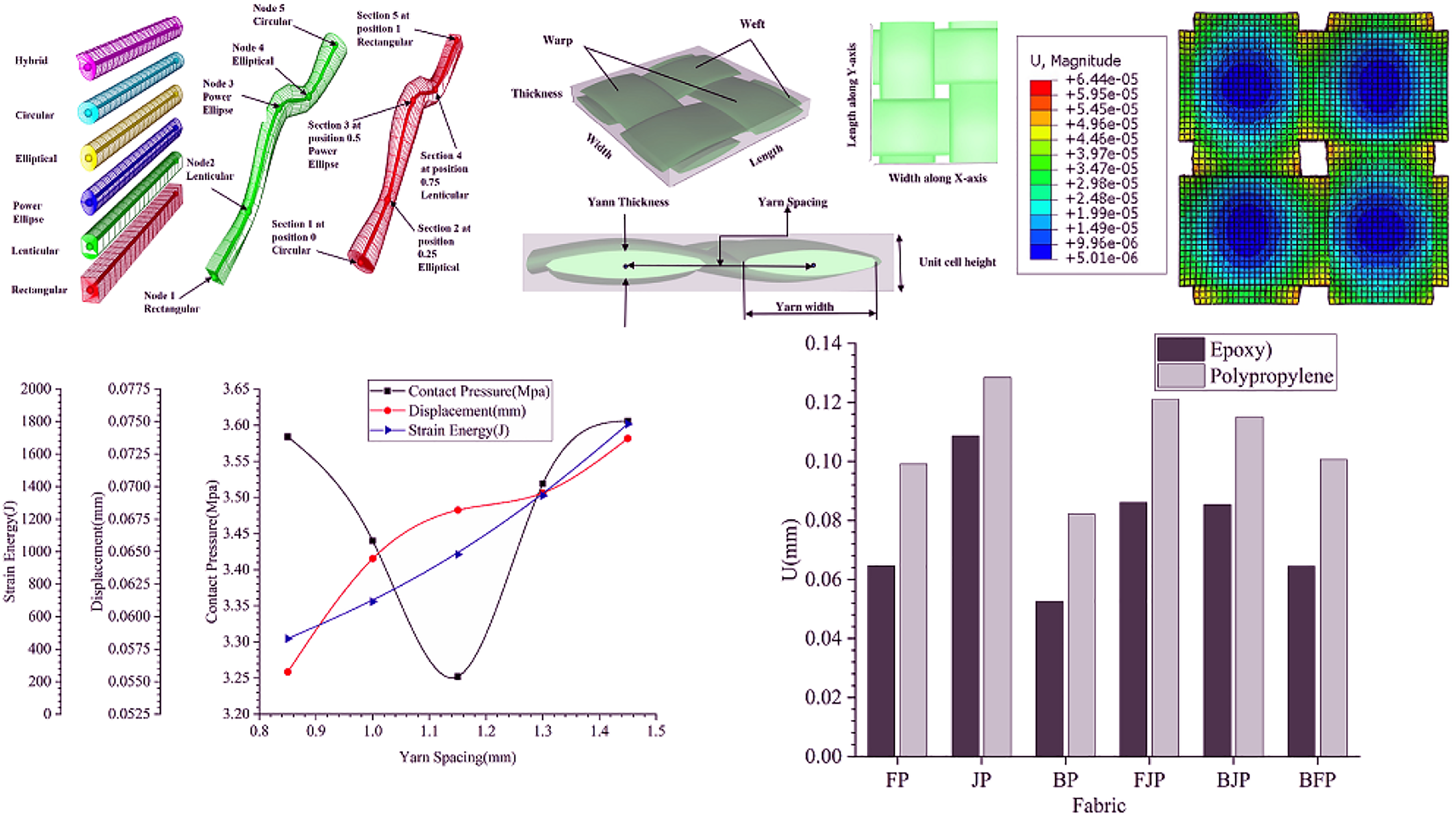
Get full access to this article
View all access options for this article.
References
Supplementary Material
Please find the following supplemental material available below.
For Open Access articles published under a Creative Commons License, all supplemental material carries the same license as the article it is associated with.
For non-Open Access articles published, all supplemental material carries a non-exclusive license, and permission requests for re-use of supplemental material or any part of supplemental material shall be sent directly to the copyright owner as specified in the copyright notice associated with the article.
