




Abstract
This study concerns a numerical analysis of the meshing temperature for a multicomponent nylon gear by incorporating typical viscoelastic responses of polymers. Firstly, the generalized Maxwell model parameters were calibrated by the dynamic mechanical analysis to capture the viscoelasticity of polyamide 66. Next, the finite element model predicting the meshing temperature was established, including the heat generation analysis model, which calculates the generation of the frictional and hysteretic heat, and the heat propagation analysis model, which simulates the heat transmission. Different material models were used for polyamide 66 to investigate the influences of temperature dependence, strain rate dependence, and hysteretic effect. The effect of the iteration sequence on the meshing temperature calculation was also analyzed, i.e., how the heat generation should be updated as the loading cycles increase. A reasonable iteration scheme was determined by balancing the computational precision and consumption. It is noteworthy that the evolution of the ambient temperature around the gear and the worm within the housing was also considered. Finally, the accuracy of such meshing temperature analysis was validated on a self-developed gear test rig, in terms of the peak temperature evolution on the gear side surface. The experimental results and the simulation with the ambient temperature correction match well and the maximum error is 5 °C.
This is a visual representation of the abstract.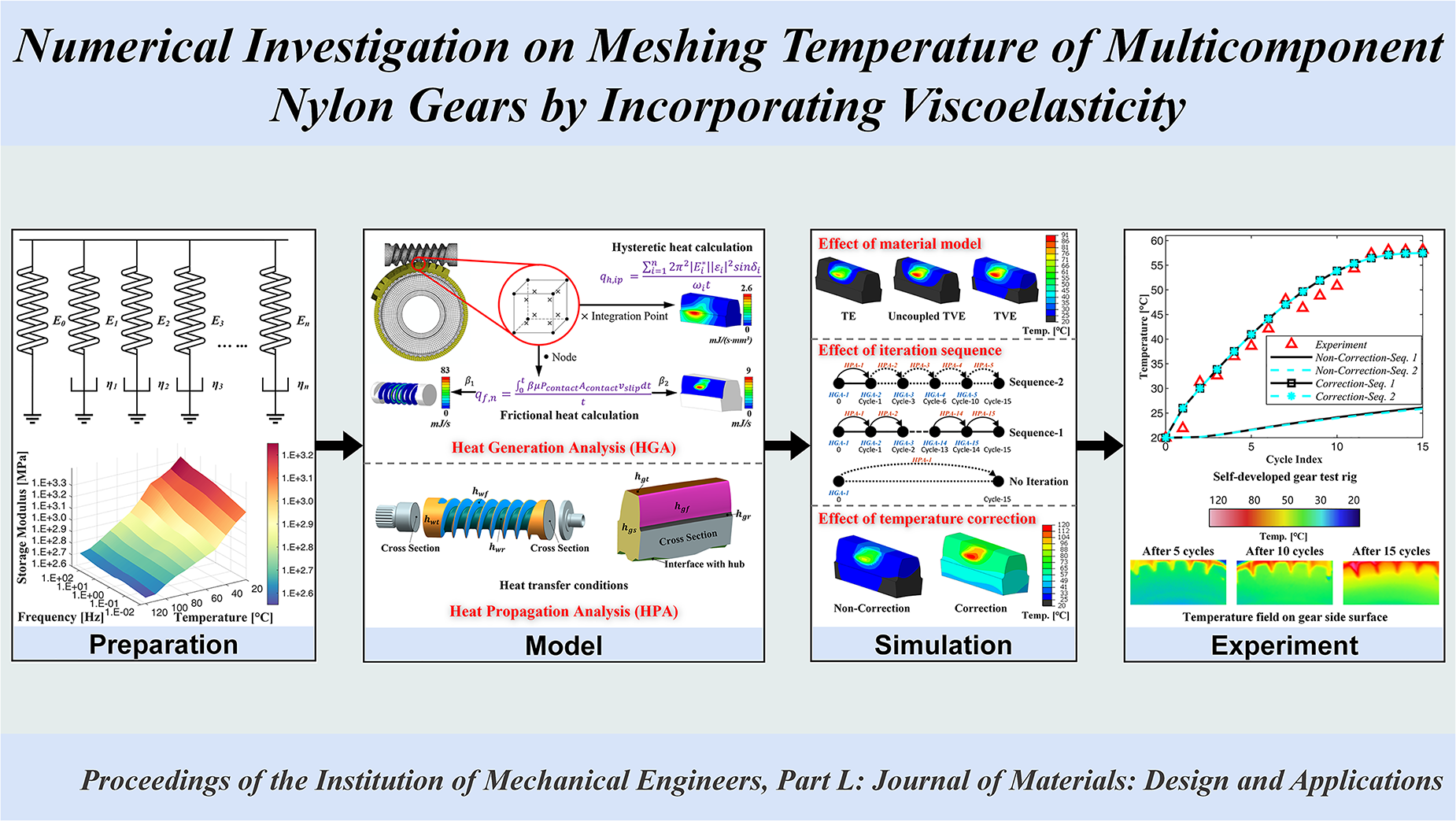
Keywords
Get full access to this article
View all access options for this article.
References
Supplementary Material
Please find the following supplemental material available below.
For Open Access articles published under a Creative Commons License, all supplemental material carries the same license as the article it is associated with.
For non-Open Access articles published, all supplemental material carries a non-exclusive license, and permission requests for re-use of supplemental material or any part of supplemental material shall be sent directly to the copyright owner as specified in the copyright notice associated with the article.
