



Abstract
This paper reports on the exploratory potential of encounters with loose parts in an art museum. It illustrates a process of engaging young children (aged five and under) with open-ended resources, objects and museum space to become co-producers of knowledge and art. Vignettes highlight children's agency in exploring the possibilities of open-ended provocations and exhibits in an art museum in England, UK. Exploring the entanglement of children, materials, play and museum space offered a way of interpreting children's embodied literacy engagements and co-production of knowledge and art. Emphasised is the importance of children's participation in informing museum practices and offerings to them as agents rather than passive audiences of content and learning. The paper considers how to foster belonging in art museums for the youngest children by offering makerspaces and mobile sensory meaning-making opportunities.
Introduction
In early childhood education settings in England, young children's participation in the arts is embedded in the Early Years Foundation Stage curriculum's expressive arts and design specific area (Department for Education (DfE), 2025) as an invitation to engage with materials, painting and sculpting amongst other creative activities. Arts-based learning also takes place beyond early childhood settings in art galleries and museums, which are well placed to offer children different opportunities to interact with art and cultural artefacts. Many such settings work proactively with schools in particular to offer initiatives and programmes that support formal education (Andre et al., 2017; Hackett et al., 2020).
Historically, however, the youngest children have experienced limited engagement with art galleries and museums due to lack of accessibility and expectations of the behaviours perceived as appropriate as opposed to realistic conduct. Oftentimes, the perceived ‘correct’ ways of exploring museum settings do not necessarily welcome young children's exploratory engagement through the senses (Hackett, 2014; Weier, 2004). As a result, the early childhood stage before compulsory schooling has been somewhat overlooked in accessing organised cultural activities on a regular basis. Despite some evidence of museum settings’ engagement with the early childhood age range (e.g. Hackett et al., 2020), most offerings tend to be by large museums and galleries in urban and central locations, which have the financial means, capital and space to enhance provision for younger children. By contrast, smaller settings tend to find it more difficult to adjust practices, spaces and offerings to the exploratory and learning behaviours of young children due to smaller budgets and insufficient staffing. Yet the museum as a creative space and one that exhibits products of artistic activity has a responsibility to engage with society, including young children and their local communities (Sleigh, 2024). Tokenistic physical access to the buildings of museums and galleries for exploration and play is not sufficient, there is a need to foster belonging and cultural citizenship within museum settings whereby children can make contributions to understanding art and engaging with it in appropriate ways for their developmental stage and their sensory and communication needs. To encourage activity and agency, children should be enabled to interact with museum artefacts and spaces to fully expand their repertoire of exploratory behaviours (Birch, 2018; Thiel, 2015) and literacy practices in embodied ways (Hackett et al., 2018; Wohlwend et al., 2023).
This paper offers an exploration of what young children make of and can contribute to museums, and how such settings can learn from children's exploratory behaviours and embodied literacies to make their spaces more welcoming and engaging. Series of provocations with loose parts were offered in an art museum in the North of England, UK. A pop-up play space informed by the museum galleries and exhibits at the time was set up as an invitation to play, explore and learn. The environment was intended as inspiration for the children to interact with materials, space and exhibits, in addition to creating their own art forms. The provocations resembled the practice of children and adults coming together to collaborate, design and experiment with media and resources in a makerspace (Woods and Baroutsis, 2020). A makerspace is a site for creative engagement, design and creation where children (and adults) with varying levels of experience are encouraged to explore different ideas, learn new skills and make products utilising different materials and media (Marsh et al., 2019; Sheridan et al., 2014). Makerspaces promote hands-on experimentation, active learning and alternative ways to create products (Marsh et al., 2017) as means to understand both the process of making and its ‘final’ products. They have been utilised in a variety of early childhood settings – formal education and classrooms (Sheridan et al., 2014), preschools (Wohlwend et al., 2017), libraries (Marsh et al., 2017), museums (Marsh et al., 2019; Wohlwend et al., 2023) and within the community, albeit more rarely so for younger children (Marsh et al., 2017).
In this project, children were able to explore and engage with loose parts, open-ended resources and the wider museum environment to create tangible objects and artefacts alongside meaning of what embodied engagement with a museum can be. This engagement was recorded with snapshot observations, brief notes of what was said and photographs. Utilising the lens of embodied literacies in museums, the central question was how do museum spaces, art on display, loose parts and children encounter each other in meaning-making? Could the museum space, galleries, objects and paintings become loose parts for children to explore and make meaning? What ‘could be’ if we opened the art museum to children to engage with materials and space in their own ways and develop a sense of belonging?
Young children's exploration of museums
Young children's explorations are marked by movement, manipulation and noise making (Weier, 2004), which pose a challenge for museum settings traditionally characterised by stillness. In relation to a young child's physical frame, art museums are ‘imposing spaces’ that are often ‘intolerant’ of child-centred exploration due to their overwhelming architecture, quietness and artworks displayed at adult height (Andre et al., 2017; Birch, 2018). While these cultural settings are less likely to open their doors to young children, they would be particularly attractive because they would foster a sense of curiosity about art marked by abstraction, diversity, scale and experimentation (Andre et al., 2017). Museums offer a different, unusual perspective on the everyday whereby young children can experience works on display individually while being part of the bigger frame (Fawcett and Hay, 2004). Such experiences enable young children to co-create knowledge about the world and themselves in terms of communicating their interests, likes and dislikes, encompassing both the physical scale of artefacts and buildings and a sense of belonging to a culture of art creation.
Museums offer a different atmosphere to that of the settings children usually attend, not least because of their quietude alongside possibilities for engagement with matter and materials within the physical environment that comes across as unusual, abstract and curiosity provoking. The open-ended and interpretive nature of many of the objects and artefacts in the art museum invites playful encounters, moving beyond the ‘learning’ child trope (Birch, 2018) towards a ‘sensing’ and active child. Museums exhibit a wealth of objects with power to attract attention and evoke a desire to touch, manipulate and move. Exploring how young children notice and fixate their attention on objects is not a one-directional enquiry with the child as the only agent. While children consider their surroundings, the environment also acts in enticing them to notice and engage with it, bringing to the fore a focus on the interactions between human and more-than-human actors (Barad, 2007). A proposition might be that the agency of the child, the agency of the objects and the agency of the museum become combined, or entangled, to create a shared experience (Kind, 2014; Thiel, 2015) of space, place and belonging.
As cultural citizens, children participate in museum settings in embodied and material ways by leaving a mark, a trace, an impact within the space as a sign of having been present (Wallis and Noble, 2022). Art creation, painting and drawing opportunities set up for visitors in galleries contribute to such mark making as the usual products of children's activity, but the museum space and atmosphere offer additional opportunities, ways of seeing and meaning-making beyond pen, brush and paper. Mark making need not be a permanent product or a physical trace, it could be transient and intangible once children have moved on or left. For example, children's walking and running in the museum has been explored as means to communicate and not simply as the practice of moving through space or from one place to another (Hackett, 2014). The communicative potential of movement occurs through the body being and moving within space whereby the architecture of the museum is combined with the actions and interactions of the child to create new meanings of what it is like to be there (Hackett and Somerville, 2017). Young children's movement is more than sensory practice – movement is expression and meaning-making practice through negotiation with materials, space, others (Daniels, 2019). Such practices are situated in a context of co-dependency between human and more-than-human (Barad, 2007) as indistinguishable and entangled. Movement alongside object manipulation, design and imagined possibilities can be read as embodied literacies that lead to leaving a mark in a less conventional sense.
Children's encounters with museums can be interpreted as a form of enquiry (Wallis and Noble, 2022) where children, objects and space work together to promote sensory engagement and experiences in the present moment. In this context, children should be welcome to leave verbal, physical and geographical traces of their participation, being and belonging, which are by no means permanent. Children's meaning-making in a museum, their movement and their sensory experiences are a trace of ‘what is’ and ‘what could be’ interpretations of objects, spaces and ultimately art. Meaning-making acknowledge and welcome children's use of their senses and bodies as tools for exploration and interpretation (Birch, 2018; Weier, 2004). By the act of being in museums and art galleries, children create and leave behind transient impacts within and on museum spaces (Wallis and Noble, 2022) resulting from engagement and interaction with the environment.
Loose parts and embodied literacies
Loose parts play is a commonly employed form of unstructured child-directed activity with limitless possibilities for inventiveness and interpretation by using open-ended resources and small loose objects (Simoncini and Lasen, 2021). The Theory of Loose Parts identified play and experimentation with ‘components and variables’ as a form of creativity to which young children are naturally attracted (Nicholson, 1971, 1972). In both makerspaces and play with loose parts, children encounter different problems and scenarios, and devise solutions based on their interpretations, which in turn promote the development of crucial cognitive and social skills utilised beyond educational settings. For instance, such play offers opportunities to communicate about intended designs and experimentation, to name objects and processes, to take turns and negotiate problem solving and to develop fine and gross motor skills while manipulating resources, all of these representing essential skills underpinning child development.
The potential of loose parts play extends beyond learning to offer embodied possibilities, flexibility and openness to new ideas that spark curiosity, imagination and possibilities (Birch, 2018). Children's agency in encountering resources, materials, objects and spaces thus promotes the entanglement of object and child (Barad, 2007). For instance, a sheet of paper does not need to be limited to a surface to draw on, it could be manipulated and folded to create structures and hideaways or be crumpled and torn to be felt and heard. By encountering paper, children will inevitably learn about its properties, but in this entanglement, they utilise their senses to mould the paper, which in turn moulds their bodies, resists and sparks curiosity, activating further sensory exchanges. Entanglement, as the process of a human and a more-than-human as entities that relate to each other coming together (Lisle, 2021), leads to the sharing of their agency, intent and experience. The manipulation of the paper merges the agency of the child and object in a tactile sensory exploration whereby their entanglement is ‘a much more open-ended affair in which transfers of sensation take place through multiple openings and closings – all of which are subject to mutation’ (Lisle, 2021: 446). Such entanglement of child and paper raises questions about ‘what is’ and ‘what could be’.
To situate entanglements into the art museum, a child encountering a painting may stare in amazement, reach out to touch, jump to communicate excitement, replicate the painting's composition physically or verbally. One explanation may be that the child as an independent agent reacts to the paining, but this is a social and inherently partial reading of the situation. Another explanation is that the painting with its colours, shapes and textures communicates with the child to evoke the described responses. The encounter where the child reacts becomes an entanglement with the agency of the child and object merging to produce new meaning. This captures the impossibility of knowing how a child might engage with a space or object due to their agentic entangled potential (Lenz Taguchi, 2009). Entanglements involve both materials and child in an exploratory situation where the two cannot be treated as separate entities (Frid, 2021). In this paper, the term entanglement is used to explain how children and loose parts engage in a process of meaning-making, design and exploration in a museum.
Engagement with objects can be read as literacy practice whereby human and more-than-human are entangled in the intersections of materiality, embodiment and subjective experience (Thiel, 2015). In such entanglements, children engage in multimodal and embodied literacy practices like narrating their play through verbal and non-verbal means of communication while making decisions about meaning, representation of ideas and the audience to their activity. Multimodality is concerned with the holistic ways in which children make, express and share meaning using different literacy modes: sounds, words, gestures, movement (Flewitt, 2008). Multimodal, whole-body and sensory ways of expression are forms of embodied literacies (Taylor and Leung, 2020) that prioritise meaning-making through various means and media over the more traditional understanding of literacy as language and communication skills. Embodied literacy practices are part of young children's ongoing meaning-making through communication of their needs, wants and understanding of the world in the widest sense possible. In play, this can include manipulating props imaginatively, communicating props’ intended purpose and role through whole-body and sensory engagement or designing new forms by repurposing said props, materials and spaces. Such literacy practices thus involve sensory, bodily and linguistic explorations without prioritising specific forms of expression. Children's embodied explorations have been termed ‘tinkering’, a form of literacy engagement whereby children ‘manipulate’, define and redefine the meanings of objects, bodies and spaces in a context to engage in meaning-making in relation to materials and oneself in tandem (Wohlwend et al., 2023). In such exploration, objects as ‘vibrant matter’ incite and entice children to do something, for example, touch, move, fiddle, play-with, talk-with (Thiel, 2015). The ‘tinkering’ with ‘vibrant matter’ is highly relatable to young children's engagement in museum settings where spaces and exhibits act as invitations to explore in physical and embodied ways that utilise the senses. This combination of children's and objects’ agency transforms both (Lenz Taguchi, 2009) to become something else. Children and more-than-human agents thus become a ‘community as a way of mattering’ (Wargo, 2017: 404) in their production of embodied literacies.
Research design: Open-ended encounters in the art museum
The project was informed by a qualitative participatory methodology underpinned by attentive listening (Clark, 2017; Lomax and Smith, 2024) and young children's embodied explorations and encounters with objects and space (Hackett et al., 2018). The focal points were children, materials, space and the (inter)play between these in the context of time and space for children to slow down, be in the moment and explore according to their own rhythms (Clark, 2023). Working collaboratively with an art museum, a series of open-ended loose parts workshops for families with children aged five and under were developed. The focus for these emerged from museum exhibitions at the time and key concepts within early childhood practice: shape and scale, opposites, knowledge about oneself and the world. Children were invited to explore provocations set up within the galleries and the art displays around them. The materials included traditional art supplies such as paper, card, crayons and pencils, and open-ended resources with multiple imaginative uses: ribbons, pom-poms, blocks, tiles, mirrors, sticks and connectors, among others. The provision was informed by an attempt to think about creativity in the context of artistic spaces and to draw in families from the local community to engage with the museum as a cultural space. This afforded an opportunity for children and their adults to spend time surrounded by works of art while exploring resources of their choosing and the museum. The workshops aimed to encourage children's imagination, engagement with materials and making rather than final products (McLennan, 2010), positioning children as agents and makers, and thus, cultural citizens.
The workshops
Three workshops took place in the museum galleries. Each was focused on an art concept, such as line, colour, shape, form, space and texture, and specific exhibits and exhibitions within the museum (Figure 1). The first workshop explored ‘shape and form’ and took place in a sculpture gallery where children were surrounded by varying sculptures and display cabinets, although these were above their direct eye level. Large, mirrored panels were provided by the museum to complement the play space that was set up to explore building with wooden blocks, bangle stacks, a den and fabric kit and treasure baskets with loose parts intended for building sculptures, such as pom-poms, ribbons, card and paper. Relevant books with shapes, structures and stories were placed in the play space. The set up stretched across the floor and several tables with chairs. The second workshop focused on the concepts ‘light and dark’ and was situated in a large and airy hall filled with natural light where the white walls contrasted with darker paintings on display. The loose parts provision included tabletop maker activities like drawing, painting and collage, and the floor provision included den kits and shiny fabric, torches, fairy lights, aluminium foil rolls, coloured cellophane and treasure baskets with shiny loose parts like sponges, bangles, rings, discs and other shapes. The third workshop was about ‘self and place’, inspired by a current exhibition about the local area (Kaneva and Mason 2022). The provision for this included tabletop activities with resources to make people, faces, portraits on paper and canvas and flip books with faces, and it also included floor-based activities and dressing up treasure baskets containing hats, scarves, gloves, bangles, feathers, sponges and mats. Guest artists were present to support experimentation with different art techniques. Children and their adults were invited to explore the resources and surrounding space at their own pace as means to developing cultural capital in a museum context.
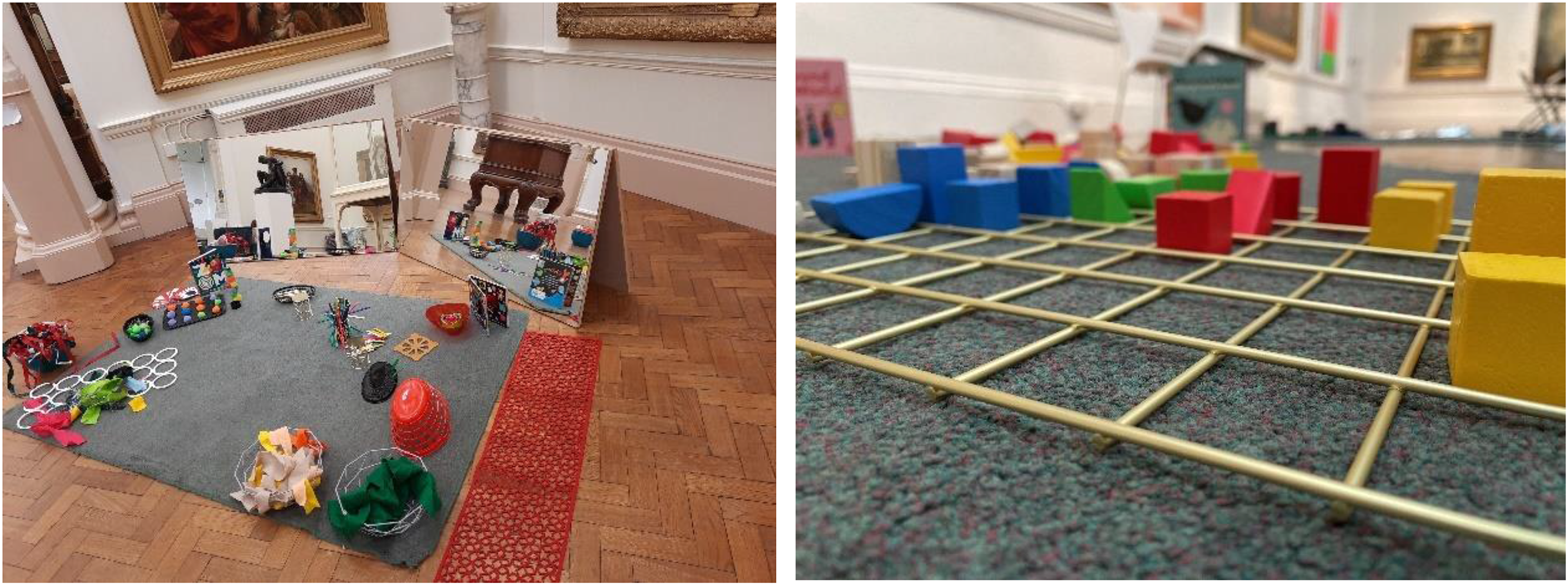
Loose parts set up (Workshop 1 ‘shape and form’ and Workshop 2 ‘light and dark’).
When set up in a setting that also displays works of art, loose parts bring children closer to the process of creating works of art in which artists engage before their artefacts are ready to be displayed. While loose parts shift the focus to the process, process and product co-exist (Axelsson et al. 2022). This is important in developing children's understanding that artists engage in a creative process of making and produce works over a period of time. The loose parts and children's engagement led to entanglement and evolution of child, materials, process and product to inspire divergent thinking and collaboration (Pacini-Ketchabaw et al., 2017) in the creation of new and oftentimes unintended works. The loose parts also supported broader forms of meaning-making, communication and embodied literacies whereby children were able to express their ideas in other ways alongside or instead of verbal utterances. They offered opportunities for multi-sensory engagement, play and development of ideas through construction and reconstruction of possible uses, meanings and narratives.
Navigating young children's sensory and physical explorations was a challenge in the museum due to the positioning of exhibits, such as large paintings, within easy reach, encouraging little hands to touch and feel. The sculptures and display cabinets across the floor space were viewed by children as hiding places, and supervision was not always easy as once on the move, children were not within sight. Nevertheless, the larger gallery spaces offered more flexible and safe areas, with less ‘disruption’ to the exhibits and crowding when other visitors entered the gallery.
Participants
Each workshop was open to 20 adults and their children based on the available space at the museum. Some of the attendees came for all three sessions, while others attended once or twice. All adults were invited to participate in the research on arrival, however, not participating did not preclude them from enjoying the workshops. Once written consent was obtained, children were approached for verbal permission to watch them play. Across the three sessions, 20 adults and a total of 28 children agreed to participate. Children's ages ranged from nine months to five years old. The units of adults and children were parents, some attending with more than one child; grandparents attending with grandchildren; and a childminder with a small group of children in their care.
Ethical approval was granted by the University of Huddersfield School of Education and Professional Development (at the time of research) Ethics Committee and followed the expected protocols around informed consent, children's assent, confidentiality and anonymity. Written permission was obtained to use photographs of children at play as long as participants were not identifiable.
Methods
The workshops were documented through snapshot observations, snippets of conversations with both children and adults recorded as notes, photographs and children's physical creations. Many of the children engaged by asking questions, asking for help, explaining what they were doing and inviting participation in their play. These documentation methods are commonplace in early childhood practice and, when employed in combination (Clark, 2017), have the potential to uncover insight into children's engagement, knowledge and learning. As such, the documentation developed during the workshops was more than research evidence, it provided insight into children's ideas, problem-solving and representations (Fawcett and Hay, 2004). To move beyond the immediate impressions about children's engagement and into deeper analysis, attempts to ‘catch the moment’ and ‘stretch time’ (Carlsen and Clark, 2022: 209) were made by collating observation notes and photographs side by side. Neither observation notes nor photographs alone would have provided the richness achieved through combining different pedagogical tools and research methods. The combined documentation provided layered understanding of children's encounters and play (Franks and Thomson, 2020).
Data were analysed using thematic analysis as an approach to identifying themes (Bryman, 2012), with a specific focus on engagement, making and entanglement of children and materials (Lenz Taguchi, 2009). Written observations and photographs were initially coded based on children's interactions with the loose parts and the museum environment as interpretive practice (Braun and Clarke, 2022) rather than a systematic approach of assigning identifiers. Children's engagement, physical movement, narrations with the resources and their play generated ‘themes as interpretive stories’ (Braun and Clarke, 2022: 2). In this paper, three vignettes capturing children's encounters and play are presented.
Children's embodied meaning-making in an art museum
The workshops enabled young children to engage with loose parts creatively and without limitations related to the purpose or use of materials and space. In the process of engaging children with art concepts and materials, three key themes in their practice were identified: arranging and rearranging the resources, making things and moving around the physical space.
(Re)arrangers: Transient compositions
Children spent prolonged periods of time playing imaginatively with the loose parts materials. This was reinforced by the offer of an open space and freedom to explore (Fawcett and Hay, 2004; Marsh et al., 2017). Two boys are using soft materials from the bath sensory baskets, carefully positioning them on top of round cork mats [Figure 2]. Initially, I assume they are making sandwiches as the ‘toppings’ are squeezed between two mats. I am quickly corrected that their creations are in fact ‘pizzas’. ‘What pizza is it?’ I ask. ‘It's a Christmas one!’ one of the boys replies, as he puts a shiny sponge on top of his pizza and promptly runs away. A younger sibling attempts to join, but as she is ignored, she starts her own investigation of the heuristic sensory baskets nearby. (Workshop 3)
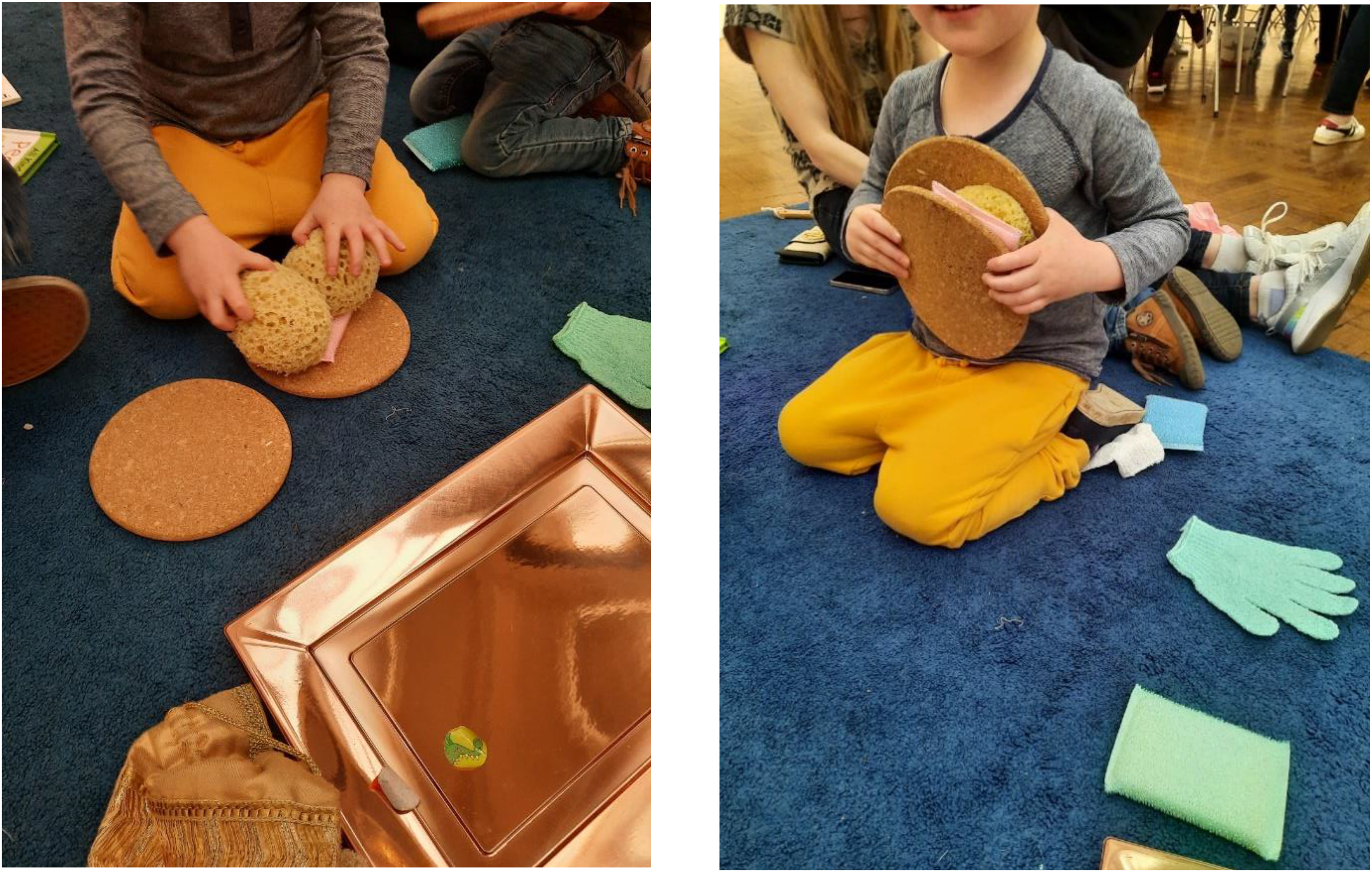
Making a pizza (M, aged four, Workshop 3 ‘sense of self’).
The two children played with the sensory baskets for a while, making new creations, feeling and manipulating the materials and objects, moving around and communicating with their siblings and adults. The sensory baskets were set up primarily for the youngest children, however, the four-year-old boys demonstrated high levels of concentration exploring the resources, imagining what they could be and attributing them a specific purpose. This observation illustrates a focus on the process of making: the children created artefacts to play with, which ceased to exist as their play ended. Therefore, it did not matter that there was no lasting product resulting from the entanglements, the children still left transient marks in the museum space. The ‘pizzas’ were temporary compositions until the next child who picked up the loose parts used them differently. Through manipulating loose parts and materials, the children experimented with possibilities and their sensory experiences heightened perceptions about materials, leading to meaning-making by identifying a purpose and entangling the agency of object and child whereby the pizza and the child only existed in play in that moment (Frid, 2021; Thiel, 2015).
Makers: Process and products of engagement
Meaning-making as a literacy practice and way of experimenting, naming and attaching value to self-created artefacts was evident during the ‘pizza’ exchanges and on other occasions. Children were able to ‘read’ the materials and loose parts as a form of embodied literacy and adapt them for their own imaginative purposes (Franks and Thomson, 2020) due to the materials’ interpretive, sensory potential and transient nature in that they could be experienced in action. This ambiguity of experience (Birch, 2018) helped children explore what materials and spaces could be, as part of their cultural citizenship and engagement with the museum.
A variety of materials, books and opportunities for discussion were made available to children to encourage participation and engagement (McLennan, 2010). Books are an essential artefact in many young children's lives and traditional tools to encourage literacy practices. Engagement with story narratives and illustrations exposes children to various forms of art and expression through verbal and non-verbal means, experiencing different emotions and building relationships. In addition to content, books can also provide inspiration in terms of form and format whereby children can engage as makers.
A book made by one of the children during the ‘shape and form’ workshop (Figure 3) utilised different types of paper that were provided as loose parts, as well as folding techniques demonstrated by the workshop artist: ‘“This is a book about pop-up things. They pop from the pages”, a girl tells me as I look through her book. She decides to take her artwork home with her’ (F, aged four, Workshop 1).
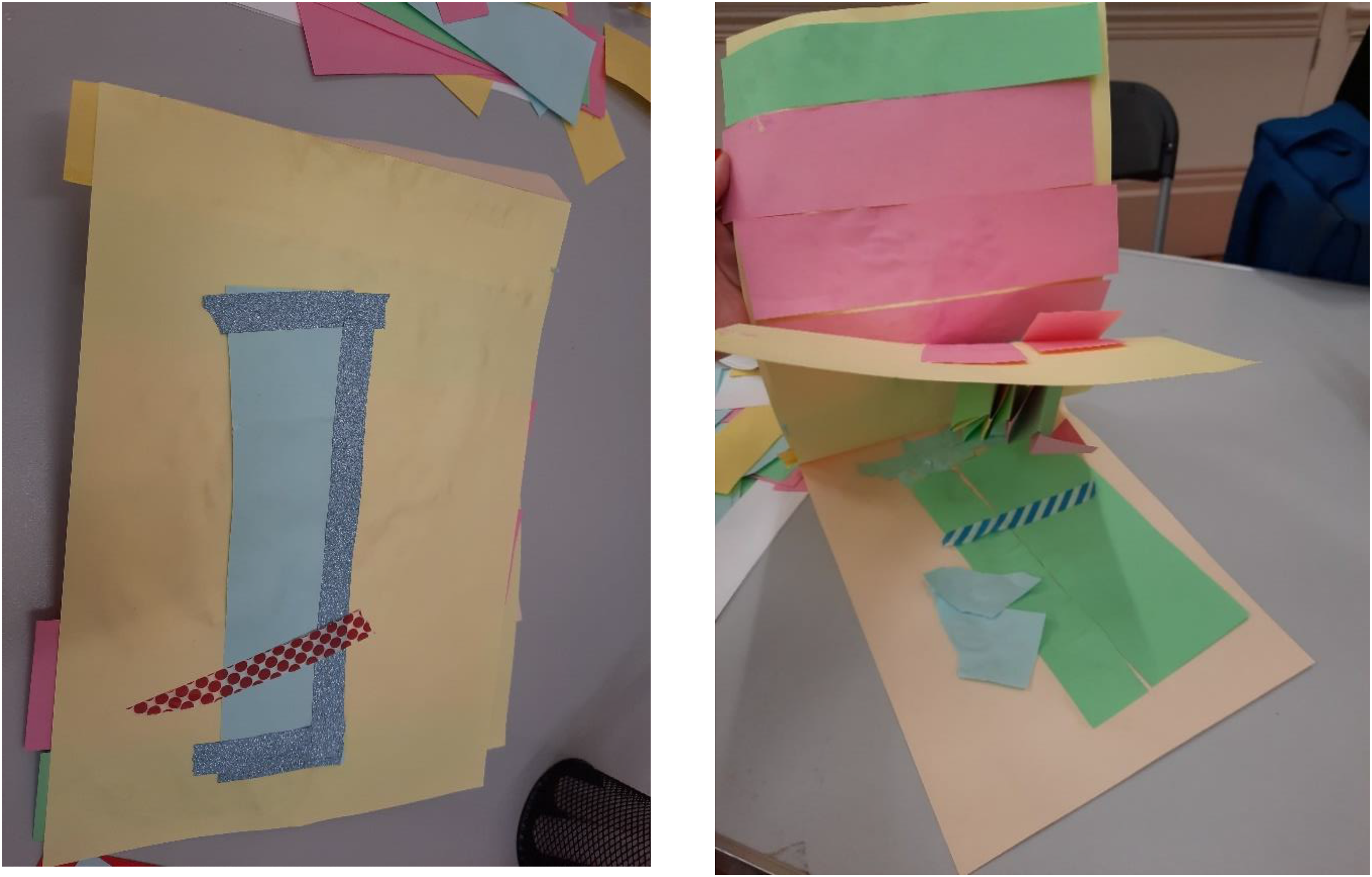
A book about ‘pop-up things’ (F, aged four, Workshop 1 ‘shape and form’).
Making the book, the child engaged with and recreated her own versions of key concepts and ideas on the pages – lines, shapes and three-dimensional sculptures that act and ‘pop up’ from the pages. This is significant in relation to the physical setting of the workshop in the sculpture gallery whereby three-dimensional sculptures acted as inspiration for what could be created. The child had ‘read’ about the potential of the loose parts that were available by layering different types of paper, experimenting with size and shape by using scissors and tearing paper and practising folding techniques. In this instance, the child, the paper and the book became entangled in producing a final product that moved, jumped and ultimately interacted in its actions with the child. Both child and book are vital for what is being created in a specific time and space, exemplifying the entangled agencies (Barad, 2007) of child, drawing, sculpture and folded model.
By working towards a specific outcome, the child had applied problem-solving skills while manipulating the paper, negotiating the paper's response, discussing materials and tools with adults and finally planning and executing her book with a high level of care, all the while navigating the materials’ properties and actions. She then proceeded to communicate her idea of the book by demonstrating the ‘pop-up’ technique and narrating the experience as an embodied literacy practice involving the reading of loose parts materials, alongside the reading of the book and sharing a story with an audience. This is also an example of creating art as a lived experience (Irwin, 2004) where children engage in different forms of thought through knowing, doing and making. Through this engagement, the child became temporarily embedded into the cultural domain of the museum as an active contributor of ideas, material artefacts and practices. She skilfully utilised her existing knowledge and experiences of books, her sensory explorations of moving pages and different textures and the immediate experiences of paper created by the artist and the sculptures in the gallery. The museum environment was instrumental in creating a book that would not have come to be otherwise. The space, loose parts, arts books and resources were the catalyst for the book-making process, including spatial and sculptural inspiration with origami from the workshop artist. Children benefitted further from opportunities to narrate their play while interacting with both materials and the wider environment, explicitly or implicitly, and increased their sense of autonomy (Franks and Thomson, 2020) and cultural contribution to the museum.
Movers: Movement as communication
Movement is a communicative practice (Hackett, 2014). Figure 4 documents two instances of how children made use of museum spaces and moved around the galleries to communicate their explorations.
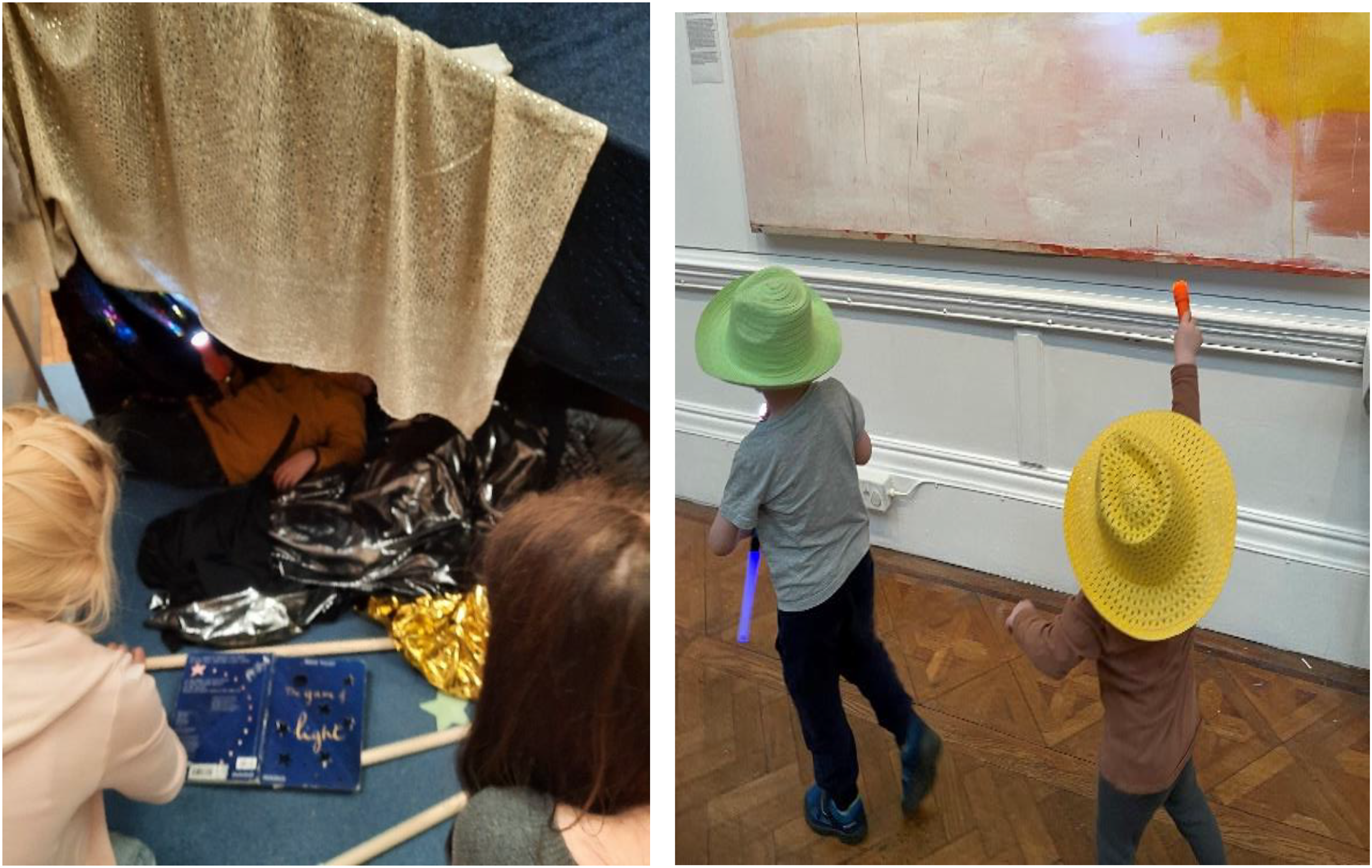
Movement in the museum (Workshop 2 ‘light and dark’ and Workshop 3 ‘self and place’).
During the ‘light and dark’ workshop, children explored the light and scale of the gallery by contrasting being in the open airy space with crawling in enclosed dark dens that they built with large wooden posts and fabrics. Light-blocking fabrics and shiny materials were provided alongside torches and fairy lights. The scale of the gallery served as a provocation to explore such contrasting concepts and spaces. Dens were designed, built and rebuilt, children comforted each other with ‘cosy blankets’, ‘bedtime stories’ and flashes of light from torches in the backdrop of a large open space filled with sunshine. Once out of their dens, children stretched and engaged in more active movement, including skipping and running. The embodied literacy practices demonstrated by children here centred on movement as a mode of expression. The children communicated comfort through routines and daily activities that are commonplace in their lives. Children and space became entangled in these experimentations where movement stretched and contracted between the open spaces and the dens, manifesting as large-scale movement such as stretching and running in the open space versus huddling together, crouching, crawling, rolling and lying inside the dens. These movements represented children's ideas about the space, materials and inherent possibilities for imaginative play through experimentation and meaning-making.
Young children's movement patterns in museums can be seen as means of communication and ‘place-making’ (Hackett, 2014; Hackett and Somerville, 2017). Movement in and out of self-built dens is unusual for a museum setting, yet this sensory experience can make art concepts such as light and dark, form and shape, accessible. Through their movement, children engaged in different ways of seeing, experiencing and knowing museum spaces employing all their senses. Being able to move freely, children communicated belonging and turned the space into their own, where hiding, lying on the floor or running around became acceptable. This prompted us – researchers, museum staff and parents as observers – to reimagine the museum as a children's place rather than one where things are specifically set up for children. Through movement, children demonstrated their own interpretations of place, exhibits and reactions to what they encountered, slowing down to look at specific paintings and speeding up to move to the next activity. Such sensory exploration of the museum space was evidence of children's cultural citizenship, awareness and capital. Upon entering the museum gallery, visitors would observe the children with fascination as if rethinking children's right to be there (United Nations, 1989), and they would take in children’s different engagement with the setting, contrasting with the expected stillness and quietness, thus advancing the notion of cultural citizenship to include visitors’ awareness of the presence and engagement behaviours of younger children.
During the ‘self and place’ workshop, children repurposed the torches and once again became entangled with the museum space. Upon reading a story with their adult, two boys used the torches to flash onto the pictures in the book as if looking for something, they then proceeded to explore the artwork around them using the same approach. The encounter was clearly influenced by the popular children's story We Are Going on a Bear Hunt by Michael Rosen (1989), except they were on an ‘art hunt’, exploring the paint, colour, texture of the paintings on the walls and the physical space while running in the gallery. They employed their senses for a hands-on exploration as far as allowable, where concerns about the safety of artworks were mitigated by strategically positioning furniture in front of paintings that were within reach and reminding children of the ground rules not to touch. The torches, in this case, acted as a metaphorical touch, an entanglement between the light touching the paintings and the children through their innovative approach to experiencing and appreciating the art around them.
Discussion: Rethinking young children's engagement with the art museum
The workshops offered young children direct engagement with art, encounters that sparked curiosity and opportunities to appreciate the museum's physical setting and atmosphere in its imposing entirety. The vignettes captured children's entanglements with materials and different ways of knowing and belonging in the museum through (re)arranging loose parts in transient compositions, making objects and moving within the space. Children identified and seized opportunities to design, create, explore (Woods and Baroutsis, 2020) and ultimately make the museum space their own (Hackett and Somerville, 2017) by negotiating activity and movement on their own terms. The loose parts enabled entanglement of child and resources but also museum as a combination of space, exhibits, people and atmosphere. In these entanglements, children, loose parts and the museum became collective co-producers of knowledge and exploratory activity.
As cultural and community settings, museums have a responsibility to meet the needs and facilitate learning of children as embodied perspectives (Birch, 2018; Sleigh, 2024). This points towards children's bodies and senses as exploratory tools during enquiry in museum spaces. Through their individual and collective explorations, children were able to model embodied literacies for meaning-making and different ways of engagement which demonstrated agency, independence and a maker mindset in ‘tinkering’ with loose parts and space (Marsh et al., 2017; Thiel, 2015; Wohlwend et al., 2023). Children made connections, were imaginative and innovative in their engagement and explorations of ‘what is’ and ‘what could be’ with loose parts and the museum. Their senses were instrumental in exploring the resources and space while navigating and communicating complex ideas. Children were able to experience the process of creating art and designs, which is not dissimilar to an artist's work. The offering of resources and space, where children engaged in making while being surrounded by the final products of artists, enabled temporary marks to linger in the museum to establish children's presence, their belonging (Wallis and Noble, 2022) and cultural citizenship as co-creators of cultural content. Through their engagement, children were agents in shaping the spaces and practices in the art museum.
Children's self-made objects, creations and play temporarily became art exhibits within the galleries, with both the human and more-than-human being vital for what was created through handling, controlling and manoeuvring objects (Thiel, 2015) and the museum space. The loose parts in this context became expressive literacy forms of learning and imagining through focus on the potential of materials and space intertwined with the child (Wargo, 2017). As forms of embodied literacy, children engaged in demonstrating and explaining their creations, developing story narratives about and around the loose parts and objects while communicating purposefully about their ideas of how loose parts became tangible final products in play within the museum as both a backdrop and inspiration. Being able to create and communicate tangible material responses to the museum experience, children positioned themselves as cultural citizens, and not passive visitors (Wallis and Noble, 2022).
Children's encounters provoked reflection on how museums can be transformed from places for children into interactive settings for makers (Marsh et al., 2017) to leave a mark (Wallis and Noble, 2022) through sharing interpretations of the art and its surroundings as means of active participation. For the museum, this offers an opportunity to consider the engagement potential of the setting. Exhibits tend to focus on transfer of knowledge and information from the museum to audiences, however, young children's action-based and sensory explorations (Birch, 2018; Hackett, 2014) call for appreciation of different ways of exploring and knowing art. Loose parts explorations could act as a reflection point for museums to consider how young children can become more engaged with exhibitions and space beyond the notion of still, observant audiences, and into the realm of makerspaces (Wohlwend et al., 2017). The museum can thus become a place of co-creation and belonging where children's presence leave an impact.
Ultimately, museums have a responsibility through their engagment strategies to create exploration opportunities for young children of the physical, emotional and sensory aspects of their spaces and practices. Without appreciating how young children engage in creative encounters, museums will not truly position children as active participants with rights to access, appreciate and enjoy the cultural provision in their spaces and practices. Young children act, manipulate and move around, and to welcome them, a museum must rethink the resources, spaces and expectations to accommodate different ways of knowing and engaging.
Conclusion
This paper exemplified the potential of specifically set up and existing loose parts in museums to foster exploratory possibilities as embodied literacy practices for young children. While playing, children and materials formed and established their own communities. They were active participants in organising and reorganising a formal space that was made their own through imaginative use of familiar and unfamiliar open-ended resources. For instance, the building of dens provided hiding places and a sense of safety; the fabrics were reimagined as clothes and dress-up possibilities while adopting the behaviours of different characters; and the space became a playground, all of which exemplifies agency in manipulating resources and creating new possibilities through entanglement. These entanglements spanned beyond the specific resources that were set up into the wider museum environment, raising questions for adults about children's engagement with the intended and beyond-intended use and experience of museum galleries.
An embodied sense of ownership and belonging in museums and galleries (Wallis and Noble, 2022) must be considered more deeply as part of an inclusive narrative of young children in museums; thus, in forging future projects with museums, we are left to think about the traces of children's creative presence in order to capture and exhibit the ‘here and now’ of their experiences, and not just past encounters. By engaging young children within museum spaces and giving them permission to make the place their own, children's encounters offer new ways of thinking about what a museum can be – a creative space, an inspiration, an experiment where the youngest children belong and drive activity.
Footnotes
Acknowledgments
The author would like to thank Natalie Mason from The Earlybird Project for her assistance during the study and input into an early version of this manuscript.
Consent to participate
All parents of children participating in the study gave their written consent. Children provided verbal assent to take part.
Ethical approval
This study received ethical approval from the School of Education and Professional Development (at the time of research) Ethics Committee, University of Huddersfield.
Funding
The author received no financial support for the research, authorship, and/or publication of this article.
