



Abstract
There has been an emphasis, and in some cases, an overemphasis, on the anti-Black violence, suffering, and pain Black children experience and have experienced in early childhood classrooms. Early childhood scholars have underscored the five historical and contemporary types of anti-Black violence (e.g., physical, symbolic, linguistic, curricular/pedagogical, and systemic school) to which most teachers intentionally or unintentionally subject Black children. We argue that the intentional focus on Black suffering overshadows what we term the pro-Black protections Black children experience in early learning and care environments from teachers who are committed to their love, safety, care, and protection. Drawing on the notion of pro-Blackness, we revisit the five types of anti-Black violence, reframing them as types of pro-Black protections. Using a multi-case study design, we center classroom-based examples of Black male teachers, demonstrating how they enact pro-Black protections in early childhood classrooms. We conclude with recommendations illuminating how early childhood teachers can foster the curricular and pedagogical liberation of Black children through pro-Black protections in early childhood education.
My son [Roland] isn’t very interested in school, and because he doesn’t like school, Mr Henry was a motivator for him to go there. (Mrs Boins, Black mother)
Roland's story
In the opening quote, Mrs Boins, a Black mother whose son, Roland, was enrolled in Mr Henry's (a Black male kindergarten teacher) class, points to the rewarding and enriching experiences her son had under his tutelage. According to Mrs Boins, Mr Henry motivated her son, who previously hated attending school. Mrs Boins further added that Roland hated attending preschool because his teacher, a White woman, often lacked patience with him and subjected him to anti-Black curricular and pedagogical experiences, which contributed to his disinterest in the schooling process. Simply put, she did not know how to teach him in ways that affirmed and honored his racial and gendered ways of knowing and being.
Roland's schooling experiences are not an anomaly; many Black children, and especially Black boys, are treated as if they were “beyond love” (Duncan, 2002: 131) in early childhood classrooms. Duncan (2002) has suggested that when Black boys are treated as if beyond love, they do not receive the kinds of love, care, and protection they deserve in schools. Culturally relevant and sustaining teachers, like Mr Henry, ensure that Black boys are loved, and become the motivation for Black boys like Roland to attend school. They also provide Black boys what Johnson and Nicol (2023: 1888) refer to as the “curricular and pedagogical resuscitation” (CPR) they need to revive their minds, bodies, and souls from the painstaking effects of anti-Blackness.
Background
Given the pervasiveness of White supremacy, and racism in society more broadly, Black children, like Roland, have been subjected to anti-Black violence in early childhood education (typically, pre-K3) that causes them to lose interest in school. In this sense, in the words of Shujaa (1994), they endure too much schooling and too little education; the former kills their spirits or spiritually murders them, whereas the latter serves to help Black children understand how they matter in society and schools (Love, 2019; Shujaa, 1994).
Over the past few decades, a litany of research studies has documented the anti-Black violence Black children have faced in early childhood education and beyond. Johnson et al. (2019) and Boutte and Bryan (2021) have identified the five types of anti-Black violence to which Black children are subjected in the early years. They propose that Black children are victims of physical, symbolic, linguistic, curricular/pedagogical, and systemic school violence. We will thoroughly explain and provide examples of each type of violence in a later section of this paper.
Although the scholarship on anti-Black violence is well-meaning and provides a nuanced understanding of how White supremacy and racism metastasize like cancer in early childhood classrooms, we believe it overshadows how Black children experience love, care, and protection from culturally relevant and sustaining teachers who genuinely swear to and uphold the oath of “first doing no harm” in early childhood classrooms. Boutte (2016) has long proposed that most early childhood teachers are committed to first doing no physical harm to young children but often ignore how they enact harm in other ways, for example, through curricular and pedagogical practices that omit Black cultural ways of knowing and being.
Considering the growing interest in Black educational possibility scholarship (Tichavakunda, 2023; Warren, 2017, 2020), academic scholars and researchers should find utility in what we term pro-Black protections enacted by culturally relevant and sustaining teachers who are committed to the love, safety, care, and protection of Black children in early childhood classrooms. Acknowledging pro-Black protections allows us to move away from damage-centered research in which Black and other minoritized children are solely positioned as victims of the vestiges of White supremacy, racism, and anti-Blackness/Brownness (Souto-Manning, 2021). Rather, it pushes us toward prioritizing desire-centered research that foreground the cumulative community cultural assets, resources, and wealth inherent in Black and other minoritized communities that are far too often relegated to the margins of early childhood research (Souto-Manning, 2021). To that end, Souto-Manning has called for a moratorium on damaged-centered research.
Responding to the moratorium on damaged-centered research in early childhood education (Souto-Manning, 2021) and drawing on pro-Blackness (Boutte et al., 2024), we revisit the five types of anti-Black violence (e.g., physical, symbolic, linguistic, curricular/pedagogical, and systemic school violence) that have been introduced in early childhood research, to reframe them as pro-Black protections that teachers can uphold to support the academic and social success of Black children in early childhood education. Using a multi-case study design, we center classroom-based examples to demonstrate how Black male teachers enact pro-Black protections in early childhood classrooms. We focus exclusively on Black male teachers because they are underrepresented in early childhood classrooms and their teaching and schooling practices are rarely highlighted in early childhood research; yet, they play an integral role in supporting the academic and social success of all children, but especially Black boys who long to experience the presence, pedagogies, and practices of Black male teachers in classrooms (Bryan, 2021). Moreover, amid current bans on diversity, equity, and inclusion (DEI) in the United States, Black teachers who center DEI in teaching and learning are further unprotected and subjected to racial violence in and beyond classrooms. What is often missing from discussions on Black male teachers is how despite structurally and institutionally racist legislations and conditions complicating their professional roles, they know and have always known how to protect themselves and children from anti-Black violence within hostile educational environments (Bristol, 2018; Givens, 2021). In other words, for Black male teachers, protecting themselves from anti-Black racism has always been a prerequisite for protecting Black children from it. To that end, we ask the following research question: How do Black male teachers enact pro-Black protections in early childhood classrooms to support the early learning experiences of Black boys?
Against this backdrop, we begin this paper by sharing the significance of our work. We then position ourselves as early childhood teacher educators who are committed to acknowledging the challenges Black children face in early childhood education, but also the love, care, and protection some teachers provide them to overhaul anti-Black violence in their early years experiences. From there, we introduce the five types of anti-Black violence to which Black children are subjected in early childhood education, followed by a detailed explanation of pro-Blackness and what we term pro-Black protections.
Furthermore, because we are not offering up pro-Black protections as a new conceptualization, we engage in a brief review of the literature, demonstrating how Black teachers historically and contemporarily have always enacted pro-Black protections in early childhood classrooms. With respect to the methodology section, we use a multi-case study design to share classroom-based examples, illuminating how Black male teachers contemporarily enact pro-Black protections in early childhood classrooms. As previously mentioned, we celebrate Black male early childhood teachers’ presence, pedagogies, and practices, and their long-standing commitment to protecting Black children, especially boys, in early learning spaces and beyond (McKinney de Royston et al., 2021). Centering Black male early childhood teachers as enactors of pro-Black protections and given that they are rarely socially constructed as models of excellent teaching and schooling practices, we conclude this paper by discussing our findings and sharing recommendations for early childhood teachers.
Significance
There is an overwhelming attention given to the presence, pedagogies, and practices of White teachers in early childhood education, thus overhauling what we know and can learn from Black male teachers regarding how to better support Black children, especially boys, in classrooms. Despite the growing body of scholarship on Black teachers, few scholars have empirically studied the pedagogical and curricular practices of Black male teachers in early childhood education. Therefore, the purpose of this study is to highlight Black male teacher practices in early childhood classrooms and the ways they counter anti-Black violence to foster pro-Black protections in those settings.
Researchers’ positionalities
The first author is a Black male teacher educator and former early childhood educator who is committed to centering Blackness in early childhood curricular and pedagogical experiences to ensure that Black children, especially boys, be academically and socially well in early learning spaces. Specifically, drawing on Black critical theories and Black masculinities, he illuminates the constructed identities and pedagogical styles of Black male teachers, and the lived schooling and play experiences of Black boys in early childhood education.
The second author is a Black woman and former early childhood classroom teacher. She is interested in the experiences of Black children in early childhood education spaces. She is consciously working to undo harm and violence she and other teachers may have unintentionally inflicted on Black children and families while teaching. She is also interested in exploring the experiences of Black mothers in early childhood education and how their motherly wit informs pedagogical and schooling practices.
Anti-Blackness and anti-Black violence in early childhood education
Boutte and Bryan (2021) and Dumas and Ross (2016) define anti-Blackness as an embodied experience of social suffering. This experience is beyond race and racism and highlights the ways Black children are experiencing anti-Black violence in schools and classrooms. Anti-Black violence can be enacted in implicit and explicit ways. As previously mentioned, Boutte and Bryan (2021) identify and explain the five types of anti-Black violence that dehumanize Black children in early learning spaces. For example, physical violence is the abuse Black children experience when teachers injure and harm their bodies and spirits in classrooms. Countless examples (e.g., Kaia Rolle was arrested for having a tantrum) of Black children being physically dragged away from schools and classrooms abound in the media and popular press.
Symbolic violence represents the kind of metaphorical abuse Black children experience that is rooted in racial prejudice and discrimination. When teachers explicitly and/or implicitly refer to Black children as unintelligent, lazy, thugs, etc., they enact symbolic violence against Black children. Linguistic violence entails the policing of Black children's language and the silencing of their voices in classrooms. When teachers refuse to listen, hear, and understand Black children, and to acknowledge, honor, and value their use of Black language instead classifying it as “broken English,” they engage in linguistic violence. Curricular/pedagogical violence is just as egregious as physical, symbolic, and linguistic violence. It entails excluding Black histories and knowledges from early childhood curricula and pedagogical practices, subjecting Black children to Eurocentric dominance through curricular and pedagogical means. Last but certainly not least, systemic school violence serves as the fulcrum on which all the types of violence depend. It reinforces school policies that are exclusionary and dehumanizing to Black children. For example, zero tolerance policies that funnel Black children into a pervasive preschool/school-to-prison nexus is symptomatic of systemic school violence.
Pro-Blackness
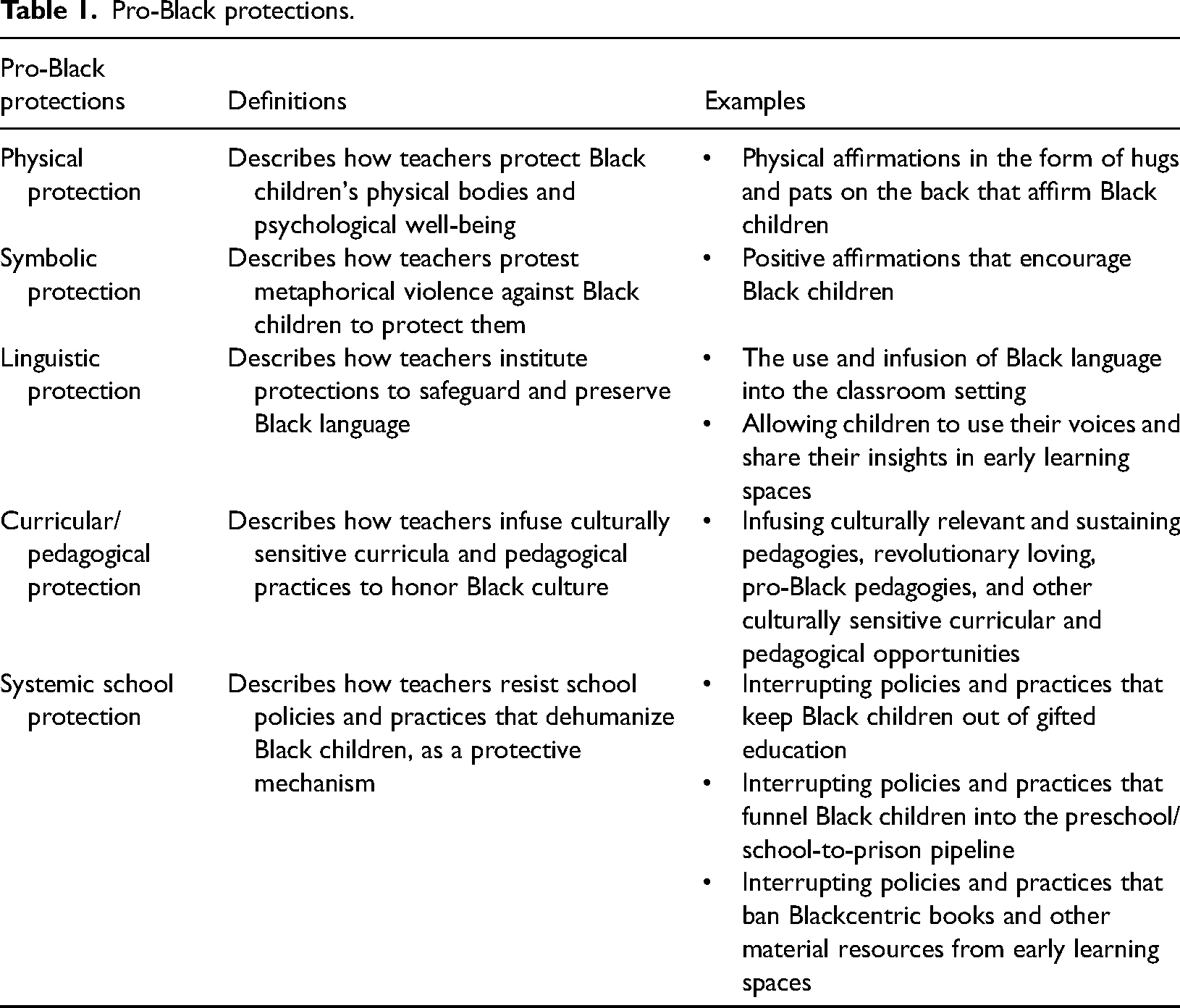
As we search for possible long-term solutions to the violence young Black children face in schools, we want to include pro-Blackness as a theory to consider. According to Boutte et al. (2024), pro-Blackness is not anti-White but situates Black cultural ways of knowing and being in early childhood curricula and schooling practices from which all children can benefit. For example, contributing authors in the book Pro-Blackness in Early Childhood illuminate ways in which early childhood teachers can infuse African Diaspora Literacies and Ma’at principles into their teachings to build young Black children's racial consciousness and positively impact their academic, cultural, and social outcomes. Furthermore, pro-Blackness is also an antidote against White supremacy and anti-Black violence in early childhood education. To that end, we draw on the five types of anti-Black violence to conceptualize what we term pro-Black protections in early childhood classrooms. Table 1 briefly provides an overview of the five types of pro-Black protections in early childhood classrooms.
Pro-Black protections.
Pro-Black protections in early childhood classrooms
In the same ways Black children experience anti-Black physical, symbolic, linguistic, curricular/pedagogical, and systemic school violence, they also experience pro-Black protections. By this, we mean that when they are afforded access to the presence, pedagogies, and practices of revolutionary loving teachers (Boutte et al., 2024), they are subjected to pro-Black physical, symbolic, linguistic, curricular/pedagogical, and systemic school protections. Pro-Black physical protections include how revolutionary loving teachers ensure the physical bodily love and care and the psychological and spiritual well-being of Black children in early childhood classrooms. Furthermore, these teachers also express symbolic protection, which means that they protest any type of symbolic violence Black children may experience at the hands of White and other internalized racists in classrooms. Linguistic protections highlight the ways teachers honor Black language and centralize it in their teaching and learning processes to ensure that Black children develop a deep love for their own linguistic ways of being in early childhood classrooms. Curricular/pedagogical protections come in the form of culturally sensitive curricula and pedagogical practices (e.g., culturally relevant and sustaining pedagogies) that teachers use to demonstrate their love and care for young Black children's academic development and social well-being. Finally, systemic school protections illuminate how teachers protest school policies that demonize and exclude Black children from school-related opportunities. In the next section, we draw on pro-Black protections to demonstrate how teachers have curated loving and humanizing early learning spaces.
Review of related literature
Black teachers and the historical and contemporary enactments of pro-Black protections in schools
Black teachers, regardless of gender, have always provided pro-Black protections for Black children in pre-K-12 schools. During segregated schooling, Black teachers protected Black children by building their critical consciousness through their curricula and pedagogies. For example, Givens (2021) documented how Black female teachers defied White supremacist curricular norms and expectations by centering Black cultural ways of knowing in school curricula and pedagogies to protect Black children from an anti-Black schooling experience. Siddle-Walker (1996) also illuminated how Black teachers provided physical and spiritual protections in K-12 schools by documenting how they affirmed Black children's brilliance, agency, and capabilities in classrooms.
Black teachers’ enactment of pro-Black protections expanded beyond segregated schooling. Ladson-Billings’s (2009) conceptualization of culturally relevant pedagogy, and Gay’s (2000) culturally responsive pedagogy are examples of pro-Black protections designed to protest the anti-Black violence of Black schooling. Grounded in Ladson-Billings’s conceptualization of culturally relevant teaching, several scholars have highlighted how Black teachers enacted symbolic protection by engaging Black students in “the talk” to help them navigate racist schooling environments (Lynn, 2006). Other scholars have proposed that Black teachers have even engaged in linguistic protection as they affirmed Black language and infused it in their curriculum (Baker-Bell, 2020). Moreover, researchers have also demonstrated how Black teachers have engaged in systemic school protection. Drawing on critical race theory principles (e.g., racism as endemic to American society and schools), Bradley et al. (2024) illuminated how Black teachers defied school policies that pushed Black high schoolers out of gifted education/advanced mathematics classes; these teachers created a pipeline of future gifted math students by identifying them in middle school and providing them the essential skills so that they could enroll in gifted/advanced mathematics courses in high school.
McKinney de Royston et al. (2021) illuminated how Black teachers protect Black children from racialized harm in schools by enacting politicized caring relationships (e.g., relying on alternative discipline policies and practices, etc.). Along these lines, our study extends this academic work by demonstrating how Black male teachers engage in pro-Black protections in early childhood classrooms.
Methodology
We used a multi-case study methodology to investigate over nine months the following question: How do Black male teachers enact pro-Black protections in early childhood classrooms? Multi-case study methodology allows researchers to use an interpretative approach to investigate research participants’ experiences. Multi-case study also allows researchers to investigate larger external purposes such as how Black teachers enact pro-Black protections across early childhood classrooms (Stake, 2006).
Participant demographics and selection process
To investigate how Black male teachers enact pro-Black protections in early childhood classrooms, we engaged in criterion sampling to select participants. Criterion sampling allows researchers to select participants based on specific criteria. The criteria to select Black male teachers to participate in the study were as follows: (a) self-identify as Black and male, (b) teach early childhood education, and (c) work with Black children, especially Black boys. Consequently, we selected three Black male teachers who taught in a variety of geographic locations, including urban, suburban, and rural schools. Additionally, we used criterion sampling to select family members of the Black boys. The criteria to select family members to participate in the study were as follows: (a) self-identify as Black and (b) have a Black boy enrolled in the class of one of the male teachers. Table 2 provides a profile of the participating teachers, and Table 3 lists the participating family members.
Teacher profiles.

Family members.

Teacher profiles
Mr Tal
During the time of the study, Mr Tal was a 24-year-old Black male who had been teaching in a predominantly Black elementary school, Tillers Plain (pseudonym), in the Southeastern United States for three years. A former participant in the Call Me Mister grow-your-own-teaching initiative, Mr Tal developed and grew his passion for teaching against White supremacist ideologies and beliefs in early childhood education.
Mr Javien
As a 35-year-old Black male who had been teaching for four years in a rural school—Simon Elementary (pseudonym)––in the Southeastern United States during the time of the study, Mr Javien had already learned what it meant to support his Black boys in culturally and gender responsive ways. Drawing from his own experiences as a Black boy growing up in the South, he used that personalized knowledge to inform his curricular and pedagogical practices.
Mr Henry
Mr Henry was a 26-year-old Black male teacher who had a similar love for the classroom and the football field. At Ponce De Leon Elementary School, located in the Southeastern United States, where he had taught for four years, he leveraged his former status as an athlete and a high school football coach to teach and inspire his Black boys, who were also driven by interests in sports.
Family members’ profiles
Mrs Boins
Mrs Boins is the mother of Roland, a six-year-old Black boy enrolled in Mr Henry's classroom. Mrs Boins is a licensed attorney in a Southeastern state.
Mrs Aretha
Mrs Aretha is the grandmother of Maurice, a six-year-old boy enrolled in Mr Tal's class. At the time of the study, Mrs Aretha was a stay-at-home grandmother, raising her grandchildren because of her daughter's military deployment.
Data collection methods
Consistent with the theoretical frameworks and the methodology of the study, we used a variety of data sources, including semi-structured and structured interviews, focus groups, classroom observations, document analysis, teaching artifacts, and field notes. We engaged in one semi-structured and one structured interview with teachers and family members, and a focus group discussion with teachers. Each semi-structured and structured interview lasted between 30 and 45 min with teachers and family members; focus groups with teachers lasted between 60 and 75 min and were conducted at school sites. During the semi-structured and structured interviews, participants were asked about how they demonstrated or witnessed the demonstrations of love, care, and protection in early childhood classrooms to counter anti-Black violence therein. Because we wanted to learn about how Black teachers enacted pro-Black protections in early childhood classrooms, we conducted weekly classroom observations to learn about teacher practice over the course of a nine-month period. We also analyzed documents and teaching artifacts, including teacher lesson plans, instructional materials, and student assignments. During the classroom observations, we took copious field notes to document teacher practice.
Data analysis
After we collected the data, we transcribed them. Consistent with multi-case study design, we first treated each teacher as an individual case study, allowing for within case analysis. We then investigated the teachers collectively to treat them as bounded cases, allowing cross-case analysis. During the within case analysis, we engaged in inductive coding, using comparative methods. Using comparative methods, we examined the data sources (mentioned above) utilizing the theoretical frameworks (e.g., anti-Blackness, pro-Blackness, pro-Black protections) and external codes. Following the development of the initial internally codes within the case, we engaged in a thematic cross-case analysis, which allowed us to refer to the theoretical frameworks and research questions to ensure alignment. This alignment allowed us to develop a set of dominant categorical themes.
Findings
Three themes emerged in our multi-case study: (a) protecting Black boys’ spiritual well-being, (b) protecting Black boys from symbolic violence, and (c) protecting Black boys curricularly, pedagogically, and linguistically. Below, we briefly discuss each theme.
Mr Tal: Protecting black boys’ spiritual well-being
Mr Tal has always been concerned with protecting his Black boy students from spiritual murder, that is, the racial act of dehumanizing Black children in such a way that negatively impacts their socioemotional well-being in and beyond early childhood classrooms. Drawing on his own schooling experiences, he understood how teachers were complicit in the spiritual violence against Black boys. For example, most of his teachers labeled him a nonreader, and such a label negatively impacted his scholarly identity, the ability to see his own brilliance and academic capability. For these reasons and more, he was intentional in building up the spirits of his Black boy students by constantly praising and reminding them of how brilliant and intelligent they were in all academic areas. Even when some Black boys did not meet Mr Tal's academic expectations, he still found a way to lift their spirits by encouraging them to always do their best. Often, he gave them high fives (a physical expression and exchange that includes the clapping of hands between two agreeing parties) or exchanged handshakes to affirm and encourage them. Mr Tal realized that these racial microaffirmations (Perez Huber et al., 2021), or ways to affirm Black boys, had long-term consequences on their spiritual well-being as they often served to encourage the boys to embrace their scholarly identity.
Mrs Aretha, the mother of Maurice, who was enrolled in Mr Tal's class, also confirmed how he protected his Black boy students spiritually. She acknowledged that during a school opening event during which families met teachers, Mr Tal, recognizing the boy's apparent anxiety about attending school, lifted the boy’s spirit by kneeling, looking at him in the face, and reassuring him that he would be safe in his classroom. Comparing Mr Tal to previous teachers her son had experienced (most of whom were White), she stated that she knew she had finally found the right teacher for her son, and that she was sure he would thrive under Mr Tal's tutelage. In other words, the mother knew her son was in a safe space, and that Mr Tal would provide him the love, care, safety, and protection he deserved, and mitigate the symbolic violence her son might experience in other early childhood classrooms that were not culturally and gender responsive to her son's needs.
Mr Henry: Protecting Black boys from symbolic violence
Much like Mr Tal, Mr Henry was also a safety net for his students by challenging the symbolic violence that dehumanized his Black boys. He understood how Black boys are often categorized as discipline problems since early childhood education, where teachers label them as such. During a conversation with Mrs Felice, the mother of Joshua, a boy enrolled in his class, Mr Henry learned about how White teachers compared attendance rosters to identify Black boys who they deemed behavior problems, a practice that had been passed on from one teacher to another in his school. Mr Henry stated that he realized that classifying Black boys as discipline problems is connected to teachers’ biases and stereotypes about them. Thus, he was adamant about positively affirming Black boys and keeping them in the classroom, even when they were seemingly engaged in off-task behaviors. Mr Henry was extremely critical of practices in early childhood classrooms that required Black boys and other children to behave as adults (e.g., sitting quietly for hours) instead of children (e.g., being playful). Rather than blaming the boys for off-task behaviors, he questioned his teaching practices, making pedagogical shifts to engage the boys. For example, given Joshua's and the other boys’ love for basketball, Mr Henry used basketball examples to engage his boy students in mathematics activities. The boys were often so excited that they blurted out answers to show their engagement in the teaching and learning process. Although Mr Henry often warned the boys to allow other children opportunities to respond, he also praised them for their excitement about the math content. Such pedagogical consideration not only disrupted symbolic violence but also curricular/pedagogical violence that causes teachers to disregard the personal and collective needs and interests that Black boys bring to early childhood classrooms.
Mr Javien: Protecting Black boys curricularly, pedagogically, and linguistically
Although all the Black male teachers in this study used curricula and pedagogical practices that reflected the Black boys’ cultural and gendered ways of knowing and being, supporting their academic and social success in their classrooms, Mr Javien's style was especially unique. He used hip-hop music and styles to engage his Black boys, particularly Ameer, a six-year-old Black boy. When describing Mr Javien's literacy practices, Ameer suggested that the teacher used children's books that reminded him of rap music. In other words, the inflection of Mr Javien's voice during reading aloud activities reminded Ameer of rap music he was perhaps accustomed to listening to at home. Mr Javien also frequently played jazz music and shared brief biographies of the jazz artists to whom the students listened. Sharing such music styles and artists not only signified Mr Javien's ability to counter curricular and pedagogical violence that often shows up through Eurocentric schooling, but also kept the boys connected to Black history, which is rarely taught in early childhood classrooms.
Mr Javien was also a Black language speaker. He grew up in the Lowcountry of South Carolina, where the Gullah dialect was prevalent. Enslaved African people co-constructed Gullah to communicate during enslavement, and the language remains a staple of Gullah culture in the South (Baines et al., 2018). Mr Javien often used Black language to engage his boys in the teaching and learning process. During a lesson, Mr Javien wanted his students to understand the word “headliner.” Understanding the students’ love for Beyonce (a Black female music artist), he encouraged them to imagine they were attending a Beyonce concert. He told them that when Beyonce is on the stage entertaining her fans, she is the headliner of the concert. Following the use of the example and to encourage a classroom community environment where everyone works to support each other, he told the boys that “there ain’t no headliners in our classroom.” Mr Javien's use of Black language was intentional and served to help the boys understand the importance of establishing community in the classroom and valuing the Black language they spoke in their home, school, and community.
Like Mr Tal experienced as a boy, Mr Javien's teachers labeled him a struggling reader, which impacted his scholarly identity. He decided to implement a Mystery Reader Program to invite Black men to his classroom to read children's books. The boys were extremely excited about this program, and Black men from the local school district and community motivated the boys to fall in love with reading as they read culturally and gender relevant children's books such as The King of Kindergarten to them.
Discussion
A growing body of academic literature (Dumas and Ross, 2016; Johnson et al., 2017) has documented the anti-Black violence that Black boys and other minoritized children face in early childhood classrooms; however, the purpose of this manuscript was to identify what we term pro-Black protections that Black children, especially boys, experience in early childhood classrooms despite institutional and structural schooling conditions steeped in anti-Blackness. Across three cases, Black male teachers—who are rarely seen as effective pedagogues who counter anti-Blackness to protect Black children, and are instead seen as disciplinarians whose sole purpose is to discipline Black boys (Brockenbrough, 2012)—were intentional in protesting the anti-Black violence that is typically present in most early childhood classrooms. They drew on their personal experiences as men who were once boys to create early childhood classroom environments that protected (rather than violated/harmed) Black boys and catered to their academic and social needs. For example, recalling his personal experiences of being labeled a nonreader/struggling reader, Mr Tal challenged the spiritual violence in the form of deficit labeling that Black boys typically face in classrooms. As an act of spiritual protection, Mr Tal found ways to uplift the spirits of Black boys by drawing on their assets rather than their deficits. Scholars have noted that when teachers acknowledge and value Black children's, boys in this case, academic assets and center them in classrooms, Black boys perform better academically in and beyond early childhood classrooms (Boutte and Bryan 2021; Wright and Counsell, 2018). As such, with the pedagogical and schooling practices of Mr Tal in mind, teachers should find ways to spiritually protect Black boys from the normalization of spiritual violence/murder in classrooms. Consequently, Black male teachers like Mr Tal become mentors who model for aspiring and practicing teachers how to spiritually protect Black boys from the quotidian violence that is normalized in early childhood classrooms.
Most research studies tend to position Black male teachers as those who comply with traditional school norms without critically understanding how dehumanizing they are to Black boys; they also socially construct Black male teachers as mentors, father-figures, and disciplinarians for Black boys who defy hegemonic schooling expectations and systemic school violence. However, much like Black boys, Black male teachers also defy those practices, norms, and expectations, understanding how they serve to inflict harm upon Black boys and other children of Color. In other words, Black male teachers are not oblivious to the inner workings of anti-Black misandric violence (racial and gendered harm) done to Black boys in early childhood classrooms (Bryan, 2021). Mr Henry challenged the normalcy of anti-Black misandric curricula and pedagogical practices by centering the interests of Black boys at the heart of the teaching and learning process. He used sports referents to engage them in math lessons, because he spent time building positive relationships with them, learning about rather than assuming their personal and collective interests that might engage them in the teaching and learning process. When teachers assume that all Black boys are interested in sports, they fail to embrace the mosaic of differences of Black boyhood (Bryan, 2021). Although Mr Henry used sports as a cultural and gender referent, he also understood the importance of valuing the many ways one could be Black and boy (e.g., boys who play with dolls).
Black boys are socially constructed as underperforming in math (and other content areas; see Aratani et al., 2011); however, these boys were able to demonstrate their academic prowess when their teacher acknowledged their interests and centered them in the math curriculum. Therefore, Mr Henry engaged in symbolic protection (e.g., contesting the notion of Black boys as underachievers in math) to illuminate the mathematical geniuses in his boy students. With Mr Henry's practices in mind, we wonder how teaching Black boys in ways that honor their full humanity might mend the leaky pipeline to the field of mathematics where Black and other minoritized groups are underrepresented (Jett, 2021). Jett has provided case studies of Black boys/men who have excelled in math given the support from family and community members, and teachers who enact symbolic protections like Mr Henry.
Despite the curricular, pedagogical, and linguistic types of violence that emerge from academic mandates (e.g., Developmentally Appropriate Practices, DAP; Bryan, 2021) that are normalized in early childhood classrooms (Boutte and Bryan, 2021), Black male teachers like Mr Javien work collaboratively with Black boys to contest such violence. To that end, he provided curricular, pedagogical, and linguistic protections so that Black boys would not be subjected to anti-Blackness and anti-Black misandry in his classroom. Much like Mr Henry, he spent time getting to know his students and building strong and positive relationships with them to learn about aspects of their cultural and gender ways of knowing that could be included in his curriculum and pedagogical practices. As such, he provided curricular protection by using the inflection of his voice in ways that mirrored hip-hop/rap music, which resonated with Ameer. Understanding how Black boys and other children are encouraged to see Black men in pathological ways (e.g., bad, dangerous, nonreaders), he developed a Mystery Reader Program that invited Black men to his classroom and positioned them as readers to encourage his boys to develop a love for reading. In other words, Mr Javien provided his Black boys mirrors in which they could see themselves through the presence of Black men, and windows through which to develop an expansive view of Black men and themselves as readers.
Additionally, most early childhood classrooms are inundated with culturally unresponsive children's books (Boutte et al., 2024). Consequently, Black boys often miss out on opportunities to deepen their knowledge of self (Howard, 2014). Given the lack of books that elevate Black boys’ knowledge of self in early childhood classrooms, Mr Javien's infusion of children's books that reflect the boys’ cultural and gender ways of knowing and being is a type of curricular, pedagogical, and linguistic protection that is not always readily available to Black boys in early childhood classrooms.
Black boys lack opportunities to use their native tongue, such as Black language, without scrutiny Bryan (2021). Black language and other nondominant forms of spoken or written English are often socially constructed as “broken English,” and individuals who speak those variations are deemed unintelligent (Baker-Bell, 2020). Thus, Black male teachers like Mr Javien who enact linguistic justice by speaking Black language and encourage their students to do so protect Black boys from the linguistic violence they are subjected to in and beyond early childhood education.
Recommendations for early childhood research and practice
Because we care deeply about early childhood practices that support the well-being of all children, especially Black boys and other minoritized children, we provide recommendations for early childhood education research and practice we believe can encourage current and future teachers to engage in pro-Black protections in classrooms. We highly recommend that early teachers and researchers center Black male teachers as mentors in research and practice, tap Black male teachers to serve as supervising/cooperating teachers, and prepare current and future Black male teachers to engage in pro-Black protections in classrooms, especially in affinity spaces, including “grow-your-own” initiatives like Call Me Mister (Jones and Jenkins, 2012), designed to inspire, recruit, and retain Black male teachers.
Centering Black male teachers as mentors in research and practice
Given the growing movement to center educational possibility, we hope that early childhood educators see the possibilities and find the pro-Black protections of Black male teachers in this study beneficial to their teaching. Much like Black men who are tapped to serve as mentors and role models (Thompson, 1996) for Black boys, Black male teachers can also be tapped to serve as mentors for teachers, especially for White teachers who often misunderstand Black boys. Perhaps when Black male teachers are positioned as mentors, they can assist White (and other) teachers in overhauling the cultural tug-of-war (Milner, 2010) or antagonistic relationships they often foster in and beyond early childhood classrooms. As such, we recommend that researchers and scholars expand this work by continuing to investigate the pro-Black protections and pedagogical styles of Black male teachers so current and future teachers can overhaul the physical, symbolic, curricular/pedagogical, linguistic, and systemic school violences that deeply and negatively impact the schooling lives of Black boys.
Tapping Black male teachers to serve as supervising/cooperating teachers
Teacher preparation programs are especially vital in the preparation and professional development of teachers (Wynter-Hoyte et al., 2019). For example, aspiring teachers are often assigned to schools to engage in field experiences during which they shadow and learn with and from in-service teachers. However, what is often ignored in the research literature on field experiences is the apprenticeship of observation, which Lortie (2002) originally theorized to describe how children who attend K-12 schools observe the “normative pedagogical practices” of teachers that they later imitate or enact in classrooms if they decide to pursue teaching as a professional career. The apprenticeship of observation can also be conceptualized to describe how aspiring teachers observe the “normative teaching practices” of cooperating/supervising teachers during field experiences, and how they uphold them as what should be happening curricularly and pedagogically for children in early childhood classrooms.
Like the national teaching demographic in general, most cooperating/supervising teachers are White and female (Wynter-Hoyte et al., 2019). When they mentor aspiring teachers in culturally and gender unresponsive ways, they pass on a legacy of anti-Black misandric practices that lead to perpetual harm and violence enacted against the minds, bodies, and souls of Black boys. Therefore, we recommend that teacher educators be intentional in tapping the 1.8% of Black men who enact pro-Black pedagogies and currently serve as teachers in US public schools to serve as cooperating teachers to support the development of the overwhelmingly White teaching force. These Black male teachers can also serve as mentors and models for Black male teachers who are critically unaware of racist schoolings systems. We recommend that colleges of education find ways to compensate these teachers for their effort in preparing the future teaching workforce. For example, these teachers can receive monetary compensation in the form of monthly stipends and/or scholarships to attend graduate programs in education to pursue advanced degrees to hone their curricular and pedagogical skills.
Preparing current and future Black male teachers to engage in pro-Black protections
A large majority of the research on teacher education focuses on the preparation of White teachers in urban schools, preparing them to work with Black boys (Hancock and Warren, 2017; Warren, 2017). We agree with Wynter-Hoyte et al. (2019), who believe that this hyperfocus on White teachers obfuscates the teacher preparation needs of Black males and other minoritized teachers. To that end, we recommend that teacher preparation programs center scholarship on pro-Black protections at the heart of the teacher education curriculum so that future teachers can learn from Black male peers. This effort will require teacher educators to overhaul and abandon course content that does not lend itself to prioritizing scholarship on pro-Black protections. As such, as Black men (figures/characters) serve as “mentors on paper” (Thompson, 1996) in children's literature to encourage Black boys to read, Black male teachers can serve as mentors on paper in research articles and book chapters to encourage White and other teachers to engage in pro-Black protections in early childhood classrooms.
There is increasing interest in grow-your-own teaching initiatives, especially those that are hyper-focused on inspiring, recruiting, and retaining Black male teachers in pre-K classrooms. The Call Me Mister initiative has sparked an outgrowth of other grow-your-own teaching programs, including Profound Gentlemen and Black Men to the Blackboard, that have served to inspire, recruit, and retain Black male teachers. Although these initiatives are well-meaning, they are not necessarily designed to prepare teachers to engage in pro-Black protection efforts and in culturally and gender responsive teaching in the early childhood classroom. In fact, respectability politics and heteropatriarchal mentoring (Singh, 2021) often inform Black male teacher preparation in these programs. For example, although well-meaning, a recently released documentary on a Call Me Mister initiative, The Mile High Misters, documents how participants are heralded as “Black super men” (Pabon, 2016) who are summoned to schools and classrooms to save Black boys from deprived selves and to give them a vision for success, without critiques of structural and institutional forces that negatively impact the boys’ life chances. Therefore, as Bryan and Milton-Williams (2017) have argued, we need more than (Black) male bodies in classrooms, but those who are critically conscious of how anti-Blackness and anti-Black misandry inform every aspect of the early childhood classroom so that they can contest them. As such, we recommend that grow-your-own initiatives that serve to inspire, recruit, and retain Black male teachers find ways to center research on pro-Black protections, providing a model for participants to overhaul the violence Black boys and other minoritized children face in and beyond early childhood classrooms. In other words, Black male teachers must move beyond dressing up in suits and ties, positioning themselves as models for how Black boys should dress and navigate the anti-Black misandric society in which they live.
Conclusion
Contrary to popular belief, Black male teachers have always played an important role in protecting Black boys and other minoritized children in pre-K-12 schools (Foster, 1997; Siddle-Walker, 1996); however, few research studies have documented this. In response to this limited research, our study has demonstrated how Black male teachers engage in pro-Black protections to overhaul anti-Blackness and anti-Black misandry in early childhood classrooms. This shift is a positive and intentional one from a hyperfocus on anti-Black violence to pro-Black protections that is needed to heal the wounded spirits of Black boys and other minoritized children in early childhood classrooms. Black boys deserve teachers who protect rather than harm them in classrooms, especially when there is an intentional conspiracy to destroy them in society more broadly.
Footnotes
Ethical approval
This study has been approved by the university's Institutional Review Board and adheres to the board's ethical guidelines.
Funding
The authors received no financial support for the research, authorship, and/or publication of this article.
