



Abstract
An interprofessional approach is often implemented to ensure a child's right to support when their support needs are complex. This study was designed to define the characteristics of significant interprofessional support in the context of early childhood education and care (ECEC) in Finland, to promote a more systematic and functional praxis. The data were collected from ECEC teachers and special needs teachers as written and drawn maps (N = 34) presenting the interprofessional practices and networks in which they engage. Member check interviews (N = 2) were conducted to deepen the trustworthiness of the results. The maps and interviews were analysed with content analysis, and co-occurrences of the identified key themes were studied as a part of the analysis. The study concludes that interprofessional work was deemed more sustainable in Finnish ECEC when the professionals had a systematic approach or existing operational model that included elements of the found characteristics of functional significant interprofessional support.
Keywords
Introduction
Interprofessional collaboration is often suggested when a child has complex support needs in early childhood education and care (ECEC). As Ogletree et al. (2017: 217) put it, ‘any one discipline representative will not possess the knowledge to meet the collective needs of a person with severe disabilities’. In Finland, research on support in education indicates that the Finnish system is not successfully meeting the more demanding support needs (Kontu et al., 2017: 10). Finnish ECEC teachers also report a need to widen their professional networks to support children with high support needs more effectively (Äikäs et al., 2023: 537). To describe the support required by children who often have intellectual disabilities, autism or behavioural challenges, the concept of significant support and, later, significant interprofessional support has been adopted, referring to the continuous, systematic, intensive and collaborative support practices (Pesonen et al., 2023) that complement the ECEC teachers’ pedagogical solutions. In interprofessional collaborations promoting the social inclusion of these children, the partners should recognise and gain access to various sources of expertise in local educational, social and healthcare systems, and mediate the roles and responsibilities of their strategies both with other professionals and with the child and family (Daniels et al., 2007: 522).
Mowrey and King's (2019: 1053) patterns of collaboration describe the partners and networks with whom the participants work (who), the activities in which they engage (what), the context and frequency of collaboration (where and when) and the characteristics or tools that make the collaboration functional (how). These patterns were used in this study to interpret teachers’ experiences of significant interprofessional support in Finnish ECEC, and to generate suggestions for how to improve future actions (Metcalfe, 2008: 1098). The data were collected as written and drawn maps and analysed with content analysis in Atlas.ti 24. The research questions were as follows:
Who are the partners in significant interprofessional support, and how do teachers view these partnerships? What kinds of activities do ECEC professionals associate with significant interprofessional support? What characteristics do ECEC professionals consider functional in significant interprofessional support?
According to Pfeiffer et al. (2019), there are quality variations in the way of organising collaborations and orientating to common goals, leadership and individual collaboration skills in United States. Indications of these quality gaps are also reported in Finnish ECEC (Äikäs et al., 2023; Heiskanen et al., 2021). Connors-Tadros (2019: 1095) suggests that further research on significant interprofessional support in ECEC is needed to gain a greater understanding of partnership and collaboration strategies, and to examine how to establish the necessary conditions for deep and sustainable collaboration. This study aims to fill this gap by investigating characteristics of significant interprofessional support in Finnish ECEC. More precisely, the focus of this study is on teachers’ experiences of their networks and partnerships, the forms of work in which they engage and facilitators and barriers of the work. The results of this study, as Äikäs et al. (2023: 538–539) argued, can be used to promote a more systematic praxis to both grant children their right to receive support and improve the well-being of all ECEC employees.
Perspectives on interprofessional practice and significant interprofessional support
Recent studies on support practices use varying terms, such as team collaboration (Sinai-Gavrilov et al., 2019) and multi-professional teamwork (Karila and Kupila, 2023), to describe the interactions between staff members of different educational backgrounds in daycare centres. Support practices between ECEC and other organisations are also often referred to as interprofessional collaboration (e.g. Äikäs et al., 2023; Fukkink and van Verseveld, 2019; Ogletree et al., 2017). This study adopts Pesonen et al.’s (2023) concept of significant interprofessional support, which describes a flexible praxis of multidisciplinary support that could be provided in any tier of support. Therefore, the range of support should be set according to the individual child's needs and in cooperation with the guardians (Pesonen et al., 2023: 4).
D’Amour et al. (2005: 127) stated that collaborative processes are constructed to benefit not only the child but also the professionals. For instance, Äikäs et al. (2023: 537–538) identified that when a child's support was lacking, teachers experienced sole responsibility of it, but when teachers reported shared interprofessional effort, support was functional. This indicates that interprofessional collaboration improves the child's support and also serves the teacher's professional needs. Families and teachers often evaluate a child's services by the amount of one-on-one time the professionals spend with the child, instead of assessing the meaningfulness of the service goals (Ogletree et al., 2017: 224–225) or the expansion of the professionals’ expertise on functional support when interacting with other disciplines. Thus, in Forsythe and Larson's study (2023: 87), the professionals outside of education more often mentioned a more coach-like approach in which they shared their expertise to help teachers work more inclusively in their classrooms. Therefore, there are differences in teachers’ and other professionals’ experiences of best practices; other professionals’ time spent with the child is not necessarily a guarantee of quality support, and the characteristics of functional interprofessional practices vary depending on the study and discipline (e.g. Bronstein, 2003; Connors-Tadros, 2019; D’Amour et al., 2005; Levere et al., 2019; Prentice et al., 2019).
This study employs both Reeves et al.’s (2018) typology of interprofessional practice as well as Bronstein's (2003) model of interdisciplinary collaboration as theoretical frameworks. Reeves et al. (2018) highlight that the main purpose or need for interprofessional or multidisciplinary practice determines the modes of cooperation. The modes of teamwork, collaboration, coordination and networking differ depending on the urgency of the task, the level of interdependence and integration between the professionals and how the responsibilities are shared. For instance, in teamwork and collaboration, the professionals are more dependent on each other, and in coordination and networking, the tasks are less urgent and the participants can also communicate online.
Bronstein (2003) suggests five core components for activities shared by professionals from different disciplines: interdependence, newly created professional activities, flexibility, collective ownership of goals and reflection on the process in the theoretical model of interdisciplinary collaboration. Interdependence means differentiated roles and time spent between the professionals, as well as respect for each other's input on the shared work, while newly created professional activities refer to collaborative structures that can achieve more than a sole profession could (Bronstein, 2003: 299). An example of this kind of structure is Finnish basic education's student welfare services, which cover individualised and preventative welfare work in schools with representatives from different professional groups (Vainikainen et al., 2015) such as school counsellors, psychologists and school nurses. Basic education teachers working in significant interprofessional support also collaborate with other teachers, teaching and care assistants, school administrators, guardians and different therapists (Kokko et al., 2014: 62).
Flexibility in collaboration refers to the intention of blurring the boundaries between professional roles to compromise and find creative solutions (Bronstein, 2003: 300). Differences in vision and philosophy are a challenge for collaborative partnerships (Levere et al., 2019); therefore, collaborators should also establish collective ownership of the goals (Bronstein, 2003: 299). To fulfil the goals, partners rely on mutual trust, commitment or contractual arrangements that facilitate their cooperation (Prentice et al., 2019: 792). Daniels et al. (2007: 533) argued that effective collaborations also require the individual professional to learn the ‘who’, ‘how’, ‘what’, ‘why’ and ‘when’ of other professions, not only to build a confident understanding of their skills and expertise but also to create trails to access them.
The core components of interprofessional activities are influenced by professional roles, such as the ethics guiding every profession; structural characteristics, such as organisational factors supporting shared agency; personal characteristics, meaning the way we view each other as people; and history of collaboration, referring to earlier experiences of cooperation (Bronstein, 2003: 302–304). The organisational culture of a school especially impacts the way the services are executed and the extent to which the partnerships are utilised (Bronstein et al., 2012: 162), and well-led and well-organised cooperation has a positive impact on professionals’ engagement in working together (Timperi et al., 2024: 7). Heterogeneity between professionals brings expertise, commitment and diversity to the team (Jackson, 2021: 821–823). However, richer perspectives can also bring a struggle or confusion over roles and responsibilities (Karila and Kupila, 2023: 12). Individual professionals should therefore develop a constructive style of working together but also experience appreciation and opportunities to develop their expertise (Timperi et al., 2024: 6–7).
Study context
This study investigated significant interprofessional support in the context of Finnish ECEC. The Finnish context offers an interesting arena for inquiry, as recent Finnish studies have identified that the current support system is not meeting the needs of all children in ECEC or basic education (Heiskanen et al., 2021), leading to the development of the concept of significant interprofessional support. This concept refers to the praxis of organising support that especially requires interdisciplinary and interprofessional collaboration. Children receiving it may have intellectual disabilities, autism or emotional, psychological or behavioural challenges (Pesonen et al., 2023: 4).
The background of this concept in Finland originates in the from 2011 to 2015 government-funded The Intensive Special Education Endorsement (VETURI) project (Kontu et al., 2017: 10), which estimated that around 10,000 Finnish pre- and primary school students had more demanding support needs than the Finnish support system could respond to. Currently, the concept of significant interprofessional support is recognised in the Finnish Act on Vocational Education and Training (531/2017) (Goverment of Finland, 2021) but not in Act on Early Childhood Education and Care (540/2018) (Goverment of Finland, 2022) or the recent Act Reform on Early Childhood Education and Care (326/2022) (Äikäs et al., 2023; Goverment of Finland, 2022), since significant interprofessional support is, above all, perceived as a professional praxis rather than a legislative requirement or a service system. However, inconsistencies in the organisation of support for children with diverse needs have led to local differences in significant interprofessional support (Heiskanen et al., 2021), which can set children in unequal positions based on their location.
The data for this study were collected amid the Finnish legislative reform in 2022 (Act Reform on Early Childhood Education and Care 326/2022), as well as social, healthcare and regional government reforms. At the beginning of 2023, self-governing well-being services counties took over the responsibility of organising health, social and rescue services from the municipalities. ECEC and other education are still provided by municipalities.
Participants and research data
The participants in this study were Finnish ECEC teachers (23.1%) and special needs teachers (66.3%) who took part in a national university-led in-service training and research project on significant interprofessional support in Finnish ECEC from 2021 to 2023. Altogether, approximately 350 ECEC professionals participated in the training. The participants were mostly women (96%), and 46% had over 10 years of experience in the ECEC field. Participation was voluntary; the ECEC professionals enrolled were interested in expanding their knowledge of collaborative working methods for working with children with high support needs. The project was advertised on Facebook and Twitter by its funder, the Finnish National Agency for Education.
To collect information on the network around ECEC teachers and their interprofessional work and collaborations, the respondents were asked to submit a mind map answering the following questions: ‘What does your interprofessional network look like?’ ‘With whom is the work established and functional?’ and ‘How could the shared work be improved?’ In total, 34 maps were submitted, 13 of them mostly in text, 14 as mind maps and five combining mind maps and text. All of these are referred to as maps in this study. Informed consent for participation was sufficient to proceed with data collection (Finnish National Board on Research Integrity TENK, 2019: 61). The data were anonymised by transcribing the recorded material and using codes (e.g. M30) for the participants. Pseudonyms were used for any names indicating participants' location, to minimise the risks of identification. The group accessing the raw data was the first author and co-authors of the article.
Data analysis
All documents were imported into Atlas.ti 24 software for qualitative content analysis. The first step was to familiarise ourselves with all the documents, and second, to form a draft of the main analysis categories by answering the research questions inductively. The third step was to build a sample for trial coding of one-third of all the different document types, and to create data-driven categories on the trial sample after Flick and Schreier (2014: 176).
All visual aspects of the mind maps were coded as answers to the first research question regarding the networks with which ECEC teachers work. Symbols (e.g. hearts, smileys) on the maps were coded with a holistic approach, considering the influence of the text on the symbol being coded (Ahuvia, 2001: 145). The networks and professionals mentioned on the maps were also coded into two dimensions of frequency. The closer to the centre, the more frequent the shared work was, unless the participant made other clear distinctions such as colour codes or written explanations (see Mammen and Mammen, 2018: 585). The fourth step was to evaluate the coding frame and improve the decision rules and category definitions before the main coding phase, to avoid overlapping. The fifth step was the main analysis, in which all the materials were analysed according to the coding frame created in the trial coding phase (Flick and Schreier, 2014: 176).
The networks and professionals mentioned in the documents were coded based on the language participants used. These partners were then divided into three categories: healthcare and social services, early childhood education and basic education. Healthcare and social services were combined due to the many integrated services in Finland. Within that category, however, important distinctions were made. For instance, therapy was separated from rehabilitation to enable comparison between the integrated service ‘rehabilitation’ and other ‘therapy services’ that were mostly mentioned separately on the maps.
All the text materials were coded as interpretations of the content (Ahuvia, 2001: 141–150) into smaller segments of collaboration characteristics and collaboration barriers, as well as larger segments or dimensions of frequent, infrequent, successful and challenging collaboration, to answer the second and third research questions: what kinds of activities do ECEC professionals associate with significant interprofessional support? and what characteristics do ECEC professionals consider functional in significant interprofessional support? Coding the materials into smaller and larger segments enabled analysis of co-occurrences (in Atlas.ti 24) between professionals and the characteristics and dimensions of frequent, infrequent, functional and challenging collaboration. Table 1 presents the number of times partners were mentioned in the documents, and the co-occurrences of the dimensions of frequent or infrequent and functional or challenging partnerships.
Co-occurrences of mentions of partners in significant interprofessional support.
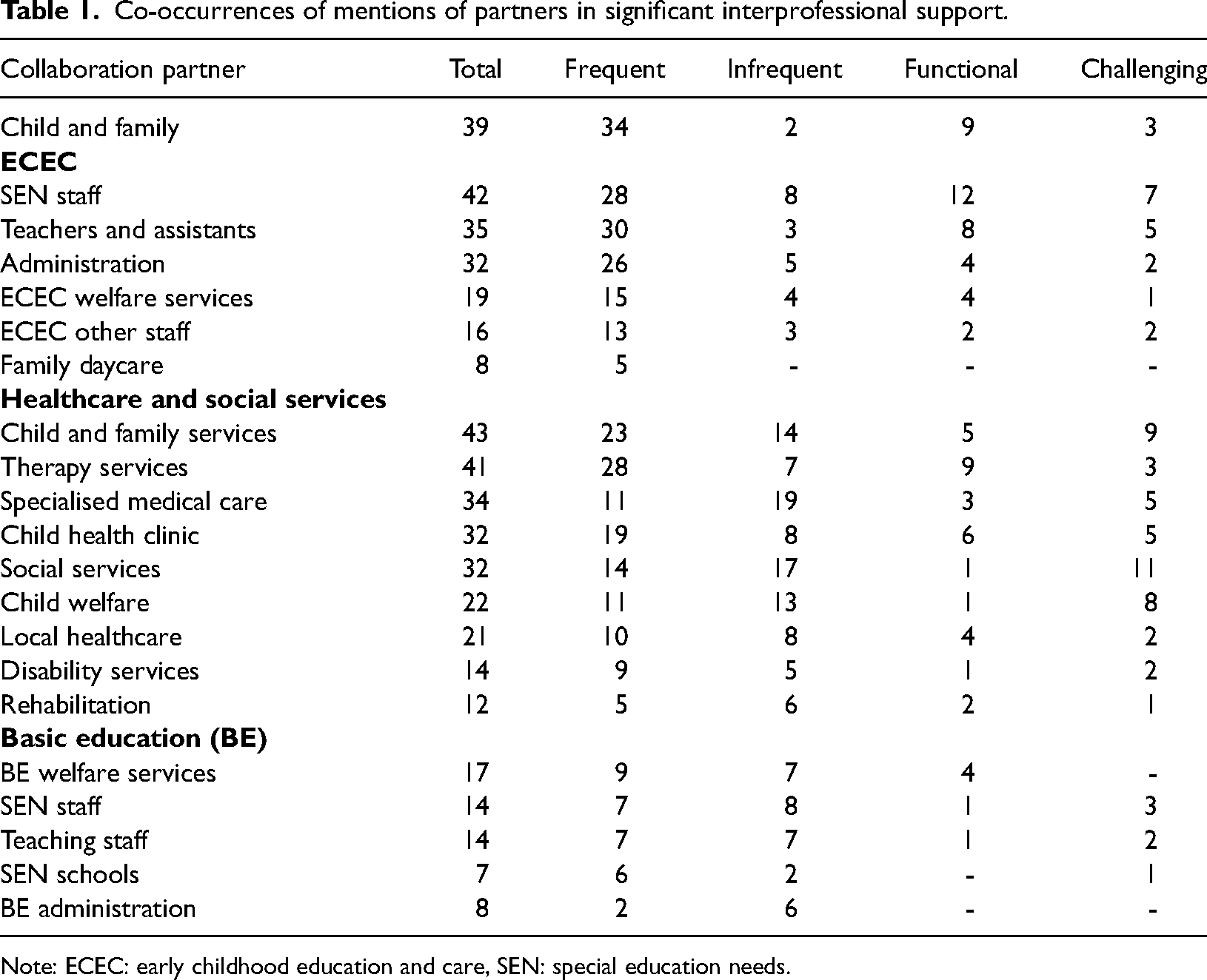
Note: ECEC: early childhood education and care, SEN: special education needs.
After the first round of analysis, the preliminary results were discussed with two of the participants as member check interviews, to gain a greater understanding of their experiences (Carl and Ravitch, 2018: 1050) as well as to discuss and reflect on the analysis and to promote researchers’ trustworthiness during the research process (DeCino and Waalkes, 2019: 381). The sixth and final step of the analysis was to interpret the findings and compare them with previous research (Flick and Schreier, 2014: 176): using Reeves et al.’s (2018) typologies of interprofessional practice as well as Bronstein's (2003) model of interdisciplinary collaboration, to detect similarities or differences compared to the context of significant interprofessional support in Finnish ECEC.
The findings include a closer examination of with whom the teachers work, the various kinds of activities in which they engage and definitions of the characteristics of functional interprofessional support. Participants are referred to as teachers, and the results are shown using quotations, with participants and quotations identified with numbers (e.g. M2:9, where ‘M2’ stands for Map 2, and ‘9’ refers to the quotation number from the document). The frequencies with which actors were mentioned on the maps are in parentheses.
Findings
Partners in significant interprofessional support
The partners in significant interprofessional support worked mostly in ECEC, healthcare and social services as well as basic education, as Figure 1 illustrates. To visualise the distances from different partnerships in collaboration, the teacher is positioned at the centre of the diagram. The partners in the blue sections of the diagram represent ECEC, those in the green sections represent healthcare and social services and those in the yellow sections represent basic education. The number of times partners were mentioned on the maps is given in parentheses, and examples of named professions are presented outside the circles.
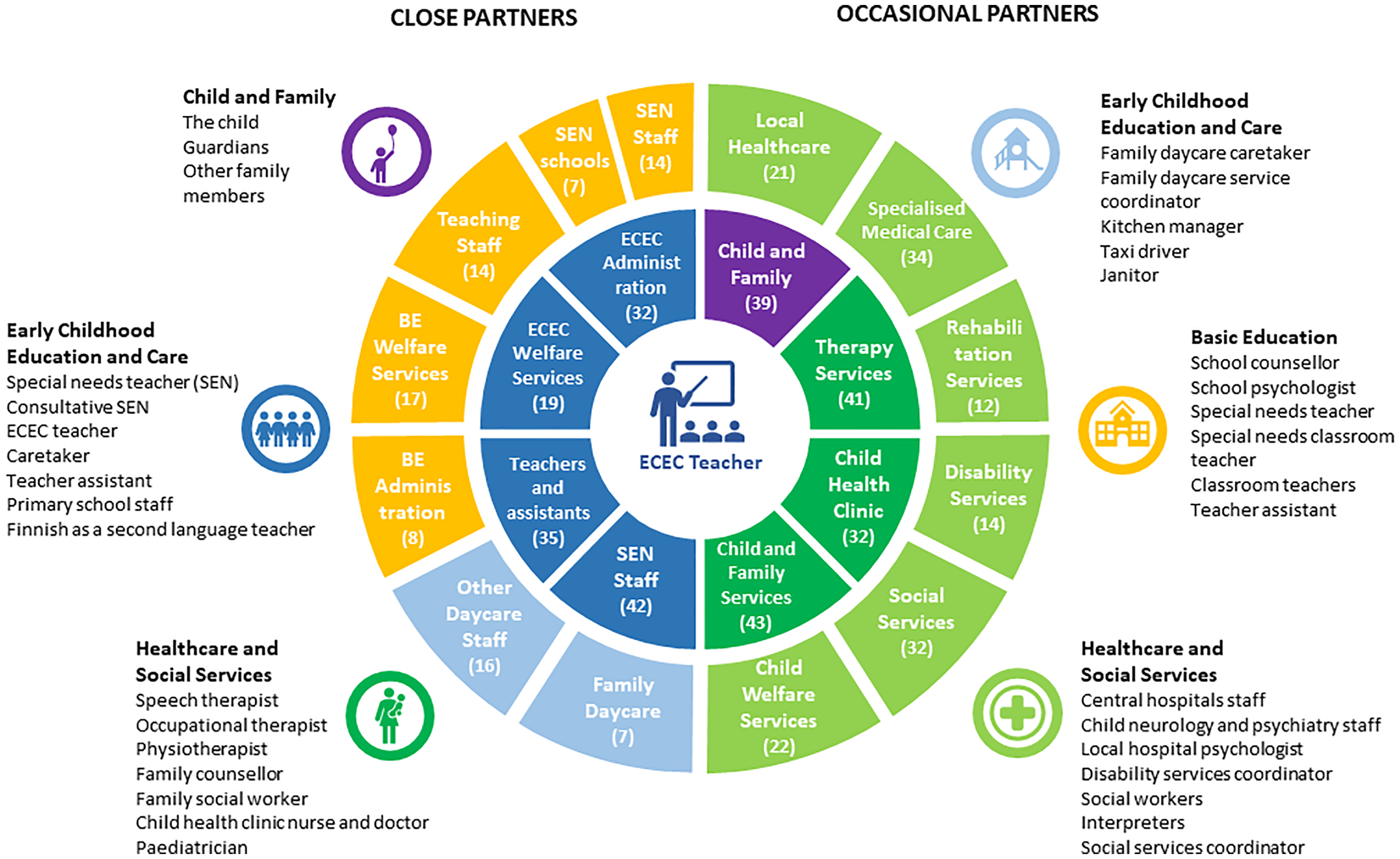
ECEC teachers’ partners in significant interprofessional support.
The inner circle around the teachers in Figure 1 consists of the categories of partners that were most mentioned on the maps and for which the partnership was deemed more frequent and established than with other partners. In these close partnerships, work was well organised in a way that the teachers had time to get to know the child and family as well as the professionals they shared the work with. Communication between all participants was deemed fluent. The teachers also expressed that they were highly dependent on shared learning, especially with their closest teaching colleagues and the child's therapists. The teachers experienced challenges in these partnerships when a lack of resources and a high staff turnover rate hindered meetings between the partners.
The furthest circle in Figure 1 consists of partnerships that were considered more infrequent or were scarcely mentioned. Partnerships with the professions and institutions in the outer circle were deemed functional when the partners had fluent communication and opportunities to share their knowledge, consult and learn from each other, and when the work followed an operational model or a plan. Meanwhile, the partnership was challenging when information exchange between the partners was unreliable, staff turnover rate was high or partners’ commitment to the shared work was not mutual.
Modes of significant interprofessional support in ECEC
Activities in significant interprofessional support focused on supporting the child and the family, planning and evaluating the support and developing shared work with other professionals. The main themes of child support were education, individual learning plans, physical growth and development, behaviour, mental health and medical and other rehabilitation. Support for the families consisted of collaboration with ECEC, case management, parenthood support, well-being and family interactions.
Interprofessional teamwork involved mostly daily and continuous communication, pedagogical planning and reflection among the different professionals working in the ECEC centres. In M2:4, the work was described in the following way: ‘to promote the learning of all the children in the group in the best way possible on their learning paths’. This highlights the importance of making inclusive pedagogical choices that benefit both the child group and the individual child, even in the context of significant interprofessional support.
The work in collaboration was not as frequent as teamwork. Collaboration partners had planned meetings, the professionals also visited the child group and the partners had the chance to reach out to consult with each other on more urgent matters. Teachers especially valued the therapists’ visits. M30:1 reads, It is great that the children's therapy sessions are held during their stay in daycare. We, the pedagogical professionals working in the child group, get direct guidance on how to work with the child in the context of the ECEC centre.
Therefore, the collaboration was considered to benefit teachers as well.
Other prominent collaboration partners were primary school teachers and special needs teachers, who visited children in preschool during the school year to get to know them before the start of first grade. The ECEC centres also collaborated with primary schools to plan preparatory education for children whose Finnish language skills and other abilities were not yet adequate to study in Finnish-speaking groups.
The collaboration procedures also aimed to give more structure to the shared work around the child's and the family's needs, and the goal was often to plan and evaluate the child's support and individual learning plans. The collaborations consisted of meetings between the professionals and meetings convened by the family with multidisciplinary representatives, such as special needs teachers, rehabilitation professionals, social workers or special care professionals.
Unlike interprofessional collaboration, cooperation in ECEC occurred mostly in consultative groups. The groups met face-to-face from every month to a couple of times a year, and the partners also included professionals further from the individual child and their needs, such as professionals from other municipalities and the local ECEC administration. Interprofessional networks, on the other hand, were local, area-based or nationwide groups for consultation, evaluation and development. These networks had predictable and more infrequent meetings, which were often held online. The network participants attended, for instance, in-service training together and ‘agreed on areas of development’ (M4:14) in which each professional would focus within their purview. Even though these networks were not described as forums to resolve issues related to a child's support, professionals’ consultation, evaluation and development still indirectly contributed to an individual child's environment and support through their teachers’ shared learning experiences and broader knowledge.
Characteristics of functional significant interprofessional support
The child and the family at the core of collaboration
Teachers mostly placed the child and the family at the centre of their networks, and meeting their needs was considered a starting point for the interaction among all the professionals in significant interprofessional support. This was rationalised as ‘the child's right to support’ (M19) and the ‘well-being of the child’ (M14). A teacher also described the family's or guardians’ role as ‘piercing through all the levels’ (M34) of support. Supporting the family was also seen as a central part of ECEC teachers’ and special needs teachers’ work (M5:44). Families needed support, for instance, to find the right social security services outside ECEC. Participation of the child required observing them and actively listening to the families regarding the child and which professionals should be involved in planning and organising the child's support. The guardians could also give teachers written permission to discuss the support in a consultative manner outside the child's network. Written permission to transfer information regarding the support was also required in case the child was transferred to another ECEC centre.
Interdependence between partners
Teachers described interdependence as supporting and helping each other. Support was considered important between professionals as well as with the child's guardians. In M22:1, having a common goal, working together and helping and supporting each other were depicted as drawings of a child, a family, two people walking in the same direction, a person standing on the palm of a hand, two people holding hands and a person with a hand on another person's shoulder. Understanding and supporting each other was considered crucial in providing the child with individually planned and implemented support. Trust between partners decreased in cases where common agreements were not actualised. For instance, in M12:55, COVID-19 was mentioned to have caused disruptions in meeting schedules, thus shaking the trust between partners.
Interdependence also involved the sharing of knowledge between professionals. For instance, if the child visited a therapist, teachers valued receiving information on the child's progress so that they could ‘use the same proved methods’ (M2:6) in the child group. Teachers argued that professionals with different professional backgrounds brought more expertise and knowledge to their work than they would have come across by themselves. Sharing knowledge was described as sharing ‘nuanced observations and tips’ (M9:11) and ‘ready-to-use materials and concrete advice’ (M30:1). Information sharing benefitted not only the child directly, but also teachers’ learning as professionals. The maps mentioned in-service training programmes and meetings as an opportunity outside the child’s networks to develop interprofessional cooperation and support systems in their own ECEC centres, municipalities and areas.
Regular, accessible and open communication
On their maps, teachers considered a regular exchange of information, easy access to consultation, openness and listening skills as crucial to communication in significant interprofessional support. Tools such as online meetings, having a contact person, using contact forms and having a consultation telephone line were found to improve the exchange of information.
Challenges in communication were experienced when up-to-date information from other professionals was lacking. This is described on M7:8: [O]ften, the children are taken into custody with short notice. If the child is a customer of child welfare services, the information from the other direction [child welfare services] does not necessarily find the ECEC centre unless we start asking questions ourselves.
Documenting the support progress was also considered a form of communication. On M31:1, a teacher described how even the transitional phases of the work were documented, for instance: ‘Still trying to contact a speech therapist’. This made it easier to follow up the work process for everyone involved. Openness in communication between professionals meant transparency in the documentation and trust that everyone is making decisions in the child's best interest. Communication also occurred in scheduled meetings among all the professionals. The goal of this kind of information sharing was mostly to ensure that the child's support would continue in a new ECEC group, centre or comprehensive education even if the professionals working with the child changed.
Well-organised and praxis-reflective work
Work was well organised when its common goal and the roles, responsibilities and tasks of those involved were clear. A well-organised beginning of the shared work and regular meetings were also important when working towards a common goal. This required making time for regular meetings so the support were not only reactive to the child's and family's current situation but also planned, as it was deemed necessary ‘evaluating how the plan is actualised’ (M35:1). Reflection on the shared work included discussing the goals, necessary attendees, priorities, possible challenges, whether the support resources were equally divided and whether the planned support was working for the child’s best interest.
When the work was well prioritised, teachers highlighted the role of their superiors in making the right decisions. A teacher argued on M8:22: ‘When they [superiors] have too big of a workload, and the work is not organised effectively, the overall quality of the work diminishes’. This implies that teachers experienced their superiors as having the power to create the necessary conditions for other professionals’ shared work, and that a barrier to this was the superiors’ excessive workload.
A shared history of collaboration
The teachers commented that getting to know the child and the family was essential for significant interprofessional support. The work was also considered easier when the participants had a shared history or knew each other previously. Teachers also counted other professionals’ knowledge of support structures in ECEC as an advantage to common work. One teacher argued, ‘Due to the children's significant and sustained support needs, our child group has a wide support network; thus, there is and will be a lot to cover’ (M9:7). Therefore, regularly spending time together made the work especially fluid with the children and colleagues they met daily at their ECEC centres, as opposed to other interprofessional partners.
The high staff turnover rate both in ECEC and in health and social services was considered a great challenge, as it was described as delaying the work due to confusion about roles and responsibilities, and to the time required to get to know each other's tasks. In some cases, the collaborations had also ‘withered out’ (M1:15) due to the high staff turnover rate. Therefore, the networks around the child were strengthened through a shared history of stability, effort and time spent together.
Structural factors as enabling or challenging collaboration
Teachers considered working at an ECEC centre to be a benefit, as they had time to get to know all the children and make observations during their daily work. In M8:22, working in a small municipality led to feelings of loneliness as the only ECEC special needs teacher, but was also considered beneficial since getting to know the other professionals was easier. Working in a small municipality could also be seen as a challenge in another way, as a teacher argued on M6:14: ‘The work could also become, so to speak, routine where the need for development is not seen [by the centre's administrators and other colleagues]’. Another structural characteristic determined by location was the lack of qualified ECEC teachers and special needs teachers, which was attributed to the lack of resources or, as expressed on M32:1: ‘areal segregation’. This lack of resources was connected to a heavy workload both at ECEC centres as well as for partners in healthcare and social services. To the child, this lack of resources implied long queues for different services and even disruptions of their planned support.
Discussion and conclusion
This study aimed to investigate Finnish ECEC teachers’ experiences of the characteristics of significant interprofessional support through written and drawn maps. Findings indicate that the teachers formed partnerships varying in frequency to engage the necessary professionals to meet the child's needs. The modalities of significant interprofessional support were similar to Reeves et al.’s (2018) teamwork, collaboration, coordination and networks, depending on the way the work was organised, which professionals were participating and with what intensity. Furthermore, six characteristics considered useful in significant interprofessional support were identified: (a) the child and the family at the core of collaboration, (b) interdependence between partners, (c) regular, accessible and open communication, (d) well-organised and praxis-reflective work, (e) a shared history of collaboration and (f) structural factors as enabling or challenging collaboration.
Sustainable interprofessional partnerships relied on interdependence, similarly to Prentice et al. (2019: 792): as ‘mutual commitment and trust', but also as ‘shared knowledge and learning'. Regular, accessible and open communication was highlighted in every form of significant interprofessional support. When communication was lacking, teachers indicated not being able to guarantee the child's support in the best way possible. A shared history between partners (Bronstein, 2003) allowed the fluid sharing of work, since all the participants were familiar with their roles and areas of expertise. A well-organised and praxis-reflective work required a shared philosophy (Levere et al., 2019); and teachers often experienced the work as functional when the partners shared an operational model that included common goals, clear roles, clear responsibilities and the measurement of process outcomes.
The results of this study confirm the existence of quality variations in the way significant interprofessional support is organised (Äikäs et al., 2023; Heiskanen et al., 2021; Pfeiffer et al., 2019) in Finnish ECEC. The work was deemed more functional when it was systematic and regular, similarly to student welfare groups in Finnish comprehensive education (Vainikainen et al., 2015), while the size of the municipality, the number of qualified staff in ECEC and the heavy workloads of both teachers and interprofessional partners determined the possibilities to plan and execute systematic significant interprofessional support together. However, the results also indicate that, while more resources in the Finnish ECEC are hoped for, the gaps in support can be improved by educating teachers, their interprofessional partners, leaders and policymakers on the identified characteristics of functional support. Increased knowledge would allow them to administrate a more coherent praxis by prioritising the professionals’ opportunities to get to know each other and their roles, share tasks and communicate efficiently, reach common ground, reflect on the outcomes and create operational models together.
The findings also implicate that significant interprofessional support in Finnish ECEC has specific frequent partners, such as therapy services, child health clinics and child and family services. Therefore, strengthening the connections with these partners can be additionally beneficial. The identified modes of interprofessional work vary in intensity; thus, it can be concluded that the work is not necessarily functional the more time partners spend together, as Ogletree et al. (2017: 224–225) argued. The time shared should be carefully planned according to the child's and the teachers’ support needs.
The ECEC and special educational needs (SEN) teachers in this study highlighted the participation of the child and family as central to successful support. Therefore, the partnerships in and characteristics of significant interprofessional support should be more closely studied from children’s and guardians’ perspectives to further strengthen the support praxis.
Limitations of the study
The current study’s results are limited to the context of significant interprofessional support in Finnish ECEC. Participants took part voluntarily in the in-service training programme in which the data were collected; therefore, there is the possibility of them overrepresenting a group that is more interested in the topic (Khazaal et al., 2014: 9). Another limitation of the study was that detailed information about the types of services from which participants were was not collected. The types of services in which the teachers collaborated were concluded by interpreting the language used on the maps. Some maps contained more detailed descriptions of the professions with which teachers collaborated, such as ‘family centre social worker’, whereas others described the partners at the institutional level, such as ‘social work’.
A third limitation of the study is the low rate of basic education partners mentioned, although the collaboration between ECEC and basic education is likely before children start first grade. The fewer mentions in this study can be explained by the low number of participants working with children aged 6 (i.e. those who will soon be starting first grade in Finnish basic education), meaning that collaboration is yet to begin.
The reliability of this study was assessed through member validation through interviews with two of the participants who had lengthy careers as special needs teachers in ECEC. Both participants were also engaged in projects aimed at developing support systems in their municipalities. They confirmed the first round of analysis and complemented the interpretation of results. The analysis process and preliminary results were also presented to other researchers in meetings and at a conference to gather more diverse insights.
Footnotes
Declaration of conflicting interests
The authors declared no potential conflicts of interest with respect to the research, authorship and/or publication of this article.
Funding
The authors received no financial support for the research, authorship, and/or publication of this article.
