




Abstract
Much of the discussion about parents’ positions in the early childhood education and care (ECEC) institution relates to the discussion of ECEC quality, in which parental involvement is a key factor. This article suggests that focusing on the sociomaterial nature of the reality, including quality, will help to furnish a more nuanced view of how parents’ positions within the ECEC institution are shaped. The concept of assemblage is used as a tool to examine how parents’ positions are produced in interaction between situational social, symbolic, and material elements related to local ways of organizing ECEC and families’ situations. The research material consists of interviews with parents of four-year-old (n=51) children. The analysis focused on the parents’ varying positions and how they are produced in sociomaterial assemblages. Four case families, each of which illuminates how a certain position within the ECEC institution is produced, were chosen to demonstrate the usefulness of the concept of assemblage in understanding the productive force of the interlinkage between families’ varying life circumstances and local ways of organizing ECEC. As a result, the opportunities for families to be part of the decision-making related to the organization of ECEC can vary greatly.
The present study explores the relationship between parents and early childhood education and care (ECEC) institutions. Parents’ relationships with education institutions have become a topic of policymaking and public debate. For example, the Organization of Economic Cooperation and Development's (OECD) 2001–2021 Starting Strong series stresses the importance of parental partnerships and suggests that ECEC can support in developing home-learning environments. In this discussion, it becomes the parents’ responsibility to ensure high-quality children's learning at home (Author 1 et al.), and parental involvement is thus conceptualized as a means of promoting academic success (Devlieghere et al., 2022). In sum, parental involvement seems to be politicized, and policy discourses aim to institutionalize the ECEC–family relationship by implying that “the parent as well as the child must be enlightened” (Schmidt and Alasuutari, 2023: 232).
Much of the discussion about parents’ positions in the ECEC institution relates to the discussion of the quality of ECEC, in which parental involvement is a key factor. Even though parental involvement can refer to practical activities such as participation in projects, volunteering and attending in events, in this article, the concept ‘parental involvement’ refers to positions parents receive in relation to ECEC institution. ECEC is said to be an investment that benefits both individuals and society (Heckman, 2011; MacEwan, 2015). There is a consensus among parents, professionals, and policymakers that quality is crucial for early education so that its positive effects, such as children's development and future educational attainments, are realized in practice (Cornelissen et al., 2018; Krieg et al., 2015; Melhuish et al., 2015; Taggart et al., 2015). In particular, this discussion highlights the positive, long-term outcomes for children from economically disadvantaged positions who benefit from high-quality ECEC (Barnett, 2010; Bakken et al., 2017; Sylva et al., 2004). Devlieghere et al. (2022) point out how in the scholarly literature, parental involvement is mostly conceptualized as a means to secure children's learning outcomes and academic success and call for a shift from instrumentalizing parents toward a more diverse and nuanced discussion on the relationship between ECEC and parents.
Previous research has examined the relation between parents and ECEC from various perspectives. For example, researchers have examined parents as decision-makers in marketized ECEC (Chen and Bradbury, 2020), and the different positions that parents receive in policy documents (Schmidt and Alasuutari, 2023). This article combines these approaches in a novel way. We explore the positions posed for parents in more or less marketized ECEC practices. Parents’ positions in defining ECEC quality vary depending on which paradigmatic position is taken in defining quality. Positivist discourse has dominated research on the quality of ECEC (Fenech, 2011), and understanding the position of a parent as someone in need of enlightenment resonates with this paradigm. Dahlberg et al. (2013) argue that quality needs to be spatially and temporally contextualized. This quality paradigm highlights more reciprocal and symmetrical relationship between teachers and parents (e.g., Tobin, Adair and Arzubiaga, 2013). We suggest that expanding the application of this paradigm by focusing on the sociomaterial nature of the reality, including quality, will help us gain an even more nuanced view of how parents’ positions in the ECEC institution are shaped. This article contributes to this discussion and examines how parental involvement in ECEC is constituted in everyday practices. We use the concept of assemblage (Deleuze and Guattari, 1987; DeLanda, 2006) as a tool to examine how parents’ positions are produced in interaction between situational social, symbolic, and material elements related to local ways of organizing ECEC and families’ situations.
Our emphasis on the sociomaterial production of parental involvement directs our focus to the everyday realities of families, from which they weigh whether the service is meaningful for them or not. The concept of assemblage (Deleuze and Guattari, 1987; DeLanda, 2006) enables us to focus on such everyday realities by examining how parents’ positions in relation to ECEC are shaped. An assemblage is not a thing but, rather, a process whose elements (e.g., buildings, people, policies, and culturally structured norms produced in speech) come together over time, work together to produce certain kinds of relations between parents and the ECEC institution, and will eventually fall apart. Thinking with the concept of assemblage does not aim for an understanding of its (i.e., parents’ relationship with the ECEC institution) essence but rather looks at how an assemblage works to produce something—here, parents’ positions in the ECEC institution.
Parental involvement in ECEC in Finland
The empirical material of this study was generated in the Finnish context. Therefore, contextual information concerning ECEC in Finland and, in particular, parental involvement in ECEC in Finland is needed. The relationships between the ECEC institution and parents in Finland must be seen in the context of municipalities’ large degree of autonomy. Both the national administration and municipalities have roles to play in the Finnish early childhood education (ECEC) system. In the Nordic countries, municipalities are obliged by law to provide basic services to their residents and ensure the quality and supervision of such services. Municipalities can decide independently how to organize these services (Kröger, 2011). Statutory duties include education and ECEC, which must meet statutory requirements (Act on ECEC, 2018). In Finland, every child has a subjective right to full-time ECE. All children under school age have the right to publicly organized ECEC.
Municipalities coordinate the placement of children in ECEC. ECEC is organized for children in ECEC centers, group family daycare, and family daycare. Alternatively, families can apply for an ECEC place directly from a private ECEC or family daycare provider if these services are available. The fee charged for municipal ECEC is tied to the family's income, the number of family members, and the number of hours the child spends in ECEC per week. Private ECEC centers’ customer fees are publicly subsidized by income-related vouchers (plus possible add-ons) or through the private home daycare allowance, in which case the customer fees may be higher. The private sector accounted for approximately 19% of the provision of ECEC in Finland in 2020 (FIfHaW, Citation 2021). Every six-year-old has had the right to free pre-primary education before the age at which they start compulsory schooling since 2000 (Government proposal 91 1999). In total, 35% of children under the age of three and 87% of children aged three−five attended ECEC in Finland in 2021 (Statistics Finland, 2022).
Secondly, in understanding the Finnish context, it is worth noting that parental involvement is highlighted in the Finnish ECEC steering documents. The Finnish Early Childhood Education Act legally entitles parents to take part in developing ECEC services. According to the Early Childhood Education Act (540 / 2018 §20): A child's parents or other persons who have custody of the child shall be given an opportunity to participate in and influence the planning, implementation and assessment of the early childhood education and care of their child. Children and their parents or other persons who have custody of the children shall be provided with regular on-site opportunities to participate in the planning and assessment of early childhood education and care.
Thus, parents or guardians have the right to participate in ECEC regarding their own child, but also in the planning and evaluation of the activities of the center and organization of ECEC. The aim of the law is to support the child's parent or other guardian in the child's upbringing, but what this means in practice is left to be resolved locally. The question thus arises of how parental positions in ECEC are shaped by local ways of organizing ECEC.
Assemblage as a tool for analysis
To better understand the ways in which local ways of organizing ECEC shape parental positions in ECEC, we make use of assemblage thinking. Applying assemblage thinking, inspired by Deleuze and Guattari (1987), we pay special attention to the everyday aspects of the relationship produced between parents and the ECEC service. Our approach can be described as “thinking with theory” (Jackson and Mazzei, 2013). The premise of the article is that quality is not just a technical matter that everyone understands in the same way. Rather, it is political, philosophical, and ethical at the same time (Dahlberg et al., 2013). Expanding on this view, we assume that parents’ relations to ECEC quality are formed in complex interactions and as interrelated combinations built, among other things, from family politics, physical environments, local regulations, and cultural norms.
Deleuze and Guattari's (1987) concept of assemblage and DeLanda's (2006) interpretation of it provide a framework for examining the relationship between the micro- and macro-levels of how parents’ positions in the ECEC institution become produced in practice. The individual elements do not explain the assemblage; instead, what the assemblage produces depends on the interaction between the parts (DeLanda, 2006, 2016). Thus, an assemblage is not a thing or object that exists in the world. Each assemblage has features that simultaneously enable and constrain its components, which also work together and influence each other in a complex and multidirectional way (DeLanda, 2006). Parents’ relations to the ECEC institution appear to parents in a certain way depending on what kinds of factors are connected to the assemblage.
To better understand what an assemblage is, we need to look how it works (Deleuze and Guattari, 1987). For example, the elements of the assemblage producing parents’ positions in the ECEC institution (e.g., buildings, staff, and policies) come together over time and will eventually fall apart. Jackson and Mazzei (2013: 262) describe the action thus: “an assemblage isn't a thing—it is the process of making and unmaking the thing. It is the process of arranging, organizing, fitting together.” To capture this movement, we need to pay attention to how things are related to each other and connected to other assemblages. In the following sections, we explore how parents’ relationships to the ECEC institution are formed in complex interactions and interrelated combinations built from, among other things, family politics, physical environments, local regulations, and cultural norms (DeLanda, 2006).
Research inquiry
The concept of assemblage leads us to examine the production of parents’ positions in relation to the ECEC institution from the perspective of families’ lives. It allows for a multilayered reading of the complexity of social life. The research material has been collected as part of CHILDCARE research project funded by Strategic Research Council (SRC), Academy of Finland (2015–2021), which examined the Finnish ECEC system from the perspective of equality. The research project was carried out as a multi-method follow-up study with parents of one- and four-year-old children. The family leave model that was implemented during the period of the research was a key criterion for defining the target group for the survey. The research material used in this study consists of interviews with parents of four-year-old (n=51) children. The interviews dealt with ECEC arrangements and families’ background factors. The interviewees were recruited from ten municipalities (from 309 municipalities in Finland), which were selected on the basis of their geographical location (population and economic structure), the childcare allowances they offer, and the ways they organize ECEC. The interviewees were purposefully recruited among survey respondents. The survey concerning decisions on childcare and ECEC arrangements was sent to all guardians of children born between 2014 and 2015 in these ten municipalities. Each respondent could express their desire to participate in an interview on the subject. The interviewees were selected paying attention to the variation of the situations of the families in terms of their childcare solutions, family compositions, and parents’ education and income levels. However, a limitation is that less-educated, and more socio-economically disadvantaged parents are underrepresented in our data.
The interviewed guardians were contacted again when the children turned four years old. In this article, we use the material collected during the follow-up interviews (n = 51). The thematic interview framework consisted of questions about each family's everyday life and childcare solutions and their justifications, how they reconciled work and family commitments and made childcare-related decisions in the family, and the family's prospects (see also Terävä et al., 2018.) The interviewed parents were asked to reflect on the childcare arrangements in their families, working lives, family leave, and parenting. While doing so, they also talked about their relations to ECEC and the sociomaterial conditions in which these relations became produced.
Using Jackson and Mazzei's idea of thinking with theory (2013) the analysis proceeded in two phases (see e.g., Author 1 et al.). The first phase focused on the varying positions of parents in all of the 51 interviews and the second on how these positions were produced in sociomaterial assemblages. Since assemblages always work to produce something, the analysis aimed to unravel what the assemblage does to the parents’ positions. In practice, this meant interrogating the data with questions such as how parents describe their relations to the ECEC institution and what sociomaterial elements are connected to the events they describe. During this process, we strove to trace the whole in which the relationship is formed. In the analysis, we paid attention to both the material (e.g., buildings, food, and vehicles), social (e.g., the preferences described by parents), and policy elements (e.g., how ECEC was organized in a particular municipality). The purpose of this phase was to identify the elements of the assemblages and their relations. This helped us in understanding how parents’ positions were produced in sociomaterial assemblages. In this article, we present four cases that illustrate what happens to parents’ positions when certain elements become entangled. The cases show the productive power of the assemblage but do not categorically describe all the positions appearing in the material. The cases were selected to illustrate the different ways of organizing ECEC between and especially within the municipalities. In the section that follows, we present these cases and describe how certain relationships to defining ECEC quality are shaped and how they affect a parent's position in relation to the ECEC institution.
To protect the anonymity of the families, some detailed information regarding, for example, labor market status has been slightly modified.
Parents’ positions in the ECEC institution
In this section, we introduce four case families. Examining these cases will demonstrate how varying positions in the ECEC service become produced in interaction with local ways of organizing ECEC, sociopolitical contexts, and families’ unique life circumstances. We have named the positions that could be identified in our cases informed actor, service user, outsider, and involved citizen. The examples highlight the productive power of assemblage and the concrete differences in the parents’ positions depending on the families’ situations and local ways of organizing ECEC in the municipalities of residence. The case families are from two different municipalities: the first three live in the same big municipality, and the fourth lives in a small municipality. This distinction is important as in Finland, the formal responsibility for childcare provision rests with municipalities, and they have wide autonomy in organizing these services, as explained in an earlier section. Municipalities vary in terms of the number of families with children, demographic change, and financial situation. Thus, the practical solutions for organizing ECEC services vary. For example, private ECEC services are, in general, offered more often in big municipalities, which have a large enough population base for private business (Finnish Education Evaluation Centre, 2019). In small municipalities, the services are typically mainly publicly provided.
As previously stated, the concrete elements of an assemblage are its recognizable parts, but an assemblage is de facto defined by its external relations and occurs only once at a given moment (Deleuze and Guattari, 1987). Thus, the following section aims to examine how the positions of the case families become produced in sociomaterial assemblages that include the way in which ECEC is organized in these two differing municipalities.
Informed actor
The Aalto family comprises two adults who work as teachers and one child. They live in a big municipality, where many different ECEC options are available, and there is strong support from policymakers at the local level to advance market-oriented service provision, for example, through zoning policies or “starting grants” (Ruutiainen et al., 2020). Parents can choose either municipal or private ECEC for their child, but the fees may not be the same for both types, especially for low-income families. Parents can apply for a municipal service voucher granted by the municipality or a private daycare allowance from the Social Insurance Institution of Finland. The municipality facilitates the application process by providing extensive information on municipal websites, and each ECEC center has a homepage. In addition, the municipality organizes ECEC service guidance on application-related matters for both public and private ECEC services. The municipality aims to organize an ECEC place for a child close to the family's home, but this aim is not realized in all neighborhoods. The mother of the Aalto family describes the process of applying the ECEC place: Well, I read through all the ECEC plans. First, I noticed that private ECEC centers do not offer (services), and then I don't know any family daycare workers in this area, so it would have been a bit of a search. Then, I read through the ECEC plans of ECEC centers that are strategically located. But at the time, at least, I couldn't think that I needed any such extra pedagogic emphasis, so it was quite easy to rule them out. I eliminated the ECEC centers that somehow haven't written their ECEC plans openly or the whole plan couldn't be found, then I just ranked them with a simple ranking.
The parent describes the content of ECEC that is important for her and explains that a well-described ECEC plan on the website is proof of such content. The early education plan is part of the assemblage, but so is the parent's educational background, as she has teacher education, and the resources she brings to finding and assessing these documents become intertwined in the situation. The concept of assemblage leads us to look at what a certain kind of assemblage produces. Here, the parent has the resources and abilities to negotiate with service organizers and producers. She is an active actor, even if the desired outcome is not certain: Here, it is not always guaranteed that you will get into the ECEC center you have applied for. Yes, they called me too and asked if other areas would be suitable as well, since there is so much pressure on the ECEC centers in our area. And then I had to think quickly on the phone about which other areas there could be. Fortunately, the place was arranged.
The parent describes the challenges posed by the local way of organizing ECEC in the big municipality: ECEC centers are full, and parents’ wishes are not always met. The parent receives a call from the service guidance, inquiring about the family's other options if there are no places available in the preferred ECEC center. In this situation, the parent is expected to know the system and the various options open to them. The parent described this situation as “sudden” because she had to name the alternative options immediately over the phone. In the end, her child received a place in the preferred ECEC center.
The concept of assemblage leads us to see how the local way of organizing ECEC, which highlights the possibility of choosing, entangled in this case with the parent's educational resources, the content of ECEC, and the family's preferred mode of transportation. As a result, the parent was positioned as an informed actor in relation to the ECEC institution. When the way in which ECEC is organized in the municipality is connected to the assemblage, an environment of choice is built for parents. In these conditions, the available information and different options are of great importance. In such a system, rational decision-making is underlined. For example, a lack of information could create uncertainty for a parent, but in the case described here, the parent had the necessary skills, knowledge, and resources to search for the necessary information. This assemblage produces parents as informed actors in the ECEC institution.
Service user
The Laine family lives in the same municipality as the Aalto family and comprises two working adults and one child. The first time the family applied for an ECEC place for the child, they were allocated a place at an ECEC center located at some distance from the family home and in the opposite direction to the parents’ workplaces. The parents applied for the child to be transferred to a center located near the family home, and the following year they were allocated a place in the ECEC center of their choice. In this assemblage, the location of the ECEC center plays a central part: Of course, there would have been other options. We probably had other options there, but this (ECEC center) is definitely the best of the options we had. Yes, the location was probably the most important thing, that it's so close to home means it's very handy.
The parent describes how there would have been other ECEC options in the municipality, but they were disregarded because the most important thing for the parents was that the ECEC center was located close to their home. A good location enables short transitions between their home and the ECEC center, which saves the family time and makes everyday life smoother. So, in this assemblage, the location and the smooth everyday life it enables play central parts: It made it much easier when we got a place in that second ECEC center, as sometimes we have had two cars and sometimes one car. And at the time, when we were there in the first ECEC center, we had one car, and that practically meant that my wife went either by bus or by bike, and then I took the child to ECEC by car in the morning and picked up the child from ECEC, which extended my day quite a bit, and there was no flexibility in my working hours, which made it really much more difficult. Sometimes, if absolutely necessary, I went by bike and my wife took the car.
The parent's previous experience with the system was that the family's wishes were not met, and as a result everyday life became difficult. This experience becomes part of the assemblage that produces the position of service user for the parent. The parent is in the same environment that highlights choice in ECEC markets as the one described above by the Aalto family. However, the parent's negative experience as a choice maker gave him a passive position in relation to the service.
The following excerpt describes how the parent identified various factors that, in principle, are important to him in ECEC, but which become less important as the location becomes prioritized: Yes, they do their best. They usually organize trips on a weekly basis. It has been a little less often now, but they’re probably doing their best. But for sure, if I were to start a private ECEC myself and I wanted it to be really good, it would probably be different. His [ECEC center] is a bit of an old building and has a few other things wrong with it, but nothing directly objectionable. So, it's very basic. I think it's important that the ECEC staff is good, and they have been really good so far. After all, the child will probably get used to the physical environment, if it's not dangerous to health in any way.
The parent describes the qualities of what he considers markers of good ECEC. They are related to the material environment, such as buildings, and constructions of a good life and childhood, including safety and the possibility of stimulating activities. However, not all these things are fully realized in the current ECEC center. The parent's previous experience with the system becomes plugged in to the assemblage, making the other elements secondary. In this assemblage, the parent's position becomes produced as a user of the service who lacks involvement in actively influencing the content of the service. The market-oriented model in the production of ECEC services requires an active role in selecting the service but one that does not necessarily influence its content. However, as the location is important for the family, this father cannot really take up the possibility of being involved by making a customer choice. As a result, his position in the institution ends up being passive.
Outsider
The next case concerns the Niemi family. Their situation is as incompatible with how ECEC is organized in their municipality of residence as that of the Laine family. The Niemi family comprises three children under school age and two adults. The mother is a student and needs the family car to commute to her place of study. The father of the family does not participate in the labor market. As neither of the parents is currently in employment, the family has financial constraints. The parents’ experience of the family's financial constraints, the distance between home and the mother's place of study, and having three children that they want in the ECEC center are rigid and restrictive elements of the assemblage. These restrictive elements shape the parents’ relationships to defining ECEC quality by putting some options outside the family's reach: There is a private ECEC center right next door. And the reason we went to that municipal ECEC center is financial. This private ECEC is significantly more expensive.
There is a private ECEC center close to the family's home, but it was not an option for the family, because they would have had to pay more for private than public ECEC. For low-income families, in particular, the price of private ECEC can be much higher than that of publicly produced ECEC, despite subsidies. Since the mother of the family needs a car to get to her place of study, they prefer an ECEC center located as close as possible to the family home. For the same reason, they prefer to have all their children enrolled in the same ECEC center so they can transport the children without a car. The childcare solutions are linked to what kinds of costs the family incurs from using the service. Private ECEC is not an option for the Niemi family because, unlike public ECEC, it may incur additional costs. When the system of the municipality of residence is connected to the assemblage, it creates an environment of choice in service provision, but one in which the assemblage of this family does not allow it to participate. In fact, on the contrary, it positions the family as an outsider.
The parents also talk about an incident in the ECEC center that has affected how they cooperate with the ECEC staff. In the following excerpt, the parent describes a situation where the parent and ECEC staff had conflicting views of the family's situation. The parent says that the staff overreacted in this situation without any reason. In this case, the staff member's concern did not lead to any further actions or support. However, the event changed the parent's attitude toward the ECEC staff: I said [to the ECEC staff] that I won't cooperate with you at all. If I had the power and the possibility, my children would leave this place immediately. But I have been forced into this situation, and I will not deal with you.
The parent describes how the conflict with the ECEC staff made him dissatisfied with the ECEC center. The parents would prefer to send their children to another ECEC center. Yet, he describes how their situation is such that they cannot choose another center. Instead, he avoids communicating with the ECEC staff any more than is necessary. This produces an outsider position in relation to the service.
Involved citizen
Unlike the cases described above, the Pelto family lives in a small municipality where there is a limited number of ECEC options. There are no local private service providers to choose from, and thus parental choice is not emphasized. Yet, the family describes the system as flexible, and it seems to enable the individual wishes of families to be considered. The municipality's service organization is small. The municipality's website has information about the municipality's ECEC places, and the units have their own webpages.
The Pelto family consists of one child and two adults, one of whom is employed, and one is not. The mother cared for the child at home with the help of the child home-care allowance until the child turned three years old. She had a stable labor market position and has returned to the job she left on parental leave when her child was born. The mother had the legal right to work–life flexibility even after she returned to working life. In Finland, an employee can work shorter working hours to take care of a child until the child finishes the second grade of primary school. Of course, the starting point would be that since he is an only child, he would have company of his own age, and everything related to daily activities and everything to support his development. At the age of three, he was very social, so you didn't have to think so much about how he might manage there. And the ECEC started well, so then we thought it was a really good solution. The back-up plan was that if the child had a hard time at daycare, my husband, who is not working, would basically have been able to take care of the child. I would probably have considered shorter working hours, maybe six hours or even less, if the ECEC had turned out to be a bad choice for him. But he was enthusiastic about the ECEC from the beginning, and there have been no problems.
The parent describes how the content of ECEC and the social relationships it enables for the child are important to her. The construction of the needs of the child is a central element in this assemblage. The family was ready to care for their child at home if for some reason the child had not enjoyed ECEC. The parents’ desire to act according to the child's needs is made possible by their work situation, in which case it also becomes part of the assemblage. Below, the parent describes the ECEC application process: Then, we just announced well in advance, in the fall, when we knew that the start of ECEC was coming in January, that there would be a need for ECEC starting from this time. They contacted me well in advance and told me what the group would be like, because there were slightly older children in the group, and they wondered if he would do well in that group, since he had just turned three. But then we threw the ball to the ECEC staff, that if they think that a child, who might still need a little help with food and toileting, can be in the group, that's fine with us. And then it happened that we found out well in advance that we would get a place at that nearby ECEC center.
The parent describes how the process progressed and how the service organizer asked for the parent's opinion about the day-care place offered. The parent was consulted, but she describes how she wanted to leave the final decision to the professionals, whose expertise she obviously trusted. In the end, the family found out that the child had received a place at a nearby ECEC center, which she describes as a good solution for the family's everyday life.
The local way of organizing ECEC in a small municipality plugs into the assemblage and produces a citizen-based position for the parent. In a small municipality, the ECEC system is strongly based on public services, where the user of the services adopts the position of a citizen. In this position, the parent has little choice, but she gets the service she needs and describes an experience of having influence. The parent's trust in the professionals can be understood as based on the fact that in Finland, people are used to outsourcing responsibility to the public sector, which takes care of citizens. Citizenship as a position traditionally includes a functional aspect, namely, participation. The parent's involvement is therefore realized without the parent being active herself. The concept of assemblage enables us to see how parental participation becomes possible when connected to the local way of organizing ECEC that enables it. In the small-town system, the parent becomes produced as a competent citizen whose point of view is relevant in dialogue with those of others.
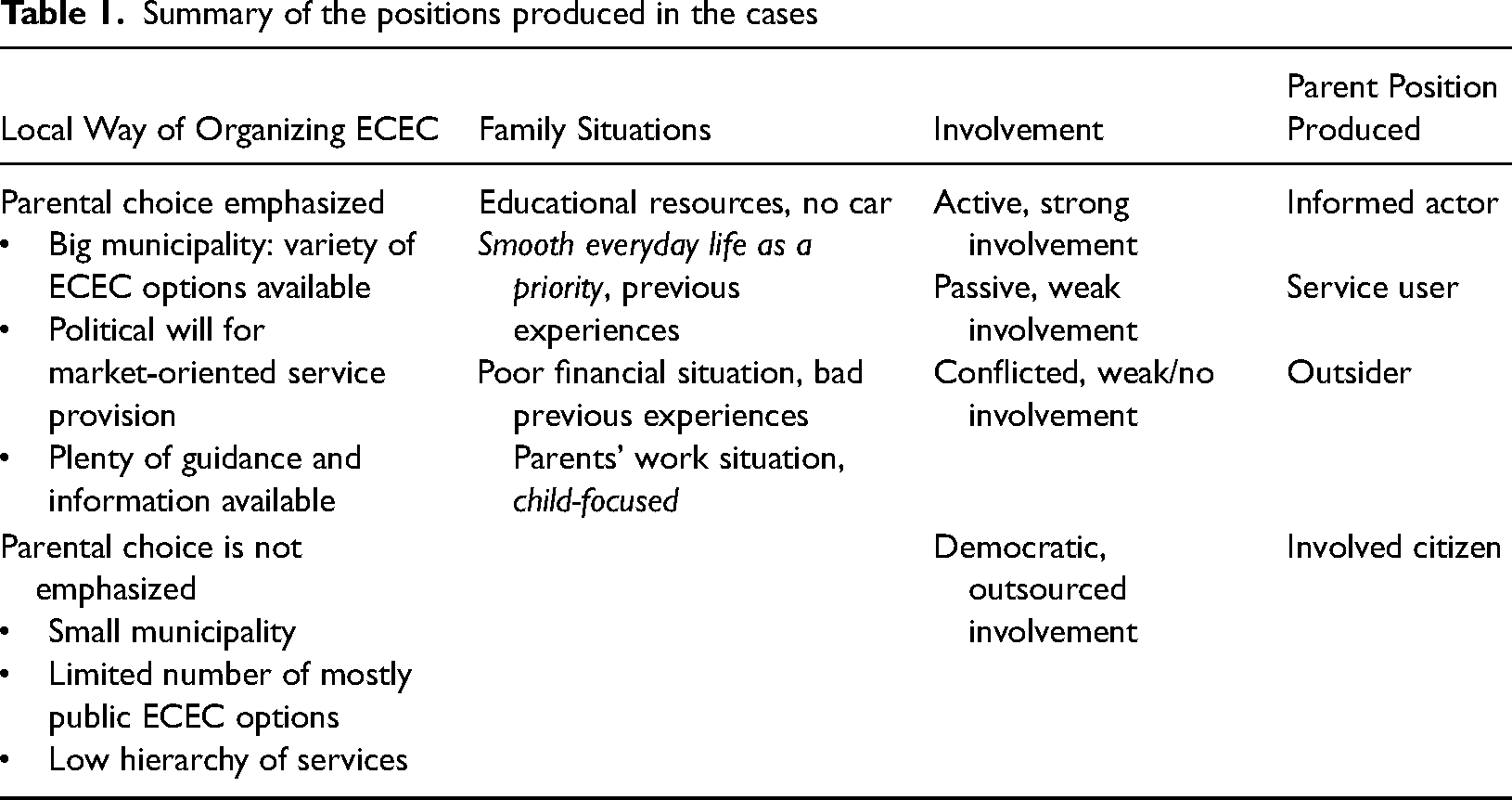
As we can see from the cases and summary (Table 1) above, the local way of organizing ECEC sets different requirements for parents and changes the implementation of parental involvement. In the municipality where parental choice is emphasized, parents’ positions vary depending on the families’ situations. Instead, in the municipality where parental choice is not emphasized, parents’ positions are more consistent. The concept of assemblage (DeLanda, 2006) led us to examine these cases in a way that illustrates how the ECEC system becomes connected with various sociomaterial elements, forming an assemblage that produces a certain position for parents within the ECEC institution. In sum, we can state that freedom of choice both changes the parents’ positions in relation to the institution and makes it possible or impossible for them to participate in it. When the local way of organizing ECEC is built on the principles of the market model, it requires activity and responsibility from the parent. In this type of sociopolitical context, the parent must make the solutions themselves, and the responsibility for the solutions is imposed on them. Correspondingly, in a small municipality, the services are mainly provided publicly and there are few options to choose from; consequently, the parent's own activity or abilities are not relevant to their position in the same way.
Summary of the positions produced in the cases
Discussion
In this article, we sought to demonstrate how parents’ positions in the ECEC institution become produced in sociomaterial assemblages. The concept of assemblage (DeLanda, 2006) led us to examine the production of parents’ positions in relation to the ECEC institution from the perspective of families’ everyday lives, from which their relationship with the institution is built. Firstly, this study shows how parental involvement is shaped by various sociomaterial factors. Sociomaterial assemblages are interesting because of their productive quality. Secondly, the concept of assemblage offers a tool to better understand the varying positions parents occupy in relation to the ECEC institution. The concept enabled us to view how parents’ involvement is constituted as a combination of the varying situations of families and the local way of organizing ECEC.
The study suggests that parents’ positions are constituted in relation to, among other things, family policies, the physical environment, the local logics of organizing ECEC, and practices and cultural norms related to child rearing. In a big municipality with market-oriented service provision, the positions of parents varied depending on the families’ situations. Correspondingly, in a small municipality, the parents’ positions were produced in a fairly coherent manner. Hence, families’ opportunities to be part of ECEC decision-making can vary greatly. Parental involvement in ECEC has been emphasized in policy discourses: it is highlighted that high-quality ECEC requires an equal partnership between parents and ECEC. Yet, our study shows that the way in which ECEC is organized shapes parents’ relationships with the ECEC institution.
Earlier literature concerning parents’ positions in relation to the ECEC institution paid attention to the tendency to institutionalize the ECEC–family relationship by implying that parents must be enlightened so that they can best support the growth of their children (Schmidt and Alasuutari, 2023): the parents’ responsibility becomes ensuring high-quality children's learning at home (Author 1 et al.), and parental involvement becomes conceptualized as a means of promoting academic success (Devlieghere et al., 2022). Our approach enabled us to contribute to the discussion by showing how parental positions become produced in connection to the way in which ECEC is organized. In sum, freedom of choice both changes the parents’ positions in relation to the institution and makes it possible or impossible for them to participate—the service is amenable only to certain families. When the system is built on the principles of the market model, it requires “know-how” and an active approach from the parents. Correspondingly, when the ECEC system does not lean on the market model, parents’ positions vary less.
Without examining the production of the relations between parents and the ECEC institution, we might fail to notice those sociomaterial constellations of ECEC that might reinforce social inequality. A parent's relationship with ECEC institutions produces their place in society on a macro-level. The influence of social and material factors on parenting must be recognized to fully understand the everyday reality of families. Are we really interested in the perspective of parents? Who is eligible or qualified enough to participate?
In addition to the different family situations, the positions of parents in ECEC are produced differently depending on the ECEC system of their municipalities of residence. For this reason, it is important to consider what the large degree of municipal autonomy might mean from the point of view of parents. The solutions reflect both the parents’ educational backgrounds and labor market statuses as well as the families’ municipalities of residence and the opportunities they offer (Grogan, 2012; Karlsson et al., 2013; Vandenbroeck and Lazzari, 2014). The ideal of the freedom of choice challenges the traditional understanding of the concept of citizenship and parental involvement (Barrett and Edgerton, 2016). Inequality is a risk closely related to freedom of choice (Newman and Tonkens, 2018). Freedom of choice is supposed to improve the quality of services, but it requires the ability and desire to make choices that not everyone wants to make, or the possibility of choice does not exist. For example, well-educated people often know how to express their needs more clearly because they are used to working with professionals. Those in a good socioeconomic position are familiar with choice and utilizing service networks; in other words, they are used to operating in a choice environment.
We do not aim to claim that the positions we identified conclusively describe the positions of all parents. For example, in our data, we did not identify parents talking about the institutionalized ECEC–family relationship identified in other studies based on document analysis. There are limitations to the material used in this study; for example, less-educated parents and ethnic and language minorities are underrepresented in the material.
Therefore, in order for the ideals of the parental partnership emphasized in the OECD's Starting Strong series to be realized, it should be ensured that all parents, regardless of their family situations or places of residence, have the same opportunities for parental cooperation.
Footnotes
Funding
The authors received no financial support for the research, authorship, and/or publication of this article.
