




Abstract
According to the latest research in both arts education and childhood studies, young children's agency is relational, entangled and negotiated. However, in early childhood visual arts education, modernist practices emphasising the independent and self-expressive child–agent are still recognisable. In this article, early childhood artistic activities are seen as a shared venue for interaction, social exchange and joint meaning-making, thereby providing a specific forum for displaying agency. Informed by conversation analysis, we explore discussions between 14 preschoolers and a researcher on contemporary art and children's self-authored photographs in a workshop in an early childhood education and care centre. By examining our discussions as turn-by-turn procedures, we identify children's displays of agency. The findings illustrate children's agency as a multifaceted and complex interactional phenomenon based on verbal and non-verbal communication and demonstrating both imaginative, progressively oriented talk and modes of resistance. While a shared playful stance appeared as a suitable means to approach art/creative photographs, it simultaneously became an essential interactional resource for inviting and promoting children's agency. Collaborative play with photographs provided an interactional space in which the fixed child/children–adult binary could be questioned and different types of agency were available for both children and the adult.
Introduction
Recent research in both childhood studies and early childhood visual arts education has highlighted the entangled, relational and collective nature of young children's agency (Esser et al., 2016; Kind, 2013; Osgood and Sakr, 2019; Schulte and Thompson, 2018). Yet, a modernist discourse still has a strong hold in early years’ art pedagogy. Emphasising the autonomous and self-expressive child–agent, it positions artmaking as a child's private affair (Kind, 2018: 8; McClure, 2011). These solitary and independent artistic processes of children have received wide interest in research, especially within the dominant developmental paradigm (Sakr and Osgood, 2019). However, there are surprisingly few studies on young children experiencing and viewing art, with a focus on their collective involvement with the visual culture surrounding them.
Most existing research on art reception has concentrated on assessing children's pictorial competence and aesthetic appreciation skills in accordance with aesthetic-cognitive developmental stages, visual literacy, and learning values as set by museums and other educational institutions (Danko-McGhee, 2004; Deetsch et al., 2018; Parsons, 1987). In line with this research, young children tend to prioritise artworks’ subject matter and prefer realistic pieces relating to their personal experiences. The aforementioned research also implicates children as becoming art audiences whose rudimentary visual skills, perceptual awareness and descriptive power of language need developing. Moreover, only limited research (Bell et al., 2018; Semenec, 2017) explores young children as audiences of contemporary art. These few studies highlight children as innovative meaning-makers and risk-taking players when encountering prominent contemporary images. Recent research on young children's art encounters in a museum context describes children's meaning-making as a multimodal process, thereby, focusing on the body, movement and place (Hackett et al., 2020). Yet, more inquiry is needed to broaden our understanding of children's agency as producers, users and interpreters of visual culture.
In this article, we explore children viewing and discussing contemporary art and children's self-authored photographs. We combine the post-developmental discourse in childhood art (Sakr and Osgood, 2019) with the sociocultural view of arts education, which highlights social processes and human/non-human relations within or influencing children's artistic endeavours (Thompson, 2019). Thus, rather than focusing on individual children's developing skills in experiencing art, we decipher art as a social practice (Kind, 2017), providing a potential forum for both children's and adults’ agency.
To promote children's agentic experiences in early childhood education and care (ECEC), it is essential to understand how these experiences unfold, focusing on the kinds of strategies that children and adults apply in their verbal and non-verbal conversational turns and how that interaction is collectively co-produced (Bateman, 2015). Thus, we examine agency as an interactional phenomenon among 14 preschoolers (six-year-olds) and a researcher (first author) in a photography workshop in a Finnish ECEC centre.
Understanding agency as a phenomenon unfolding in interaction, we explore conversations about photographs. Using methods informed by conversation analysis, we reflect on the child/children–adult relations during the discussions. By examining turn-by-turn trajectories of talk, we aim to make explicit what kinds of interactional resources and practices the children and the researcher employ in their conversational turns and the extent to which the children's agency unfolds during these discussions.
Agency as an interactional endeavour
We draw on a premise of childhood studies regarding children's agency, considering children as social actors influencing their own lives and the lives of those around them and as relevant and valuable meaning-makers (James and James, 2012; James and Prout, 1997).
Although children's agency is a well-established academic concept, it seems to be an ambiguous term that is often used without a clear definition (Esser et al., 2016: 5; Spyrou, 2018). The definition applied here sees agency as an ongoing process in which individuals influence the world and one another through their relational connections and joint action. Instead of being owned by an individual child, agency is contested, re/negotiated and accomplished via social constraints and opportunities provided by peers and adults within everyday environments (Esser et al., 2016; Kumpulainen et al., 2014; Stoecklin and Fattore, 2018). Thus, we consider children's agency as an interactional phenomenon (Burkitt, 2015) emerging through human and material relationships (Barad, 2007) via, in this study, joint discussions on photographs. Consistent with Rainio (2008), we pay special attention to children's initiative orientation to conversations, that is, how children make verbal and non-verbal initiatives to affect the flow of events. Agency may thereby appear as imagining, suggesting, elaborating on or supporting another's ideas or as resistant gestures, such as testing the social limits of the joint situation.
Interactional situations in education are essential in shaping how children understand themselves as actors in the world (Hilppö et al., 2016). The view of children as competent actors has been accepted as part of ECEC ideology, yet the relationships between children and educators, the participatory roles they assume and their organisations of interaction are typically asymmetric (Alasuutari and Karila, 2010; Roos, 2015: 18). There is an overall prevalence of teachers’ questions in classrooms, including the frequently used initiation–response–follow-up–evaluation (IRF/E) turn-taking organisation, in which the educator poses a closed question and finally accepts, rejects or asks for a revision of the child's response (Gardner and Mushin, 2017; Pike, 2010: 167).
Children employ diverse strategies to gain the floor in teacher-steered settings. For instance, the use of a ‘Guess what?’ turn-taking device guarantees the educator's immediate response, ‘What?’, and provides a conversational floor for the child in the third turn (Sidnell, 2010: 107). In attempts to dismantle vertical asymmetries of educator–child relationship, playful exchanges between children and educators are significant. Playful stance refers to ludic interaction, shared pleasure, creativity and emotional experiences, providing an interactional space in which both children and educators can act as intimate play companions and make teacher–child role reversals (Pursi, 2019; Singer, 2013). In playful interaction, children can question the authoritative epistemic stance normally taken by educators (Cekaite and Evaldsson, 2019). Improvisation in play relocates educators from either side of the conventional binary – hands-on controlling or hands-off enabling – into participants, requiring dynamic engagement from all involved (Rautio and Winston, 2015).
Although art, play and playfulness are not the same, they are closely linked to each other by implying active imagination, social engagement and heightened sensitivity to and enjoyment of sensuous and expressive qualities for their own sake (Bateson and Martin, 2013; Bonsdorff von, 2017; Szekely, 2015). Through their preference for experimental approaches, multimodality, open processes, decontextualisation and thinking otherwise, artistic activities provide a potential frame for promoting symmetry in interaction and encouraging children to become investigators of their own social and material worlds (Kind, 2018; Semenec, 2017; Sirkko et al., 2019). By attracting children's inherently playful, multisensory and imaginative being in the world, art affords a special leeway for children's agency.
Data production in the photography workshop
The data for this research were produced with children (Christensen and James, 2008) in a photography workshop in a Finnish ECEC centre. Before the workshop, we asked both the children's parents and the children for consent regarding their participation in the research. The consent included using children's self-authored photographs as data and their display in two exhibitions. By using participant observation and modified photo elicitation interviews (Rissanen, 2020), we aimed to provide room for children's multimodal means of producing and displaying knowledge (Spyrou, 2016). The data were audio-video recorded and transcribed verbatim. The children were not involved in analysing the data due to the length of the project and the children starting compulsory education and not being reached as a group anymore.
In the workshop, the preschoolers (N = 14) viewed, took and discussed photographs. First, children viewed 13 pieces of contemporary art photography (Appendix 2) which were projected on the ECEC centre's wall. The photographs dealt with prominent themes in Finnish contemporary art, including identity, relationship to nature, play/humour, media culture and image as representation (Suonpää, 2011). The photographs’ style varied from documentary snapshots to narrative, staged and digitally manipulated photographs. Second, the researcher made a list based on the preschoolers’ interpretations on the art photographs, including themes such as family photo, funny witch and ninja movements. Third, each child chose 1–2 of these themes for their photoshoots and took photographs during one week at home. Each child was asked to bring five photographs to the ECEC centre where they were discussed in groups of 2–4 children and the researcher (Rissanen, 2020). Finally, the children chose two photographs for public exhibitions and, thereafter, children got the photographs for themselves.
The two datasets (discussions on contemporary art photography and discussions on the children's self-authored photographs) provided variations of child/children–adult interactions and types of agency. However, the salient features of children's agency were similar in both datasets, as explicated in the analysis.
The preschoolers were familiar with photography, yet they had not before discussed their photographs together, let alone pondered them in relation to contemporary art. In introducing the workshop's premises to the children, the researcher emphasised an explorative approach, presenting the joint discussions as collaborative play, with the researcher participating as an engaged co-player rather than as an objective observer (McClure, 2011) and the children and the adult sharing epistemic authority as co-tellers (Farini et al., 2023). However, the researcher acknowledged questions of power and positionality in producing data with children (Christensen and James, 2008). As an adult, she could not become the children's peer, nor could she deny certain asymmetries inherent in educational settings or neglect the influence of her role as an enquirer with a particular research agenda.
Research informed by conversation analysis
To explore agency as a social and interactional phenomenon, we applied methods informed by conversation analysis (CA). CA is a methodology often used in studying child/children–adult conversational sequences in ECEC (e.g., Bateman, 2015; Cekaite and Evaldsson, 2019; Ehrlich, 2017; Pursi, 2019). However, according to Mashford-Scott and Church (2011), we have no clear understanding of what educators say and do within the early childhood environment that is effective in promoting children's agency.
Consistent with CA research interests, we examined how the trajectories of talk and intersubjective understanding were achieved, maintained and negotiated in discussions on photographs (Vatanen, 2016: 312–313). By applying CA's premises, we approached discussions as observable constructions of joint understanding and here-and-now achievements, involving participants’ sequentially organised turn-taking, progressively oriented talk and non-verbal expressions (Schegloff, 2007).
In CA research, talk is deciphered as a thoroughly structured and orderly social practice in which the interlocutors must orient themselves to organise their talk and make their actions possible (Peräkylä, 2004; Sacks, 1984). Conversations are typically structured in pairs: a turn of talk is seen to produce preferences inviting, yet not determining, particular kinds of response from the listeners, who, in turn, display understanding by correcting or confirming (Sacks et al., 1974). The most basic and frequently used form of such a talk sequence is an adjacency pair, in which utterances produced by different speakers join together in close proximity, as exhibited in conventional question–answer and request–grant/refusal exchanges (Schegloff, 2007; Schegloff and Sacks, 1973).
Young children's means of communicating is multimodal, yet this is often regarded as a way of compensating for developing linguistic skills. CA focuses on talk and lexicalisation. However, it considers multimodality as a significant part of communication at any age, paying equal attention to the embodiment of meaning through the complex layering of action, gaze, gesture, timing, phonetic output and use of physical context (Gardner and Forrester, 2010: x, xii).
While CA is concerned with what a turn in talk does in the conversation rather than analysing its content (Schegloff, 2007), the following analysis focuses on talk-in-interaction as a means of displaying agency. Consistent with Pyyry (2015), we consider photography talk as embodied thinking with photographs instead of treating photographs as visual data of the world that viewers name and explain. Thus, photographs are seen to have the capacity to affect their viewers and inspire agency.
Our analysis focused on children's initiatives and other effective behaviours. We tracked children's talk/interaction, with codes for whether they included playful, multimodal activity and progressively oriented talk with other children or the researcher, and whether they indicated reluctance to talk or resistance towards the ongoing activity. Thus, we created two categories of children's agency. Next, by introducing these categories, we demonstrate how children's agency unfolds via diverse interactional resources (facial expressions, gestures, laughter etc.) and practices (sequence organisation, turn-taking etc.). We chose five interaction episodes with salient features of discussions on contemporary art and the children's self-authored photographs for display. The excerpts also elucidate different kinds of child–adult relations.
Agency as playful performatives and joking
The first interactional category presents interlocutors who display agency by initiating and engaging in lexically rich and imaginative conversations, including negotiations in the form of suggestions. Along with adult-led question–answer adjacency pairs, the children took turns in forms of insert expansions (Schegloff, 2007), in which a follow-up turn cut in before the previous turn made its response. The children also used extended turns (Schegloff, 1987), in which a single interlocutor's unrestrained story received its spark from the preceding turn and then took the floor, depriving the next potential speaker of a turn. The researcher joined in the discussions occasionally by asking for clarifications or elaborating on the child-initiated conversation, so her role became that of a fellow interlocutor or a listener.
In the first excerpt, the children are viewing Ea Vasko's (2009) art photograph (Figure 1). The photograph generated lively discussions, and the children expressed their accounts as suggestions: ‘It is as if it was a painting … like there were colourful candles burning … as if it was a city with shops.’ Next, Reko (all children's names are pseudonyms) takes a turn. Excerpt 1. Ninja movements (for the CA transcription conventions, see Appendix 1. M = researcher) 01 Reko: HEY(.) it looks exactly like a ninja, if one looks at it like this {tilts his 02 head and rises up} 03 ((M gives a laugh. Other children mimic Reko's gesture)) 04 Reko: Those two th:ere {is about to come to the white screen, stops and looks 05 interrogatively to educators and M} (.) 06 M: Yeah, you can. 07 ((Reko steps on a bench, M reaches out to help, but Reko neglects it 08 and jumps in front of the screen)) 09 Reko{pointing}: These two they are like legs (.) on this direction (.) th:ese 10 M: You [found-] 11 Reko: [And] here is the vest which ninjas have (.) and 12 M: Okay, ninjas were found ((Vilho makes movements while sitting)) 13 (.) Now why don’t you go back to your place ((Reko returns to the 14 bench)) 15 Vilho: Me and Johannes know how to make ninja movements. 16 M: €Well, I 17 Reko{looks at M}: [SO CAN I] like this, an eight {rises up and makes 18 curves with his hips} 19 M: €Yeah€ (.) good = we can look at those movements at the end- 20 Vilho: ME↑ (.) me and Johannes
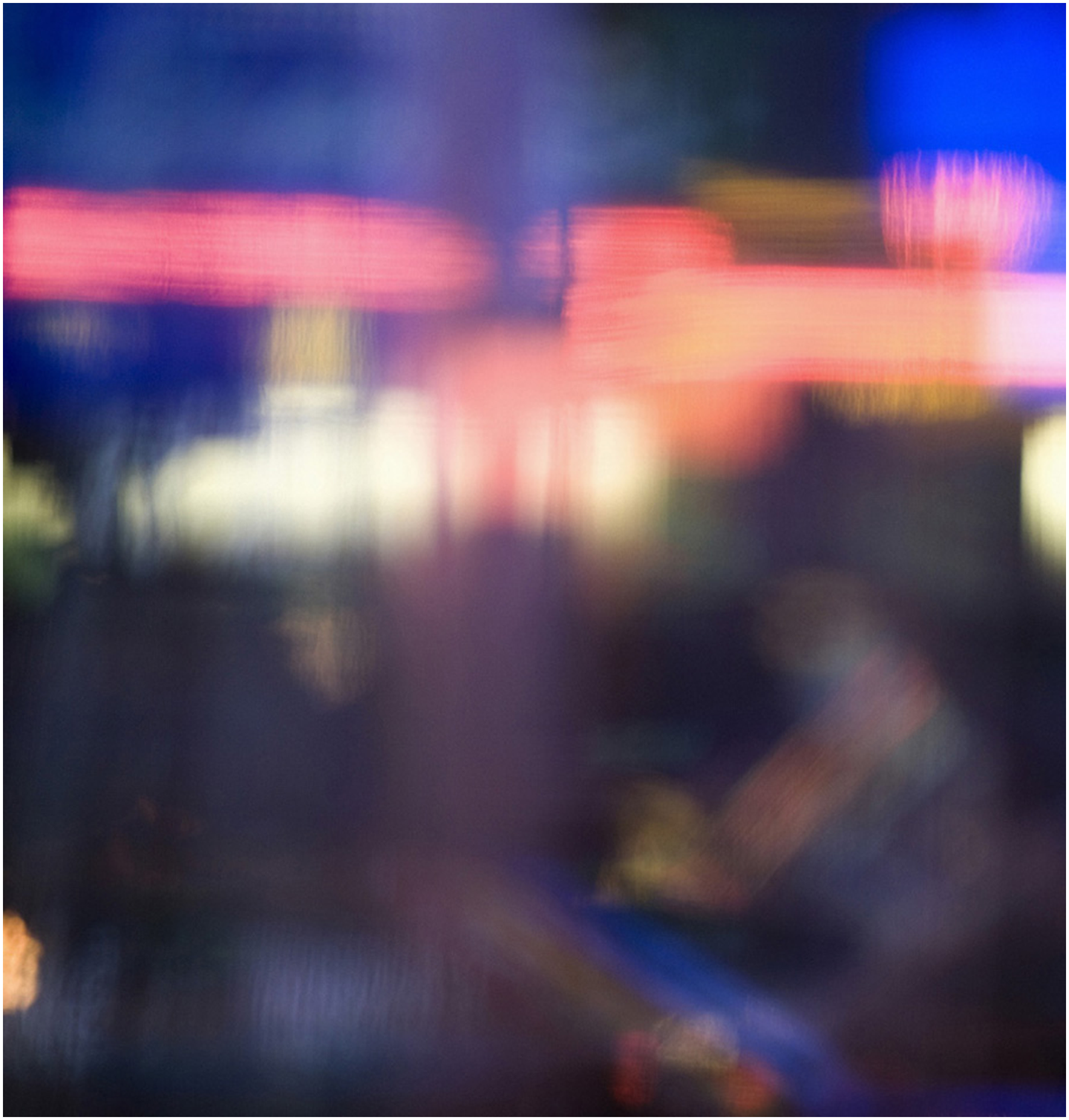
Ea Vasko, #3 of the series Reflections on Ever-Changing (The Short History of Now), 2009. Digital photograph. Reprinted with permission.
Reko initiates the discussion without raising his hand by loudly voicing, Hey, thus receiving the others’ attention. With an innovative gesture and suggestion (lines 01–02), Reko invites other children to investigate the photograph in the way he does. The researcher finds Reko's suggestion surprising; thus, she confirms it with laughter. Next, Reko continues with a few words (line 04) while simultaneously moving towards the screen. Recognising the viewing situation's rules, Reko stops and asks permission from the educators before approaching the screen (line 05). After permission is granted, Reko comes to the screen by himself and continues his turn independently. The researcher tries to cut in with a comment (line 10), which Reko ignores. Like the children, the researcher is now part of the audience listening to Reko.
The researcher closes the sequence with a post-expansion okay (Schegloff, 2007), after which she asks Reko to return to his place (lines 12–13). Next, Vilho enters the discussion. He has made a certain kind of gesture on the bench while listening to Reko and now elaborates on the ninja theme by referring to his and his friend's competence. This seems to generate competition among the interlocutors, for after the researcher's supportive acknowledgement of Vilho (line 16), Reko immediately takes a turn by raising and demonstrating his ninja skills. Part of the talk overlaps, indicating both Reko's enthusiasm in affiliating with Vilho and his urge to gain the floor. The researcher closes the sequence by promising to return to the ninja movements later (line 19). Yet, Vilho independently takes the last turn, reminding the listeners of who was the first to mention ninja skills.
The boys’ agency is performative and embodied. Taking a turn and presenting one's view to the audience while enacting it seems to entail elucidating gestures, loud voicing and even competition. Along with words, postures and gazes reflect the speakers’ stances on the significant issue they are making explicit (Bateman and Church, 2016). Turns follow each other in quick tempo, demonstrating an intensive connection between the interlocutors and a shared enthusiasm about ninjas.
The children's initiatives were frequently accompanied with laughter. A few times laughter appeared alone, but more often it was shared. In interaction, laughter has many functions: participants can entertain each other, display affiliation, question things or relieve tension in situations involving interactional or epistemic trouble (Andrén and Cekaite, 2016; Arminen and Halonen, 2007; Glenn, 2003). In the next example, joking and laughter are used for amusement and contesting. Four children have discussed Santra's photographic arrangements in her photograph Looking from High Above. Santra has mentioned a particular detail in her photograph that seemed surprising to the listeners and resulted in joint laughter. Next, Vilho asks the researcher an informative question. Excerpt 2. Sister's popsicle 01 Vilho{turning to M}: Could↑ I have photographed whatsoever from high above?{gives 02 a hesitant laugh} 03 M: €Yes, you could have€ 04 Vilho: Oh, like my sister's (.) lollipop{gives a laugh} 05 ((Santra and Saku burst out laughing, Saku bends over the table 06 while laughing, Vilho joins in)) 07 M{touches Vilho's shoulder}: €Well, if you like€ 08 Saku: HEY, your sister's lollipop{laughs aloud bending backwards} 09 ((Other children join laughing))
Vilho's solo laugh invites the other children to join him, thus completing the joke. The researcher confirms Vilho's comment as humour by touching his shoulder, smiling and saying, Well, if you like. However, the tenor of her voice is slightly dismissive, both building on the humour in the children's exchanges and simultaneously implying that their actions may be going too far (Piirainen-Marsh, 2011: 373). This is perhaps why Saku repeats Vilho's utterance, starting with a loud Hey inserted with a laugh token, thus accepting Vilho's account and highlighting it as a joke (Sidnell, 2010: 119–120). The children direct their comments to each other while the researcher is the listener, displaying acquiescence with them and refraining from adult editing (Shayan, 2022). With Vilho's guidance, the children keep the floor to themselves with joint language play, including laughter, puns and artful variations in pitch and volume (Cekaite and Aronsson, 2005), thereby challenging the photography assignment given to them by the researcher.
There were also situations in which a playful stance and shared laughter consumed both the children and the researcher, as when viewing Jalo's photograph Black Ghost (Figure 2). Excerpt 3. Ghost's biceps 01 ((Jalo clicks the photograph on the laptop. Eliel bursts out laughing and 02 bends over the table. Jalo joins in)) 03 M{gives a laugh}: 04 Eliel{laughing}: A kind of funny ((Jalo snickers)) 05 M: Quite funny = was the [brother]- 06 Eliel{pointing at the photo}: [€There's] a lump of force€ 07 ((Jalo bursts out laughing)) 08 M: Well = 09 10 photograph the little brother as a ghost? 11 ((Jalo nods while holding his laughter. Eliel snickers. The boys burst 12 into overwhelming laughter. M joins in.))
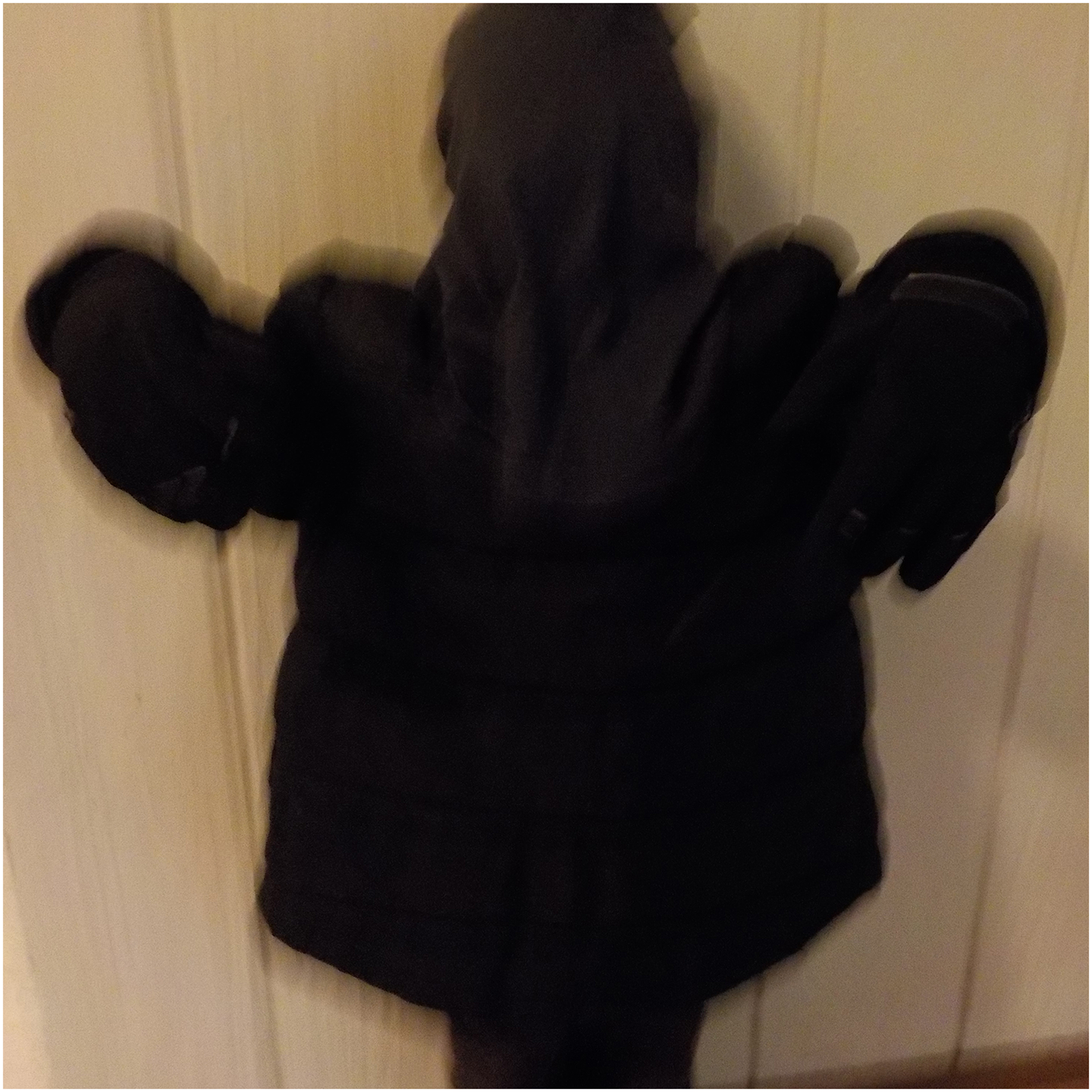
Jalo, Black ghost, 2014. Digital photograph.
Notably, Jalo first tries to follow the sequential order of conversation by answering the researcher's question with a nod while Eliel snickers (line 11). The boys clearly try to resist their self-indulgent and inappropriate laughter, but they cannot hold it for long. Jalo's blurry photograph of the black ghost provides leeway for Eliel's humorous imagining, with which Jalo affiliates. This reciprocal joking and laughter allow the researcher to join in (line 12). Yet, she takes a risk, as the boys can either accept or deny the researcher as part of their humorous alliance. Thus, momentarily, the shared laughter seems to balance the inherent asymmetry of the situation and to favour the participants’ closeness in communicating.
Agency as resistance and questioning
In a few cases, there were challenges in the presupposed discussion trajectory. The interaction was built mostly on adult-led question–answer adjacency pairs. No peer discussions emerged. Thus, the researcher's role as the maintainer of conversation and supporter of individual interlocutors became significant. The children used different means to manage these situations. One solution was to reject the researcher's attempts to promote discussion by making small gestures of resistance (Hendrickson, 2012; Rainio, 2008). Another strategy was to question the viewing situation's intersubjectively shared social frames by introducing competing framing cues (Goffman, [1974] 1986), with assumptions about what would happen next.
In the next excerpt, Aino, Liina and the researcher discuss Aino's Small, Soft-Furred Animal photograph (Figure 3). Excerpt 4. Teddy bears ((M clicks on Aino's photograph on the screen)) 01 Liina{admiring}: O:h a pony ((Aino smiles at the photograph)) 02 M: € 03 ((Aino closes her eyes and presses her lips together as a tense smile)) 04 (0.4) 05 ((Aino opens her eyes and stares at the photograph)) 06 M: What↑ could you tell about this photograph? 07 ((Aino taps her shut lips with her index finger and looks at the photograph)) 08 M: We’ll take-{moves to the door} some of the light off (.) if it would 09 make it easier for us to view- 10 (0.3) 11 M: 12 (0.1) 13 Aino: €Teddy bears€ 14 M: €Well 15 Aino: M-mm↑
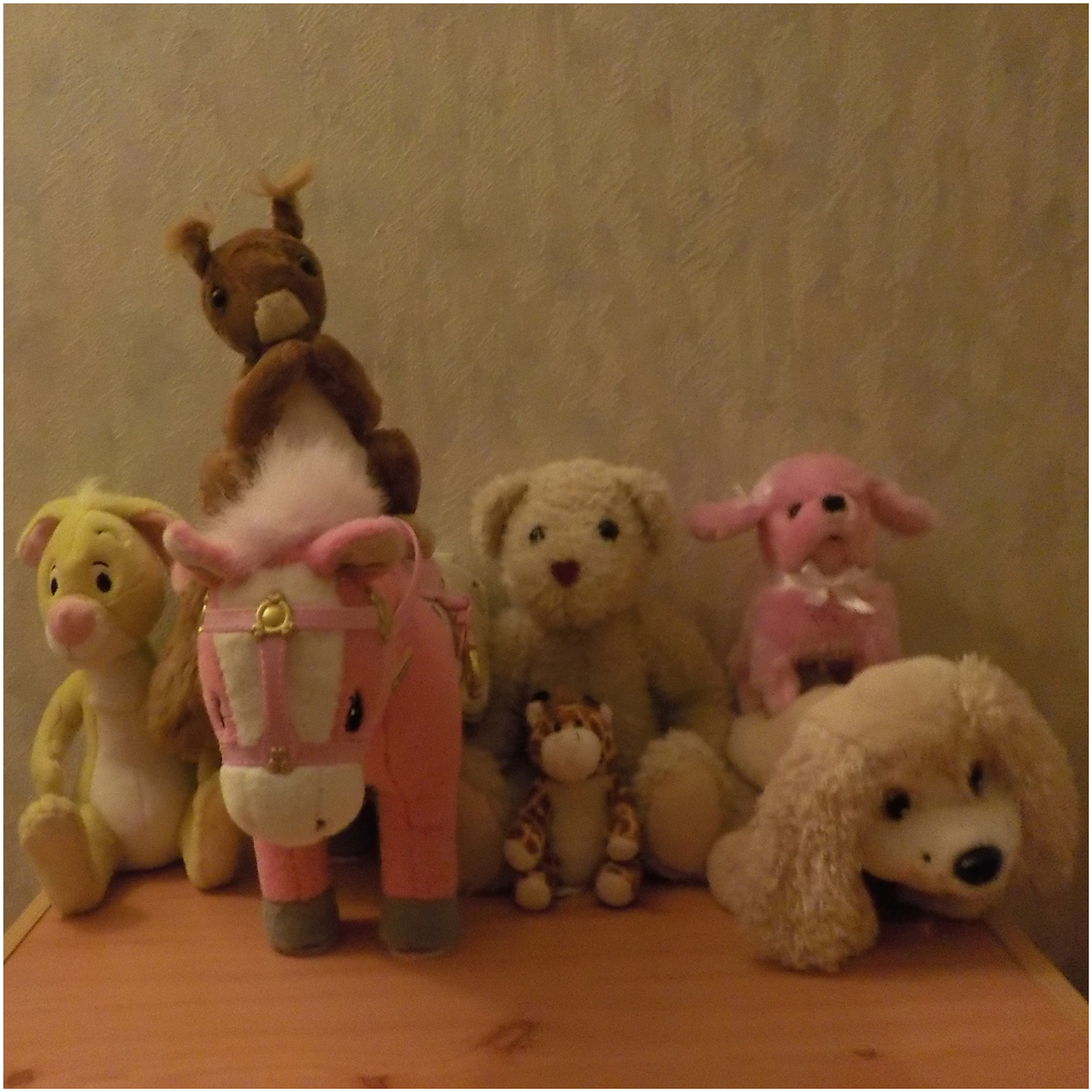
Aino, Small, soft-furred animal, 2014. Digital photograph.
Notably, Aino does not respond to Liina's appraisal but instead smiles at the photograph. The researcher takes the next turn, asking about the nature of the photograph (line 02). Instead of answering, Aino makes a strong gesture by closing her eyes and giving a strained smile. The researcher interprets Aino's behaviour as a request for assistance and redesigns her question (line 06). Aino does not answer this question either.
The pauses in the sequence and the facial expressions imply that the situation is challenging for Aino. Next, the researcher takes a physical distance from Aino to minimise possible tension. She refers to adjusting the lighting in the room (lines 08–09). The implication is that bad circumstances might make it difficult to see the photograph, making it challenging to discuss it. Still, Aino remains silent.
Following abstract questions (lines 02 and 06), the researcher asks something concrete about the photograph, with an open-ended question (line 11). After a short pause, Aino answers with a smiling voice, teddy bears. The researcher's response is an accepting one, after which she continues by asking a closed question, with which Aino can agree or disagree. Aino replies with a vocal continuer, mmm, carrying a rising intonation at the end, thus inviting the researcher to continue (Schegloff, 2007).
There may be several reasons for Aino's silence. Long silences can indicate problems, but they can also imply resistance (Spyrou, 2016). Aino's silence, combined with her gestures of closed eyes and a tense smile, is perhaps not a sign of confusion; instead, it can be seen as a self-imposed agentic act (Spyrou, 2016). In other words, she intentionally chooses not to speak even though the others expect her to join the discussion. It is also possible that Aino has nothing to say about the photograph, for the photograph resembles its referent, and smiling and looking at it might suffice for her.
Excerpt 5 illuminates another kind of resistance – frame breaking – in a conversation on the art photograph (Vasko, 2009) introduced in Excerpt 1. Reko has been active throughout the discussion. He now listens to Vilho, who explains finding a slingshot in the photograph. Excerpt 5. Let's fetch Simo 01 Vilho: It's there{pointing to the photograph} ((Reko has raised his hand)) 02 M: 03 then↑ Reko? 04 Reko: Can I fetch Simo-hedgehog and bring it here as Nikander's friend 05 {pointing to the teddy bear on shelf} 06 M: We can do that = I also noticed that one can find here good friends 07 for Nikander = We can do that shortly = but 08 {pointing at the screen}I find a
During Vilho's turn, Reko raises his hand. The researcher confirms Vilho's notion (line 02) by directing it to all the children, using the collective pro-term ‘we’ (Butler, 2008). In his turn, Reko inquires (line 04) if he can fetch a stuffed toy as a friend for Nikander the teddy bear, which the researcher brought to the workshop as a mascot. Thus, Reko changes the direction of the overall conversation by speaking publicly against the presumed order. The researcher's response is negotiative, providing the option to fetch the toy later. Notably, rather than belittling Reko's suggestion, she affiliates with his playful stance by elaborating on his idea of toys being friends (lines 06–07).
By suggesting picking up Simo the hedgehog, Reko tries to ease his possible boredom at listening to the others’ turns. Reko does this skilfully by changing one playful frame, in which the children are interpreting art photography, to another: make-believe play with stuffed toy animals. Instead of purposefully disrupting the classroom activities, Reko tries to reclaim the discussion space (Hendrickson, 2012). The frame Reko introduces is actually apt for the workshop's playful and explorative premise. However, the researcher immediately redirects attention back to the photograph by starting a new sequence with what she has found, thereby revealing her expectations regarding how the discussion should continue.
Although in the excerpts, the children do not play active roles in discussing the photographs per se, they are not passive. Instead, they are strongly present in the interactional here-and-now by making explicit their stances through diverse modalities. By disregarding opportunities to join in the conversations on photographs, they challenge the ongoing activity and its modes of participation by taking a distance from it and contesting its significance to them (Rainio, 2008).
Discussion
This article has made explicit those interactional resources and practices that the preschoolers and the researcher used when discussing photography in a workshop in an ECEC centre. Informed by CA, we described in detail how children's agency unfolded turn by turn in joint conversations. We aimed to broaden the conception of young children as interpreters and producers of contemporary images, thereby influencing the discourse of young children's agency in ECEC visual arts education.
Consistent with recent research (Esser et al., 2016; Schulte and Thompson, 2018; Sunday, 2015), our findings show that children's agency is relational, interdependent and negotiated rather than an individual endeavour. While some of the children took the floor as flamboyant solo performers, instead of foregrounding the self-expressive, unitary child–agent (Spyrou, 2018: 21), the data illustrated agency as a socially constructed, public and joint achievement. The findings highlight children's agency as a fundamentally interactional event within which children co-produce intersubjective understanding through a complex layering of sequentially ordered talk (Schegloff, 2007), timing, gesture and use of space and organise it ‘to fit with actions of others’ (Kidwell, 2013: 511). As shown in Excerpts 1 and 3, an individual child's agency was dependent on fellow conversationalists’ alignment and affiliation, that is, how they shared that child's playful stance, yielded the floor, and repeated and elaborated on utterances and gestures. By asking permission to do things (Excerpts 1, 2 and 5), individual children acknowledged their interdependency with traditional classroom conventions.
The discussions on contemporary art photography (as a whole group) and on children's self-authored photographs (in smaller groups) provided distinct participation roles and turn-taking structures. Yet, certain salient features were found in both datasets, which were then divided into two categories. The first category introduced playful, embodied and imaginative interaction between several children who took the initiative and sometimes the leading role, thus establishing the position of a listener or a fellow interlocutor for the adult. The children's performative acts included competing for acknowledgement and position in the group and sometimes challenging the adult-led photography assignment by creating children's own shared culture of pleasure in the classroom (Shayan, 2022).
The second category comprised talk that questioned a discussion's presumed order and sequential implications. While the researcher took the role of lead questioner, the children's agency appeared as resistance through long silent gaps (Excerpt 4) and frame breaking (Excerpt 5), which required all co-participants’ improvisation and sensibility. Consistent with earlier research (Hendrickson, 2012), the preschoolers’ resistance did not happen in the form of revolutionary acts of defiance but rather in subtle gestures.
Although the workshop was not designed for teaching, the researcher was the instructor. Thus, the turn-by-turn scrutiny of the preschoolers’ and the researcher's interaction provides pedagogical implications for educators seeking to promote children's agency in ECEC. The findings explicate an adult's interactional strategies and facilitation styles (Farini et al., 2023) in observing and responding to individual children's contributions, that is, confirming and elaborating on comments through positive continuers and open-ended questions, with attuned use of gesture, emotional nuance and gaze, which are central means of conveying affect in interaction (Peräkylä, 2004). As in Excerpts 2 and 3, the researcher's empathetic facial expressions, smiling, supportive tokens, repetition of children's accounts and imitation of their prosodies, as well as sharing laughter with them, encouraged the preschoolers’ engagement and enhanced the reciprocal play.
In our findings, contemporary art photography and children's own photographs appeared as specific catalysts (Sunday, 2015) for negotiating, thinking otherwise and improvising. Hence, among these human agents, the photographs became provocative actors (Pyyry, 2015; Rissanen, 2020), encouraging the participants to play and explore. Multilayered and complex artworks, instead of the funny, fast and frenetic imagery often produced for children (Kenway and Bullen 2008: 169), invited multifaceted and suggestive talk as well as ‘it is as if’ imaginings. Humour and laughter (Excerpts 2 and 3) were also used in testing how things might be, thereby implying willingness to encounter the unknown in the photographs (Bonsdorff von, 2005). As a collaborative social practice, art became a shared, relational form of thinking, making meaning and articulating experience (Kind, 2017).
The findings suggest that the preschoolers’ engagement with the photographs is best described as process-oriented rather than object-focused reflection (Kind, 2013; Semenec, 2017). Contemporary art and children's self-authored photographs gave spark to playful endeavour, which momentarily focused on the photograph and then moved onto something that might have only slight identifiable connections to the initial photograph. Thus, in Excerpt 1, Vasko's (2009) art photograph Reflections of Ever-Changing (The Short History of Now) turned into ninja movements in the preschoolers’ multimodal discussions and appeared later as dynamic movements and framings in their own photographs (Rissanen, 2020). The photography talk was thus generative becoming – the interlocutors’ moment-by-moment achievement – rather than a transmission of predetermined meanings (Rautio and Winston, 2015).
As a specific contribution to knowledge, we consider a playful stance (Pursi, 2019; Singer, 2013), which the children and the researcher shared, both as an apt tool for approaching contemporary art and children's creative photography and as an essential interactional resource for promoting children's agency. The children's and adult's reciprocal engagement and improvisation with art and the children's creative photographs were favourable means for balancing the inherent asymmetry of an educational situation. However, we distance ourselves from the idea of art as an emancipatory force that can ignore the interactional rules and conditions of an ECEC classroom. Instead, we contend that by allowing children's multimodal initiatives, spontaneous role reversals, humour and associative storytelling, joint engagement with arts in ECEC provides an interactional space in which the fixed child–adult binary can be questioned and different types of agency are offered, both for children and adults.
In generalising the study findings, the data production's situatedness and the researcher's engaged role need to be recognised. Hence, the findings should be read as one example of an encounter of young children, an adult and a particular set of photographs. However, the discursive strategies identified in the children's displays of agency and in the researcher's facilitative actions in promoting children's agentic status are valid and transferable to other ECEC contexts (Farini et al., 2023; Goodman, 2008), providing educators with an understanding of the complex interactional nature of young children's agency. Further research is nevertheless needed to understand how children and educators can share epistemic authority as co-players and narrators in ECEC's visual arts education.
We hope that the present analysis contributes to the limited research on educators’ strategies for promoting children's agency in their daily ECEC interactions (Mashford-Scott and Church, 2011). By explicating the finest details in the photography workshop's interactional infrastructure, we have aimed to increase sensitivity to and awareness of how children's agency unfolds in joint engagement with art and to guide educators in creating favourable conditions and choosing appropriate participatory practices for supporting children's agency in ECEC.
Footnotes
Acknowledgements
We wish to thank the children, their families and the staff in the ECEC centre for their commitment and contribution to our research. We would also like to give credit to the artist Ea Vasko, who gave permission for us to publish her photograph in this article.
Funding
The authors received no financial support for the research, authorship and/or publication of this article.

Authors biographies
Appendix 1
Transcription conventions (amended version of Jefferson, 2004): [word] Overlapping talk {word} Overlapping non-verbal actions = No break between or within turns ↑ Shifts into high pitch : Sound before colon stretched WORD Loud voice €word€ Smiley voice wor- A cut off (0.5) Time intervals in silence (.) Micropause ((comment)) Transcriber’s comments
Appendix 2
List of the contemporary art photographs viewed in the workshop.
Marjukka Vainio (2006–2010). Red II. Pigment print on archival paper, diasec. 68 × 68 cm, edition of 7 + 2AP. Retrieved from http://www.helsinkischool.fi/exhibitions/marjukka-vainio-kimono, 29.5.2024. Marja Pirilä (2013). Camera Obscura/Alvar and Erik, Rovaniemi. Pigment ink print, 142 × 111 cm, edition 7 + 7 + 2AP. Retrieved from http://www.marjapirila.com/interior.html, 29.5.2024. Miklos Gaál (2007) Coastline II. C-print, 100 × 155 cm, edition 7. Retrieved from https://www.galleriaheino.fi/en.php?k=120700, 29.5.2024. Riitta Ikonen & Karoline Hjorth (2011). Eyes as Big as Plates # Agnes II (Norway). 120 × 100 cm, edition of 7 + 2AP; 60 × 50 cm, edition of 10 + 2AP. Retrieved from http://www.riittaikonen.com/yz7gwvf6uxt9mlvkuzp2xexzlv99s4, 29.5.2024. Heidi Lunabba (2011). From the series Twins [Tvillingar/Kaksoset]. Retrieved from https://www.valokuvataiteenmuseo.fi/fi/nayttelyt/kaksoset, 29.5.2024. Ea Vasko (2009). #3 from series Reflections of the ever-changing (the short history of now). Digital c-print, mounted on matte diasec. 155 × 150 cm, edition of 5 + 2AP; 262 × 60 cm, edition of 3 + 1AP. Johanna Hackman (2006–2010). From series Utan oss. Ilman meitä [Without Us]. Retrieved from http://cargocollective.com/visugalleria/Johanna-Hackman, 29.5.2024. Julius Koivistoinen (2011). Kontula, Helsinki. #9 from series Terrarium, Everyday paradise. Retrieved from https://www.artnet.com/artists/julius-koivistoinen/kontula-helsinki-gxA-nzOrWLSJDIL48GdiFA2, 29.5.2024. Susanna Majuri (2009). Raven. C-print on Diasec. 100 × 150 cm, edition of 5 + 2AP. Retrieved from http://www.susannamajuri.com/raven, 29.5.2024. Kai Fagerström (2010). From series House in the Woods. In K. Fagerström, H. Willamo and R. Rasa (2011). House in the Woods, p. 5. Helsinki: Maahenki. Martti Jämsä (1999–2004). From series Kesä [Summertime]. In M. Jämsä (2003) Kesä, Summertime, p. 47. Helsinki: Musta taide. Janne Lehtinen (2010). By Boat. From the series Sacred Bird. Inkjet print, 100 × 130 cm, edition of 5 + 2AP. Retrieved from https://www.personsprojects.com/artists/janne-lehtinen?x = works/sacred-bird/3by-boat-2010, 29.5.2024. Ilkka Halso (2004). Rollercoaster. From the series of Museum of Nature. 100 × 134 cm, edition 6; 50 × 67 cm, edition 10. Retrieved from https://www.personsprojects.com/artists/ilkka-halso?x = works/museum-of-nature/gtpilhal2004rollercoaster300 dpi, 29.5.2024.