




Abstract
International field visits aim to provide transformative learning experiences that stimulate the professional development of staff, but outcomes may vary among programs. In this mixed-methods study, we investigated the transformative learning experiences of Dutch and German professionals (n = 28) from early childhood education and care (ECEC) who participated in a blended intensive exchange program with mutual field visits. Our findings indicate a transformative learning process in which the participants developed an awareness of cultural differences, moved to understanding these differences and, occasionally, to adaptation of new professional beliefs related to the interaction with young children. However, it proved difficult to implement new practices in the own centers after the program. We discuss how international exchange programs may foster transformative learning and the professional development of ECEC staff.
Keywords
Introduction
International field experiences are a well-known part of professional development for early childhood education and care (ECEC) professionals. The international exchange and the immersion in a different ECEC setting are assumed to trigger a break away from deep-seated patterns and to stimulate transformative learning (Anderson and Fees, 2018). Transformative learning is defined by Mezirow (1991) as the process of becoming critically aware of how and why the structure of our psychocultural assumptions has come to constrain the way in which we perceive our world” (i.e., awareness) and also to act on these new understandings and reconstituting that structure in a way that allows us to be more inclusive and discriminating in our integrating of experience (i.e., enactment in practice). Transformative learning is thus a shift in basic premises of thought, feelings, and actions (Calleja, 2014). Constructivist epistemology is foundational for transformative learning and this theory describes how individual learners become critically aware of professional beliefs and practices to form a new view on their work. This critical reflection at individual level is combined with critical discourse at group level, which is social and collective in nature. Transformative learning is thus not only an individual, rational process, but also involves an affective and social dimension (Hyde, 2021; Taylor, 1997). Critical discourse with others is thus assumed to support critical reflection, which may subsequently lead to action and change at work (Hyde, 2021).
Hoggan (2016; 2018) summarized the outcomes of over 200 published articles that supported the basic assumption of transformative learning that adult learners may experience a transformation that results in significant changes in the way a person experiences, conceptualizes, and interacts with the world. The starting point for gaining a new perspective for working professionals is to reflect critically about one's own practice (Lundgren and Poell, 2016). Identifying a problematic idea or belief in professional practice may be a disorienting event that serves as the catalyst for transformative learning and may result in a significant change in the frame of reference of professionals (Akpovo, 2019; Taylor, 1997).
The professional development of ECEC staff has also been studied from a transformative learning perspective. In the context of childcare, these studies have highlighted that critical inquiry is important for early childhood teachers and may help in the dentification of a problematic idea or belief (Black, 2019; Linn and Jacobs, 2015). Cochran and Smith (1999) emphasize, therefore, that ECEC professionals should be encouraged to “raise fundamental questions about curriculum and teachers’ roles” (p. 274) to identify critical ideas from their own practice and critique their own experiences and beliefs. Critical reflection is stimulated by discussion with colleagues (Akpovo and Nganga, 2018; Anderson and Fees, 2018; Brown and Englehardt, 2016). Based on their qualitative meta-synthesis of US studies for early years educators, Brown and Englehardt (2016) emphasize the importance of a dialogic nature of learning, because individuals are better able to analyze their experiences and make meaning of those experiences through conversation and discussion with others. The interaction among professionals is also important to conceptualize best practice (Anderson and Fees, 2018; Brown and Englehardt, 2016). Hence, the emotions of ECEC staff and the social dynamic deserve explicit attention in research into the professional development of staff (Lundgren and Poell, 2016).
Learners move through a series of developmental forms to reach higher levels of learning. Building on the work of Mezirow, various authors with an interest in international exchange programs in an ECEC context (e.g., Akpovo, 2019; Lee, 2005) have shown that professionals may start with an initial awareness of cultural differences between regular childcare that is familiar to them and new ECEC practices they observe during the international field visit. A typical question for the first stage is “What is different?” and these learning experiences are typically reflected in factual, observational descriptions. In the second stage, labeled dynamics of differences, the professionals may move to an understanding of the experienced differences. A typical question at this stage is “Why do they do this in a different way?” and learning experiences are characterized by comments related to new teacher beliefs, a pedagogical approach or ECEC tradition. In the third stage, learners may value the new practice and adapt a new professional belief (i.e., What does this imply for my professional orientation?). Finally, the implementation of new professional practices in the enactment stage (i.e., What does this mean for my professional practice?) is the highest level of transformative learning.
It is open to debate whether international field experiences in ECEC are effective in fostering transformative learning. If the participants are not guided in a systematic way during the international experience, the visit may be not much more than voyeurism (Akpovo and Nganga, 2018) or educational tourism (Anderson and Fees, 2018). In fact, the international visit may even result in professional ethnocentrism (Anderson and Fees, 2018; Bennett, 2017). The final enactment stage of transfer of learning experiences to implementing new practices often lags behind (Romijn et al., 2021). It is thus not straightforward that an international field visit results in newly acquired knowledge and beliefs, which subsequently transfer into new skills and innovative ECEC practices.
A limitation of our understanding of transformative learning in the ECEC context is that we know too little about how transformative learning takes place. Identifying problematic ideas or beliefs serves as the catalyst for adult learning, but this fundamental concept of transformative learning is the least investigated (Taylor, 1997). Further, much research into professional development “ignores the complexity of the contexts in which early educators operate and the knowledge-of-practice required to navigate the realities of the varied early learning communities,” according to Brown and Englehardt (2016). They conclude that there is a lack of “studies that provide qualitative data illuminating such issues as how teachers’ practices changed as a result of professional development in their day-to-day interactions with children across a range of instructional contexts.” There is an absence of thick descriptions of staff experiences and learning throughout professional development programs in the literature (Brown and Englehardt, 2016), which offer concrete insight into the social dynamics of transformative learning (Black, 2019; Bonnett, 2015; Sheridan et al., 2009). Our study aims to provide an in-depth empirical investigation of transformative learning experiences of ECEC staff, including critical observations and their transfer to an understanding of these differences, adaption of professional beliefs, and, finally, to implementation of new professional practices.
The international exchange program: Theoretical and international background
Two Dutch childcare providers have collaborated since 2016 with a German childcare provider from Berlin to organize an exchange program each year. A unique characteristic of the program is that the exchange is mutual: the first exchange took place in the Netherlands, followed by the second exchange in Berlin (both 1 week). The blended program combined physical meetings with online meetings in the preparatory and follow-up phase. To facilitate collaborative learning and exchange, participants of blended intensive programs undertake a short-term physical mobility abroad combined with virtual components. The program started with two online meetings (2 h each) for all participants. Further, the Dutch participants from the two partnering organizations met, before the international physical exchange, with an individual colleague at each other's centers in the Netherlands (approximately 2 days). The participants from the Netherlands finally participated in an online follow-up meeting (2 h).
The literature recommends that an international exchange program should be well embedded within the organization and the management team. Relatedly, Romijn et al. (2021) advocate a team-based strategy with inclusion of key figures from the organization (i.e., not targeting only individual teachers). In the Dutch-German program, a mixed team of caregivers, coaches, staff members, center directors, and the CEO's participated.
To stimulate critical reflection, international exchange programs may include instructional activities before, during, and after the visit. At the start of a program, structured activities with introductory information may prepare participants for potentially disorienting experiences (Anderson and Fees, 2018). A needs assessment on the teacher and ECEC context may be used to arrange a custom-made program for individual participants instead of a one-size-fits-all approach (Romijn et al., 2021). In the program, the coordinators made an inventory of learning interests and professional profiles at the beginning. The colleagues from the organizations were subsequently linked, based on their shared interests and professional profiles. The coordinators created a tailored program where dyads or triplets were linked with different centers.
During the visit, the program should offer professionals ample opportunity to discuss teacher beliefs and ECEC practices to stimulate transformative learning. This reflection may be stimulated with external, active guidance (Romijn et al., 2021), for example by a cultural mentor who can act as positive role model (Akpovo and Nganga, 2018). In line with the recommendations from the literature, the exchange program included ample opportunities for discussion during the visits of the centers, a social program in the evening, and a meeting at the end of the week to round off the visit. A cultural mentor with extensive knowledge of the Dutch and German culture, language, and ECEC joined each meeting and gave an introductory presentation to highlight some pedagogical differences between Dutch and German childcare (see below).
After the visit, participants may reflect in retrospect on their learning experiences. At a follow-up, they may be stimulated to think about enacting the new ideas and lessons learnt in their own ECEC practice (Anderson and Fees, 2018; Brown and Englehardt, 2016).
Fitting in with the literature, the evaluated program included a follow-up session where each participant was invited to discuss one's professional growth and the implementation of new practices after the return.
The mutual exchange of the program is innovative for this type of program. The organizations have chosen for this extensive format because it allows the professional development of participant staff from each organization. The changing roles of host and visitor at the first and second visit for each participant means that everyone has an equal and active role in the program. The dual investment with two visits is also aimed to stimulate a positive social dynamic and critical reflection.
It should be noted that there are variations between German and Dutch ECEC, despite their geographical proximity. We briefly highlight here three themes, because they are relevant for this study and related to transformative learning (see European Commission/EACEA/Eurydice, 2019; Oberhuemer and Schreyer, 2017 for more information). First, in the Netherlands, childcare centers are overseen by the Municipal Health Services (“GGD”) based on a national assessment model with various indicators for the pedagogical climate, safety, and health. Many childcare providers are critical about the regulatory burden this procedure poses for staff. In Germany, no national assessment system is in place to receive an operating license for childcare, but centers are responsible for quality management. Quality assurance often involves hybrid measures, including both external and internal monitoring tools (e.g., parent and manager surveys, self-reflection reports, portfolios, and checklists).
Second, the UN Convention on the Rights of the Child (CRC) fully applies in both Germany and the Netherlands and children's autonomy is an important value in the ECEC of both countries. However, this leaves room for national or regional variation (Edmonds, 2019). In Germany, the implementation of the CRC has stimulated progress in legislation toward a more child-friendly legal environment and a shift of views by granting more liberties and more participation rights to children (Schmahl, 2016). In the Netherlands, there is no similar trend.
Third, centers are different with regards to participation rates of infants. In the Netherlands 55% of 0–2-year-olds are enrolled in formal ECEC, whereas in Germany only 29% are enrolled (OECD, 2016a; 2016b). Further, Dutch childcare may include babies from three months, whereas the children in German enrolled in ECEC are often older than one year (Autor:innengruppe Bildungsberichterstattung, 2022). These differences in inspection procedures, recent policy changes, and the childcare population influence the pedagogical climate in both countries (see the Results section).
Present study
In this study we investigated the learning experiences from the participants in an international exchange program with mutual visits. There were two related main questions:
What is the social dynamic of transformative learning in an international context during the program? How does the program stimulate transformative learning?
Transformative learning is defined for the purpose of this study as a “process of effecting change in a frame of reference” (Mezirow, 1997, p. 5, emphasize in original). Professionals have acquired frames of references through a coherent body of experience (e.g., concepts, values, feelings). The process of transforming frames of references is based on critical reflection. It starts with the identification of a new professional practice or belief. This may involve a disorienting event that serves as a catalyst for further inquiry and discussion. Following stages of transformative learning from the literature (see Akpovo, 2019; Lee, 2005), we explored whether the participants move from (1) an initial awareness of cultural differences (2) to an understanding of these differences, (3) to the adaption of professional beliefs, and, finally, (4) to the implementation of new professional practices.
Method
In a mixed-methods study with concurrent collection of qualitative and quantitative data (Tashakkori and Teddlie, 2003), we investigated the learning experiences of the participants. By triangulating qualitative and quantitative data, at group level, we investigated how participants evaluated the discussion and reflection during the program (question 1) and their individual learning outcomes (question 2), which are two key dimensions of transformative learning.
Sample
The sample consisted of two Dutch childcare service providers and a German service provider from Berlin, Germany, who collaborated to organize the international exchange program.
In total, 28 participants were involved in the program, including 13 Dutch and 15 German participants. First, an experienced Dutch manager was coordinator of the program, who collaborated with two German coordinators. Further, seven Dutch caregivers (4 + 3 for both Dutch organizations) participated, who met ten German colleagues. Three pedagogical staff members participated (1 + 2 for both Dutch organizations, 2 coaches and 1 policy advisor), working with two German colleagues. The CEOs of all the organizations also joined the program. The participants were, on average, 40.6 years old (SD = 9.2), varying between 25 and 57. All participants were first-timers on this program apart from the coordinators and the CEO. Two Dutch CEOs, the external expert, and three German caregivers were male, the other participants were female. An external expert also participated in the program, but was not included in the sample because he was not ECEC staff. The sample size for the survey was 24 at the pretest and 11 at the posttest; CEOs did not participate.
Procedure
A researcher (i.e., the first author), who was invited to join and evaluate the program, attended the preparatory online sessions, the visits in the Netherlands and Germany, and the follow-up meetings. He also received all emails, apps, pictures, and project documents (e.g., PowerPoints, schedules), which were shared with all participants during the program.
After giving their informed consent, the participants filled out an electronic survey after the first introductory meeting; participants could choose between a Dutch, German, and English version. The Dutch and German researcher designed the survey, translated the questions, and checked the cultural fit of the items. The Dutch participants did also participate in a brief posttest to evaluate the program. Table 1 summarizes the schedule and collected data.
Schedule of program and collection of data
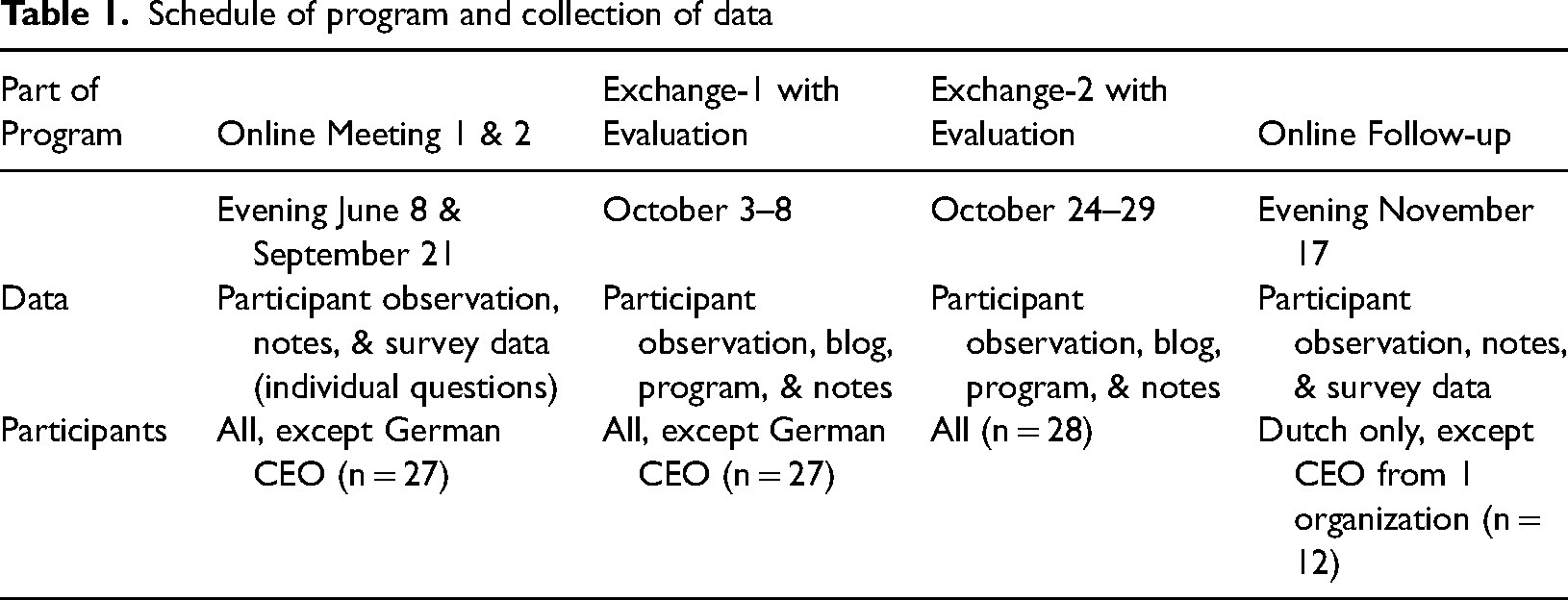
The researchers shared tentative findings with all participants in the preparatory meeting, at the evaluation in Berlin and during the final follow-up meeting. The final report was sent to all three organizations to check facts and to discuss the interpretations of the researchers as a member check (Yin, 2014).
Data collection
Analysis
Observational data and field notes were used to describe relevant themes within the meetings, participant's experiences, feelings, and learning gains to capture the dynamic of transformative learning within the exchange program (question 1). To answer question 2, we coded (I) levels of transformative learning and (II) content domains, and analyzed the survey for (III) time for dialogue and reflection and for (IV) perceived learning gains.
Based on models from the literature that distinguish (I) levels of transformative learning in an international context (Akpovo, 2019; Lee, 2005), we categorized comments from the transcripts using a scheme with four different levels: (1) awareness of differences: the comment reflects a factual description of ECEC (typical question: What did I observe, what is different?, also referred to as “surface culture”); (2) dynamics of differences (Why do they do this in a different way?); (3) adaptation of professional beliefs (What does this imply for my professional orientation?); and, finally, (4) enactment (What does this mean for my professional practice?). We further distinguished (II) seven content domains: (a) comments explicitly related to working as an ECEC professional with children; (b) with parents; (c) colleagues with similar professional profiles; or (d) with the community; (e) in an organization; (f) as member of the ECEC sector. Finally, a category “other” (g) was added to include miscellaneous comments.
After two training sessions, two master students from the University of Amsterdam with ECEC experience coded independently the qualitative data. All data were available for both coders. Both coders and the researcher met at four three-weekly sessions meetings to discuss the coding procedures. In an iterative process, coders coded individually and then compared codes with each other to arrive at a final code. Any disagreements were resolved through discussion. We tallied the frequencies for each category (see Table 2) and related outcomes to the different parts of the program (Figure 1).
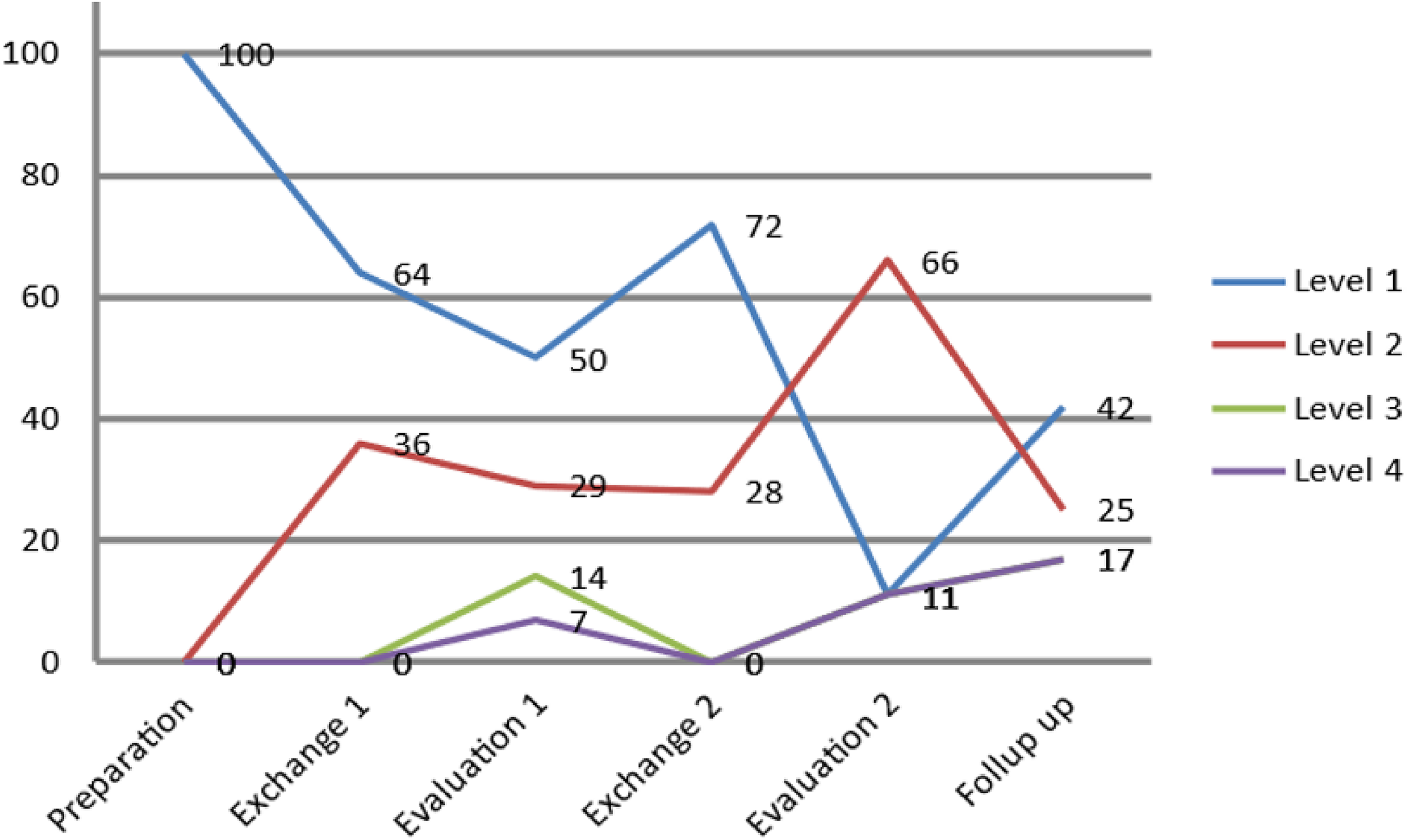
Dynamics of learning: Comments related to levels of transformative learning (%) during the program
Classification of participants’ explicit learning experiences during the program
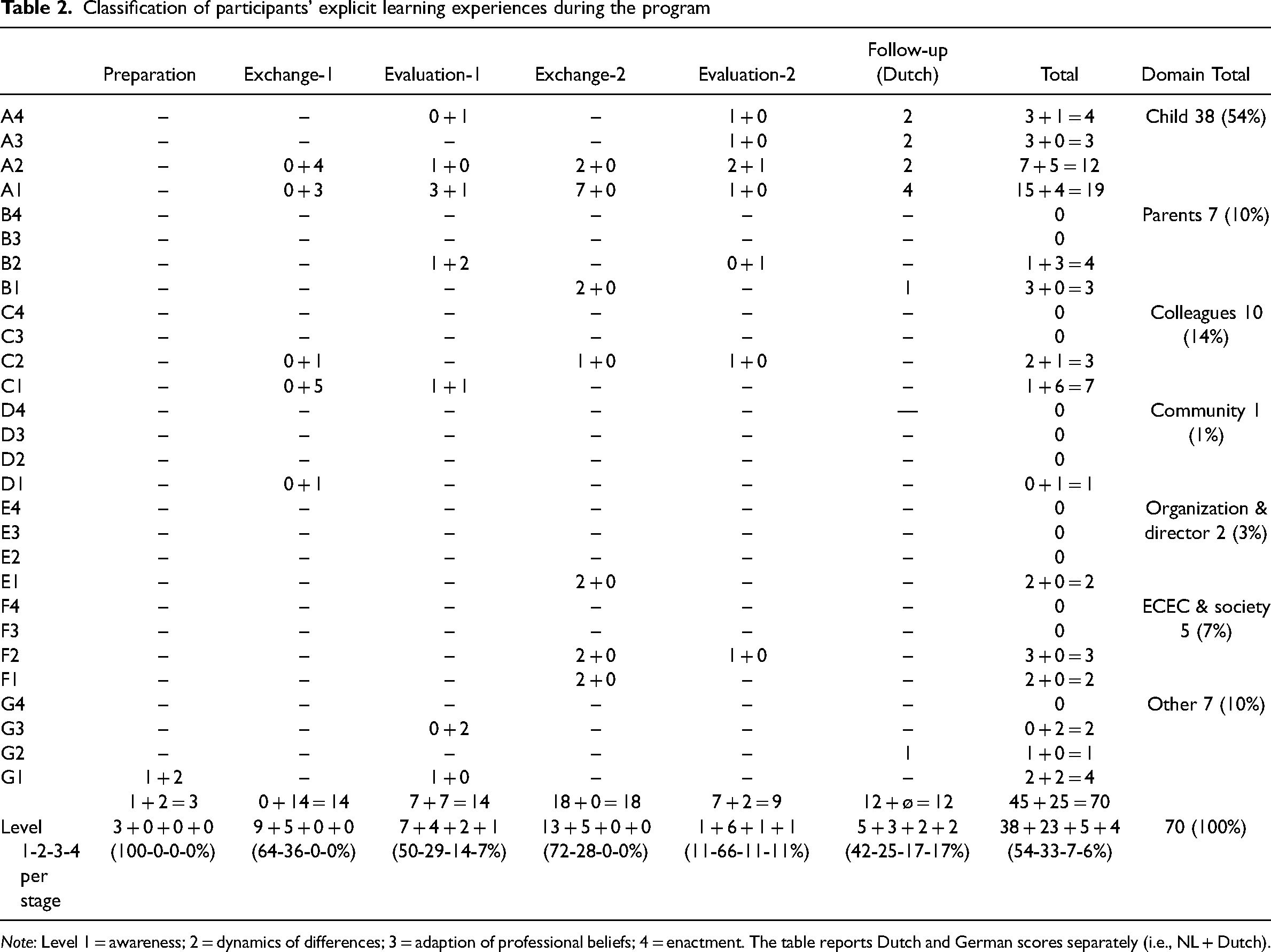
Note: Level 1 = awareness; 2 = dynamics of differences; 3 = adaption of professional beliefs; 4 = enactment. The table reports Dutch and German scores separately (i.e., NL + Dutch).
We triangulated qualitative and quantitative data, at group level, based on the model of transformative learning. Specifically, we checked whether our coded observations of the group reflection converged with the outcome of the (III) Time for dialogue and reflection measure: were the participants satisfied with the room for discussion during the program? Secondly, we checked whether our coded observations related to learning outcomes were related to the (IV) Perceived learning gains measure: did the self-perceived learning outcomes after the meeting match with our coding of learning outcomes during the meetings?
Results
In this section, we report the participants’ experiences and outcomes in chronological order to describe the dynamic of transformative learning (question 1). We summarize in Figure 1 and Table 2 the learning outcomes (question 2).
Results question 1: The social dynamic of transformative learning in an international context
Preparatory phase
The two initial online meetings were used for mutual introduction with PowerPoint presentations. The teams presented first general information about their organization. The cultural mentor subsequently gave a brief presentation in which characteristics of Dutch and German ECEC were highlighted. The group split up thereafter in break-out rooms to meet individually and to discuss questions. A large part of the meetings was devoted to logistic matters, like setting a date and discussing the tentative schedule. Hence, transformative learning played a minor role at this stage.
First exchange: Visiting Dutch ECEC
The visiting Berlin caregivers worked in pairs or triplets at one of five selected Dutch centers in the morning and early afternoon; the visitors were supernumerary staff. The staff members met coaches and center directors to discuss various pedagogical and managerial matters during work, lunch, and dinner. There was also a plenary meeting at the main office with a presentation.
An important theme was Dutch regulations for childcare. The German staff were surprised to see high beds for the children; children in Dutch ECEC often sleep in high, stacked beds behind bars. The Dutch caregivers had explained that these beds were used to avoid bending over and lifting or lowering children, as required by labor conditions policy, and because of safety regulations from the Dutch childcare inspectorate. The German group learnt more about safety, hygiene, and working procedures during their duties as part of the Dutch childcare regulations.
First group evaluation
At the end of the week, all participants met to evaluate the first exchange in a group evaluation. After some questioning by the coordinators, the German guests mentioned a disorienting observation. One of the caregivers said that “The high beds in Dutch childcare were shocking.” The German visitors had learnt that Dutch regulations for childcare and restrictions for children and staff are important in the daily work of their Dutch colleagues (e.g., “There is a focus on safety regulations in the Netherlands”; “Hygiene is important in Holland”).
A different, dominant theme in the meeting was the overwhelming learning experience for the German participants, which made it difficult for them to communicate learning gains at this stage. Many participants emphasized, often in their own language, the impressive experience of the past week (e.g., “So much input in so little time”) and the need to sort things out (“My head is full, I cannot yet sort things out”). At the end of the session, one of the German coordinators acknowledged these learning difficulties and said that connecting theory to practice at this stage is difficult, because “this requires transformation.” The coordinator emphasized that transformative learning is not something that one has to do individually. The other German coordinator also stressed the positive dynamic of the heterogeneous composition of the group (“We have a mixed group with both regular staff, special staff, and managers this year, which creates a new dynamic and stimulates exchange of ideas at different levels”).
Finally, the first German coordinator ended the session on a high note with her closing words that “everyone had been an ambassador this week for one's country, for ECEC and for the European Union.” “After the recent Brexit and the lockdowns which isolated so many countries, I felt this year the European spirit during our exchange,” linking the program to global citizenship in an international perspective on ECEC.
To conclude, the coordinators invited in a group discussion each German participant to express experiences and learning gains, which proved hard for everyone. There was a clear focus on experiential learning of the visiting staff; the Dutch peers were active listeners in this session. Transformative learning for the German colleagues immediately after the first exchange was limited. Possibly, the German staff were still involved in interpreting their learning experiences, as indicated by their comments related to the overwhelming experience. The disorienting observations related to the working conditions, hygiene, and safety procedures (i.e., level 1) were contextualized by their Dutch colleagues (i.e., level 2) during the program, but they were also framed as negative, both by the visiting and hosting staff. Hence, these experiences did not become a catalyst for transformative learning at higher levels (i.e., 3 or 4). The German coordinators acknowledged the challenges of transformative learning in an international context.
Second exchange: Visiting German ECEC
At the second visit, the Dutch guests visited different centers in Berlin on each day. The Dutch pedagogical coaches also visited a different childcare provider, where a local expert explained the “Berliner Bildungsprogramm” (a regional curriculum developed in 2003). At the last day, all participants visited a center in the former French sector of Berlin, where the Dutch participants heard both German and French, learnt about multilingual ECEC and the French “école maternelle” in a Berlin context.
After the first visits to different centers, the Dutch participants were struck by the freedom of the children in Berlin childcare, and they discussed this during the social evening program. The Dutch participants had observed, for example, that “the children [in Berlin] are allowed to start with chocolate mousse and do not eat vegetables” at lunch. One participant commented, “We get children out of the bushes, but here I learnt that you just can let them play in the bushes.” German children generally “get more space and time” for their individual activities, as one of the caregivers concluded. This pedagogical approach, which was new for the Dutch team, was a critical observation that subsequently stimulated a shared exploration of professional beliefs. The Dutch participants reformulated and shared the following question, which guided the exploration during the rest of the week: Why do the children in Berlin centers get more autonomy than in our centers in the Netherlands? The participants discussed various topics during the week, similar to the first exchange, but a difference between the first and second visit is that the Dutch group jointly discussed and reformulated their explorative question.
Second group evaluation
Just like the first evaluation in the Netherlands, the focus in Berlin was on learning experiences from the visitors. The autonomy theme structured a large part of the group discussion; some quotes from this evaluation exemplified a transformative process. The Dutch participants said they were impressed by the “democratic perspective” and the “respect for children's autonomy.” “Everyone was really patient” with the children and “there is more of a laissez-faire attitude in Berlin, trying to let things go, let the children doing it themselves.” The Dutch caregivers concluded that “we guide and support more in the Netherlands” in the interaction with children, and they critically argued that “perhaps we may help too soon.” An important nuance, formulated by one of the Dutch coaches, is that the Berlin approach is not just a laissez-faire approach in raising children. A coach and the policy advisor noted that the room the Berlin caregivers provided for children's autonomy was carefully structured (“I liked their structure in a democratic, open system”). For example, the caregivers had conversations with individual children about food-related practices during lunch, after which a child decided what to eat and how (e.g., the quantity and selection of foods). The general autonomy theme was subsequently contextualized. First, the participants mentioned that Berlin ECEC does not include children younger than one year (as in the Netherlands) and this influences one's thinking about children's safety and autonomy. In addition, the group size in Berlin is often larger than in the Netherlands, which may also affect how children are supported during activities. The pedagogical coaches had learnt during their week that the regional “Berliner Bildungsprogramm” emphasizes the importance of children's autonomy. Relatedly, there has been a strong focus on children's individual freedom in ECEC, especially after the reunion of former West and East Germany.
A different theme, mentioned by different Dutch participants, was fatigue, both physically and mentally, after an exhausting week.
The evaluation ended with concluding comments at a meta-cognitive level related to the professional development of staff. One of the German coordinators gave the message that “it is easier to change when you see it in reality, when you actually see it. And when you get in touch with colleagues,” but “change costs time.” The other German coordinator added that is not easy to let go of traditional values and to realize that things can be organized in a different way. In sum, the second evaluation was characterized by the central theme of autonomy for children and showed some examples of transformative learning.
To conclude, the Dutch participants shared a disorienting observation related to children's autonomy (i.e., level 1), which subsequently triggered their positive interest and stimulated further exploration with both Dutch and German peers (i.e., level 2). In addition, the Dutch participants were able to share their focus during the next visits. Individual reflection and critical discussion were thus closely aligned in a supportive, social dynamic. The Dutch visitors were able to formulate their learning experiences at the level of awareness, dynamics of differences, and the adaption of professional beliefs (i.e., levels 1, 2, and 3).
Follow-up meeting
After the visit, the Dutch participants organized an online follow-up meeting; no German colleagues took part. A new theme in this meeting was sharing experiences with other colleagues who did not take part in the international exchange program. The directors from the Schiedam organization had planned to share experiences with colleagues who did not take part in the program by giving a picture presentation, telling stories and showing videoclips. A director of this organization had organized lunch with the children in a “Berlin-like way” (i.e., with much freedom for children's choices) with the children in one group, which she had videotaped so she could share this with colleagues. Another participant from the same organization had started using the separate sleeping rooms (mandatory in Dutch childcare and used for only a couple of hours during the day) for quiet activities, like reading and yoga.
A colleague from the partnering organization indicated that “once you have returned home, the issues of the day take over,” like shortage of staff (“It's surviving at the moment”). The initial enthusiasm about new ideas, written down in a personal log, ebbed away, according to this staff member (“Although the largest part of the team is involved, I have not yet done anything concrete”). Additionally, sharing one's experiences from the program with colleagues who stayed at home means fulfilling a specific role (“Just sharing pictures [from the Berlin week] raises several questions and it takes time to discuss these. I do not want to bombard my colleagues, suggesting that I have the ‘Egg of Columbus’”).
To conclude, implementing changes in the own organization, relatively soon after the program, was visible in one organization, but proved challenging in the other. A facilitator for sharing learning experiences may be the use of visual materials and discussions with colleagues, although more information is needed to find out whether changes may be implemented and in a sustainable way. A clear barrier for the implementation of new practices (i.e., level 4) is a busy agenda and pressure from external circumstances.
Results question 2: The stimulation of transformative learning in an international exchange program
The explicit learning experiences and the levels of transformative learning of the participants (research question 2) during each part of the program are categorized in Table 2.
At the beginning of the program, learning experiences at level 1 were a predominant category, as Figure 1 shows. At the evaluations and follow-up, all levels were observed. There was a slight increase of level 3 (i.e., adaption of professional beliefs) and level 4 (i.e., enactment) during the program.
In sum, the positive findings from the brief survey converged with the conclusions from the qualitative data related to the critical discussion and learning outcomes of the participants during the program.
Discussion
Our study shows that the innovative format of a mutual exchange allowed a balanced program for international exchange where the participants were active learners. The online meetings at the start ensured that the participants were already somewhat familiar with each other and the different organizations; in addition, they had basic knowledge of the different ECEC systems. The mutual exchange and the preparatory online meetings for all participants seem useful components for other international exchange programs as well.
The findings show that transformative learning occurred at different levels during the program. Awareness of cultural differences as the first level predominated. The professionals were curious about differences between Dutch and German ECEC and various factual observations of ECEC practice were linked to a deeper understanding. Explicit changes of professional beliefs were present as well. However, the adaptation of new practices, as the highest level of transformative learning, is thus difficult, although they were apparent at the final stage of the program. Higher levels of transformational learning were visible at the group evaluations in particular (see also Akpovo, 2019; Vandermaas-Peeler et al., 2021). Our study also points at a specific barrier for enactment, which is the Achilles’ heel of international field visits (Romijn et al., 2021). The fact is that the participants in our study returned after the visits at their own centers where pressing and urgent matters required everyone's full attention. In addition, disseminating the findings from the international visit puts professionals in a new role as the (intended) change agent and they may have some diffidence with their new role. Disseminating findings after return also requires a new approach, because sharing findings is not based on lived experiences and dialogues, as during the visits.
Our investigation of the mutual exchange program also revealed that each visit may have clearly different themes, disorienting events, and learning experiences. This finding reflects, first of all, the experiential nature of transformative learning in which the learning of staff is often triggered by a specific event in an authentic context. The experiences during the second visit study strongly suggest that transformative learning is facilitated if participants coordinate their individual critical reflection during the visit, because then they can join forces in their exploration in a complex program. This applies to international exchange programs in general (i.e., no mutual exchange is required for this).
In the evaluated program, there was an emphasis on learning experiences from the visitors (i.e., not the hosts) in the evaluations at the end of each visit. It was possible to stimulate critical discussion and reflection among all participants simultaneously in international exchange programs, so not only for visitors but also for hosts. In an international exchange context, the visiting professionals may thus start a critical reflection, triggered by a disorienting event, but both visiting and hosting staff may subsequently be involved in transformative learning together in complementary roles. In future research, evaluators should distinguish between learning experiences from both hosting and visiting participants to explore (transformational) learning from both groups. Specifically, it is interesting to investigate whether the visitors exchange their first learning experiences with the hosts, and, if so, whether this is followed by a mutual discussion about their professional practice. This line of research may make clear whether transformational learning is limited to the visiting participants or whether transformational learning may be a shared experience for all (i.e., both visiting and hosting) participants.
Limitations
This study is not without limitations. First, the principal researcher was Dutch, and his position was closer to the Dutch participants. It is therefore likely that some of the learning experiences of the German group may not have been included and this limitation certainly applies to the post-test survey. Second, the time frame of our study may have been too short to capture transformative learning, which may need more time to grow at both individual and institutional levels. Third, the group evaluations at the end of the week were rich discussions, but they were focused on the learning experiences from the visiting professionals. We may have, therefore, limited insight into the experiences of the hosting colleagues in the same week. Fourth, the order in the program schedule may have affected the learning experiences of the German (i.e., the first visiting group) and Dutch group (i.e., the second group). A possible sequence effect in favor of any group can, therefore, not be excluded.
Conclusion
An extensive international program with mutual exchange can yield transformative learning gains of experienced ECEC professionals from two neighboring countries with different ECEC systems, including caregivers, coaches, managing directors, and CEOs. Participants from both countries became aware of several differences between their childcare practices (i.e., the first level of transformative learning) and could contextualize them as well (i.e., second level), which sometimes resulted into adapting new professional beliefs (i.e., third level). The highest level of learning that pertains to the implementation of new practices in ECEC proved more difficult, however.
Footnotes
Declaration of conflicting interests
The authors declared no potential conflicts of interest with respect to the research, authorship and/or publication of this article.
Funding
The authors received no financial support for the research, authorship, and/or publication of this article.
Ethical approval
The research complies with all relevant legislation and received the appropriate approval of the Amsterdam University of Applied Sciences.
