




Abstract
Initially, this article aimed to present findings from an empirical set of data, where postgraduates explored their pedagogical practice within early childhood education and care (ECEC). However, predictable modes of knowing were disrupted while braiding an artefact from Irish mythology known as the Crane bag, together with indigenous knowledge and posthuman concepts. In the generation of knowledge, the teachings of the Crane bag transformed the methodological approach to go beyond the fabricated split of matter and spirit. This transformation created the conditions for an onto-epistemological becoming with water. Hence, the intra-action of braiding together multiple theories became part of the empirical data. From the initial set of data, a photograph, capturing children rolling down a hill, was submitted by a research participant as an example of their approach to safety. In agreement with the research participant, I re-present the photograph in a different format, to tell the story of how an onto-epistemological becoming created an opening to decentre the image of the child. This opening changed the approach to the data analysis, which in turn allowed the more-than-human to come to the fore in the spirit of reciprocity.
Keywords
The context of this article
In bringing the Crane bag as an artefact of Irish mythology into dialogue with indigenous knowledge and posthuman concepts, the dynamic of spirit and matter emerges as an integral part of the research process. As advanced by Snively and Williams (2016), this article adopts the conceptual model of braiding indigenous science with western science. When braiding indigenous worldviews with western perspectives, as illustrated by Snively and Williams (2016: 3), each strand of knowledge remains, ‘a separate entity’, which ‘requires a certain tension’. However, ‘all strands come together to form the whole’ in the spirit of reciprocity. At the beginning of curating this article, as with most creative endeavours, it was not fully conceived or even imagined. From the outset the methodological approach aimed to use posthuman methods. Although this proved difficult as there are no clear guidelines on how to carry out post-qualitative empirical research (Lather and St. Pierre, 2013; Mannion, 2020). Yet as found by Hart and White (2022), when thinking with multiple theories, different assemblages often happen in the middle of things, resulting in the reconsideration of what counts as empirical research. In the middle of writing this article, the teachings of the Crane bag emerged to create an opening for matter and spirit to be immersive. In this immersive experience the boundaries of thought and skin dissolved. Thus, the methodological approach was transformed to go beyond the fabricated split of spirit and matter. The intra-action of braiding together posthuman concepts, indigenous knowledge, and the Crane bag, as a lost artefact, became part of the empirical data. Hence the original aim for the article changed. Initially, this article aimed to present findings collected from a larger empirical set of data, where twenty postgraduates explored their current pedagogical practice within ECEC. A photograph (Figure 1) capturing children rolling down a hill was submitted by a research participant as an example of their approach to safety. Informed consent was obtained from parents/guardians. Ascent was sought from the children on the day that the photograph was taken. In keeping with the policy of the ECEC setting the photograph did not identify any child, the setting or location. In agreement with the research participant, I re-present the photograph in a different format (Figure 2) to tell the story of how an onto-epistemology positioning changed the approach to data analysis. An onto-epistemological becoming created an opening to decentre the image of the child, which in turn allowed the more-than-human (green suits, photograph, grassy slope) to come to the fore in the spirit of reciprocity.
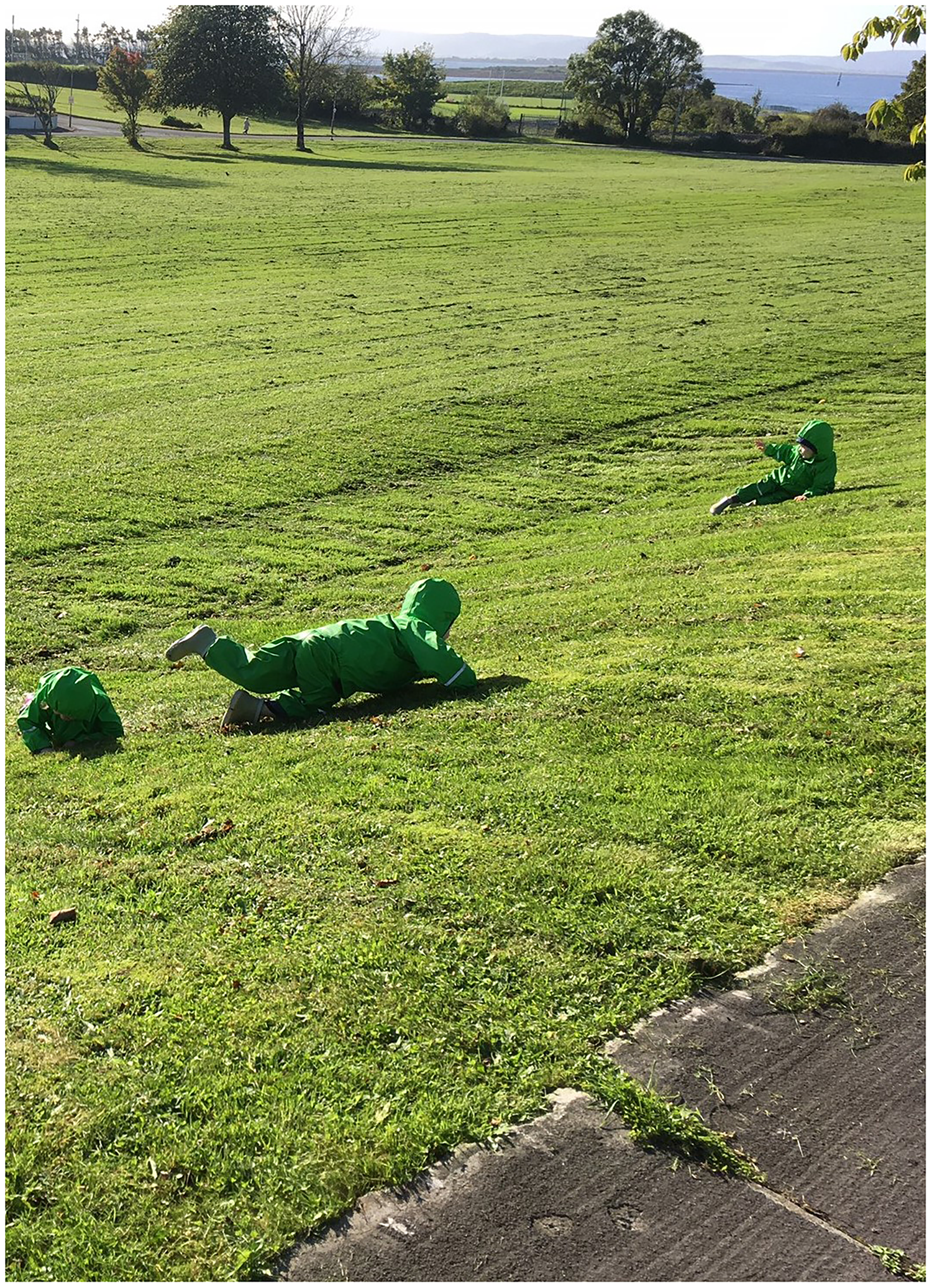
Decentring a child-centred gaze. Original image courtesy of Helen Hanley.
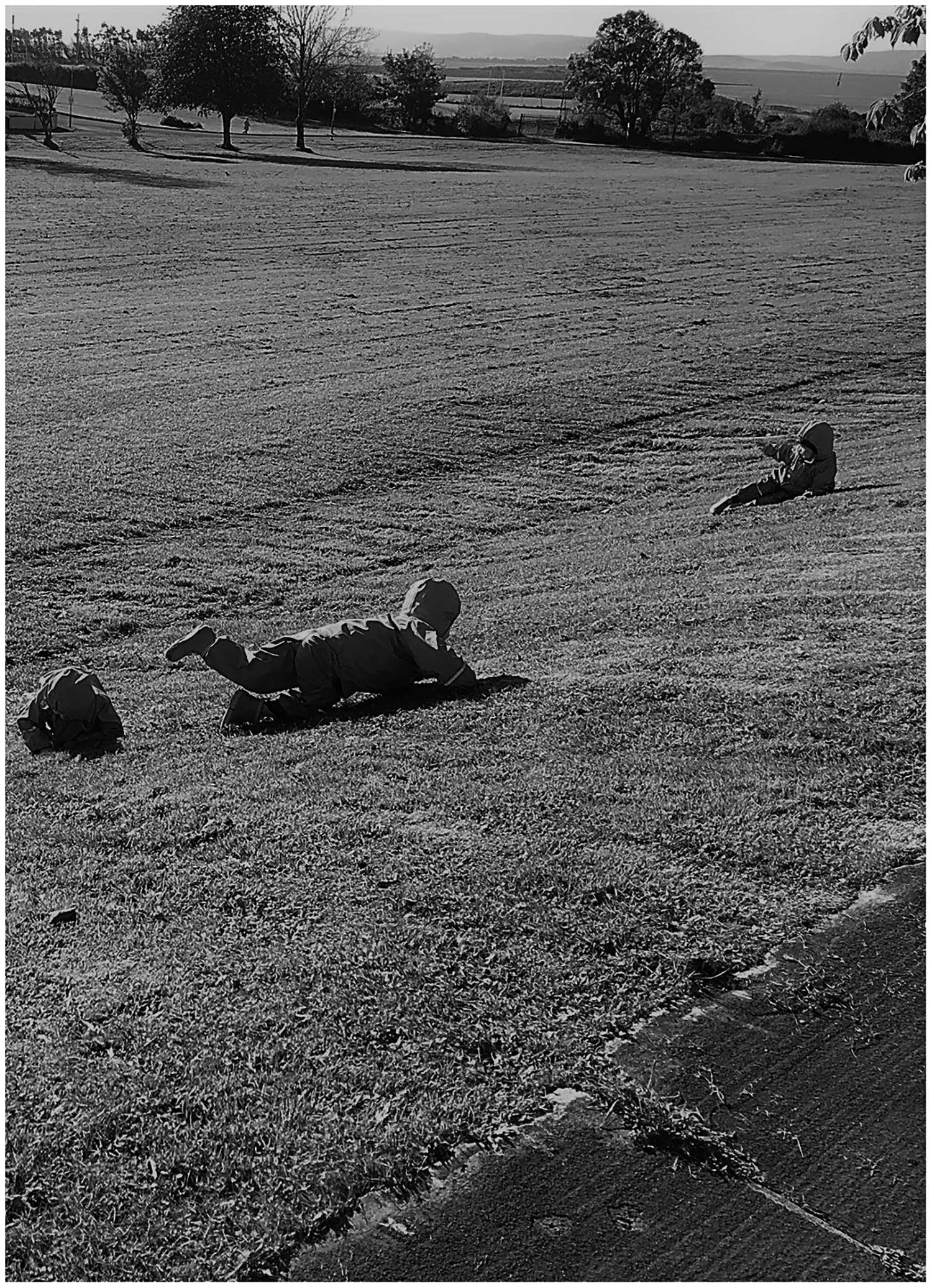
Listening to the spirit of reciprocity. Original image courtesy of Helen Hanley.
The structure of the article is as follows, firstly, the indigenous strand of the article is foregrounded to include a brief overview of my personal position, and the constraints of Irish mythology alongside the origins of the Crane bag. An onto-epistemology of water is explored through the work of indigenous thinkers Robin Wall Kimmerer (2020, 2003) and Margaret Somerville (2014, 2017), who reflect indigenous perspectives. Next, indigenous cosmology, spiritual essence and activism are discussed. The ensuing section presents the western strand of thinking from a posthuman perspective. Relying on the work of Karen Barad (2007, 2014), key concepts such as an ethico-onto-epistemology positioning, new materiality and agency, are considered. In situating this article within the scholarship of reconceptualising ECEC, I draw on research from Lenz Taguchi (2010), Jane Osgood (2022), and Hackett and Somerville (2017). This article departs from the fact that within ECEC, posthuman concepts, such as new materialism, have been successful in shifting a focus towards the more-than-human. However, this article foregrounds the need for posthuman concepts to contemplate the human–spirit relation from a local perspective, not only with nature but also with the research process itself. Indeed, this research responds to the challenges set out by Vintimilla et al. (2023: 6) to ‘create over and over, living knowledges which can nourish the field allowing new possibilities of provocation for early childhood education and care’. The subsequent section presents three key teachings from the Crane bag as experienced during the intra-action of braiding multiple theories; Teaching 1: An onto-epistemology becoming with the Crane bag; Teaching 2: Decentring a child-centred gaze; Teaching 3: Listening to the spirit of reciprocity.
Personal position in the knowledge-making process
To be clear the Irish are not an indigenous people. In a recent blog Billings (2022), highlights that modern Irish culture is a result of many factors including historical colonialisation, which was then replaced by self-colonisation. Hence, as Billings suggests there is no way of knowing what was or is indigenous. Nor is this an attempt to romanticise indigenous thinking or claim indigeneity. However, taking the lead from Watts (2013), this article draws on Irish mythology in a bid to access the pre-colonised mind. Knowledge, however, can never be neutral but is always heavily imbued with interpretations that correlate to the position and location of the subject (Haraway, 1988). While I recognise my own personal position as neither stable nor fixed, my lived experience is entrenched in a particular historical and political context. In the late seventies, due to the ongoing violence in Northern Ireland, along with many others my family was displaced (Urwin, 2021). These events influence the way in which I approach the knowledge-making process. Moreover, my position as an anglophone poses the risk of distorting other indigenous epistemologies (Sundberg, 2014; Todd, 2016; Watts, 2013). To address this ethical dilemma, I anchored my own subjectivity within a specific geographical location of place, hence drawing on local mythology.
Indigenous strand
Irish mythology
As with many indigenous knowledge systems, Irish mythology was passed down to generations through an oral tradition of storytelling known as Seanchaí (Ryan, 2006). Indigenous traditions of storytelling, as postulated by Bruchac and Smith (2014), convey important insights from animated entities, organic and non-organic. However, from the 4th century onwards, Irish mythology was adopted by early Christianity and produced in written form (Williams, 2016). Due to Christian censorship the authenticity of Irish mythology must be treated with a certain caution. Also, Ireland's history has been shaped by various events, including colonisation, poverty, mass famine, loss of language, emigration, alongside the repressive influence of the Catholic Church (Smyth, 2022). Furthermore, as portrayed by Lynch et al. (2012: 5), modern-day Ireland is an ‘Anglo-American zone of influence for reasons of history, culture, language, colonization and trade’. Undoubtedly, a turbulent history damages the integrity of Irish mythology as a body of authentic knowledge. Nonetheless, through an array of mediums Irish mythology has displayed a certain tenacity to refigure and capture the human imagination. These reconfigurations are embodied in literature, art, film, popular culture and neo-spirituality (Cluine and Maginess, 2015; Cullen, 2016; Williams, 1983). Inspired by Irish mythology's tenacity to reconfigure, this research deployed the artefact known as the Crane bag to think with. Additionally, this article is encouraged by Robin Wall Kimmerer's advice, a citizen of the Potawatomi nation (2020: 371), to ‘reclaim anything that may be of use, a story, a song, a tool that was dropped on the ancestral road, something for all our relations, human and more-than-human that can collaborate in shaping a worldview of flourishing in the future to come’. Also, reclaiming the myth of the Crane bag stands as an act of decolonising the knowledge making process within ECEC.
The Crane bag
The Crane bag is an artefact that appears frequently in Irish mythology and archaeological records. One of the first written accounts of the Crane bag is in the 13th century. As found by O’Flaherty (1996), from these literary references, the Crane bag appears to be much older, having been in circulation pre-13th century One day while swimming, Aoife, a princess of the Tuatha De Danann, was turned into a bird known as the Crane, by Luchra, a jealous rival who casted a spell. Subsequently, Aoife remained in Crane form for two hundred years. Upon Aoife's death, Manannan Mac Lir, deity of water, made Aoife's skin into a bag. This bag is known in Irish as the ‘Corr-bolg’, which translates to English as ‘the Crane bag’. Manannan placed his most treasured possessions in the bag. These treasures wielded powers to transform and protect the bearer. The contents and the bag are only visible at high tide. (Macneill, 2018; O’Flaherty, 1996)
Although there is much speculation as to the meaning of the Crane bag, archaeological investigation confidently conceives that the artefact reflects an ancient belief system that held a deep spiritual relationship with water (O’Flaherty, 1996; O’Toole and O’Flaherty, 2011). For example, Aoife was turned into a Crane while swimming. Cranes are water birds whose breeding grounds are wetlands. In Irish mythology, Manannan Mac Lir is a deity of water. The Crane bag and its contents only become visible at high tide. According to archaeological evidence water held a strong place in the social imagination of premodern times (Williams, 2016). In Ireland, this coincides with archaeological findings of hoards (collection of objects) in bags placed beside water. As highlighted by O’Flaherty, in pre-Christian Ireland, many hoards have been regarded as ritual offerings to deities or spirits validating the possibility that the bag had ritual purposes. Although Shiva (2013) stresses that indigenous thinking is far from homogenous, nonetheless water is commonly revered within most ancient beliefs as a source of knowledge with generative properties.
Onto-epistemology of water
Indigenous worldviews bring attention to different knowledge systems that are deeply intertwined with the spiritual and materiality of nature, particularly water. Collaborating with indigenous knowledge, Shiva and Somerville are among the many scholars around the world that are developing onto-epistemologies of water. In the 21st century Shiva (2013, 2016), highlights that water as a resource is being depleted and is one of the most urgent resource crises of our time. Indigenous thinker Kimmerer (2020) emphasises that water, land and humans are kin within an emerging processual relationship that can be accessed through ritual and ceremony, but most of all through listening. Additionally, indigenous knowledge from an aboriginal perspective, as reflected by Somerville (2014, 2017), is not only fundamental to addressing an escalating planetary crisis but also to signposting ways to restore our relational being with water. Likewise, Kimmerer points out that in the era of climate change ecological restoration is inseparable from the need to restore the human spiritual relationship with the Earth. In the embrace of indigenous systems of knowing, Somerville (2014: 410) remarks that the western knowledge holder needs to change from the privileged location of knowing to a position of ‘uncertainty and unknowing’. Furthermore, Somerville (2014: 410) argues that displaying positions of certainty and knowing creates ‘the necessary conditions for transformational change in how we know, practice, and do water in our everyday worlds’. Water onto-epistemologies, as highlighted by Crinall and Somerville (2020: 1317), have always being in existence where ‘becoming with water disrupts linear, predictable modes of knowing and being’. When knowing, like water, has no centre, only movement with flow, there is a continual alteration from the position of knowing to unknowing, thereby allowing knowledge to emerge rather than be acquired (Crinall and Somerville, 2020; Shiva, 2016; Somerville, 2014). Hence, becoming with water opens the possibilities of multiple worlds with diverse ways of being, allowing interactions beyond one fixed reality, where hierarchies of knowledge are managed by humans only.
Indigenous cosmology, spiritual essence and activism
Although indigenous knowledge systems vary, a shared concept of a webbed life force with the Earth can be found, commonly called animism. Animism is the belief that all things, water rocks, plants, animals and inanimate objects possess an essence of spirit. However, animism emerged within anthropology as a concept that promoted the colonialisation of indigenous lands worldwide. The word animism, which is Latin in origin, was first used by anthropologist E.B. Tylor. Animism was depicted by Tylor (1871: 382), as a belief system of ‘savages and lower races’ that fuelled an argument of evolutionary hierarchy between human beings. The political concept of animism became a defined attribution of primitive thinking which in turn justified the ‘civilised mind’ to carry out atrocities towards indigenous lands and people worldwide (Rose, 2013). Consequently, it is important to recognise that animism was part of a broader colonial project that pursued imperialism and domination. Throughout history indigenous communities and knowledge systems have endured colonisation, forced assimilation, displacement, genocide, and erasure of beliefs and traditions (Chunhabunyatip et al., 2018; Todd, 2016; Watts, 2013). For example, Moggridge (2023) highlights that the aboriginal people of Australia were not legally recognised as human beings by settled colonists until 1960. Therefore, it is vital to acknowledge the historical role that the concept of animism played in suppressing other ways of knowing. Indigenous knowledge espouses spiritual wisdom embedded within systems of communication that guide the human towards a reciprocal relationship with the more-than-human (Battiste, 2013; Snively and Williams, 2016; Todd, 2016; Watts, 2013). Accordingly, this positions human beings as having an ethical responsibility to live in harmony with the natural world. Planetarily, indigenous communities continually bring attention to the devastation of human activity on the Earth (Chiblow and Meighan, 2022). Amidst the historical and ongoing agenda to impose systems of racism and capitalism, Todd emphasises the fact that indigenous communities continue to draw on their spiritual beliefs to bring about change and assert their political rights. For example, in 2008, constitutionally, Ecuador acknowledged the rights of nature. This alternative constitutional development, as documented by Kauffman and Sheehan (2019), was shaped by the Ecuadorian indigenous movement against neoliberal economics. The Ecuadorian constitution now portrays nature's inherent right to all the Earth's ecosystems. Within the constitution, nature is referred to as Pachamama, a sacred deity from the indigenous tribes of the Andes, translated into English as ‘Mother Earth’. Notably, in 2017, after a long campaign by the Whanganui iwi, a local Māori tribe in New Zealand, succeeded in changing legislation when the Whanganui River was granted legal personhood and the status of a living entity (Hutchison, 2014; Kauffman and Sheehan, 2019). Indigenous communities have developed knowledge through generations of direct interaction with the natural environment, encompassing diverse fields such as medicine, ecology, agriculture and governance (Battiste, 2013). Yet these traditional systems of knowledge-making are continually rejected in favour of a western model of knowing (Castleden et al., 2017), even though indigenous philosophies of thought and modes of activities offer valuable insights into practices that embed holistic approaches to living in harmony with the Earth.
Western strand: Posthuman perspectives
Posthuman concepts of ethico-onto-epistemology
The posthuman perspective, as extensively illustrated by Braidotti, (2006, 2013, 2019), recognises the current dilemma of the human condition as living in the Fourth Industrial Revolution of advanced technology, while simultaneously dying in the current event of the Sixth Mass Extinction due to the geological force of human activity. This current dilemma is underpinned by a belief system that places the human subject in a position of exceptionality, which in turn has dislocated human connections with other planetary entities (Barad, 2007; Haraway, 1988). In going beyond the dislocation of the human subject, Barad questions the long-standing separation of epistemology and ontology as binary positions. According to Barad the division of epistemology and ontology in this manner has imposed an artificial split on how we are ‘in’, ‘being’ and ‘becoming’ of the world. This artificial split reflects the logic of Cartesian dualism that unethically insinuates an inherent separateness between ‘human and nonhuman, subject and object, mind and body, matter and discourse’ (Barad, 2007: 185). To overcome these imaginary positions of separateness in an ethical manner, Barad (2007: 185) proposes ‘ethico-onto-epistemology’ as a paradigm where ‘practices of knowing and being are not isolable; they are mutually implicated’. Hand in hand with the posthuman agenda of broadening the notion of ethico-onto-epistemology is the concept of new materialism. Alongside thinking about political discourses and culture, new materialism recognises the agency of matter as an integrated part of being in the world. New materialism, as expressed by Barad (2003: 801), is where all ‘matter comes to matter’. Furthermore, Barad (2007: 141) uses the term ‘intra-action’ to express that agency is not only exercised by humans but is a ‘dynamism of forces’, which is also exerted by the more-than-human. Although Rosiek et al. (2020) argue that there is nothing new in the concept of new materialism, in fact agency beyond the human condition is integral to many indigenous philosophies where all things in the world possess a spiritual essence to transform and co-shape the world. Thus, onto-epistemologies are at the core of indigenous perspectives. Indigenous thinkers such as Kimmerer would question the way in which western knowledge continually produces an artificial split between spirit and matter. Moreover, Shipley and Williams (2019) highlight that most social science researchers distance themselves from the metaphysical as it is not empirical, measurable, rationale or indeed objective.
Reconceptualising ECEC: New materialism
In ECEC, as part of the reconceptualisation movement that challenges normative child development, posthuman scholarship flourishes. According to Malone (2015), the application of posthuman concepts, such as new materialism, has been successful in dismantling the romanticised notion that children's pure relationship with nature will rectify the decimation of the Earth. Inspired by new materialism many scholars within the field of ECEC are opening spaces for understanding the ways in which children learn through the materiality of their bodies while interacting with the more-than-human world (Merewether, 2023; Osgood, 2022; Osgood and Andersen, 2019; Taguchi, 2010). For example, Lenz Taguchi puts forward intra-active pedagogy as a strategy to consider the entangled relations of children with other beings, where the more-than-human also has agency in the interaction. Merewether questions western concepts of knowing that position land and water as non-living entities. Furthermore, Merewether challenges colonial notions of animism by developing the concept of enchanted animism, which suggests that children's speculative play relates to the world in the spirit of kinship and care. Taking things a step further, Osgood (2022) asks us to consider a world with a deep sense of ethical responsibility for multispecies flourishing, where lichen, a plant, is taken seriously as a teacher of how humans and more-than-humans can collaborate in a story of earthly survival. In addition, Hackett and Somerville (2017) locate posthuman literacies of young children in the actions of moving with the more-than-human world. Hackett et al. foreground material realities in an exploration of children's literacies that relies on Barad's (2007, 2014) description of being in the world were vibrational movement captures agency as a dynamism of forces between the human and more-than-human. This exploration of children's communication together with the more-than-human is exemplified through bodies moving in motions of banging, marching and playing with mud (Hackett and Somerville, 2017). Hackett and Somerville also base these observations on points made by Taguchi (2010: 48), ‘that the skin is not the border of our bodies but a territory or region of interference, a “diffraction” of communicative “waves” between matters’. Building on the previous research of posthuman literacies, Hackett and Rautio (2019) put forward running and rolling with a grassy slope as multimodal forms of meaning-making between the human and the more-than-human. Thus, the human-centric perception of the children's actions of running and rolling is disrupted as an intentional response to the environment only. Moreover, the agency of the grassy slope emerges through the action of the children, as the more-than-human participates in these moments of multimodal communication (Hackett and Rautio (2019). These pedagogical shifts offer new possibilities for early childhood educators to frame inclusive meaning-making with other entities where the materiality of body and mind entangle with the agency of the more-than-human. However, Watts (2013: 30) criticises posthuman theories for neglecting the spiritual essences of the more-than-human, which in turn has led to a ‘subjugated agency’. Thus, the concept of agency for the more-than-human is diluted and in fact is in danger of recreating a system of suppression. In this epoch of rapid climate change, Kimmerer (2020, 2003) reminds us of the fact that we are not in control of nature. However, we are in control of our relationship to the Earth. Thus, as stressed by Kimmerer (cited in Aronson et al., 2011: 257) the human obligations to the more-than-human world are ‘simultaneously material and spiritual, and, in fact, the two are inseparable’.
Reclaiming the teachings of the Crane bag
Teaching 1: An onto-epistemology becoming with the Crane bag
Returning to the story of the Crane bag, Aoife, transmuted across space and time, continually renegotiates the boundaries of form, firstly from a human body to a Crane bird, then from a bird to a bag: human–more-than-human–organic–nonorganic–dead–matter–spirit. Somerville (2014: 407) highlights that ‘it is through skin, the permeable membrane between inside and out, that humans-more-than-humans participate in the flesh of the world’. Also, skin, as Taguchi points out, is not a fixed boundary of our bodies but a location between matter. In the intra-action of braiding indigenous knowledge with posthuman concepts, the writing/thinking became more than a fleshy endeavour only. Upon Aoife's death as a bird her skin was made into a bag filled with objects that have the power to transform the bearer. The contents and the bag are only visible at high tide. The element of water is a metaphysical site that supports going beyond the limitations of physical bodies to include spiritual spheres of practice and thought (Somerville, 2014, 2017). As the data ebbed and flowed, the Crane bag reorientated the research to decentre from the human-physical form of knowing. Thus, the methodological approach transformed from a representational mode to a cyclic process of doing–being–knowing–unknowing. Through the writing process, I moved beyond the boundaries of skin and thought to become immersed in water with/as the Crane bag. Transmuting across space and time not bound by skin, Aoife transformed, as did I, to experience the pluralistic aspect of spirit in the knowledge-making process. In this immersive intra-action, a pluralistic position unfolded, which resonates with points made by Barad (2007: 185), that the ‘practices of knowing and being are not isolable; they are mutually implicated’. Furthermore, an onto-epistemological framing, as advocated by St. Pierre (2021), does not begin with the human subject, and therefore detaches any claim in advance to know the methods or modes of analysis. Surrendering from the position of knowing to unknowing, from certainty to uncertainty, the data ebbed and flowed to allow knowledge to emerge.
Initially, this article aimed to present findings collected from an empirical set of data, where twenty postgraduates explored their pedagogical practice within ECEC. During the data-collection phase for the original proposal, a photograph (Figure 1) capturing children rolling down a hill was submitted by a participant as an example of their approach to safety. Assent was sought from the children on the day that the photograph was taken. Dialogue between indigenous knowledge and posthuman concepts helped articulate the idea of the Crane bag as a tool for creating a foundational shift towards an onto-epistemological becoming with water. This changed the approach to analysing the data. In agreement with the research participant, I re-present the photograph in a different format (Figure 2) to tell the story of how the approach to data analysis changed. An onto-epistemological position created an opening to decentre the image of the child. Decentring a child-centred gaze in turn allowed the more-than-human, in this instance green suits, a photograph, a grassy slope, to come to the fore in the spirit of reciprocity. Decentring the image of the child within the analysis was a crucial move to listening to the more-than-human. Applying posthuman concepts solely within the analysis ran the risk of recapitulating the colonised discourses of animism alongside reducing the notion of materiality to just the physical and biological. However, within the folds of this article, indigenous knowledge has allowed the Crane bag to come forward as a tool that supported an onto-epistemological becoming, while recognising the spiritual relationship between humans and the more-than-human. The next section presents the processual ways that the more-than-human emerged within the data.
Teaching 2: Decentring a child-centred gaze
In an exploration of pedagogical practice with postgraduates within ECEC, a photograph (Figure 1) was submitted by a research participant with the following explanation: For safety, I usually asked the children to spread out, so they could roll down the hill without bumping into each other. On this occasion, I didn’t say anything about safety. And off they went rolling down the hill. (participant)
As the researcher, I began to analyse the data. On the initial viewing of the photograph, I centred the timeless childhood experience of rolling down a grassy slope. It was/is difficult to go beyond the revered practice of centring the child, which is grounded in a human-centric perspective. Within pedagogical practice, centring the child as the main figure in the early educational experience is a prevailing approach in western-based teacher training (Land et al., 2022; Langford, 2010). Thus, the more-than-human elements of the photograph such as the grassy slope, the distant sea, all appeared less significant to that of the children's experience. I considered questions raised by Taylor and Pacini-Ketchabaw (2015) regarding theories of normative development, which tend to idealise the child in nature, thereby maintaining nature–culture binaries. From a child-centred perspective, many programmes in ECEC promote the outdoors as a perfect medium for children to take risks and develop holistically. However, Nxumalo and Cedillo (2017) highlight that the idealisation of the child's experience in nature disregards the context of neocolonial relations, social injustice and ecologically damaged places. Despite these considerations, as I viewed the photograph the children continued to be the first point that drew my human eye, alongside the brightness of the green suits. The children rolled down the grassy slope to the backdrop of the ocean, their green weatherproof suits protecting them from the elements, simultaneously protecting and hindering the children in their interactions with the grassy slope. This reflection aligned with observations made by Osgood (2022: 7) of a group of children playing in an outdoor park in London where ‘small bodies and what they can do are reconfigured by the clothing that is designed to enable greater freedom but somehow imposes restrictions’. Not all children, however, are protected from the harshest of the elements, nor do all children get to experience nature in a benevolent manner. The sea beckons as water calls me to listen. I think of the children who are not centred in the photograph. The children who risk their lives crossing the sea in a bid to escape war as they experience the harshness of both nature and humankind. According to the UNCHR database (2023), at the end of 2022, of the 108.4 million forcibly displaced people, an estimated 43.3 million (40 per cent) are children below 18 years of age. I present this one stark statistic as a heavy reminder that our relationships are not only broken with the Earth but with ourselves as humans, where some children are disproportionately bearing the burden.
Teaching 3: Listening to the spirit of reciprocity
As the data ebbed and flowed, the Crane bag reorientated me as the researcher to decentre from the human-physical form of knowing. This reorientation brought forth an onto-epistemological becoming with water, where knowledge has no centre, only movement and flow. In turn this created an openness within the research process that allowed the photograph to come to the fore as a teacher. In agreement with the participant, I as the researcher re-present the photograph (Figure 1) to tell the story of how becoming with water in the form of the Crane bag changed the approach to data analysis (Figure 2).
In the preparation of this photograph for publication, I applied the prescribed criteria of grayscale 600-dpi resolution to the image. In Figure 2, the application of grayscale resolution removed the colour from the image, which in turn removed from the mind's eye the restriction of binary dualism between the human and the more-than-human. In this moment the children became forms rather than discursive bodies (forms refer to the dimensional shapes observable in the photograph). The grayscale of all entities in the image melted into one. For me, the grayscale resolution allowed the images of the children as entities to move, as advocated by Haraway (1988), from the humanistic paradigm ‘I am in nature’ to the posthuman paradigm ‘I am of nature’. In this moment the grass was no longer rendered inferior to the human experience. In keeping with Barad's notion (2007: 152) that ‘matter and meaning are mutually articulated’, the grassy slope and the children became joint in their materiality, guiding each other in the physical fleshy realm. Aligning with the research by Hackett and Rautio (2019), which points to the relation between the grassy slope and the motion of the rolling human body, the environment invites the child to run or roll. The human and the more-than-human respond to each other in a multimode of communication. Additionally, Hackett and Rautio (2019) argue that the child might intend to roll down the grassy slope, yet it is not her rolling body alone, but the difference between human and the more-than-human that sets the body in motion. The physical action of rolling and running by the children in response to the environment demonstrates the animated capacity and agency of the grassy slope (Hackett and Rautio, 2019). Yet, an indigenous worldview recognises the interconnectedness of all beings and entities within a reciprocal relationship that extends to both the material and the spiritual. There is no divide. Although, positioning the human from I am in nature to I am of nature removed the binary divide of nature/human, there was/is a continued risk of creating a hierarchical frame that subjugates the agency of the more-than-human. Thinking from an indigenous perspective, Kimmerer (2020, 2003) emphasises how plants and other beings communicate and respond to human presence and actions. For example, grasses, as highlighted by Kimmerer (2020), carry their growing points beneath the soil surface, so when their leaves are lost, they can quickly recover, but this recovery is dependent on disturbance to stimulate growth. In this moment, I return to the Crane bag, to encompass both the spiritual and the material with no divide. Aoife, a descent of Danu, an Earth goddess, continually renegotiates the boundaries of her body, shifting from human form to more-than-human form, as a bird and then a Crane bag, where matter is not only active but vital with spirit. Hence, through the prism of the Crane bag the children are not restricted to bodies fixed by skin or thought only. Nor is the grassy slope constrained to a form of subjugated agency. The grassy slope is not silent or mute, the grassy slope is communicating, the children are rolling on the Earth, close to the ground – listening. The children listen as the grass speaks. Indeed, as expressed by Kimmerer, plants are viewed as guides which help humans to explore their higher consciousness of interconnection with the Earth. Thus, the children's bodies become actions, which are spiritually bound to the land's intentionality accessed through the ritual of rolling. To this end, the intertwining of the children and the grassy slope becomes more than matter that is mutually articulated. The ritual of rolling connects the human spirit with the spirit of the land in a moment of restoration that is embedded in a reciprocal relationship of give and take.
In gratitude
Through the ritual of braiding multiple theories, the teachings of the Crane bag became an invitation to experience knowledge-making within the discipline of ECEC as a spiritual force. Within the process of writing there was a connection to the spirit of a shared world. This article thereby serves as one example, not a blueprint, amongst many, of how spirit might manifest within the research process itself. Indigenous worldviews bring attention to different knowledge systems that are deeply intertwined with the spiritual and materiality of nature, particularly water and land. Guided by the teachings of the Crane bag, as a lost local knowledge, there was a becoming with water, where knowledge has no centre only movement and flow. This becoming with the Crane bag afforded an onto-epistemological framing, which overcame the artificial split between spirit and matter. In the convergence of posthuman concepts with an indigenous worldview, the position of certainty was disrupted. Thus, the research process was transformed from predictable ways of knowing to unanticipated modes of meaning-making that emerged in the intra-action of doing.
This disruption brough forth several paradigm shifts for me as the researcher that included decentring from a child-centred gaze to a posthuman location, where matter between the human and the more-than-human is mutually articulated. A further paradigm shift occurred that recognised the interconnectedness of all entities within a reciprocal relationship that extends simultaneously to the material and the spiritual. Indeed, in refocusing the reciprocal relationship between water, land and the human as both material and spiritual, this article responds to the challenges set by Vintimilla et al. (2023) to create living knowledges which can provoke new opportunities in ECEC.
Reclaiming the myth of the Crane bag stands as an ethical and political act of dismantling colonised methods of knowledge-making within ECEC. Furthermore, this article urges posthuman perspectives to recognise that colonial discursive practices still vibrate in many guises, such as the fabricated split between spirit and matter and the concept of animism. The Crane bag guided this story to respond in some ways to indigenous thinker Robin Wall Kimmerer's question (2020: 31), ‘how in our modern world can we find our way to understand the Earth as a gift again, to make our relations with the world sacred again?’
In gratitude for the teachings of the Crane bag, I offer this article as a story of collaboration between humans and the more-than-human in shaping a worldview of listening within a sacred relationship of matter and spirit.
Footnotes
Acknowledgements
I would like to acknowledge all the reviewers who read earlier versions of this article, and the more-than-humans involved in the creation of this article. All errors are my own.
Declaration of conflicting interests
The author declared no potential conflicts of interest with respect to the research, authorship and/or publication of this article.
Funding
The author received no financial support for the research, authorship and/or publication of this article.
