



Abstract
Few would dispute the importance of equity, inclusion and belonging in early childhood education and care, yet translation into meaningful practice rarely centres the priorities of historically divested communities. The national learning framework for early childhood in Australia is the Early Years Learning Framework, positioning the child as a capable agent and describing inclusive, culturally competent practice. This article presents part of a larger study investigating educators’ beliefs and practices when using culturally diverse literature to address the Early Years Learning Framework’s diversity principles. A critical theoretical framework enables a robust examination of how the Early Years Learning Framework constructs, maintains, legitimises and/or disaffirms social inequities, implicitly probing how literacy education mediate/s messages children receive about their identity, cultures and roles in society. The findings suggest that instead of pursuing anti-racism and transformative justice, educators’ pedagogical practices were likely to legitimise existing racist structures. The findings are discussed in relation to 20 recommendations published by a consortium of experts in the updating of the Early Years Learning Framework. The implementation of the updated Early Years Learning Framework must act on questions of justice for whom and according to whom. To move to ideologies, methodologies and pedagogies of potentiality, it is necessary to interrogate and reject oppressive and harmful practices, inaccurate and insensitive portrayals, and pedagogies damaging to Black, Indigenous, and other communities of Color which this study shows have beenevident in the EYLF to date.
Keywords
Introduction
Few would dispute the importance of equity, inclusion and belonging in early childhood education and care (ECEC). Yet despite the articulation of principles of diversity in educational policy worldwide, translation into meaningful practice has rarely centred the priorities of historically divested communities (Souto-Manning, 2021). Instead of pursuing anti-racism and transformative justice (Winn and Winn, 2021), many practices legitimise existing racist structures, with experts arguing that ‘there is much work to do in order to upend … racist structures and exclusionary practices’ (Souto-Manning, 2021: 1). The process of book sharing is one way in which educators can assist in strengthening children's learning about justice and equity.
Educators can disrupt exclusionary practices promoting equity and inclusion principles through the culturally responsive sharing of diverse children's literature (Boutte et al., 2008; Roberts et al., 2005; Souto-Manning, 2009; Souto-Manning and Mitchell, 2009; Souto-Manning et al., 2019). When educators incorporate authentically diverse literature, they can engage children in conversations to develop understandings of the sociopolitical dimensions of society and children's lifeworlds (Morrison et al., 2019). Importantly, this can help children from majority groups ‘to develop the kinds of skills that will allow them to critique the very basis of their privilege and advantage’ (Ladson-Billings, 2017: 83). For this practice to be effective in pursuing anti-racism and transformative justice, it can be argued that educators would need to engage in culturally responsive practices to ensure that children's backgrounds and funds of knowledge are central to the experience (Morrison et al., 2019).
In Australia, early education and care is governed by the Australian Children's Education and Care Quality Authority, and ECEC settings are required to follow the Early Years Learning Framework (EYLF; Department of Education, 2022; Department of Education, Employment and Workplace Relations, 2009), which forms the foundation for ECEC in Australia. The EYLF recognises and articulates the importance of children's books as a means to explore, value and encourage the appreciation and use of diverse languages and cultural backgrounds; build on children's existing knowledge and languages; and explore, listen to and appreciate diverse perspectives. Further, the EYLF encourages educators to include texts in the home languages of children and also highlights that texts are culturally constructed artefacts that can promote consideration of diverse perspectives. In addition, explicit mention is given to encouraging educators to share oral and written stories from Aboriginal and Torres Strait Islander traditions, and from Australia’s geographic neighbours, as well as those brought by immigrants to Australia. The EYLF also highlights that when engaging children with literature, there is an emphasis on ‘sharing the enjoyment of language and texts’, and beginning ‘to understand and evaluate ways in which texts construct identities and create stereotypes’ (Department of Education, Employment and Workplace Relations, 2009: 28).
This article reports on educators’ understandings and practice when using culturally diverse literature to address diversity, inclusion and EYLF principles, and how these challenged, disrupted or reproduced racist structures and exclusionary practices. The findings are also considered in light of the National Quality Standard (NQS) and its relationship to the EYLF. This article reports on part of a larger study conducted in four Western Australian ECEC settings since the release of the EYLF and in view of the soon-to-be-implemented updated EYLF.
Why diverse literature is important to combating racism and prejudice
In Australia, the work of Mac Naughton (2001) through the Preschool Equity and Social Diversity study found preschool children to have strong awareness of colour and race, including the association of these with power. Mac Naughton (2001) further highlights that children define both themselves and others through these understandings. Other evidence demonstrates that children develop their own race bias from a very young age, with some suggesting that this can be as early as three months of age (Apfelbaum et al., 2012; Bar-Haim et al., 2006; Ito and Urland, 2003). Interestingly, evidence also shows that the disruption of this bias can also take place with very young children through exposure to diverse races, even in picture form (Bar-Haim et al., 2006).
The provision of authentic diverse children's literature through culturally responsive practice is a powerful way for educators to help children develop identity, intercultural understandings and global perspectives (Bishop, 1997; Boutte et al., 2008; Souto-Manning, 2009; Souto-Manning et al., 2019). When using diverse books in culturally responsive ways, educators can assist children to develop critical awareness of wider sociopolitical dimensions of communities and society (Morrison et al., 2019) through the examination of privilege and equity (Ladson-Billings, 2017; Souto-Manning et al., 2019; Yared et al., 2020). Thus, educators can ‘support their students to become both critically literate of texts and critically conscious of the social, cultural, economic, and political dimensions of their life-worlds’ (Morrison et al., 2019: 23). Importantly, this supports ‘those in the mainstream to develop the kinds of skills that will allow them to critique the very basis of their privilege and advantage’ (Ladson-Billings, 2017: 83).
Is diversity portrayed in the literature being used in ECEC settings?
Studies, including the larger study related to this article, show that many book collections for children reflect monocultural Eurocentric viewpoints (Adam, 2021; Adam and Barratt-Pugh, 2020; Crisp et al., 2016), and often the only representation of diversity in these collections is stereotypical and outdated. For example, in Adam’s and Barratt-Pugh study (2020), only 18% (n = 432) of 2413 books reflected any level of cultural diversity and, in the majority of these, diverse characters played insignificant roles, often only reflected in background illustrations. Only 2% (n = 42) of the books portrayed authentic contemporary representations of an under-represented cultural group, and only three of these books portrayed contemporary representations of Aboriginal and/or Torres Strait Islander peoples.
Studies from others (e.g. see Boutte et al., 2008; Crisp et al., 2016) show a similar dearth of diverse literature in early education settings. Thus, the absence of positive representations of diverse races contributes to the invisibility of those from under-represented groups (Adam, 2021). Further evidence suggests that this lack of diverse books, coupled with a lack of culturally responsive practice in book sharing, leads to a superficial focus on visible aspects of culture, including food, clothing and celebrations (Adam, 2021; Adam and Byrne, 2023; Harbon and Moloney, 2015). Such practice leads to the diminishing and othering of children from under-represented backgrounds and the reinforcement of a sense of white superiority in majority-background children, thus legitimising existing racist structures rather than promoting opportunities to combat racism and prejudice.
The EYLF and NQS in Australia
Background to the EYLF
Australia's first national EYLF was a policy initiative released in 2009, as part of the National Quality Framework, which is designed to drive quality in early education. As part of the National Quality Framework, the quality in ECEC is rated and assessed using the NQS by each state or territory's regulatory authority (Australian Children's Education and Care Quality Authority, 2018). There are five quality ratings: Excellent, Exceeding, Meeting, Working Towards and Significant Improvement. Services rated lower tend to be re-rated more frequently than those with higher ratings. The NQS requires ECEC services to base their educational program on approved learning frameworks, such as the EYLF.
The EYLF (Department of Education, Employment and Workplace Relations, 2009) positioned the child as a capable agent and described inclusive and culturally competent practice, like that foregrounded in the United Nations Convention on the Rights of the Child (Office of the High Commissioner, 1989). The writers later claimed that they had envisioned an anti-bias curriculum but that political pressure had led to a ‘toning down’ (Derman-Sparks and Anti-Bias Curriculum Task Force, 1989: 7), and that Aboriginal and Torres Strait Islander peoples had been rendered invisible in the final approved EYLF (Sumsion et al., 2009).
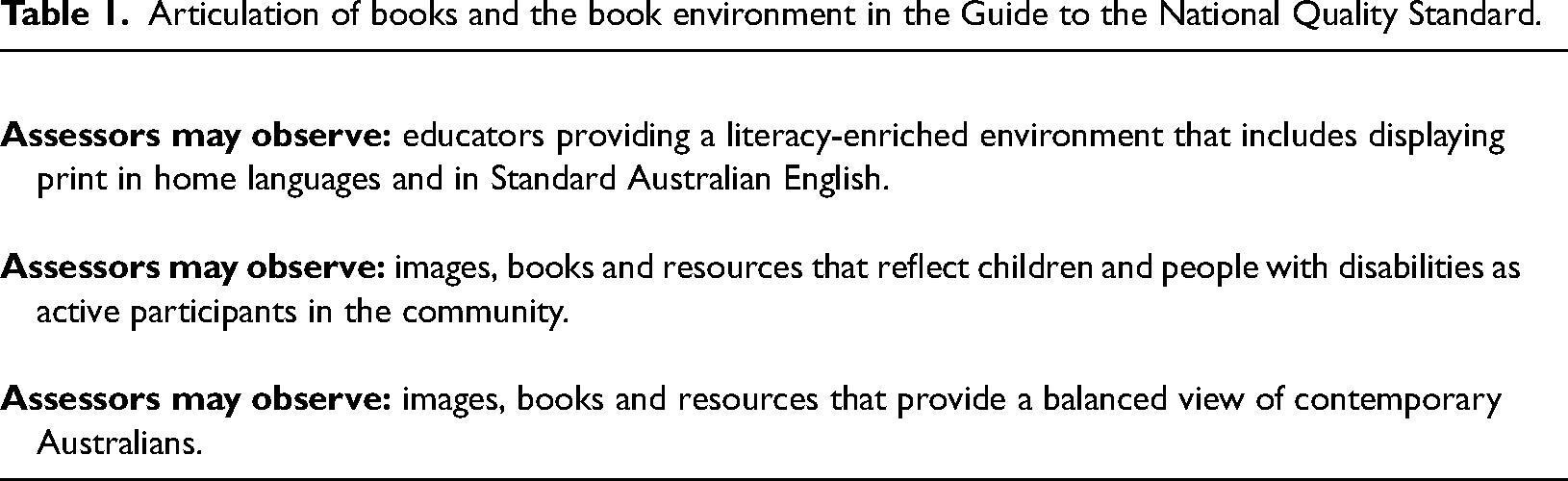
While the information in the EYLF outlines the use of diverse books with children, the same level of emphasis is not reflected in the National Quality Standard Assessment and Rating Instrument (Australian Children's Education and Care Quality Authority, 2018), which is the mandated measurement instrument for early learning environments. The Guide to the National Quality Standard (Australian Children's Education and Care Quality Authority, 2017) makes three references to books under the heading ‘Assessors may observe’ when assessing three of the elements of the NQS, thus suggesting that the evaluation of books may form part of the assessment of a centre but the NQS itself requires no formal evaluation of this. These three references are shown in Table 1.
Articulation of books and the book environment in the Guide to the National Quality Standard.
Updating the EYLF
In 2021, a consortium led by a partnership between Macquarie University, Queensland University of Technology and Edith Cowan University was engaged by the Australian Children's Education and Care Quality Authority to deliver the National Quality Framework Approved Learning Frameworks Update project. This consortium made 20 recommendations for updating the EYLF, strengthening elements of Aboriginal and Torres Strait Islander perspectives, inclusion, equity, cultural responsiveness and culturally safe environments for children and families (Hadley et al., 2021). Version 2 of the EYLF was subsequently trialled and released in 2022 (Department of Education, 2022).
Given this consortium's recommendations, it is timely to consider whether Sumsion et al. (2009) may have been justified in stating that the original EYLF fell short of providing direction for educators to strengthen children's learning about social justice and equity. In this article, this is considered through the lens of book sharing. Similarly, it could be argued that the new consortium's recommendations to strengthen Aboriginal and Torres Strait Islander perspectives, diversity, inclusion, anti-racism and transformative justice must be evident in the updated EYLF and evaluated in the NQS. Over time, the NQS has undergone revision, where later versions have attempted to address the potential for ‘narrow, reductionist, compliance-oriented approaches’ (Sumsion et al., 2018: 342).
The consortium developing the updated EYLF gave 20 recommendations for improving the EYLF (Hadley et al., 2021). Three of these relate to the focus of this article and open thinking on how to use book sharing as a vehicle for transformative justice. This section outlines these three focus areas in updating the EYLF (Department of Education, Employment and Workplace Relations, 2009) and their importance to centring the priorities of historically divested communities.
Cultural responsiveness and safety
Culturally responsive pedagogy originated in the USA in the context of promoting equity in African American education (Morrison et al., 2019). The definitions of culturally responsive pedagogy acknowledge the cultural ‘funds of knowledge’ (O’Keeffe et al., 2019: 154) that children bring to the service as a conduit for the teaching process (Ukpokodu, 2011: 48). Countries in which culturally responsive pedagogy has been embraced have seen ‘promising outcomes among marginalised student populations’ (Morrison et al., 2109: v; see also Aronson and Laughter, 2016). Morrison et al. (2019: v) argue that while much research and the incorporation of culturally responsive pedagogy has been undertaken internationally, there has been ‘very little attention in Australian educational policy or practice’. Therefore, it must be argued that attention to culturally responsive pedagogy needs to occur in Australia. Further, this must include consideration of how culturally responsive pedagogy would be differently approached in Australia with regard to the Australian context to accommodate the historical treatment of Indigenous Australians and the position of indigeneity, as opposed to the historical experience and implications of slavery amongst African Americans. Encouragingly, the recommendations of the consortium for the updated approved learning frameworks call for a shift in practice to ensure equity, cultural responsiveness and culturally safe environments for children and families (Hadley et al., 2021). Evidence shows that, in programs with a strong focus on culturally responsive pedagogy, children's language, culture, cultural knowledge and life experiences are welcomed and incorporated into rich teaching and learning environments with benefits for all children (Adam, 2021; Miller and Petriwskyj, 2013; Morrison et al., 2019; Zilliacus et al., 2017). Such approaches create culturally safe spaces and build cultural responsiveness (Barblett et al., 2021).
However, others have found that, in many contexts, including Australia, children's languages and cultural backgrounds are viewed as deficits or burdens (Boutte et al., 2021; Buchori and Dobinson, 2015). Ignoring the social and cultural worlds of children leads to educational environments in which ‘some literacy practices are valued while others are devalued’ (Compton-Lilly, 2009: xii). This can contribute to the perception of culturally and linguistically diverse children as lacking, requiring more support or interventions to bolster their language and literacy development when, in fact, their own literacy backgrounds are not recognised or valued (Compton-Lilly, 2009; Sumsion et al., 2009; Whittingham et al., 2018). As a result, ‘the longstanding traditions of oppression, racism, and white supremacy … are systemically reseated and reinforced by learning and social interaction’ (Patel, 2016: i).
Developing citizenship
Goal 2 of the Alice Springs (Mparntwe) Declaration (Department of Education, Skills and Employment, 2019: 6) advocates that all young Australians ‘become … active and informed members of the community’. Culturally responsive learning experiences can ‘build inclusive attitudes towards diverse groups, enabling children to contribute to respectful practices’ (Barblett et al., 2021: 18) and thus develop understandings of responsible citizenship. Studies suggest that children should be involved in ongoing discussions about race, racism and racial bias (Yared et al., 2020) to actively develop intercultural understandings and counteract racism and discrimination. Moreover, studies show that children are capable and open to having these conversations (Silva and Langhout, 2011; Yared et al., 2020). Such conversations have the potential to develop children's sense of citizenship. When sharing diverse books with children, educators can stimulate discussions about diversity, difference and respect.
Embedding Aboriginal and Torres Strait Islander perspectives
Particular concerns are held that ‘Aboriginal and Torres Strait Islander cultures, ways of knowing and being are silenced in the EYLF with general statements about diversity’ (Barblett et al., 2021: 14), leading to overlooking the development of respect for and understanding of Indigenous knowledge (Sumsion et al., 2018). This, arguably, is evidence of systemic racism and bias, and counter to the goals of the EYLF. The inclusion of Aboriginal and Torres Strait Islander literature, along with oral stories, is one way educators can embed Aboriginal and Torres Strait Islander perspectives in ways to assist in Reconciliation.
This article aims to consider how book-sharing practice implemented through the EYLF constructs, maintains and legitimises and/or disaffirms social inequities.
The study
Conceptually, this study is framed within a critical pedagogical perspective (Boutte et al., 2008). Implicit in this is a probe into how literacy education including literature ‘mediates messages that children receive about their cultures and roles in society’ (Boutte et al., 2008: 943). This article comes from a larger study that investigated kindergarten educators’ practice when using literature to meet principles of diversity (for more on the larger study, see Adam, 2019).
The research questions for this study are:
What is the nature of educators’ understanding and practice in addressing principles of diversity through culturally responsive use of children's literature? What influence do the requirements of the EYLF and National Quality Framework have on educators’ understanding and practice in addressing principles of diversity through culturally responsive use of children's literature?
Participants
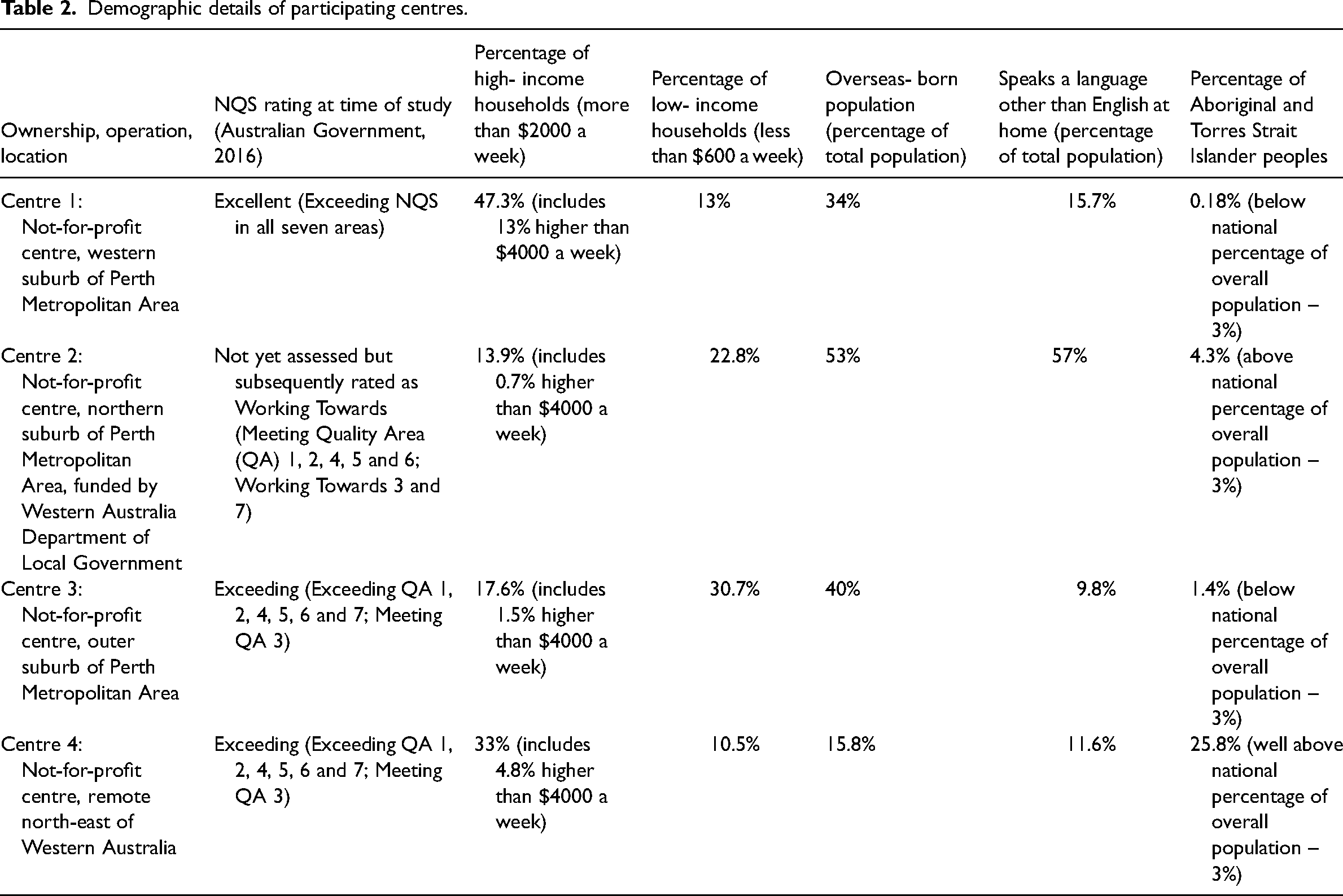
The study was conducted in the kindergarten rooms of four long-day-care centres in Western Australia, which were selected by stratified purposeful sampling informed by data from the 2011 Australian Census (Australian Bureau of Statistics, 2011), ensuring a range of demographic locations, and included one centre catering for a large Aboriginal population. Twenty-four educators participated, including kindergarten educators and centre coordinators. Their qualifications ranged from an Education Assistant Diploma to a Bachelor of Education. One hundred and ten children also participated. Table 2 gives the demographic details for the four centres.
Ethics
Ethical approval was granted through the University Ethics Committee (Approval Number 10741). The adult participants in the centres were given an information letter outlining the purpose of the research and their involvement. They were informed about confidentiality, security and their right to withdraw at any time, and asked for signed consent. The children's parents gave informed consent for observation of the children's participation in book sharing. The researcher spent time in each centre showing the children the video cameras and talking to them about the process of recording them prior to beginning the observations. The children were asked for their verbal assent and, during the observations, the children's rights to remove themselves from being video-recorded were honoured at all times. The centres and participants were assigned pseudonyms.
Data sources
For the purpose of this article, data was drawn from the following:
27 hours and 7 minutes of video observations of book sharing between the educators and children; 3 hours and 35 minutes of recorded interviews with the educators about their perceptions and practices when sharing books with children to promote principles of diversity; 672 pages of centre documents, including policy and curriculum documents as well as planning documents and records of children's activities.
This article also draws on findings from another part of the larger study, in which the 2413 books available across the four centres were audited for representation of cultural diversity. These multiple data sources provided opportunities for triangulation of the findings, thus enabling validation of the themes by cross-checking the information.
Interviews
At the commencement of the study, each centre coordinator and lead educator was interviewed. The educators were asked about their experience, their understandings and practice relating to selecting and using children's literature, and their understandings of children's literature in relation to the EYLF. Appendix 1 presents the semi-structured interview framework that was used for the interviews. Further semi-structured interviews took place before and after the recorded book-sharing sessions to ensure the researcher was aware of the teachers’ attitudes and rationale for book selection and practices. Once transcribed, the interviews were returned to the educators for endorsement or correction. Thus, the potential for misinterpretation of their motivations and aims was mitigated.
Video-recorded observations
Video-recorded observations were made of all book-sharing sessions involving an educator and one or more children over a period of five consecutive weekdays in each centre. The researcher designed a detailed observation spreadsheet to record details relating to the book-sharing sessions. The data included the stated intention of the session, the book used for the session, and associated analyses of each book regarding its cultural diversity, viewpoint and ideologies (Adam and Barratt-Pugh, 2020).
Documentation
The documentation, which was collected with the educators’ consent, included centre policy, curriculum planning and reporting documents, and educator documentation related to the recording of children's activities.
Data analysis
The semi-structured interviews and teachers’ discourse in the video-recorded observations of book sharing were transcribed and, along with the centre documentation, analysed following Braun and Clarke's (2006) five stages of thematic analysis through an inductive approach, in which ‘frequent, dominant or significant themes inherent in raw data emerge from the application of a systematic analytical process’ (Crisp et al., 2016). NVivo 10 was utilised as a tool to support this analysis. Once the themes were induced, a second coding cycle using deductive analysis focused on describing the following themes found in the first cycle of analysis: educators’ beliefs, perceptions and attitudes towards cultural diversity and children's backgrounds, and the role and practice of using and selecting children's books to meet the principles of diversity.
Two experienced researchers and the first author analysed the data and intercoder agreement was shown, giving some trustworthiness to the themes coded from the data. Common themes were induced from the first cycle of analysis and allowed for comparison and contrast in the second cycle. In this synthesis of the themes, significant relationships and their meanings were sought.
Demographic details of participating centres.
Findings and discussion
The analysis revealed three interrelated findings: (1) a mismatch between the EYLF and the NQS, resulting in exclusionary and harmful practice; (2) books as resources – problems with policy; and (3) narrow views of children's backgrounds, cultures and interests, and how these relate to book use.
Mismatch between the EYLF and the NQS, resulting in exclusionary and harmful practice
This study found that book-selection and book-sharing practices promoted what many refer to as a ‘tourist approach’ (Adam, 2019: 226; see also Bennett et al., 2022) and othering of those from minority cultural backgrounds (Adam, 2019; 2021; Adam and Barratt-Pugh, 2020; Bennett et al., 2022; Plastow and Hillel, 2010). Of the 148 book-sharing sessions observed across the four centres, only four were conducted with an educator describing an intention of promoting principles of cultural diversity. This accounted for less than 6% of the book-sharing time in three of the centres and none of the time in the fourth. The outcome of this limited practice was that the majority of the book sharing took place through using monocultural books, in which the worlds, backgrounds and cultures of children from under-represented groups were invisible and unacknowledged. Such exclusionary practice further legitimises and promotes white normativity and superiority.
In the four sessions in which cultural diversity was a focus, both the observations and interviews showed that the educators focused on aspects of culture that they promoted as ‘special’ or ‘different’ (Centre 1, Betty, observation; Centre 1, Adina, observation and interview; Centre 2, Rhiannon, observation; Centre 3, Bethany, observation), resulting in what can appear as tokenistic practices. Such practices are likely to demean and confuse children from under-represented backgrounds by positioning what may be common to them as something exotic and special. In turn, this can increase all children's misconceptions of others. Other examples that could be seen to diminish minority cultures include statements such as ‘This mummy is not like your mummy because she comes from another country’ (Centre 1, Betty), when referring to a character dressed in a sari, and ‘This man is wearing a special costume’ (Centre 1, Betty), when referring to a character wearing a turban. Likewise, some traditional dress was misrepresented through either naive or misinformed assertions, such as ‘In Portugal, they like to wear fruit on their heads’ (Centre 3, Rhiannon, observation), when teaching about cultural celebrations, or through judgment statements that could evoke negative responses, such as one educator highlighting an Aboriginal character in traditional dress holding a spear and asking the children: ‘Oh, does he look scary?’ (Centre 2, Bethany, observation). Notably, this instance was the only observed attempt to include stories from Aboriginal and Torres Strait Islander traditions. Rather than leading to the development of respect and understanding of Indigenous knowledge (Sumsion et al., 2018), this is arguably evidence of a lack of cultural competence and bias, and runs counter to the goals of the EYLF (Department of Education, Employment and Workplace Relations, 2009).
The absence in the NQS (Australian Children's Education and Care Quality Authority, 2011) of explicit evaluation of book environments and educator book-sharing practices could explain why none of the centres have policies guiding the provision of such books, viewing them as one among many resources. Further, the educators’ practice ran counter to the requirements of the EYLF (Department of Education, Employment and Workplace Relations, 2009), despite the articulation in the EYLF of the need for, and role of, diverse books. However, this seemed not to impact the quality assessment processes, with two of the centres being rated as Exceeding the NQS and a third receiving the highest possible rating of Excellent. This suggests a discord between the two levels of government policy.
It could be argued that these centres view their NQS ratings as an endorsement of their practices when using literature to meet the principles of diversity. This is not to suggest that they do not deserve their high ratings; rather, it raises questions about the role of children's literature and the importance of recognising diversity in centres’ evaluation processes and practice. These findings suggest that a requirement to provide and use culturally authentic literature should be made explicit in policy and assessed as part of the NQS accreditation processes for childcare providers in Australia. The combination of these factors suggests that perhaps the concerns of Sumsion et al. (2009) that their goal of an anti-bias curriculum was toned down in the EYLF were well justified.
Books as resources – problems with policy
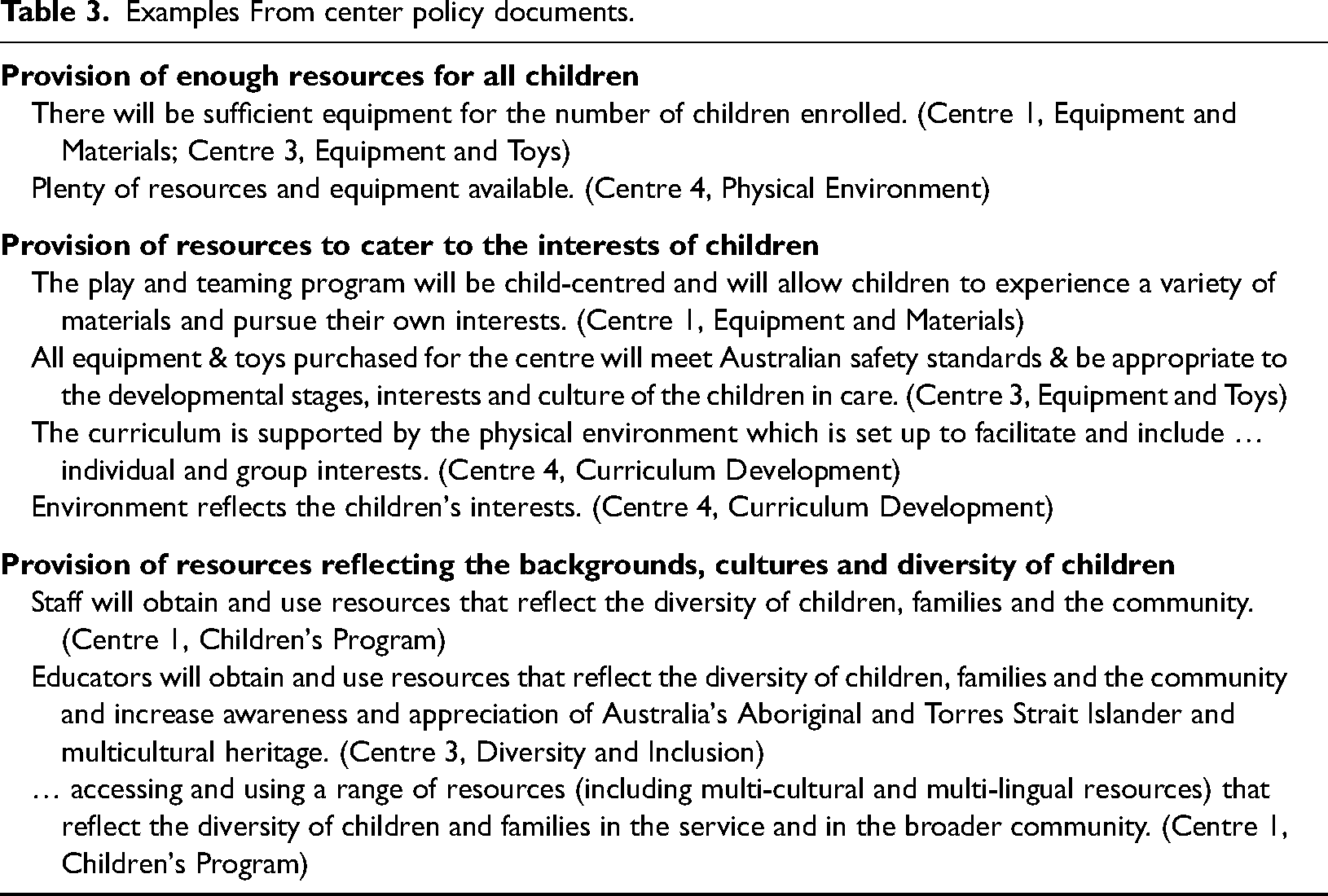
As outlined earlier in this article, the NQS (Australian Children's Education and Care Quality Authority, 2011) assessment instrument and associated guide do not explicitly mention, and therefore evaluate, the literacy or book environments of early learning centres. The results from this study appear to show that such absences are echoed in centres’ policies. It was evident from the analysis of the policy documents that all of the centres had policies relating to the provision of equipment, materials and/or resources reflecting cultural diversity, children's backgrounds and catering to children's interests. However, none of these polices specifically mentioned a need for books. The examples in Table 3 are from the centres’ policy documents and are followed in brackets by the title of the policy from which they are drawn.
Examples From center policy documents.
When asked about the absence of the explicit mention of books in the centres’ policies, all of the educators said that they assumed policy requirements about equipment, materials or resources were inclusive of books. This assumption tended not to translate into the provision of diverse books. In sharp contrast, other resources, such as dolls, toys and puzzles, were representative of cultural diversity. Further, in their interviews, the educators talked about diverse books as something extra rather than an integral and equitable part of book collections (Bush, 2008). As outlined in the background to this study, there was a dearth of books in the collections reflecting cultural diversity, and the few that did portrayed under-represented groups in insignificant roles or background illustrations only (Adam, 2019).
All of the centres’ polices were based on relevant policy documents and their legislated requirements, raising the question of how these official documents represent the role and nature of children's literature, particularly as it relates to supporting diversity, equity and inclusion in early childhood contexts. However, given the lack of clear expectations in the NQS (Australian Children's Education and Care Quality Authority, 2011) relating to book provision and use, it is perhaps not surprising that the centres’ policies contain similar omissions. It also appears that the factors that are overtly assessed by the NQS may take precedence over the principles of the EYLF (Department of Education, Employment and Workplace Relations, 2009) in the formation of centre policy and practice.
Narrow views of children's backgrounds, cultures and interests, and how these relate to book use
The interview data from all of the centres revealed understandings of children's backgrounds encompassing broad aspects related to family structure, cultural background, difference and relatability. However, when the educators referred to considering children's cultures or backgrounds, their perceptions and understanding varied, and an element of hesitation and tentativeness was apparent. For example, the lead educator from Centre 2 referred to cultures but gave an example of a child with allergies: Especially with things like the stereotypes or different books on different cultures and things like that, or, like I said, the allergy book, it talks about being different and kind of, it's shown that it's something that they can talk about and look out for each other, and now sometimes they notice that Levi can’t have it, and they say, ‘Oh, you can’t have that Levi’, and they will kind of be aware of each other. I know that they love a lot of the classics; they are quite good. I mean, they love Going on a Bear Hunt [Rosen and Oxenbury, 1996].. I mean, I’ve read it about 50 times over the last couple of weeks alone, but they love that.
The educators’ narrow view of the role of diverse literature in meeting children's best interests was reflected in their observed practice. First, this was seen in a lack of representation of cultural diversity in the books available. As outlined earlier, in the majority of the observed book-sharing sessions, the books used were monocultural. In addition, in the few observed sessions when diverse books were used with a stated intention to support principles of diversity, they were not made available to the children afterwards. The educators did not appear to consider that the children might show an interest in, respond to or use these books if they were made available to them. At times, the children did request these books, which implies interest, but they were either not permitted to use them or, in one case, only permitted access for half a minute. At other times, the books in question were considered ‘special’ books that only the educators could use (Centre 2, Lily; Centre 4, Debbie). It appears that the educators may not have considered that making these books available would support the children's interests. This was in sharp contrast to contexts where the children were perceived to have enjoyed or loved a storybook (indicating what the educators saw as interest), where the educators would frequently and intentionally make the books they shared available to the children afterwards, thus increasing the children's exposure to monocultural viewpoints and ideologies. Equally, this practice, which was confirmed through the interview data, rendered ‘culture’ an isolated topic to be brought out at special times, as opposed to promoting it as a way of living and being (Buchori and Dobinson, 2015; Derman-Sparks et al., 2010).
Thus, the educators did not appear to recognise that they could use diverse books to develop children's interests and contribute to the construction of their ‘own identities and understanding of the world’ (Department of Education, Employment and Workplace Relations, 2009: 9). Nor was it considered that exposure to culturally diverse books may diffuse ethnocentric notions of identity and encourage children towards unbiased views. Similar evidence from others also highlights that educators should leverage the interests of children to extend and support their learning and development (Siraj et al., 2019). It is possible too that the absence of the requirement for diverse books in centre policies translated into the limited understandings of using books to promote equity, inclusion and belonging.
Implications
The findings outlined in this study have significant implications for the implementation of the updated EYLF (Department of Education, 2022). For the update of the EYLF, stakeholders in Stages 1 and 2 of the project advocated for the ‘updating of Learning Outcome 1 in relation to the importance of identity in framing children and young people's personal self-worth, uniqueness, and a positive sense of themselves as learners’ (Barblett et al., 2021: 48; see also Hadley et al., 2021). The evidence taken from these two stages suggests that this is essential and must include the interweaving of contemporary ‘Aboriginal and Torres Strait Islander stories into education by teaching Indigenous cultures and perspectives’ (Barblett et al., 2021: 29).
The updating of the EYLF (Department of Education, 2022) should embrace the urgent need and opportunity to focus on cultural responsiveness in education and care, as described in the literature review accompanying the update (Barblett et al., 2021). Included in this is ‘a genuine commitment to embedding Aboriginal and Torres Strait Islander perspectives in all aspects of service provision’ (Barblett et al., 2021: 63).
For practice, it is clear that educators require support in implementing culturally responsive practice, and the updated EYLF (Department of Education, 2022) could include ‘providing more guidance and examples of what the learning could look like and how educators could promote learning to better reflect difference and diversity’ (Barblett et al., 2021: 48). In assessing practice, the evidence presented in this article has shown a concerning mismatch between the EYLF and the NQS (Australian Children's Education and Care Quality Authority, 2011). This mismatch directly contributes to centre policies and practices that not only run counter to principles of diversity but also potentially exacerbate systemic and institutional racism and bias. There is a serious urgency for this to be addressed at the highest level. The educators and carers of our youngest citizens deserve and need clarity and consistency with regard to expectations and accountability, along with adequate training to support their practice (Buchori and Dobinson, 2015).
For the issues raised in this article to be adequately addressed, educators themselves need and deserve appropriate training. We argue for a wholesale program of professional development to raise the quality of professional knowledge about the use of children’s literature as culturally responsive practice. Further, the Australian Children's Education and Care Quality Authority should follow the precedent established by the Australian Institute for Teaching and School Leadership to ensure that Indigenous knowledge and culture within the curriculum is a high priority and, additionally, that appropriate training is provided for educators to ensure that, in their everyday practices, they intentionally use Indigenous and culturally diverse stories that highlight different ways of knowing, being and doing. In turn, children's learning experiences will allow exploration of a range of diverse perspectives that can combat racist structures and exclusionary practices.
Conclusion
We echo the calls and vision of the national consortium to ensure that the updated EYLF (Department of Education, 2022) includes a focus on cultural competence in early education and care. Further, the evaluation processes of the NQS (Australian Children's Education and Care Quality Authority, 2011; 2023) and the professional development of early childhood educators must require and support those in ECEC to act on the question of justice for whom and according to whom (Souto-Manning, 2014). The implementation of the updated EYLF must demonstrate ‘consideration of human rights perspectives, including the United Nations Convention on the Rights of the Child, cultural competence and representation of Aboriginal and Torres Strait Islander perspectives, and representation of socially and culturally diverse perspectives’ (Hadley et al., 2021: 48). To truly move to ideologies, methodologies and pedagogies of potentiality, we must ‘reject a return to an oppressive past marked by harmful practices, pathologizing portrayals, and damaging pedagogies for Black, Indigenous, and other communities of Color’ (Souto-Manning, 2021: 3). This study has shown that the original version of the EYLF has not assisted in bringing educators’ attention to using children's literature as a tool for culturally responsive practices. Additionally, we call for the NQS (Australian Children's Education and Care Quality Authority, 2011) to reflect the culturally diverse practices espoused by the EYLF and extend what assessors evaluate to include evidence of the use of diverse books in everyday practices. In turn, these changes should be used to inform centre policies, documentation and ways of cultural responsiveness with young children.
Footnotes
Declaration of conflicting interests
The author(s) declared no potential conflicts of interest with respect to the research, authorship and/or publication of this article.
Funding
The author(s) received no financial support for the research, authorship and/or publication of this article.
Author biographies
Appendix I: Semi Structured Interview Framework
This framework represents the key content and topical areas of focus – the actual questions and the exact wording may vary)
Please tell me about your background, qualifications and experience in working in child care? How long have you worked in this centre/room? Where did you obtain your qualifications from? When? Can you recall in your training what emphasis and importance was place on using children’s literature when working with children? Can you recall or have you subsequently learn any pedagogy or theory regarding using children’s literature with children?
Could you tell me about the role and place of children’s books in your centre/room? Do the centre polices and curriculum requirements have specific mention and emphasis on selection use of children’s books – can you tell me about this and what it means to you in your role? Could you tell me about what you believe the importance of children’s literature is in the experience of a child in your care? How does that influence your approach to using children’s literature?
Who selects the children’s literature texts for your room/centre? What considerations do you make when selecting texts? Do you face any particular challenges when selecting or accessing books for the centre/room? How do you decide where to store books and which books to make available for children to select and use? Are there any challenges associated with this? How often do you rotate the books for the children?
Could you tell me about the activities you plan for using children’s literature? How do you select the texts for these? What types of unplanned activities take place with children’s literature? Who selects the texts for these?
Could you tell me about some of the activities you do with children’s books? How do you engage the children? What types of books do the children prefer? Why do think this is so? What books do you like to use the most? Why? How often do you conduct planned activities with books? How often do you conduct unplanned activities with books? What other opportunities do children have to interact with children’s literature texts? Do you ever do follow up activities with children after sharing a book with them? Can you give me some examples? Do you ever link children’s literature to other activities learning within the curriculum? Could you give me examples Do you ever make spontaneous or incidental links to children’s interests or other activities? Could you tell about some examples of sharing books with children that you think were most successful? Can you tell me about some of the response to literature that you have observed in the children? (Note: this will be a semi-structured discussion rather than item by item interview)
Outcome 1: Children have a strong sense of identity
Children feel safe secure and supported Children develop their emerging autonomy, inter-dependence, resilience and sense of agency Children develop knowledgeable and confident self-identities Children learn to interact in relation to others with care, empathy and respect Outcome 2: Children are connected with and contribute to their world
Children develop a sense of belonging to groups and communities and an understanding of the reciprocal rights and responsibilities necessary for active community participation Children respond to diversity with respect Children become aware of fairness Children become socially responsible and show respect for the environment Outcome 3: Children have a strong sense of well-being
Children become strong in their social and emotional wellbeing Children take increasing responsibility for their own health and physical wellbeing Outcome 4: Children are confident and involved learners
Children develop dispositions for learning such as curiosity, cooperation, confidence, creativity, commitment, enthusiasm, persistence, imagination, and reflexivity Children develop a range of skills and processes such as problem solving inquiry, experimentation, hypothesising, researching and investigating Children transfer and adapt what they have learned from one context to another Children resource their own learning through connecting with people, place, technologies and natural and processed materials Outcome 5: Children are effective communicators
Children interact verbally and non-verbally with others for a range of purposes Children engage with a range of texts and gain meaning form these texts Children express ideas and make meaning using a range of media Children begin to understand how symbols and patterns systems work Children use information and communication technologies to access information, investigate ideas and represent their thinking.
Do you face any challenges in regard to working with books and young children? Do you encounter any challenges in regard to making books available to young children for their own use?