



Abstract
Advances in artificial intelligence (AI) over the last few decades are transforming the world, pervading nearly all sectors of society, including education, and many aspects of life. In the education discourse, interest in artificial intelligence has sparked various reactions and controversies—everything from appreciation for AI's capabilities to make teaching and student learning more efficient and effective to apprehension about their potential overuse and misuse. In this article, the authors discuss how artificial intelligence is a double-edged sword in early childhood education by presenting some of its positive effects (personalized learning, personalized interactive support, and increased accessibility to broadened learning experiences) and negative effects (overuse and misuse). Considering that young children are growing up in a nearly AI-ubiquitous world and are likely exposed to AI-powered tools, the authors propose applying the POWER (purposeful, optimal, wise, ethical, responsible) principles to maximize the benefits and minimize the drawbacks of AI use. Additionally, the authors recommend the integration of the POWER principles into AI literacy as an imperative for promoting the appropriate use of AI-powered tools.
Keywords
Artificial intelligence (AI) may be referred to broadly and simply as a technology that imitates and simulates human intelligence to perform complex tasks that would typically require the cognitive capabilities of human beings (e.g. Abbass, 2021; Calo, 2017; McCarthy, 2007). AI is a term that is believed to have been first coined by McCarthy et al. (1955) in their written proposal for the famous summer research conference on AI held in 1956 at Dartmouth College in the United States. However, the concepts underlying AI can be traced back nearly a decade earlier to the seminal work of Alan Turing, a noted British computer scientist. In 1947, Turing delivered a lecture where he publicly mentioned computer intelligence and, in 1948, he wrote a technical report titled “Intelligent machinery” (albeit unpublished), which is considered “the first manifesto of AI” (Copeland, 2004: 2). Since then, Turing’s pioneering conceptualization of AI has paved the way for others to subsequently reinvent the field into a sub-discipline of computer science. This development has also led to the invention of various technologies associated with AI for practical application, thereby demonstrating a proof of concept.
In recent years, we have witnessed burgeoning practical breakthroughs in the invention and deployment of emerging AI-powered technologies for various purposes and in various contexts. For example, at the time of writing, the latest innovation is the Chat Generative Pre-trained Transformer (ChatGPT, https://chat.openai.com), launched in November 2022 by OpenAI (https://openai.com/blog/chatgpt). ChatGPT is essentially an AI language model trained to act as a chatbot that fulfills a myriad of functions, such as generating answers to questions and prompts, providing translations, and adapting to learning based on user feedback. Since its debut, ChatGPT has been widely popular in its usefulness, but its ethical use remains wildly controversial in the public discourse. ChatGPT is just a recent example suggesting that AI is a double-edged sword—a phenomenon that is especially evident in the educational use of AI-generative tools. To contribute to this critical and timely education discourse, we discuss a few of the most noticeable positive and negative effects of AI use. We then present the five interconnected POWER (purposeful, optimal, wise, ethical, responsible) core principles for conceptualizing, guiding, and analyzing the appropriate use of AI to maximize its positive effects and minimize its negative effects.
AI as a double-edged sword
Young children are growing up in a world where the presence of AI is nearly ubiquitous. Notably, AI-powered tools are becoming increasingly popular in early childhood education, as they offer innovative and effective ways to engage young children, support their learning and development, and enhance the quality of their educational experience (e.g. Kewalramani et al., 2021; Lin et al., 2020; Prentzas, 2013; Vartiainen et al., 2020; Williams et al., 2019). The possibilities abound for the use of AI to benefit children's early education. Yet there are also drawbacks, giving rise to ethical concerns and considerations (Adams et al., 2022; Jobin et al., 2019). While this article is not meant to provide an exhaustive list of all the positive and negative effects, we offer a few examples worthy of consideration.
The positive effects of AI in early childhood education
Early childhood education refers to the educational programs and experiences designed to serve young children, such as those aged 0-8 in the United States (NAEYC, 2022). Teachers play a vital role in scaffolding these children's learning within their zone of proximal development, which is defined as the space between what a child can accomplish independently and what a child can achieve with assistance from more competent individuals (e.g. teachers, parents, or peers; Vygotsky, 1978). The emerging AI-powered adaptive learning technologies can serve as scaffolds to enhance a child's learning within one's zone of proximal development (Vygotsky, 1978; Wertsch, 1984). Prior research (e.g. Kewalramani et al., 2021; Lin et al., 2020; Prentzas, 2013; Vartiainen et al., 2020; Williams et al., 2019) has identified positive effects of AI on children's learning and development by serving in scaffolding roles (e.g. a tutor/assistant or humanlike conversational agent) to provide personalized or individualized learning, personalized interactive support, and increased accessibility to broadened learning experiences.
Personalized learning
Adaptive learning platforms use AI algorithms to analyze each child's performance, ability, learning style, needs, and pace, and then provide a learning experience that is tailored to these unique developmental needs of the child (Prentzas, 2013). AI-powered educational applications, games, and digital platforms, such as paid educational programs (e.g., IXL, https://www.ixl.com; Raz-Kids, https://www.raz-kids.com) and free reading ones (e.g., Epic, https://www.getepic.com; ReadTheory, https://readtheory.org), can personalize or individualize learning experiences for children in various ways, such as by adapting the difficulty level of activities based on the child's individual strengths and weaknesses in performance, providing immediate feedback, and tracking the child's learning progress over time. Chatbots/virtual assistants (e.g. the travel chatbot Octa (https://www.octa.ai) or ChatGPT) can personalize support for learners in a conversational manner by answering questions and providing information and advice. Furthermore, the personalized learning provided through AI-supported services may be viewed as an aspect of child-centered AI-based education (Devi et al., 2022).
Personalized interactive support
Interactive AI-powered smart toys that are designed to serve various functions, such as recognizing the child's speech/questions and responding accordingly, can promote learning that is not found in traditional education. For instance, children (aged four to six) can learn the functions of AI by building, programming, training, and interacting with PopBots (Williams et al., 2019). Children (aged four to five) can foster three types of inquiry literacies (creative, emotional, and collaborative) through playing with AI-interfaced robotic toys (Kewalramani et al., 2021). In addition to providing cognitive support, a social robot can serve as a “friend,” offering emotional support to children as demonstrated in a study by Cañamero and Lewis (2016) on 7-12 year olds with diabetes.
Increased accessibility to broadened learning experiences
AI-powered assistive technologies—such as the speech-to-text, text-to-speech, and automatic speech recognition—can serve as educational support and be made accessible for children who will likely benefit from these services, such as those with special educational needs and those with learning difficulties. For instance, Speechify (https://speechify.com), an AI-powered assistive text-to-speech tool for listening to rather than reading the text, can help enhance student learning and is especially beneficial to those with learning disabilities, such as dyslexia. Intelligent tutoring systems (ITS), that are accessible anytime and anywhere, can offer effective and efficient support in areas, such as language learning (Slavuj et al., 2015; Swartz and Yazdani, 2012). An example of ITS is Duolingo (https://www.duolingo.com), a tool that helps language learners practice reading, writing, and communication skills.
The negative effects of AI in early childhood education
While AI has revolutionized and advanced student learning by providing unique kinds of support services that are not typically found in traditional education, it is critical that we consider its potential pitfalls. We discuss two here.
Overuse of AI
Just because we can does not mean that we should use AI technology excessively. While AI has made access to information more convenient and easier, excessive use can make children develop overdependency, which can conceivably lead to a reduction in or a lack of human interaction. Furthermore, while AI-powered tools may act like a teacher by effectively and efficiently supporting certain aspects of children's learning, they cannot replace the role of human teachers, as well as parents and peers, who provide the kinds of support (such as emotional support and social interaction) that cannot be fully simulated or replicated by AI. Research has consistently attested that human interaction is critical for children to develop the social and emotional skills needed to interact competently with others (e.g. Chen and Adams, 2022; Chen and Badolato, 2023; Chen and O’Donnell, 2022). Thus, children should seekout AI only as a support system when needed, rather than relying on it overly at the expense of turning to their parents, teachers, and peers for academic and emotional assistance.
Misuse of AI
AI-powered technologies can support children's learning and development. However, if misused or used inappropriately, these tools can do more harm than good. For example, if children rely heavily on ChatGPT to generate answers to their homework questions or complete written assignments, it can undermine the educational process and hamper their ability to develop as well as apply critical thinking and problem-solving skills. Relatedly, when children rely on AI to “do the work” for them instead of putting in the effort to learn and understand the work, it can impede their learning and academic success in the long run. Worse, such intention and action can infringe on the integrity and ethical aspects of AI use. For one, the final product may not reflect the children's true learning and understanding. For another, the information provided by AI may be inaccurate, biased, irrelevant, or outdated. At worst, the misuse of AI-generative technologies can lead to negative consequences, such as plagiarism and other forms of academic dishonesty. For example, children may inappropriately copy the ideas generated by AI to pass off as their own.
Applying the POWER principles to guide the appropriate use of AI
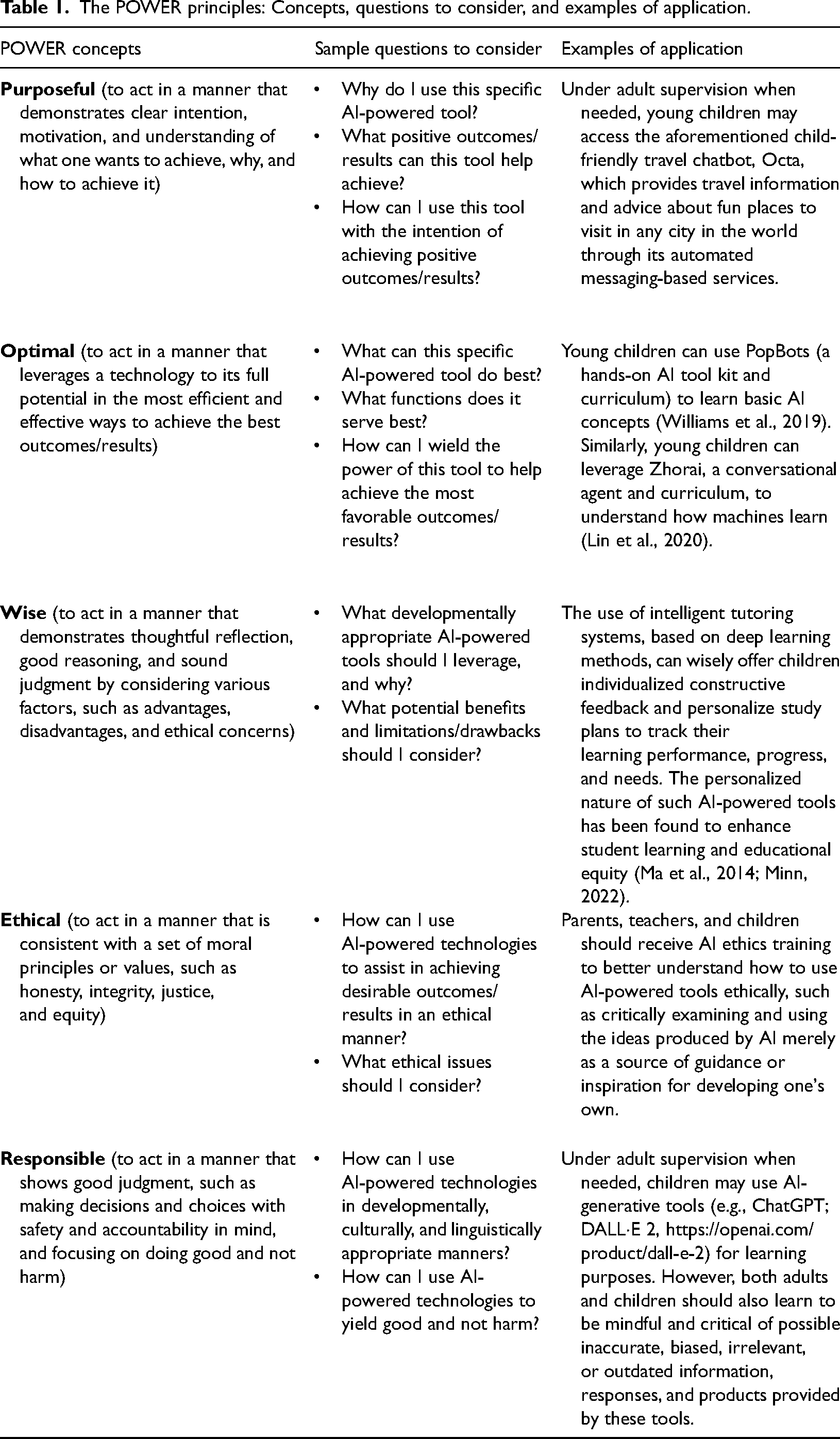
While there is no silver bullet for solving the problems of overuse and misuse of AI-powered technologies that are becoming increasingly omnipresent, there are principles that teachers and parents can learn to understand and apply. In turn, they can help guide children in using AI appropriately to potentially maximize its positive effects and minimize its negative effects on these children's learning. We propose five action-driven and conceptually intertwined guiding principles in the acronym POWER (purposeful, optimal, wise, ethical, responsible) and provide examples to demonstrate the how-to aspect of engaging appropriately with AI (see Table 1).
The POWER principles: Concepts, questions to consider, and examples of application.
These POWER principles can serve as a critical aspect of AI literacy, which is defined as the ability to understand, use, assess, and reflect on AI applications (Long and Magerko, 2020; Ng et al., 2021). Young children may already be engaging with AI-powered technologies. However, they may not have acquired AI literacy, including understanding the concepts and principles underlying these technologies and using them in an ethical and responsible manner (e.g. Kong et al., 2021, 2022; Long and Magerko, 2020; Ng et al., 2021; Su and Yang, 2022). To keep pace with the advances in AI use within education, it is particularly imperative that teachers, parents, and children all learn to develop and apply AI literacy appropriately.
Conclusion
While AI capabilities continue to emerge and expand, they will increasingly pervade many realms of society and human life. In education, AI is a powerful catalyst that can transform, personalize, and advance children's learning and development. Yet, AI is also a double-edged sword -- having both upsides and downsides. AI-powered technologies are empowering, but only by understanding their power and limitations can we integrate them more effectively and efficiently in the educational process to enhance teaching and student learning. While AI literacy has made inroads in the education space, the proposed core POWER principles can further provide a critical roadmap for guiding the appropriate use of AI-powered tools to help build a productive partnership between AI and education, thereby benefiting children's learning. In this connection, it would be beneficial to integrate the POWER principles into AI literacy or broadly digital literacy in early childhood education and beyond as they have the potential for relevant and wide-ranging applications across all educational levels and sectors. However, future research is merited to validate these principles and assess their practical implementation by teachers, parents, and children.
Footnotes
Declaration of conflicting interests
The authors declared no potential conflicts of interest with respect to the research, authorship, and/or publication of this article.
Funding
The authors received no financial support for the research, authorship, and/or publication of this article.

Author biographies
Jennifer J Chen, EdD, is tenured full professor of early childhood and family studies at Kean University in New Jersey, USA. She has published more than 70 authored/co-authored scholarly works, including three books and many research articles, in the fields of early childhood education and psychology. Her most recent line of research focuses on artificial intelligence in early childhood education.
Jasmine C Lin is a junior in West Essex High School in New Jersey, USA. During her research assistantship, she co-authors articles with Dr. Jennifer Chen in the areas of artificial intelligence, child development, and teaching practices.