



Abstract
Drawing on Donna Haraway's notion of speculative fabulation, in this study the authors investigate how a pedagogy grounded in mythical nature spirits, children's imaginative explorations and storying activities created spaces for children to explore socio-ecological worlds. Their inquiry draws on an ethnographic case study of three children (aged seven to eight) in a Finnish primary school who participated in a cross-curricular unit framed by a set of pedagogical materials called ‘The Riddle of the Spirit’. Their inquiry shows how speculative fabulations emerged into performing spaces, in which imaginary fabulations of humans, spirits and places created alternative narratives about more-than-human relations. Such fabulations emerged when the children became spirits, when the spirits were transformed from kings to queens, and when trees that humans had cut down could be revived and returned to the forest. Thus, the authors’ inquiry suggests that myths embedded in storying activities can offer unexplored educational opportunities to invite children to attend to and imagine socio-ecological worlds.
Introduction
Children growing up today confront a troublesome world of climate change, pollution, forest deprivation and increased urban development. This reality of an increasingly damaged Earth calls for educational practices that value affects and imagination, and understand humans as beings ‘of the world, not standing outside of it’ (Malone, 2020: 511; see also Massumi, 2015). There is also a call for research which acknowledges that children feel trouble, loss and grief caused by encountering the reality of climate change in their everyday lives (Malone et al., 2020).
Drawing on Haraway’s (2016) notion of speculative fabulation, we inquired into how a pedagogy that draws on mythical nature spirits and children’s storying activities invites children to enter into spaces in which they explore their socio-ecological worlds. Speculative fabulating is a co-created process in which alternative worlds and future pictures emerge through fiction and storying (Haraway, 2016). Our study recognised that ‘it matters what stories make worlds, what worlds make stories’ (Haraway, 2016: 12). Thus, we hold that the potential for both human and non-human stories to be told and weaved together lies within children’s speculative fabulations. Specifically, we draw on a perspective of storying as performative and always connected to the ‘worldings’ and interconnections of socio-ecological and material worlds. In storying, blurring the line between fact and fiction includes potentials, open-endedness and conflicts, which means that storying can also entangle ethical issues and matters (Greenhalgh-Spencer, 2019). According to Haraway (2016; see also Greenhalgh-Spencer, 2019), myths and fiction open up worlding processes and have the potential to challenge the understanding and sense-making of socio-ecological worlds. Socio-ecological worlds are defined in this study through a relational ontology (Barad, 2007; Vladimirova and Rautio, 2018; Yaka, 2019) to emphasise the interconnectedness, open-endedness and liveliness of human and non-human ecologies, which includes social, material and ecological phenomena. We also acknowledge that recognising this relational dimension of our existence is an ethical issue (Yaka, 2019) that includes the rights of non-human others, and that this recognition can ‘enrich the understanding of who we are as humans’ (Vladimirova and Rautio, 2018: 337).
Although recent posthuman research in climate change education has addressed speculative fiction as an ontological tool (Rousell et al., 2017, 2023), there has been little research that embraces non-human perspective-taking (Molloy Murphy, 2020, 2021). An example of such an inquiry is Molloy Murphy's (2021) research, which focuses on young children's speculative fabulating with the more-than-human creatures of elves. Molloy Murphy's (2020: 78) research shows how acknowledging children's unconventional narrative paths can reveal ‘invisible lines’ that extend beyond the human. Sintonen (2020) has also raised the question of how cultural myths can enrich environmental education within early childhood. Inspired by Molloy Murphy's (2020) and Sintonen's (2020) research, in this study we inquired into how mythical nature spirits can create new forms of speculative imaginaries for children to explore socio-ecological worlds. Our approach embraced a ‘playful sensibility’ that can bridge the gap between what we see as sense and non-sense (Renshaw, 2019).
The Finnish curriculum for early childhood education and basic education emphasises holistic and playful pedagogies that are responsive to local contexts and children's lifeworlds (Finnish National Agency for Education, 2014, 2018). However, educational research about myths from the perspective of Finnish early childhood education is scarce (see Sintonen, 2020). In our research, we investigated how pre-modern Baltic Finnic myths coupled with children's storying can enrich children's imagination and exploration of their local contexts and the ancestral heritage that these mythical stories evoke (Sintonen, 2020; Tarkka et al., 2018). Our purpose in this study has hence been to recognise multiple ways of knowing and being in the world through children's imaginative explorations and storying activities with myths.
Our research was grounded in a four-month ethnographic case study of three children's small-group-oriented work in a Finnish primary school classroom and its local environment. The children participated with their classmates in a cross-curricular unit grounded in a set of playful pedagogical materials called ‘The Riddle of the Spirit’ (Wong et al., 2020), which began with the mythical story of Ukko, the thunderstorm spirit, who loses control of the climate. Our previous findings have shown that meaningful and personal storying can have the transformative power to affect, connect to societal and environmental phenomena, and challenge children's thinking in diverse ways (Byman et al., 2022). Our analysis of the children's storying and fabulating with the pedagogical material draws on an expanded and relational understanding of storying that is embodied, fluid and unexpected across sense and non-sense, fact and fiction (Molloy Murphy, 2020; Phillips et al., 2018). This means making stories that are also ‘wordless’, such as gestured, sung, dramatised, drawn or painted stories (Molloy Murphy, 2020: 212; Phillips et al., 2018). In this study, we delved into the relational dimensions of the pedagogical approach and asked how children's storying with mythical nature spirits creates spaces for exploring socio-ecological worlds.
Herein, we first define our theoretical understanding of speculative fabulations and how it has affected our thinking about children’s storying with mythical nature spirits. Then, we describe the study context and pedagogy based on a storyline inspired by pre-modern Baltic Finnic myths about nature spirits. We adopted the methodological perspective of diffractive reading (Barad, 2007; Malone, 2019) to analyse the data and storying as material-discursive events where different agencies and materials create movements by affecting each other. Lastly, we present the results of our study, illuminating how the pedagogical materials of ‘The Riddle of the Spirit’ emerged in speculative spaces, and conclude by discussing how children's storying with mythical nature spirits created speculative fabulations with socio-ecological worlds.
Speculative fabulations and becoming affected through storying
We focused on how children's storying with mythical nature spirits has the potential to knot together imaginaries and becomings. Inspired by Haraway’s (2016) speculative fabulations, we dwelt on stories created by children with mythical nature spirits, materialities and the local environment. According to Haraway (2016), speculative fabulation is a way of storying or a narration that brings out and explores possible futures. Fabulations bring attention to what could be possible in the given moment, and are therefore also directly connected to our reality. Furthermore, speculative fabulations have been emphasised as a way of exploring relationalities with human and non-human others and entanglements with the environment (Haraway, 2016; see also Molloy Murphy, 2021). Thus, story-crafting and storytelling practices are understood as speculative events that include unique, shifting and felt relational becomings across human and more-than-human agencies (Byman et al., 2022; Haraway, 2016; Kumpulainen et al., 2021; Renshaw, 2021; Rousell and Cutter-Mackenzie-Knowles, 2020).
In our study, the focus on affects was helpful in understanding the complex entanglements, movements and relationalities that children's storying entails (Nxumalo et al., 2022). Haraway (2016) suggests that storying holds the potential to expand the imagination to recognise and create affects and relations across different more-than-human materialities. As Somerville (2020: 123) writes, in these affective encounters with ‘the intertwined materiality of bodies, each becomes different, and new ways of being and knowing are born for both’. This perspective resonates with how Massumi (2015: 6) describes that, ‘in affect, we are never alone’, giving value to the relational dimension of storying and becoming with the more-than-human world. Thus, affects are not directly experienced as something personal or ‘within’ ourselves; rather, we are enveloped by affective tonalities (i.e. moods) or atmospheres, which create motions towards something new (Stewart, 2007). This turns the focus on the dynamic characteristic of affects to shape, reshape, and unshape human and non-human bodies (Nxumalo and Villanueva, 2020). In the ‘thinking-making-doing’ of storying practices, these affective intensities emerge in between bodies, enriching the present and creating new ‘speculative middles’ of socio-ecological worlds (Springgay and Truman, 2018: 212). This open-ended quality of storying is particularly useful in troubled times to challenge the taken-for-granted ways of living and relating in socio-ecological worlds (Tsing, 2015).
In line with previous studies that have expanded the notion of anthropomorphism (Malone, 2019; Rautio, 2017), we aimed to broaden and challenge the understanding of mythical nature spirits as solely humanly characterised non-human others in children’s storying and fabulations. Following Malone (2019), our extended perspective acknowledges the relational dimension of sense-making with non-human others. Malone (2019; see also Rautio, 2017) uses the concept of ‘ecomorphism’ to emphasise an embodied and sensuous understanding of shared ‘sensorial ecological knowing’ that reshapes and unshapes the sense-making of socio-ecological worlds. This extended perspective of anthropomorphism invites non-humans, such as mythical nature spirits, into the speculative sphere as coexisting agencies to sense and imagine with.
Lastly, we have sought to bridge this speculative discussion about storying and mythical nature spirits further to Deleuze's (1994) definition of sense and non-sense as a way to broaden our understanding of storying from a pedagogical and materialist perspective. Why is it so important to acknowledge that ‘there’s more than rationality in the production of the world’ (MacLure, 2023: 215)? Deleuze (1994) argues that non-sense is always an entangled and paradoxical part of sense, which is described as a multiple and complex flow of events. This perspective of sense draws attention to the embodied and affective dimensions of language (and storying), highlighting the performativity of materiality in language and broadening the understanding of language and storying as having playful and non-representational dimensions (MacLure, 2023). Influenced by how MacLure (2013) expands Deleuze’s definition of sense as ‘sense-events’, we underlined how the irrational and absurd spheres of socio-ecological worlds connect to children’s storying and have the potential to reveal fabulations that ‘precede and exceed reason’ (MacLure, 2020: 503).
A study embedded in a pedagogy inspired by mythical nature spirits
Our inquiry draws on a four-month ethnographic case study of three children (aged seven to eight) – Vera, Karim and Riku (all names are pseudonyms) – in a Finnish primary school. The primary school is located in an urban environment surrounded by rich green landscapes, including hills, rocks, woods, streams and parks. With their classmates, the children participated in a cross-curricular unit that explored a set of pedagogical materials called ‘The Riddle of the Spirit’ (Wong et al., 2020). The material invites children to create imaginative solutions to a riddle and to reflect on climate change. The pedagogical design combines relational, imaginative, multimodal, multisensory, playful and holistic approaches and was developed from an interdisciplinary collaboration between researchers, teachers, designers, artists and educators (Wong et al., 2020; Wong and Kumpulainen, 2020). The data consists of video recordings of the children's explorations, transcriptions of the children's conversations and the artefacts (drawings and videos) the children created.
The pedagogy behind ‘The Riddle of the Spirit’ is inspired by pre-modern Baltic Finnic myths, which are stories and poems about humans and non-humans, including mythical nature spirits (Siikala, 2002; Sintonen, 2020). In recent folklore studies, pre-modern Baltic Finnic myths have been viewed as inhomogeneous – that is, as diverse and formed through voices from Karelian, Finnish and Sami cultures, arts, oral traditions and ways of life (Fewster, 2006; Lehtonen, 2018; Tarkka et al., 2018). In pre-modern Baltic Finnic traditions, the forces of the water, wind and forest all had their own characteristics and guardian spirits (väki), through which humans and the natural elements could communicate with each other (Tarkka, 2013). These myths approached entanglements between humans and non-humans as a dynamic becoming and relating. Nature spirits were thus approached as agentic beings with consciousness (Herva, 2009; Herva and Ylimaunu, 2009), and socio-ecological worlds were viewed as reflecting reality (Tarkka, 2013). We acknowledge that myths were entangled with both fictional stories and actual lived experiences, changing and transforming through the storying process and socio-ecological contexts where they were created and re-storied (Siikala, 2002; Tarkka, 2013).
The key aim of the pedagogy lies in engaging children's exploration of climate change by inviting them to attune to, story and imagine the relationalities across the more-than-human world. For this pedagogical aim, we created a storyline inspired by mythical nature spirits to enrich children's storying. The pedagogical material involves seven activities, including the design of physical props, templates, instructions for teachers, and questions to evoke collective discussion and meaning-making in the classroom. During the first activity, the children were introduced to the riddle of Ukko, the thunderstorm spirit who loses the ability to control the weather, thereby affecting humans and also other nature spirits, such as Tapio the forest spirit and Vetehinen the water spirit.
In this study, we focused on one of the riddle activities – ‘The Spirit Totem Poles’ – through which the children explored and fabulated their connections to the mythical nature spirits and local environments. During the activity, we explained to the children that humans used to believe in the protective powers of totem poles. The children were asked to build nature-spirit totem poles by using physical totem-pole blocks, and they observed their local environment through these materialities and different guiding questions, such as: How do Ukko, Vetehinen and Tapio protect us? Look around, is there anything in your surroundings related to the three spirits? Look around your environment; how are our daily activities connected to the spirits? Do we use anything or eat anything given to us by the spirits? (Wong et al., 2020: 10)
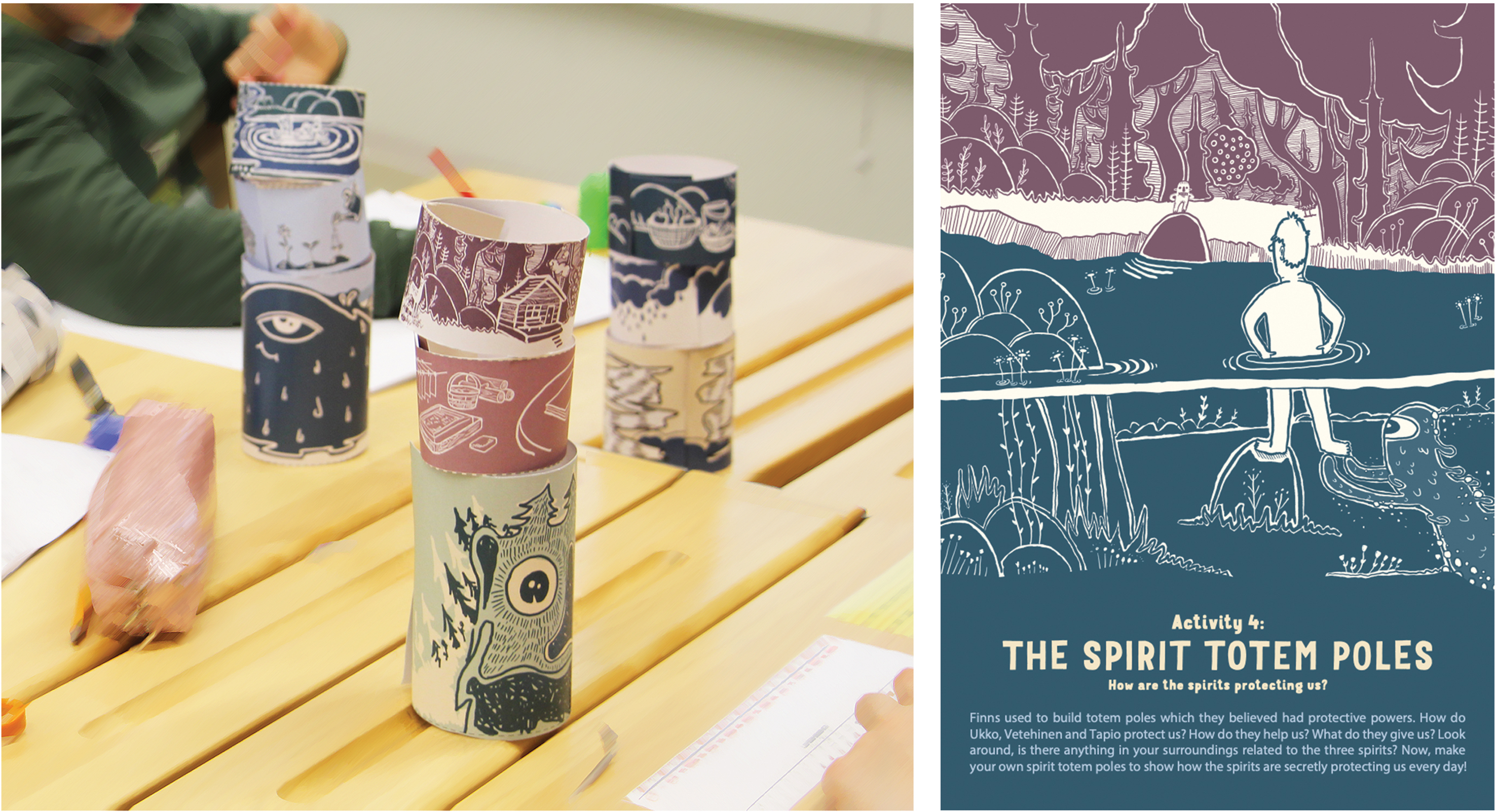
The spirit totem poles that the children built and the activity card for ‘Activity 4: The Spirit Totem Poles’.
Diffractive reading of children’s storying with mythical nature spirits
In our inquiry into the children's storying, we applied ‘diffractive reading’ (Barad, 2014), which is grounded in a relational ontology. In a relational ontology, the world is understood as a continuous process of becoming through encounters of human and non-human agencies that perform transformations (Barad, 2007; Malone, 2019). Thus, diffractive reading treats theory, practice and data as discursively and materially entangled, and argues that analysing these through each other will reveal new movements and affects (Lenz Taguchi and Palmer, 2013). Thus, diffractive reading unpacks the ‘material-discursive’ entanglements between human and non-human agencies (Barad, 2007; Haraway, 1997; Young et al., 2022). In our diffractive reading, we were inspired by more-than-visual methods of analysing video data to embrace the interconnectedness between human and non-human others, and to become ‘affected by the unfolding of events’ (Lorimer, 2013: 68). For our recorded data, we used more-than-visual methods of analysing the children's embodied movements with the pedagogical material, the mythical nature spirits, other children and the researchers (Malone, 2019). Throughout the analysis, we repeatedly revisited the visual data, on which our reading and thinking were developed and depended, each time encountering the data anew. Writing became an essential way through which thoughts, affective tonalities and embodied movements entangled with the theoretical perspectives and material dimensions of moving with the visual data.
We approached the children's storying with mythical nature spirits through Haraway’s (2016) concept of speculative fabulations. Haraway (2016; see also Truman, 2019) describes speculative fabulations as an ongoing diffractive process of co-imagining and co-creating possible futures. Inspired by Haraway’s (1988) notion of differences as relational forces, Barad (2007) explains how diffractive reading is a process that is similar to how ocean waves move and transform through recursive rolling and swelling (see also Hultman and Lenz Taguchi, 2010). In diffractive reading, the focus is on how the coming together of several agencies and materials creates movements by them affecting each other (Malone, 2019). This draws attention to the interconnectedness between the children, mythical nature spirits, pedagogical materials and environments, researchers and speculative stories that emerged. On the basis of this understanding of relationalities and the work of Molloy Murphy (2020), we ‘drew invisible lines’ of how the children, humans, materialities and non-human others of the nature spirits moved between different spaces, temporalities and atmospheres through storying. In her doctoral research, Molloy Murphy (2020) diffractively followed both children's interconnected narrative paths and paths that were not clearly interconnected, such as when children refused to follow linear paths of storying or stayed silent. Interconnected narrative paths were defined in the research as stories that followed linear plots of specific themes or included related concepts (Molloy Murphy, 2020). Similarly, our diffractive analysis was inspired by seeing opportunities in both the children's interconnected narratives and the ‘unruly’ paths that challenged conventional storying practices. Our diffractive analysis emerged by drawing lines between the children's storying and re-storying during the classroom activity with the spirit totem poles and the children's earlier narrative threads. We were also reading these storying events diffractively through the storyline and activities of the pedagogical material, which were introduced to the children during the activities. Within these blurred middles, reading diffractively performed multiple new threads and movements (Barad, 2007; Lenz Taguchi and Palmer, 2013).
Reading diffractively helped us to notice fleeting moments in the children's embodied, affective and multimodal exploring of materialities and more-than-human others. As Lorimer (2013: 70) acknowledges, moving with and viewing visual data inspires ‘shared feelings’ and ‘haptic sensibility’, and thus an embodied witnessing of encounters. Moreover, the non-linear analytical approach of more-than-human visual methods brings attentiveness beyond textual and verbal dimensions (Lorimer, 2013), and a focus on the irrational and non-representational dimensions in storying practices. In our analysis, moving affectively with the more-than-visual data also included paying attention to ‘strange’ affects, which included myriad storying events filled with curiosity, unknowns, speculations and interruptions (Lorimer, 2013; Molloy Murphy, 2020; Pacini-Ketchabaw et al., 2016). The multimodal storying of Vera, Karim and Riku reached out to us and grasped our attention through events or intensities that ‘glowed’ (MacLure, 2013). These events in the data compelled us to think about the embodied movements and affective becomings between human and more-than-human agencies. Murris and Bozalek (2019: 881) explain how diffractive reading should ‘make the reader feel and think differently about subjectivity’, thus transforming how we approach performativity and agency within socio-ecological worlds. Thus, through reading diffractively, we sought the potential in the new meanings and questions that this approach evokes, and delved into the voices, performativity and unknown spaces of the materialities – specifically, nature spirits, but also other human and non-human agencies.
Children entering into speculative spaces with mythical nature spirits, materialities and more-than-human landscapes
Our inquiry showed how speculative fabulations emerged into performing spaces, in which imaginary stories of humans, spirits and places created alternative more-than-human relations. Such fabulations emerged when the children became spirits, when spirits were transformed from kings to queens, and when trees that humans had cut down could be revived and returned to the forest. These fabulations afforded the children with speculative spaces to move and dwell within more-than-human worlds, resulting in mutual becomings. Furthermore, through these speculative spaces of imagining with the nature spirits, the children found ways to reflect on troubles in their socio-ecological worlds.
In what follows, we illuminate our findings through two events from the pedagogical activities, which we describe as follows: ‘Silences, movements and gazes materialising as a speculative space’ and ‘Remarkable transformations of spirits and trees’. During these events, we witnessed how ‘The Riddle of the Spirit’ also emerged as an affective pedagogy.
Silences, movements and gazes materialising as a speculative space
During this pedagogical activity, the children constructed spirit totem poles in the classroom and explored how nature spirits help humans. In the following event of speculative fabulating (see Figure 2), Vera and the researcher met the gaze of the mythical nature spirit. Our diffractive reading reveals how speculative spaces, imbued with affective silences and embodied movements, were created through human and more-than-human agencies, including Vera, the researcher, mythical nature spirits and spirit totem poles: After building the props, Karim, Vera and Riku are spending a long moment familiarising themselves with the nature spirits, and the children are playfully exploring with the spirit props. Karim is explaining to Vera and Riku how Vetehinen is his ‘cute water spirit’. While explaining this, he is placing the totem pole of Vetehinen close to him, next to his cheek. Vera is observing him quietly and then grabs the prop for Tapio and looks at it closely. After observing Tapio for a while, she comments that the forest spirit is also very lovable. She then looks at the totem pole again for a while and shows it to the researcher, who is standing next to her, explaining that the nature spirit also seems to be sad and looks as though it could be crying. The researcher is quiet for a while and observes the totem pole. Vera is directing attention to the nature spirit's eyes and touching it gently, which creates a situation in which she and the spirit meet each other's gaze. The researcher then asks why Vera thinks the spirit is crying, and Vera answers that she does not know why. At the same time, Vera peeks inside the forest-spirit totem pole and then touches the spirit's eyes gently once more. The moment is followed by Vera's silence, while she is looking at Tapio's totem pole while turning it gently from side to side. This silence is crowded by sounds of other children talking, paper rustling, scissors cutting and the researcher responding to the discussion. The researcher confirms that the spirit's eyes indeed look a bit sad and then moves closer to the table, directing attention to the next forest-spirit totem block.
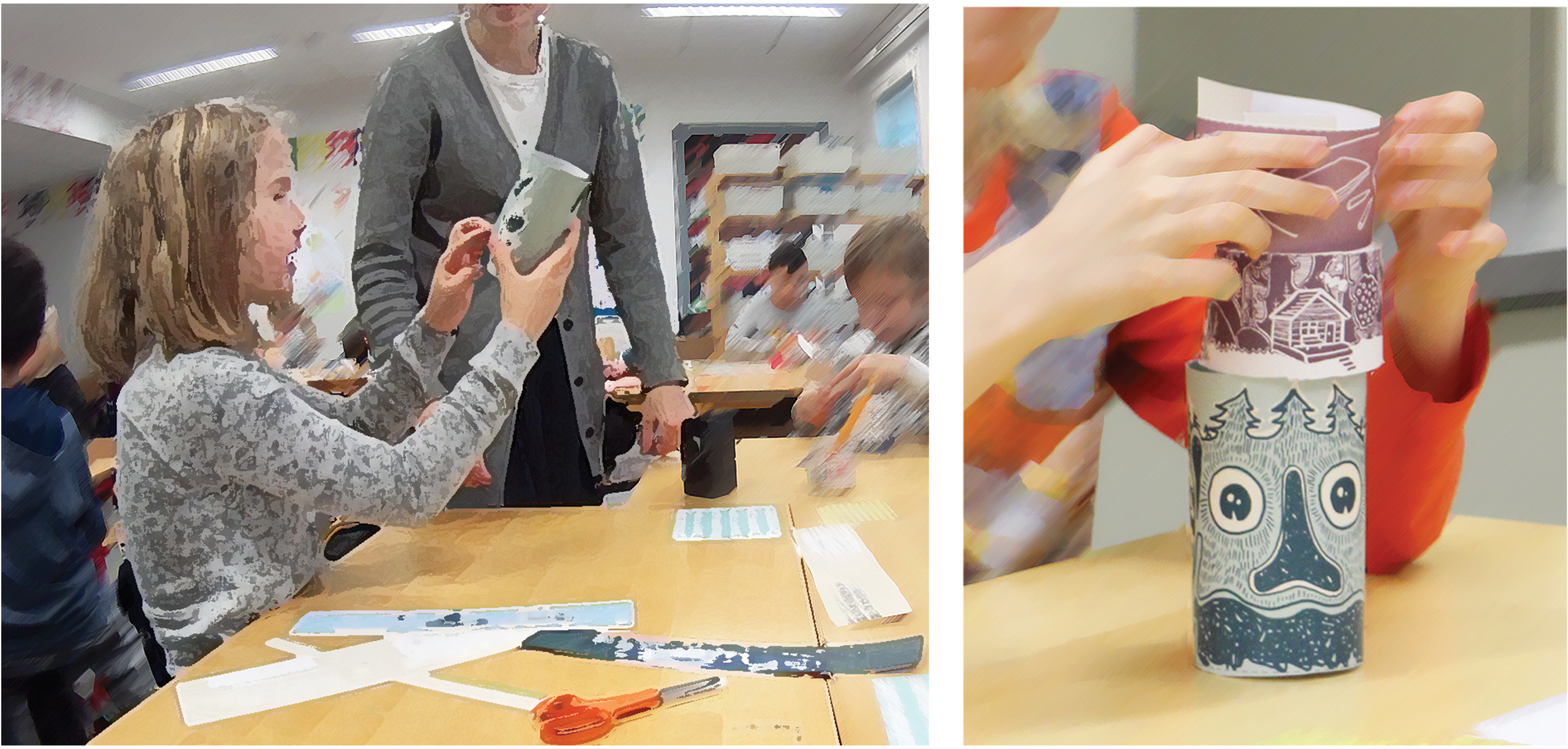
Meeting the gaze of Tapio, the forest spirit.
During this event, Vera looked at Tapio's eyes, which raises the question of what happened between their gazes. The event illuminates how affects emerge with a sense of empathy and care, as Vera wondered why the nature spirit looked sad. We found that this speculative space unfolded through taking the other's perspective, such as that of Tapio. These flickering, mundane and affective moments of silence in the material relations revealed how the children attuned through material events to the mythical nature spirits’ feelings and experiences (Nordström, 2022), thus showing how affects move through embodied experiences and actual material events, forming a relational bridge between the self and others (Deleuze, 1994; Springgay and Truman, 2018). During the event, Vera also expressed that she did not know why Tapio was sad, which connects to another significant aspect of speculative spaces: the unknown – something that is indescribable in words but felt in the body, making one wonder, recognise something unexplored or imagine something new. Children do not and cannot just decide to be caught in these affective tonalities and moments as they envelop them (Massumi, 2015). Similarly to MacLure’s (2013) research, in our analytical examples, silence seemed to open possibilities for the children to view ‘unruly’ worlds (Haraway, 2016; Tsing, 2015). In these events, silence was not the absence of noise but an active presence, a key part of the affective tonality. The relational gazes that emerged from these events were also fuelled by the movements of the children – fingers touching the eyes of the spirit, bringing the totem-pole block close to their cheek, or playfully placing the totem-pole blocks on top of each other. Reading diffractively allowed for the silence and unknown in our analysis to emerge as active and embodied forces and helped us to acknowledge the more-than-human materialities connected to silence (Deleuze, 1994; MacLure, 2013, 2023). Thus, a gaze is always more than just a gaze and, in these encounters, the children moved with the totem-pole blocks.
Furthermore, during the active analysis, one of the authors shared that when she originally painted the face of Tapio, the forest spirit, on the totem pole, she did not plan or acknowledge that the forest spirit would look sad or worried. Tapio’s gaze was thus transformed during the event when Vera's and Tapio's gazes met. Within this shared space, Tapio looked sad, and Vera empathetically sensed this sadness, which also invited the researcher to join in the affective moment. When Vera said that she did not know why the spirit was sad, a lingering discomfort remained in the silence and the gazes that met. Vera often talked about her concerns over climate change and human actions that were harmful to animals and plants. Due to the ecological crisis, this anxiety, which had seeped into the speculative space, seemed to materialise into encountering Tapio's gaze. The children’s and researchers’ reflections could have unfolded differently if Tapio had been illustrated as a forest rather than as a character with expressions and characteristics connected to the forest. This reflection revealed unintentional speculative spaces between humans and non-humans, and how the actual illustrations of Tapio evoked an affective and relational space that invited embodied exploring (Vladimirova and Rautio, 2018).
In the events of the silences, movements and gazes through which the children composed speculative fabulations with the spirit totem poles, we do not regard storying as only wording tales, but as performing affective relationality and embodied movements. Moreover, storying in these events materialises speculative spaces in which more-than-human agencies can come together and be transformed in open-ended, unpredictable and unexpected ways. The affective tonalities of silences, movements and gazes ‘enveloping’ the storying events challenged us to move towards a more-than-representational and non-linear understanding of storying (Malone, 2020). These storying events can be described as ‘fleeting encounters’ (Malone, 2019: 8) – that is, moments of slowing down when both adults and children engage with the entangled lifeworlds of humans and non-humans.
Remarkable transformations of spirits and trees
The diffractive reading of our data also revealed the transformative potentials of the speculative spaces that emerged between multiple agencies during the imaginative play with the nature spirits Tapio, Vetehinen and Ukko. In these events, speculative fabulations about trouble emerged in relation to the characteristics of the nature spirits and the troublesome reality of forest degradation and water pollution. In these events, we witnessed how pre-modern Baltic Finnic myths are entangled with the everyday context of a primary school classroom. These events emerged spontaneously when the children were building and storying with the totem poles. In the following event (see Figure 3), Vera is re-storying the characteristics of Tapio, the nature spirit: Vera playfully places and builds a whole totem pole using two totem-pole blocks, which include an illustration of forest landscapes and the face of Tapio. She then explains how her totem pole of Tapio is actually the queen of the forest: ‘Look. This is the queen. This is the queen of the forest’. This moment is followed by a quiet moment when the researcher and Vera are looking closely and silently at the prop together.
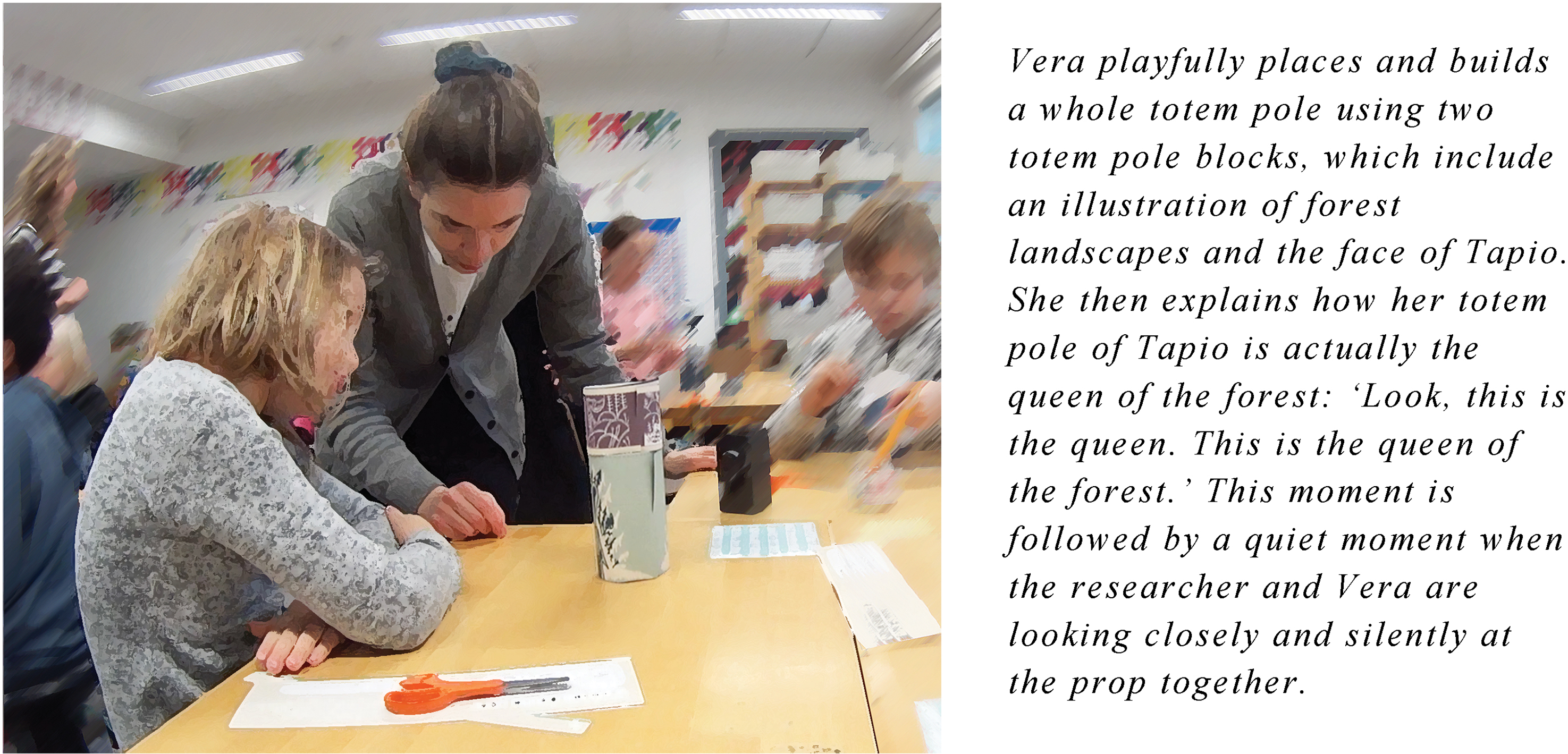
Looking silently at the totem pole of the forest queen, Tapio.
The nature spirits’ past mythical storyline, the child–researcher–nature spirit exploration in the present moment and Vera's re-narration of the spirit Tapio unfolded again into speechless affective moments and moods (Hohti et al., 2021). The events were inspired by the stories about mythical nature spirits, but they mingled with things the children had experienced and knew about from before. Another event of playful exploration and storying with the spirit totem poles emerged when the children were discussing what nature spirits provide for humans. In this discussion, a similar reflection as earlier appeared but now more strongly also connected to trouble in the past: Thank you [nature spirits] that animals can live in nature. Thank you that there are woods here. Thank you that Vera is here! Yes … back in the day, girls have been treated very un[respectfully] … They have not been able to attend school when boys have.
In this event, the mythical nature spirits engaged the children to think about changes that were previously the impossible presents in socio-ecological worlds. Moreover, in this event, a narrative line built up between Vera's earlier storying with the totem pole as the queen of the forest. Through the encounters with Tapio, the forest spirit, and other material agencies, Vera explored how earlier generations of girls did not have the opportunity to attend school, reflecting that the reality that girls are living today was only a possible future for earlier generations. Here, the past narrative of the forest spirit unfolded into a critical reflection on what was possible in the present, connecting the unknown dimensions of Tapio, to the lived present and a narrative thread that aroused grievance in Vera. Vera's speculative fabulating partly changed Tapio's narrative and recognised the trouble within it. In their mundane and imaginative play of moving with materials and in the open-ended, uncertain and material reality of the speculative space in a classroom environment, the children seemed to have the freedom to create speculative fabulations with mythical beings and transform stories into a reflection on power tensions and possibilities in the past and present (Haraway, 2016; Truman, 2019).
The following event (see Figure 4) further reveals how speculative fabulations emerged through embodied movements and irrational spheres, where the children also faced the troublesome realities of socio-ecological worlds. At the beginning of this event, Vera, Karim and Riku spent a longer amount of time piling up their totem poles and familiarising themselves with the pictures on them. The researcher asked the children why these blocks belonged to certain nature spirits, which prompted the children to imagine and explain how the weather spirits help plants to grow, the water spirits protect water elements from the impact of rubbish, and the forest spirits provide the school with both books and colouring pencils. When the researcher left, the children speculated about what nature spirits give to people through imaginative play with the forest and water spirits. In this speculative fabulation, Vetehinen, the water spirit, and Tapio, the forest spirit, led the playful exploration of a possible future.
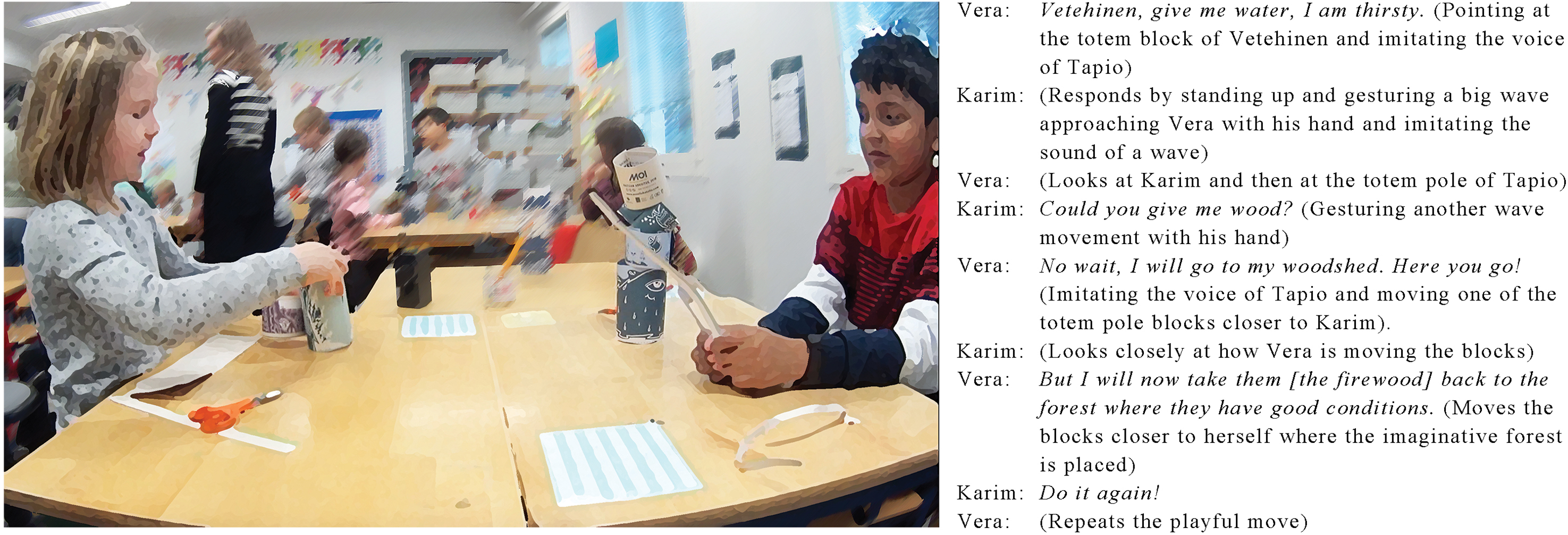
Imaginative play of the forest spirit, Tapio, returning firewood to the forest.
Here, Vera and Karim connected the world of the forest spirit to environments and contexts that were familiar to them, such as a woodshed. Vera expressed an understanding of Tapio's values in protecting trees when she claimed that the spirit would rather return the felled trees to the forest. In the becoming of Vera and the world of spirit totem poles, myths, forests and an ordinary backyard, a speculative fabulation emerged where trees that humans had cut down could be revived and returned to the forest by the spirits. During this imaginative play, the children showed attentiveness to the more-than-human forces of nature spirits, creating a becoming of the two worlds of humans and more-than-humans – ‘a collective-worlding … not limited to human notions of justice’ (Molloy Murphy, 2021: 146). Thus, we suggest that ‘The Riddle of the Spirit’ can be acknowledged as an affective pedagogy. The affective tonalities created by material performativity, situated knowledge and storying with imaginative creatures in our study transformed the ordinary classroom into a speculative space to explore futures and the myriad assemblages in the present (Massumi, 2015; Truman, 2019). Furthermore, a diffractive reading of the invisible lines (Molloy Murphy, 2020) of the different fabulations emerging in these events revealed how facing differences and friction requires becoming together through an affective pedagogy that embraces creativity, which creates multiple new connections between human and non-human agencies.
Conclusions
In this study, we addressed how children's storying with mythical nature spirits created spaces for exploring socio-ecological worlds. Our study shows that embodied movements and storying with the pedagogical material ‘The Riddle of the Spirit’ transformed an ordinary classroom into a speculative space where children created, storied, re-storied and attuned to speculative fabulations with socio-ecological worlds. The methodology of reading diffractively enabled us to follow how the children ‘moved’ with the materialities and affective tonalities that these encounters performed. Our inquiry acknowledges the affective becomings across children, materialities, nature spirits, and the blurred middles of sense and non-sense. ‘The Riddle of the Spirit’ became an affective pedagogy during our inquiry by entangling the children's current classroom activities with memories and stories from the past and imaginings of the future. Thus, during these activities, the more-than-human world of mythical nature spirits and materialities emerged as creative and affective aspects of the children's speculative fabulations (Rousell, 2021). In line with recent research, our study suggests that an affective approach that embraces non-human perspective-taking challenges us to work with and become attuned to the complexities, unsureness and fluctuating moments in children's encounters with socio-ecological worlds (Hohti and MacLure, 2021; Merewether, 2020).
In line with previous post-qualitative methodological studies, our results also emphasise the importance of ‘slow being’ and leaving room for children's meaning-making with and thoughts about the material agencies they encounter (Hackett, 2022; Nordström, 2022; Ulmer, 2017: 202; Yuniasih et al., 2020). Uncertainty and unruliness, such as silences and not knowing, are entangled with vibrant movements with the materialities, which became something ‘more’. Our results also show how the exploration and affective noticing of the rhythms of more-than-human agencies through embodied movements such as silences and gestures allows for the opportunity to create new forms of methodological approaches in early childhood education. Through diffractive reading and drawing invisible lines (Molloy Murphy, 2021) between children's storying and re-storying, and by weaving together more-than-visual data (Lorimer, 2013) and complex embodied movements, our attempt was to visualise the aspects of the study that cannot be easily conveyed in conventional language.
Our results show how the children's storying with mythical nature spirits performed unexpected and speculative fabulations for exploring their socio-ecological worlds. The children imaginatively confronted troubles in their socio-ecological worlds and entangled their everyday spaces and places with new materialities and agencies, resulting in the emergence of affective and transformative stories. In these events, speculative spaces became tangible. Our diffractive reading also revealed how the spontaneous movements of and frictions between the children and materialities of the spirit totem poles seemed to fuel the children to engage in speculative fabulating (Haraway, 2016). In these events, speculative fabulations became entangled with the challenges of gender issues, forest degradation and pollution. These events emerged in and through speculative fabulations with the nature spirits and non-human others such as trees, water elements and places in the local environment, and revealed the educational potential of irrational sense-events to affect (MacLure, 2013, 2023).
These tales and sensuous and material encounters are also connected to Malone’s (2019) notion of ecomorphism – the ecological sense-making that unshapes and reshapes our understanding of unseen coexistences and bodily entanglements. This is in line with Braidotti’s (2019: 126) affirmative ethics, which speaks for working collectively to notice the agentic power of silenced voices and ‘alternative ethical flows’, and also entails facing grievance and pain. Similarly, Barad (2012: 219) writes that ‘[l]iving compassionately requires recognising and facing our responsibility to the infinitude of the other … who gifts us with both the ability to respond and the longing for justice-to-come’. Barad (2012) highlights that affirmative ethics is always an embodied, paradoxical process arising from engagement with socio-ecological worlds. Thus, friction can become a powerful force to affect and inspire children to create and story possible futures and refigure the present collectively (Renlund et al., 2022; Pacini-Ketchabaw, 2013; Tsing, 2020). By fabulating with the pedagogical materials, the children in our study created and imagined stories and alternative narratives that combined the past, present and future of their socio-ecological worlds. At the same time, our study reveals how creative storying and situated knowledge through frictions and embodied movements might be easily missed by educators if relational and affective becomings are not acknowledged.
We also want to emphasise that the places and spaces of speculative and unruly fabulations must be seen as contested (Dernikos and Thiel, 2020; Somerville, 2010), as traditional folk tales such as the Baltic Finnic myths were often interlaced with the socio-historical past of the place where the stories were created. Thus, further research is needed to find ways within early childhood education to collaborate with children to harness risky, speculative and unruly fabulations that challenge western humanist exceptionalism and draw attention to more-than-human ecologies. Moreover, we want to emphasise that our results only emerge from the specific context of one classroom. Therefore, further research is needed into young children's meaning-making and fabulating with myths and traditional folk tales. Our research also raises questions about how speculative and unruly fabulations emerge in various contexts and across place and time. Lastly, to paraphrase Colebrook (2019; see also Hohti and MacLure, 2021), we call for a ‘nomadic’ and critical approach within early childhood education that is entangled with the silenced voices of the more-than-human world and cultivates the differences and unknowns that these relationalities unfold.
Footnotes
Acknowledgements
We thank all the children and adults who participated in this study. We are also grateful to the researchers Laura Hytönen and Noora Oksa for their contributions to the data collection.
Declaration of conflicting interests
The authors declared no potential conflicts of interest with respect to the research, authorship and/or publication of this article.
Funding
This work was supported by Koneen Säätiö (grant number 202008316), Maj ja Tor Nesslingin Säätiö (grant number 202100303) and the Australian Research Council (grant number DP190102067).
