



Abstract
This article puts forward a discursive analysis of early childhood leadership in Australia, offering new ways of understanding the work of early childhood leaders and adding to the methodological tools used to consider work in early childhood education and care. While an emerging body of work recognises the complexities of early childhood leadership, there is little empirical work that identifies how early childhood leaders draw on discourses to understand their roles. This article reports on a study that problematises discursive understandings of ‘good’ early childhood leadership in collective-biography workshops with seven participants. A poststructural feminist inquiry, informed by Foucauldian theory, enabled complex and nuanced readings of early childhood leaders’ accounts. Discourses – or ways of thinking, speaking and doing – were identified and scrutinised through Foucauldian-informed discourse analysis. The findings were conceptualised through ironic categories that hold together discursive tensions and contradictions. Ironic categories, such as ‘diplomatically bossy’, provoke and stimulate new ways of thinking about what it means to be a ‘good’ early childhood leader. The findings add to the emerging conversation and new methodological approaches that address complexity, diversity and contingency in understandings of early childhood leadership.
Keywords
Introduction
Early childhood leadership has featured in international and national policy agendas for more than a decade, with leadership a continuing focal point in the advancement of quality. While the value of investment in early childhood education and care (ECEC) and quality provision is espoused (Elango et al., 2015), critical workforce shortages (Education Services Australia, 2021; Jackson, 2020) and the COVID-19 pandemic have reinvigorated discussions around leadership quality (Douglass, 2019; Harrison et al., 2019; Organisation for Economic Co-operation and Development, 2017) and effectiveness (Stamopoulos and Barblett, 2018). Discursive critiques have challenged conceptions of quality in ECEC (Dahlberg et al., 2013; Fenech, 2013), as well as ‘good’ and ‘effective’ leadership in education (Gillies, 2013). This article similarly challenges accepted and traditional ways of thinking about leadership in ECEC through analysis of empirical materials gathered as part of a larger study (White, 2021).
Early childhood leadership occurs within contexts where responding to legislation and standards, workforce issues, and the needs of children, families and communities are among the challenges of leaders’ daily work. In Australia, rapid growth in the sector will see early childhood teacher job roles growing by 22%, expecting to reach 9000 jobs by 2023 (Children's Education and Care Industry Reference Committee, 2020a). A looming shortage of ECEC professionals with the requisite skills to fill leadership and management positions presents another challenge (Children's Education and Care Industry Reference Committee, 2020a, 2020b). The factors impacting the sector are complex, and leaders in ECEC are at the forefront of maintaining quality services that support children, families and staff.
Investigations into early childhood leadership are timely, especially as the relationship between leadership and educator well-being is being reported on (Logan et al., 2021). While complexity is recognised as implicit to early childhood leadership (Harrison et al., 2022; Rodd, 2013; Waniganayake et al., 2017), empirical work does not always respond to or reflect the complexities, or the ways in which conceptualisations of leadership evolve. The small number of inquiries into leadership perceptions in ECEC reveal a disconnect between the current requirements for leadership and perceptions and enactment of leadership (Martin et al., 2020; Thomas and Nuttall, 2014). A response to ongoing change in contemporary educational contexts requires hearing from the leaders themselves in order to understand the complexity and contingent nature of leadership.
This article begins with a backdrop to the study and extant literature. Next, the methodology, participants, data generation and analytical approach of Foucauldian discourse analysis are explained. Finally, the findings are discussed by examining leaders’ stories from the field to identify the ways leaders talk, speak and produce leadership. Ultimately, it is argued through the presentation of ironic categories that ‘good’ early childhood leadership is complex, at times contradictory, and contingent. Looking to irony provides an unexpected new way of considering early childhood leadership which challenges the discourses that are currently available and proposes different ways of being a ‘good’ leader.
Early childhood leadership
The study of leadership in ECEC is relatively young (30 years). At the outset, studies focused on defining leadership through typologies and leaders’ characteristics, roles and duties (Hayden, 1996; Nupponen, 2006; Rodd, 1996). The focus was largely on the individual or leader-as-hero understandings. These studies created an empirical base for early childhood leadership, most importantly revealing the distinctive nature of work in this sector. While interest in the roles, responsibilities and characteristics of leaders persists (Aubrey et al., 2013; Ho, 2011; Rodd, 2013), there have been shifts towards relational understandings of how leadership is interpreted and enacted within social and cultural contexts (Hard, 2006; Nuttall et al., 2016; Ord et al., 2013), and through models such as distributed leadership (Heikka et al., 2013, 2021; Waniganayake et al., 2017), pedagogical leadership (Palaiologou and Male, 2018) and shared leadership (Stamopoulos, 2012). Research into early childhood leadership is also emerging in response to ongoing change in the sector. For example, the role of Educational Leader in Australia (Fleet et al., 2015; Grarock and Morrissey, 2013; Martin et al., 2020; Rouse and Spradbury, 2016; Sims et al., 2018; Stamopoulos and Barblett, 2018; Zhou and Fenech, 2022) and the continuing effects of workforce challenges and the COVID-19 pandemic (Logan et al., 2021) have provided the impetus for new empirical work.
The idea that leaders can be identified by personality traits or that leadership is found in ‘this’ or ‘that’ model or style reflects a modernist theoretical framing. Such a view presupposes leadership as an essential and fixed reality, which leaves the concept of leadership itself largely unchallenged. Some have challenged an unquestioned acceptance of leadership as an overarching or explanatory framework (Eacott, 2018; Gillies, 2013; Sinclair, 2007). Poststructuralist conceptions of leadership as dynamic, socially constituted and in constant flux make different understandings of leadership possible (Nicholson et al., 2018). In the early childhood leadership literature, postmodern conceptions of leadership as non-linear, non-hierarchical, complex, shared and uncertain have emerged only in the last 10 years (Gibbs, 2022; McDowall Clark and Murray, 2012; O’Gorman and Hard, 2013; Sisson et al., 2021; Stamopoulos, 2012; Thomas and Nuttall, 2014). Feminist poststructural or postcolonial perspectives on ECEC leadership are especially rare, with Davis et al. (2015) being one exception. Those who contest traditional leadership theories argue that the diversity and complexity of leadership in practice cannot be accounted for through the simple application of models, styles or categories (Davis et al., 2015; Gibbs et al., 2019; Gillies, 2013; Nicholson et al., 2018; Niesche, 2011). This article adds to a small body of literature that interrogates leadership in early childhood through a poststructural theoretical lens.
Understandings of ‘good’ early childhood leadership are shaped in part by the discourses that are available. In this work, ‘good’ leadership is problematised in a way that was inspired by Dahlberg et al. (2013), who applied poststructuralist thinking to contested notions of ‘quality’ in ECEC. Moss (2014) suggests that concepts like ‘good’ or ‘quality’ are infused with value judgements that are often taken as self-evident, neutral and incontestable. Bringing ethical and moral dimensions of leadership to the forefront makes possible a certain type of critique. Foucault's notion of critique foregrounds a reflexive subject who contests the limits of knowledge (MacKenzie, 2018). To hold a concept like ‘good’ up for inspection in this manner signals an attitude of doubt and a form of scepticism towards the legitimacy of the truth claims that are possible when ‘good’ leadership is the basis for claims to knowledge. So too are opportunities opened up for moving beyond current understandings and envisioning new possibilities for early childhood leadership.
The body of work on early childhood leadership and the paradigms from which it has emerged enable and constrain the ways in which leadership is understood. For example, leadership in the National Quality Framework (Australian Children's Education and Care Quality Authority, 2018) embodies role-based, hierarchical discourses where practices of leadership are regulated by standards on which leaders are required to model their practices. Power is therefore attached to leadership standards. This is because to speak of practices that do not meet the standards or appear contradictory to the standards is not generally permissible. Leadership standards enable certain ways of speaking about ‘good’ leadership while simultaneously excluding others. In this way, understandings of ‘good’ early childhood leadership are limited to those made possible within the current discourse. In the study reported in this article, the limitations of current understandings of leadership are challenged by adopting research methodologies that foreground critique and problematisation, opening leadership up to being considered in different ways.
The study
Moving beyond investigation of leadership behaviours, traits, skills and roles, the study set out to problematise early childhood leadership. Instead of asking the (perhaps) familiar questions of what leadership is or what leaders do, the focus is on what leadership does. What leadership does, or the effects of leadership, does not imply an instrumentalist understanding but a discursive one. This perspective makes possible the following research question: How do leaders in early childhood produce understandings of ‘good’ leadership? The use of ‘good’ (in quotation marks) flags an intention of the research to include consideration of values, judgements and questions of ethics (Gillies, 2013) in the scrutiny of discourses of leadership. The moral dimensions of leadership are all too often unspoken and taken for granted in the more instrumental ‘what works’ or technical discourses enmeshed in notions of ‘quality’ or ‘effectiveness’. Highlighting the inadequacy of purely functionalist or instrumental analyses of leadership, Gillies (2013) suggests that the moral dimensions of leadership (while contested) offer an additional complexity that is useful in unsettling overarching or supposedly value-free claims about leadership. The research design put this thinking to work by employing the tools of collective biography and Foucauldian discourse analysis.
Methodology
Collective biography
Collective biography is a feminist poststructural research strategy that was developed by Davies (1994) and expanded by Davies and Gannon (2006). Collective biography is based on the foundational memory-work strategy of the feminist sociologist Frigga Haug and her colleagues in Germany (Haug, 1999). In this method, data is generated through sharing memories on a particular topic. In collective biography, the participants not only tell their memory stories but these stories are then opened up to questions from fellow participants. Questions are asked with the express intention of getting closer to the experience of the teller. Stories that are told in the process of a collective-biography workshop become collective and no longer individual.
Collective biography is apt for a study drawing on the theoretical work of Foucault (1977, 1984, 1994, 2002), particularly Foucault's conceptions of discourse, power/knowledge, regimes of truth and governmentality. Poststructural feminist identity theories (Butler, 2004; Davies, 2006) added further layers and possibilities for analysis of ‘good’ early childhood leadership. Memories, as research data, are not considered a ‘better’ way to access knowledge, nor are they treated as a pristine record, retrieved as if from a drawer. Through the process of talking and listening to others’ stories, memories are worked on and over according to the discourses that are available. Just as the things we say and do are shaped by circulating discourses, so too are the ways we tell stories about our lives. In drawing on these poststructuralist perspectives, the participants’ memories are treated not as a transparent view into what leadership was or is, but as a discursive surface from which understandings of leadership can be scrutinised. Through this process, rich and complex ways of understanding ‘good’ leadership were made possible.
Participants and setting
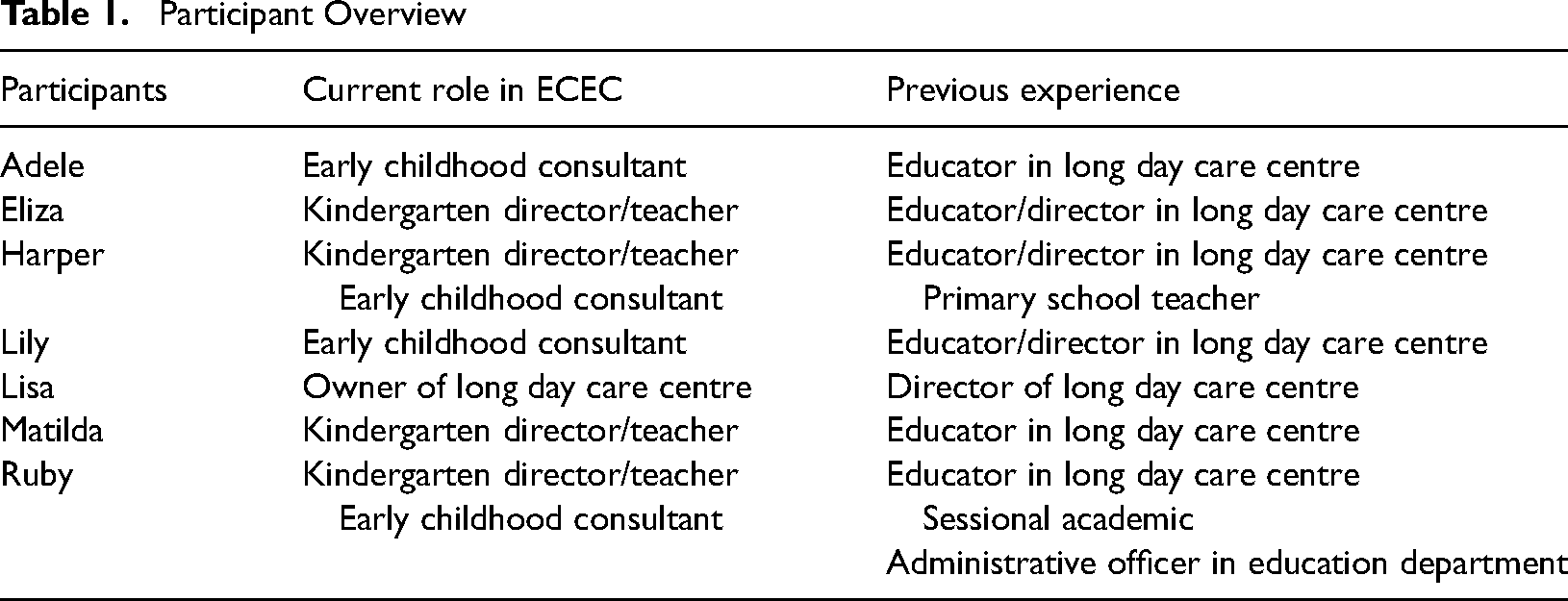
With ethical approval, purposive sampling was used to invite seven early childhood leaders (inclusive of myself, the first author, as both a researcher and ECEC leader) to participate in the study. The participants were known to me and identified based on their involvement in professional networks (of which I was part), as well as their professional histories. The participants were early childhood professionals working in the ECEC sector in a range of leadership roles. While the recruitment process did not specifically seek representation of particular genders or cultures, the participants ultimately included white Australian, middle-class, female perspectives. Table 1 provides an overview of the participants and their professional experience (pseudonyms are used).
Participant Overview
Data generation
The research data was generated through 3 three-hour collective biography workshops with seven early childhood leaders, which were designed to generate rich data that would support a poststructuralist discourse analysis. The audio-recorded workshops were held over a three-month period on dates and at times negotiated with the participants. In each collective biography workshop, the participants took a turn sharing a memory of leadership in response to a stimulus question, which was shared via email in the week before the workshop. The questions were: Can you remember a time when you were a leader? Can you remember a leader that you worked with? Can you remember a really tough time as a leader? The other participants were invited to respond to each memory with questions seeking clarification and detail to enter into the experience of the story, as if they were there.
My role in the research
My role as a co-researcher in the process of collective biography meant that I also was confronted with interpretation of my own stories. Davies and Gannon (2006: 187) explain the complexity of this relationship for the role of the person leading the research: ‘I was both an equal participant in the memory-work and the leader, and this often required a delicate stepping back as well as a decisive movement forward’. My position as ‘the PhD student’ and ‘the teacher and director of the kindy’ had implications for both the workshop process and my own reflexivity. An example of this was during the early stages of data generation when there were times when the participants wanted to know if the talk that they were engaging in was ‘right’ for my research. At another point, when reflecting on the first collective-biography workshop, another participant said: ‘It's tricky when you know you’re being recorded’. This was a complicated yet key aspect of adopting a post-qualitative research methodology.
Analytical approach
The data analysis involved the following steps. First, the audio recordings of the workshops were transcribed. Second, the transcripts were read through a slow, incremental process of familiarisation with the data. The first reading of the transcripts was followed by another reading, this time using a ‘start list of constructs’ (Lasky, 2005: 904) to mark out emergent ideas, patterns and relationships, and noting points where these ideas became saturated (Hesse-Biber and Leavy, 2008). A range of discourses were coded using coloured Post-it notes. These discourses, along with corresponding segments of data, were then entered into a mapping document, which was used to assist with organising the data and making decisions about which discourses were most relevant for further analysis. This document enabled a visual mapping of connections, contradictions, tensions and repetitions in the participants’ talk.
Interrogating the data through Foucauldian discourse analysis sought to deconstruct accepted and taken-for-granted ways of understanding ‘good’ leadership in early childhood. Just as concepts like ‘quality’ and ‘effectiveness’ have been discursively taken up in such a way that they often seem so obvious as to be beyond question, so too has what is taken to be ‘good’. Taken-for-granted ways of understanding ‘good’ leadership are found in the dominant discourses that standardise and normalise ways of thinking and speaking about leadership. ‘Good’ leadership, for example, is often discursively produced through models such as distributed leadership or, more specifically to early childhood leadership, a discourse of relationships.
A focus on discursive practices requires different ways of looking at data. Data is ‘read as texts’ (McArdle, 2001: 99; original emphasis). Discourse analysis in a Foucauldian sense ‘looks to statements not so much for what they say but what they do’ (Graham, 2011: 667; original emphasis). As such, the work of discourse analysis rests on examining what is said, the effects of what is said, and why what is said is sayable in the first place. The analytic approach also employed ironic thinking to deal with conflicts, tensions and contradictions in the data. Rorty (1989) proposes the use of irony as a rhetorical tool that can address this kind of dilemma by thinking opposites together (McArdle and McWilliam, 2006). Thinking seemingly opposite ideas together generates predicaments, from which new ways of thinking become possible.
Limitations of research methodology
This research is small in scale and does not claim to be representative or generalisable. The small sample, nonetheless, enabled in-depth conversations and the production of rich memory stories and analysis, which offers new ways of thinking about leadership in early childhood.
Producing ‘good’ early childhood leadership
The data was read as text against the research question: How do leaders in early childhood produce understandings of ‘good’ leadership? The discourses were located and, consistent with Foucauldian discourse analysis, moments of collision and contradiction were mapped. The data presented here as findings is the memory stories of two participants, Lisa and Adele, in response to the question: Can you remember a really tough time as a leader? The data is presented here as a ‘thick slice’ (Geertz, 1989), offering the reader a window into the findings of the study.
Writing club
Lisa is the owner of a long day care centre, holding the position of the Nominated Supervisor and Educational Leader. Lisa shares a story of an interaction with her colleauges about a classroom practice that she had observed. Colleagues introduced ‘writing club’ in the room by placing tracing templates, laminated cards, etc., on a desk with pens and paper. I was interested in where this had come from and queried. The response was very, and quickly, defensive. But there was no thinking underpinning the discussion – responses were around prep readiness, some children really like it, it's a conversation starter between children and so on.
That ‘good’ early childhood teachers dedicate care and consideration to their teaching practices is an idea that is so taken for granted that it would be almost beyond question to suggest otherwise. Discourses of care through dedication to children and families are so dominant that it would be unsayable to describe a ‘good’ early childhood educator as anything other. Thinking about your practices and drawing on knowledge of early childhood theories and theorists reflects the new expectations of teachers embedded in current ECEC policy (Department of Education, 2009; Rivalland et al., 2019). For example, the document underpinning ECEC in Australia – the Early Years Learning Framework (Department of Education, 2009) – demonstrates a shift from developmental psychology and practical applications of teaching and learning to more conceptual and theoretical approaches. Framing the expectations of her colleagues in the way that she has makes it possible for Lisa to suggest that their thinking is lacking, as current discourses mean that early childhood teachers should be able to think and talk rigorously about their practices. According to the discourses Lisa drew on to tell her story, her colleagues did not respond to her questions in the way she expected they should. In the spirit of collegiality and professionalism, ‘good’ followers should have willingly engaged with her queries.
Lisa's final statements in this part of her story see her describing how early childhood educators should talk about their practices: There was no talk about where it had come from, why it looked the way it did or whether it fit into our belief structure. My thinking is that it came from fear around how parents interpret what ‘learning’ must look like. The introduction of ‘writing club’ appeared to be a compromise of fear and self-doubt, and exposed the educators as vulnerable to a presumed pressure.
According to Lisa, making meaning of and thinking deeply about and articulating one's practice is a key demonstration of competence. Lisa's conversations with her colleagues suggest that ‘good’ leaders should be interested and engaged in talking about the pedagogical practices in their centre. ‘Good’ leaders should also inquire about curriculum knowledge and expertise and, if necessary, challenge staff to share their thinking and demonstrate its theoretical rigour. Lisa's rationale about what ‘good’ leaders and ‘good’ followers should do forms a regime of truth (Foucault, 1977) about ‘good’ leadership: I was torn between wanting to understand and acknowledge possibilities of practice and frustration that the team would not stand firm on an approach. I could see a correlation between the educators doubting the program enough to appease parents’ fears and how the educators did not advocate for their choice to me.
Through her talk, Lisa constructs an idea of a ‘follower’ – that is, someone who is agile, flexible and articulate, as opposed to those who are ‘vulnerable’, driven by ‘fear’ and ‘self-doubt’. They need to be willing to articulate themselves, to discuss, debate and reflect on their teaching practices, in ways that are not defensive. This positioning reflects discourses of professionalism where teachers are ‘pedagogical experts capable of acting ethically with professional autonomy and discretion’ (Waniganayake and Sims, 2018: 231). The conduct of Lisa's colleagues therefore departs from what a ‘good’ early childhood educator should be. Lisa speaks a regime of truth (Foucault, 1977) that ‘good’ followers should be autonomous, confident and certain about their practices, and able to advocate for and defend their choices.
The way in which Lisa positions her colleagues is important, as it is from this positioning that she is able to speak of her response as a leader. Her colleagues’ deviation from expectations legitimates the kind of leadership that Lisa speaks of. Through her story, Lisa speaks of a leader who rigorously questions educators about their practices, even if this causes difficulty. Yet there are also contradictions in Lisa's talk. She seemingly wants her colleagues to be outspoken in thinking for themselves, yet limits are placed on their autonomy when, according to Lisa, they still need to explain their choices to her. It seems that Lisa detects this contradiction through her expression of feeling torn. It seems necessary for her to challenge practices that she does not approve of, yet she also wants her colleagues to ‘stand firm on an approach’, thus being the kind of leader who facilitates autonomous decision-making.
Lisa's frustration suggests complexity for early childhood leaders in navigating the discourses available to them. Lisa struggles between a discursive construct of ‘good’ leadership that involves facilitating others to act on their own and another construct where ‘good’ leaders offer challenge and disruption in order to facilitate thinking. Discourses do not always sit neatly or easily alongside one another, but rather compete, collide and intersect, producing ‘good’ early childhood leadership in complex and sometimes unexpected ways.
I can’t do that
Adele also tells of a difficult time she experienced as a new leader, having recently been appointed to a new position as a kindergarten director: I went along to an interview in a kindergarten and, in the interview, I was told that they were really looking for someone who is strong and knowledgeable, to drive change. I was very, very excited. I thought, ‘Yes, this is the place I want to be in’.
Adele initially perceives there to be a good match between her personal characteristics and skills and those sought by her employer. The idea of character traits such as strength and knowledge aligns with heroic leadership discourses, which emphasise attributes that set leaders apart from others (Spector, 2016). Adele also refers to important leadership behaviours, such as the capacity ‘to drive change’. Leadership and change are, in this way, discursively interconnected (Moyles, 2006). Adele's excitement at her new appointment is short-lived as her experience of enacting the type of leadership that she believed her employer wanted, was not as she expected: The first few months passed and I noticed that things aren’t received well and when I was talking to people and questioning the direction of the events, they thought that I was just imagining things and it was basically mixed messaging. I was told one thing and behind my back people started talking about ‘This is too radical’, ‘It's not a good fit’, ‘We can’t do that’, ‘How about the culture of the centre?’
Adele's talk about the degree to which her ideas were received by her colleagues reflects a role-based understanding of leadership where leader–follower binary relationships dictate the norms for behaviour. For example, in this kind of leadership discourse, leaders can expect dependability, cooperation and loyalty from their colleagues (Spector, 2016). A regime of truth (Foucault, 1977) is thus created, where leaders can ‘naturally’ expect cooperation from followers. Adele's attempts to talk to and question the staff were rebuffed, resulting in them talking behind her back. For Adele, her colleagues are not only neglecting their roles as followers; their objections to her leadership are also seemingly contradictory to the reasons why she was employed.
Suggesting that her leadership was not ‘a good fit’ and ‘too radical’ for the centre is incomprehensible to Adele, given that she was employed with the explicit proviso to ‘drive change’. In this case, ‘a good fit’ was seemingly understood through notions of consensus, collaboration and harmony in relationships between colleagues (Rodd, 2013). ‘Good’ early childhood leaders should embody such ideas through their practice. Yet leaders are also expected to ‘transform cultures’ (Rodd, 2013: 19) by promoting improvement and the adoption of change. Adele's leadership was charged with being an inadequate ‘fit’ for the centre – so much so that it was deemed ‘radical’. This demonstrates how power is exercised in the relations between individuals as the ‘conduct of conduct’ (Foucault, 1994: 341). Declaring that Adele is ‘too radical’ effectively strips her leadership of legitimacy. In Adele's experience, power is attached to ‘fitting in’ as opposed to being radical. This makes for a contradictory situation for Adele as she sees her role as challenging staff in relation to pedagogical practices (a role she felt that her employer wanted), yet her leadership is challenged by her colleagues when doing so. Regimes of truth (Foucault, 1977) around women in leadership are formed by drawing on various discourses that suggest how to do and be a ‘good’ early childhood leader. Given that regimes of truth govern both what can and cannot be said, it is unsayable for Adele in her role to be radical and be accepted as a ‘good’ leader. Through her talk, Adele struggles to make sense of being called radical and to make sense of herself as a leader in the context of such a claim.
In the next part of the story, Adele attempts to explicate the cause of her colleagues’ contestation: I possibly should have resigned much earlier than that because I had very strong ideas as to what I believe in and I wasn’t willing to compromise those. I caused a great deal of stress to myself and my family and the children as well. I wasn’t the best teacher I know myself to be and that really was painful to see.
To make sense of how she could get into trouble for the leadership that she thought had been wanted by her employer, Adele refuses the discursive positioning whereby her strong ideas were ‘too radical’. She does so by attempting to reappropriate the idea of being radical with being unwilling to compromise her ideas. In doing so, she pays the ultimate price – resigning from her job. Adele's justification suggests that holding steadfastly to one's beliefs, despite manifold consequences, is perhaps proof of ‘good’ leadership. Adele continues to grapple with articulating herself as a ‘good’ leader, considering the charge of radicality: I learned to pick my battles and now, when I work as an early learning consultant, I really try to understand where people are at, and I think that's a really important thing for me to do because I could say, ‘Yes, we need to do this, this, this, this, this’, but just understanding what people's priorities are and how people work. Ultimately, what I want is to bring about change so children can have better programs.
Adele's faith in her beliefs appears to have softened in the compromise of ‘picking [her] battles’. This idiom generally means avoiding minor, unimportant or overly difficult arguments, saving one's strength for matters that will be of greater importance or where one has a greater chance of success. ‘Picking [her] battles’ suggests that Adele could use more directive strategies but is perhaps choosing an alternative. This shift in strategy is legitimised through a focus on the purpose of her leadership. Through this new manoeuvre, Adele maintains her position as a ‘good’ leader. Now, Adele's role as a leader (in this case, as a careful strategist and holder of the vision for the centre) and her knowledge as an early childhood teacher (that is, her knowledge of what constitutes ‘better’ programs) coalesce to make a strong case for her leadership to be unquestionably ‘good’. Power circulates through these discourses of leadership and teaching. Unlike earlier in her story, Adele's authority is now conferred through pedagogical vision and ideas, rather than in hierarchical authority. Through her vision, Adele mobilises this authority to speak, and therefore validate, her own truths about early childhood education. Adele, however, must also confront the problem of influence – that is, how to address her colleagues’ less than favourable assessment of her leadership: ‘That's what I want, so I have to work with what we’ve got and noticing the positives and acknowledging people's efforts, and all those kinds of things’.
Through her talk, Adele affirms her vision for ECEC as well as new ways of approaching her work with her colleagues. First, Adele affirms her unchanged values and beliefs – that is, her vision as a leader. Next, she worked to address how, by necessity, she translates that vision into another form of influence with her colleagues. With her previous colleagues, Adele employed strategies of challenging and questioning. Now, she talks about ‘noticing the positives’ and ‘acknowledging people's efforts’. Adele thus speaks of leadership as a process of support for her colleagues – a ‘process through which leaders change the way followers feel about themselves in order to elicit their best performances’ (Fairhurst, 2007: 97). This shift in strategy and use of an alternative discourse coalesces in Adele's assertion that she must ‘work with what we’ve got’. While, on the surface, this may seem to represent a ceding of power, it may also be considered a redeployment of power relations – drawing on a new set of discourses. ‘Getting inside the head’ of followers to work with their thoughts and feelings is presented by Adele as an effective strategy to achieve her goal of change. She struggles with the effects of choosing to be either directive or supportive as a leader. The consequence of being too directive was so severe that Adele adopts a seemingly more supportive approach in her new role. This new positioning, however, is also not without trouble: Very often there is the contradiction because, in a female-dominated profession, we want to be nice and we want to avoid conflict at all costs. We say one thing but we think something very different, so I think by respectfully naming it and owning it, that I’m noticing and I’m thinking that this is not sitting really well with you. Can you help me understand? Because ultimately what I want … I want to help you and I want the best programs for children.
There is a struggle in Adele's talk as she attempts to reconcile how to be a ‘good’ leader with her colleagues, when she seemingly needs to be both in charge and directive yet at the same time a team player who is supportive and understanding. Notwithstanding the seemingly intractable problem that being directive and supportive generates for leaders in ECEC, Adele holds together these contradictions through her talk. She does so by circling back to the idea that the vision guiding her practices makes it possible and necessary to work with the contradictions and quandaries that present themselves for leaders in ECEC.
Ironic thinking about early childhood leadership: ‘good’ leader as ‘diplomatically bossy’
Through their talk, both participants – Lisa and Adele – describe leadership that is both supportive and challenging. Discourses of support and challenge are not, on the surface, complementary. This goes some way to explaining the difficulty that is expressed through their memories of being a leader. Being supportive is about collegial relationships focused on the needs of others, yet ‘good’ leaders also sometimes need to challenge staff in ways that are more directive. The participants’ talk suggests that, while challenging staff and being forthright in upholding and conveying one’s values is important and necessary, in reality, there were consequences in doing so. Being supportive, while possibly a more familiar or comfortable way of working with colleagues in ECEC, does not always produce the desired outcomes of leadership either. Lisa's talk of being torn encapsulates the quandary that such a clash of discourses produces for leaders in early childhood. These ways of speaking reflect the complex ways in which discourses compete and collide with each other, as well as the effects of such interactions on the ways that early childhood leaders make meaning of their work.
The ironic category of ‘diplomatically bossy’ is one way of capturing the tensions that arise from the interaction between discourses. Ironic categories (Haraway, 2013), underpinned by Rorty's (1989) work on irony, provide a way to redescribe the data. Ironic categories are a fun and transgressive way to problematise ‘good’ early childhood leadership and to speak about it in ways that may otherwise be unsayable, illogical or even taboo. In keeping with the spirit of the doctoral research and with Rorty's (1989) work, ironic categories are not suggested as models that one could or should consider in any sort of applied sense. It is not suggested that one might look to a model or style in order to be ‘diplomatically bossy’. Nor is the term intended to provide a direct or transparent view into what ‘good’ early childhood leadership is or should be. Rather, it is a way of putting forth and redescribing the problem that arises when discourses collide as they are drawn on to produce leadership, and how subjectivity is at the nexus of such clashes. It acknowledges that there is no easy way out of such a dilemma.
Early childhood leaders are caught in between discourses that require them to be simultaneously supportive and directive in their relationships with colleagues. The use of irony makes possible a way of speaking ‘good’ early childhood leadership that involves a degree of both diplomacy and bossiness. The ironic category allows for a different reading and perhaps then a different possibility of understanding ‘good’ early childhood leadership. Rather than being one or the other, ironic categories suggest that both are necessary and both are true (Haraway, 2013). The category of ‘diplomatically bossy’ straddles seemingly opposing though at the same time necessary discourses to create a new way of understanding what it means to be a ‘good’ leader.
Concluding thoughts
This article has explored some of the ways that ‘good’ early childhood leadership is produced by early childhood leaders. ‘Good’ leadership was problematised in ways that allow for expanded understandings of the complexity of leadership produced within discourses that do not always easily coexist. This article has demonstrated how ‘good’ leadership is produced as a contingent multiplicity (Thompson, 2011) such that discursive framings like ‘diplomatically bossy’ become possible.
Layering analysis with ironic categories makes possible new ways of considering taken-for-granted assumptions about leadership. The participants’ stories powerfully demonstrate how it is possible to consider leadership through the discourses that constitute ‘diplomatically bossy’. We argue for the utility of ironic thinking (Rorty, 1989) in generating spaces for ‘thinking otherwise’ (Ball, 1998: 81) about ‘good’ early childhood leadership. The discourses that powerfully shape our subjectivity are difficult and troublesome; ironic categories make palpably visible just how tricky they are. Generating and bringing together seemingly opposing ideas makes visible the truths that make ‘this way’ or ‘that way’ the norm. Ironic categories make it impossible to ignore the assumptions that typically shape how it is that we can see, think and do ‘good’ early childhood leadership. If a ‘good’ leader might indeed be discursively produced as ‘diplomatically bossy’, how might that shape future discussions about ‘good’ early childhood leadership? Ironic categories offer an unexpected and playful new way of considering the complexities, tensions and contradictions of early childhood leadership without resorting to the well-worn and perhaps ill-fitting models or styles of early childhood leadership that are currently available.
The perspectives on ‘good’ early childhood leadership put forward in this study make a timely contribution to the field. Conceptions of leadership that account for subjectivities and power relations offer expansive and generative ways of considering early childhood leadership. As leadership continues to be an important pillar of early childhood workforce policy responses, more generative accounts of leadership that consider complexity, diversity and nuance will be crucial to informing ongoing leadership development in the field. Expansive conceptions of early childhood leadership, generated from the accounts of leaders themselves, resist the possibility that hegemonic perspectives of early childhood leadership are repeatedly reinforced or reinscribed as the field continues to grapple with leadership.
Further consideration of the theoretical perspectives drawn on for this study – feminist poststructuralism – highlights a space for thinking more deeply about the intersections between gender and culture in the production of leadership. Further questions that would be valuable to pursue include: Whose power is being (re)inscribed? Whose ‘good’ is being valorised? Which women are framing understandings of ‘good’ leadership? Given that this study was undertaken in Australia, where the participants did not identify as First Nations people, it is pertinent that understandings of Indigenous ways of leadership are considered and made visible when thinking about challenging traditional and dominant understandings of ‘good’ leadership.
The understandings of early childhood leadership proffered in this study add another layer to the existing literature. This layer is one in which tensions and complexities are embraced for their expansive potential – arguably not so readily explored in the literature to date. The rich and detailed analysis and playful findings of this study offer early childhood scholars, policymakers and practitioners different ways to think about and develop early childhood leaders for the future.
Footnotes
Acknowledgements
The authors would like to acknowledge the contribution to the doctoral research by Professor Jo Lampert of Monash University. Jo's contribution to the formulation of the methodology made an invaluable addition to this study.
Author note
Marie White is currently affiliated with Queensland University of Technology.
Declaration of conflicting interests
The author(s) declared no potential conflicts of interest with respect to the research, authorship and/or publication of this article.
Funding
The author(s) received no financial support for the research, authorship and/or publication of this article.
