



Abstract
This article proposes the diffractive practice of blogging-with Place as an alternative to a reflective journal. Reflective practice is a priority for teachers, with reflective journaling often employed as a method for documenting a teacher's experiences and knowledge about sites that are intended for place-based teaching and learning. However, when implemented for the purpose of improving place-based approaches, reflective journaling is limited by its grounding in an epistemology that values knowledge as leading to mastery and control over the environment. In response to calls for a radical reimagining of place-based approaches, the diffractive practice of blogging-with Place offers an opening for (re)imagining place-based pedagogies that (re)situate children as part of Place–children common worlds. This article has emerged from a study during which the researcher walked- and blogged-with Gabbiljee, a wetlands ecosystem also known as the watery place at the end of Derbarl Yerrigan (also known as the Swan River) in Perth, Western Australia. The inquiry revealed that whilst the potential for diffractive practice was acknowledged, there were challenges for a teacher-researcher trained in reflective practice to make this shift. The author found that the intentional implementation of hesitating and (de)composing practices intervened in ways that disrupted reflective habits, prompted necessary unlearning and created openings for diffractive possibilities. Using excerpts from two different blogs, the limitations of reflective blogging are compared to the possibilities, challenges and unlearning that transpired when engaging with the diffractive practice of blogging-with Place. Speculative, transparent and emergent, blogging-with Place is an alternative method for documenting encounters with Place.
Keywords
It is widely accepted that reflective practice is an integral component of the teaching profession. For example, in an Australian context, this is evident in national policy and curriculum documents where it is listed as a priority for teacher education (Roberts et al., 2021). Despite a well-documented body of literature championing the potential for reflective practice, there are scholars who maintain that its capacity for contributing to significant change is limited. This is attributed to a lack of clarity around its meaning, as well as its grounding in an epistemology that values certain knowledges and practices whilst ignoring others (Bozalek and Zembylas, 2017). The ambiguity associated with terms such as ‘reflection’, ‘reflective thought’ and ‘reflective practice’ has resulted in what is essentially a complex process being reduced to routine, whilst the development of reflective tools and frameworks has further narrowed the scope for what is considered worthwhile for reflection (Beauchamp, 2015). In short, reflectivity has become a technical and formulaic practice for many teachers.
Understanding these limitations is particularly pertinent at a time when place-based approaches have been identified as critical to making a positive impact on sustainability and climate change (Duhn, 2012; Wals, 2017). Grounded in the understanding that teaching and learning do not only happen within a classroom, place-based approaches situate teaching and learning in areas outside of the perimeter of a school (Sobel, 2013). With an emphasis on experiential learning over a sustained period of time, there are increased opportunities for teachers to practise and develop skills for reflection in situ. Consequently, a wide range of tools and reflective frameworks have been developed to support teachers to engage in reflective practice about their knowledge of a particular place (Sheppard et al., 2019), and the impact of place-based pedagogies on children's learning and development (Gray and Piggot, 2018; Linnemanstons and Jordan, 2017).
In recent years, research into the benefits of place-based teaching and learning has increased in response to the call for education to attend to worldwide environmental concerns. However, there is a growing number of scholars who question the likelihood of these current approaches making any consequential difference (Common Worlds Research Collective, 2020; Hodgins, 2019; Nxumalo, 2015). This is because current place-based approaches rely on the recycling of technoscientific solutions to environmental problems (Haraway, 1992). These types of solutions lead to sameness, as they reproduce a narrative that positions humans as being able to control and/or master the environment (Haraway, 1992). We see these types of responses play out in early childhood settings when children engage, for example, in weed-pulling or rubbish-collecting initiatives, which serve to ‘fix up’ environments that have been adversely impacted by human activity. Whilst there is nothing bad to be gained from these types of experiences, they contribute to a long history of a nature–child(ren) binary in early childhood education (Taylor, 2013). Reflective practice relies on certain ways of knowing that operate within this dualistic system. This results in the implementation of pedagogies that position children as somehow separate from the places they visit, and limits the possibility of engaging with otherwise ways of knowing and working with place and children (Lenz Taguchi, 2012).
In contrast, diffractive practices open up possibilities for examining Place and children from a perspective of relations. 1 This perspective is predicated on the assumption that children are embedded within ecosystems, instead of somehow being separate from the worlds with which they live (Common Worlds Research Collective, 2020; Latour, 1993). Living and working in an Australian context, it is important to acknowledge that a relational ontology has always been central to Aboriginal and Torres Strait Islander peoples’ ways of knowing and being with the world (Country et al., 2016). This relational world view underpins the work of the Common Worlds Research Collective, an international and transdisciplinary initiative with interests in early childhood education. 2 A common worlds perspective acknowledges that the future of the planet relies on humans learning to live with more-than-human worlds, and in ways that consider the ethical implications of everyday practices (Common Worlds Research Collective, 2020). 3 Diffractive practices are concerned with the ways in which different elements of common worlds intra-act to co-construct the making of different worlds (Barad, 2007). 4 Originally employed by physicists to explain a physical phenomenon, the term ‘diffraction’ has become a helpful metaphor for understanding the possible effects of these differences encountering one another (Barad, 2007). Similar to the diffractive patterns that occur when light encounters an object, waves of diffraction emerge from the intra-actions of human and more-than-human bodies, knowledge, theories, histories, culture, nature and so much more.
Understanding this potential, researchers in early childhood education are engaging with diffractive practices as a way of opening up possibilities for thinking otherwise about ethics, pedagogies and practices that are commonplace in early childhood education. For example, diffractive practices have been used to interrogate normative notions of care (Arndt, 2020), for (re)thinking ways of observing and interpreting children's play (Hill, 2017; Merewether, 2019), and for thinking otherwise about literacies in early childhood (Kuby et al., 2019; Spector, 2015). Others are working with diffraction in ways that trouble the image of the all-knowing, reflective teacher (Hill, 2017; Lambert, 2021; Moxnes and Osgood, 2018; Murris, 2018). The commonality of these projects is that they are all concerned with differences, as opposed to the sameness that perpetuates reflective practice (Barad, 2007). Diffractive practices make space for researchers to examine encounters from different theoretical and conceptual entry points, with each new entry diffracting into something entirely new (Moxnes and Osgood, 2018). These diffractions are what disrupt sameness, by enabling teachers and researchers to explore unforeseen and not-yet-known possibilities.
The inquiry from which this article has emerged builds on this important scholarship by working with diffractive practices. The aim of the study is to (re)imagine the ways in which teachers engage with place-based approaches in early childhood contexts. Working within a common worlds framing, I propose the diffractive practice of blogging-with Place as an alternative to the reflective documentation that is usually used in conjunction with place-based approaches. I begin by providing some context for the study and explain how blogging-with Place is situated within this. By situating myself in the study and with Place, I describe the ways in which my background and experiences made engaging with diffractive practice challenging. Next, I provide an overview of the ways in which reflective documentation is typically engaged with in early childhood contexts. In this section, I use the specific example of reflective journaling in the form of a blog to highlight the limitations of reflective practice. I then share three excerpts from a diffractive blog and, for each, discuss how hesitating and (de)composing practices were necessary for both suppressing reflective habits and engaging with diffractive practices. Finally, for both of these practices, I highlight the process of unlearning that has transpired, and explain the implications of this unlearning for future place-based practice.
Situating the study
Planned as a pilot for a larger PhD project, this inquiry took place over a series of six walks I took at a site visited by a local school as part of its bush-school program. The walks took place on Noongar Country in Boorloo (Perth), Western Australia, on wetlands nestled between the school and a major highway. The area holds particular historical and spiritual significance to the Whadjuk Noongar group, and learning about Aboriginal knowledges and histories is a central theme of the school's bush-school program. During their weekly bush-school visits, the children are involved in activities such as bush-walking, cubby-building and birdwatching. They also participate in ongoing sustainability projects such as weed-pulling and rubbish-collection initiatives. Originally, it was intended that I would be walking-with a group of Year 1 children and their educators during their weekly visits to the wetlands. Restrictions associated with COVID-19 meant that walking-with the children was not an option at this stage of the study. Consequently, this phase was reconfigured to be a pilot project that would see me walking-with the same wetlands by myself.
Rather than a setback, I was able to take advantage of this time to walk alone with the wetlands. Teachers often visit places they intend to take children to, usually for the purpose of conducting risk assessments, checking facilities and planning activities. These visits can also be an opportunity for a teacher to reflect on their knowledge about the site and make plans to gather information about topics that might interest the children or link with the curriculum (Linnemanstons and Jordan, 2017). My walks-with Place had a different intent to these types of visits. My walks build on the work of other early childhood researchers who propose that walking alone with-Place can be a critical practice for generating reconciliation pedagogies (Hamm, 2015) and rethinking the ways in which schools engage with zoos (Blaise and Hamm, 2022). Engaging with critical walking practices (Springgay and Truman, 2018), the aim was to explore the potential for generating situated place-based pedagogies that sit within a paradigm which acknowledges the relational interdependence of Place and children. Critical walking practices acknowledge children as embedded in complex and relational ecosystems, and are employed by researchers who are seeking to trouble more traditional child-centred walks that focus only on the interests and development of children (Blaise et al., 2019; Hamm, 2015; Wintoneak and Blaise, 2021).
Following each walk, I employed the practice of blogging-with Place as a method for documenting the walking event (Nociti and Blaise, forthcoming). Used for a variety of purposes, documentation is a key component of a teacher's daily practice. In Australia, for example, the National Quality Standard (Australian Children's Education and Care Quality Authority, 2018) and the Early Years Learning Framework (Department of Education, 2009) highlight documentation as integral to the cycle of planning, assessment and reflection, with journaling promoted as a useful method for documenting the reflective process. The user-friendly and innovative nature of blogging has led to it becoming a favourable platform for this type of documentation (Stiler and Philleo, 2003). Its popularity can also be attributed to the ways in which it promotes regularity and routine (Stiler and Philleo, 2003), and invites feedback from the reader (Beale, 2007). Consequently, teachers commonly use blogs to document and share reflections about practice (Yang, 2009), and as a tool for developing reflective skills (Beale, 2007; Stiler and Philleo, 2003). In contrast to these examples that focus on an inward study of oneself, blogging-with Place is composed in a way that draws attention to relations and possible realities that exist beyond the writer's own interpretation of an experience. Therefore, the inclusion of -with is key to this method as it signifies that this type of blog is not composed in isolation but always with Place, theory, histories and more (Nociti and Blaise, forthcoming).
The practice of blogging-with Place proved to be critical to the success of the pilot study as it brought to light the difficulty in composing a blog that pushed beyond the limitations of reflective practice. My education as an early childhood teacher meant that I had spent many years developing skills for reflective practice. This challenge was compounded by the realisation that my first attempt at blogging fell back on the familiarity of a reflective journal. Although I had acknowledged the potential for engaging with diffractive practices, the pilot study revealed that diffractive practice does not just happen. It requires an intentional unlearning (Myers, 2017) of reflective practices, followed by an engagement with practices that deliberately disrupt the linearity and purpose of the reflective cycle. Therefore, hesitating and (de)composing practices were necessary to support a shift away from reflective habits and, at the same time, created openings for diffractive possibilities. Without this intentional but necessary work, I found that it was all too easy to fall back on the reflective habits that encapsulate the making of a reflective-type blog.
Blogging as reflective practice
Within the teaching profession, reflection is a practice that occurs either after (on action) or during (in action) an event. The latter is credited to the work of Schön (2017), who describes reflection-in-action as a practice that accounts for teachers’ professional knowledge as occurring during their everyday practice. Implemented as a reflective tool, journaling in the form of a blog is an example of reflection-on-action, taking place after an experience and during which a teacher documents their observations. The process of composition follows a particular cycle, beginning with the practitioner recording their observations. This is followed by a phase where the educator attempts to make sense of the experience or an event, sometimes linking this to theory or conducting further investigations (Beale, 2007). The cycle concludes with a planning phase, during which educators decide on a plan for future action, with the intent of improving future practice.
In recent years, there has been criticism directed at reflective journaling for the way in which it reinforces self-surveillance as evidence of learning (Ross, 2011). Critics have also questioned the way in which the practice assumes that one can understand and improve one’s true self through a process of writing about an experience (Ross, 2011). These critiques are compounded by concerns about the ways in which reflective practice in general omits the role of emotions and subjectivity in one's interpretation of events (Beauchamp, 2015). Critical reflection (Fook, 2015) has been successful in addressing some of these shortcomings and, in fact, several examples of studies into the benefits of reflective blogging include some elements of critical reflection (e.g. see Yang, 2009). However, even with a component of critical reflection, the practice remains grounded in an epistemology that values knowledge as predicated on a humanist discourse of mastery and control over a subject (Bozalek and Zembylas, 2017). Written after my first walk-with Place, my initial blog is an example of a reflective journal published via a blogging platform. It was composed in two sittings – one in which I revisited the photographs and videos taken during the walk and wrote down my observations, and another in which I wrote some revisions and edited my work so that it was ready for publishing. For the purpose of highlighting its limitations, I will now share an excerpt from this blog: I hear running, bubbling water. Walking down the embankment, I find the creek and immediately notice movement. Water seeps, creeps into the earth along its banks. There is something, somewhere at the beginning of this waterway that is causing this movement. I feel compelled to find it. I follow the creek, it leads my way. Is it the creek causing the movement? Or something else? I notice the reflection of trees in the water. The water is mostly still and quiet here. The water gently holds a reflection of the trees above. The outline of each tree, branch and leaf clearly defined. Little ripples in the water make tiny, gentle movements and the reflection blurs for a moment. And then it is back, the crisp, clear reflection.
This excerpt reveals the ways in which reflective practice sets up a binary between myself (the knower) and Place (the known). Knowing about the creek, water, reflections and more is limited to my knowing and what I see and experience during the walk. Furthermore, the blog does not account for the ways in which my knowledge is implicated in this experience. In seeking to know more about this Place, I close off the possibility of exploring unexpected and unforeseen possibilities that come from knowing-with the creek, water, reflections and so much more. In focusing on the end result (a representation of my experience), I have missed the opportunity to be attentive to the ways in which things, doings and ideas interconnected during the making of the blog. I have not made space for interrogating the reasons why I have organised my ideas in a certain way and followed a particular process as I wrote down my observations, or why I have been attentive to certain aspects of Place and overlooked others. To do this requires a different type of blogging, which engages with different practices.
In contrast, blogging as inquiry places emphasis on the performative aspect of blogging (Barnes, 2017). Attending to the process of making the blog creates opportunities for the writer to immerse themselves in an exploration of concepts and theory as they ‘decide which ones resonate and which ones to discard’ (Barnes, 2017: 18). Furthermore, the transparency of the blog is an invitation for input from multiple sources throughout its composition, allowing ideas and theory to connect across time and space as the blog comes into being (Barnes, 2017). This type of experimentation can be seen in the blogging practices that Wintoneak and Blaise (2021) developed during their inquiry with Derbarl Yerrigan and young children. 5 Their series of blogs, titled Walking with Derbarl Yerrigan, story the complexity of river–child(ren) common worlds through an assemblage of multiple and situated voices that include the river, child(ren), researchers, weather, Noongar knowledges and more. 6 The diffractive practice of blogging-with Place resonates with these experimentations in that it attends to the intra-actions of different elements as the blog is composed, decomposed and recomposed multiple times over. I now share an excerpt from the beginnings of a diffractive blog, which is followed by a discussion about how the practice of hesitating was necessary to the process of its composition and consequent unlearning. This particular blog emerged from my encounters with Bracken Fern, a plant that I noticed growing in abundance during my walks-with the wetlands.
Blogging-with Place
Trampled, greying and dying, upright, green and thriving, Bracken Fern lines the banks of the creek in various stages of life and death. A dry, brown carpet of dead Bracken envelopes the surrounding bushland. Scattered glimpses of bright vivid green emerge from the brown, dry carpet. Bracken Fern is everywhere and seems determined to flourish.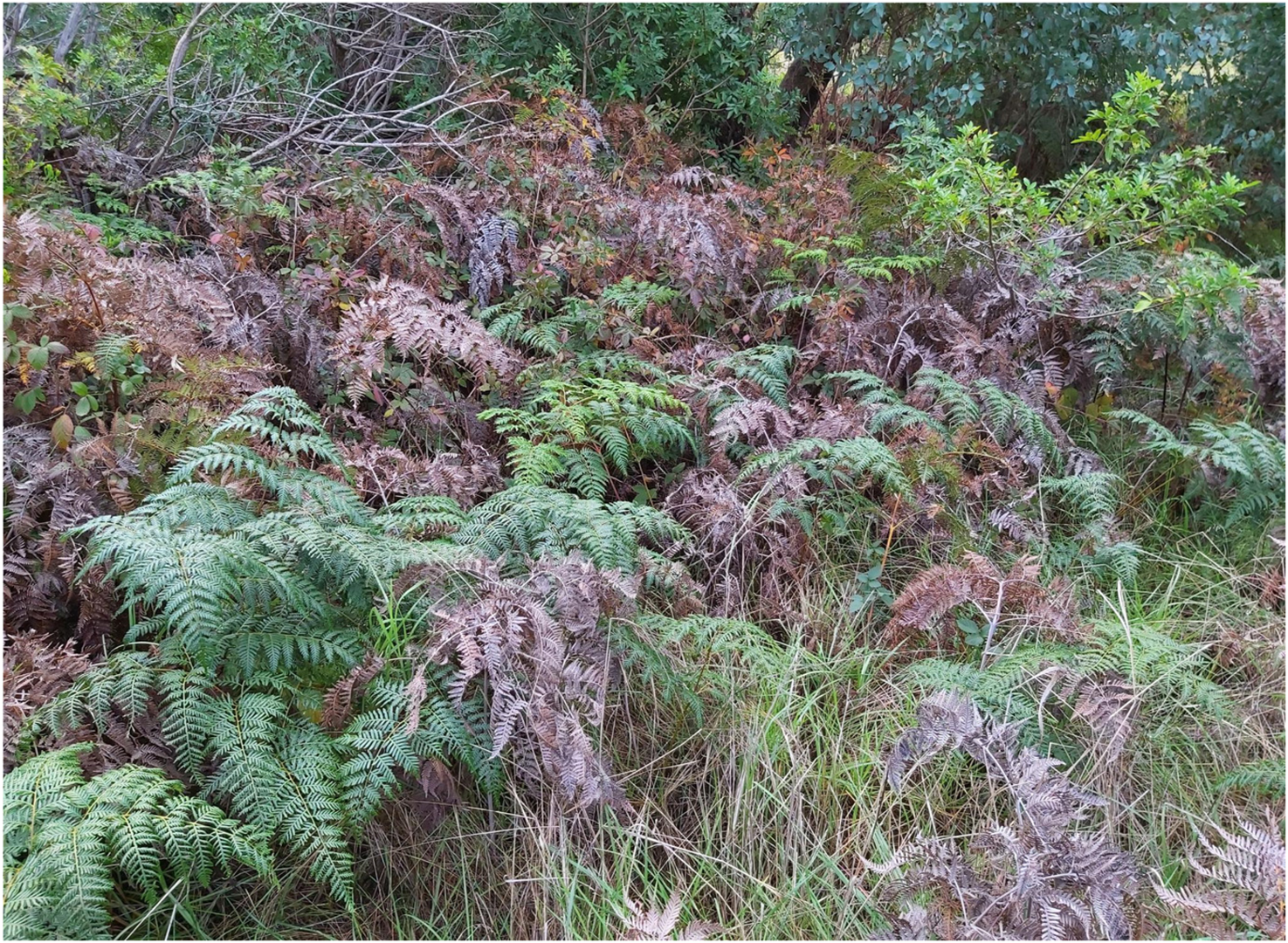
Bracken Fern is a plant identified by the local shire as an invasive weed. The council, various volunteer groups and local schools have been working together to try to eradicate Bracken Fern from the area. Due to its prolific and rapid growth Bracken Fern has damaged bushland that surrounds the wetlands.
To control the spread of Bracken Fern you must completely destroy its rhizomes. Even when badly damaged, rhizomes are still able to regenerate. Bracken Fern colonises especially rapidly in fire affected areas. However, its rapid growth after fire provides welcome shelter for Quenda.
Hesitating practices
In her proposal for an ecology of practices, the Belgian philosopher Isabelle Stengers (2013) suggests hesitating as a practice for countering normative responses that take for granted certain knowledges as universal and objective. The necessity for early childhood educators to engage with hesitating practices is highlighted by Blaise and Hamm (2022) in their account of lively emu encounters at an open-range zoo situated on Kulin Country, Australia. Blaise and Hamm describe how first noticing and then unlearning human-centric ways of knowing was essential to their process of troubling the ways in which playgroups engage with children and zoos. Like Blaise and Hamm, my engagement with hesitating began by pausing to notice the ways in which typical place-based approaches privilege certain types of knowing and doing over others. For example, prior to my walks-with Place, I was aware that the local council was working on eradicating Bracken Fern from the wetlands area. Noticing its prevalence, it was easy to fall into the familiar habit of naming Bracken Fern as a weed, and interpreting this as the cause for its immediate removal. This interpretation of a weed as something invasive and alien aligns with an anthropocentric view of nature as something that humans can control as they ‘decide to rid their neighbourhood of those they don’t like’ (Rose, 2015: 87). Place-based approaches often engage with practices that play into this narrative by romanticising children's play in nature, with nature acting as an attractive backdrop for children's learning (Taylor, 2013). Initiatives such as weed-pulling contribute to this discourse in ways that see children positioned as able to ‘fix up’ and restore nature to something more idyllic or natural (Taylor, 2013). Hesitating, prior to naming Bracken Fern definitively as something that needs to be removed, marks a point in my departure away from a habitual way of thinking about weeds in this manner.
By hesitating, I make space to interrogate the logic that has led me to knowing weeds as something that ruins native flora and fauna, and therefore should be removed. In an Australian context, the definition of a native plant derives from settler-colonial descriptions of bushland that is unruly and uncultivated – that is, bushland that has never been impacted in any way by humans (Mastnak et al., 2014). However, this logic denies an acknowledgement of the sophisticated agricultural practices that have been enacted by Aboriginal peoples for thousands of years. Recognising the partiality in my initial interpretation of weeds and the binary that this creates with native flora, I sought out alternative ways of knowing Bracken Fern. I find out that the wetlands have been home to Aboriginal peoples for at least hundreds of years, and that the Beeliar Group relied on the wetlands as a food source during the hot Noongar season of Bunuru. Listening to a talk by a Noongar speaker, I also learned that the waterway which runs through the wetlands holds significant spiritual meaning for the Noongar language group. These situated Place stories invite tension as I sit-with an interpretation of the wetlands that disrupts my past and present experiences with children, Place and weeds. However, Moxnes and Osgood (2018: 301) argue that it is precisely at these moments when we feel uncertainty or discomfort, which provides us with ‘access to diffractive moments’. Therefore, I intentionally chose to stay with the trouble (Haraway, 2016) as I composed, decomposed and then recomposed the blog in ways that included these alternative ways of knowing Bracken Fern and the wetlands ecosystem.
Unlearning weeds
Prior to hesitating, I understood weeds as something in opposition to native flora and fauna. My education taught me that weeds are harmful, alien and unattractive, and should be removed at all costs. Hesitating made space for me to acknowledge that this understanding has been influenced by colonial and anthropocentric perspectives of plant worlds. Unlearning this perspective required a deliberate engagement with Noongar histories and alternative Bracken Fern stories. This process has helped me to (re)learn Bracken Fern worlds as entangled not only with Noongar Place histories, but also with creek, fire, quenda, humans and so much more. Thinking-with Bracken Fern in this way has implications for the ways in which I now approach the topic of ‘weeds’ when either walking alone or engaging with children and/or the pre-service teachers with whom I work in my role as a lecturer in early childhood studies. By using scientific or local-language names, I can avoid setting up a binary between good and bad plants. Unlearning anthropocentric naming practices draws me to the scholarship of Kimmerer (2013: 55), who describes the necessity for a ‘grammar of animacy’ when talking and writing about plants. According to Kimmerer, calling Bracken Fern by name is a sign of respect and recognition of human kinship with plant worlds. Furthermore, instead of drawing attention to Bracken Fern alone, I might point out its interdependence with water, soil, wind and Noongar histories. When we do this, we situate Bracken Fern as embedded in common worlds that we also share with this Place (Common Worlds Research Collective, 2020). Perhaps most importantly, by (re)situating Bracken Fern as part of wetland–human worlds, we activate responses that are very different to weed-pulling-type activities. These otherwise responses are invitations for teachers and children to learn to live and learn with Bracken Fern worlds in ways that both acknowledge and nurture our shared relations and entangled futures. Hesitating and unlearning practices are entry points for expanding the blog to include multiple relations, knowledges and histories. This requires writing which is more speculative and evocative than that used for reflective journaling (Hultman and Lenz Taguchi, 2010). Consequently, unlearning a reflective writing style becomes necessary to make a shift towards diffractive practice. These shifts in thinking, writing and practice are highlighted in the following excerpt: This walk-with creek, Bracken Fern and more took place on Noongar Country in Perth, Western Australia. I walk-with Gabbiljee, also known as the watery place at the end of Derbarl Yerrigan (Swan River) and Djarlgarra (Canning River). Djarlgarra means place of abundance; Djarlgarra was once abundant with yakkan (turtle), mulloway, marron and Waakal Ngarnak (reeds). Pausing, I imagine the complex system of waterways that once characterised this Place, bodies of water that provided food but also spiritual connections. Noticing the damp, sodden ground I sense the presence of these waterways beneath my feet. I wonder about Bracken Fern’s relations with these ancient water bodies. Bracken Fern’s stem meets with ground. Underneath the ground, rhizomes spread forwards, backwards, sideways, wherever soil allows. Sitting-with Bracken Fern, I imagine rhizomes reaching like fingers, pushing, shaping and moulding the soil, whilst at the same time absorbing water and nutrients. Water is needed for Bracken Fern to reproduce. But it also relies on the Djeran wind to distribute its spores across the earth, scattering its seeds in preparation for a new generation of ferns.
(De)composing practices
Hesitating meant that I had amassed a large collection of material to think- and blog-with Place. This included (but was not limited to) photographs and field notes from my walks, snippets of information derived from the local council, notes taken from the talk by a Noongar speaker, theoretical readings and a book of prose written by Noongar author Ambelin Kwaymullina (2020). These were fragments of data that represented only partial glimpses of a much bigger picture. The composition of a reflective blog might involve ordering these materials into a timeline or sorting by themes. In fact, my initial attempt at blogging fell back on the familiarity of a linear description of events that I had organised into neat categories – walking alongside the creek, encounters with the creek, wondering about reflections in the water, and so on. In a description of diffractive methodologies, Mazzei (2014) cautions that this type of coding narrows an analysis to familiar themes, and that any inquiry which follows is limited by these categories as we try to make our analysis ‘fit’. Alternatively, a diffractive assemblage of data experiments with the ways in which different fragments intra-act to produce something new. In a diffractive analysis of puddles and children at play, Merewether (2019: 109) works with this type of analysis, flying what she calls ‘murmurs’ alongside one another in order ‘to see what intra-actions emerge as they mingle’.
With the intention of disrupting the linearity and certainty of reflective practice, I experimented with what I call ‘(de)composing practices’. This process involves the pairing of different materials to see what different or unexpected insights emerge. In contrast to reflective journaling, the (de)composition of a diffractive blog is active, unfixed and emergent, with each new pairing an opportunity to sit-with otherwise ways of thinking and doing.
I now share a third excerpt from the (de)composing blog, which is followed by a discussion of the ways in which (de)composing practices made space for diffractive thinking and consequent unlearning: In Indigenous systems time is not linear, it moves in cycles, it exists in space, in Country and is as susceptible to action and interaction as any other life … Life doesn’t move through time. Time moves through life. (Kwaymullina, 2020)
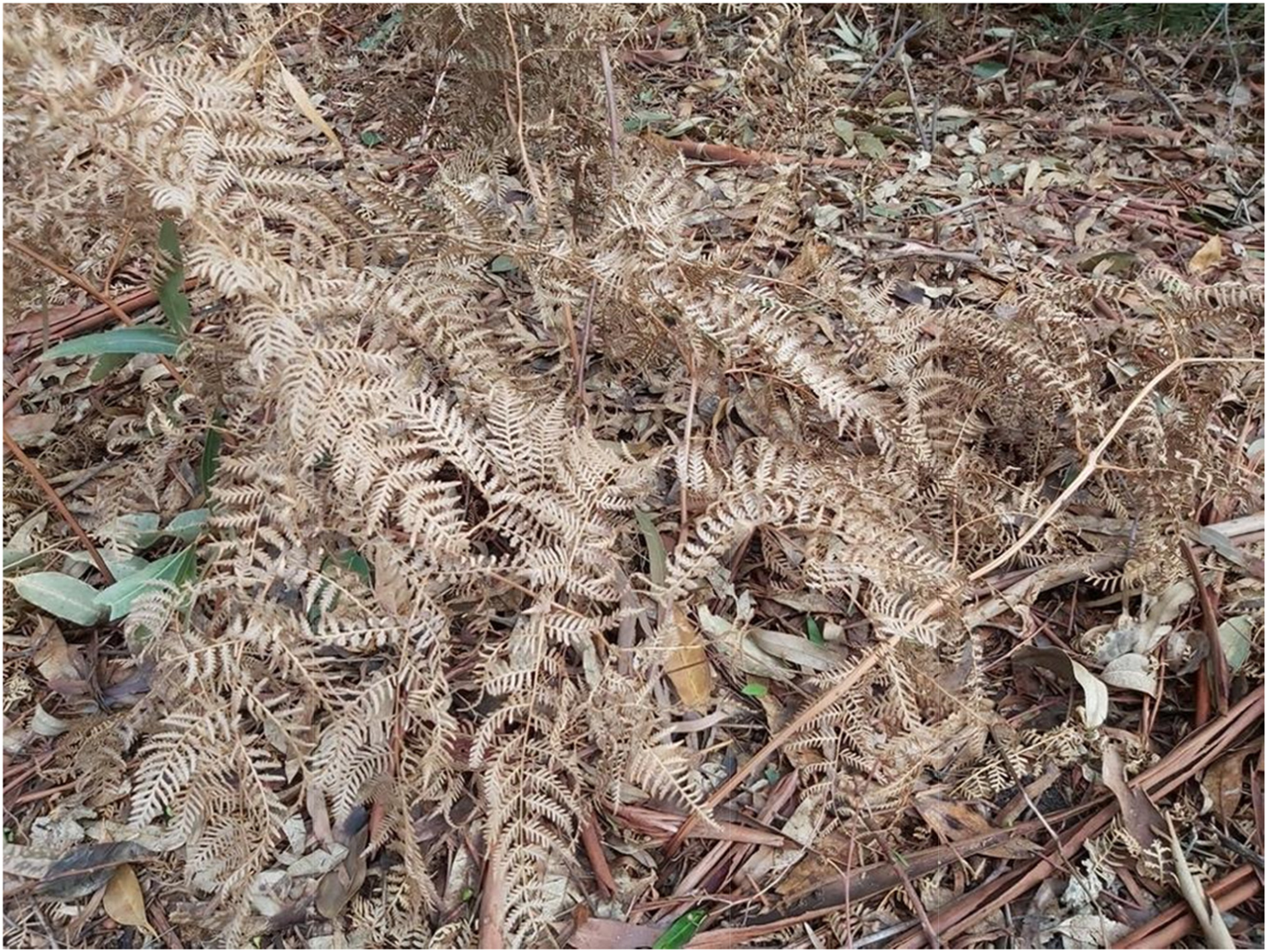
Sitting-with layers of Bracken Fern, Banksia, Grasstree, Jarrah, Marri and Paperback mattering. Here you can dig your fingers down towards earth and feel the layers of mattering. You have to dig a while to reach earth because there are lots of layers. Spiky, sharp, fragile, dry … each layer feels different. Or scoop up a handful and let the layers sift through your fingers. It is like holding hundreds and hundreds of years in your hands.
Throughout the process of walking- and blogging-with Place, I was reading prose written by Noongar author Ambelin Kwaymullina (2020). Kwaymullina's writing about Indigenous ways of knowing time prompted me to return to a photograph depicting layers of leaf litter lying below a Bracken Fern frond. 7 This unexpected pairing prompted me to think beyond a scientific imagining of the complex ecosystem that lies beneath the layers of leaf litter. Instead, I noticed something different within the layers – a sense of time that invited me to notice the leaf litter in an unexpected way. Sensing a deep time within the layers, I am led to the scholarship of Catherine Hamm (2015), where she talks about the ways in which Place holds layers of ‘colonial inscription’ (57). Hamm proposes that we might expose these layers by thinking-with the concept of pastpresents as a way of acknowledging that land ‘is entangled in stories, ceremonies, and traditions; they are not gone from here, it is just a matter of paying attention in particular ways’ (62). 8 In other words, the histories of the wetlands are visible in the present but, to be able to see them, one must learn to notice Place in different ways.
Reading and rereading the material through prose, leaf litter, touch, photographs, pastpresents and more means the blog is broken up and made again multiple times over in an ongoing process of (de)composition. Whereas a reflective blog is made visible to the reader once complete, the process of blogging-with Place saw me sharing these multiple iterations with other academics both within education and across disciplines. These conversations invited further (de)composition as I reworked the blog to accommodate new thinking and ideas. Mazzei (2014: 743) describes this type of analysis as an ‘assemblage in formation’, with the emphasis being on the process of the putting together and reading of data in different ways. Apart from inviting difference, the very nature of (de)composition practices required an unlearning of the reflective writing process and of the ways in which time is understood in Euro-western education systems.
Unlearning time
To engage with (de)composition, it was necessary to unlearn the certainty and linearity of the reflective cycle. The deliberate inclusion of practices such as reading-with Aboriginal authorship, thinking-with concepts and making the blog visible during (de)composition supported the unlearning process. Furthermore, these otherwise ways of documenting Place prompted the unlearning of time as something that can only be measured by Euro-western markers. This unlearning is difficult and does not come easy. Unlearning universal notions of time is particularly challenging in educational contexts where time is marked by periods, bells and school terms. However, unlearning invites opportunities for relearning time to include more expansive and multiple temporalities, which then has implications for the ways in which I engage with Place and time. Instead of marking each visit to Place as a separate event, Place encounters might be approached as a continuous experience of always becoming-with Place. Walks-with Place might attend to time in ways that prompt children to notice situated ‘in-the-moment’ encounters, rather than as marked by pre-planned activities. By making space for children to experience Place in this way, there is potential for noticing pastpresents in Noongar seasons, water, rhizomes and leaf-litter worlds.
As I blogged-with Bracken Fern, leaf litter, microbes, pastpresents and more, the story of the wetlands transformed in ways that revealed a complex assemblage of multiple realities and worlds. Blogging-with Place directly challenges the assumption that there is only one reality that is open for interpretation, and dissolves the expectation that one can ever understand or master realities other than one’s own (Law, 2015). This way of understanding Place directly challenges the dualistic thinking that is commonplace in early childhood place-based approaches and in reflective practice. As an alternative to reflective methods of documentation, this article offers blogging-with Place as an effective entry point through which teachers can (re)consider the ways in which they plan for place-based teaching and learning. The blogs are a space to sit-with differences and to notice diffractive possibilities for taking thinking and practice in directions that account for humans’ shared relations with multiple worlds.
However, diffractive practices are neither simple nor easy, especially for teachers and researchers who are already trained in reflective practice. It requires a deliberate unlearning of the reflective process. Whilst hesitating and (de)composing practices offer ways of documenting that intentionally disrupt reflective habits, diffractive practices also require a commitment to unlearning taken-for-granted ways of thinking, being and doing. In this inquiry, the process of blogging-with Place prompted unlearning about naming practices and troubled Euro-western ways of measuring time. This unlearning was an opening for (re)learning these concepts in ways that include differences. It is these differences that offer diffractive possibilities for (re)imagining place-based approaches in early childhood education.
If the ‘world is materialised differently through different practices’ (Barad, 2007: 89), then blogging-with Place has the potential to make visible these different worlds. By paying attention to these differences, there is the potential for teachers to transform place-based experiences in ways that makes space for an ethic that attends to the well-being and care of collective futures.
Footnotes
Acknowledgements
I would like to thank Professor Mindy Blaise, Associate Professor Lennie Barblett and Associate Professor Gill Kirk for sharing in this journey of unlearning and (re)learning. I will be forever grateful for the feedback, mentorship and care that you so generously share.
Declaration of conflicting interests
The author declared no potential conflicts of interest with respect to the research, authorship and/or publication of this article.
Funding
The author received no financial support for the research, authorship and/or publication of this article.
