



Abstract
Play is a central discourse in policy and practice pertaining to young children's learning, development and well-being in many countries around the world. Dominant ways of understanding and advocating for play often construct universalising notions of children and childhood, overlooking that play is always-already culturally situated and ideologically inflected. In play discourse, happiness is constituted as an unproblematised condition, goal and outcome of children's play, and as an antidote to contemporary childhoods burdened by geopolitical, social and environmental issues. In this article, the authors analyse images of children at play in curriculum frameworks, documents and reports, exploring the ways that happiness consistently features as a largely unspoken/unwritten expectation and rationale for policies and policy advocacy concerning play in early childhood. Informed by post-structural theories of biopolitical power, everyday practices and the cultural politics of emotion, and utilising analytical techniques from social semiotics and discourse analysis, the authors argue that visual representations in the documents analysed depict play and happiness as co-implicated. They contend that these representations function in the production of play discourses that both assume and obligate children and childhood to happiness. They interrogate play in these terms, critiquing discursive tropes that are contingent on the co-implication of play and happiness with biopolitical subjectification in order to consider the relevance and utility of play as a policy and pedagogical export to diverse parts of the world.
Introduction: discursive domains of play and happiness
Contemporary discourses of play in many parts of the world are largely synonymous with notions of happiness, drawing closely woven, interconnecting threads through the fabric of everyday beliefs, values and imaginaries regarding children and childhood. These discursive threads, in turn, shape social expectations, professional practices and policy agendas, and are pervasive in the language, and the curricular and pedagogical approaches in early childhood education, where the connection between play and happiness is seldom problematised (Ailwood, 2003; Chapman and Saltmarsh, 2013; Grieshaber and McArdle, 2010; Saltmarsh, 2014). More broadly, the co-implication of play with happiness is a familiar trope in human rights discourse, popular culture and everyday parenting practices, mapping onto pervasive beliefs ‘that children should be happy and that childhood should be a happy, perhaps unusually happy, stage of life’ (Stearns, 2019: 1). In this article, we consider some of the ways that these ideas operate in visual texts, unproblematically constructing play and happiness as co-implicated. We argue that the co-implication of play and happiness is inscribed in the images as a universalising and homogenising ‘truth’, and show how these truth claims function to inscribe happiness as a ‘duty’ (Ahmed, 2005, 2010a, 2010b).
Our analysis of images of children at play in policy documents and reports highlights how, in visual texts, happiness features as a largely unspoken/unwritten expectation and rationale for policies and policy advocacy concerning play in early childhood. Informed by cultural and post-structuralist theory, we contend that the co-implication of play and happiness functions as a discursive mechanism for governing childhood. This operates – at least in part – through largely unproblematised truth claims that construct happiness as the goal, outcome and (on behalf of children) entitlement of children. Our main points of unpacking and troubling these dominant sociocultural constructions of play are nested within the positioning of post-structural onto-epistemological perspectives. Drawing from post-structural theories of biopolitical power, everyday practices and the cultural politics of emotion (Ahmed, 2005, 2010a, 2010b; De Certeau, 1984; Foucault, 2008), and utilising analytical techniques from social semiotics and discourse analysis, we consider how visual representations of play almost uniformly depict happiness in biopolitical terms.
Nearly two decades ago, Ailwood (2003: 288) identified three dominant discourses of play around which childhood was seen to be governed: ‘(1) a romantic/nostalgic discourse, (2) a play characteristics discourse, and (3) a developmental discourse’. These discourses were, and continue to be, co-extensive and shaped to no small degree by western social, cultural and political constructions of childhood as a period of vulnerable human development requiring special protection, guidance and biopolitical technologies to guard its sacredness and purity (Nadesan, 2010). These constructions of childhood have also had considerable overlap in the values, beliefs and practices of parenting. For example, parents might compare their own childhood memories of play with their children's experience of play, constructing contemporary childhood play as being more restrictive and less carefree and enjoyable than the play of their own childhood memories (Ailwood, 2003, 2011; Rixon et al., 2019). Nostalgia for the past, it has been argued, ‘is predominantly a “happiness” emotion, but with a bittersweet undercurrent of a past lost, never to be regained’ (Harris, 2017: 20). Parents’ perspectives on play also intersect with developmental and other play discourses, making connections between popular, educational and social ideals that place value on certain types of play and their perceived learning value and other benefits to children. Research in recent years has also shown that parents’ perspectives about play are shaped by a range of factors, including the gender of both parent and child, social class and cultural background (e.g. see LaForett and Mendez, 2017; McFarland and Laird, 2018; Turk and Lash, 2017; Warash et al., 2017).
The discourses of play that are familiar in everyday life also hold powerful sway across a range of disciplinary fields, policy agendas and domains of professional practice, and perhaps nowhere so obviously as in early childhood education. Discourses of play that inform policy and practice in early childhood education tend to reflect dominant western views, norms and assumptions about the nature, functions and purposes of play (Brooker, 2018; Li, 2004; Rogers, 2011). As Brooker (2018: 15) points out: ‘By the early 2000s, belief in play as an instrument of early learning dominated the pre-school curricula of European, American and Australasian nations, and had begun to infiltrate the curricula of former colonies with very different cultural traditions’. Inscribed in these ways of understanding play are beliefs about the benefits and functions of play, children's need for play, and their rights and entitlements to play.
In what is described by Brooker (2018: 15) as an unassailable ‘orthodoxy that children “learn through play”’, happiness is also a familiar trope. Indeed, some early childhood education experts have pointed out that the ‘rhetorics of child play dictate that children develop, through play, skills that enable them to continue to play successfully, which in turn generates happiness’ (Grieshaber and McArdle, 2010: 8). These normative views have invariably been woven throughout the work of experts and educators promoting play as a policy ideal in non-western countries. This can have unintended ramifications for some children – most notably, those whose families and cultures differ in their perspectives about the functions and purposes of play (Ebbeck et al., 2010; Wood, 2014). As Wood observes: Children who have not been enculturated into western forms of ‘educational’ play experience early childhood settings as limiting rather than enabling their participation, which may put them at a disadvantage in accessing the curriculum or negotiating childhood and classroom cultures. (Wood, 2014: 6)
These limitations notwithstanding, across the globe, play is promoted as a universal educational philosophy in early childhood education curriculum guidelines and learning frameworks, and play-based learning is the foundation of numerous progressive pedagogical approaches to teaching and learning in the early years (Bubikova-Moan et al., 2019; Ebbeck and Waniganayake, 2017; Pyle et al., 2017; Synodi, 2010; Wasmuth and Nitecki, 2017). This is not to suggest that these ideals have been unproblematically taken up, and scholars point out that notions such as play-based learning remain the subject of debate and controversy in many parts of the world (Bubikova-Moan et al., 2019). Rather, it is to point out that, globally, dominant discourses of play construct enjoyable, stress-free and active engagement in meaningful learning within a lexicon of universal values and homogenous human development. These discursive constructions are further supported from a human rights perspective, with play enshrined in the United Nations Convention on the Rights of the Child as a fundamental right of all children, and children's right to play being given equal importance to all other domains of human rights (Office of the High Commissioner for Human Rights, 1989).
Alongside these parental, educational, policy and human rights discourses, adult sentiments in popular discourse and visual culture have persistently romanticised play as synonymous with childhood innocence and happiness. These sentiments have, in turn, become embedded within a wide range of popular imaginaries concerning children and childhood (Ailwood, 2003; Robinson, 2013; Saltmarsh, 2011, 2014; Saltmarsh and North, 2011). It is to these sentiments and their reiteration in popular imaginaries that our discussion now turns, as we consider the ways that the co-implication of play and happiness functions as a truth claim around which the biopolitical governance of childhood is in part accomplished. We then analyse images of children at play in visual texts of national and international policy documents and reports, exploring the ways that play and happiness consistently feature as a largely unspoken/unwritten expectation and rationale for policies and policy advocacy concerning play in early childhood, as well as a technique of biopolitical subjectification.
The biopolitics of play: governing happy childhoods
The playful, carefree, happy child is ubiquitous in what Rose (1999: 86) has referred to as ‘the public habitat of images’, where tacit connections between play and happiness function as homogenising truth claims within ‘a plurality of pedagogies for living a life that is both pleasurable and respectable, both personally unique and socially normal’. These truth claims have particular currency in the biopolitics of contemporary childhoods, where happiness becomes not only a state of being that is desired and desirable, but also an obligation or a duty. As Ahmed has observed: happiness is what follows being natural or good. Going along with happiness scripts is how we get along: to get along is to be willing and able to express happiness in proximity to the right things. The child thus has a happiness duty. (Ahmed, 2010b: 59)
The assumption of happiness as synonymous with good, and with being a particular kind of social subject who is recognised and recognisable as good, raises important questions about the role of happiness in constituting power relations around which it might be organised, and the subjectivating function of these. In Foucauldian terms, power relations operate through forms of knowledge and resistance that are operationalised through techniques or operations of power: This form of power applies itself to immediate everyday life which categorizes the individual, marks him by his own individuality, attaches him to his own identity, imposes a law of truth on him which he must recognize and which others have to recognize in him. It is a form of power which makes individuals subjects. (Foucault, 1982: 781)
These operations of power construct idealised social subjects – in this case, the happy child of play – thereby governing childhood through the kind of ‘duty’ or obligation to happiness that Ahmed queries. It follows that play, as the idealised activity through which children's happiness is produced, has a similar obligating function.
The happiness duty does more than assume and oblige, functioning also as a technique of biopolitical power. The notion of biopolitics posed by Foucault (1998, 2008) concerns power and the ways that technologies or techniques of power operate in the governance of populations at the site of individual bodies and lives. Foucault (1998: 142) traces how sovereign power gave way over time to ‘the administration of bodies and the calculated management of life’, operationalised through ‘numerous and diverse techniques for achieving the subjugation of bodies and the control of populations, marking the beginning of an era of “bio-power”’. In the case of childhood, these techniques take multiple forms and have long been dispersed through a variety of social domains. Thus, as Nadesan (2010: 2) argues: ‘Although biopolitical knowledge and practices often derive from expert understandings – from knowledge formations produced by educational, psychological, and psychiatric authorities – they also derive from economic authorities and from everyday people engaged in everyday routines and practices’.
All this is not to suggest, however, that dominant or homogenising discourses are without contention. Indeed, for Foucault (1982: 781), biopolitical power is dispersed and operates through forms of knowledge and resistance, and he suggests ‘analyzing power relations through the antagonism of strategies’. Discursive contradictions and the struggles to which they give rise are important sites of such analyses. Thus, the predominance of sentimental, romanticised notions of childhood notwithstanding, there are competing and contradictory narratives simultaneously at play. For example, despite the normative ideals of childhood as a life stage characterised by innocence and purity, Park (2021: 11; original emphasis) also reminds us that ‘young children are a structurally marginalized population illustrated as social objects often associated with less than narratives – as dependent, deficient, passive, and in need of adult intervention’. In this tension between the normative ideal and its other, it is possible to interrogate how the ideal itself functions as a technique of governmentality, and to query how regimes of truth through which contemporary biopolitical governance is operationalised might be contested: Contemporary liberal regimes of truth constrain public discourse about the contradictions posed by extant neoliberal technologies of government. Neoliberal governmentalities are seductive in their promises to maximize personal liberty and happiness but offer limited vocabularies and technologies of government for addressing people, events, and phenomena rupturing liberal fantasies. (Nadesan, 2008: 215)
For Vintimilla (2014), it is necessary ‘to think about neoliberalism, not only as a state's economic orientation, but as particular modes of subjectivity, and how one becomes (or may resist becoming) a neoliberal subject, especially through the project of education’ (80). In her discussion of neo-liberalism as it pertains to early childhood education, Vintimilla highlights the importance of moving beyond thinking of neo-liberalism in terms of economic principles, policies and effects. She calls instead for understanding neo-liberalism ‘as a rationality, one which expands its normative ideology and values to other spheres of our lives through specific discourses and practices’ (80). The ‘concept of fun’, she suggests, provides a useful site for considering the ways that subjectivities are addressed and managed through normative expectations and practices.
Vintimilla contends that ‘the concept of fun as a neoliberal operant should be seen as a concept involved in the management and government of everyday life because it signifies a specific way of being in the world’ (82). An expression that at once implies something positive about the kind of person one is and confers meaning on particular activities, experiences and identities, ‘fun’ functions as an indicator of success and well-being, and ‘plays a key part in governing emotions’ (82). Importantly for our consideration of play and happiness, Vintimilla points out that in everyday practices of early childhood education, adults are reluctant to speak about topics or permit situations that might make children unhappy, to such an extent that ‘we have moved away from allowing ambivalence in children's emotional lives or supporting ways of being that are more complex than being happy’ (82).
This reluctance to veer, or to permit children to veer, too far from the narrative of happiness speaks to its success as a technique of governmentality. This success lies in no small measure in its credibility as a storyline with recognisable values and convincing social truths. As De Certeau (1984: 148; original emphasis) has observed: ‘The credibility of a discourse is what first makes believers act in accord with it’. We have already seen in the introduction how the acceptance of childhood as a time of joyful, carefree innocence, the happiness of which is secured through the exercise of rights and entitlements to play, has become an orthodoxy in multiple domains of contemporary western societies.
This is not to suggest a single, fixed set of meanings and, indeed, Sutton-Smith (1997) has highlighted ambiguities surrounding the ways that play has been theorised, practised and discursively produced. He addresses these ambiguities in terms of rhetorics of play, using the term ‘rhetoric’ ‘in its modern sense, as being a persuasive discourse, or an implicit narrative, wittingly or unwittingly adopted by members of a particular affiliation to persuade others of the veracity and worthwhileness of their beliefs’ (Sutton-Smith, 1997: 8). These rhetorics of play and their co-implication with happiness, and the extent to which they function in parenting, professional practice, education policy and popular culture, illustrate De Certeau's (1984: 149; original emphasis) contention that ‘normative discourse “operates” only if it has already become a story’. This story is woven through broader social narratives, such that ‘the happiness of childhood functions as a symbolic barometer for optimism/pessimism about the future for the individual child, for the nation state and for society more broadly’ (Chapman and Saltmarsh, 2013: 62). In the following section, we bring these concerns to bear in an analysis of images that illustrate the visual rhetorics through which happiness and play function in the discursive construction of storylines whose credibility is maintained by normative assumptions that are acceptable to romanticising adult sentiments.
Visual culture and playful images: happiness and enjoyment in play
As discussed above, a significant aspect of play discourse is the way that happiness is constituted as an unproblematised condition, goal and outcome of children's play, and as an antidote to contemporary childhoods burdened by geopolitical, social and environmental issues. By questioning ‘the way in which knowledge circulates and functions, its relations to power’ (Foucault, 1982: 781), we consider the discursive co-implication of happiness and play in a selection of early childhood education learning frameworks, curriculum documents and reports in the public domain. We draw on these theoretical insights, in dialogue with the relevant substantive literature, to analyse the happiness rhetorics constructed through the interplay of image and text in these documents. Following the discourse analysis work of Van Leeuwen (2008: 137), we consider the ways that written and visual texts contribute to the discursive construction of meanings and associations, which ‘are seemingly read into the images by the viewer, rather than being encoded into the image by the producer’. Our interest here is to consider images and texts not just as representing play and the curricular and pedagogical practices in relation to it, but also as doing something in discursive terms – as constructing, explaining, and legitimating and reiterating discursive and social ideals about both play and happiness.
Our selection of documents for analysis is guided by this special issue's focus on Asia and our interest in the ways that ideas about childhood and education ‘travel’ across national, regional and global boundaries and borders. For this article, we chose documents from Hong Kong and Singapore, where early childhood curriculum documents are published in English and are in current circulation in the public domain, and from their nearest anglophone neighbours, Australia and the USA. In some cases, these are national frameworks; in others, such as the Head Start Early Learning Outcomes Framework: Ages Birth to Five (Office of Head Start, 2015), examples are drawn from nationally funded early childhood education programmes that have been, and remain, highly influential both nationally and internationally, and whose framework was developed in consultation with other national bodies in the USA. We also selected a recent UNICEF report documenting progress towards the goals articulated in the UNICEF Strategic Plan 2018–2021 (UNICEF, 2020). We selected cover images and other pictures from within the documents depicting children at play, noting that across all of the documents, play is uniformly depicted as a happy activity. Importantly, it is not our intention to make claims about the representativeness of these documents or the images they contain in relation to the broader, seemingly inexhaustible, array of similar documents in the public domain. Instead, we consider these documents as providing examples of ways that the tacit and explicit co-implication of play with happiness has made its way into a variety of national policy cultures and global humanitarian ideals.
In some examples, images are used sparingly – Hong Kong's Kindergarten Education Curriculum Guide (Curriculum Development Council, 2017), for example, uses only one image on the cover, and the remainder of the document is written text. The cover image depicts three children looking intently at and pointing to countries on a desktop globe. While the children appear to be engaged in the task at hand, neither the activity nor the children's facial expressions give an impression of the joyfulness indicated in the document’s subtitle: Joyful Learning through Play, Balanced Development All the Way. The content of the document, however, makes clear the intentions of the Education Bureau with regard to children's happiness: ‘We intend for quality kindergarten education to nurture every child so that they become • • • •
These curriculum aims, the document states ‘are conducive to nurturing children to be
In the other written texts we examined, play is seldom discussed explicitly in terms of generating happiness, with the focus remaining primarily on the role of play in achieving educational goals. Belonging, Being and Becoming: The Early Years Learning Framework for Australia (Department of Education, Employment and Workplace Relations, 2009), for example, mentions happiness only once, and this is in connection with the outcome pertaining to children's sense of well-being (Outcome 3). In a table headed ‘Children take increasing responsibility for their own health and physical wellbeing’, happiness appears in a single bullet point: This is evident, for example, when children: … • are happy, healthy, safe and connected to others. (Department of Education, Employment and Workplace Relations, 2009: 35)
Here, happiness appears not as an affective response or state of being, nor as an outcome of any particular activity, personal desire or effort, or curricular goal, but as evidence of self-responsibilisation. This, it should be noted, is a subjectivating practice, as children are obligated to happiness as an indicator of self-responsibility, such that ‘their conduct [is] made visible by being judged against institutional norms’ (Rose, 1999: 214).
Similarly, within the US context, the Head Start Early Learning Outcomes Framework: Ages Birth to Five (Office of Head Start, 2015) mentions happiness only three times, each of which is in reference to the milestones expected of children at various developmental stages, such as showing, indicating or using words to describe when they are happy. There are 58 photographs placed throughout this document, with children shown either smiling or focused intently on learning activities. Interestingly, in 19 of the 32 photographs in which adults are shown, they are smiling, and in all they are actively engaged with the children. Although the language of the document privileges ‘outcomes’ – those things that children are able to do, develop, demonstrate, use and exhibit across a range of domains – its visual rhetoric constructs learning as a pleasant, happy enterprise. The document makes 87 direct mentions of play, yet only one of these makes any explicit affective connection.
Happiness on the page shown in Figure 1 is expressed verbally in terms of ‘enjoyment’ and ‘showing delight’ in the caption adjacent to the photograph. The image of the children dressed in colourful clothing and happily playing with brightly coloured toys, however, stands out on an otherwise bland page filled with dull-coloured tables and small type. As Van Leeuwen (2008) contends, analysing images of this sort necessitates considerations of both how the people in the photographs are depicted and how they are depicted in relation to the viewer. The children and adults in all of the images in this document are depicted interacting with others, or with toys, books and other objects. Their gaze is focused on one another or on the objects they are using, ‘offered to our gaze as spectacle for dispassionate scrutiny … rather than as interactants’ (Van Leeuwen, 2008: 140–141). The viewer is positioned to look in on scenes of pedagogy and play, with the smiles of the children and the grinning approbation of the adults functioning as a visual reassurance that the eduspeak (Kelly, 2007) of the document, and the outcomes and successes it promises, can be accomplished without compromising children's happiness.
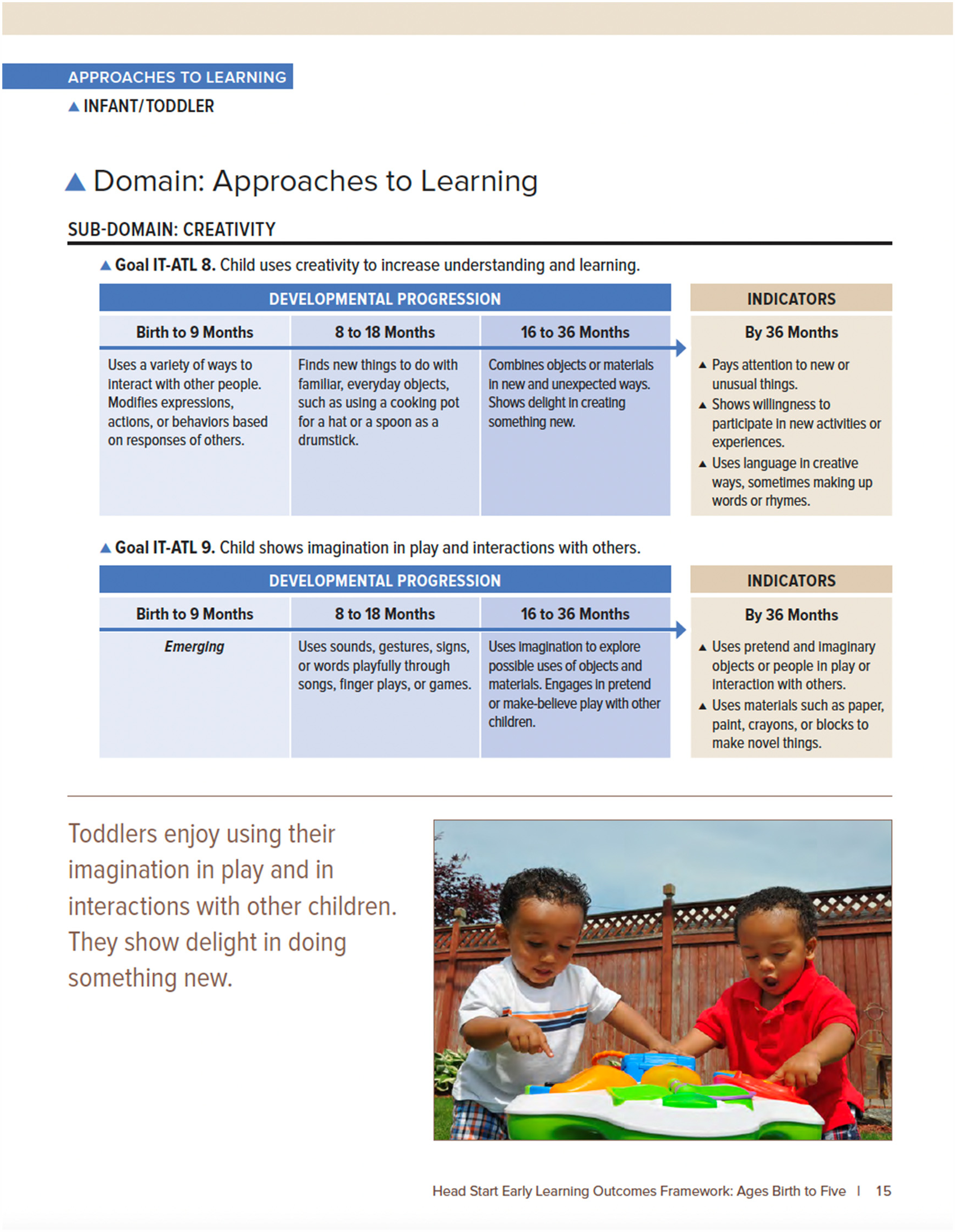
Sample page from Head Start Early Learning Outcomes Framework: Ages Birth to Five (Office of Head Start, 2015: 15).
Throughout this document, the written text is consistent with the position statement of developmentally appropriate practice adopted by the National Association for the Education of Young Children (2009) on play as a vehicle for learning, and also sticks to dominant developmentalist and neo-liberal scripts, employing the language of learning outcomes, school readiness, child development, self-regulation, good teaching and instructional alignment. In this way, we can see how ‘[t]he biopolitical dispersion of sovereignty across everyday life simply decenter[s] sovereign operations, rendering them more mundane, more ubiquitous’ (Nadesan, 2008: 215). However, the images throughout the document present a very different picture, in which happy, smiling children play together as they participate in a variety of tasks and activities. This rhetoric of play as co-implicated with happiness is situated at the site of embodied children, without whom the identifying written narrative would be wholly superfluous. Irrespective of what might be written or said about play in the document, it is the photographs that illustrate De Certeau's (1984: 149) contention that ‘every social orthodoxy makes use of instruments to give itself the form of a story and to produce the credibility attached to a discourse articulated by bodies’.
Even in early learning frameworks where there is less policy emphasis on the centrality of play, the storyline of children playing happily in learning contexts is visually reiterated. For example, the front cover of Singapore's Ministry of Education brochure On to a strong start features children laughing, smiling and happily playing together (Figure 2).
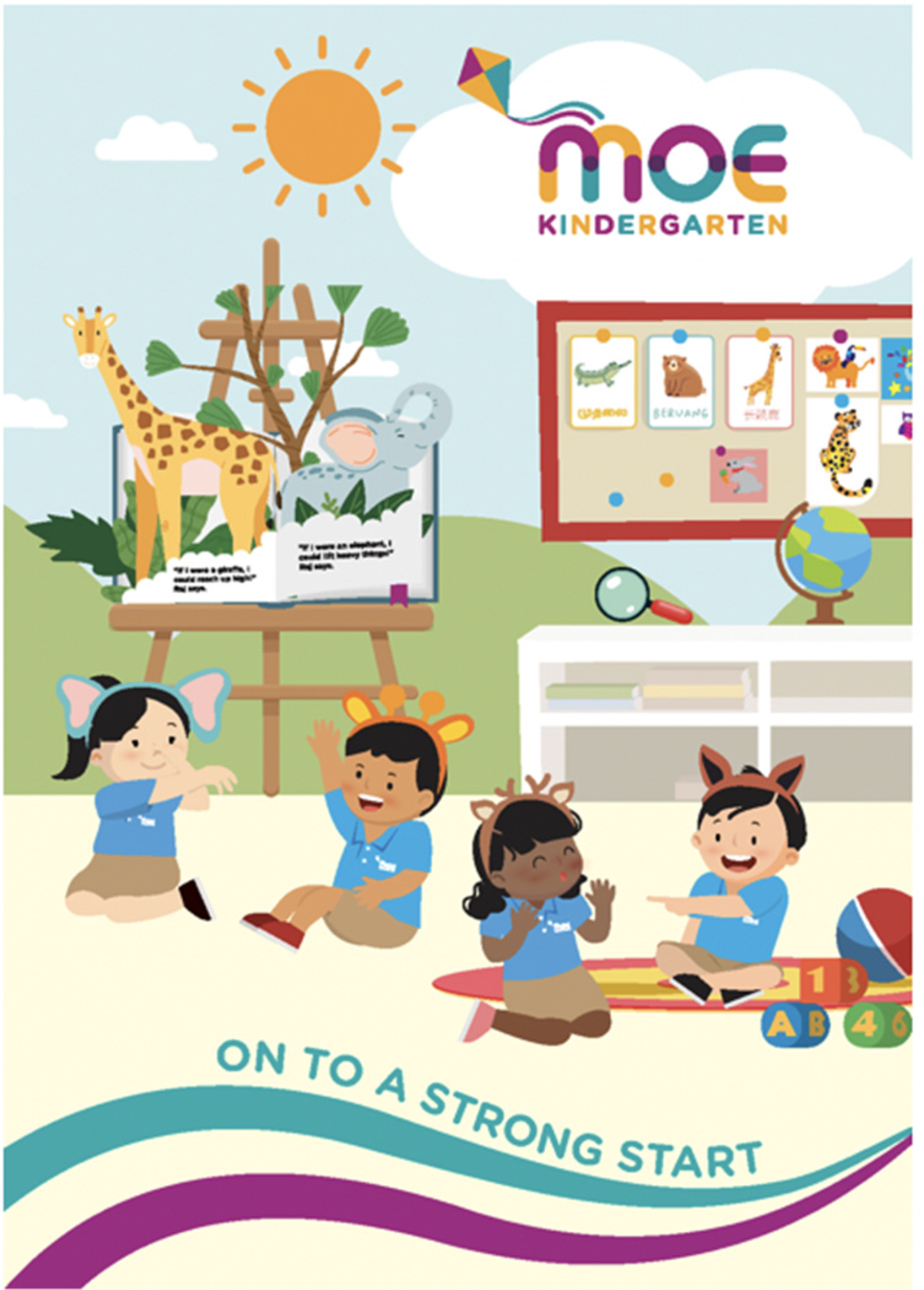
Front cover of On to a strong start (Ministry of Education Singapore, 2021).
The visual rhetoric connecting play with happiness is repeated in other images throughout the document, with 14 of the 18 photographs in the document, and both the front and back cover images, showing children smiling as they play together in their learning environments (Figures 2 and 3). The written text, however, mentions play almost entirely in terms of describing types of learning experiences. In only one of the five times play is mentioned in the 14-page document is there any concession to the affective dimension of play, albeit only insofar as it is seen as being harnessed to achieve particular educational ends: ‘Through enjoyable play experiences that are intentionally planned and guided to achieve learning outcomes, your child will engage in lively discussions with his or her teachers and friends to build on ideas and concepts together’ (Ministry of Education Singapore, 2021: 6). The explicit goal of play throughout the written text is primarily pedagogical, whereas the images tacitly reiterate its affective functions in the production of happiness.
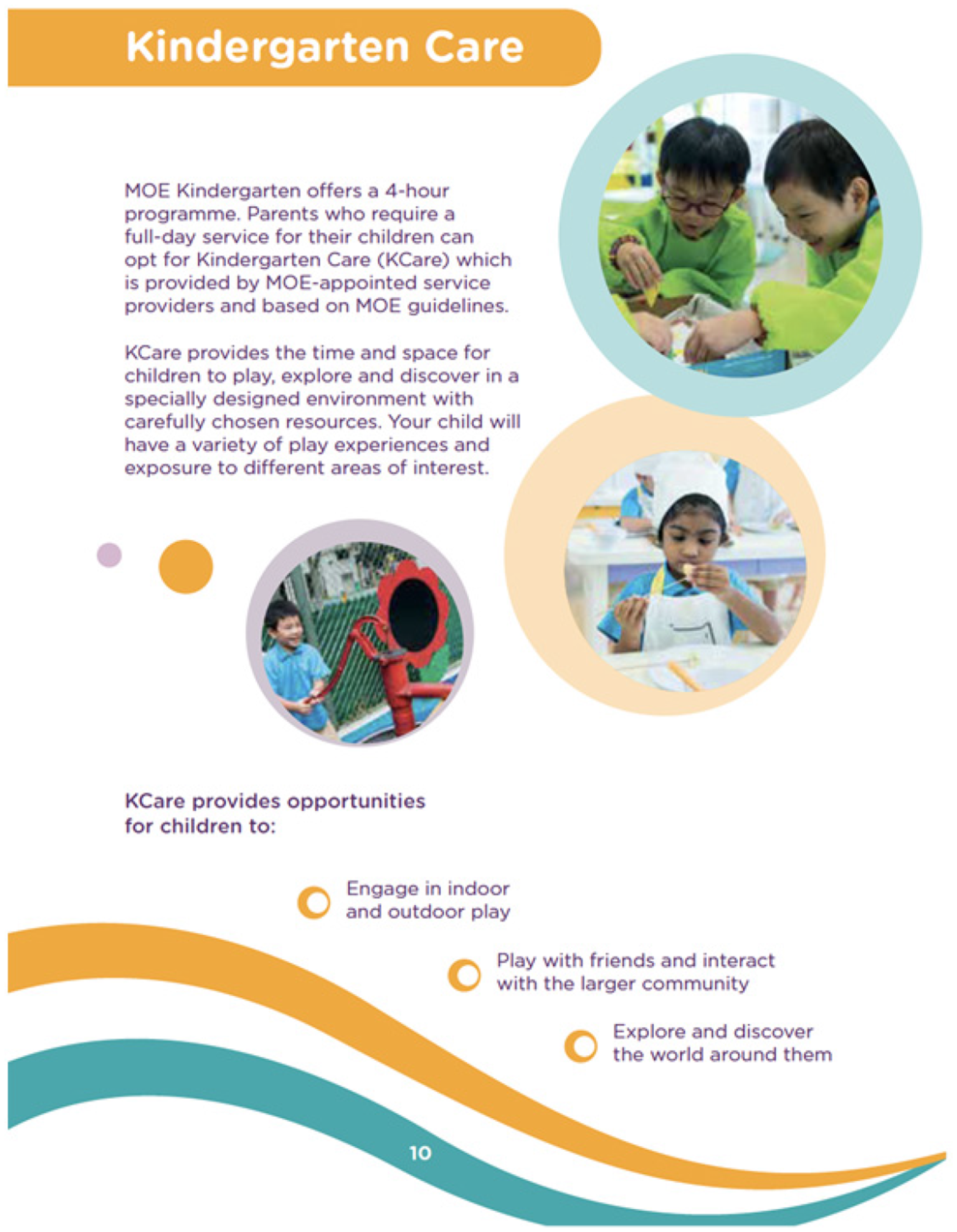
Sample page from On to a strong start (Ministry of Education Singapore, 2021: 10).
The overt address to parents maintains the educational agenda of play for the purpose of particular types of learning experiences, while the images of children happily enjoying play activities simultaneously reassure parents that their children will be happy whilst learning. This exemplifies what Chiong and Dimmock (2020: 394) refer to as part of an ‘architecture of trust’, which is designed to speak to the increasing anxieties of parents who are concerned by the effects of neo-liberal competition and self-responsibilisation, and, in so doing, build and restore trust between the state, schools and families. This is an interesting example of the ways in which ‘governmental operations are dispersed in the micropractices of the market … and in everyday practices and familial relationships (e.g., in schools and families)’ (Nadesan, 2008: 10). Enjoyment and happiness are not the goal here, but rather a familially and socially palatable means of facilitating the child's educational and future success as the child learns to think, create and become ‘an entrepreneur of himself’ (Foucault, 2008: 226) in the global economy.
In addition to the happiness-play narrative illustrated in state and national learning and curriculum frameworks, documents with a more global scope are contributors to this storyline. For example, Figure 4 shows the cover of a recent UNICEF annual report on progress towards the goals articulated in the UNICEF Strategic Plan 2018–2021, intended to deliver on the United Nations’ Strategic Development Goals. The cover photograph is one of 34 images in the report, and shows a group of laughing, happy children running gleefully towards the camera. This image is one of many in the report that illustrate what Ahmed (2010b) refers to as ‘the promise of happiness’.
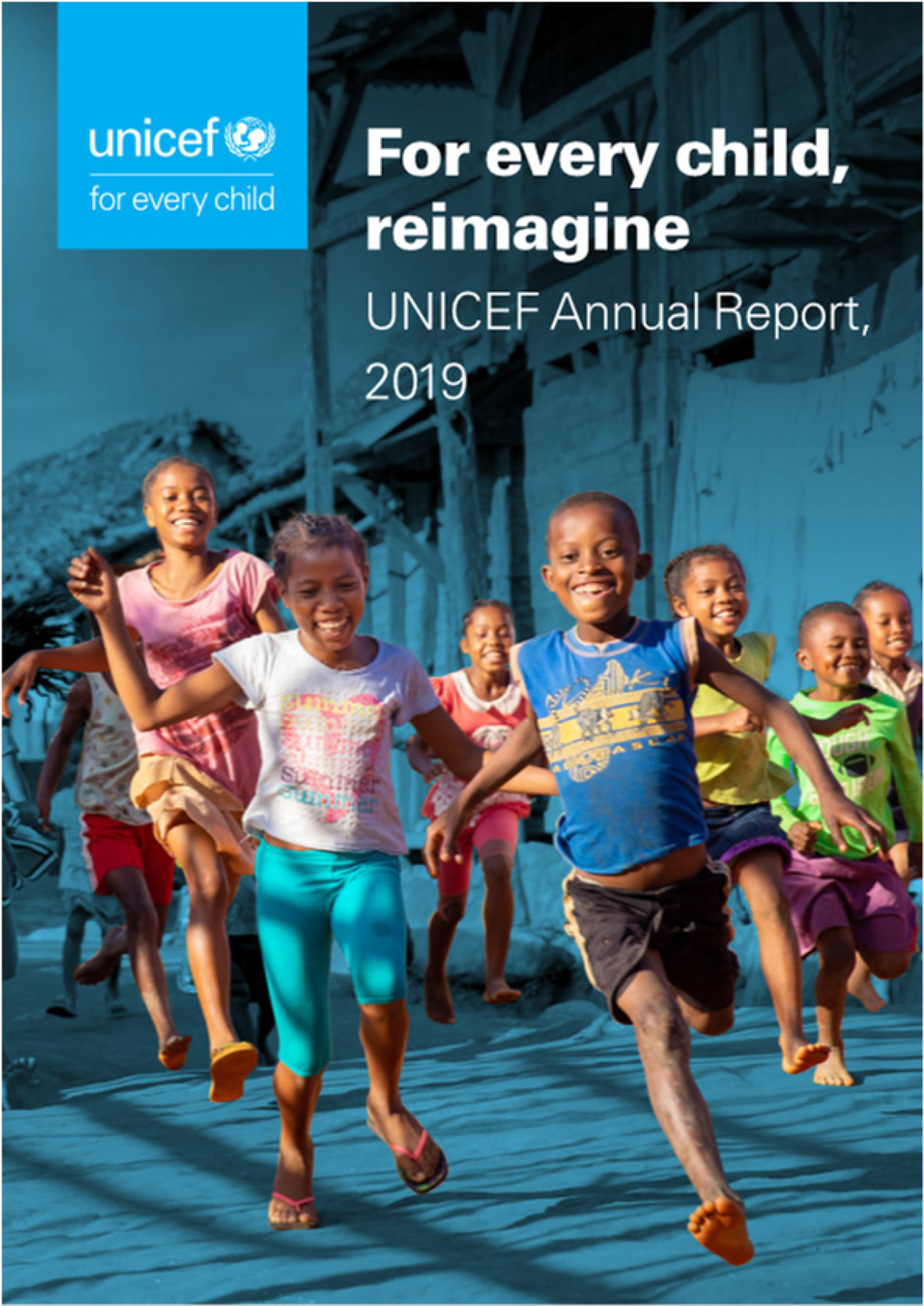
Front cover of For every child, reimagine (UNICEF, 2020).
In this report, play is never explicitly discussed in terms of happiness. Rather, images of smiling, laughing children accompany written references to play. Unlike the images of children in the curriculum documents, the children in the cover image gaze directly to camera. For Van Leeuwen (2008: 141), in images of this sort, in which those depicted ‘address us directly with their look, the picture articulates a kind of visual “you”, a symbolic demand’. The viewer is addressed visually by laughing, playing children, and reminded that happiness comes from children's educational prospects, future goals and efforts in attaining these. In this respect, we see at work how ‘neoliberalism encourages individuals to assume responsibility for their employment, their health, their education, their life-long learning, their financial independence, and their happiness’ (Nadesan, 2010: 14), even in circumstances that are profoundly affected by geopolitical issues such as poverty, gender inequality, public health and other crises.
The visual narrative of children's happiness seamlessly confers success on the efforts of UNICEF, its partners and its stakeholders, positioning alternative readings or critiques as somehow against children's happiness. As Ahmed elaborates: If we take up happiness as an intellectual history, it is striking how consistent this history is on one point: happiness is what gives meaning, purpose, and order to human existence … Happiness: a wish, a will, a want. What would it mean to suspend belief that happiness is what we wish, want, or will, or even that happiness is a good thing? (Ahmed, 2010a: 572)
Ahmed's question does not query whether happiness is good or not, but rather what we are able to ask about its discursive truths. As critiques of play discourse have pointed out (Shaw, 2020; Vintimilla, 2014; Wood, 2014), dominant ways of thinking about and advocating for play tend to rely on and maintain universalising notions of children and childhood, overlooking that play is always-already culturally situated, ideologically inflected and subject to unequal operations of biopolitical power.
Conclusion
In this article, we have shown how contemporary discourses of happiness and play as co-implicated make their way into a range of public documents that contribute to the governance of conduct (Foucault, 1982) regarding children and childhood. Reliant on embodied images of children’s smiling, laughing faces and active yet disciplined bodies, and on their organised and orderly individual and collective interactions with adults and other children, the images analysed here represent happiness through western romantic and nostalgic notions of play as joyful, cooperative and orderly. We contend that these representations function in the production of play discourses that both assume and obligate children and childhood to happiness, alongside written texts which focus on neo-liberal biopolitical governmentalities that ‘target life through social and scientific engineering, through expert administration, and through everyday technologies of the self’ (Nadesan, 2008: 2). While these would seem to sit uneasily alongside notions of happiness and play, we suggest that visual rhetorics draw attention to and seek to offer reassurance of the prospect of childhood enjoyment even in the face of neo-liberal emphases on education as a means of achieving responsibilised subjectivities. Our intention here is not to query whether children are or should be happy, nor is it to advocate for or against play as an educational or social good. Rather, it is to query the ways in which normative discourses of play are constructed through visual texts as though happiness can be both assumed and obliged. We contend that play in these terms merits further interrogation in order to better assess its relevance and utility as a policy and pedagogical export. In particular, we hope to highlight the problematic assumptions of universalising discursive tropes that are contingent on equating the co-implications of play and happiness with biopolitical governance and subjectification.
Footnotes
Declaration of conflicting interests
The authors declared no potential conflicts of interest with respect to the research, authorship and/or publication of this article.
Funding
This work was supported by the Education University of Hong Kong (grant number: RG 51/2020-2021R).
