




Abstract
Providing spaces for children’s culture becomes an issue when it conflicts with or threatens to reverse the notion of ‘legitimate’ culture. Here, legitimate culture refers to the dominant values of the official curriculum and teachers’ cultural values. This article, which stems from an ethnographically oriented pilot study, explores the experience of children’s and adults’ diverse beliefs, ideologies and cultures in an art classroom that is situated in a university facility. It demonstrates how children seek spaces for their culture. Only high official culture, the school culture, and parents’ and teachers’ culture are deemed appropriate, true and good. In the world of adults, children’s culture is often seen as immature, as something to be fixed and refined. Kline suggests that humour and play might be an independent form of children’s culture. What children find funny and humorous may not be funny, or even appropriate, to adults. Bakhtin’s carnival theory demonstrates how a medieval culture used dangerous jokes at the expense of authority. Although the carnival was a temporary festival, it was the means through which the peasants’ marketplace culture was communicated to the officials, and by which they were able to demonstrate resistance – following their own rules, methods and culture. The author employs Bakhtin’s theory to help see the carnival in an art classroom, as children resist the presence of a legitimized culture by continuing to create spaces for their own cultures of pleasure, parody and even the grotesque.
On an extracurricular community art programme’s social media page, two pictures (Figures 1 and 2) were posted as part of a weekly post on students’ art-making. These pictures depict children’s drawings of their collective storybook and writing of words such as ‘butt’, ‘penis’ and ‘poop’. The posting of the pictures caused the immediate reaction of parents’ outrage because of not being appropriate for young children. The parents’ anger, combined with the educator’s discomfort with their students’ content, raises particular questions that I wish to consider here: How do adults’ notions of appropriateness hinder children’s access to particular knowledge? How do children seek spaces to cultivate their own culture of childhood?
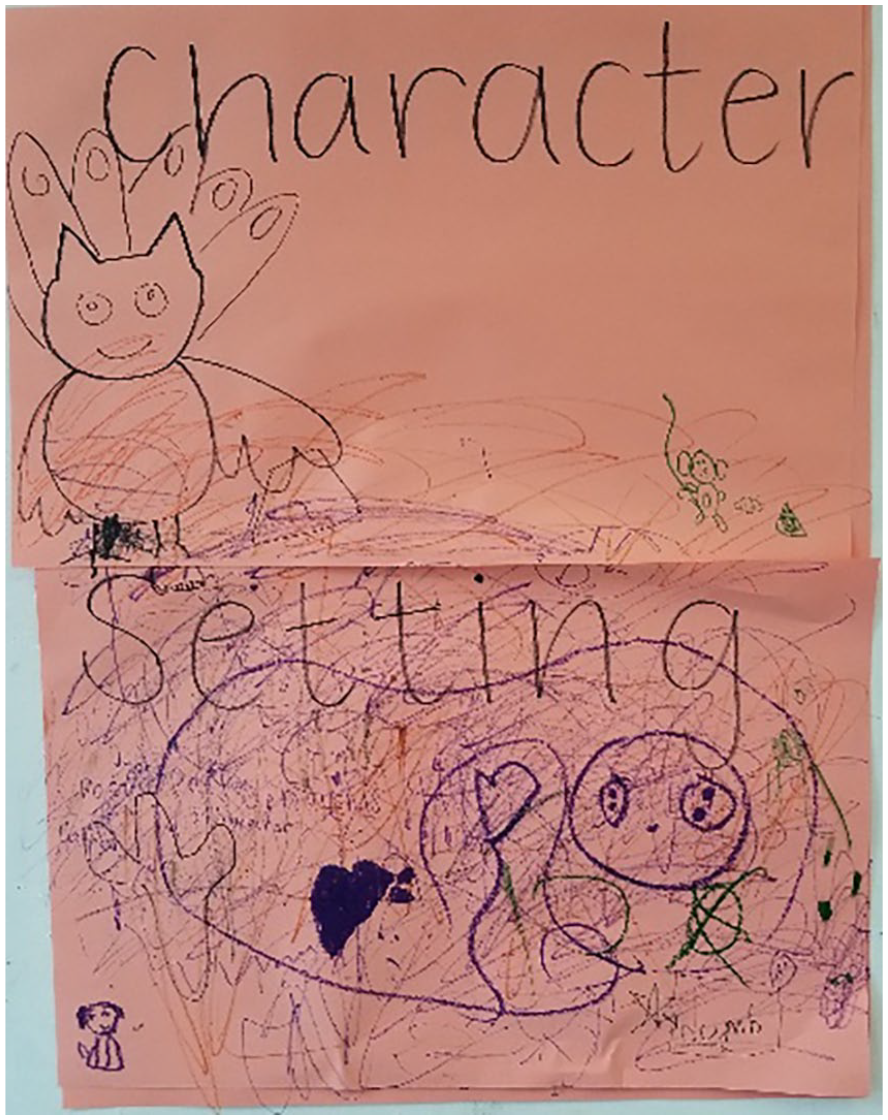
Children’s collective story character.
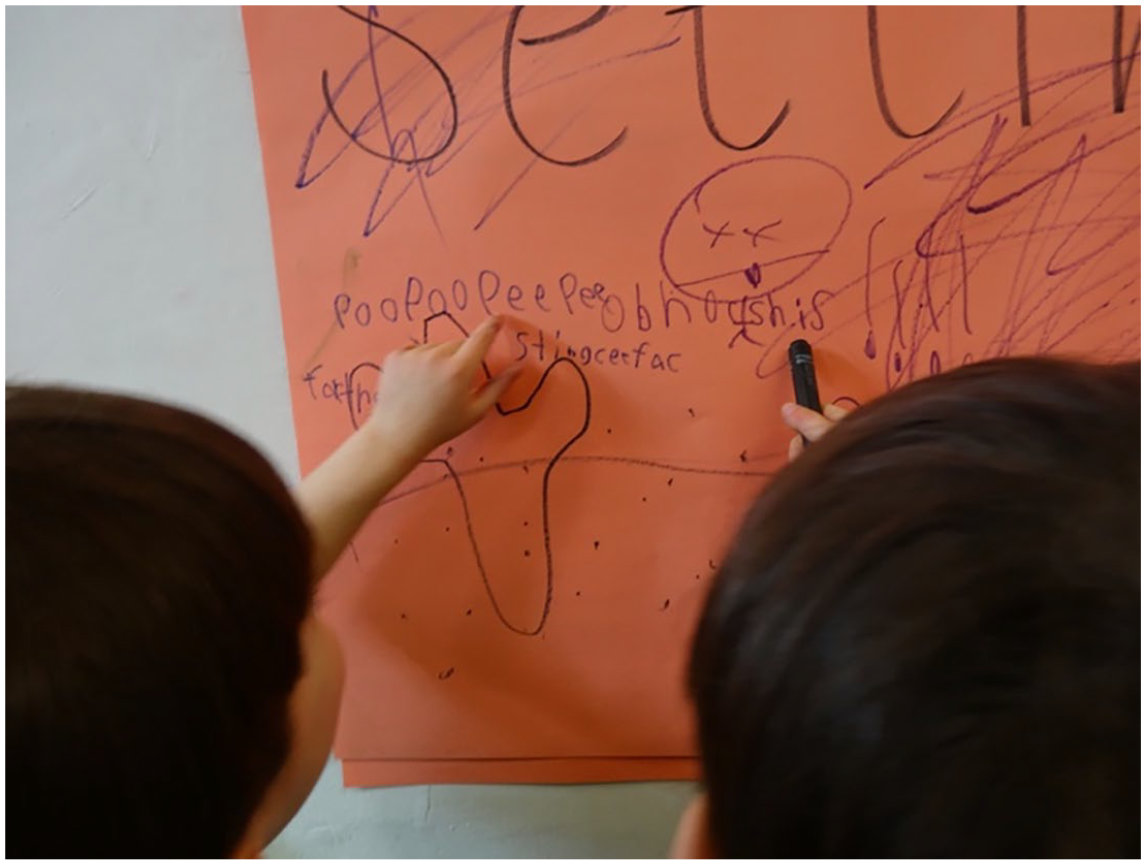
Children pointing at their writing.
Introduction
Adult notions of appropriateness often silence the culture of childhood. As a result, the culture of childhood is often negotiated in classroom spaces. According to Giroux (1996: 89): ‘children’s culture is a sphere where entertainment, advocacy and pleasure meet to construct conceptions of what it means to be a child occupying a combination of gender, racial and class positions in society’. While different cultures define the boundaries of childhood differently, given children’s age ranges, childhood can be characterized as a cultural group. Children form their culture by playing with their peers and trying various ways of being and practices. Children’s interactions and their unique aesthetic choices distinguish their culture from adults’ culture (Kenway and Bullen, 2001). There are many ways to discuss children’s culture, one of which is to look specifically at humour and play. Kline (1998) states that humour and play uniquely inform the culture of childhood. Arnott & Duncan write (2019:310) that ‘play and creativity are not discrete activities but rather the projection, development and cognitive and metacognitive demonstration of children’s appropriation of their particular cultural context’ (310).
One form of humour and play found in children’s culture includes communication about the body’s natural processes of elimination and jokes that contain sexual language. Adults perceive such toilet talk as immature, something to be fixed and refined because it is not part of ‘legitimate’ culture. Often, only ‘legitimate’ culture – the school culture or the parents’ and educators’ culture – is deemed appropriate, true and good. Knowledge of sexuality is not considered appropriate to be part of legitimate culture. Similarly, when sexuality is an element of childhood culture, it threatens adults’ conceptions of children’s innocence (Davies and Robinson, 2010; McGinn et al., 2016; Robinson, 2013; Surtees and Gunn, 2010; Thompson, 2006; Tobin, 2001; Walkerdine, 1990). According to Davies and Robinson (2010: 249): ‘children’s access to sexual knowledge has always been considered “risky” and controversial due to the fraught relationship between childhood and sexuality’. Sexuality is often considered difficult knowledge since it challenges the standard forms of knowledge expected from children (Robinson, 2013). As the above vignette suggests, such forms of expression are censored by parents for not being rightful. As such, parents voiced their concern about the programme’s curriculum.
In this ethnographically oriented pilot study, I explore how adults’ diverse beliefs, ideologies and cultures silence children’s culture in art learning spaces. First, I conceptualize the culture of childhood and how children pursue resistance to create spaces for their culture, including toilet talk. Then, I consider how Bakhtin’s (1984) carnivalesque theory helps to situate children’s desire for entertaining toilet talk and sexual jokes. Finally, I present my findings from an ethnographically oriented pilot case study. Ultimately, I argue that children create spaces for difficult knowledge to challenge the authority of adults and establish spaces for their culture.
The culture of childhood
As a subgroup of the dominant culture, children form their own cultural group where social learning and socialization happen (Kline, 1998). Sociologists use the term ‘culture of childhood’ to study children’s experiences and practices in their own right beyond developmental paradigms (Grahame and Jardine, 1990). According to Grahame and Jardine (1990), Piaget’s developmental framework views children’s actions as a progression towards adulthood rather than an established cultural group. However, there is a substantial body of work that discusses children’s aesthetic choices as a component of the culture of childhood (Arnott and Duncan, 2019; Buckingham, 2011; Grace and Tobin, 1997; Grahame and Jardine, 1990; Henward, 2015; Jenkins, 1998; Kenway and Bullen, 2001; Kline, 1998; Mitchell and Reid-Walsh, 2002; Thompson, 2006). As a separate cultural group, the form of children’s cultural expression depends on their community’s social beliefs and practices (Kline, 1998). As such, the culture of childhood is not free of influences from the values of ‘legitimate’ culture.
‘Legitimate’ culture, as an official culture, deems children’s culture as not worthy of legitimation and attention (Kenway and Bullen, 2001), and silences children’s desire for pleasure through sexual jokes and toilet talk. Gutierrez et al. (1995) use the term ‘legitimate’ culture to describe the dominant values of an official curriculum and educators’ cultural values. According to Gutierrez et al. (1995), legitimate culture comes from the dominant sociocultural and political discourses of a local place. Children’s humour and play with sexual language act as a way to counter legitimate culture. Thus, providing spaces for the culture of childhood is always an issue when it reverses the notion of legitimate culture. Kline (1998) suggests that humour and play might be an independent form of children’s culture. What children find humorous may not be funny or even appropriate for adults. These taboos are exemplified by the story of the children’s drawings of poop. The classroom and home context highly influence the ways in which children negotiate their culture with legitimate culture.
The pressure that adults place on the culture of childhood demonstrates the power of legitimate culture. When words such as ‘poop’ and ‘penis’ were displayed on the programme’s social media page, parents voiced their concerns about the curriculum of the art programme. Their complaints limited not only their children’s experience but also the other children, by pressuring the educator to discourage the usage of taboo language.
An asexual view of children
The developmentally appropriate image of the child is asexual, innocent and immature (Dahlberg et al., 2013; Davies and Robinson, 2010; Lenz-Taguchi, 2010; Robinson, 2013; Surtees and Gunn, 2010; Tobin, 2001; Walkerdine, 1990). Consequently, contemporary childhood is intensely surveilled and regulated (Moss, 2019; Robinson, 2013). Adults wish to protect children’s innocence, therefore children are forbidden access to so-called ‘difficult knowledge’ (Robinson, 2013). Robinson (2013) draws from psychoanalysis to state that children’s knowledge of sexuality is often labelled as ‘difficult knowledge’, taboo or inappropriate, and is thus pushed outside the realm of the culture of childhood. Adults shelter children from difficult knowledge to protect their innocence and access to sexual content (McGinn et al., 2016; Robinson, 2013). For example, fiction and popular culture both paint pictures of children as asexual (Rose, 1985; Walkerdine, 1990) and sanitize any concept of sexuality. To make it appeal to parents, the content of children’s media has to be appropriate and educational (Kenway and Bullen, 2001).
To a large extent, early learning settings do not provide space for a culture of childhood that pertains to and includes difficult knowledge and children’s humour. In educational settings, adults simply use a short statement – such as ‘No toilet talk outside the bathroom’ – to silence children’s discussions of sexuality and toilet humour. Adults ban toilet talk without explaining to children why such talk is taboo, and thus rarely provide time and space for children to discuss it. Despite the influence of cultural taboos, children continue to resist the power of adults’ sanctions of word use and create secret cultural spaces defined by the taboo language.
Children’s resistance to adult editing
Children resist adults’ editing of what can be included in their culture. Such acts of resistance are noted by childhood studies scholars (see Henward, 2015; Tobin, 2005) to highlight the tensions created between legitimate culture and their own culture of childhood. Such tensions often cause adults to label children’s resistance as misbehaviour. Situated as resistance, it becomes a way to create situations that are not under adults’ control (Grahame and Jardine, 1990; Henward, 2015; Walkerdine, 1990).
In classrooms, an act of resistance occurs when individual or group actions manifest outside the boundaries of teachers’ prepared activities. In this understanding, children resist particular norms and rules that do not pertain to their interests. According to resistance theory, children’s resistance is a way to reclaim the space rather than trying to purposefully disrupt classroom learning (Hendrickson, 2012). Elsewhere, Grahame and Jardine (1990) write that student-initiated trouble (such as jokes and pranks) is a form of intentional resistance that communicates their opposition to classroom norms and disrupts the learning space. This suggests that children resist demanding child-controlled spaces. In many circumstances, children’s resistance does not happen in the form of a revolutionary act of defiance but rather in passive and subtle acts, such as talking in the classroom, sarcastic replies, asking inappropriate questions or disturbing the flow of the class (Hendrickson, 2012; Tobin, 2005). Walkerdine (1990) writes that classrooms have overt messages about exploration and activities. Her work from the primary classroom suggests that the ‘discourse of good behavior, neatness, and rule-following exists covertly alongside overt messages’ (Walkerdine, 1990: 140). Although teachers ignore the presence of covert behaviours, they exist and operate in secret spaces – for example, writing or drawing sexual jokes. As such, Schultz (2005) argues that children take control of their actions and choose their own sense of appropriateness, which crosses the boundaries of adults and schools.
Theoretical perspective: the carnivalesque and making spaces for pleasure
In understanding the culture of childhood to exemplify children’s acts of resistance as their demand for power and playful spaces, I employ Bakhtin’s (1984) concept of the carnivalesque. In Rabelais and His World, Bakhtin (1984) notes that culture is hierarchical and lower forms of culture are rarely appreciated by those in charge. He illustrates this by writing about the festival of the fools during carnivals in the Middle Ages, where the political, ideological and legal authority of both the state and the church was temporarily reversed. The church and the state had no control over the lives of the people for the duration of the carnival. During this time, the lower classes subverted the authorities through humour. This activity is what Bakhtin labels the ‘carnivalesque’. The carnivalesque was an act of resistance.
Bakhtin (1984) pays attention to grotesque realism, which attends to the principle of the material human body and bodily functions such as drinking, eating, defecation and sex. Grotesque realism gives importance to the lower stratum, meaning lower parts of the body (e.g. the genital organs, belly and buttocks), and also contains the principle of laughter and parody. During the Middle Ages, laughter remained outside all official spaces and was eliminated from official ceremonies. An authoritarian tone prevailed in official social relations. Using humour and language with lower-stratum words, the lower classes mocked the official and religious authorities. Grotesque realism demonstrates how a medieval culture used dangerous jokes at the expense of authority. As such, the carnivalesque paved the way for new and challenging ideas to enter into official discourses.
Space is an important aspect of the carnivalesque. The carnivalesque happened at a particular time and space in history (Folch-Serra, 1990), demonstrating the significance of making spaces for a different human relationship. Although Bakhtin does not theorize the notion of space in the carnival, in his essay ‘Forms of time and of the chronotope in the novel’, Bakhtin (1981) discusses the representation of time and space in language and discourses using the term ‘chronotope’. He borrows the concept of time and space from Einstein’s (1982) theory of relativity, but applies it in literary criticism. He states that the configuration of time and space affects each genre’s narrative character: ‘Time, as it were, thickens, takes on flesh, becomes artistically visible; likewise, space becomes charged and responsive to the movements of the time, plot and history’ (Bakhtin, 1981: 84). Müller (2010) writes that the chronotope draws attention to the physical space in which actions and narratives take place. Therefore, the chronotope given to the carnivalesque was emancipatory. The chronotopes given to carnivalesque activities show the culture of the place.
According to Holloway and Kneale (2000), Bakhtin’s use of markets, streets and the public realm is grounded in a conception of space. Bakhtin’s carnivalesque advocates for a time and space where power hierarchies are overturned. Peasants mocked authority without the carnivalesque. Yet what made the carnival a revolutionary event was that an ideological and social space in a physical place was devoted to the repression of authorities with the actual presence of authorities. How might we provide spaces for carnivalesque activities in the classroom? The application of Bakhtin’s (1984) theory of the carnivalesque to the classroom allows for understanding adult-sanctioned spaces, like the classroom, as places of negotiation and contestation. When there is no chronotope dedicated to carnivalesque festivities in classrooms, as shown in Figures 1 and 2, children transform time and space to talk about difficult knowledge.
Children’s acts of resistance cannot be deemed acts of naughtiness but rather an intentional desire to exercise power (Schultz, 2005; Tobin, 2005). Tobin (2005) suggests that Bakhtin’s post-structuralist theory of the carnivalesque as a critical act of resistance is more applicable when thinking of acts of resistance in the early childhood classroom than the more commonly applied theory of resistance as revolution. For Bakhtin, resistance happens to reverse the ‘feudal order of rulers and subjects’ (Tobin, 2005: 34). During the carnival, the peasants opposed the power and authority of the rulers. In this case, ‘relations of power and resistance are continually reproduced, in continual struggle, and constantly shifting’ (Walkerdine, 1990: 4). Giving children moments for resistance does not mean giving them control of the classroom; rather, like the shifting relations of the feudal order, it teaches children to practise serious and playful forms of resistance (Tobin, 2005). In fact, children create opportunities for carnivalesque moments to seize power, as demonstrated by children’s desire to draw humorous and difficult content to create playful and joyful experiences in the classroom.
Grace and Tobin (1997) e that children hold a fascination with things that adults consider rude and gross. Perhaps children use grotesque language to demand a playful space without adult rules. However, as sociocultural theorists Kenway and Bullen (2001) state, adults become anxious when they cannot govern children. Having children talk about difficult knowledge perhaps reflects bad manners and adults’ irresponsibility. During the carnival, the peasants’ culture had legitimacy and value. What if we provide value to the grotesque culture of childhood in educational settings and at home? As adults, letting go of our fears about children’s behaviour may create a democratic and pleasurable space for both adults and children (Grace and Tobin, 1997).
Methodology
Setting and participants
My study was conducted in a Grade 1–2 art classroom at an extracurricular Saturday Art School class housed on a university campus in the north-eastern USA. The overall curriculum goal of the class was to foster artistic language by using art to create stories. The Saturday Art School offers classes for 8 weeks for children aged 3 to 18. The Grade 1–2 classroom consisted of 20 children, both boys and girls, between the ages of 6 and 8. The children and one pre-service educator participated in the study. The parents signed consent forms on behalf of their children. I used pseudonyms to refer to participants to keep their identities confidential.
Positionality/research role
As a researcher, I sought to position myself as an interested adult in relation to the children. Instead of a teacher, I attempted to adopt the least adult role available, which meant adopting a friendship role and being less authoritarian (Mandell, 1988). Using an access strategy, I tried to enter into children’s ongoing play (Corsaro, 2003) to become a participant observer. Corsaro (2003) explains that an access strategy involves listening and understanding what others are talking about, and then joining the conversation. My way of joining the children’s conversations often started with observations and later involved asking questions to better understand what the children were doing. However, this does not mean that the children and I had equal status. As Fasoli (2001) reminds us, power is continuously negotiated in research with children. While being aware of my positionality as a researcher, I opened myself up to the emergence of and encounters with listening to difficult and often taboo content in order to see possibilities (Davies, 2014).
In this role, I was able to listen and respond to the children rather than intervene in some way, which means that I often heard conversations that educators were not privy to. Such ideas subverted my role as an adult and created an uncertain situation for both myself and the educator in the classroom. While we were not certain about how to respond to children’s conversation pertaining to sexuality or ‘toilet humour’, we did not give value to such topics either.
Data collection and analysis
This ethnographically oriented pilot case study lasted eight weeks, which was the entire duration of the Grade 1–2 Saturday Art School class. The case study allowed me to focus on one classroom. A case study is an empirical study of a single case with a focus on ‘holistic description and explanation’ (Merriam, 2009: 43). In addition to analysing the culture of childhood in the classroom context, I also investigated how outside influences such as family decisions affected the curriculum. As such, I present an in-depth understanding of the complexity of the context and its culture (Creswell and Poth, 2018).
As Creswell and Poth (2018: 90) note: ‘an ethnography focuses on an entire culture-sharing group’. Ethnography fits the research framework for this study since it studies the culture of childhood. The interpretive research approach that ethnography offers brings us closer to the experience of children (Graue and Walsh, 1998) and provides a framework to interpret children’s experiences.
As a pilot case study with an ethnographic orientation, I drew on Emerson et al.’s (2011) methods of collecting data. I collected data through field notes, children’s drawings, semi-structured audio-recorded interviews with children, videography, photographs, artefacts, necessary documents shared by the coordinator and the social media page of the school, along with observations and participant observation of the daily experiences of the children. I identified potential children for an interview and conducted semi-structured interviews using video- and audio-recording devices. Semi-structured interview questions also emerged when the children were discussing sexuality and toilet talk.
I collected and analysed my data simultaneously (Merriam, 2009). After transcribing the interviews, field notes and videos, I reviewed my data (Merriam, 2009) in addition to analysing my in-process memos (Emerson et al., 2011). I decoded the data to reflect its meaning and, after determining its relevance to my research, I encoded it (Saldaña, 2015). I analyzed my data after coding it. Saldaña (2015) argues that when data is grouped according to similarities or patterns, it facilitates the development of categories. I grouped my data according to similarities and developed tentative themes.
Findings
This study suggests three main themes: children seeking spaces for difficult knowledge, power, pleasure and parody; outside influences on children’s culture; and children’s acts of resistance.
Seeking spaces for difficult knowledge, power, pleasure and parody
On the first day of Saturday Art School class, the pre-service educator, Maya, placed several tables in a row to create a communal learning space. Twin brothers, Sam and Tom, and their friend Joe sat next to each other. They drew vigorously while laughing. Their behaviour was seen as disruptive when they continuously moved out of their seats. Sam wanted to grab Joe’s attention by pointing towards his drawing. He said: ‘It’s like a butt face’. Stephanie heard him from the table across. She shouted: ‘Stop to say that. It is so rude’. Since Sam, Tom and Joe came from the same elementary school, their imaginative play containing difficult knowledge was full of energy and transgressed classroom norms.
The educator found their play and butt jokes disruptive. The next day, she placed their sketchbooks on different tables. However, when they came in, both twins immediately took their sketchbooks back to the same table as their friend Joe. All three children resisted the teacher’s sanctioned places by moving their sketchbooks back to the previous table. They continued with their drawing of poop. Their loud and exciting play invited other children to participate in their carnivalesque activity.
It is within the construction of spaces that children are encouraged either to build a cultural connection with each other or to share their cultural values with the ‘legitimate’ culture of the classroom. Gutierrez et al. (1995: 446) write that ‘the construction of the classroom, as the construction of society, is a dynamic system of relationships and structures’. When children’s resistance goes against an educator’s defined rules, creating individual place is one of the ways to manage the problem of resistance.
Censorship of children’s culture entailing difficult knowledge
In every class, Maya began her lesson by giving the children a few minutes of drawing time. Sam asked Maya: ‘Can I draw what I want?’ She responded: ‘Yes, you can draw anything’. Permitting the children to draw anything that they wanted yet censoring some forms of knowledge presented a dilemma for the children. The children took this affirmation as an opportunity to draw anything that they wanted in their sketchbooks. A few minutes into their drawing, Tom and his friends burst out laughing. Wanting to know, I inquired: ‘Why is it funny?’ Tom could hardly talk as he was still laughing. He responded: ‘Because it is poop and fart. Hahaha! He pulled his underwear off’. Joe took a peek at Tom’s drawing and questioned: ‘Who is it? A cat?’ Tom answered, laughing: ‘The teacher’. As much as their laughter and humour were contagious, so was their drawing (see Figures 3, 4 and 5). Joe began drawing a person who had had an accident at school. Joe took his sketchbook home. When his mother saw the poop drawing in his sketchbook, she became concerned about the curriculum. She told the coordinator of the programme that she hoped Joe would draw real people and it was not appropriate for him to draw poop. Joe felt torn between his culture and his mother’s notion of legitimate culture. The drawing of poop went contrary to his mother’s notion of what was appropriate and valuable artwork. Being in a relation of power with his mother, Joe accepted his mother’s decisions and learned that not all forms of knowledge are appreciated in public spaces. His mother’s advice meant not to engage in subversive behaviour with his peers. The next day, Joe censored his poop drawing. First, he redacted it with a black marker; he then ripped it out of his sketchbook and threw it in the garbage bin. While interviewing this group of children, I asked whether they were allowed to talk about poop, butts and other forms of difficult knowledge at home. Joe was not allowed, whereas Tom and Sam could draw poop but not talk about it. Based on my interview with them, they were certainly not allowed to talk about difficult knowledge in school. Tom told me that when he used the expression ‘farting tomato’ in his elementary class, he had to see the teacher. The teacher told Tom: ‘Don’t do it again’. He warned Tom that if he used potty talk twice, he would have to see the principal.
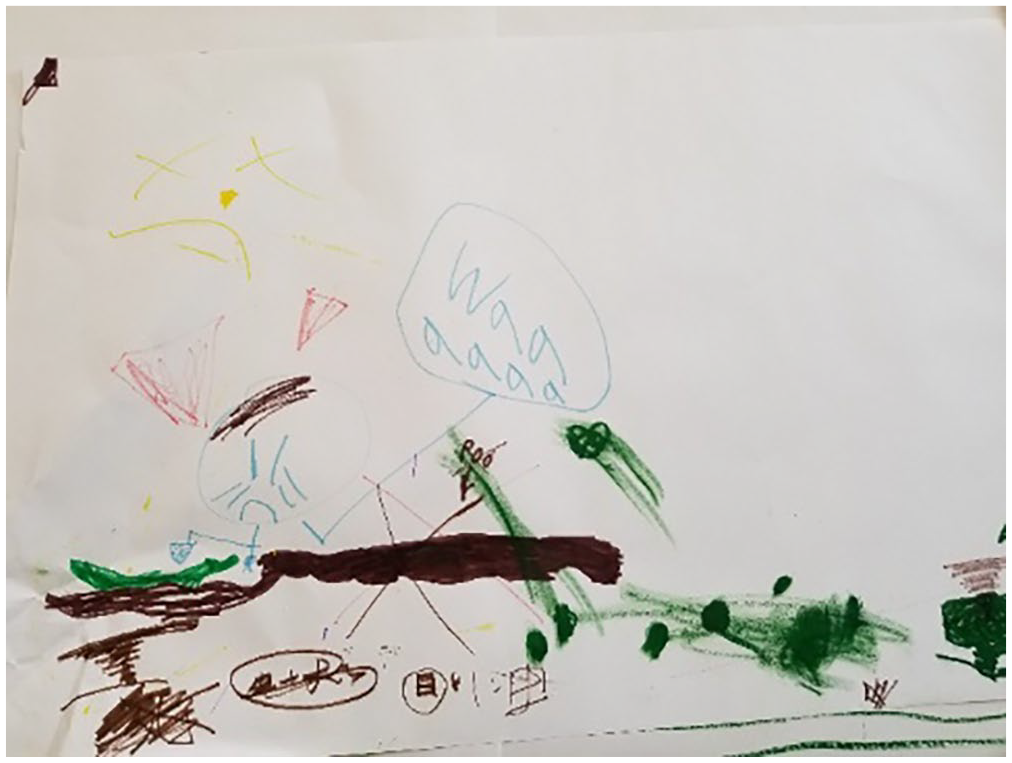
Sam’s drawing of poop.
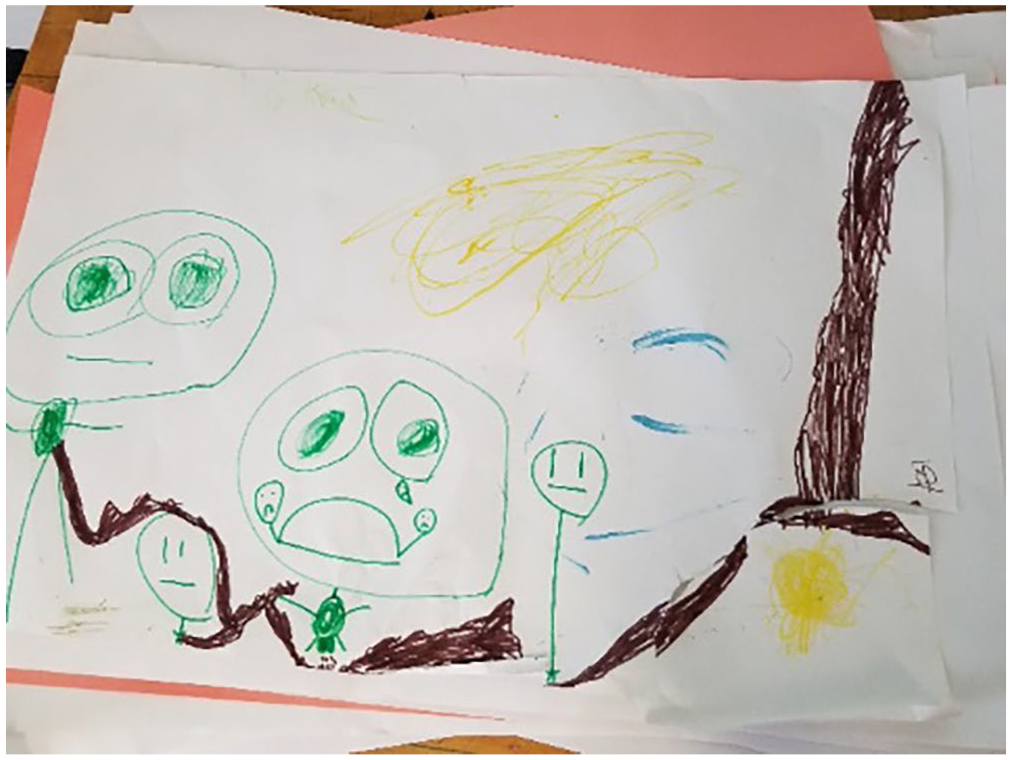
Tom’s drawing showing the teacher pulling his underwear off.
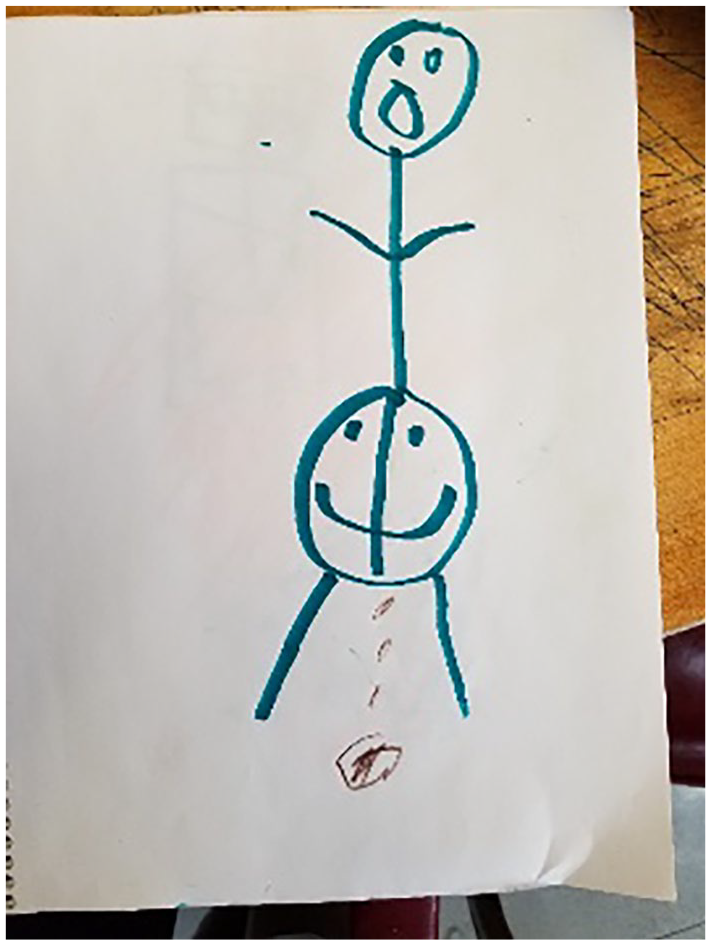
Joe’s drawing depicting a person who had had an accident at school.
Censoring the use of words such as ‘butt’, ‘penis’ and ‘poop’ is not only done by adults. Adults influence children to regard such words and concepts as taboo. Joe was influenced by his mother. Another day, Sam found a small piece of black charcoal on the floor. He drew a big round shape on a piece of brown paper and shouted: ‘Guys! Look!’ Joe looked and inquired: ‘What is that? Can I see what that is?’ Sam’s tone rose with excitement: ‘A butt’ (see Figure 6). Tom found it funny and laughed really loudly. Joe frowned and questioned: ‘A butt? Inappropriate. Scribble scribble’. He used a grey coloured pencil and scribbled out Sam’s drawing. Sam felt embarrassed and said: ‘I was just kidding. I just made something and I wasn’t drawing’. Joe’s response to Sam’s drawing demonstrates how children embrace adults’ editing of their culture and the way children are introduced to humour and sexual content. Joe felt ashamed of discussing difficult knowledge. According to Robinson (2013: 24): ‘sexual taboos and shame associated with sexual conduct can operate to shut down or repress behaviors and conversations around sexuality, which in turn reinforces taboos and shame’. Children construct their culture with their peers while continuously negotiating the boundaries of their culture. Children are not only policed by adults but end up policing themselves.
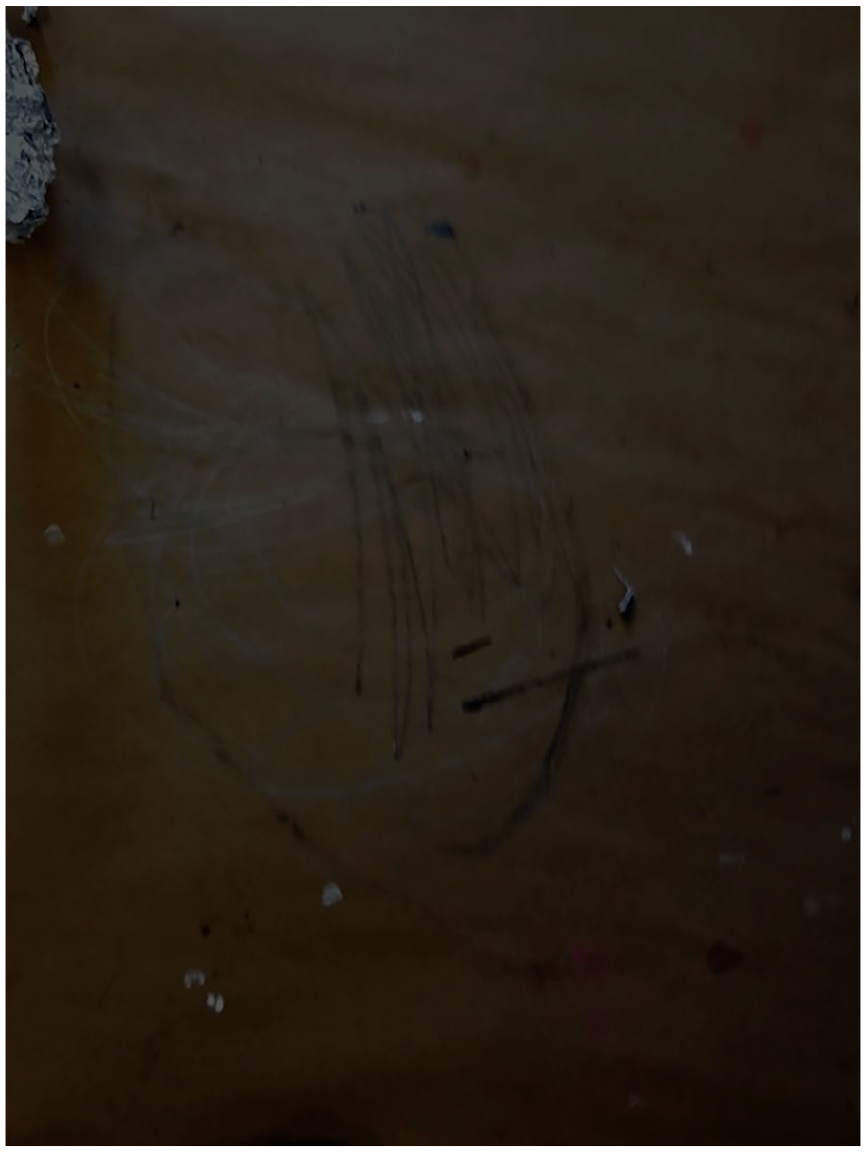
Sam’s drawing of a butt.
Censorship happens among children when they draw collectively as well. Scribbling out and ripping off ‘inappropriate’ words from the paper was their response to each other’s conversation pertaining to difficult knowledge. In the art programme, due to censorship by their parents, the children’s drawings of difficult knowledge put the pre-service educator in an ambiguous situation where she was unsure of how to respond to the children’s drawings and jokes. Although she encouraged a democratic space by telling the children at first to draw what they wanted, she did not provide space for the children’s drawings of difficult knowledge in her curriculum, as she had been questioned by parents about this. She may have been reluctant to have all the children engage in the drawing of poop and penises for fear of the children’s behaviour becoming uncontrollable. Moreover, having children discuss sexual and taboo topics suggests the vulnerability of the classroom teacher in ‘managing’ the curriculum of the classroom.
Children’s acts of resistance
Resistance takes shape when ‘legitimate’ culture clashes with children’s culture. The children’s attempts to create carnivalesque activities often meant negotiating the classroom rules, the classroom set-up and the teacher’s practices. Tom, Joe and Sam demonstrated resistance when they decided not to draw separately in their sketchbooks. Instead, they drew on a giant box covered with paper (see Figure 7). By challenging an established traditional classroom set-up, they disrupted pedagogies that silenced their quests for entertaining difficult knowledge. The box became the hub for the emergence of collective drawing where appropriate and inappropriate stories dwelled. On top of the box, Amina wrote a poem: ‘A hat and a cat a and a cut and the rat. It is also a but wait I forgot another cind of butt’. She embedded the word ‘butt’ in her poem in the form of a puzzle. By finding ways to communicate about taboo topics, she subverted the classroom’s legitimate culture. The class had ended and Amina’s mother came to pick her up. Amina did not want to leave and continued writing. Her mother told her that she could not play with the iPod unless she listened. Amina resisted and wrote: ‘My mum poops in underwear, nay’. Her mother read it and rolled her eyes. ‘The underwear talk is never over’, she said.
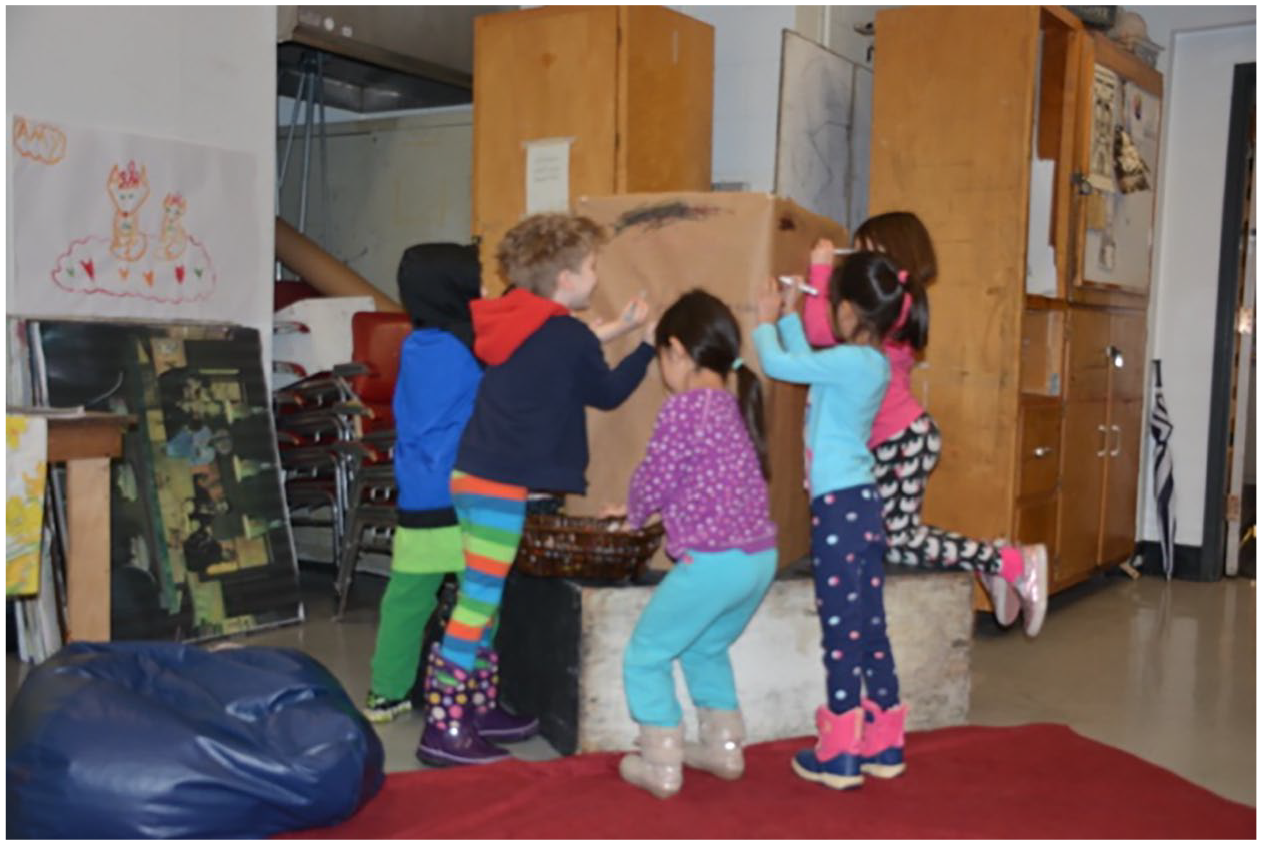
Children drawing collectively.
Amina’s poem demonstrates that children communicate about the lower parts of the body in secret places or often create secret spaces for it. Talking about sexuality is deemed private and often rude in public spaces. This exemplifies how difficult knowledge content becomes a form of ‘code’ to be communicated. Children’s use of words such as ‘butt’ and ‘vagina’ continues to push adults’ boundaries. Amina’s mother exercises power when telling Amina that she cannot play with her iPod unless she listens. In return, Amina shows her power by ridiculing her mother’s authority through underwear jokes.
Discussion
In educational settings, children and adults encounter different beliefs, ideologies and cultures. Children’s talk about poop, for example, or discussions that they have about the human body are humorous to children, generating laughter and parody, while adults often see these endeavours as not appropriate, immoral, dangerous or premature for children. Adults assume that children are too young to understand sexuality. ‘Sexuality is generally viewed to begin at puberty and mature in adulthood, correlating with developmentalist theories which reinforce biologically determined understandings of childhood and sexuality’ (Davies and Robinson, 2010: 251). King (1982) writes that the goal of education has been to create environments only for good play with socially accepted behaviours. As such, whether children talk about difficult knowledge to subvert authority in the same way as Bakhtin’s carnivalesque or get pleasure from discussing it, they are often silenced by adults. Not only does the curriculum content have to be free from the culture of childhood about difficult knowledge, but the material and design of the classroom space encourage them to follow an established classroom culture with rules and regulations. As I have shown, there is no intentional space provided for children to engage in activities that depict their culture, especially the marginalia of this culture. The culture of childhood is treated in the same way as lower-class culture was in the Middle Ages. Only legitimate culture, the family’s culture and the educators’ culture are deemed appropriate, true and good. Thompson (2006: 37) explains that ‘teachers may resist the incursion of that unofficial world into their classrooms’. Many adults make it their responsibility to protect children from ‘bad’ people, ‘bad’ play and ‘bad’ words (such as vagina, penis and butt). Children are seen as immature when they are using grotesque language. One of the children, Joe, demonstrates this attitude when he tells his friends that he is not drawing or talking about poop any more because he is mature. Despite adults sheltering children from adult knowledge of sexuality, to echo Robinson (2013), children’s access to sexual knowledge is an issue of civil rights and equity to ensure their physical well-being and mental health. Children may access knowledge of sexuality from other sources. However, would it not be beneficial coming from parents or teachers in a more informed and educational way? Thus, regardless of the spaces children inhabit, discussing difficult knowledge transgresses and transmogrifies.
While examining the position of girls and women in two nursery schools, Walkerdine (1990) discusses that young boys make sexual references to their female teachers to exercise patriarchal power and place them as the powerless subjects of sexist discourse. Since the majority of my data comes from prepubescent boys, the desire to speak about difficult knowledge suggests that even very young children are sexual, and perhaps young boys do exercise patriarchal power over their female teachers. Could prepubescent boys’ desire to entertain grotesque language and imagery be coming from the biological changes happening in their bodies? Tallant (2015: 258) writes about preschool children’s desire to entertain difficult knowledge because ‘they may have only recently become toilet-trained and gained control over their bladders and bowels, contributing to them feeling empowered by their own corporeal awareness’. Looking through a Bakhtinian (1984) lens, children use difficult knowledge to subvert adults’ roles and exercise agency. Adults attempt to impart their cultural knowledge and children resist the presence of a legitimized culture by continuing to create spaces for their own cultures of amusement, parody and even the grotesque. Bakhtin (1984) did not see the carnivalesque as mocking authority only; to him, it represented people’s power to regenerate the entire social order from the bottom up. Despite being a temporary festival, the carnival was the means through which peasants’ culture was communicated to the officials and they were able to demonstrate resistance, following their own rules, methods and culture. According to Bakhtin (1984: 257), the carnivalesque provides ‘the right to emerge from the routine of life, the right to be free from all that is official and consecrated’. How might we provide spaces for children to be free from surveillance and the classroom’s legitimate culture? Children are in fear when using grotesque language in public spaces. Grace and Tobin (1997) ask for opening spaces for pleasure and the carnivalesque in the school curriculum to allow children to experience power, parody and pleasure, and be in control of their own culture. Tom’s drawing of a teacher having an accident shows that children may not express their resistance in direct words to their teachers at school, but through drawing. To satisfy the requirements of the art classroom, Joe, Tom and Sam created stories about ‘Captain Poopoo Pants’ and ‘Captain Yurnis’, who had ‘big bogi butt’ and ‘big bum butt’. The setting of their story was ‘Toilet Headquarters’. Their story was about power, pleasure and laughter. The images communicated through the children’s drawings challenge the cultural norms reinforced by adults and educational settings, as well as the type of artwork that is acceptable, beautiful and valuable, as well as not acceptable. Their artwork presents a subservient response to the curriculum by making humour the theme of their story. As Tallant (2015: 258) notes, children ‘can degrade and debase adult authority by engaging with imagery that dominant cultural discourses claim as inappropriate, relishing the power they have over their own bodies’. Similar to the carnivalesque, children’s inclusion of humour in their drawing feeds their moral satisfaction.
Parents may have their reasons for regulating difficult knowledge in the school curriculum. McGinn et al.’s (2016) research with parents in the UK shows that parents want to protect their children from knowledge of sexuality in order to protect their innocence. They write that ‘parents frequently expressed concerns that children are exposed to more sexual material in the present day than they themselves were as children; many were concerned about the potential impact of this on the maintenance of their child/children’s innocence’ (McGinn et al., 2016: 589). However, not all parents may feel the same about their children’s knowledge of sexuality. Some may have an open communication with their children on these matters and may laugh with their children when they draw poop and butts. Nonetheless, it becomes problematic when one parent’s choice guides the curriculum for all children. Tallant (2015) suggests that humour is not given enough attention pedagogically. As shown in my data, children often find spaces outside of adult control to engage in carnivalesque and grotesque activities. This may be due to adults’ disapproval of such culture or children seeking spaces to be away from the adult gaze and authority where they can take the lead. In either case, educators can resist intervening and instead provide time and a place for them to continue their play. Children’s carnivalesque experiences may enriched when educators notice and value their culture by providing positive acceptance through eye contact or a smile (DaSilva Iddings and McCafferty, 2007).
Concluding thoughts
This article illustrates how children’s resistance opens spaces for negotiation and the confrontation of appropriate and inappropriate ideologies. By drawing from Bakhtin’s (1984) notion of the carnivalesque, it illuminates how children are constantly pushing adults’ boundaries to create spaces for their cultural knowledge and carnivalesque topics pertaining to bodies, faeces and sexuality. The findings, although limited, show a correlation between Bakhtin’s carnivalesque and children’s humour. Bakhtin’s carnival theory depicts a time and space where the lower classes had the right to be in control of the official space. They were given the space to practise their culture, even though this conflicted with official culture. Children’s urge for carnivalesque moments resists official culture. Instead of constraining children in a confined ideological and physical space, the curriculum and pedagogical approach of educators need to respond to their resistance and give them space for carnivalesque events. Adults need to shift their thinking from moral panic to recognizing children’s desire to construct their sexual subjectivities (Robinson, 2013) and to be in spaces that are free from adults’ direct surveillance. To have children’s culture be part of the curriculum content, families and educators must be educated about children’s desire for understanding and entertaining difficult knowledge. In early childhood settings, sexuality is considered a private matter that can be discussed only in the bathroom. Difficult knowledge and grotesque language are often labelled as ‘potty talk’ or ‘toilet talk’ and cannot be entertained in the official classroom environment. However, even very young children resist adult-designated spaces when they codify grotesque language to communicate their point and demonstrate their willingness to pursue entertaining carnivalesque activities. Adults should not project beliefs on children that consider difficult knowledge as taboo. Our bodies’ natural processes of elimination and sexuality are topics of curiosity as well as meaning-making. Children’s drawings can exemplify a carnivalesque chronotope where difficult knowledge content is expressed through humour and jokes. We are often reminded that art is about cultural and personal expressions and meaning-making. When children are discouraged from drawing poop and butts, it tells us that not all forms of knowledge and cultural expressions are valued. The hierarchy of power in art becomes obvious when teachers make decisions about what kinds of art can be displayed in an exhibition. Artwork containing difficult knowledge – like the art of Sam, Tom and Joe – rarely makes it to the exhibition space. As exemplified in this pilot study, when children practise their culture, the boundaries of legitimacy, power and authority are compromised. In these instances, letting children express humour and difficult knowledge in their artistic practice without the editing of adults is important not only to respond to children’s curiosity about their sexuality or health and well-being, but also to have them feel empowered and enrich their culture milieu.
Footnotes
Acknowledgements
I wish to acknowledge the help provided by Dr. Christopher Mark Schulte, Dr. Samantha Nolte-Yupari and Dr. Allison Henward. I appreciate their generosity for sharing their time and knowledge. Thank you for your valuable and constructive suggestions
Declaration of conflicting interests
The author declared no potential conflicts of interest with respect to the research, authorship and/or publication of this article.
Funding
The author received no financial support for the research, authorship and/or publication of this article.
