




Abstract
Quality, teaching and assessment in early childhood are often steeped in developmental logic and narrow understandings of teaching and learning. Pedagogy situated in agency and complexity disrupts these taken-for-granted narratives and offers multiple ways of teaching, learning and doing. In this article, the authors offer an example of these pedagogies through daily plans. Daily plans are a process of mark-making, deep listening and engagement with children’s theories of their everyday worlds. Further, they illustrate a reciprocal relationship between child and teacher, co-participating in learning and teaching. Through daily plans, children engage as capable, pedagogical intentions are made visible, and the complexity of teaching and learning is realized.
Dominant discourses in early childhood education are steeped in developmental logic and govern many popular theoretical perspectives and practices in early childhood (Burman, 2007; Grieshaber and Cannella, 2001; Kessler and Swadener, 1992; Lubeck, 1998). These expected or taken-for-granted discourses are perpetuated through narrow teaching and assessment practices that are seen as hallmarks of quality. For example, traditional early childhood practices of observation and assessment activate ranking and measuring as commonplace and adhere to developmental logic. This is seen in classrooms through the use of checklists, prescribed tasks, externally created assessment tools, frameworks, policies that are generated outside early childhood settings, and a focus on ‘matters of fact’ (Latour, 2004). These narrow understandings of children are framed by the construct of the ‘universal’ child within linear developmental theories. This perpetuates decontextualized perspectives and strategies that situate quality in response to ‘standardisation, predictability and control’ (Dahlberg et al., 2007: 2). From this perspective, the child is seen from a distance by the teacher and often through checklists or milestones created outside the context of this relationship. This separates the teacher from the child, positioning the child as deficit and in need of intervention from the teacher. The image of the child as deficit has a long history, beginning in the Middle Ages with the image of the child as innocent and later being practised through the kindergarten movement (Sorin, 2005), reflecting the child as incapable and needy. When children are viewed as deficit, quality, teaching and assessment are constructed with little complexity (Pacini-Ketchabaw et al., 2015).
In this article, we challenge these ideas and situate quality, teaching and assessment within the reconceptualist discourses of early childhood education (see Bloch et al., 2018; Dahlberg et al., 2007; Pacini-Ketchabaw et al., 2015). This generates pedagogy as ‘the agency that joins teaching and learning’ (Britzman, 2003: 65), where children and their teachers co-participate in everyday learning moments. By thinking with data generated in a well-established preschool in the USA, we make visible teachers viewing children as capable and implementing co-participation and teaching practices based on this image of the child. ‘Children as capable’ is an image that is rooted in the conceptual ideas underpinning the infant-toddler schools and preschools in Reggio Emilia, Italy. Children are ‘born with immense and unknowable potentiality’, with the ability to make ‘meaning of the world (learning) right from the beginning of life, as a protagonist, an active subject’ (Moss, 2019: 50). Specifically, we discuss the use of daily plans as an example of disrupting traditional early childhood practices and resituating the image of the child as capable. We focus on rethinking assessment practices away from utilizing standards and developmental milestones and towards assessment as co-participation between children and teachers. Further, as we think with daily plans, we consider how they offer a way to rethink taken-for-granted narratives of ‘quality’ early childhood education.
Daily plans are a process of mark-making, deep listening and engagement with children’s theories of their everyday worlds. Children begin creating daily plans with their morning group meeting, where inspiration for what might happen that day is offered. Children then create their own daily plan on a sheet of paper (see Figure 1), which is the focus of a meeting with their teacher, where the teacher and the child co-participate in a discussion with the daily plan. Daily plans can include a range of elements – for example, children might make marks or draw graphic representations. Children lead the mark-making process and then share their thinking and ideas with the teacher through a check-in process. The teacher works through the marks with the child to generate a shared understanding of the child’s theories that are represented in the daily plan. This process activates co-constructed meaning-making between children and their teachers, where learning is always in relation. Central to this practice is a relationship characterized by viewing children as capable and honouring the complexity of teaching, learning, and the co-participation of the children and teacher. This article describes the elements and processes of daily plans and then discusses this work in terms of discourse, agency, co-participation, and the image of the child and teacher.
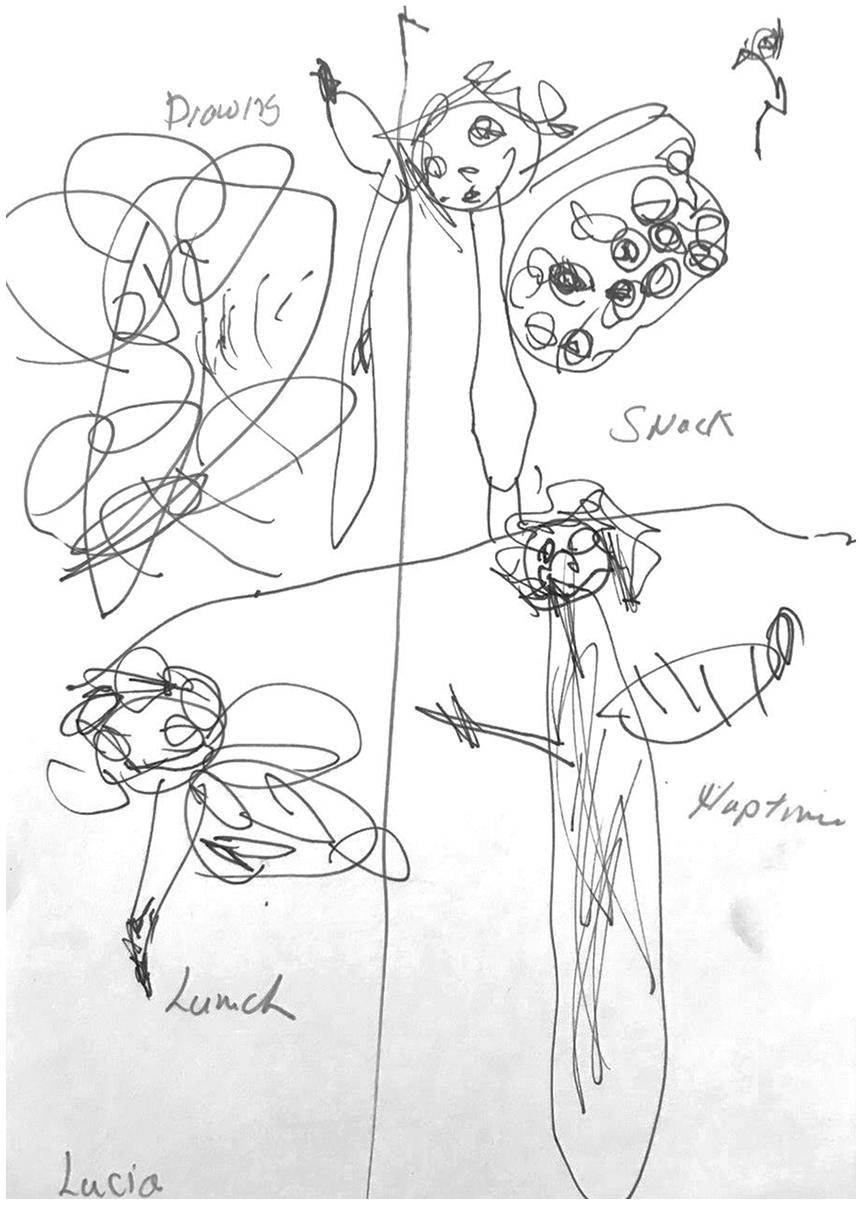
An example of Lucia’s daily plan.
The study: the recognition of daily plans within the research
The data and discussion in this article emerged from a larger study focused on documenting a preschool community in the USA, viewing children as capable and how the adults in this community engage as both teachers and researchers, co-participating with the children. The methodology utilizes narrative as ‘a way of understanding one’s own and others’ actions, of organizing events and objects into a meaningful whole, and of connecting and seeing the consequences of actions and events over time’ (Chase, 2005: 656). Narrative, in this way, invites access to this story while also giving the researchers and writers a new context in which to consider the constructs of early childhood (Leavy, 2009). Part of this includes rethinking the positioning of the child, parent/family, teacher and researcher as co-participants. Writing in this research project is a process – ‘a way of wondering, reasoning, connecting, questioning, creating, illustrating, and representing’ (Pindeo-Burns, 2015: 167. This includes tracing, assembling and paying attention to the unexpected within the data as a way to think with the data and engage in the writing process (Latour, 2005). The data was collected through document review, active interviews with teachers, follow-up questions through email and short interactions with teachers, and researcher journals.
When the daily plans were identified as a central practice of the pedagogista within this study, the researchers (Jeanne Marie, Catherine, and Kirsten) worked directly with the pedagogista (Leslie) on articulating the description and process of daily plans in addition to the original intention of the research project. This process included reviewing the daily plans from several children in the preschool community, an intense review of and reflection on one child’s daily plans, and interviews/conversations with the pedagogista.
The personal and the professional informing pedagogy: how daily plans emerged
Daily plans are the creation of the pedagogista (Leslie) in the preschool community. For Leslie, the image of the child as capable has a long history within her experience. At the start of her teaching career, she worked with children with special rights and initially described these children as capable – much before her own beginning experiences with her work inspired by the infant, toddler and preschool programs in Reggio Emilia, Italy (where the image of the child as capable is foundational). This way of viewing children with special rights draws from a critical disability perspective. ‘Critical disability theory politicizes dominant special rights practices (Goodley, 2013) and is a useful tool as it provides educators with multiple perspectives that trouble the binaries and deficit-based practices that can accompany encounters with difference in the classroom’ (Pacini-Ketchabaw et al., 2015: 96).
Viewing children as capable and competent is central to Leslie’s teaching practice and is reflected deeply in her choice to use the daily plans as the only form of official assessment in the preschool community. The daily plans are reflective of the everyday work of the children. For Leslie, there is no need for a checklist or assessment package created outside the preschool community. Rather, she views children as capable and has implemented a practice that reflects this view, trusting the actual work of the child as the way to understand the child. This practice is further used as the teachers analyse the daily plans to inform the curriculum and create learning stories for each child at the end of each semester. These practices disrupt the traditional and expected early childhood paradigm, reconceptualizing the everyday work of teachers.
At its conceptual base, the daily plan creates a space for the teachers to follow a child’s thinking through the child’s use of symbols. Symbols in this experience are representative of the ‘hundred languages of children’ – ‘the different ways children (human beings) represent, communicate and express their thinking in different media and symbolic systems; languages therefore are many fonts or geneses of knowledge’ (Vecchi, 2010: 9). These ‘languages’ include expressive, symbolic, ethical, communicative, cognitive, logical, imaginative and relational languages (Edwards et al., 2012; Reggio Children, 2010). Moss (2019: 64) notes the ‘hundred languages’ as a ‘provocation to think about the many ways children and adults represent, communicate and express themselves and to highlight the equal dignity that should be given to all languages’. The daily plan process provides an extended time frame to consider and ponder what the children are documenting while they develop a mindset around the ‘hundred languages’ through symbols and conceptualizing symbols for communication. A very sophisticated level of looking at the intentionality of lines or marks as a language is employed by the children, and is a window into following their divergent thinking. Lines/marks are utilized and interpreted by the children and, within the process, they become very adept at reading the nuance of a line as communicating a thought. The plans document which symbol or symbols communicate meaning for the children and what it is within the macro story that they feel is important enough for them to try to convey or communicate that idea or word to others. The plans push the child to think about the meaning of a symbol. Within this process of making a plan – or symbol – the nuance of a mark or a line now takes on importance and meaning because the child has converted a word into a symbol. Now, the child can mess about with the symbol, adding or taking away marks or lines, until meaning can be conveyed to the reader. This critical thinking about marks and lines causes the child to move from casual marks or lines to intentional marks or lines, adding to the nuance of meaning.
The daily plans are not specific or tied to the process of the children’s work – rather, they capture the essence of their work. In a way, the thinking process is like generating a title for a story. You have the story and need a title that best captures the essence of the story you have in mind. In a like manner, this entire process is the child’s editing of their day that is yet to unfold. It is about choices and decision-making in what the children choose to communicate in their constructions of the essences of their day.
The daily plan is more than a plan in the traditional sense of the expected early childhood concept (like the use of a calendar, schedule or timeline) as it responds to the children’s thoughts, questions and wonderings. There is a fluidity to the overall process that allows for morphing and evolving practices (like symbol development or rethinking within the check-in), as well as an openness to doubt and a letting go of the ‘right’-answer expectation that is so prevalent in teaching and learning. The process of the daily plan follows a group of actions.
Announcements and appointments
In a group meeting, the teachers make announcements about various new materials and what is happening in the atelier (art studio), as well as the appointments for the day. The appointments for the day are often tied to the flow of the day – that is, snack time, lunchtime, where the children are working in the room and home time. The teachers give a specific list of appointments that will become the child’s symbol/appointment. The specific appointments that are given are tied to the research that the teachers are gathering about each child’s symbolic thinking, which is an important part of the process of the daily plan. As the year unfolds, the daily appointments/symbols also become the site of documenting children’s theories and ponderings. For example, a daily plan may include a theory symbol of how to share a memory with a peer or family member, what type of wind they listened with in a local place, or a fantasy theory of how they will catch a leprechaun.
Generating and drawing plans
Once the announcements have been made, the children begin their work of generating their plans. During this time, the children choose where they wish to work: on the floor with clipboards or at the tables. The paper for the plan is a blank sheet of paper that matches the size of the small clipboards.
Check-in
Once their plan has been drawn, each child checks in with an adult through a reciprocal dialogue process, which can create, as Parnell (2011: 118) suggests, ‘synergistic teaching and learning moments’ where the teacher and the child can work towards shared meaning at the same time. This process provokes the children’s thinking as the child unpacks the meaning of the marks they have written or drawn through a negotiating process with the teacher around the readability of the marks, where the child and the adult co-participate and come to a mutual understanding of the child’s intentions for the mark or symbol. Readability is an active moment of co-participation when the child and the teacher come together in ‘meaning making’ (Moss, 2019) towards ‘knowledge building’, where knowledge is the ‘process of construction by the individual in relation with others, a true act of co-construction’ (Rinaldi, 2006: 125).
During the negotiation between the child and the teacher, the child advocates for why they have chosen particular marks; it is a major part of the check-in process. The child’s advocacy around the intentions for their mark/symbol is an equally important layer of the recognizability of the symbol. It is a time when the children make their thinking processes visible as they elaborate on the intentions for what the mark or symbol is saying. It also ensures that each child’s thinking is seen and valued in this process.
Napping, drawing, peaches and dolphins: Lucia’s daily plan
This section focuses on a daily plan of one child, Lucia (aged four and a half), and her check-in with her teacher (see Figure 2).
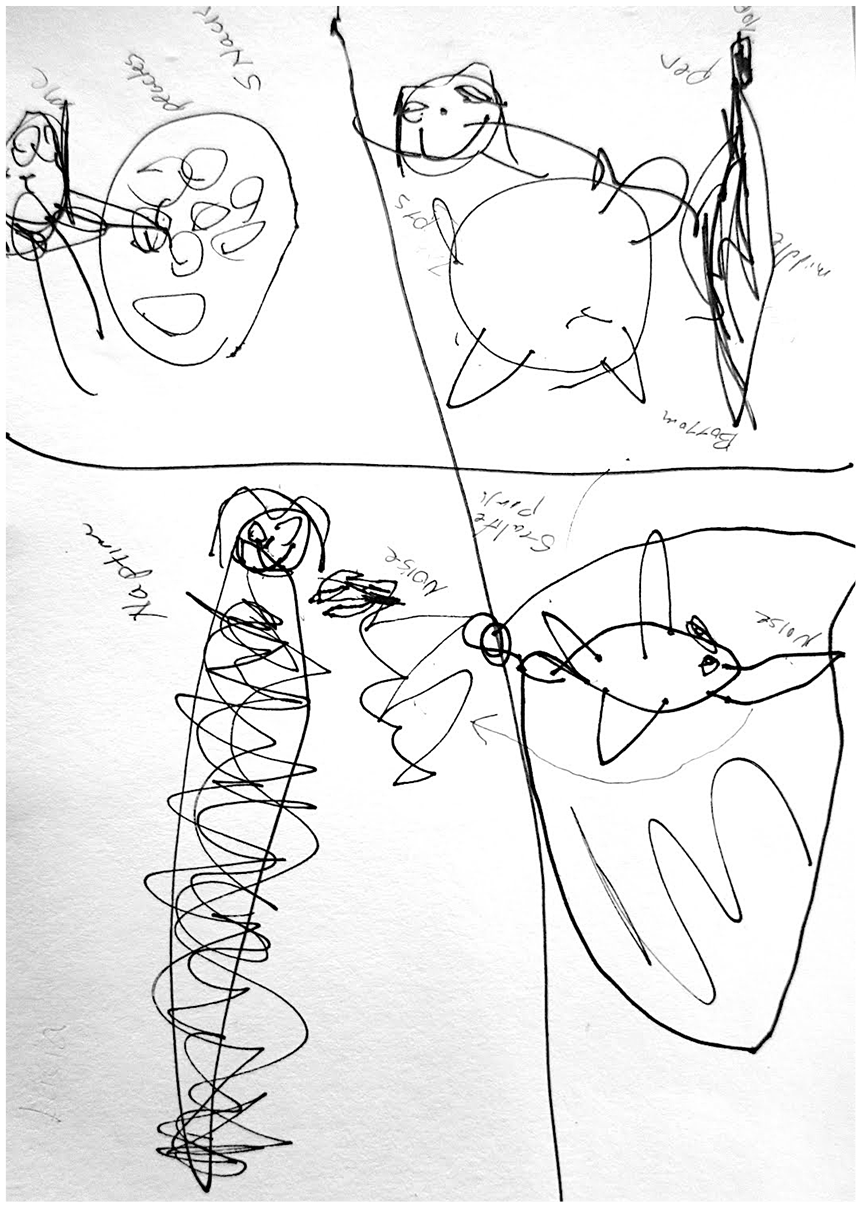
A second example of Lucia’s daily plan.
The teacher begins the check-in process with Lucia by stating: ‘I could almost read all of [your plans] but I’m a little bit confused about two of them, so I’m going to check in with you to make sure I’m reading them right, okay?’ The teacher is wondering if she (teacher) is reading the appointment/symbol correctly, rather than shifting the problem to Lucia. This strategy helps to support the child’s thinking about the readability of their marks. Lucia’s marks have meaning in her own mind, but the teacher wants to have Lucia take a different perspective – the reader’s viewpoint.
The first appointment that the teacher can read is ‘nap’ (see Figure 3). Based on Lucia’s marks, the teacher can read that Lucia is lying on her mat with her eyes open. Lucia smiles, perhaps because she knows that she was able to make that symbol readable and because that is indeed how she looks during nap time – wide awake!
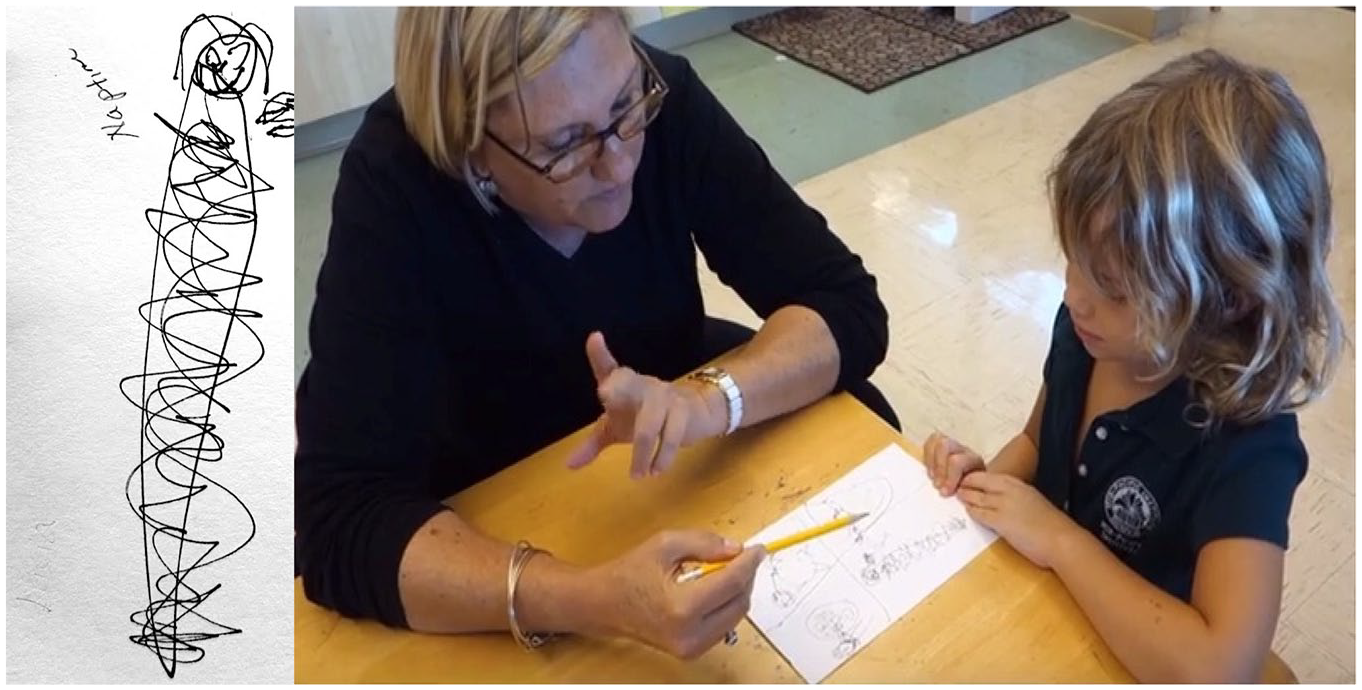
Lucia’s appointment for a nap.
Moving on to the next appointment (see Figure 4), the teacher says: ‘Let’s see what I can read here’. Lucia’s appointment for a snack includes some great details. Pausing for a brief second, Lucia exclaims: ‘Peaches!’ The teacher responds that she could read those and remembers that Lucia did have peaches for her snack. Looking closer, she notices Lucia has also added the marks for her arms reaching for the peaches. As Lucia explains: ‘I am trying to grab one’. The teacher suggests that Lucia might add some fingers. This small detail will offer the teacher a window into her intentions: Is she holding the peaches? Is she grabbing them to place them somewhere? These small nuances add to the readability of the symbol and what the author’s mindset is as she communicates her ideas. Lucia quickly adds some fingers at the end of the arm that is grabbing a piece of peach. Again, this adds to the readability of the symbol.
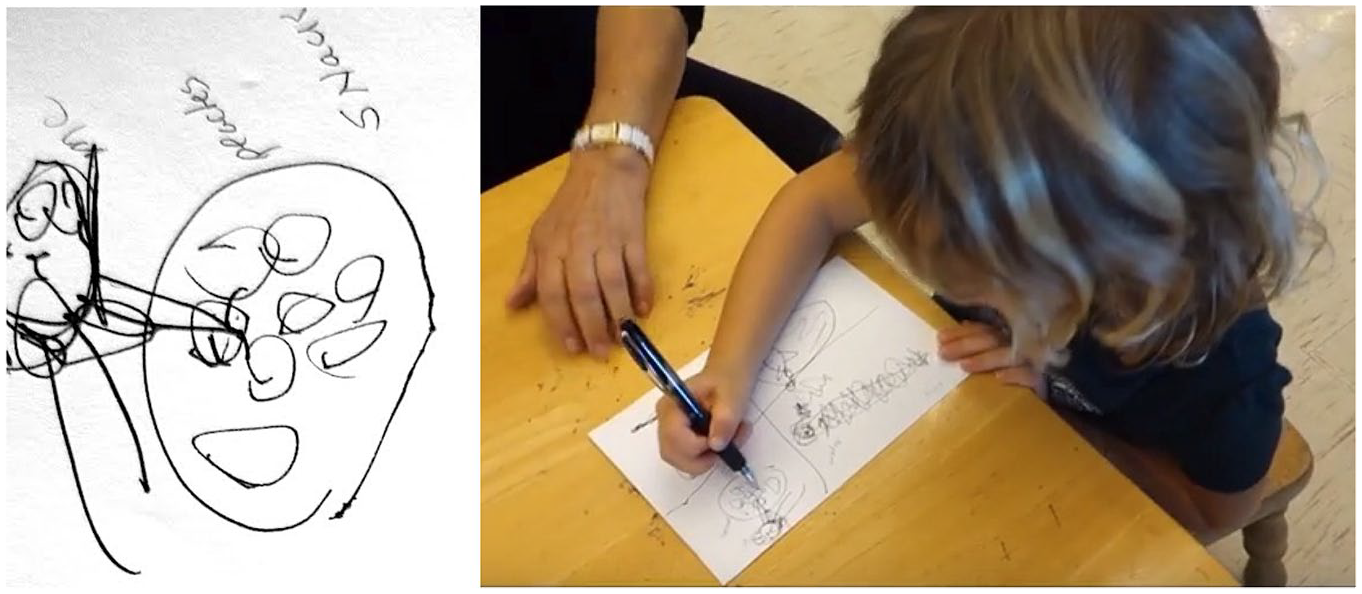
Lucia’s appointment for a snack.
In the next appointment, for ‘work’ (see Figure 5), Lucia explains that she will be drawing at the table. At one point, she explains that she was trying to make each of the corners of the table ‘small and pointed’ but the one in the top left got too big. This is significant because it makes visible Lucia’s metacognitive thinking about the process of drawing the marks and how the marks connect to the readability of the symbol. In wanting to make the table readable, Lucia has drawn the corners, but not getting them exactly how she wanted, she edits her marks and feels that this is important enough to mention to the teacher – perhaps in an effort to make her symbol clearer. The teacher calls attention to the marks Lucia has used for herself in this symbol and in the other appointments. In rereading her symbols, she notices that she needs to add hair. However, the beauty of this moment is in Lucia’s close reading of her symbol, as she notices that she has forgotten to add arms to herself in the symbol for ‘where she is going to work’. Bravo! At this moment, Lucia epitomizes critical thinking at its best.
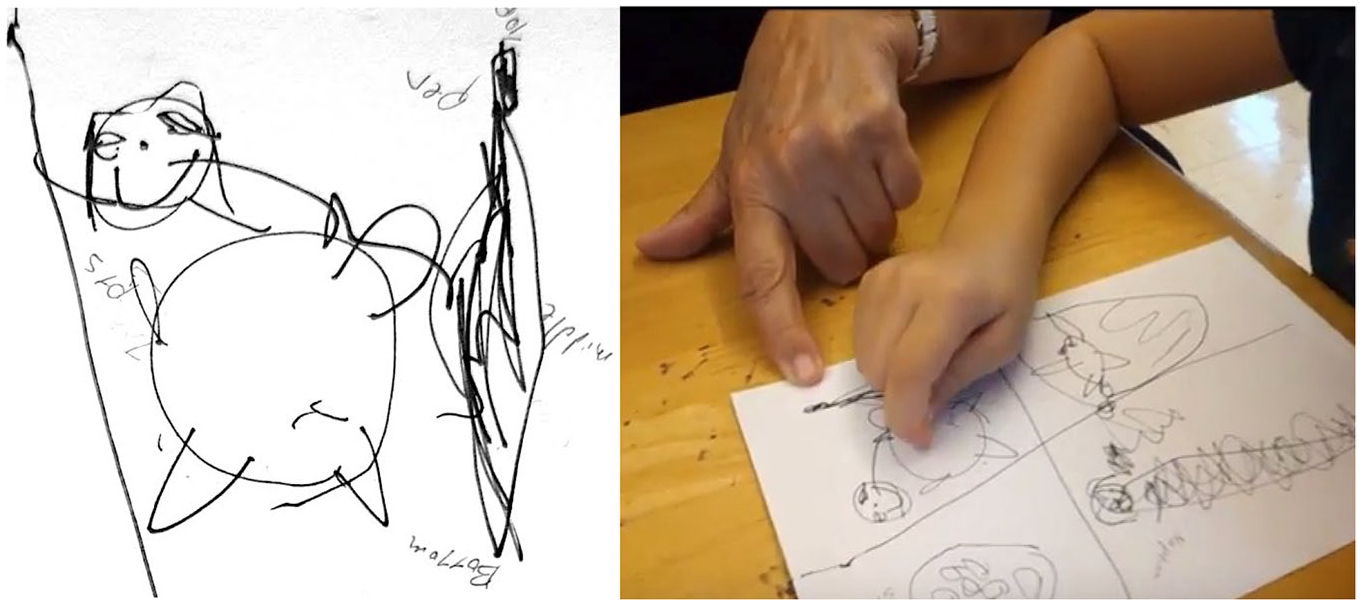
Lucia’s appointment for drawing.
For their last appointment, the children were asked to draw their favourite place, where they would collect a treasure for their classmates to guess. Lucia wrote a symbol for a local ocean park (see Figure 6). Reading her symbol, Lucia has added very intentional details or marks, including eyes and a blowhole. In addition to these marks, however, Lucia has also written a mark that, to her, is ‘saying’ that the dolphin is making a sound. (She is implying that the mark is sort of like a sign that is saying that dolphins make sounds). Lucia explains that the sound actually comes from the mouth of the dolphin, though she has drawn the sound behind the dolphin. Noting this, the teacher considers offering Lucia a mark that will help make her intentions clearer (a mark that will be a gift – a term coined by the teacher in this setting – for Lucia’s future thinking). The teacher shares a small bit of information – a mark (an arrow) that expands the meaning of a symbol by providing directionality. Although Lucia did not respond on this day to the arrow, we will be on the lookout in her future plans and drawings to see if, indeed, the arrow will become part of her symbol repertoire.
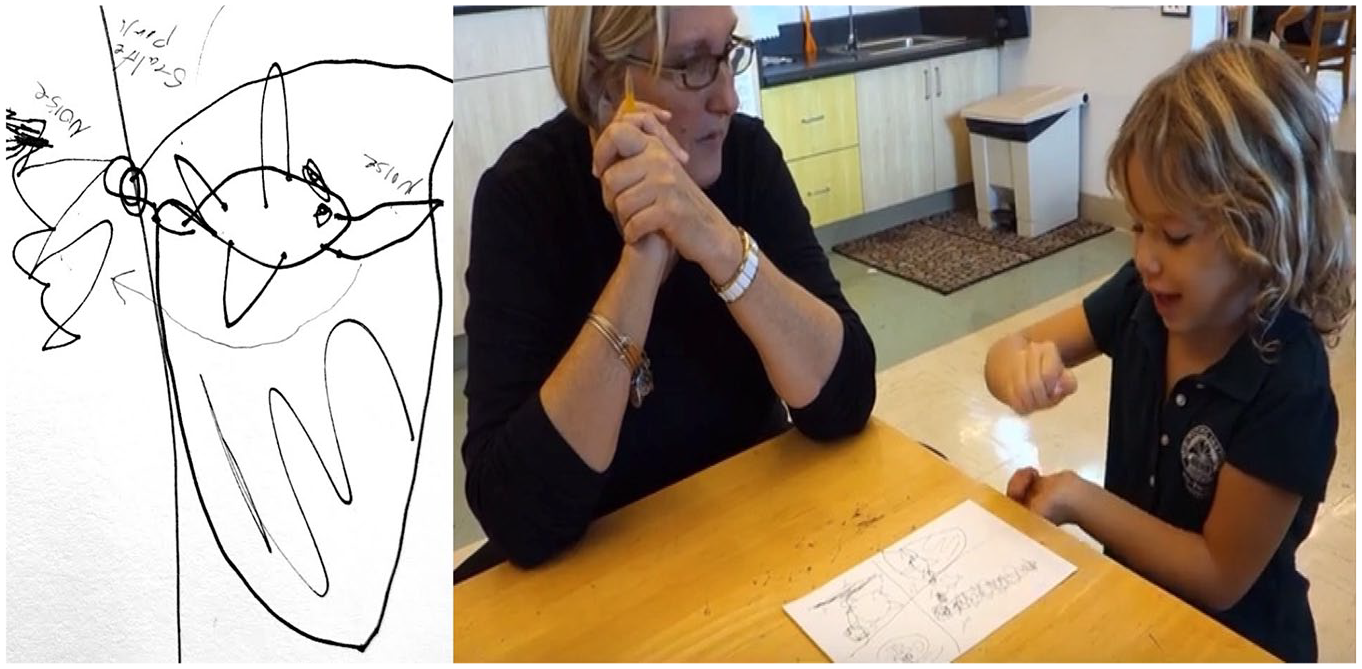
Lucia’s favourite place.
Discussing the practice of the daily plan
Throughout the year, the daily plan process offers the teachers at this site a complex and in-depth view of what the children are thinking and understand, and makes visible moments of co-participation between teacher and child. The daily plan experience pushes the teachers to think about children’s representations, how children and teachers communicate, the way children think about and think through their day, and how children move towards making their intentions for their work readable to the viewer. Daily plans establish the image of the child as capable, as the child’s thinking and thought processes are how the child is defined and assessed; essentially, the children are trusted to provide the information needed to understand them without the need for any prescribed assessment, checklist or standards. For example, in Lucia’s appointment for ‘where she is going to work’, she details herself drawing. Considering what she has chosen to include and following her reflection on and close reading of her symbol with the teacher, Lucia adds the arms to her person. If we isolated this to a traditional and standardized assessment of drawing a person, often used in early childhood, a teacher would have marked Lucia’s original person as incomplete because it was devoid of limbs. However, through the daily plans, we see the rich context of the marks that Lucia has used for her person and, through reflection, Lucia ‘edits’ her symbol as well as previous symbols. This process of self-editing through reflection constructs learning as a deep and thoughtful activity.
The daily plans validate the children’s thinking processes as a means for communicating with each other about their day. Further, the daily plans provide a vehicle for the children to revisit their thinking and make their intentions readable day in and day out. It is this revisiting connection that strengthens the children’s thinking, pushing the children on to become proficient communicators. The concept of ‘re-visitable’ (Forman, personal communication, 2007) emerges as a criterion within the daily plans. Rinaldi (2001: 84) cites ‘revisiting’ as an ‘action’ within documentation and ‘an integral part of the knowledge-building process’. Creating documentation (as in the daily plans) that is ‘re-visitable’ defines the work as a way for the children and teachers to engage with thinking and co-participation. During the process of Lucia’s check-in, the teacher notices different marks added to her symbol of herself in one of the appointments drawn, which leads Lucia (and the teacher) to look at her other marks as she adds arms to her person, demonstrating her own revisiting as a means to further build her knowledge of communicating clear symbols that make her thinking visible.
The children’s planning processes have transformed each day through the daily plans and generate opportunities for the teachers to co-construct ongoing pedagogical intentions with the children. Pedagogical intentions are ‘an uncertain but purposeful, layered but limited, consequential but non-linear practice of navigating and co-constructing everyday pedagogical relationships’ (Land et al., 2020: 136). The teachers engage with pedagogical intentions that put at risk the dominance of traditional child development narratives. Rather than attempting to ‘guide’ the children’s learning through a set of predetermined developmental goals, the teachers activate the image of the child as a co-participant in the learning process.
Initially, the teachers regarded the plans as a way to support children to move from one level of competence in communication to a more complex level. However, they activated a ‘web of reciprocal expectations (more than the teachers themselves) that sustains individual and group processes’ (Rinaldi, 2001: 83). The daily plans are a means for children to organize their thinking and their intentions for their work – a type of mental map of the child’s day, but something that also contributes to how both the child and the group listen and respond. Through the daily interactions in the plan process, simple and direct questions posed by the teacher – ‘Help me understand your mark’ or ‘Where do you plan to work today?’ – were enough to cause the children to refocus on their symbol/marks for their work possibilities or intentions for the day. For example, in Lucia’s daily plan, we find that where she intends to work is in the drawing/message area. As this proficiency emerged for the children – the ability to plan, to communicate and to self-assess – they began to work together as they made matching plans, indicating the social and negotiated foundation of the daily plans. The children would assist others or share symbols with one another that provoked open-ended questions such as ‘Why?’ or ‘What is occurring?’
Meaning-making
On viewing the work of the plans more closely, it soon became evident that the children were on the threshold of something important and unique to this learning community: they were becoming the authors of a common classroom discourse based on the created marks utilized in their daily plans – the children were meaning-making. Meaning-making, in this sense, values subjectivity, context, multiplicity, complexity and uncertainty (Dahlberg et al., 2007). Different ways of knowing, being and doing emerge in the planning process, which enables children to share these as symbols with their peers in order to make their intentions clear and communicate more effectively with one another. Some symbols appropriated by two or three children – such as for the loft or Lego – were soon adopted by other children. In this process of sharing symbolic representations, the teachers found that the children were meaning-making through the process of creating and using a classroom discourse reflecting this community of children and their experiences.
The children demonstrate agency in the daily plan process, making decisions and controlling how they describe their actions and thought processes, and, in some instances, practising resistance. We see resistance as Lucia draws her nap experience in her daily plan. While the expectation and accepted early childhood practice is to sleep during nap time, Lucia always chooses to stay awake (as is evident in her wide-open eyes illustrated in her plan), and her plan reflects this resistance to the common early childhood structure. Moss (2019: 7) argues that resistance to taken-for-granted practices in early childhood provides the opportunity for alternative narratives to be ‘heard by those who choose to listen’. In this case, Leslie listens and accepts the alternative story of Lucia and her nap, creating a space for Lucia’s agency and co-participation between the child and the teacher.
Children and teachers as co-participants
In order to do this work, the teacher is also viewed as capable, but at the same time is ‘open to doubt’ (Rinaldi, 2001: 41), allowing for traditional and expected means of assessment (such as testing or checklists) to be left behind. This supports the teacher to be open to the divergent thinking of the child. This shift opens the teacher’s mindset to understanding the children’s intentions for their symbols/marks. Further, it opens the space for the child to be capable and not limited to a narrow view of linear development. Rather, the absolute truths often tied to development are challenged as teachers listen and respond to the child rather than the stage of the child’s development. Making the choice to focus on daily plans as a central pedagogical practice puts at risk the dominance of child development narratives and challenges the notion of universal or single truths about the ways in which children learn. Being ‘open to doubt’ through daily plans releases the teacher to co-participate with the child, generating a deep relationship that is full of listening and responses, rather than the usual practices embedded in the developmental logic of the teacher just doing with no intention beyond standards or set expectations outside of the school. Absolute truths, certainty and universality in beliefs and practices are disrupted, as teachers trust children and their work as the primary means of understanding each child and eliciting a response from the child.
As children check in with their teacher after writing their daily plans, the teacher sees this interaction as a provocation for the child: the child is provoked to make meaning of their daily plan, to make what they have drawn or written readable to the teacher. It also offers a clear example of the co-participation of the child and the teacher in the meaning-making process: the teacher understands the lived experiences of the child (Van Manen, 1990) and then ‘bridle[s] them’ (Dahlberg, 2006) or interprets the child’s experiences in order to understand and respond to the child. At the same time, within the process, the teacher comes to understand themself within the co-participation of the experience.
Understanding is always more than merely re-creating someone else’s meaning. Questioning opens up possibilities of meaning, and thus what is meaningful passes into one’s own thinking on the subject . . . To reach an understanding in a dialogue . . . we do not remain what we were. (Gadamer, 1998: 75)
We see this during Lucia’s check-in as she explains (sometimes through questions posed by her teacher – a co-participation moment) the table where she will draw, her process of drawing the corners of the table and her struggle to draw the one corner on the top left, as it ‘got too big’. Within the collaboration, Lucia advocates for herself as she speaks about her intentions, makes meaning and openly shares her problems in drawing, illustrating her trust in her teacher and her understanding that, in her relationship with her teacher, she will not be judged or assessed for her drawing or marks.
This example recognizes the child and the teacher as being in relation with each other, the context and the materials, engaging in an unfolding event between co-participants where questions are considered and reciprocal meaning-making occurs. Both will leave this experience with more understanding of each other, themselves and their community. This example also activates what Lenz-Taguchi (2009: 90) names as ‘intra-active pedagogy’, a process where bodies, discourses and materials come together in a specific context ‘around questions and problems arising in the moment or event. This makes the teacher change the material conditions of her practice sometimes in the midst of the process’. The process of a symbol functioning as readable is so much more than the child just using words for the teacher to understand. Readable becomes the opening up of possibilities for what can happen within the moment of intra-action. Readable impacts the teacher as the check-in provokes the teacher to consider possible responses to the child. Readable emerges as an unexpected event, assembled through co-participation of the child, the teacher, experiences and marks (Latour, 2005). Leslie continues to consider how her responses to children during the check-in process intensify the complexity of their learning. When Leslie offers Lucia a mark during her check-in as a gift to support Lucia’s future thinking, this is a choice made by Leslie in response to Lucia’s marks and conversation, and as part of co-participation. Through gifting the mark, Leslie activates the pedagogical intentions of deep listening and co-participation. Leslie trusts Lucia to use this mark at some point in the future, and there is no expectation for this mark to be utilized immediately. The intention of the teacher is not to offer a mark that Lucia will later be assessed on, but rather to offer Lucia another way to communicate, think and ponder.
Conclusion
The daily plans contribute to research that is often placed at the margins, regardless of the complexity represented. Instead of numbers and statistics, the actual work of children and teachers with the process of the daily plans tells a story and presents significant examples of children as capable. This research provides another lens for constructing early childhood education and experiences in a post-developmental paradigm, and runs up against the readiness discourse where children and early childhood experiences are steeped in frameworks promoting absolute truths and often standardized assessment (Iorio and Parnell, 2015). Rethinking the view of the child as capable is critical to move beyond the narrow visions of a ‘standardized childhood’ (Bloch and Kim, 2012: 272) with a prescribed curriculum and testing. The daily plans and the actions of the children engaged in this process expand the vision of childhood towards infinite possibilities. Further, the daily plans illustrate the richness of research in the classroom where teachers are researchers, collaborating with their participants (children), using symbols, drawings and dialogues, revisiting and thinking to make meaning, construct knowledge and continue to become in the context of children as capable.
This story of the child as capable and actions that reflect this practice illustrate what can be otherwise when assumptions of children as incapable are disrupted. In the work with daily plans, both the image of the child and the image of the teacher are as capable, creating a space for doubt and uncertainty as well as interpretation and rethinking. Negotiations and considerations happen as children create their own discourse, teachers are situated to listen, and a responsive practice is enacted through co-participation. The daily plans demonstrate how research can and should be part of classroom practice.
Footnotes
Acknowledgements
The research team would like to acknowledge the preschool and its community for their contribution to and support for this project. We would also like to thank Lucia for her willingness to be part of this research and article. Finally, thank you to Professor Peter Moss for his feedback in our revision of this manuscript.
Declaration of conflicting interests
Author 2 is the parent of the child whose daily plan is discussed in the article.
Funding
The authors received no financial support for the research, authorship and/or publication of this article.
Author biographies
 ). Her publications (with co-editor Will Parnell) include Rethinking Readiness in Early Childhood Education: Implications for Policy and Practice (2015), Disrupting Early Childhood Education Research: Imagining New Possibilities (2016) and Making Meaning in Early Childhood Research: Pedagogies and the Personal (2018). Her most recent text Higher Education and the Practice of Hope (2019) (co-authored with Clifton Tanabe) is part of the Rethinking Higher Education (Springer) series she co-edits with Clifton Tanabe.
) and her current projects involve investigating children’s relations with place. Her research brings together post-developmental perspectives of early childhood, environmental humanities and Indigenous worldviews.