




Abstract
The importance of community has been widely recognised in the field of early childhood education. However, the various ways it has been conceived, together with taken-for-granted notions of education, have made it difficult to actualise the processes involved in contextually meaningful ways. This article draws on cultural models theory to explore educational leaders’ re-imagining and redesigning of early childhood educational learning communities in a range of diverse settings. The examination of the processes and artefacts used to promote democratic identities and agency highlights the significance of establishing shared principles, sociality and challenging power relations to engage in processes of communing that are contextually meaningful, sustainable and democratic.
Introduction
Community has become a ‘keyword’ in social discourse. People speak of ‘serving the community’, ‘giving back to the community’ and ‘responding to community needs’. We have ‘community housing’, ‘community literacies’, ‘community radio’, ‘community sport’ and now ‘community transmission’, but who, what and where is a community? Who belongs to which communities? These complex questions underpin the study discussed in this article. Rather than approach community as an abstract phenomenon or as an adjective to describe other practices, we take up a version of community that sees it as an active unfolding process of doing – communing – which is crucial when it comes to negotiating early childhood educational relationships.
The concept of community is recognised as significant by educational policymakers internationally, and increasingly so as the make-up of populations in neighbourhoods changes and becomes more diverse. Community is highlighted in Belonging, Being and Becoming: The Early Years Learning Framework for Australia (Department of Education, 2009). This policy document describes teachers’ roles in developing learning communities. As the framework suggests, ‘[teachers] become co-learners with children, families and community and value the continuity and richness of local knowledge shared by community members including Aboriginal and Torres Strait Islander Elders’ (Department of Education, 2009: 14). In New Zealand, community is highlighted as a key principle of Te Whāriki (Ministry of Education, 2017), and it receives similar recognition in Canada (Best Start Expert Panel on Early Learning, 2007). Educational literature also positions community as playing an important part in learning (Comer and Ben-Avie, 2010; Davies, 2014; Gandini, 2012; Rinaldi, 2013: 44), though the term itself is often left undefined. Millei (2012: 250) explored the multiple ways that community has been defined in contemporary discourse, including as characterised by membership and recognition, and associated with having things in common, such as shared aspirations and a ‘sense of the common good’. She also critiqued this ‘inclusive’ notion of community as masking how difference is positioned within a view of the ‘common’.
Such contentions about the concept of community and how it is defined play into taken-for-granted, universal assumptions about early childhood education and community, and are not helpful to leaders who wish to engage with the more challenging processes of building community, often in diverse local contexts. Studdert and Walkerdine (2016) problematised universal notions of community as static places or fixed entities. They emphasised the importance of understanding the action and processes for ‘communing’ as an alternative, and it is this approach we take here.
To return to our own context, Carla Rinaldi, a renowned pedagogue from Reggio Emilia, Italy, was an Adelaide Thinker in Residence during 2012–2013.
1
This program brought Rinaldi to South Australia to help re-imagine early childhood education. Rinaldi challenged educators and educational stakeholders to rethink early childhood education as the location of cultural, philosophical and economic change. In her concluding report, she urged reflection on early years education provision, and a re-imagining of educational settings as sites of learning not only for children, but also for families, teachers and the community: South Australia has an amazing opportunity to THINK and REFLECT ON early childhood as a new source, a new source that can inspire a big cultural, philosophical and economic change for the country. Early childhood centres that don’t simply want to offer services for families, but as places of and for learning for children, teachers, parents and the community, ‘a learning community’. (Rinaldi, 2013: 11)
In response to the Rinaldi residency, the state initiated The South Australian Collaborative Childhood Project (TSACCP) with the aim of enacting the recommendation to re-imagine schools in South Australia as learning communities. Expanding the notion of what is meant by the term ‘community’ in the Reggio Emilia education project, Leila Gandini (2012) recalled Loris Malaguzzi’s thoughts. He considered that community is a dynamic process that is built on relationships between peoples – relationships that connect them not simply through warm acceptance, but in a way that enables mutual evolution towards particular shared goals. Dahlberg (2012) extended the point by noting that the ripples of children’s and adults’ participation in educational settings are likely to extend to their identities as global citizens. In a similar vein, Miskeljin and Sharmahd (2018) focused on the process of participation to meet the increasing diversity of those accessing early years settings.
This state context provided an opportunity to explore participating TSACCP early childhood leaders’ experiences in re-imagining their sites as learning communities. Cultural models theory (Holland et al., 1998) provides a useful framework for understanding how the social contexts of early childhood education are formed, reformed or created anew, and the relationships within them. As educational researchers, we explored the tensions, challenges and supports that leaders encountered, and the processes and artefacts they found most useful to engage in communing. Drawing on cultural models theory, and more specifically figured worlds (Holland et al., 1998), we argue that shared principles, sociality and challenging power relations are significant to engaging in processes of communing that are contextually meaningful, sustainable and democratic.
Theoretical framework
Cultural models theory (Holland et al., 1998) was a useful framework for exploring how people were working together to re-imagine their pedagogy and practice. Cultural models theory describes social contexts as figured worlds, constructed of objects, practices and shared languages that inform identities and craft culturally situated values and beliefs. The concept of ‘figured worlds’ fits well with Studdert and Walkerdine’s (2016) notion of ‘communing’, as it is also used to understand social contexts not as static physical places, but as ‘[p]rocesses or traditions of apprehension that give people shape and form as their lives intersect with them . . . they are socially organised and performed, they are dependent on interaction and people’s intersubjectivity for perpetuation’ (Urrieta, 2007: 108–109). In other words, communities as figured worlds are formed and reformed through the everyday practices of those who inhabit them (Holland et al., 1998), and thus can be changed or altered by everyday practices. Within figured worlds, the governing perspectives and their accompanying mandates have the effect of denying the existence of alternative viewpoints, making it difficult to re-imagine new possibilities (Holland et al., 1998). Taken-for-granted practices are socially reproduced without question through accepted dominant discourses (Holland et al., 1998). In education, examples of taken-for-granted practices include parent–teacher conferences/interviews and the writing of reports on student achievement, which position families as receivers of information about their child. Of particular importance to our research were mandated practices such as those associated with assessments and curriculum decisions, which formed parameters dictating how teachers, children and families could participate.
Artefacts also play an important role within figured worlds. They are symbols that are used to create an embodied understanding of values and beliefs, becoming mediators of human identity and action (Holland et al., 1998). Like dominant discourses, they become accepted cultural constructs (Hatt, 2007) and serve as trusted powerful markers of worth (Holland et al., 1998). The use of letter or number grades to indicate achievement level is an example of a cultural artefact within the figured world of education. Outside of this figured world, such grades may have little or no significance. However, in the figured world of education, they have come to play a powerful role in making judgements about children’s and teachers’ performances.
Individuals are not just products or respondents in figured worlds, but are critical as they improvise, refiguring worlds and developing new ones. They bring with them their experiences from multiple figured worlds, referred to as ‘histories in person’ (Holland and Lave, 2001). Holland et al. (1998) drew on Bakhtin to describe how perspectives from different figured worlds come into dialogue with each other at the point of the individual. Individuals can enact agency through improvisations as they orchestrate multiple perspectives from many figured worlds that have shaped their ‘history in person’ (Holland et al., 1998; Holquist, 2002).
Cultural models theory is an appropriate framework for our research because it not only provides a useful lens for research when educational leaders in a particular area are attempting to re-imagine early childhood education, but also addresses the formation of new identities, processes and artefacts within figured worlds (Holland et al., 1998). In particular, the theory is useful in addressing how leaders re-imagine their identities and participate in ways that are contrary to typically enacted discourses and practices, thereby creating a new figured world that reflects an educating community. The use of the term ‘community’ – a term that is central to the recommendations of the Rinaldi (2013) report – is not unproblematic (Davies, 2014; Rinaldi, 2013; Studdert and Walkerdine, 2016), hence an examination of its use in educational literature is required.
Problematising the word ‘community’
The word ‘community’ is commonly employed in educational literature (Millei, 2012). However, its meaning is often assumed, remaining undefined. As a result, the term may be used to convey one or more ideas, but interpreted to mean others. Despite these variations in meaning, we argue that the term is an important one for teachers working in a socially created and figured world. People need to deeply understand the processes that bind them to build a community and those that undermine what Studdert and Walkerdine (2016) call ‘sociality’. These researchers define ‘sociality’ as ‘a way of defining the totality of our inter-relations with other people, with non-humans, with buildings and materiality in its widest sense in our life together in public, no matter how small or large, in any setting’ (Studdert and Walkerdine, 2016: 30).
The first major and most commonly employed definition is of community as a physical location and specified group of people. For example, Comer and Ben-Avie (2010: 87) state that ‘families, educators, and children can work together as a community and learn together’. Using this definition with reference to educational settings, ‘community’ would include everyone in the site: children, teachers and families. To be a member of that community, one would need to be someone who directly participates in the education site. In a variation, the terms ‘the broader community’ or ‘the wider community’ are sometimes used, as in Rinaldi’s (2013: 44) report. This use refers to people beyond those participating daily in the educational setting, adding a geographical as well as participatory dimension. Taking this idea further, and drawing on Malaguzzi, Gandini (2012) saw a blurred line between education settings and people living in that locality, proposing that if a school is to be a learning and developing entity, it needs to expand into, and engage with, those living around it, not only the families with children in the setting.
The second major use of the term, as seen in Studdert and Walkerdine (2016: 19–20), is the idea of community as an action, not a fixed entity or observable object. These theorists positioned ‘community’ not as a geographical location, nor as a group of people who are participating in a particular time and space, but rather as a verb – a process of ‘communing’ or ‘being with’. Adopting a problematising approach to the word’s use, they argued for ‘the investigation of communal being-ness in all its lived experience’, alluding to actions of sociality as illuminating the ‘particular and temporary social being-ness in common’: ‘The hope that we can break out of the current . . . gridlock concerning communal being-ness and once again think about this social being-ness of ours; what it consists of, and requires: what supports it and what undermines it?’ (Studdert and Walkerdine, 2016: 21). These theorists focused on how communities work – the cooperation and co-construction involved – rather than establishing community as a locale or group of people. Similarly, Davies (2014: 6) expressed the idea as ‘the daily doing of community, a doing that is emergent, in ongoing encounters’. Rinaldi (2013: 23) also referred to community as a verb: ‘a dynamic process’. Studdert and Walkerdine (2016), Davies (2014) and Rinaldi (2013) thus conceptualised ‘community’ as a series of ongoing, dynamic, mutually affecting encounters which create groups that are always emerging and never defined by clear boundaries.
This point regarding the dynamic nature of community is important, for, as Davies (2014) argued, an openness to the unknown is critical to groups if they are to be able to participate fruitfully, to create new ideas and ways of being, and to advocate regarding particular matters of concern to them. Davies (2014: 9) called this process ‘continuous becoming’. Drawing on Rinaldi (2006), Davies (2014) observed that if a community is clearly defined with strong borders, rules and established ‘truths’ determined by those in power, its creativity via internal dialogue among its members is stifled, and stasis results.
In this study, the problematising of the term ‘community’ is helpful in focusing on the particular processes of sociality and ‘communing’ reported by the participating leaders. This exploration provides insight into the complexities involved in understanding how communities work, rather than finding a fixed or stable definition of community.
Methodology
Design
Cultural models theory is appropriate for our study because it focuses on ‘contexts of meaning’ (Urrieta, 2007) in which streams of significant interactions occur that create a figured world, organised in a way that informs power structures, how people relate and their identities. We understood educational sites as contexts of meaning where particular attention is paid to the sociality within these settings.
Leaders shared their personal histories, and how those histories and identities shaped their thinking and practice. Each leader led a site in which considerable rethinking and reflection on educational practice had taken place. They could be said to be in the process of leading the creation of a new figured world.
Participants
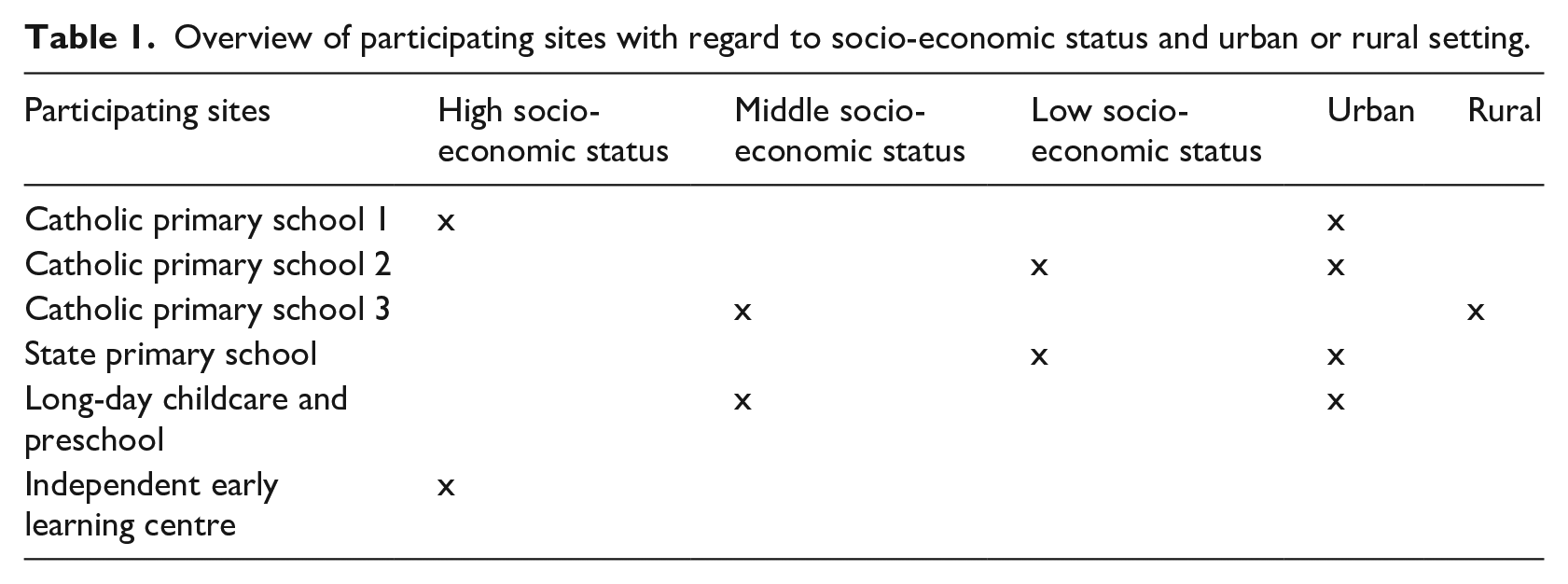
Seven leaders of educational sites and two early years leaders of state and Catholic educational organisations engaging with Reggio Emilia education principles via TSACCP were purposefully selected and subsequently agreed to participate. The site leaders comprised three Catholic principals of primary schools, two of which incorporated kindergartens; one early learning centre director in an independent K–12 (kindergarten through Grade 12) school; a state school principal and early years leader of a primary school incorporating a kindergarten; and the director of a long-day childcare centre and preschool. All were recommended by the local education providers as recognised leaders in TSACCP. The settings included urban and rural, those with high numbers of children from socially marginalised groups, and those with financially privileged children with high social status (see Table 1).
Overview of participating sites with regard to socio-economic status and urban or rural setting.
Methods
A collaborative participatory approach (Clark and Moss, 2001) was used throughout the research process. Once ethics clearance had been obtained from the university’s Human Research Ethics Committee and the ethics committees from each sector, and each leader had also provided written consent to participate, the researchers held an initial meeting with each participating leader in their sites to familiarise them with the project and to involve them in making decisions about the methods that were most appropriate for making their experiences visible. The goal was to gain the leaders’ views regarding the methods that would best reveal processes of re-imagining and redesigning early childhood education in their settings, and develop an agreed data-gathering protocol – that is, rather than simply saying that we wanted to conduct observations or interview children or parents, we invited the leaders to make suggestions about what they believed would give us the best sense of how their site operated and how the different groups of people related to each other. For example, they might suggest the importance of being there at particular times of the day, such as drop-off and collection, or during meals, so that we could experience key practices in situ.
In a second meeting, one of the researchers met onsite with the leaders, interviewing them using the agreed questions and also, during site tours and/or invited community meetings, collecting other data such as photographs and videos of learning spaces and artefacts of significance to their re-imagined work. The audio recordings of the interviews were then transcribed in full, and the images and videos were stored securely on password-protected computers.
Analysis
Employing the lens of cultural models theory, we read and reread the interview transcripts individually and together. During the analysis, we engaged in a process of thinking with theory (Jackson and Mazzei, 2013) to make sense of the multiple sources of data, literature and theory. In particular, we used a process of ‘plugging in’. Jackson and Mazzei describe plugging in as a constant, continuous process of making and unmaking. An assemblage isn’t a thing – it is the process of making and unmaking the thing. It is the process of arranging, organizing, fitting together. So to see it at work, we have to ask not only how things are connected but also what territory is claimed in that connection. (Jackson and Mazzei, 2013: 262)
The process of plugging in aligns with cultural models theory (Holland et al., 1998), as we use it as a framework to theorise the concept of community (Studdert and Walkerdine, 2016). During our analysis, we plugged into various sources of data such as interviews, observations and shared artefacts, and into the literature on communing and cultural models theory, to make sense of how the leaders were engaging in processes of communing within their figured worlds of education. In doing so, we paid particular attention to the processes, artefacts, identities and acts of agency in re-imagining their figured worlds as learning communities (Holland et al., 1998).
Communing to re-imagine figured worlds
Community as foundational to thinking and practice was common across the educational spaces. The interviews illustrated Rinaldi’s (2013) provocation of ‘community’ as an important priority for leaders. For example, one leader defined community as a constructed process, explaining the project as being ‘about community and how we were going to bring a community of people together’.
Others made it clear that community went beyond the teachers and leader to include parents by stating that they had developed a ‘real sense of community’ because ‘parents feel that there’s an opportunity for them to find a place that they can be an active member of the community’. Another leader shared: ‘the importance of being involved in community is so central to the work that we’re doing’. In this sense, community can be seen as continually becoming (Davies, 2014), as it is not solely dependent on those within the building, but also extends to families.
Although the leaders used ‘community’ as a noun in these examples, there is also evidence of ‘action’ in the statements: ‘bringing people together’; ‘build that sense of community’; ‘real sense of community that’s been developed’. The actions that inform these ideas of community further illustrate the process of communing as fluid and mobile, one that shifts and changes over time and space to re-imagine figured worlds. In what follows, we further explore the processes and artefacts in which leaders engaged to commune – to re-imagine figured worlds.
Communing to re-imagine figured worlds: shared principles
In the past, historically accepted professional boundaries had made it difficult for early childhood leaders to engage in processes of communing within their site, across their system and across sectors. Consistent with our earlier work (Sisson et al., 2018), the leaders reported that physical and even philosophical boundaries positioned them within different figured worlds. As Holland et al. (1998: 41) suggested, artefacts and discourses can be used to maintain power relations within and across figured worlds, where ‘[s]ome figured worlds we may never enter because of our social position or rank; some we may deny to others; some we may simply miss by contingency; some we may learn fully’. However, these leaders were challenging the professional boundaries between year levels and across sectors that had kept people from entering educational figured worlds together. They did so by using principles from the Reggio Emilia education project, which hitherto had been viewed as focused on early childhood. One leader explained that the principles are ‘not only for the early years, it goes right through’. Another elaborated: ‘This is an amazing pedagogical practice for all of us, and it’s developing such rich understanding of children, of educators, of learners, of adults, of community’.
The most commonly reiterated education principle from Reggio Emilia was the view of children as competent. One leader said that ‘secondary principals were blown away by the potential of their people’ and their ‘deep understanding of and deep challenging of citizenry’ for children. She added that principals and teachers ‘could see [that the] image of the child as competent isn’t just something for young kids’ in early childhood settings. Another leader reflected on how Year 6 and 7 teachers connected with the notion of the environment as a teacher to ‘make changes to their environment and to their pedagogy’. Changes to the physical environment resulted in Year 6 and 7 classrooms looking similar to preschools, with flexible seating, open access to resources and homelike furnishings. This is particularly significant at a time when the curriculum of the compulsory years of schooling is often pushed down to early childhood. The acceptance of shared principles that originated in early childhood lifted the profile of early childhood members of the field. They were seen as valued contributors to the construction of educational knowledge, rather than receivers, creating opportunities for communing across year levels. This was demonstrated in how the primary teachers began to seek preschool teachers’ perspectives.
Engagement with the Reggio Emilia education principles also provided opportunities for communing across sectoral boundaries regarding educational, philosophical and theoretical perspectives. TSACCP was named as helping to create a space for leaders and teachers across sectors to come together in dialogue about these shared principles. For example, scholars from Reggio Emilia were brought in to offer workshops focused on pedagogy. It enabled the site members to come together as an educating community where they could engage in meaning-making away from the discourse of testing, which can limit focus to things that can be easily measured and reported (Grant et al., 2018; Hardy, 2018). One leader described the feeling of ‘reassurance’ that the primary school principals experienced, in ‘being able to talk about childhood in a time when people were talking about testing children’. The opportunity to engage in communing with colleagues across sectors and year levels brought ‘possibilities for balancing’ the curriculum in ways that focused on the whole child, rather than narrowly focusing on the concepts to be tested.
Engaging across sectors in shared principles provided the leaders and teachers with an opportunity to transform their pedagogy. As one leader explained: ‘I’m only where I am now because of all those wonderful opportunities to work with exceptional educators [from other sectors]’. Another said that cross-sector colleagues ‘beautifully nurtured me and embraced me’. The newly created figured world of leaders and teachers who shared inspiration from the principles of the Reggio Emilia education project enabled people who had historically existed in different professional worlds to come together. Working together in this way, they could begin to put the principles from Reggio Emilia into dialogue with local contextual values, to provide opportunities for further communing which permeated beyond the usual boundaries. In effect, they were creating a new figured world of education through their own communing practices, which allowed them to go beyond traditional boundaries and professional identities.
Communing to re-imagine figured worlds: sociality
The leaders recognised that working in isolated classrooms, both physically and metaphorically, was an impediment to sociality among teachers. The advice given to one leader by Carla Rinaldi was to ‘find a way for your teachers to talk together. They have to share their documentation with each other’. This suggestion proved to have profound consequences. This leader re-imagined the structure of the teaching teams’ work to promote communing, which enabled higher-level thinking about practice. She shared: ‘I created twice in one term a time for each team to come together. That’s become an embedded part of our practice now . . . valuing the pedagogical documentation of daily life and valuing the opportunities to invite new perspectives’.
The valuing of pedagogical documentation has significance relevant to the Reggio Emilia principles, but also its value in promoting communing. Studdert and Walkerdine (2016: 33) explained the idea as follows: ‘inter-relational action creates being-ness in every social encounter, not just the ones to which we attach pre-emptive value’. Pedagogical documentation became a powerful artefact within this re-imagined figured world of education, which provided opportunities for members to engage in a process of communing concerning their enactment of shared values.
Some leaders positioned pedagogical documentation as research, offering opportunities for dialogue. In placing pedagogical documentation at the centre of teaching meetings, one leader found that it provoked dialogue and challenged certainty: people were struggling with those professional conversations . . . [Now] there’s an excitement in people’s voices, people are bringing their documentation and we’ve really moved it from being about a printed-off something with photos and beautiful headings to raw documentation in scrapbooks with diagrams and Post-it notes stuck in, and people having those ‘ah-hah’ moments that they want to come and share.
Providing space to engage with different perspectives through documentation led another leader to reflect about critical thinking: people are so worried about being right or wrong. We’re trying to allow these conversations but if one person says something, another person will take it quite personally, see it as a criticism. We’re trying to encourage in our schools and in our classrooms [to] feel free to voice what you’re thinking, be respectful as you do it, appreciate where people’s opinions are coming from.
The use of pedagogical documentation as a valued artefact within this figured world led to changes in practice that provided opportunities for new voices to be heard, increasing teacher agency and providing a new focus to reflect on how teacher practice impacted children as individuals.
Four leaders also physically and structurally repositioned staff to create opportunities for teachers to engage in dialogue about their reconceptualised practice. Positioning teachers in different parts of the site created social opportunities to re-imagine shared perspectives and pedagogy. Co-locating teachers in the same room was seen as creating opportunities for ‘real collaboration’, as teachers are ‘able to learn from each other because they have different strengths’. At two sites, the preschool teachers were located in primary classroom teams and the primary teachers in preschool teams. In order to support boundary-crossing, one of these sites also located a primary school leader’s office within the preschool. In another, the leader organised for the early childhood art teacher to work across both preschool and primary school classes. Such material disruptions and relocations altered taken-for-granted roles and forced new communing.
Taking sociality a step further, one leader repositioned the chef as having a ‘critical’ role. She described the importance of the chef’s role ‘in terms of engaging the families – she makes sure that she’s here quite early in the morning to get the smells going but also to talk with parents about food in general’. The leader’s recognition of the effect of the aesthetic environment afforded by the ‘smells’ of cooking, in addition to the chef ‘communing’ with parents about food as a shared cultural artefact, reinforced the significance of sociality in developing figured worlds for communing.
As Rinaldi (2013: 32) suggested, participation creates a sense of ownership and connection amongst stakeholders, teachers, parents and children: ‘Participation generates and nurtures the feelings and culture of solidarity, responsibility and inclusion’. In re-imagining professional boundaries, the leaders questioned the taken-for-granted practices of working within one’s own age or year level, one’s own classroom or even one’s own kitchen. Such re-imagining not only changed the players within these contexts, but also created opportunities for communing to take place as staff shared, contested and co-constructed different ways of thinking to inform their practices.
The action of the leaders to increase the sociality between teachers had effects on wider relationships, such as the relationships with parents and children: ‘So, collegially, they’ve built stronger teams of teachers and I think with that combined knowledge, shared understanding, shared language, shared meaning, that’s transpired into being able to have deeper, more well-informed conversations with parents as well’. This typifies the characteristic of ‘sociality as action’ noted by Studdert and Walkerdine (2016: 39): ‘that action creates more actions, more effects, none of which can remain under the control of its initiator’. Although the leaders may not have been able to anticipate the effects of their actions in deepening the opportunities for interrelationality between teachers, they noticed the profound effects, which continued to inform their practice as leaders.
The leaders’ decision to get their staff to work closely together in teams within sites, and to engage across the system and sector, is supported by the literature. In their study of community in early childhood settings, Comer and Ben-Avie (2010) found that the quality of the interactions (communing) amongst their participants was critical to whether a sense of community was able to be built. Also focusing on community as a process, Davies (2014) emphasised the need for both receptiveness to others and continuous or emergent processes of building community. These findings regarding the central role of participation and engagement within sites, and across systems and sectors, support Studdert and Walkerdine’s (2016) argument that community needs to be defined more in terms of participation and its workings, and the quality of that participation or ‘communing’, rather than geographically.
Beyond the leaders’ actions to support sociality at a site level, the engagement of cross-sector collegiality was also shown through professional organisations. The opportunities for cross-sectoral learning, focused through the principles from Reggio Emilia, were a powerful example of creating a new figured world of education that was contrary to the neo-liberal notions of competition that are marketed as important to improving quality. Professional organisations served as a safe place for individuals across a range of sectors to ‘become friends’, ‘[g]o to network meetings’ and engage in dialogue framed by shared principles.
The leaders’ strategies of supporting sociality through acts of, spaces for and roles in ‘communing’ represented a multifaceted approach to the challenge of creating a learning community. Cultural models theory highlighted the use of these strategies as improvisations made to challenge taken-for-granted ways of working with and in communities (Holland et al., 1998). They saw these changes as fundamental to the re-imagining process because teachers’ thinking and action were impelled forward in a supported process. The findings presented here demonstrate the significance of sociality to strengthening democracy in newly developed or improvised figured worlds where leaders’ identities are shaped and supported through sociality.
Communing to re-imagine figured worlds: power relations
Engaging with children and families was important to the leaders’ conceptions of a learning community. Rogoff (2003) argued that a community approach is relationship-based, where children take responsibility for contributing to their own learning and the learning of the group. The relationships with all members of the learning community are highlighted as important. As one site leader explained: ‘That reciprocal nature of the relationship is really important’. The principles from Reggio Emilia were instrumental in helping the sites ‘see [relationships] really differently – the groupness of the centre and the community of seeing parents as a critical part of the learning that’s happening’.
Unquestioned hierarchical structures within early childhood settings, however, made it challenging to engage authentically in communing. The leaders from two sites discussed how they involved children in making decisions about the development of their outdoor learning areas. One leader commented: ‘We need children’s voice. The children will be the users of this playground. They are going to be the customers, the clients, the consumers’. Another said: ‘One day, the children had written me a letter and they asked if they could present [their ideas] to the school board’. All of the leaders believed that children were competent and capable, yet some hierarchical and market-oriented power relations remained unquestioned. While these leaders and teachers were changing their previous practices to include children’s voices, the actual decision-making remained in the power of adults – how it happened, when it happened and who had the final say. Malaguzzi (1994) argued that children are strengthened as learners when they feel valued and important in their educational setting, and democracy is key to this endeavour.
A power imbalance was also present in how one leader described relationships with parents on the school board: ‘We went to our parent body and we asked for permission to not do the documentation that we had been doing’. These examples reveal the tensions of market views of education, where the child and parent are customers (Sisson, 2009), and established and unquestioned hierarchical structures regarding decision-making, seeking permission from a higher authority. These tensions illustrate how fixed views about power and decision-making processes persist, even within the desire for different ways of ‘communing’. While these leaders challenged some taken-for-granted practices, there were some structures of power which were so prevailing that they remained unquestioned.
Two sites stood out as critically challenging power structures that other sites took for granted or as natural to education. Within these sites, the diverse perspectives that families brought with them were not viewed as a challenge by the leaders, but as an asset. These leaders described how they collaborated with children and parents to inform site-based curriculum and pedagogy. One leader remarked: ‘We have moved very much from inviting parents in when we want parents to be invited in to being open to parents all the time’. At another site, the leader described children, families and teachers as ‘a diverse group of thinkers and so many of them are creative thinkers’. He described his role as helping ‘to bring these ideas in. How do we actually incorporate that [idea] . . . beyond staff too?’ This site also engaged in communing with families as part of professional development that was offered to families and teachers. This leader referred to a parent who had ‘been given space to work with our staff to influence our thinking [concerning gender equity]’. These examples show strong attempts by the leaders to challenge taken-for-granted aspects of power relationships between leaders, teachers and families.
Engagement with the principles from the Reggio Emilia education project also provoked critical reflection on ‘summative reports’ as an artefact used to report children’s learning. One leader shared their concern about these artefacts: ‘We’re not happy with it. It doesn’t fit with our values’. Critical reflection led the leaders and teachers to see children and families as not only the audience, but also contributors. They reflected on the purpose of a summative report in making children’s learning visible and in informing further learning opportunities. Collectively, they began to see a mismatch between their desire to be a ‘learning community’ and the reporting practices they took for granted: ‘We suddenly realised that this isn’t just telling the parent what this child’s like. It’s talking to the child about their learning’. During a staff meeting, they decided that ‘we need to change our reporting in the school’. Learning stories (Carr and Lee, 2012) were adapted as an alternative to writing summative reports, which pushed the boundaries in a schooling context where reporting is standardised. The leader reconciled the system requirement with the alternative by improvising with both, reflecting a compromised position where re-imagining processes for communing were in conflict with the system requirement.
The changes in the artefacts and practices of reporting resulted in a shift in relationships between teachers and families: ‘teachers have found by sending a learning story home they’ve made an immediate connection with a parent’. The use of a collaborative approach to learning stories provided children and families with opportunities to contribute their thinking. The leader said: ‘the parents now know that you know their child on an individual basis, not just getting a report that has boxes ticked and cutting and pasting’. The changed methods for reporting were found to be more relational and became a process for communing in the developing figured world where children and families were viewed as valued contributors in sharing and discussing children’s learning.
These examples of family participation demonstrate how re-imagining processes enabled families to be recognised as highly valued and involved members of learning communities. Observations at site-led learning engagements confirmed that some did not merely take on a didactic approach, but rather included families in critical discussions, where multiple perspectives were valued in forming new understandings. Parent-led learning engagements demonstrated an authentic valuing of families and the knowledge they brought to the learning community.
The leaders’ examination of power relations highlighted that previous ‘invitations’ for parent involvement and the ‘inclusion’ of children’s voices in the daily happenings at the site were conditional and in the control of the leaders and teachers. Engaging families as part of the learning community was important in promoting shared understandings to re-imagine pedagogies in democratic ways. Malaguzzi (1994) saw parents as having a fundamental role in their children’s education, and emphasised the importance in sharing goals and understandings to build strong alliances. Similarly, Miskeljin and Sharmahd (2018) argued for partnerships amongst everyone in educational systems, including parents, as democracy in action. This sheds light on the significance of continued critical reflection on participation and power relations within figured worlds where communities and ‘communing’ may already exist. The ability to recognise these, and build from them, is important as leaders and educators continue to reflect critically on their pedagogy.
Re-imagining figured worlds: final thoughts
This research inquiry revealed a multifaceted approach to re-imagining early childhood settings as learning communities. Fundamental to this work has been leaders’ willingness to reflect deeply on processes of ‘communing’ in order to illuminate taken-for-granted practices and consider how well they served teachers, children and families. Some of these practices might not be new to the education scene at large. However, they were new to these educational communities. For these leaders, shared principles created conditions for sociality and the ability to challenge power relations, affording democratic possibilities in re-imagined figured worlds. Ultimately, thinking with cultural models theory is a contribution to critical reflection by demonstrating the need to reconfigure the worlds between educational researchers and practitioners. It provides a framework for challenging practices which are not congruent with shared principles to improvise or re-author new figured worlds of education and re-imagine communing.
The leaders’ conscious crossing of sectoral and professional boundaries increased interrelationality both in their own sites and through their professional associations. The principles of the Reggio Emilia education project provided the shared language that was needed to overcome traditional barriers to cross-sectoral communication. The desire for a learning community that valued dialogue and engagement of all community members was a key driver in the choices made regarding all operations and artefacts. Critical reflection on whose voices were heard was paramount to maintaining a democratic learning environment. All of the leaders recognised children as capable and competent members of the learning community. However, taken-for-granted structures continued to place them as needing permission from adults. Further research is needed to explore strategies for including children in all aspects of school governance. For instance, how might children be included as contributing members of a school board or governing council?
The use of the principles from the Reggio Emilia education project was not characterised by the adoption of an ‘approach’. Rather, the principles were brought into dialogue with local, contextualised practice and the challenges and opportunities afforded by each setting. The leaders’ re-imagined and new figured worlds, including dynamic practices of communing, contrasted in many ways with static notions of ‘community’ that are often unquestioned within policy and practice. As the leaders were questioning some taken-for-granted narratives, other such narratives continued to prevail. For instance, one leader used the discourse of consumerism to describe how she engaged children in decision-making about the outdoor learning environment. She described a process of communing while simultaneously positioning children as ‘consumers’ of the outdoor space. Although this leader’s actions reflected more of a communing approach than a ‘consumer-centric’ approach, it is important to critically reflect on how the language of consumerism, left unquestioned, can serve to counter efforts to create democratic learning communities. Dahlberg and Moss (2004) contrasted democratic approaches to decision-making, foregrounding the greater good of the social group, with ‘consumer-centric’ approaches emphasising individualism. Sisson (2009) previously showed how a discourse of consumerism in early childhood settings within the USA has had a negative impact on teachers’ identities as knowledgeable professionals because they are being positioned as service providers to consumer families, who, as customers, are always right. According to cultural models theory, discourses powerfully inform social contexts, identities and relationships (Holland et al., 1998). As such, continued critical reflection is needed to ensure that the discourses employed align with the values and vision of the community of learners.
The leaders re-imagined artefacts, such as those used for planning and reporting. However, they were at times also required to continue with artefacts mandated by their respective system/sector and regulatory authorities. This was seen when one site re-imagined its reporting of children’s learning by using learning stories, but was ultimately required to maintain the previously used standardised reports. System requirements that are inconsistent with the perspectives of local sites shed light on the importance of reconceptualising practices not only in sites, but also at the level of policy and sectoral leadership. Taken-for-granted notions about education are socially sustained and thus difficult to dismantle (Sisson, 2011). Standardised practice inevitably presents tensions and struggles for those who wish to re-imagine processes of communing within a local context. Processes for ‘parent education’ about school practices, which maintain parents in a position as receivers of information, jar with the call for democratic practices of dialogue within learning communities (Dahlberg and Moss, 2004; Rinaldi, 2013) and cultural responsiveness (Sisson et al., 2020). As with discourses, artefacts are also powerful in informing what is valued within a figured world (Holland et al., 1998). Site leaders are subject to the visions and regulations of governments, both state and federal, and sectors’ interpretations of those directions. This finding points to a major flaw within standardised approaches to education, as they limit innovation and local community-relevant and community-informed practices.
The use of cultural models theory to understand leaders’ experiences in this research highlighted how struggles can assist in the desire for, and processes of, social change (Holland et al., 1998). Indeed, the leaders’ struggles and resistance were noticeable in the ways they worked to construct processes of communing that reflected multiple perspectives through dialogue and debate. In light of these findings, the longevity of any educational change process is key. New practices and ways of communing need time, and a sense of permission, bravery and courage. In developing processes of communing, leaders need to be able to co-construct and critically reflect on principles and practices relevant to their specific setting. Taken-for-granted top-down narratives, such as consumerism and school readiness, were counter to the leaders’ visions for authentic processes for communing. The leaders continued to enact innovative educational change with the support they received across systems and sectors through TSACCP. These supports provided validation and permission to keep exploring processes of ‘communing’ with teachers, children, parents and community members.
At a time when ‘a neo-liberal belief in market rationality is extended to all areas of life’ (Dahlberg and Moss, 2004: 29), Rinaldi’s (2013) call to re-imagine childhood within educational contexts signifies a challenge to notions that curriculum, pedagogy, policy and practice can be conceptualised as universal. This also challenges dominant narratives of education, positioning ‘early childhood education and care as a technology for ensuring social regulation and economic success’ (Dahlberg and Moss, 2004: vii). The leaders’ improvisations within this study offer an example of what Moss (2019: 68–69) refers to as an alternative narrative: ‘a story of democracy, experimentation and potentiality’, which shows ‘the viability and achievability of alternatives given sufficient attention to the conditions needed for them to thrive’. The strength of the research presented here is its emergence as a ‘local cultural project’ (Moss, 2019: 66), foregrounding the local context and enabling democratic communities of practice.
The processes of communing improvised by the leaders involved questioning what is often taken-for-granted common practice in early childhood education. Communing enabled the re-imagining of professional boundaries, as well as the deepening of children’s and families’ roles. While we focused on leaders’ perspectives regarding re-imagining processes of communing in their settings, the recognition of the importance of teachers’, children’s and families’ perspectives on this topic is a focus for future publications. The educators within this research were supported by TSACCP to undertake processes of communing to inform practice. However, further research is needed to understand the sustainability of such interrelationality in diverse and changing contexts, while contending with the pressure to employ standardised practice. We illustrate the usefulness of cultural models theory in transforming education by providing practical examples of how leaders re-imagined processes of communing with teachers, children, families and colleagues in the interest of local democratic participation. These processes of re-imagining were contextually situated. However, it is our hope that they serve as inspiration and provocation for other contexts where democratic leadership is needed. Furthermore, the article may serve to inform future policies that are supportive of such endeavours.
Footnotes
Acknowledgements
We would like to acknowledge the financial support provided by the Research in Educational and Social Inclusion Concentration, University of South Australia, and the editing support of Kate Leeson and Lyn Kerkham.
Declaration of conflicting interests
The authors declared no potential conflicts of interest with respect to the research, authorship and/or publication of this article.
Funding
This research was financially supported by the Government of South Australia: Department for Education; Catholic Education South Australia; and the University of South Australia.
