




Abstract
Media for children reflects societal views about appropriate childhoods in that the content has been chosen based on adults’ views of what is appropriate for children to engage with. In this article, the mathematics in puzzles and handicrafts in a selection of Danish children’s magazines from 1925 to 1930 are analysed to understand the childhoods that adults at this time considered appropriate. The classification of the puzzles and handicraft tasks according to the mathematical activities involved provides insights into the cultural practices deemed suitable for children and whether these cultural practices were differentiated according to gender. The analysis shows that there was a predominance of measuring and designing activities with children engaging in adult-equivalent tasks such as building a henhouse. These tasks had limited specific instructions, indicating that children needed to persevere in working out the details and have the resourcefulness to adapt them to their own situation. In addition, there are only a few features that aligned tasks to a particular gender. The puzzles and handicrafts indicate that appropriate childhoods were considered to be those that treated children as autonomous and valued the importance of doing things.
Media and adults’ views on appropriate childhoods
This special issue is about the impact of news media on children’s sense-making about the world. In this article, we have chosen to take a slightly different tack by exploring how adults’ expectations about appropriate childhoods are reflected through the mathematical ideas in the puzzles and handicrafts included in Danish children’s magazines from 1925 to 1930. In so doing, we argue that current debates about the suitability of different media for children reflect earlier discussions that followed the abolition of child labour and the consequent introduction of leisure time for these children (Weinreich, 2008). For example, De Coninck-Smith (1990) noted that at the end of the 19th century in Denmark, there were discussions about how to civilise children not just through schooling but also through play and sports in which adults should have a guiding role. De Coninck-Smith (1990) considered that these views were based on those of Spencer (1861), who wanted children to grow up to be self-governing beings, not beings that were governed by others. However, the tension between children being seen as self-governing and needing to learn how to become such remains in evidence today with the concerns about the kind of news children should consume. Understanding how children make sense of their world through news reporting that has been adapted for them requires an understanding of how these adaptations reflect adults’ views on what are ‘appropriate’ or ‘good’ childhoods. Thus, we focus on what the choice of activities in this set of magazines tells us about what adults deemed to be suitable childhoods and their relationships to potential adulthoods.
Like adulthood, there is no one kind of childhood as it is an integral part of the social environment in which children operate, ‘[rather] there can be understandings of how childhood is produced at any one time and place and an imperative to understand what kinds of childhood we want to produce, if indeed we want childhood at all’ (Walkerdine, 2009: 117). Recognition of this dependency allows for ‘a coherent understanding of different childhoods in different historical periods’ (Hedegaard, 2009: 70).
The media that children engage with contribute to the production of different childhoods and, as such, attract debate by adults with regard to their suitability. As Peterson (2005: 179) wrote: Children come to understand social power, hierarchy, gender and other cultural categories by weighing what they learn from media against what they are learning within a set of other social fields equally crucial in their lives: homes, neighbourhoods, peer groups and schools.
Debates about the influence of different media on the development of childhood have been evident for a long time. For example, Weinreich (2008: 8) described how in Denmark at the end of the 19th century reading books was considered good, ‘as it ensures that children spend their time wisely’ and so prevented them from becoming juvenile delinquents. Thus, the aim was to make children self-governing but only in socially acceptable ways. Yet, at the same time, there was a risk that the reading could get out of control. This would affect children’s spiritual powers and lead to their personalities lacking vitality. Thus, engaging with books could contribute to appropriate childhoods for Danish children as it could result in them becoming responsible adults, but only if adults monitored their book reading so that growing up without a vital personality was avoided.
Similarly, at the beginning of the 20th century, concerns were raised about the inappropriateness of Danish children watching the new media of films, and from 1907 restrictions were placed on who could watch specific films (De Coninck-Smith, 1999). At the same time, public debates appeared about the value of children, especially boys aged between 11 and 13, reading cheap books, known as story papers, featuring an American detective called Nick Carter. De Coninck-Smith (1999: 653) quoted a teacher who wrote, ‘In the playground they read “Nick Carter”, on the streets, in gateways and everywhere you can meet children “lapping up” one of these disgusting books with the frightful covers.’ Concerned adults felt that films and story papers could contribute to children daydreaming, which would lead to unhealthy thoughts, including suicide.
In Denmark, committees were formed to set up school libraries and teachers took an interest in offering alternatives for children to read. This would allow children to experience more appropriate kinds of childhoods. The alternative materials included specially designed children’s magazines, such as Børnevennen Vor Ven and Börnenes Ugeblad (The Child Friend, Our Friend and The Children’s Weekly Magazine), which are the subject of our analyses. These magazines can be considered discursive resources for forming the childhood of those who read them. Magazine reading by children seemed to be a common experience at this time. In a survey of 250 junior high school children in New York in the 1930s, only 15% had not read a magazine in the previous month. However, there was a difference along gender lines, with 7% of boys, but 21% of girls who had not read a magazine (Hicks and Hayes, 1938).
It could be expected that magazines would provide different discursive resources for childhoods based on adults’ perceptions of genders. In discussing popular culture as a resource for forming and reinforcing gender distinctions, Luke (1996: 168) wrote, ‘constructs of femininity and masculinity in the discourse of children’s toys or parenting magazines attest to the remarkable historical consistency of such differential gender valuation’. This suggests that discursive resources for constructing gender identities would be present in historical artefacts such as our 1920s children’s magazines. Certainly, for the present time, Spinner et al. (2018: 316) indicate that ‘children’s magazines present gender stereotypes through the images, activities, emotions, colors, advertisements, and narratives featured in the pages’.
Taking Walkerdine (2009: 119) as a starting point, we consider that ‘the social is the site for the production of discursive practices which produce the possibility of being a subject’. However, rather than looking at the content of articles in the magazines (see, e.g. Dixon, 2001) or the illustrations in them (see, e.g. Spinner et al., 2018), we look at how the puzzles and handicrafts presented in the children’s magazines indicate both what are appropriate childhoods and the sorts of adulthoods that children should desire to have (Peterson, 2005). Magazines are interesting in that they contain a range of genres and it is the reader who must make links between them (Peterson, 2005). Although earlier researchers have noted puzzles and handicraft activities as being part of children’s magazines (Buckingham and Scanlon, 2001; Peterson, 2005), these have not been the subject of investigation. However, like photos of children engaging with toys (Spinner et al., 2018), puzzles and handicrafts provide information about what children could engage in. Dixon (2001) discussed the inclusion of science experiments in 19th-century boys’ magazines, but Joram et al. (1995) seem to be the only ones who have focused on the mathematics in magazines. Thus, we consider that puzzles and handicrafts were the sites for the production of discursive practices (Walkerdine, 2009) from which Danish children, at this point in time, could draw understandings of themselves and their possibilities for participating in their social environment. This gives information about what those adults who produced and bought the magazines considered to be appropriate childhoods that would lead to appropriate adulthoods.
Theoretical framework
We have chosen to begin our analyses by identifying the mathematical ideas in the puzzles and handicraft tasks for several reasons. The first is that, in the media, males are often portrayed as naturally better at mathematics (Jacobs and Eccles, 1985). Thus, it is useful to consider whether children’s magazines also present males as more adept in using mathematical ideas. Another is that children’s informal activities can be determined by socially acceptable views of what is appropriate for different genders and this can lead to gender differences in mathematical performances (Eccles and Jacobs, 1986). Identifying mathematical ideas makes it possible to see how they were incorporated into informal activities such as puzzles and handicrafts and if the ideas were differentiated according to gender. The final reason is that puzzles and handicraft tasks provide an indication of the appropriate actions for ‘good’ childhoods at this time. This shifts the analysis from just considering what is read in the magazines to considering what cultural practices children were expected to participate in. Joram et al. (1995: 347) describe how analyses of this kind can shift researchers’ perspectives: Resnick (1990) proposes that shifting from viewing literacy as a competency or ability to viewing it as a set of cultural practices that people engage in changes the focus of potential research questions to include the study of the characteristics of texts that people typically read, and how those characteristics facilitate particular forms of literate practice. A similar point can be made with respect to numeracy.
In their study, Joram et al. (1995) took on a numeracy analysis by comparing activities presented in children’s, teenagers’ and adults’ magazines. However, their focus was on how the context might have supported readers’ interpretations of mathematical knowledge and so their coding scheme took a school perspective by highlighting connections to rational numbers. The results of their analysis showed that teenage magazines provided only a limited bridge between how rational numbers appeared in children’s magazines and in adult magazines. Although these results could have fostered discussions about childhoods and teenagehoods, this was not the aim of that article.
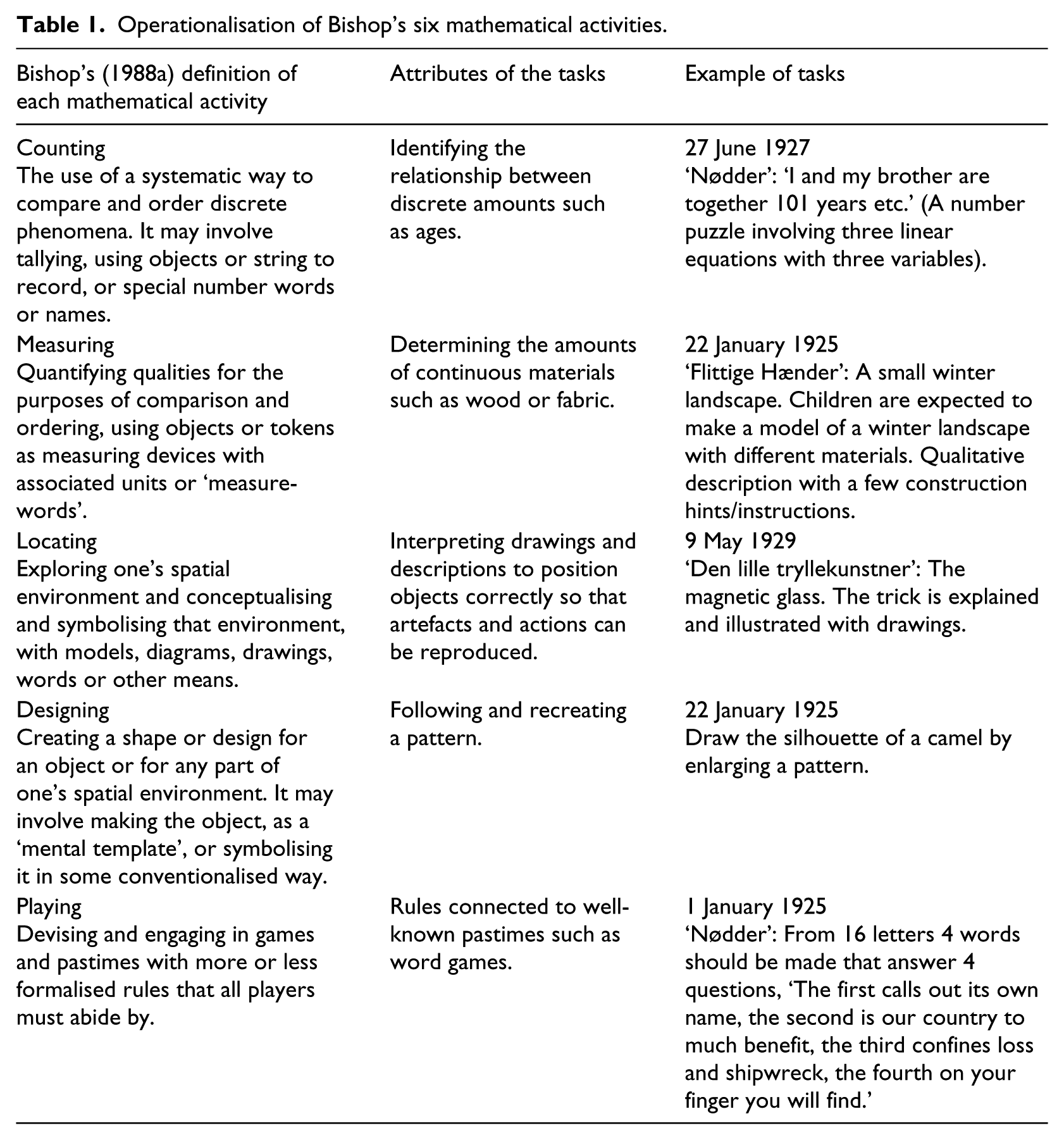
To shift our analysis to what children’s actions, as cultural practices, tell us about appropriate childhoods, we classified the puzzles and handicrafts according to Bishop’s (1988a) six universal mathematical activities. Such a classification allows for a wider interpretation of numeracy than just focusing on rational numbers as Joram et al. (1995) had done. Bishop (1988a) called them mathematical activities as the focus was on the doing, rather than the content knowledge. Bishop (1988a) provided an extensive description of the six activities in his book, which he summarised in an article from the same time: Counting. The use of a systematic way to compare and order discrete phenomena. It may involve tallying, or using objects or string to record, or special number words or names. Locating. Exploring one’s spatial environment and conceptualising and symbolising that environment, with models, diagrams, drawings, words or other means. Measuring. Quantifying qualities for the purposes of comparison and ordering, using objects or tokens as measuring devices with associated units or ‘measure-words’. Designing. Creating a shape or design for an object or for any part of one’s spatial environment. It may involve making the object, as a ‘mental template’, or symbolising it in some conventionalised way. Playing. Devising, and engaging in, games and pastimes, with more or less formalised rules that all players must abide by. Explaining. Finding ways to account for the existence of phenomena, be they religious, animistic or scientific (from Bishop, 1988b: 182–183).
Identifying how the six activities were evident in the puzzles and handicrafts in Danish children’s magazines from the 1920s provides information about the discursive resources that adults made available to children – by publishing or buying the magazines – for becoming self-governing beings. Following Resnick’s point made in the earlier quote, doing puzzles and handicrafts were typical cultural practices for the children who read these magazines. We study the characteristics of the mathematics exercises (Bishop, 1988a) in these cultural activities and then consider how those characteristics made available to children discursive resources for constructing appropriate childhoods. The analysis can contribute to understanding adults’ views on appropriate childhoods, specifically with regard to gender roles, and their relationships to potential adulthoods.
Data
The data consisted of 4 issues of Børnevennen Vor Ven from January 1925 (Volume 58, Issues 1–4), a contents list for the same volume and 28 issues of Börnenes ugeblad from 2 June 1927 to 13 March 1930 (Volume 11, Issue 22 to Volume 14, Issue 11). These magazines consisted of 8–12 pages and were published by the same publisher, Chr. Erichsen, and edited by the same editors, Erna Damgaard and Grønvald-Fynbo. The contents of these two magazines were identical (Wikipedia, 2016) and seemed to be aimed at children 12–15 years old.
Figure 1 shows the front page of one of the magazines, illustrating that they always began with factual information about a specific topic, and an example of a page of puzzles and handicrafts. In five issues, there were no task pages. In those issues with task pages, the items that were included changed from week to week. Common inclusions were ‘Flittige Hænder’ (Busy Hands) in 16 issues, ‘Lille Lises Kogebog’ (Little Lise’s Cookbook) (see Figure 1) in 3 issues, ‘Nødder’ (Puzzles) in 25 issues (see Figure 1), ‘Blink’ (factual descriptions of some phenomena, in Figure 1 these included the apparent quadrupling of the sun at high altitudes, the length of the Danish coast, the amount of stolen South African diamonds and the number of pills consumed by the English) in 3 issues and ‘Den lille tryllekunstner’ (The Little Magician) in 6 issues.
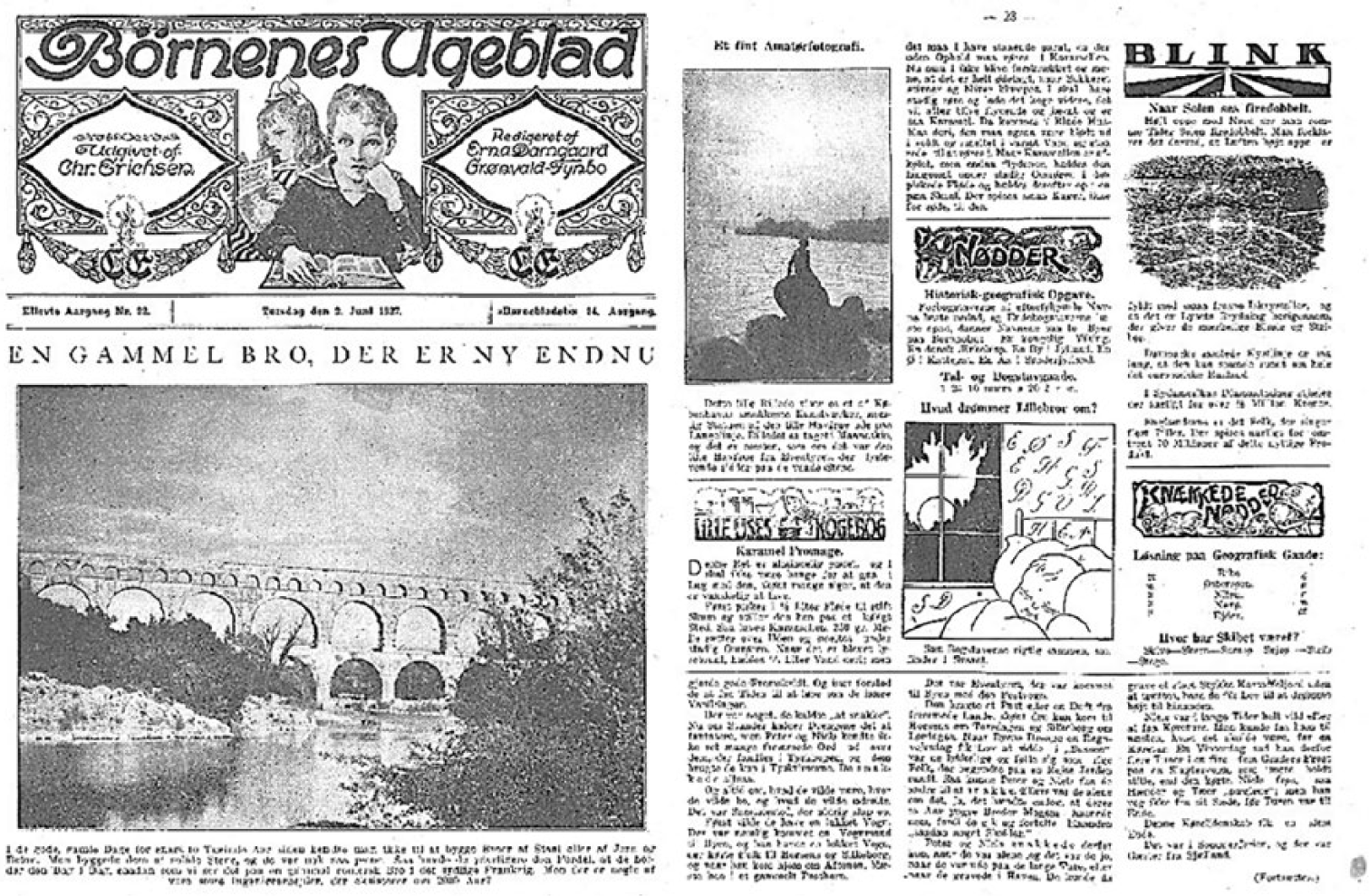
Examples of a front cover and the task page.
The title for Little Lise’s Cookbook (see ‘Lille Lises Kogebog’ in Figure 1) included a picture of a young girl tasting something from a bowl. Puzzles included word, number and geography puzzles. The border surrounding the title for the ‘Flittige Hænder’ (Busy Hands) sections differed depending on whether it was a carpentry/building (carpentry tools, see Figure 4) or sewing project (a series of girls with needle and thread, see Figure 3). Like the magazines for boys in the UK at the end of the 19th century, which included articles on how to construct rabbit hutches and model engines (Dixon, 2001), the handicraft activities included instructions on how to build toys as well as more adult structures such as henhouses and summer cottages.
Analysis
The analysis consisted of several steps. The first was to categorise the tasks in each issue. Only five of the magazines in our random selection did not contain puzzles or handicraft tasks and most of these were published around Christmas and New Year, when the children might be occupied in other ways. From this initial analysis, it seemed that the handicraft tasks, and to a lesser extent the puzzles, could be separated into those in which children made toys or involved children’s games and those in which children replicated adult-like tasks such as cooking or making adult artefacts, for example, a summer cottage. Unlike the situation with regard to current news stories, the recipes and most of the puzzles or handicrafts did not seem to have been simplified for children and were of equivalent difficulty to those designed for adults.
The second step was to identify connections between Bishop’s (1988a) six mathematical activities and the puzzles and handicrafts, by determining what it was that children were expected to do. Consequently, we decided not to analyse the ‘Blink’ contributions as children were expected only to read these and not to do anything with them. In addition, although all the puzzles and handicrafts included some kind of explanation as to what to do, we did not see these as examples of Bishop’s (1988a) mathematical activity of Explaining 1 because it was not the children who were expected to explain phenomena. Although many of the instructions were not explicit and the children would have had to reason how to carry them out, we did not consider reasoning to be equivalent to the kind of task that could be classified as being about Explaining. This means that none of the puzzles or handicrafts were categorised as involving Explaining.
Table 1 provides a description of the attributes of the puzzles and handicrafts that were classified as specific mathematical activities.
Operationalisation of Bishop’s six mathematical activities.
Many of the tasks seemed to involve the children in more than one mathematical activity. For example, many handicraft tasks in which children made something were classified as both Designing and Measuring. In the next section, we give an example connected to each of the mathematical activities, although we recognise that other activities were often evident.
The final stage of the analysis was to identify the kinds of appropriate childhoods that undertaking these puzzles and handicrafts seemed to suggest. Whereas classifying the mathematical activities indicated what children were expected to do, how the puzzles and handicrafts were to be undertaken provided insights into adults’ views on children’s independence and autonomy. Thus, we identified how the mathematical activity expectations in the tasks were connected to how children were viewed in society. For example, we categorised the tasks as either being something that only a child would engage in or something that an adult would also do. We also identified whether the expectations seemed to be connected to gender. These analyses provided information about the sorts of childhoods that adults considered to be appropriate at this time. This multi-step analysis follows Jorum et al.’s (1995) lead by considering mathematical activities as reflections of societal expectations by using them to identify the discursive resources made available to children for constructing what the adults who published and bought the magazines considered to be appropriate childhoods.
Examples of mathematical activities
The tasks showed a variety of mathematical activities (Bishop, 1988a). Of the 102 tasks in the magazines, 73 were categorised as Playing because they involved the children participating in established pastimes. Of the other mathematical activities, Designing and Measuring were most prevalent, with 27 tasks categorised as Designing and 15 as Measuring.
Counting
There were six tasks that were classified as Counting. Most of these were number puzzles involving children having to work out a specific amount from different clues. Some of these puzzles involved three unknown variables, making them quite challenging even for adults to solve. The puzzles were entertainment and although adults might engage in similar pastimes, they would be different to their work tasks.
Figure 2 shows an exception, a simple board game from 1 December 1927. We categorised it as requiring children to engage in Counting because they had to match the numbers on the dice with the number of moves they needed to make along the path. On reaching particular spots, children could either advance forward or backward. As children had to follow rules, the task was also considered to be about Playing. This was a task specifically designed for children, as it seemed unlikely that adults would choose to play such a simple game. There were no gender distinctions evident.
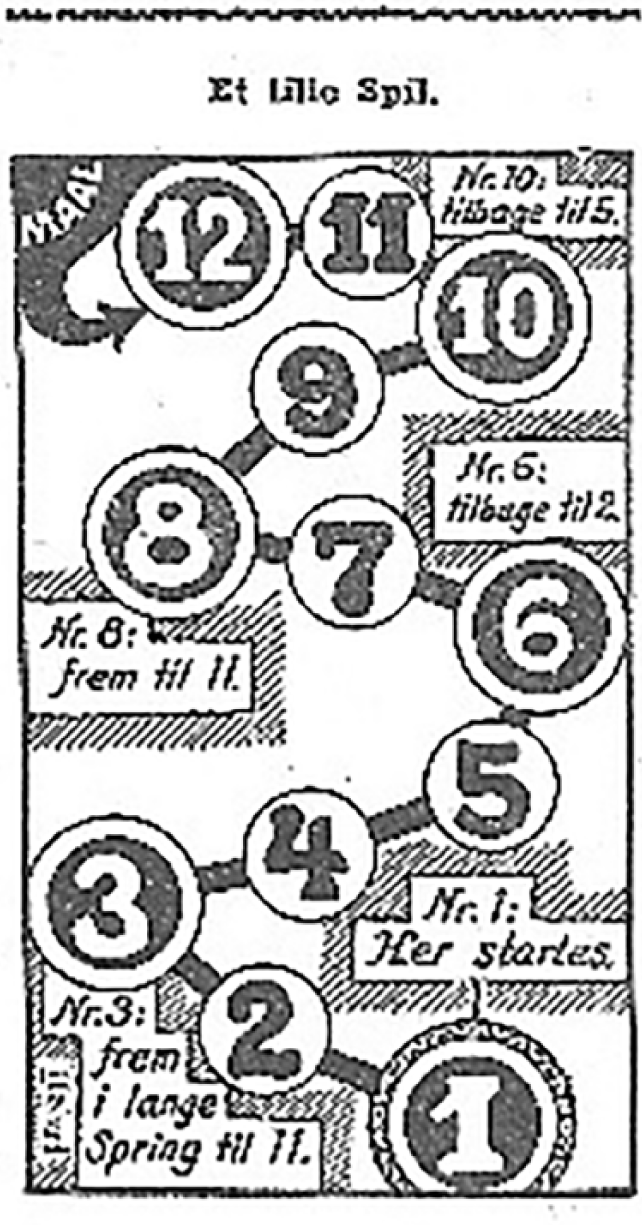
A board game to be played with counters and a dice.
Measuring
Eleven out of the 15 tasks categorised as Measuring belonged to the section ‘Flittige Hænder’ (Busy Hands). Many of these tasks were also categorised as involving Designing because the act of creating an artefact involved the children in interpreting a pattern and then creating an artefact from that pattern.
Figure 3, from 8 January 1925, is an example of one such task. It shows a pattern for a doll’s undergarment or chemise. The children had to scale each square of the pattern so that the chemise would fit their own doll. The instructions stated: The size, of course, depends on how big the doll is, and we have, therefore, drawn the model for the pattern so that you can enlarge it as you want. Take a piece of paper and work out from the size of the doll how big the chemise should be. Perhaps three or four times bigger than the drawing here, perhaps much more? But as many times bigger the chemise should be, we draw the square fields on the paper that many times bigger, and then it is not so difficult to draw the pattern in the right size.
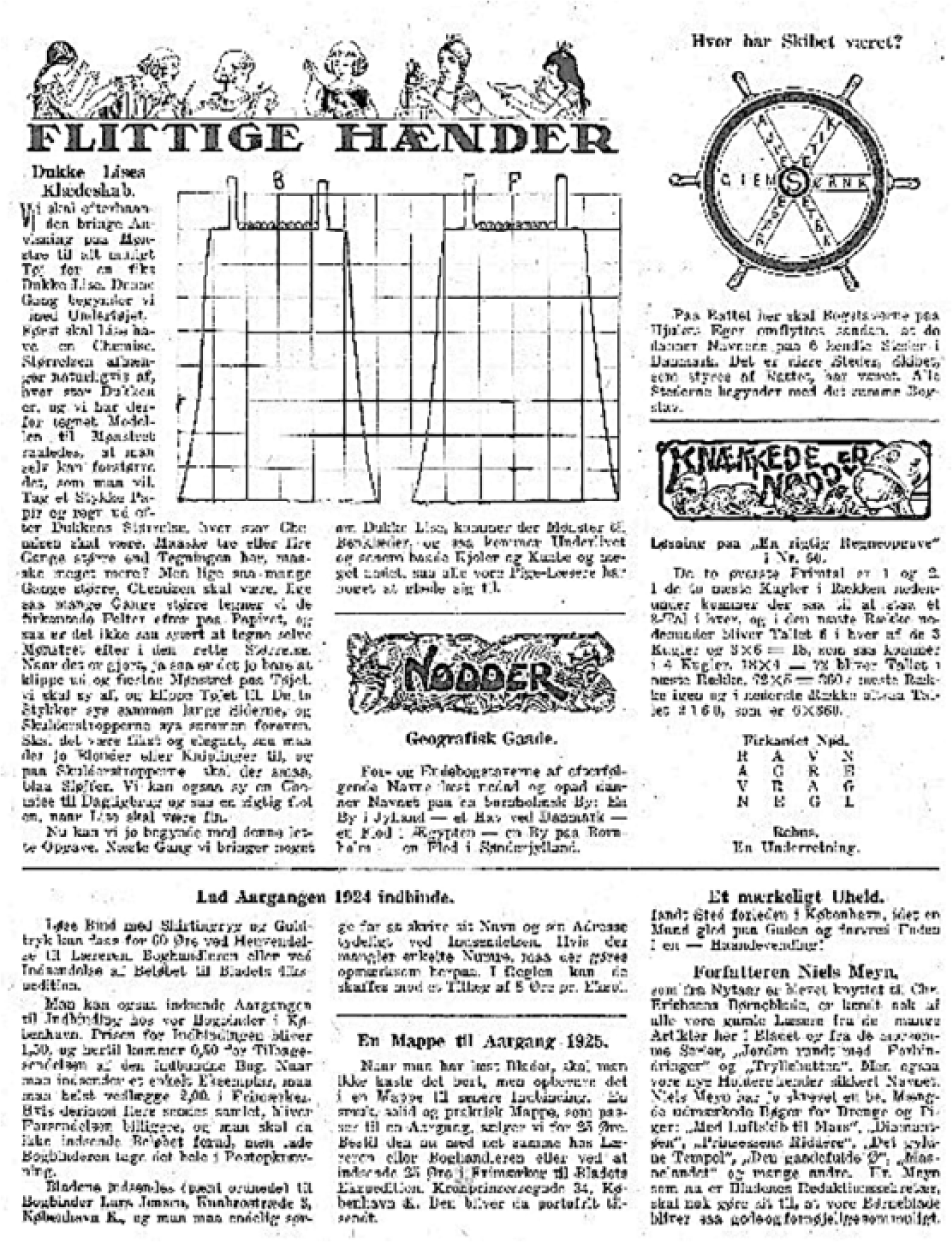
A pattern for a doll’s chemise.
The instructions provide the principles for the making the pattern but the children themselves must work out the scale factor. Although the task involved making something for a doll, it would be very similar to tasks that adults would undertake in making their own and others’ clothes.
This is one of only two tasks in the set of 102 in which girls were specifically mentioned. In all other tasks, children are nominated explicitly, using expressions such as ‘handy children’ to describe those who might want to make a model of a winter wonderland, or generic terms such as ‘you’ or no terms at all. However, sometimes, as with one puzzle for ‘Den lille tryllekunstner’, the illustrations suggest a particular gender. As noted earlier, the ‘Flittige Hænder’ tasks that involved sewing included a title border that showed girls using needles and thread, thus, suggesting these tasks were for girls.
Designing
Figure 4, from 8 December 1927, provided instructions for building a henhouse. Like the previous handicraft task, it was classified as being about the mathematical activities Measuring and Designing. The numbers in the instruction indicate amounts of particular items or distances for placing objects. As these were not about discrete amounts of something, they were not classified as Counting.
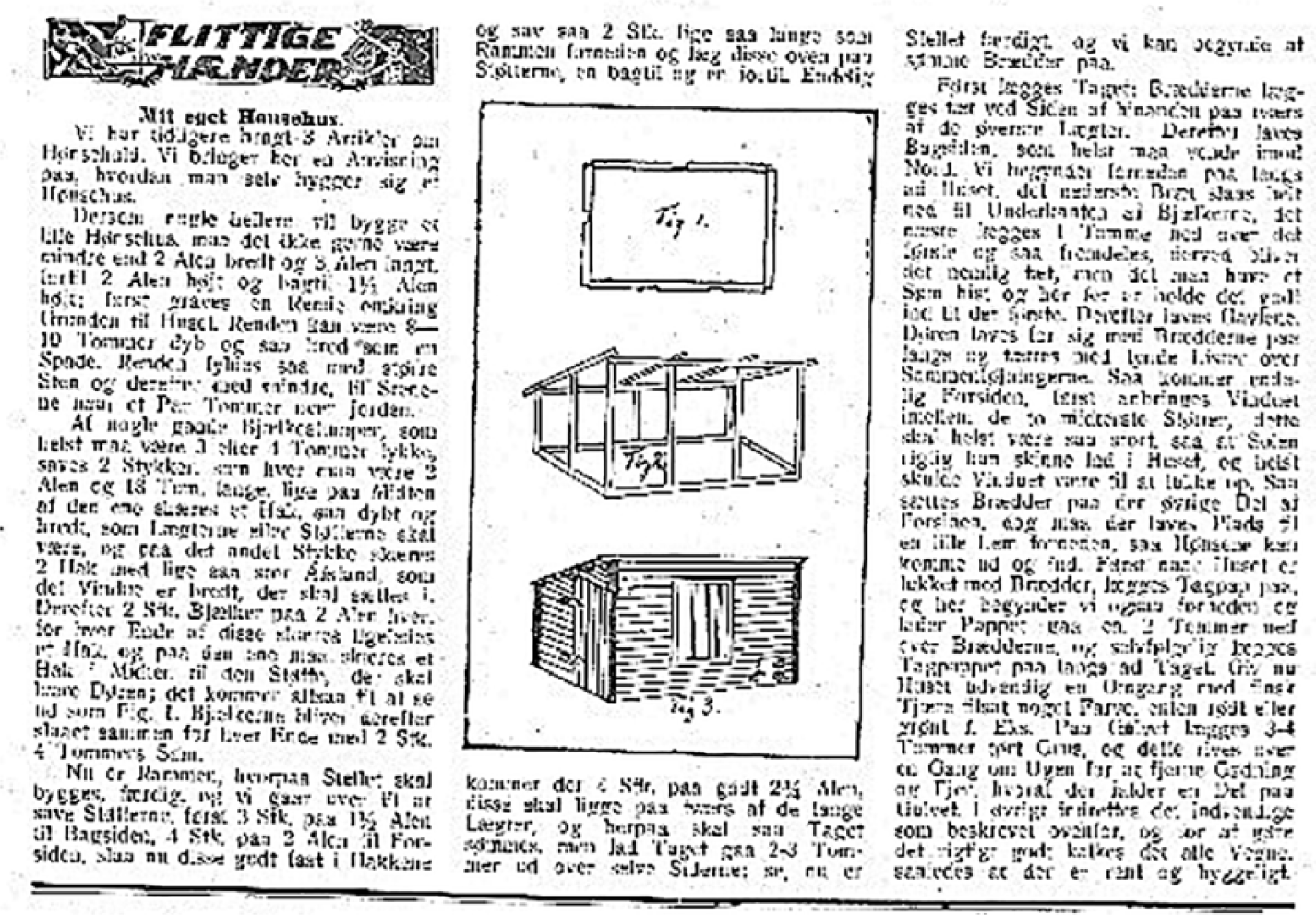
My own henhouse.
Like the other handicraft tasks, very few explicit instructions were provided, even though this would have been a complex task even for adults. The children had to work out what they should do from the brief descriptions and pictures. Tasks such as building a henhouse were tasks that adults would have done. The instructions have neither been simplified nor supplemented with extra information. This suggests that children were expected to be problem solvers who could persevere with complex tasks and respond to them in adult ways.
In some tasks, the pictures seemed to be considered sufficient explanation as there were minimal written instructions. Nevertheless, instructions could be spread over several issues as was the case with the task of building a summer cottage that was went over three issues. The instructions for building the henhouse were contained in just one issue, but followed articles in earlier issues on how to look after hens. This suggests that children were expected to maintain interest in a topic over time and put together the different parts into a coherent whole.
Locating
Very few tasks were classified as being about the mathematical activity Locating. Of the six tasks that were identified, five were to do with ‘Den lille tryllekunstner’ (The Little Magician), and involved moving objects around to first conceal and then reveal them.
Figure 5 is from 13 June 1929 and provided instructions from Uncle Dick about how to undertake a card trick that involved a broken card magically putting itself back together through the use of a hidden drawer. This trick was also categorised as Playing because it included a set of implicit rules about how to perform magic tricks using sleight of hand, which could persuade watchers that something magical had occurred. The children had to interpret the explanation about how the trick worked so that they could make their own box and place a complete card and broken parts of a copy of the same card in it appropriately so the trick would work. In so doing, they had to explore space by replicating the trick so that spatial relationships were distorted, with the broken parts being hidden and the hidden whole card revealed.
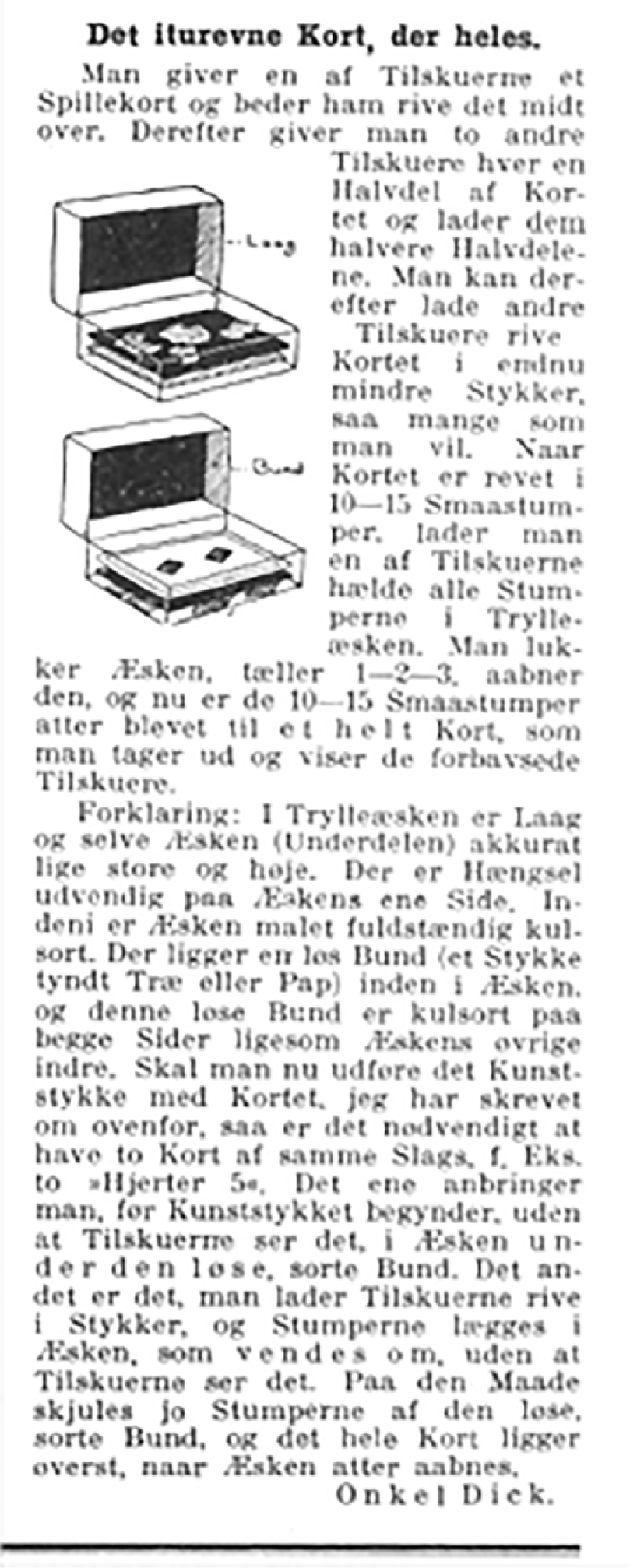
The broken card that is put back together.
Magic tricks had been particularly popular parlour games for adults since at least the second half of the 19th century (Al-Gailani, 2009) and so could have been something that children had seen adults perform. This is reinforced by the byline being given to an adult, Uncle Dick, which did not happen with any other kind of task. It could, thus, be considered as a replica of an adult task, but an entertainment rather than a work task. In the instructions, the child is addressed with the generic Danish term ‘man’, meaning ‘you’ or ‘one’, indicating that Uncle Dick could have been addressing anyone.
Playing
As can be seen in the previous examples, Playing as a mathematical activity was evident in all 72 ‘Nødder’ (Puzzles). Figure 6 is a puzzle in which 16 matchsticks had to be removed to make 5 rectangles. It is classified as both Playing and Designing.
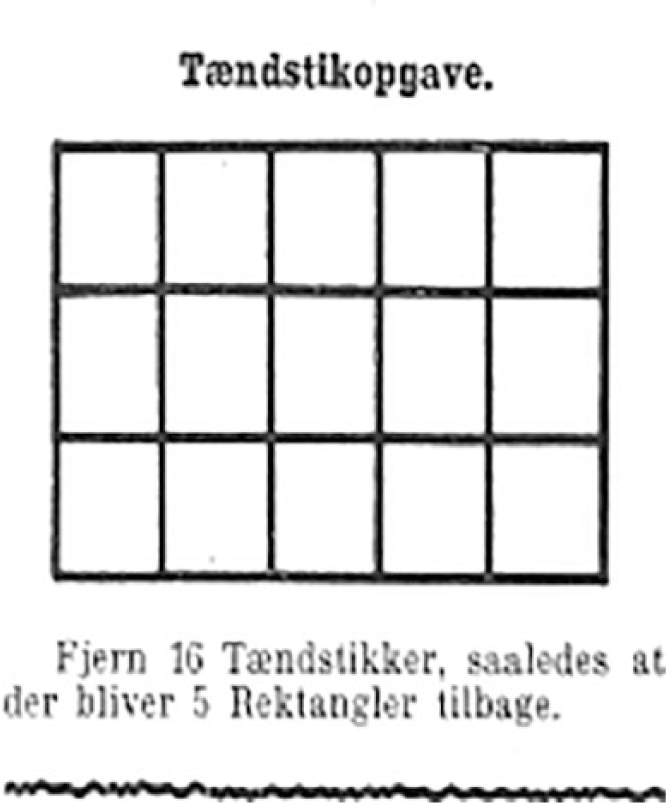
The matchstick puzzle.
Matchstick puzzles have specific rules and solution strategies. These solution strategies involve players having to produce different layouts to meet the specific requirements of the instructions. In producing the new shapes, the children were engaged in Designing as well as Playing.
Matchstick puzzles had originated as games on matchboxes when matchboxes were first introduced (Young, 2013) and so were originally designed for adults as recreational tasks. Thus, matchstick puzzles had a strong connection to the adult world.
Discussion
In this article, we have identified the mathematical activities (Bishop, 1988a) in the different puzzles and tasks to gain insights into what adults in the second half of the 1920s considered to be appropriate childhoods. Although all the mathematical activities, except for Explaining, were evident, Measuring and Designing were the most common. This suggests that the discursive resources provided by the adults who produced or bought these magazines indicated that appropriate childhoods included doing things. Although Buckingham and Scanlon (2001) noted that modern magazines for young children provided activities, such as dot-to-dot tasks, more active projects, such as planting seeds, were in the information to parents, not to the children themselves. Children could be involved in doing things but only under the supervision of adults.
The discursive resources embedded in the puzzles and handicrafts differed between suggesting that children should engage with tasks on their own terms as children and suggesting that children were capable of engaging in adult or adult-like tasks. Tasks such as the board game provided the children with opportunities to engage with the mathematical activities of Counting and Playing, but the game was clearly one for children and to be enjoyed on its own terms. On the other hand, building a henhouse, involving Measuring and Designing, was a task that would also be undertaken by adults, with the instructions requiring adult behaviours in working out details and persevering with the complexity of the task. Other handicraft tasks presented childhoods as a mix, in that making a chemise for a doll or building a toy crane placed the final product in the child’s world but required skills and knowledge that were similar to those used by adults. The discursive practices that helped construct childhood at this time situated children as being capable with regard to the mathematical thinking needed for the handicraft tasks. This is in contrast to the children’s magazines that Buckingham and Scanlon (2001: 290) analysed, which were focused on the children learning or developing skills recognised as valuable in school, ‘Familiar everyday activities, described in the directions to the children as “colouring in”, “drawing” or “playing”, are recontextualized in this discourse as a matter of “developing skills” in problem solving, observation, manipulation and so on.’ The focus on developing skills suggests that children in modern magazines are not seen as capable and the tasks will support them to learn those skills. This is in contrast to the tasks in the 1920s, which children seemed to be thought of as capable of undertaking without adult intervention.
It is also interesting to note that gender distinctions were not as evident as might have been expected (Luke, 1996). Drawings of children in the borders (girls in the sewing version of ‘Flittige Hænder)’ and in tasks (a boy in one description of a ‘Den lille tryllekunstner’ trick) provided the clearest indications of gender. In the written descriptions, there were only two references that explicitly connected girls to sewing tasks. In the puzzles and the woodworking tasks, there is no explicit marking of gender. As Peterson (2005) noted, children’s magazines provide only one form of input with regard to the discursive resources available to children. Yet, the lack of gender distinctions is different to what Spinner et al. (2018) noted in their research on modern children’s magazines in which gender distinctions appeared in a variety of ways, providing discursive resources for constructing appropriate childhoods that were differentiated according to gender. In the second half of the 1920s, the puzzles and handicraft tasks in the children’s magazines did not provide discursive resources that differentiated gender expectations for childhoods in the same pervasive manner.
Conclusion
The analyses indicate that the puzzles and handicrafts required children to engage with a range of mathematical activities. As Bishop (1988a) suggested, mathematical activities are integrated into cultural practices and provide insights into those practices. By identifying that children were mostly expected to engage with Measuring and Designing mathematical activities in these puzzles and handicraft tasks, it is possible to see that they were expected to be autonomous and to undertake tasks independently of adults, even when the tasks provided only limited details about how they should be completed. From this analysis it was possible to consider how societal expectations manifested themselves within the cultural practices of the puzzles and handicraft tasks. For example, the lack of gender distinctions suggested that the discursive resources in most of the tasks and puzzles did not situate the childhoods as needing to be differentiated according to gender. These tasks and puzzles suggest that adults considered appropriate childhoods involved children in making things and doing puzzles. They had the skills and abilities to make sense of the limited information in the instructions and persevere until they were successful, even if this required them to adapt the task to suit their own situation, as with making the doll’s chemise. Thus, we consider that this kind of analysis provides insights into the connection of the puzzles and handicrafts, through the mathematical activities, to cultural practices, in this case understandings of childhood. Without identifying the mathematical activities, it would be difficult to understand how the discursive resources made available through the puzzles and handicrafts contributed to shaping the kinds of childhoods that adults considered to be appropriate.
This was an analysis of how children’s magazines, including those providing news for children, are based on adults’ views about appropriate childhoods. We consider that looking through the lens of mathematical activities provides other opportunities for understanding the relationship between what is presented in children’s magazines and adults’ views on appropriate childhoods.
Footnotes
Authors’ note
An earlier version of this article was presented at the 6th International Ethnomathematics Conference, held 8–12 July 2018 in Medellin, Colombia.
Funding
The authors received no financial support for the research, authorship and/or publication of this article.