




Abstract
This article conducts a critical analysis of the Incredible Years parenting programme through the lens of post-colonial and post-structural theories. Drawing from Foucault’s concept of ‘governmentality’ and ‘discursive normalisation’, the author questions the norms and definitions constructed by the implementation of Incredible Years in New Zealand, and attempts to disrupt taken-for-granted values and assumptions in modern parenting. The analysis of this study shows that the discourses in Incredible Years (re)produce colonising values and assumptions, reinforcing the privileged knowledge of the West in parenting. The author points out how this approach to parenting constructs those who do not fit into the norm as ‘the Other’ and normalises/reinforces conformity to the dominant culture in this context.
Keywords
Introduction
In response to the growing body of international research on the adverse influence of early onset conduct problems, the New Zealand government established the Advisory Group on Conduct Problems (AGCP) in 2007 (Sturrock and Gray, 2013). The AGCP was given the responsibility of recommending effective programmes and policy for the prevention and management of child conduct problems. This led to the implementation of the Incredible Years parenting programme and the Positive Behaviour for Learning Strategy (Ministry of Education, 2014) in New Zealand (Sturrock and Gray, 2013).
The AGCP identified that the largest numbers of ‘high-risk’ families in terms of conduct problems are of Māori and Pasifika origin, highlighting the importance of making the programme accessible for parents and children with these cultural heritages (Advisory Group on Conduct Problems, 2011; Robertson, 2014). The New Zealand government’s tactic to reconcile the American intervention programme with the unique needs of a New Zealand socio-demographic and cultural profile was to work in collaboration with other interested groups (Sturrock and Gray, 2013). By bringing together Incredible Years service providers, government researchers, academic advisors and Māori researchers, the New Zealand government attempted to adopt the programme in this country’s distinctive context without sacrificing Incredible Years’ ‘proven’ universal outcomes for high-risk families and children (Borden et al., 2010; Incredible Years, 2013a; Webster-Stratton and Reid, 2010). The result of this effort has been to keep the same framework and behaviour management strategies as the American Incredible Years programme while integrating some of the cultural aspects of Māori and Pasifika populations. For example, the group leaders (often with the same cultural background as the parents in the group) start meetings with karakia (a blessing ritual of Māori culture) and employ resources (e.g. the Parenting Pyramid) that have been translated into the Te reo Māori and Pasifika languages (Werry Center for Child and Adolescent Mental Health, 2014). These actions show good intentions and that much thought has been given to the modification of the programme to cater for the unique needs of Māori and Pasifika children and families. However, it remains to be seen whether these modifications are sufficient to ensure the effective and meaningful engagement of parents and children in Aotearoa New Zealand with the Incredible Years programme.
Drawing from post-structural and post-colonial theories, this article examines the discourses of parenting in Incredible Years as a product of power relations in the context, particularly the context of a colonial outcome. Foucault’s ideas of ‘governmentality’ and ‘discursive normalisation’ are applied as lenses to unpack the mechanism of power in the field of New Zealand early years parenting. Various theorists’ and researchers’ decolonising perspectives are incorporated into the analysis of the discourses in Incredible Years to complement Foucault’s ideas. The author aims to map the identity of positive parenting in the colonised landscape of New Zealand early childhood education and analyse the way in which parenting has become a site of colonisation through the power relations present within it.
Foucault: governmentality and power relations
‘Governmental rationality’, the ‘art of government’ or, in his own terminology, ‘governmentality’ was the key concept that Foucault explored during his time at the Collège de France between 1978 and 1979 (Burchell et al., 1991). He defines ‘governmentality’ as techniques of power designed to govern and control individuals and populations (Burchell et al., 1991). As he considers government as an activity, Foucault explores structures and traits of the practice of both the state and individuals in relation to ‘who can govern’, ‘what governing is’ and ‘what or who is governed’ in the context (Burchell et al., 1991; Foucault, 1977, 1991, 2014).
The object of Foucault’s study of ‘governmentality’ is to understand the techniques that made individuals into subjects in history. He analyses the different rationales behind the ‘objectification of the subject’ to gain insight into how power is exercised in the context (Dreyfus and Rabinow, 1982). Foucault (1977, 1980, 1991, 2014) argues that tracing the way in which certain knowledge or ways of being have become ‘the truth’ (the norm) in a particular context enables one to see what is made invisible under the shadow of power relations within that milieu. His studies of penal systems, clinical medicine and the self-subjection of sexuality explore the rationales that make individuals into subjects, and the techniques of power that are designed to govern and control the body of populations (Dreyfus and Rabinow, 1982; Foucault, 1977, 1980, 1988, 1991).
Another crucial theme of Foucault’s inquiry is power–knowledge relations and their implications for everyday life. In modern penal systems, judgement is passed not only on crime itself, but also on the associated thoughts and desires so that ‘punishment may strike the soul rather than the body’ (Foucault, 1977: 16). The sentence considers the guilt of an individual, as well as assessment of their normality and technical strategies to normalise the convict in order for them to fit better (as ‘normal’) in society. Judging the guilty party has become a matter of establishing ‘the truth of a crime’ by a host of technicians such as warders, doctors, psychiatrists, psychologists and educational professionals (Foucault, 1977: 19). A criminal’s past experiences, biological/medical history and even the intention of their actions are dissected, assessed and diagnosed in order to reform their perceived ‘abnormality’.
The insidious yet effective mechanism of power draws strength from its grip on the individual’s soul. It transforms one’s thoughts, and desires, and alters the way one communicates, behaves and understands the world. The technique of modern disciplinary power effectively increases its control over individuals, turning them into subjected and docile bodies (Foucault, 1977). The modern process of colonisation illustrates this point exactly (Oliver, 2004: 26): ‘The success of the colonization of a land, a nation, or a people can be measured through the success of the colonization of psychic space. Only through the colonization of psychic space can oppression be truly effective’. By wielding power over the psychic place of individuals, the newer colonising concepts take deeper root than the previous forms of colonisation, which focused on physical oppression (Asher, 2009; Cannella and Viruru, 2004; Mazzei, 2008; Smith, 1999; Yuen, 2010). The values and knowledge of ‘the West’ are internalised as ‘the only worthwhile way of being or truth’, thus subtly diverting the attention of ‘the Other(s)’ and preventing them from recognising the previous oppression by the dominant culture and assimilation into the Anglo- or Euro-centric norm (Asher, 2009; Oliver, 2004; Soto and Kharem, 2006; Viruru, 2006).
It should be noted that the term ‘the West’ is to be used with caution. It is often misrepresented and misused to generalise multiple traditions across Europe and the USA as one cohesive culture, value or knowledge (Smith, 1999). As we should not oversimplify different cultures, and it is acknowledged that beliefs exist among the various groups of people who have experienced colonisation, it would be similarly inaccurate to assume that there is one truth which is relevant for all with European or American heritage.
This article applies the term ‘the West’ with reference to Foucault’s notion of the ‘episteme’ (Burchell et al., 1991), an overarching system of knowledge, values and beliefs that filters various traditions of knowledge in the milieu. Through this ‘episteme’, multiple traditions of knowledge and cultures are categorised, (re)formed and transformed. While knowledge traditions change over time, the ‘episteme’ itself does not, perpetually influencing the way in which these traditions are understood and expressed (Smith, 1999). As an overarching rule, or a principle in the milieu, the ‘episteme’ operates as a prism to filter a certain type of knowledge, and cultures with such filters are more readily recognised and privileged. It is in this sense that the term ‘the West’ is applied in this article: the ‘episteme’ that regulates the understanding of the complexity and subtleties of life through the lens of the Enlightenment and through the modernist perspectives of Anglo-European white middle-to-high-class contexts.
Parenting as a site of colonisation
Examining Incredible Years through Foucault’s perspectives of ‘governmentality’ and ‘discursive normalisation’ has revealed that there are many discourses of colonisation masked as ‘the truth’ and ‘normal/natural’ within the norm of ‘positive/desirable’ parenting. The labels, forms of representation and positions of privilege in these discourses embody Anglo- or Euro-centric values and knowledge, and those who do not fit this norm are portrayed in a deficit manner – for instance, as uncivilised savages or incomplete human beings. The justification for intervention or corrective training is to ‘save’ immigrants and indigenous people from their own infirmities and savageness for the ‘common good’ (Cannella and Viruru, 2004; Miller, 2006; Soto and Kharem, 2006).
This leads to the following questions: What values, knowledge and assumptions are behind the western discourses of parenting in Incredible Years? Who benefits from the construction of this norm? Whose voices are silenced by the construction of the norm in Incredible Years? What are the implications of these discourses of parenting for children’s and parents’ lives?
The universal and totalising ‘truth’ of parenting in Incredible Years
The premise behind Incredible Years is that there is a universal principle of parenting – the ‘Positive Parenting Principles’ in Incredible Years terminology (Incredible Years, 2013a; Webster-Stratton and Reid, 2010). The Incredible Years course developers argue that the ‘Positive Parenting Principles’ can effectively modify parents’ behaviour towards children, ultimately changing the interaction patterns between them. The principles include implementing proactive discipline techniques (e.g. effective limit-setting, increased monitoring) and positive parenting techniques such as praise and coaching. Regardless of the context and background of the participants, the Incredible Years developers claim that transferring and training parents with these skills and knowledge will deliver the desired ‘universal outcomes’ of preventing and treating risks to society by increasing ‘parental competence’ and ‘child social competence’ (Incredible Years, 2013a; Webster-Stratton and Reid, 2010). The programme identifies ‘parents of children with conduct problems’ as ‘high-risk’ families, associating them with most of the ‘societal burdens’ in the community (Borden et al., 2010). Various clinical trials of the programme across different contexts and sectors are presented as evidence of its universal application (Borden et al., 2010; Sturrock and Gray, 2013; Sturrock et al., 2014; Webster-Stratton, 2013; Webster-Stratton and Reid, 2010).
The assumptions underlying these claims of Incredible Years are that (1) there is one truth or natural law that is applicable and relevant to all human beings and (2) those who do not abide by this ‘truth’ are burdens on society, therefore the civilised members of society must step in to prevent the behaviour of the burdensome or teach them to be more competent and responsible. Where do these assumptions originate? What are the values and knowledge that are inscribed as this universal, totalising truth in Incredible Years?
The construction of these thoughts can be traced back to ideologies that emerged from 17th- and 18th-century Europe (Cannella and Viruru, 2004; Smith, 1999). During this period – the Enlightenment – modernist perspectives became the dominant system of thought, centring human progress and reason in human existence and civilisation. The promotion of science, economic growth and politics in this era meant not only a physical extension of imperialism, but also a broadening of its reach into different dimensions of human experience, such as the psychic place or, according to Foucault, the soul of individuals. The advances of scientific technology, for instance, in transportation, communication and construction enabled the inhabitants of European countries to travel further and conquer/claim more undiscovered lands (Smith, 1999). These thoughts derived from the Enlightenment and modernist perspectives, which rationalised the act of colonisation and oppression within the minds of both the colonisers and the colonised (Cannella and Viruru, 2004).
Ideas from prominent philosophers of the time, such as Bacon, Descartes and Galileo, established and strengthened the belief that predetermined truths or natural laws were waiting to be discovered out there. These thinkers claimed that the search by European middle- and upper-class men for these predetermined or natural truths through scientific methods and reason was advancing human progress further than in any other cultures or at any other time (Cannella and Viruru, 2004). Humanity is essentialised in terms of progress and reason, therefore world views that do not express these qualities are uncivilised and less than human (Smith, 1999). The discourses produced by these ideas represented privileged white European males as ‘the eventual saviours of the world’, armed with science and reason, and spreading civilisation around the globe (Cannella and Viruru, 2004: 66), not as oppressors who exploited the riches of the land they occupied and exercised colonising power over indigenous populations. The dark and untold side of privileging universal truths of science and reason was that other kinds of knowledge and values were relegated to the periphery, and peoples of colour were categorised as savage, incompetent and ignorant not-fully humans (Smith, 1999).
From the development of Incredible Years to the programme itself, it is evident that scientific methods and cognitive psychology are favoured over other world views in shaping Incredible Years and justifying its effectiveness (Bae, 2015, 2016). The programme was developed by a clinical psychologist and nurse practitioner, Emeritus Professor Carolyn Webster-Stratton, and her colleagues at the University of Washington’s Parenting Clinic (Webster-Stratton, 2013). Incredible Years draws from Patterson’s (1982) coercion hypothesis, Bandura’s (1977) modelling and self-efficacy theories, and Bowlby’s (1956) attachment theory. The programme consists of parenting strategies and session content that are aimed to equip parents with behaviour management skills and developmentally appropriate techniques to deal with the typical developmental progression of child conduct problems (Borden et al., 2010; Webster-Stratton and Reid, 2010). There is no mention of different knowledge and values in parenting such as Māori and Pasifika epistemology; the strategies and knowledge presented in Incredible Years are portrayed as one-size-fits-all parenting principles (Bae, 2015, 2016). The programme justifies its effectiveness based on its wealth of evidence (over a dozen randomised control group research studies by the developers and independent scientists) and ‘science-based’ strategies, rationalising its implementation across diverse contexts and sectors.
What is interesting, however, is that Atawhaingia te Pā Harakeke (Ministry of Education, 2001), a whānau training and support programme for Māori, had already been developed and implemented in New Zealand by the Ministry of Education. While the AGCP identified that the highest numbers of ‘high-risk’ families and children are of Māori and Pasifika origin (Sturrock and Gray, 2013; Sturrock et al., 2014), the New Zealand government decided to scrap the programme based on Kaupapa Māori philosophy and its own context, and introduce Incredible Years in its place. Since the introduction of Incredible Years in New Zealand, the Ministry of Education has invested NZ$7.6 million for 7461 families to participate in the programme (Robertson, 2014).
The underlying assumptions of Incredible Years show the presence of colonising discourses; all humans are the same in essence, therefore there exists a natural law/universal truth of human existence that can be found by the civilisation’s active practice of reason and science (Bae, 2015, 2016). While Incredible Years places western scientific knowledge at the centre of ‘positive’ parenting, other world views are disregarded, and cultural backgrounds are identified only to highlight the over-representation of people with a different world view, and thus their inferiority and lack of civilisation.
This is a good example of how ‘discursive normalisation’ and ‘regimes of truth’ operate as an apparatus to govern individuals’ souls and bodies (Foucault, 1977). In Discipline and Punish (Foucault, 1977), this point is illustrated by using penal systems and health institutions as examples. Foucault argues that: ‘It is not simply at the level of consciousness, of representations and in what one thinks one knows, but at the level of what makes possible the knowledge that is transformed into political investment’ (185). By placing Anglo- or Euro-centric science and psychology at the centre of our knowledge system, modern disciplinary power gained the justification to pathologise those who do not fit into the norm, and to ‘correct’ and ‘cure’ these individuals (227).
Similarly, the notion of ‘positive/desirable’ parenting in Incredible Years produces a corpus of knowledge and discourses that centres on human science, authorising the colonising power to extend its reach. ‘Scientific’ knowledge and discourses are formed and entangled with the power to judge and correct children and parents, ‘masking its exorbitant singularity’ (23). Human nature is assumed to be fundamentally scientific and reasoned, normalising western thoughts as the only possible domain of knowledge in parenting. There is little room for individuals to deviate from this ‘truth’ of parenting without associating themselves with deficit terms (e.g. ‘uncivilised’, ‘aggressive’, ‘harsh’ or ‘not functioning’).
The values and hierarchical status of the West are attached to a particular system of knowledge, which is then applied as the rationality and tool to ‘sustain the operation of a relational power by its own mechanism’ (177). In this endless, circular power–knowledge relation, ‘the subject who knows, the knower’ (western middle- and high-class males), ‘the objects to be known’ (indigenous people, people of colour) and ‘the modality of knowledge’ (western scientific knowledge) are already determined (28). For example, Incredible Years establishes the truth of deficiency within indigenous people and those of colour by using a host of technicians such as researchers, psychiatrists, psychologists, educational professionals, counsellors and health professionals. Parents’ past experiences, education levels and the intention of their actions are dissected, assessed and diagnosed in order to reform their ‘abnormality’ throughout the course by means of the before IY and the after IY surveys (Incredible Years, 2013b). The programme’s referral process is also facilitated by these ‘experts’. By normalising western thought as the totalising truth, the people with this particular knowledge are automatically placed as ‘experts’, as well as the power relations being perpetuated that warranted their status of privilege.
Binary practice/dualism in Incredible Years
Many of the ideas in colonialism legitimise their claims on the basis of Descartes’s perspectives, which explain the world as existing in two spheres: the inner domain of the human mind and the external world with its natural law or truth (Cannella and Viruru, 2004; Smith, 1999). This Cartesian dualism seems to imply the dichotomies of mind/body, good/evil, civilised/savage, truth/false (non-truth), expert/novice and child/adult, consequently generating colonising discourses of language and ideology based on an individual’s conduct. Even the understanding of colonisation is highly saturated with this binary thinking. Instead of considering the subtleties and multifaceted challenges people face during and due to colonisation, duality presents the issue as existing between the colonised and the coloniser (i.e. the victim or offender; Smith, 1999). It does not acknowledge that different levels of oppression are experienced by various groups of indigenous people (e.g. the Ngāi Tahu, who negotiated with the Crown and thereby experienced the Treaty settlement process in different ways with different outcomes from other tribes) or how the oppressive nature of the colonising power influences the coloniser.
An often-used term in decolonising studies and philosophy, ‘the Other’ (Mazzei, 2008; Said, 1978; Smith, 1999) highlights the way in which this binary thinking operates as a mechanism of the colonising power. Only the gaps between the colonised and the coloniser are marked or recognised, pathologising or demonising the non-conformity or otherness of the colonised by the apparatus of power. This notion of the ‘us versus them’ of the colonising power influences understanding of the self not only in the colonised, but also in the coloniser. The only possible or imaginable way to understand the self and others, for both the coloniser and the colonised, becomes limited to this notion, which is imposed on them by the colonising power (Smith, 1999). In a colonial context, a person’s sense of self is measured against this norm of a ‘civilised us’, and their non-conformity to this norm is marked as strange and uncivilised (Said, 1978). When one understands and labels the world through this dichotomous lens with such conviction of its accuracy, uncertainty of the superiority of western thoughts over others diminishes, and the rule of one over the other is hence rationalised.
The language and discourses present in Incredible Years provide an insight into the way in which the dichotomy perpetuates the exercise of colonising power in the reality of children and parents. Table 1 shows that the language used to describe children and families in Incredible Years (2013a) reflects the Cartesian dualistic world view, reducing many complex dimensions of parenting to two extremes. At one end of the pole are competent and knowledgeable parents who are in control of their children’s conduct; at the other are non-functioning, depressed, at-risk families. It portrays clearly the forms of desirable and undesirable parenting, and distributes children and parents in relation to these two-value opposites. Once these children and at-risk families are identified, western science-based ‘Positive Parenting Principles’ and universal developmentally appropriate knowledge of children are transferred to prevent and cure the predictable and undesirable outcomes, such as violence and substance abuse in the community (Incredible Years, 2013a; Webster-Stratton, 2013; Webster-Stratton and Reid, 2010).
The language presented in the outcomes and resources of Incredible Years (2013a).
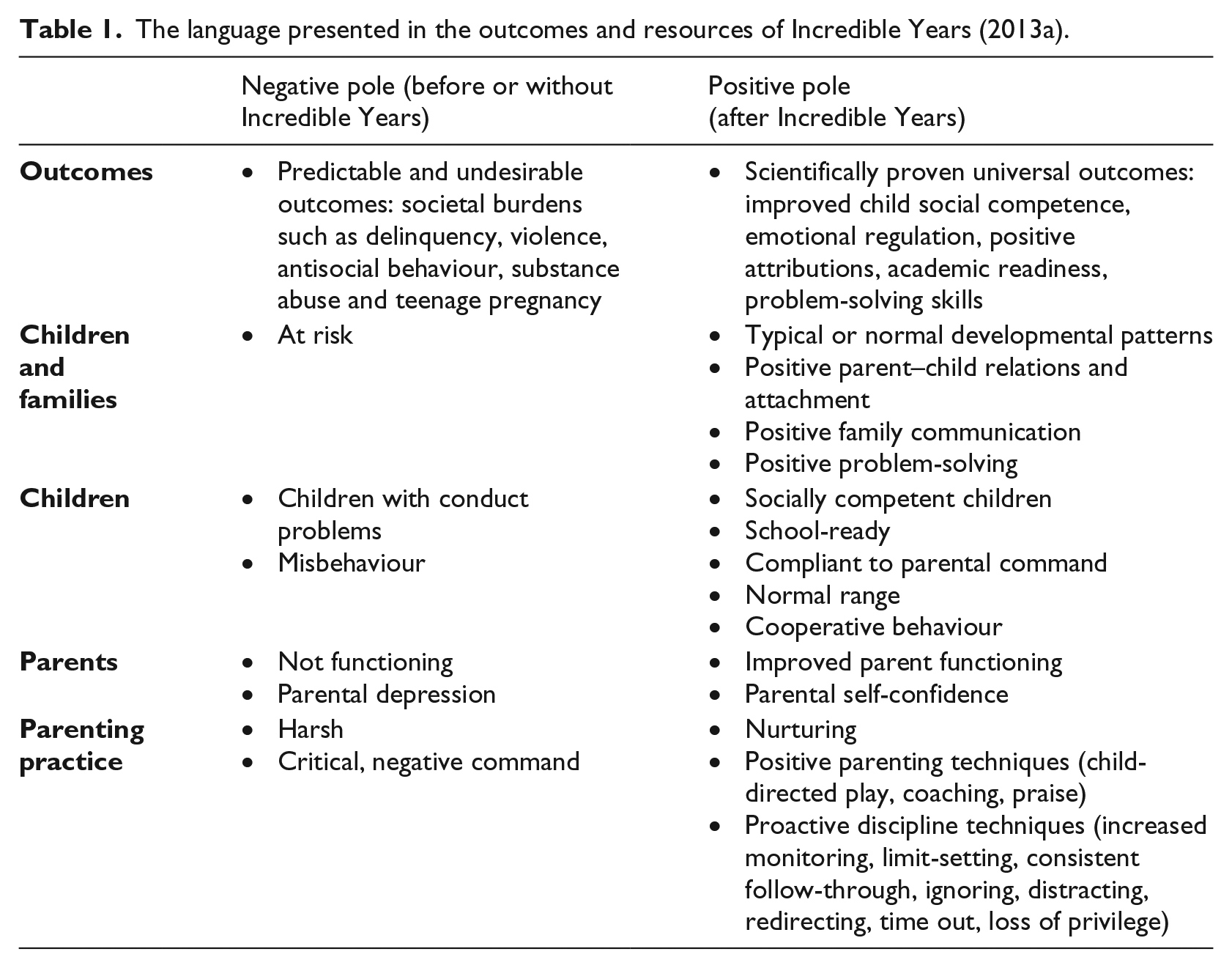
With this simplistic method of dividing and categorising the world as truth versus non-truth, parenting practice is presented with only two possible forms, eliminating the values of parenting practices that exist outside of the norm. The individualities of parents are identified only to mark the gaps between the norm and the individual, so that the most effective strategies may be applied. Presenting a particular norm of parenting as the universal truth distracts an individual from questioning the validity of its claim to be true, and redirects one to conform to the norm.
This is exemplified in the Cultural Enhancement Framework (CEF; Macfarlane, 2011), a set of ‘Kaupapa Māori principles to enhance programme efficacy for use with Māori’. As a pilot study and follow-up study of Incredible Years acknowledge in their reports (Sturrock and Gray, 2013; Sturrock et al., 2014), the unique sociocultural demographics of New Zealand and its commitment to the Treaty of Waitangi demand that more thought be given to the implementation of Incredible Years. The decision of the Ministry of Education was to develop the CEF (Macfarlane, 2011) for implementation of the programme in cooperation with Māori researchers and leaders, rather than critically examining the relevance of Incredible Years to Te Ao Māori (the Māori world view). Using the metaphor of the wharenui (Māori meeting house), the CEF carefully lays out various strategies to implement western programmes with Māori in a culturally responsive way. Culturally important routines such as kai (‘food-sharing’) and karakia (Māori blessings and prayers), as well as the use of the Māori language and resources, are encouraged in this framework.
However, the subtle yet unyielding power of colonisation is still present at the root of the framework. At the beginning of the programme (Whāianga, meaning ‘door’ in the wharenui analogy), participants in Incredible Years are introduced to the purpose and benefits of the programme, which is already constructed and draws on western values. The assessment stage (Matapihi, meaning ‘window’) also shows a similar pattern of subjugating colonialists’ values, seeking to translate the original principles of the programme into a Māori context without questioning its meaningfulness in their world view. While it is evident that much thought was given to Māori tikanga (‘customs’) in developing the CEF, it is still questionable whether or not the purported cultural enhancement is enough to provide sustainable and meaningful support for families and children with Māori heritage. By giving power to the colonised to control the less essential parts of the programme (e.g. cultural routines), the current system of power presents the illusion that its interest lies in cooperation with and respect for the Other, ‘pacifying the will to resist’ of the subjugated people (Soto and Kharem, 2006: 22). This distracts the colonised from recognising oppression by the dominant culture and dampens the need to challenge the status of western knowledge as universal truth, which effectively maintains the grip of the colonising power on individuals.
Disconnection from self and others
The binary practice or dualism of colonising power presents individuals in society with stark contrasts between the western world view and the Other (Smith, 1999). The West represents particular views of human nature and morality, and those who do not possess this social knowledge are placed in the position of savages – less-than-humans who need to be repressed and disciplined. Individuals are forced to bear the labels assigned to them by a dualistic system of differentiation – in this case, ‘good parents’ or a ‘not-functioning and at-risk family’ – rather than questioning the assumptions behind a norm that bases its rationale on western thought.
The potential richness within the Other’s conceptions of the world becomes invisible to those who operate within this power relation, as they are blinded by the brilliance of modern disciplinary power. Nothing except that which is named or represented as the Other (i.e. savage, uncivilised and exotic) by the colonising power is readily recognisable. ‘Thus, even as the identification with the coloniser diminishes the self of the colonised, it also establishes a distance between that self and home, whether in terms of culture, or language, or the connection with one’s own people’ (Asher, 2009: 3). The colonising power obscures the ability to recognise other aspects of the colonised, except what is attached to them or named by the coloniser. This alienates individuals from themselves and others, imposing a detachment from their own world views and values, and forcing them to examine themselves as an object through the eyes of the coloniser (Asher, 2009).
Soto and Kharem (2006) label this process the ‘cultural genocide’ of indigenous people as it robs them not only of their language and culture, but also of the right to name their world. It disconnects them from their history, languages, social relations, and ways of connecting and making sense of the world (Smith, 1999). By marking differences as strangeness and savageness, the Otherness of these people is only forced to appear to disappear. They are forced to learn and bear the way that their identity and world are coded into the western system. The complexity of their identity is condensed into simplistic and fragmented stereotypes, and their world is carved up to serve the needs of the coloniser. The cultural system of classification and representation of the West, then, becomes ‘the shared culture’ of the colonisers and the colonised, providing the modality by which they understand the world through only the languages and knowledge of colonisation (Smith, 1999: 45). Within this shared culture of colonisation, the colonised are only recognised through the eyes of their master, as an inferior subject to be subdued and controlled.
In order to move from the colonial periphery to the centre of the imposed hierarchy, people of colour must prove how different they are from their native selves. The success of these people in the colonised context depends on the distance they have moved from their own heritage, and how well they have adjusted to wearing white masks. For example, some immigrant parents actively avoid teaching children their heritage languages and cultures, encouraging them instead to concentrate on seamless assimilation into the dominant culture. This encourages the colonised to deny themselves and ‘take on the role of the mimic coloniser . . . almost the same (as colonialists) but not quite’ (Jones and Osgood, 2007: 292).
Using a psychiatric asylum, the penal system, Christian schools and a hospital in 19th-century Europe as examples, Foucault (1977) explains how the mechanisms of binary division and branding extend the exercise of disciplinary power. These disciplinary institutions establish the representation of binaries such as normal/abnormal and civilised/savage, and individuals are categorised according to these binaries. The categories or labels that brand an individual determine ‘who he is; where he must be; how he is to be characterised; how he is recognised; how a constant surveillance is to be exercised over him in an individual way’ (Foucault, 1977: 199). These labels and ranks, then, are applied to impose further pressure to conform, punishing or rewarding those with lower or higher positions, respectively.
As mentioned earlier, discourses produced by colonisation essentialise human nature in terms of reason and science, placing the West on a pedestal. Under its colonising disciplinary power, therefore, the world is divided and categorised into dualistic opposites such as civilised/uncivilised, human/non-human and truth/untruth. Consequently, those who do not possess these essential traits of humanity, represented by western culture, are positioned as ‘not fully human’ (Smith, 1999: 25). Being dehumanised and objectified, the colonised are assumed to be ignorant; thus, they need to be rescued and guided by the civilised West.
This is clearly exemplified in a study of Mexican immigrant children in the USA (Miller, 2006). According to this study, immigrants, especially people of colour, are depicted in derogatory terms in policies and the media (e.g. ‘threat’, ‘terrorist’, ‘societal burden’, ‘drug dealer’), and are blamed for the problems of society. This animalistic and violent picture of the Other builds a sense of fear towards them and reinforces the prejudiced belief that Otherness is at the centre of the problems in society. The construction of immigrant children and families as ‘the problem in need of fixing’ persists, even within the discourses produced by advocates for the subjugated group (Miller, 2006: 46). Soto and Kharem’s (2006) project indicates a similar result. Many so-called ‘bilingual’ or ‘bicultural’ programmes produce subtexts contending that the academic challenges experienced by bilingual children are their own fault, inciting labelling by the use of a pathological and deficient language.
Smith (1999) calls attention to the technique whereby the colonising power rationalises and reinscribes its dominance over the Other. Drawing on a hierarchically ordered representation of race and culture, the disciplinary power justifies cultural genocide or domestication of the Other with the claim that it is for ‘the good of mankind’. By dehumanising the colonised and problematising the Otherness of the subjugated, the exploitation of indigenous people is dressed up as a moral duty of civilised man – to save the savages from their defects. For example, standardised testing is highly regarded in modern education for its ability to assess the progress of children objectively. As modern education places a blind faith in standardised testing, research in education invests a huge amount of resources in finding the best way to implement and conduct tests, rather than questioning the medium and content of the assessments (Viruru, 2006). The lower test results of indigenous children crystallise the deficit representation of them, and legitimise the restricted opportunities and oppression imposed on them.
Similarly to the function of the panopticon as a constant, effective exercise of power via surveillance, this binary division and branding of individuals enables the automation of such power, making one ‘both the principle and the subject of his/her own subjection’ (Foucault, 1977: 202). Being subjected to a strong dualistic representation with values determined by the colonising power, what makes the colonised who they are as individuals, with culture and colour, becomes invisible even to themselves, while their Otherness grows ever more apparent. This point of difference is recognised by individuals, as well as others, in identifying how and where they must move so that they will be able to transform themselves increasingly closer to that which is considered to be normal. This value-embedded representation of labels and ranks is used to reward progress and punish defects, continuously increasing the pressure to conform to the norm.
The strategy of the colonising power – the alienation of the individual from the self – is evident in the delivery and discourses in Incredible Years. The pilot study and follow-up report on the application of Incredible Years in New Zealand (Sturrock and Gray, 2013; Sturrock et al., 2014) established the negative representation of Māori and Pasifika children and families. Their cultural backgrounds are only identified in terms of the negative aspects of children and families with Māori heritage – for example, the higher rates of conduct problems among Māori children (15–20% higher than non-Māori) and their lower behavioural outcome measures in the follow-up study (Sturrock and Gray, 2013: 3–5). The delivery of Incredible Years by ‘culturally-competent and experienced Māori facilitators’, or ‘Kanohi kitea or the seen face’ in the CEF (Macfarlane, 2011), also illustrates the strategies of the colonising power that are used to strengthen its control over the minds of the colonised. Those who have successfully conformed to the western world view are represented in the higher rank of group leader, in contrast to the deficit labels of children and families with Māori heritage presented in the documents. This defines the model citizen, who gains elite status by aligning their cultural and economic interests with the coloniser instead of their own community (Smith, 1999).
A linear notion of space, time and experience
Understanding the world through western ideas also establishes a certain approach to the perception of time, space and experience (Cannella and Viruru, 2004; Smith, 1999). The indigenous understanding of time and space as relative and fluid has become static under the absolute categories of colonising discourses. This notion of time, space and experiences is encoded in history, modern languages and science, influencing the way in which the individual understands the world (Smith, 1999). Whether it is time, behaviour, action or space, the notion is divided into small independent units to increase the efficiency of the colonising power over its subjects.
This is one of the strategies that disciplinary power utilises to extract the maximum time and force from bodies. A subtle partitioning of individual behaviour may seem minor if one does not consider the function of this mechanism: as ‘a microscope of conduct’ (Foucault, 1977: 173). By dividing up time, movements and spaces into infinitesimal detail (e.g. using timetables in armies and schools), the management of the multiplicity of each individual becomes rapid and efficient, with the least cost involved (Foucault, 1977). These analytical divisions further enable the constant surveillance of every individual under a single gaze.
Discourses of colonising disciplinary power are present in the structure of Incredible Years, in its outcomes and in the delivery of the programme. The progress of the programme is neatly organised along linear timelines (stage one, stage two, etc.), presenting clear, fixed outcomes that participants need to achieve at the end of each phase. Time is understood as a fixed and absolute point. Thus, the progress of parents is evaluated whether or not they reach or arrive at each point fully developed or transformed. The expected outcomes of Incredible Years are presented as the absolute truth, which stays the same regardless of the time, context and environment, urging parents to seek to attain the final stage.
The behaviour management strategies given by the programme also categorise the movement of individuals in small units, reducing the interactions between parents and children to simple verbal communication. There is no consideration of the complexity involved in relationship-building, such as family dynamics, beliefs, values and contexts, yet the programme claims that mastering the prescribed set of behaviour management skills and proactive discipline techniques will ensure positive relationships in families (Webster-Stratton, 2013; Webster-Stratton and Reid, 2010).
Conclusion
This article has examined the discourses of Incredible Years by drawing on and using Foucault’s concepts of discursive normalisation and governmentality as a lens. The analysis shows that some of these discourses are related to the assumptions of colonisation, (re)producing the colonised norm of parenting as the truth. At first glance, centring progress and science in one’s way of life may seem harmless, and one may argue that it is just a particular ‘episteme’ (Burchell et al., 1991: 54) of the time, existing among many other knowledge systems. However, a large volume of research conducted by post-colonial and decolonising theorists provides added insight into the far-reaching consequences of colonising power (Cannella and Viruru, 2004; Jones and Osgood, 2007; Kincheloe, 1995; Mazzei, 2008; Miller, 2006; Nxumalo, 2012; Oliver, 2004; Pacini-Ketchabaw and De Almeida, 2006; Pacini-Ketchabaw et al., 2006; Smith, 1999; Soto and Kharem, 2006; Swadener, 1995; Viruru, 2006; Yuen, 2010). These colonising discourses in Incredible Years transform the way in which individuals understand themselves and others, stripping away the identity and culture of the subjugated group. Within the unique cultural and historical context of Aotearoa New Zealand, the discourses in Incredible Years operate as an apparatus to (re)present children and families with Māori and Pasifika heritage in deficit terms while reinforcing western norm of parenting as the only worthwhile way of being. This mechanism of power only acknowledges the Other in terms of how far they are from the norm, and exerts pressure to deny oneself and conform to the dominant culture in this context.
It is not the author’s intention to find an ultimate parenting truth to replace the current practice; rather, she agrees with what Foucault articulates in the following: Maybe the target nowadays is not to discover what we are, but to refuse what we are. We have to imagine and to build up what we could be to get rid of this kind of political ‘double bind,’ which is the simultaneous individualization and totalization of modern power structures. (Foucault, 1982: 216)
By disrupting the norm of parenting in Incredible Years, this article has sought to disrupt the static place where only a particular way of being is considered to be true or normal, and it has aimed to dismantle the associated taken-for-granted assumptions. In so doing, the author hopes to have made space for what is unthinkable or unimaginable within the existing approach to parenting, opening up possibilities for the future.
Footnotes
Funding
The author received no financial support for the research, authorship and/or publication of this article.