




Abstract
Examining the critical potential of everyday practices within early childhood spaces, this article builds on a growing body of pedagogical research that challenges researchers ‘to use theory to think with data’ and create new concepts that are born out of the possibilities of the theory–practice relationship. By aligning Deleuze and Guattari’s theory of immanence with the concept of ‘an attitude of research’, it is argued that an inherent quality of this concept is that it is shaped by the subjectivities, values and processes of children’s spaces. It is in the critical potential of one’s engagement with quotidien practices that the identity of an attitude of research is created. By identifying the aesthetic qualities that guide interactions, visibility is brought to the patterns of thinking that are contextual and therefore unique to an early childhood space. This article demonstrates that practice and an attitude of research constitute one another, creating a new theory – ‘research as lingering’ in the threshold of the everyday.
Introduction
Concepts are not waiting for us ready-made, like heavenly bodies. There is no heaven for concepts. They must be invented, fabricated, or rather created and would be nothing without their creator’s signature. (Deleuze and Guattari, 1994: 5)
Examining the critical potential of everyday practices within early childhood spaces, this article builds on a growing body of pedagogical research that challenges researchers ‘to use theory to think with data’ (Jackson and Mazzei, 2012: vii; original emphasis) and create new concepts that are born out of the possibilities of the theory–practice relationship (Lenz Taguchi, 2010, 2012; Olsson, 2009, 2012, 2013). Using theorists and a specific concept of theorists as a ‘productive provocation’ (Jackson and Mazzei, 2012: 5), the empirical data is read with Delueze and Guattari’s (1994) concept of a ‘plane of immanence’ to describe the contextual and co-created nature of ‘an attitude of research’ (Rinaldi, 2006). Delueze and Guattari use the notion of a plane of immanence to describe the elasticity and becoming nature of concepts. The theory of immanence is explained in terms of the metaphor of rolling waves across the philosophical plane of a concept, with each wave – or engagement with a theory in practice – making, positing and constituting the next wave – the new identity or variation of that concept (Delueze and Guattari, 1994). By examining an attitude of research with the ‘productive provocation’ of a plane of immanence, it is argued that an inherently becoming quality of an attitude of research is intrinsically contextual. An attitude of research is understood as a shifting concept that is uniquely shaped by the subjectivities, values and processes within children’s spaces.
Central to the pedagogical research presented in this article is the dynamic relationship between theory and practice, with the underlying premise that they constitute one another and, in so doing, new theory is born out of practice. Jackson and Mazzei’s (2012) metaphor of ‘in the threshold’ is useful in describing how the binary between theory and practice collapses as they work together in an interdependent relationship. In architectural terms, a threshold is a connecting space or passageway that is only given meaning or purpose when it is connected with other spaces. In the same way, when theory and practice are connected ‘in the space of the threshold’, we become aware of how theory and practice ‘constitute or make one another’ (Jackson and Mazzei, 2012: 6). Indeed, each is decentred, they contaminate one another, and the separation between theory and practice collapses. The theory–practice relationship becomes one that is generative. Practice has the capacity to broaden and intensify theory, producing new knowledge through the process of analysis (Olsson, 2009). As Olsson (2013: 233) states: ‘These concepts are as important as concepts from established theories’. It will be demonstrated that practice and an attitude of research constitute one another, creating something new – ‘research as lingering’ in the threshold of the everyday.
As a starting point, the concept of ‘an attitude of research’, as inspired by the educators of Reggio Emilia, is an approach to pedagogical practice characterised by a way of thinking that values the complexity of looking for meaning-making rather than generating facts, and embraces individual subjectivities with a focus on supporting and understanding the learning processes of children and educators (Dahlberg and Moss, 2005; Rinaldi, 2006). It is an approach that ‘allows for, indeed desires, wonder and surprise, new thinking and new understandings, research that is suffused with relational ethos, an ethics of care, encounter, and hospitality’ (Moss, 2016: xiv). It is a professional attitude that is constructed in relationship with others, that defines an educator’s relationship to everyday actions. Familiar didactic strategies such as observing, searching, constructing, questioning and reflecting are lively processes that are at play within this approach to pedagogical practices. It is an epistemology (way of knowing) which is characterised by new directions and possibilities. Rinaldi (2006: 101) describes this concept of research as ‘the cognitive tension that is created whenever authentic learning and knowledge-building processes take place’ (my emphasis).
Fundamental to the concept of an attitude of research is the belief that it is a natural disposition or an innate tendency to relate to the world through research: ‘Life is research … research as humus, as an existential attitude possessed by children and mankind’ (Rinaldi, 2012, quoted in Rinaldi and Paccinini, 2012: 246, 362). This is an inclusive approach which positions children and adults as co-researchers whose research processes are intertwined.
If we accept this philosophical foundation of an attitude of research and then read the data with Delueze and Guattari’s (1994) ‘plane of immanence’, an attitude of research as a concept shifts from what it is to what it becomes. Concepts such as an attitude of research take on new qualities and are shaped into new identities through their relationship to problems, challenges and the nature of the context or plane that they occupy. Deleuze and Guattari argue that what is immanent or consistent within a concept is the philosophical plane upon which concepts are created. They state that ‘concepts are like multiple waves, rising and falling, but the plane of immanence is the single wave that rolls them up and unrolls them … Both the elasticity of the concept and the fluidity of the milieu are needed’ (Deleuze and Guattari, 1994: 36). A concept is both absolute and relative – that is to say, the concept of an attitude of research can best be understood as ‘a set of inseparable variations that is produced on a (philosophical) plane of immanence’, rather than one neatly given concept that remains intact from one context to the next (208). What remains consistent or absolute across these ‘inseparable variations’ is the ‘planomenon’ (35) – the philosophy that underpins an attitude of research. It is in practice, or how it is enacted or relavitised within the everyday, that an attitude of research ‘takes on new contours’ and new concepts emerge (18). Therefore, in this article, everyday practices are interrogated to demonstrate their capacity to shape new contours of an attitude of research in an early childhood space that values this approach as a way of working.
Research context
Documenting everyday or quotidien practices that at first glance might seem benign or perhaps might be overlooked for falling outside of the focus of the teaching–learning relationship, 1 the three pieces of pedagogical documentation presented in this article are part of a collection of over 70 narratives that together, drawing on the French tradition of quotidien inquiry, build a rich picture of the epistemological and ontological qualities of the everyday for the PhD project ‘The dignity of the quotidien in early childhood education’.
Within children’s spaces, the little things that happen on a regular basis throughout the moments of the day can provide information about what is valued and how important it is. The purpose of the research project ‘The dignity of the quotidien in early childhood education’ is to give value and visibility to the critical potential of everyday moments by applying the construct of ‘the everyday’ or quotidien to understandings of the professional identity of early childhood educators. Quotidien inquiry stems from the French tradition of examining the everyday and acknowledging the critical potential in everyday practices and interactions (Lefebvre, 1991; Sheringham, 2006). It is a construct that has great relevance to the essence of early childhood educators’ work with young children because each and every interaction throughout the day calls on educators to draw on the values and beliefs that inform practice whilst making space for children’s subjectivities. Quotidien discourse is a way to examine the connection between the philosophical beliefs of educators and the enactment of daily practice by bringing visibility to the qualities that are embedded within the decision-making of educators.
Meeting the requirements set out in the National Statement on Ethical Conduct in Human Research (National Health, 2007), the ethical aspects of this study were approved. The data collected for this study comes from an Australian long-day-care centre that celebrates the richness of the everyday and is committed to high-quality care. Taking an approach close to the ethnographic practice described as ‘embedded’ (Lewis and Russell, 2011), purposive sampling was employed (Glesne, 2006). Founded on the principles and practice of immersion fieldwork, embedded research is ‘responsive to working with reflexive collaborators’ (Lewis and Russell, 2011: 400). It is, therefore, significant that the early childhood centre identified itself as being ‘affirmative of children and adults being in collaborative processes of creation, invention and becoming’ (Lenz Taguchi, 2010: 9). The centre has a strong ethic of genuine and respectful relationships with young children, and an active interest in documenting and reflecting on children’s learning, and is committed to continued professional development. Moreover, the philosophical approach of the centre sits with the collaborative and participatory nature of the research design.
Trust has a significant place in the ethical considerations of research with children (Bae, 2005). Due to the intimate nature of the research design, and with this understanding, it was important that the criteria for selection also included that the researcher had an established relationship with the centre. I was a familiar educator within this setting, with an existing relationship with the children, educators and families. While engaged in this project, however, I was a researcher who undertook a three-month case study, taking the role of a participant-as-observer rather than being an employed educator. Emphasis was placed on participation, with the objective of learning about the perspectives of the participants. This role facilitated the opportunity to go back and forth between the analytical frame, observations, transcripts, interpretations, and educators’ and children’s perspectives (Bae, 2005). The project involved 28 children, aged from 5 months to 3 years 2 months, and 10 educators. Active consent was obtained from the parents of the children who participated in the study (Harcourt and Conroy, 2011). Even if consent was granted by the parents, the children were free to participate or withdraw based on their interest in the play interactions. The educators who gave their consent to participate in the project did so through their involvement in daily interactions with the children and the insights that they brought to the pedagogical documentation.
A transparent and respectful process of data collection and analysis was significant to the collaborative underpinnings of this research (Alderson, 2008). Data was collected through pedagogical documentation, a form of recording (defined below) that is familiar to the children, families and staff of the long-day-care centre. Focusing on children aged 0–3 years and their educators, the researcher recorded day-to-day moments through photographs and written notes; these are not unusual interventions. There was no secrecy about the interactions documented – quite the contrary, children’s natural curiosity in the photographs and notes that the researcher took was welcomed (Harcourt and Conroy, 2011). The documentation was presented to the children and adults in the form of a daily diary with written notes and photographs. In addition, mini-narratives presented in A3 panels further developed the narratives documented in the daily diary with the insights that came from the children’s and adults’ responses, questions, reflections and contestations.
Pedagogical documentation: plugging in
The empirical material in this study supports the interdependence of theory, practice and data, by inviting further investigation through its capacity to be a collectively constructed (Lenz Taguchi, 2010; Olsson, 2009). Pedagogical documentation is a living document that maintains its place in ‘the process of what goes on in between A and B. Thinking through flows and interconnections’ (Braidotti, 2002: 1–2). As a method, pedagogical documentation is a concept for making children’s ideas and learning visible through gathering and analysing examples of conversations, photographs, videos and artefacts. It is a way of working that is provoked by the work of educators in Reggio Emilia, and is described by Rinaldi (2006: 100) as ‘visible listening’. Pedagogical documentation does not simply tell or retell a story; significantly, it is bounded by a conceptual thread or narrative running through the investigation (Dahlberg et al., 2007). This is distinctly different from what is generally understood as ‘documentation’, the purpose of which is to objectively evidence reality by capturing a moment frozen in time (Olsson, 2012). As Rinaldi (2006: 100) states, pedagogical documentation is ‘Not a documentation of products, but of processes, of mental paths’ (my emphasis).
Using the strategy of thinking with theory, described as ‘plugging in’, theory is used to think with the pedagogical documentation (Jackson and Mazzei, 2012). The data is put to work with Deleuze and Guattari’s (1994: 35) theory of a ‘plane of immanence of concepts’, specifically the ‘planomenon’ of an attitude of research. Consequently, this interaction has the capacity to create something new. As Jackson and Mazzei (2013: 265) state: ‘Rather than approaching the data in search of patterns or themes … we approached the data with the analytical questions informed by the key concepts that we plugged into the data and in turn, back into theory’. By moving beyond the reproduction or redescription of what is known, theory and data have the capacity to constitute one another: ‘They make each other in the plugging in and create new ways of thinking about theory and data’ (Jackson and Mazzei, 2012: 5). As subsequently utilised to describe the generative relationship of theory and practice, the metaphor of ‘in the threshold’ is used to describe the process of thinking with theory. It is in this space that the theory–data binary collapses and ‘sprouts as something new in the threshold’ (Jackson and Mazzei, 2012: 10). As new connections are created through the constitutive relationship of theory and data, these new combinations have the capacity to create new identities to concepts such as an attitude of research.
The narratives presented in this article are plugged into the analytical question ‘How can everyday experiences constitute an attitude of research and have the capacity to create something new?’ To bring insight into this analytical question requires reading beyond what is visible in this data by identifying the aesthetic qualities that characterise shared ways of being within pedagogical spaces. When looking to identify the aesthetic qualities of an attitude of research, we are looking for the reverberating qualities that guide research, those traits that are the agents or the grammar of the experience (Dewey, 2005; Gross, 2002). They are the qualities that bring to the experience of an attitude of research the cognitive and emotional sensibilities of past experiences with the disposition to go beyond what is known within that moment – the ‘dedication to possibility’ (Bruner, 2011: 10). The aesthetic qualities of an attitude of research are those epistemological and ontological qualities that create the ‘cognitive tension’ towards knowledge.
Sitting in concert with what Massumi (2002: 18) describes as the ‘exemplary method’, the narratives in this article do not mould ‘a universalised model’ of ‘an attitude of research’; rather, they reflect the contextual and complex nature of this concept. Therefore, for the purpose of this article, each piece of pedagogical documentation brings attention to a particular quality of an attitude of research as it is characterised and experienced within the context of the children’s service. ‘No moment is overlooked’ reflects the value that is placed on honouring children’s ways of being, and the sensitivity that this brings to every aspect of the day, ensuring that no part of the day is privileged over another. In the larger research project, one of the questions concerned the connection between quotidien practices and the unseen qualities that underpinned them (Mitchelmore, 2012; Mitchelmore and Fleet, 2017; Mitchelmore et al., 2017). The intelligence of the educational setting (Gandini, 2012) is a concept that was put to use to strengthen understandings of the capacity of the relational space. ‘Moments that build culture’ is used to describe the foundation of the relational space within the complex tapestry of an attitude of research. And, finally, ‘Suredness, faith and optimism’ is presented together with the notion of aesthetic qualities, bringing visibility to the identity of the attitude that informs and shapes quotidien practices within this children’s space.
‘No moment is overlooked’: the beauty of mopping the floor
The first piece of pedagogical documentation brings attention to both the capacity of young children to find interest, intrigue and fascination in unexpected places and the disposition of the educator who values children’s ways of being. In the following narrative, Ellen, an educator in the nursery room, is utilising some quiet time in the playroom to complete the task of mopping the floor after a mealtime. Alice (1 year, 1 month) was one of the few children awake. The unfolding of this interaction is marked by Ellen’s perception and awareness in honouring Alice’s fascination with her mopping the floor, ‘aligning with children’s strategies for learning’ (Olsson, 2013: 230).
Alice crouched down, watching ever so carefully the bubbles on top of the bucket of soapy water. Ellen dipped the mop head into the bucket slowly and pulled it out so that the drips lingered; she squeezed the mop so that there was a steady progression of water. All this time, Alice was absorbed in the workings of the mop and the dance of the water. Mopping the floor was not a job to be done. Certainly, it was something that needed to be done as part of the day, but it was an opportunity for Alice and Ellen to have a different view of the everyday – to share in an everyday moment in a new way, from Alice’s perspective of wonder and intrigue. Alice waited for Ellen to empty the bucket and tidy away the mop, so they could share the solidarity of this moment with the warmth of a cosy hug. (see Figures 1.1, 1.2, 1.3, 1.4)
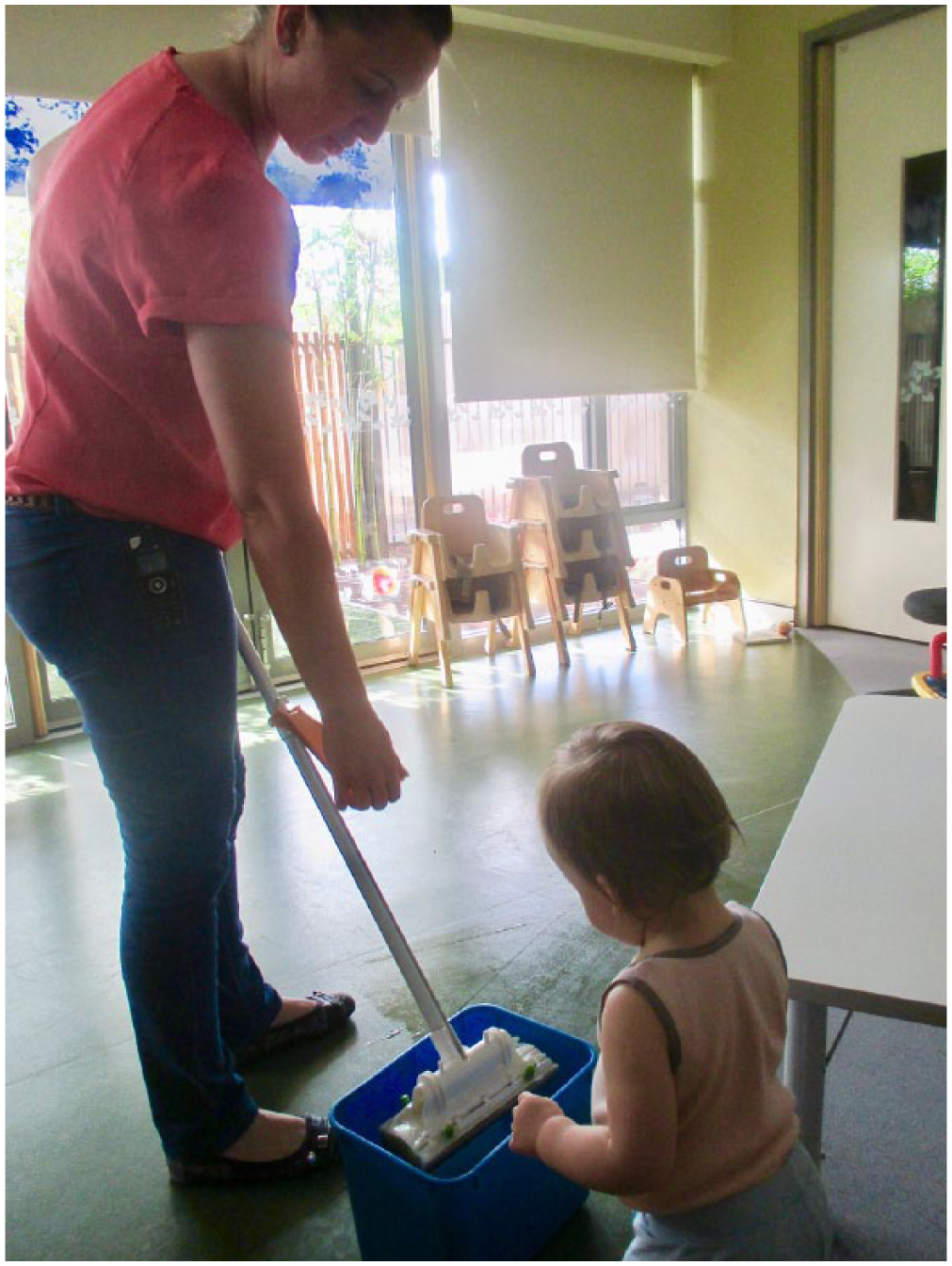
Ellen honouring Alice’s fascination with the everyday task of mopping the floor.
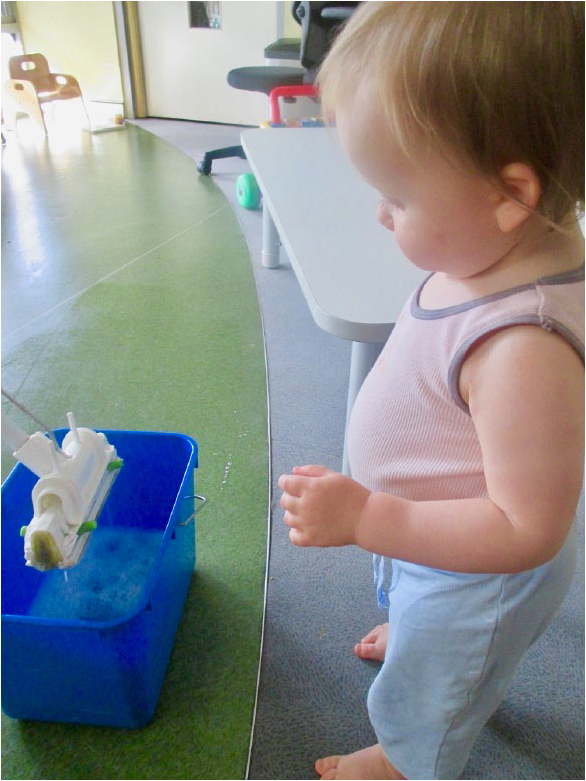
Alice absorbed by the workings of the mop and dance of the water.
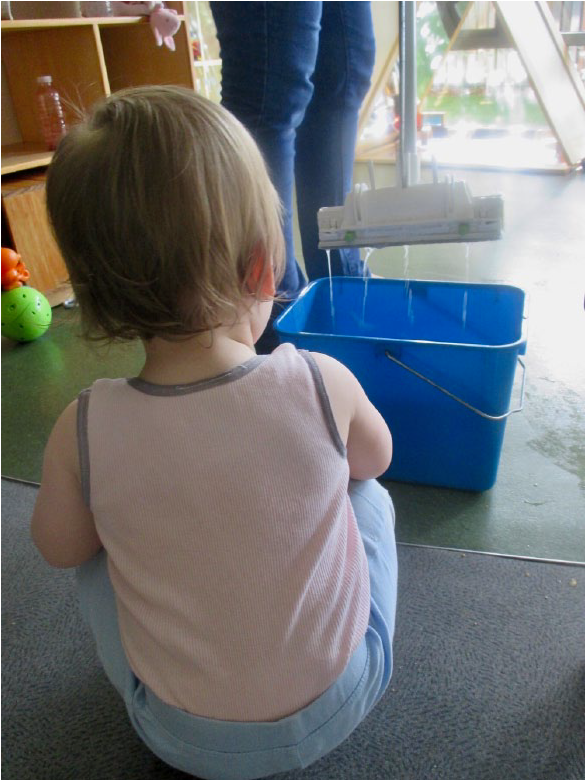
Alice watches intently as the drips from the mop linger.
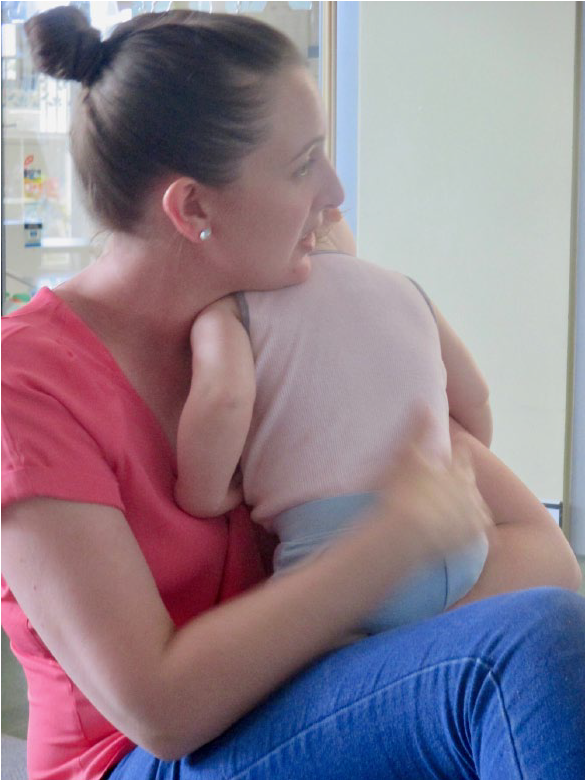
Sharing the solidarity of a moment.
Every part of the day, every moment, brings with it opportunity. Ellen’s attitude to this everyday practice, often revisited regularly throughout the day, was not to rush this process; quite the contrary, she slowed this moment down, it was sustained, so that Alice could relish in it. It was not something that had to be hurriedly completed so that the ‘real’ program of the day could be returned to. Mopping the floor was not a job to be done – a cleaning task – rather, it had a rightful place in the rhythm of the everyday and the life of being together in a children’s space. Reflecting Bruner’s (2011: 10) notion of a ‘dedication to possibility’, mopping was an opportunity to seek and find beauty in the dripping water, the creating of bubbles and the squishing of the sponge. Specifically, what we see valued is listening to children, through attentiveness to Alice’s gaze, her desire to ponder, her curiosity and her committed crouch that brought her even closer to the mop and bucket (Olsson, 2013; Rinaldi, 2006). In solidarity with Alice’s fascination, research is a way of looking and approaching the quotidien practice of mopping the floor. It is about always being in tune with children’s ‘veritable taste for creative thought and … hunt for that which glimmers’ (Olsson, 2013: 231). An attitude of research becomes an ethos, a priority, with the capacity to change the orientation of everyday practices as they are framed through the lens of continued opportunities and the surprising possibilities of ‘that which glimmers’.
‘Moments that build culture’: bubbles, blowing and catching
In this narrative, we re-meet Ellen. It is the time of the day in the nursery when the children are beginning to wake up from their afternoon sleep. Ellen is sitting on the floor, knowing that the children will be keen to get close to her as they eagerly await the arrival of the afternoon tea trolley. Rather than being a ‘waiting time’, defined and punctuated by ‘afternoon tea time’, Ellen used this time as an opportunity for the children to re-meet the shared joy of blowing bubbles. What is evident in this narrative is the capacity or intelligence of the relational space to shape a culture of shared understandings, qualities and ways of being together. The notion of the intelligence of the educational setting is underpinned by the belief that relational space has the capacity to mutually shape and shift the thinking of children and adults alike (Gandini, 2012; Lefebvre, 1991; Mitchelmore, 2012). The theoretical orientation of the intelligence of the educational setting positions knowledge as socially and ontologically co-constructed by children, adults and materials in company; it is constituted ‘through a process of meaning making in continuous encounters with others and the world’ (Dahlberg and Moss, 2006, quoted in Rinaldi, 2006: 6).
When Ellen began blowing bubbles, not only was there a delight in following the bubbles floating across the room; there was also a desire to blow bubbles. Very young children – Ben (1 year), Alice (1 year, 1 month) and Cora (1 year, 1 month) – were at one, sitting comfortably side by side, each wanting, waiting, watching and having a turn at the very tricky process of blowing bubbles. Each aspect of this interaction was characterised by participation because waiting, watching and blowing were all about ‘being with’ and ‘being amongst’. The multiplicity of this interaction meant that it was an inclusive experience that did not privilege one aspect over another. Blowing bubbles was not privileged over watching the bubbles float across the room. (see Figures 2.1, 2.2, 2.3)
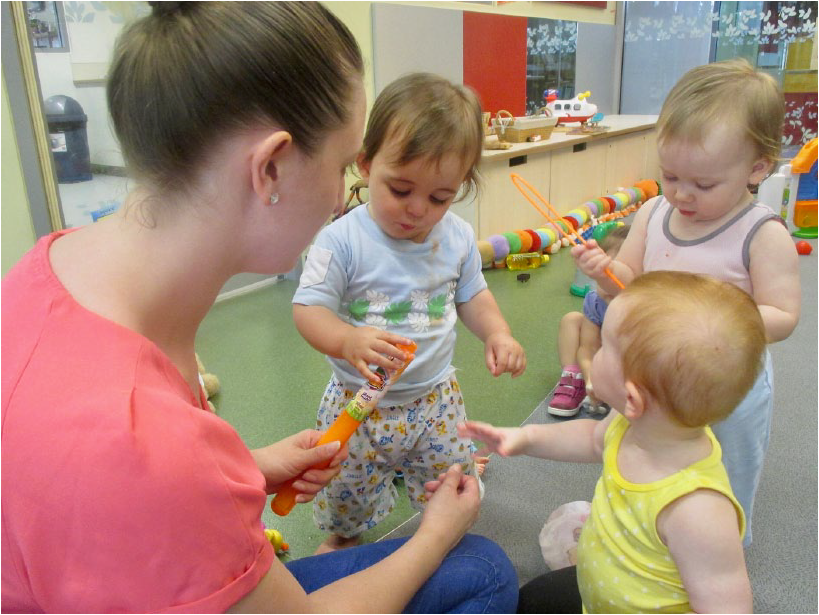
Ben, Alice and Cora re-meeting the shared joy of blowing bubbles.
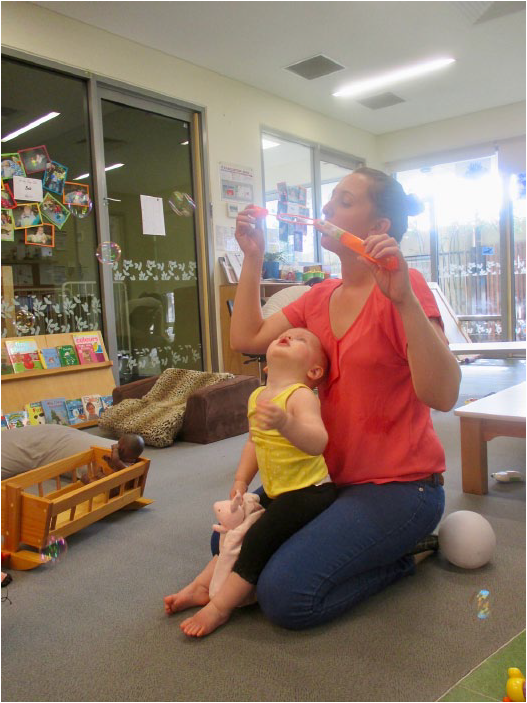
Ellen and Cora watch bubbles float across the room.
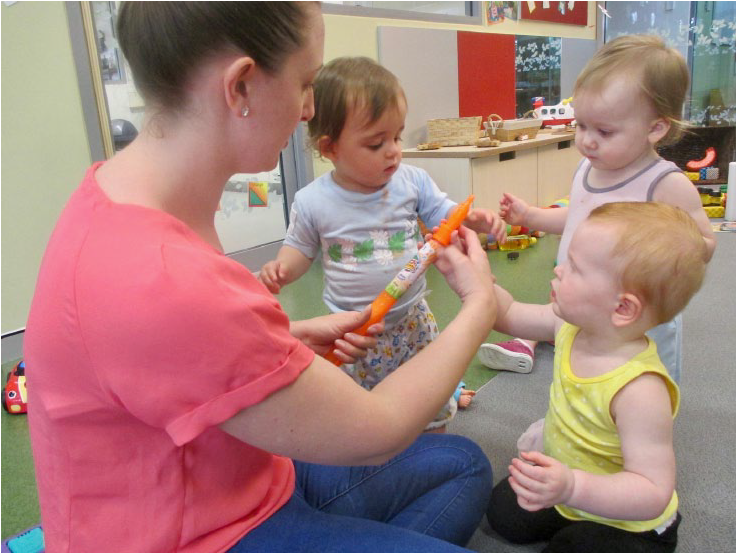
The reciprocity and friendship that comes with the shared delight in blowing bubbles.
Ceppi and Zini (1998: 13) state that the relational space is ‘an environmental fabric rich in information … with a recognisable feel about it, in harmony with a set of values and references that guide each choice and line of research’. More than a strong commitment to accommodating a physical place in this interaction, this play with bubbles is guided by recognition of the other and a sense of each other’s place in the world. This inclusivity is not so much an act of generosity but more a genuine value in the other – in the rights of the other to experience and share joy, to share in the value that comes with togetherness, welcoming, friendship and honouring children’s ways of seeing and engaging with the world through the humus attitude of research. Rather than afternoon tea defining how this time of day would be viewed, it was instead the value of inclusion, of being with and being amongst each other as the children woke from a rest. It was not just the re-meeting of the shared interest of blowing bubbles, but a reconnecting with a culture that values reciprocity and friendship. It is the intelligence of this pedagogical space that reframes time so that children and educators are not ‘waiting for the next part of the day’, but are living within the opportunities that always value this part of the day.
‘Suredness, faith and optimism’: the cup tray as a place of research
How can a tray of cups bring with it and enrich an attitude of research? By identifying the aesthetic qualities that guide interactions, we bring visibility to the patterns of association and patterns of thinking that are indeed contextual and therefore unique to an early childhood space (Dewey, 2005; Gross, 2002). While there is the philosophical ‘planomenon’ underpinning ‘an attitude of research’, the textural composition of this concept of research will look different from one educational context to the next. Every context is composed of many different individual identities and, along with this, early childhood spaces are guided by values and beliefs that are meaningful to, and situated within, the experiences of the local community. It is this unique composition of the pedagogical setting, coupled with the individuals who bring their subjectivities to each engagement with this space, which shapes the aesthetic qualities forming the substance or ‘sensitive knowledge’ of an attitude of research (Baumgarten, 1750, quoted in Gross, 2002: 408).
In this narrative, we meet Fred (2 years, 9 months), Hugh (2 years, 5 months) and their educator, Melissa. It is a summer afternoon; the children and educators commonly enjoy this cooler part of the day relaxing in the garden as children are farewelled and the day winds to a close. To look once at Fred’s actions, we could suggest that he was interrupting his play and simply accessing a drink of water; to position this documentation through the lens of quotidien inquiry, however, we have an opportunity to uncover the aesthetic qualities embedded in both the quotidien practice of the accessibility of cups for young children and the actions that accompany Fred, Hugh and Melissa engaging with the lived experience of an attitude of research.
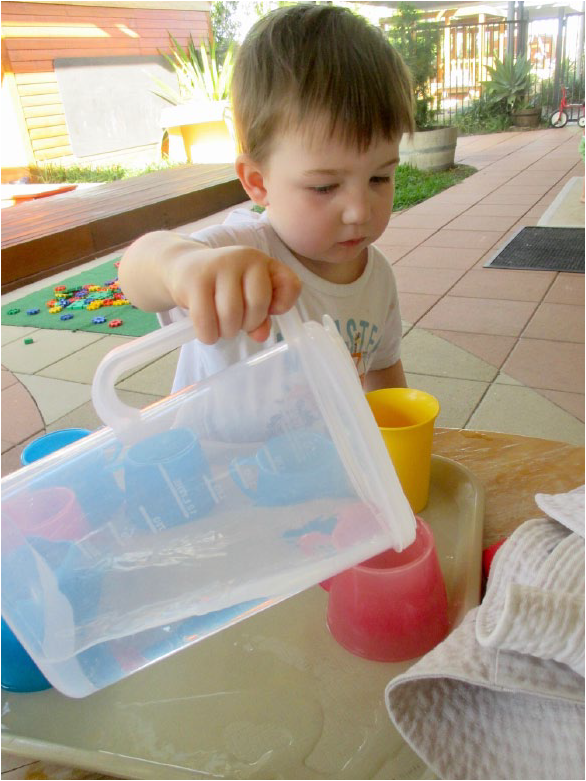
I watched Fred take himself over to the cup tray. ‘Need some water?’ I said to Fred. ‘Would you like me to help you find your cup?’ He looked back at me and then turned his attention back to the tray. Scanning with his eyes across the cups, Fred said with absolute delight, ‘This one Freddy’s!’ ‘Oh, it is too. Good on you’, I responded. In this moment, Freddy taught me so much about the aesthetic quality of suredness which is conveyed and reciprocated in the accessibility of the cups. As he reached to take a sip from his cup, Freddy noticed, ‘Need some more water’. Leaving the cup on the tray, Freddy flipped open the lid of the water jug and filled up his cup. It caused a bit of a splash but certainly not an overflow, and the tray caught the little spills. As Fred took a sip of his drink, he was joined by Hugh. Fred said to Hugh, in the same way that I had asked him, ‘Find Hugh’s cup?’ And with Hugh watching on by his side, Fred started turning the cups so that the names were visible to them both. ‘This one Hugh’s cup?’ Fred would say, pointing to the name labelled on each cup. Melissa, an educator, overheard this interaction and she gently meandered just beside the boys so as not to intrude upon them. Freddy continued to turn the labels to Hugh it seemed, so that both Fred and Hugh could enjoy the moment of finding Hugh’s name together. Melissa gently paused the moment with a question. Pointing to the ‘H’ on Hugh’s label, she suggested, ‘This one looks like your name, Hugh?’ Hugh was thrilled, and he turned to Fred, ‘That’s mine!’ Fred confirmed with Hugh, ‘This one Hugh’s?’ As Hugh picked up the cup, he said with certainty and suredness, ‘Yes, that’s my one’. (see Figures 3.1, 3.2, 3.3, 3.4)
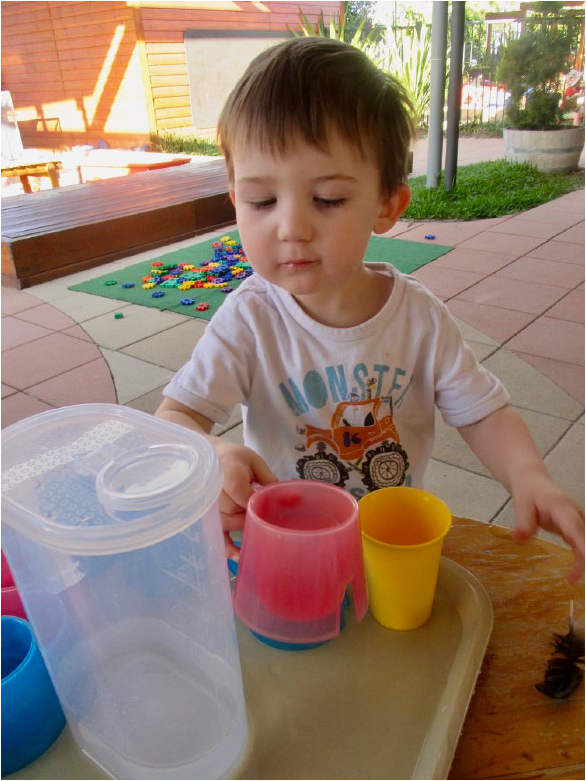
Freddy carefully finds his cup on the tray.
With a sense of ease and suredness Fred fills his cup.
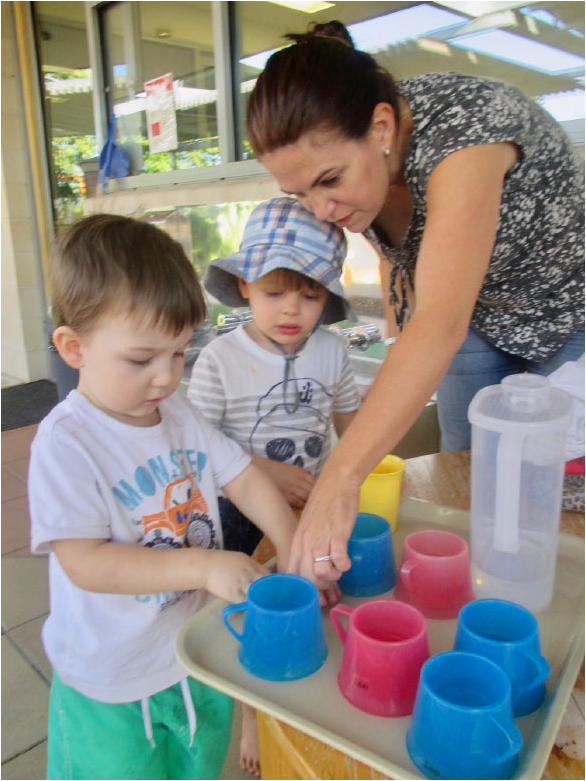
Melissa gently suggests, “This one looks like your name Hugh?”
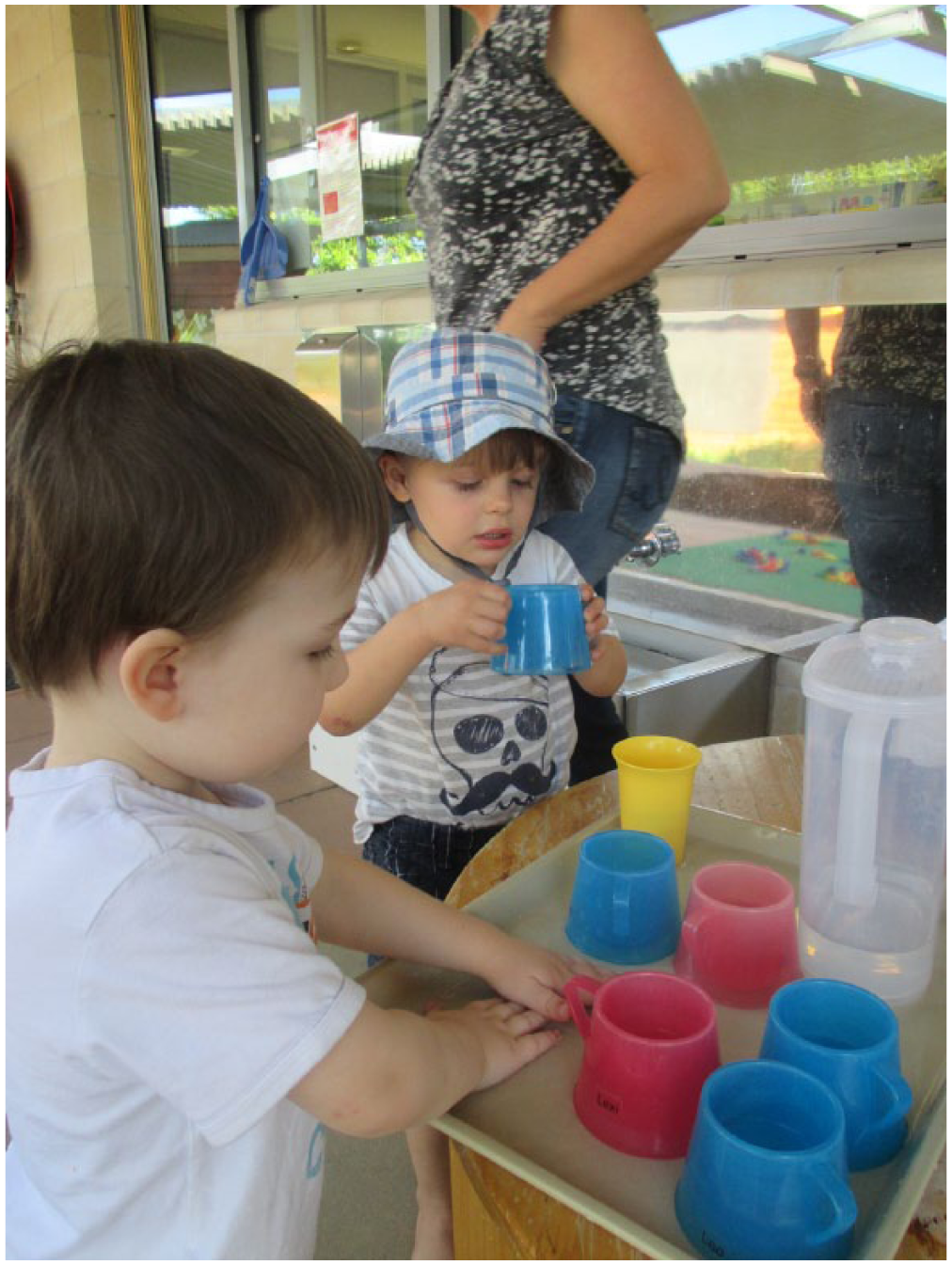
The possibilities of a tray of cups enriching an attitude of research.
Melissa paused the moment of research so that Hugh and Fred got to share a moment of suredness – the suredness of not just knowing your own cup, but of knowing others’ cups too; the suredness of knowing that should you wish to help each other or need support, adults and children alike will be by your side; the suredness of knowing that moments are not going to be intruded on, but will be valued for the faith and optimism that children and adults have in each other. This aesthetic quality of suredness is not a static quality that sits with notions of being correct; it is an intellectual trait that is integral to the experience (Dewey, 2005). Suredness in this sense is characterised by the opportunity to explore, consider and find a pathway that will be faithful to your way of relating to and understanding the world. The capacity of this quality is reflected in the joy and satisfaction that Fred and Hugh found in this familiar experience of getting themselves a drink of water; it is for this reason that a tray of cups can bring with it and enrich an attitude of research.
Discussion: lingering as an attitude of research
The empirical material in this study speaks to the value and strength of quotidien practices, particularly the critical place of the everyday in constituting new theory. In bringing together theory and practice, one does not forego or privilege the other. Hence, two ‘voices’ are at play within this article; each brings value to the other and has a value in and of itself. The foregrounding of the pedagogical documentation is grounded in the conventions of academic writing, and the narratives in the poetic sensibilities that come with the relationship of documenting pedagogically, while the analysis of the documentation brings these two voices together to create a third ‘voice’. By reading the pedagogical documentation with Delueze and Guattari’s (1994) theory of immanence, the concept of an attitude of research takes on new contours, allowing a new theory to emerge ‘in the threshold’ where theory and practice meet (Jackson and Mazzei, 2012).
Within this particular early childhood space, the aesthetic quality of lingering and an attitude of research constitute one another, creating a new theory in the threshold of the everyday: ‘research as lingering’. An attitude of lingering is the sensibility that supports interactions, motivates learning and gently creates the ‘cognitive tension’ to build and further knowledge. Research as lingering is also characterised by solidarity between children and adults in honouring fascination, the quality of inclusion, and the value of being with and being amongst – and, of course, the faith and optimism that come with a sense of suredness that your ways of looking, investigating and considering are valued as you go about everyday quotidien practices.
Waves will continue to roll across the ‘planomenon’ of an attitude of research, shifting the contours of ‘research as lingering’ within this pedagogical space. New theories will be born out of the aesthetic quality of lingering reflected in practices that allow questions and thinking to hang in the air, just like the dripping water from the mop, the floating bubbles and the turning of each cup to reveal a name. Lingering is their way of thinking and approaching an attitude of research within the context of an unhurried quotidien that does not privilege one part of the day over another, but values this part of the day.
Conclusion
Without consideration for their identity within everyday quotidien practices, concepts can fall prey to being used as ‘common terms’ that are either characterised by an assumed way of working or marginalised to a particular way of working at a designated time. In a sense, their identity, complexity and entangled meanings can become lost in translation through adoption, homogeneity or partiality. Through the process of documenting and analysing the lived experience of quotidien practices, educators open up the possibilities of enriching both theory and practice by bringing identity to and nourishing the concepts that they are working with. It is in the critical potential of our responses and our attitudes to everyday experiences, such as mopping a floor, blowing bubbles and identifying cups, that an attitude of research is shaped. Concepts are, however, inherently becoming and contextual in nature. While decisions, actions and dispositions unfold along the foundation of a philosophical plane of immanence, the context of concepts, such as an attitude of research, calls on educators to think and act within shifting boundaries. This is the joy of working with philosophical concepts – the newness that comes from the elasticity of a concept as it is made real through the everyday lived experiences of relationships and ways of being within pedagogical spaces. As Delueze (2004, quoted in Masny, 2013: 5) imparts: ‘You don’t have to go back to a theory, you make new ones, you have others to make … a theory won’t be totalized, it multiplies’.
Footnotes
Acknowledgements
I am very grateful to the long-day-care centre that participated in this study, and wish to acknowledge and express thanks for the generosity and insights of the educators, children and families from that site.
Funding
The author received no financial support for the research, authorship, and/or publication of this article.
