




Abstract
In Texas, public-funded pre-kindergarten is important because it provides the most vulnerable children with the opportunity to develop school readiness, so they can learn core competencies in kindergarten relevant to academic readiness for first grade. The Texas Legislature was back in session in spring 2019 and, not surprisingly, a bill was filed requiring all Texas school districts to offer free all-day preschool programs for students meeting certain criteria—in the interest of the public good. In this colloquium, the author seeks to bring attention to the problem of pre-kindergarten attendance—an issue that the Legislature needs to address before funding the expansion of pre-kindergarten from half-day to full-day programs. In so doing, the author’s intention is to inspire discourse among the early childhood global community of educators, researchers, and policymakers regarding pre-kindergarten compulsory policy and practice, and thereby inform current thinking and guide further study on this important issue.
Introduction
Once again, pre-kindergarten (pre-K) was center stage at the spring 2019 meeting of the Texas Legislature, this time in the form of House Bill 189 (House Journal, 2019: 308). This legislative bill requires all Texas school districts to offer free all-day preschool programs for students meeting certain criteria—in the interest of the public good. I recently initiated a pre-K study using student-level statewide data. The purpose of this colloquium is to bring attention to the problem of pre-K attendance—an issue that the Legislature needs to address before funding the expansion of pre-K from half-day to full-day programs.
Texas pre-K
In Texas, public-funded pre-K serves mainly the most disadvantaged children between the ages of three and four. Among the 231,485 pre-K students in the 2017–2018 school year, the enrollment profile consisted of 86% (n = 198,505) who were economically disadvantaged; 38% (n = 88,880) with limited English proficiency; 4% (n = 9,712) with special educational needs; 3% (n = 7,646) who were homeless; and 1% (n = 2,213) in foster care (Texas Public Education Information Resource, 2019b). Pre-K is therefore important because it provides the most vulnerable children with the opportunity to develop school readiness; they can learn core competencies in kindergarten relevant to academic readiness for first grade.
Initial findings from a pre-K study
My research plan was, first, to examine for a select pre-K student cohort the relationship between their attendance in pre-K programs and academic readiness, as defined by their promotion from kindergarten to first grade. In preparing for the analysis, I ran descriptive statistics on the attendance data, thinking that it might be a good covariate in a regression model. Table 1 shows the pre-K attendance based on a 180-day school year, as reported by public school districts to the Texas Education Agency (2019d).
Texas pre-K attendance for 180-day school year (n = 204,883).
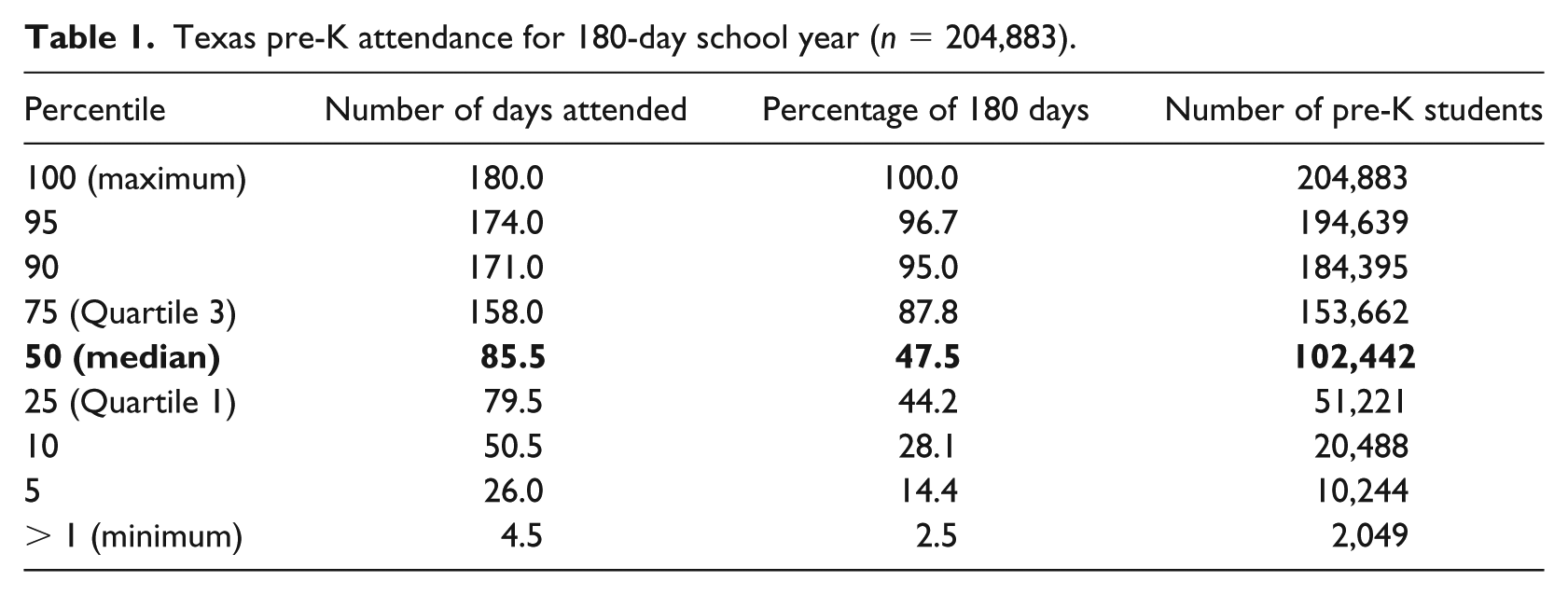
The results indicate that the median attendance among the pre-K students was 85.5 days—that is, half of the enrolled pre-K students attended for less than half of the time during the 180-day Texas school year. In order to assess school readiness at the start of the school year, the Texas Education Agency (2019a) recommends that kindergarten teachers use a variety of diagnostic instruments to assess students’ skills in literacy, including listening, speaking, reading, and writing. The implications of my findings reflect the state’s own recent report, where only 50% (n = 66,261) of the 132,316 kindergarten students attending a Texas public pre-K program for 80 or more days in the prior year were kindergarten-ready at the start of the 2017–2018 school year (Texas Public Education Information Resource, 2019a). As for those pre-K students with fewer than 80 days of attendance, one can only infer from these state findings how many of them were kindergarten-ready.
Next, I identified three groups of pre-K students in the data based on their next-year enrollment. Of the 204,833 pre-K students, about 6% (n = 12,259) did not enroll in any six-week period in a Texas public school in the following year. Another 9% (n = 18,015) repeated pre-K, which is reasonable to expect because Texas pre-K programs in public schools can enroll children at age three and for another pre-K year at age four. The remaining 85% consisted of 174,609 pre-K students who were promoted to a kindergarten program in a Texas public school. For this group, I assigned the pre-K students to four categories based on their attendance, as shown in Table 2.
Kindergarten-to-first-grade promotion by pre-K attendance category.
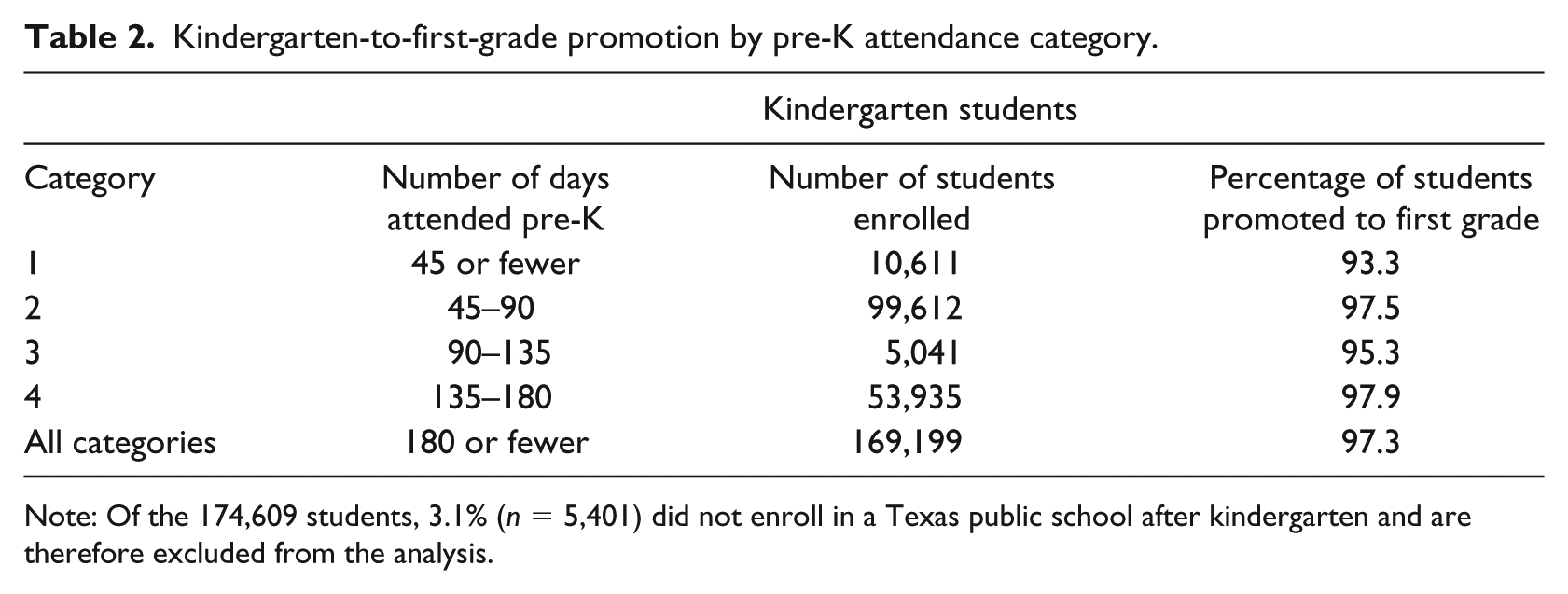
Note: Of the 174,609 students, 3.1% (n = 5,401) did not enroll in a Texas public school after kindergarten and are therefore excluded from the analysis.
If pre-K is important for young children, pre-K attendance should relate to promotion from kindergarten to first grade in that the higher the pre-K attendance, the higher the promotion rate. Yet, the results in Table 2 show very high promotion rates across all four categories. The overall rate of promotion to first grade was 97.3% among all categories, which corresponds very closely with the state’s own rate of 97.8%, implied from its 2.2% kindergarten retention rate in 2016–2017 (Texas Education Agency, 2019b).
The context of the Texas pre-K attendance problem
In order to assess academic readiness at the end of the school year, the Texas Education Agency (2019a) recommends that kindergarten teachers use tests aligned with the Texas Essential Knowledge and Skills for Kindergarten. These are the state’s standards for what students should know and be able to do at the end of kindergarten (Texas Education Agency, 2019e). Texas school districts are responsible for adopting their own local policies regarding promotion and retention (Texas Education Agency, 2019c). From the end-of-year test results, teachers make a recommendation to parents to promote or retain their child in kindergarten. Nevertheless, most districts, like my own, allow parents to make the final decision about whether their child does another year in kindergarten or enrolls in first grade, regardless of whether the child is academically ready or not.
Thus, my initial findings suggest that Texas pre-K programs do not matter to young children’s school readiness since most kindergarten students are promoted to first grade regardless of pre-K attendance—or lack thereof. More recent pre-K studies show that high-quality programs make a difference in preparing young children for school and academic readiness (e.g. Barnett et al., 2018; Camilli et al., 2010; Duncan and Magnuson, 2013; Weiland and Yoshikawa, 2013; Yoshikawa et al., 2016). How, then, can we reconcile the unexpected high promotion rates despite the lack of full attendance by students enrolled in Texas pre-K programs?
Student enrollments in Texas public schools have increased steadily over the last decade (Texas Education Agency, 2018). Concurrently, the Texas Legislature has not kept up with the rising costs in public education, thereby shifting more of the financial burden from the state to local districts (Taxparency Texas, 2019). In these conditions, I propose that educators are less inclined to address low daily attendance among pre-K students because—within this context of increasing enrollments and highly constrained budgets—full pre-K attendance means stress on classroom resources. If this is the case, we need to rethink our approach to pre-K in Texas public schools because, without fixing the problem of pre-K attendance, it is difficult to justify expanding pre-K from half day to full day—and, in the long term, to envision a future of universal pre-K for all Texas children.
Texas pre-K recommendations
First and foremost, I believe that Texans need a state law that establishes pre-K as compulsory education, with the flexibility for parents to opt out based on valid acceptable criteria (e.g. medical care, home schooling, private schooling). A Texas pre-K compulsory law would hold parents accountable to ensure that their children attend pre-K on a daily schedule like that already provided by public schools.
Second, we need to establish what funding level is adequate for full pre-K attendance and then, as Texas citizens, have the courage to commit funds to that level. If educators have been barely sustaining their pre-K programs with partial student attendance, I would expect that it is going to cost more for full pre-K attendance. Here, I believe that Texas taxpayers would be more inclined to support higher taxes for public schools, but only if the state required students to attend pre-K programs for 90% or more of the 180-day school year. This is already enforced for students in kindergarten through grade 12 through the state’s compulsory attendance law (Texas Association of School Boards, 2019).
At the most pragmatic level, we need local community stakeholders to collaborate in advocating to parents—especially first-time parents—the importance of their child’s full attendance in pre-K programs. Teachers are central to this because they are the first who can respond to parents when their child is absent from the pre-K classroom. We therefore need to give our teachers the tools, resources, and staff to make full attendance a reality in Texas pre-K programs. Another community stakeholder is the school’s parent–teacher association. I recommend that the Legislature should fund the Texas Parent–Teacher Association (PTA) to design, develop, and implement early childhood peer-to-peer parenting programs that promote full pre-K attendance.
A call for discourse
Whether the Texas Legislature funds full-day pre-K remains to be seen, even after the session is over in late May 2019. Unfunded and underfunded state mandates are commonplace. If the Legislature does not pass House Bill 189 this session, however, we should not worry. It will be back for another session in January 2021. By then, I should have my pre-K study completed. Meanwhile, I hope this colloquium will inspire discourse among the early childhood global community of educators, researchers, and policymakers regarding pre-K compulsory policy and practice. Here, I anticipate the comments and recommendations will inform current thinking and guide further study on this important issue.
Pre-K can make a difference in preparing all young children for school and academic success. At least for now, I believe that implementing these recommendations for Texas pre-K programs would move us in the right direction—like House Bill 189—in the interest of the public good.
Footnotes
Declaration of conflicting interests
The author declared no potential conflicts of interest with respect to the research, authorship, and/or publication of this article.
Funding
The author received no financial support for the research, authorship, and/or publication of this article.
