




Abstract
Much research on children’s classroom drawing emerged from an interest in the relationships between drawing and early writing and focused on drawing as a pedagogical tool to engage young children in planning, generating, and illustrating story ideas. In an eight-month case study of children’s drawing in a kindergarten language arts curriculum, the author focused on children’s classroom drawing not as a pedagogical intervention, but as an emergent event in which the intra-actions of children, drawing, and discourses coalesce. Of the many findings from this project, prevalent is the notion that children’s drawing and drawings function as vehicles for more than just pre-literacy—that drawing and drawings produce critical, creative, and constructive thinking and learning. In this article, the author discusses children’s drawing and drawings as events in which the often divergent interests of children, teachers, and curriculum materialize. Butler’s and Barad’s notions of performativity—the ways in which bodies materialize larger social discourses, such as gender—help the author to make sense of the ways children perform popular culture discourses, such as “monster,” or local classroom discourses, such as “writer,” in the kindergarten classroom. In looking at children’s drawing and drawings as material, discursive, and productive events, the author hopes to expand perceptions of children’s drawing beyond indicators of development, aesthetics, or literacy acquisition into critical, creative, and constructive learning experiences with significant cultural implications.
Lionel looks worried. He stares at the empty page of his writing journal, a blank rectangle with lines underneath. This is the second time I’ve recorded his drawing during the daily writer’s workshop. As the class expert on Avengers and other action characters, he spends much of the writing period narrating detailed drawings [Figure 1] to his table mates with large gestures and animated expressions. Today, he is uncharacteristically quiet. His teacher, Ms Walcott, starts the CD [compact disc] player and a slow, meandering piano piece filters out across the room. Some days, the music inhibits talking among table mates; other days, it just muffles it. Lionel and a few others have been struggling to finish their work in the time allowed. I’m unsure if he’s more concerned about his work or the recording device I’m holding in my lap. Finally, he puts pencil to paper and carefully begins—drawing first—starting with the teeth. Unlike the majority of his classmates, he draws facial features without an exterior outline to anchor them. It’s as if he is building the image from the inside out. He pauses mid-drawing and holds up his finger in a polite gesture for attention: “Can someone pass the brown … please?” [Figure 2]. Jennifer, his table mate along with Matteo, Jonas, and Chel, hands him a brown crayon. Lionel sits upright, rigid in his chair, holding the crayon as close as he can to its tip. Jonas, on his right, calls out to Ms Walcott for help. Lionel whispers: “Don’t wait for her. Don’t wait for her. Do it yourself.”
1
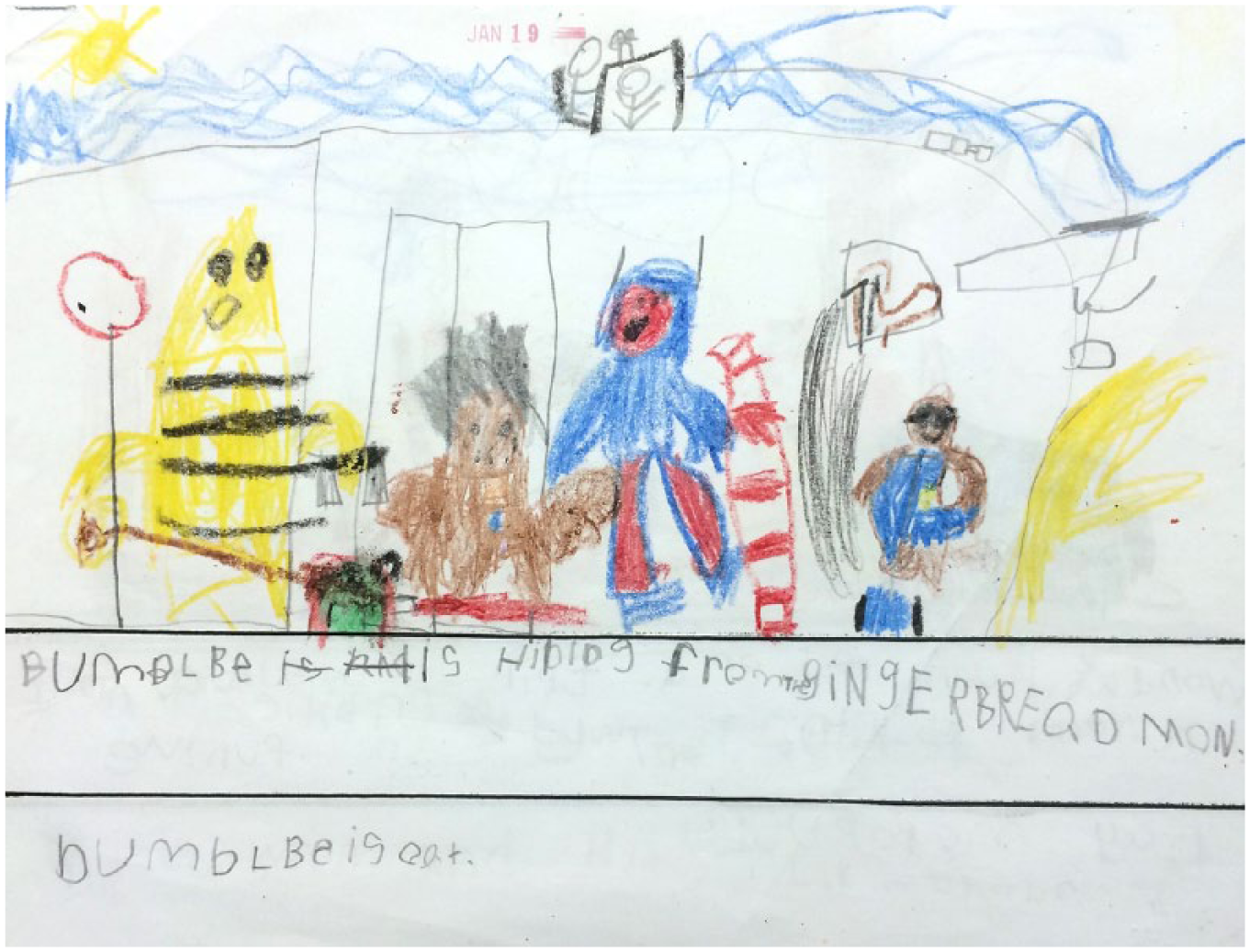
Room for monsters and writers.
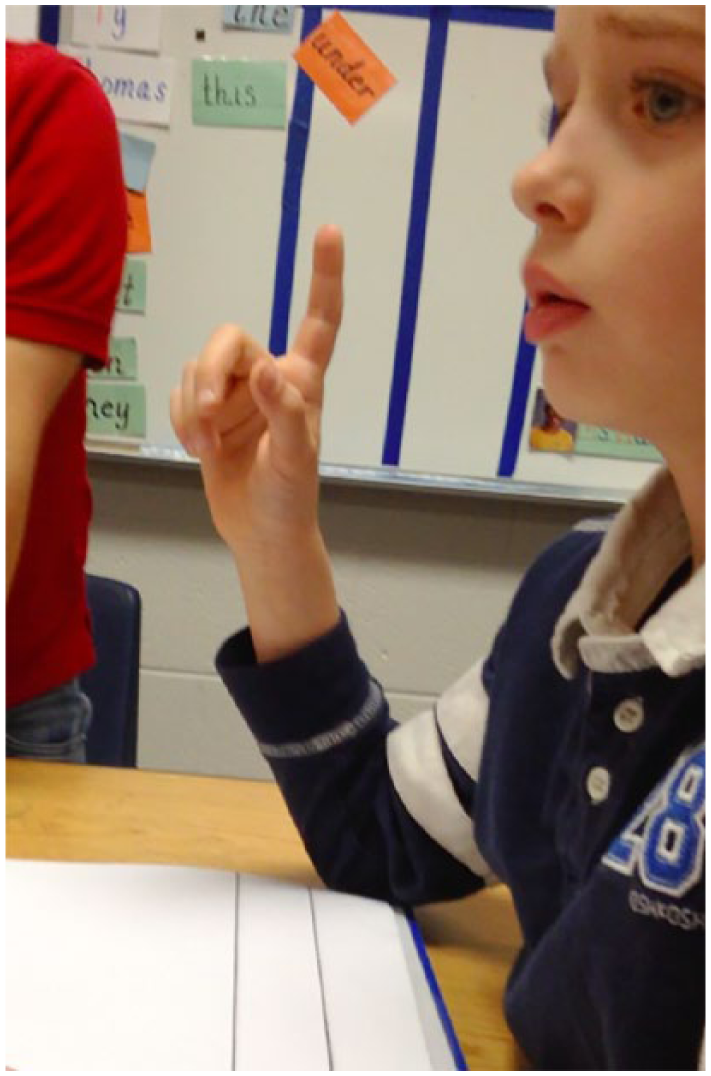
Requesting the brown crayon.
Introduction
Much research on children’s classroom drawing emerged from an interest in relationships between drawing and early writing (Atwell, 1987; Graves, 1983; Murray, 1982). Educators in language and literacy embraced drawing as a pedagogical rehearsal to engage young children in planning, generating, and illustrating story ideas (Caldwell and Moore, 1991; Graves and Murray, 1980). More recent studies in the field (Adoniou, 2014; Mackenzie, 2011) continue to reflect the focus on drawing as a developmental rehearsal for writing. But a semiotic interest in text, culture, and context led others (Dyson, 1986, 1997; Kress, 1997; Newkirk, 1989; Newkirk and McLure, 1992) to expand theories of language and literacy into notions of multimodal “literacies” and children as “symbol-weavers” (Dyson, 1986: 381). Newkirk (1989) and others (Kendrick and McKay, 2004; Leigh, 2015) argue that thinking about children’s drawing as a rehearsal for writing illustrates how writing is privileged both in school and in literacy studies, and that for many children, drawing is not an auxiliary tool but the main event. This idea collides with developmentally oriented standards in the USA that crowd drawing, an accessible mode of communication and engagement for most children, out of the curriculum after kindergarten (National Governors Association, 2010). Current research in language and literacy, among other fields, acknowledges that young children talk, draw, write, and play in ways that are entangled (Coates and Coates, 2006; Edwards and Willis, 2000; Hall, 2009; Hopperstad, 2010; Selvester and Steffani, 2012), and that drawing and other material and embodied encounters expand notions of literacy beyond the textual artifact into “literacy desirings” (Kuby and Rucker, 2015), “productions of desire” (Leander and Boldt, 2013), or “embodied literacies” (Thiel, 2015; Wohlwend, 2013). In art education, Pearson (2001) and others (Ivashkevich, 2006; Knight, 2008, 2013; Thompson, 2006; Wilson, 1997) argue that much past research on children’s drawing has focused on drawing as a developmental or aesthetic artifact and analyzed out of context. Although art education researchers have succeeded in reframing children’s drawing as embodied, performative sociocultural practices intimately tied to context (Ivashkevich, 2009; Knight, 2008, 2013; Pearson, 2001; Rech, 2018b; Schulte, 2013; Thompson, 2002, 2009; Vollrath, 2007), there is a need to continue to make connections across disciplines to investigate relationships in classroom drawing, including non-human elements, spaces, objects, and discourses—what Barad terms “intra-actions” or the mutual constitution of entangled agencies. That is, in contrast to the usual “interaction” which assumes that there are separate individual agencies that precede their interaction, the notion of intra-action recognizes that distinct agencies do not precede, but rather emerge through, their intra-action. (Barad, 2007: 33)
Rather than consider writing and drawing as activities with pre-existing properties, I locate children’s classroom drawing as emergent, unfolding intra-actions through which children, drawing, and discourses are mutually implicated.
In an eight-month case study of children’s drawing in a kindergarten writer’s workshop, I focused on intra-actions between children, drawing, writing, and local and global discourses. Of the many findings from this project, prevalent is the notion that children’s drawing and drawings operate as more than just vehicles for pre-literacy—that drawing and drawings produce critical, creative, and constructive thinking and learning. In this article, I discuss children’s drawing and drawings as intra-actions in which the often divergent interests of children, teachers, and curriculum comingle and materialize. Butler’s (2004) and Barad’s (2007) notions of performativity—the ways in which bodies materialize larger social discourses, such as gender—help me to make sense of the ways children perform popular culture discourses, such as “monster,” or local classroom discourses, such as “writer,” in the kindergarten classroom. Although drawing and writing emerge as entangled in my discussion, I focus on drawing and drawings in order to emphasize the ways in which material intra-actions move classroom engagements beyond a prescribed curriculum in which writing is privileged. In looking at children’s drawing and drawings as material, discursive, and productive events, I hope to add to the growing body of scholarship that moves drawing and other material encounters beyond indicators of development, aesthetics, or literacy acquisition into critical, creative, and constructive learning experiences with significant cultural and educational implications.
Theoretical perspective
In the opening vignette, I highlight the tensions between children, drawing, drawings, and classroom expectations. In the vignettes below, I focus on the ways in which these elements intra-act, the variations in Lionel’s verbalization and body language, and the variety of ways he performs both drawing and normative classroom practices. Butler (2004: 1) suggests that performativity—the anticipation of and repeated, sustained, embodied performance of dominant social discourses—is a key factor in the construction and “doing” of gender. In this sense, gender identities, such as feminine or masculine, performed on a daily basis, become visible in citations of dress, gesture, speech, tone, and so on, and become cemented in discursive statements that define knowledge in official ways, such as texts in science, law, and education. Butler applies much of her theory to discourses of gender and sexuality, and argues that the theory is not easily transposable. Barad (2007: 151) suggests, however, that the way forward is a post-humanist reading of discursive practices, not as a collection of static meanings or speech acts, but as discursive productions, which are themselves “material (re)configurings of the world through which the determination of boundaries, properties, and meanings is differently enacted.” In Barad’s view, there is room for reading children’s drawing as a material-discursive practice in which metanarratives in popular culture—such as “monster,” “hero,” “princess,” and so on—and local discourses of the kindergarten classroom—such as “good listener,” “good writer,” or “good friend”—materialize. Nichols and Campano (2017: 248) argue that a post-human perspective in the classroom expands the scope and opens possibilities for thinking about teaching and learning: “a post-human stance does not leave humans behind, but rather attends to the ways human life is imbricated with non-humans, institutions, and histories.” In this article, I theorize children, drawing, and popular and classroom discourses as intra-actions in which children’s play and experimentation via drawing cohabitate with adult-driven expectations. The intra-actions between drawing, drawings, Lionel, “monster,” and “writer” draw attention to the ways in which discourses materialize in the classroom, and conjure possibilities for teaching and learning.
Methodology
Lionel’s school, Paladin Elementary, stretches out over a low hill in a quiet but culturally diverse suburb of a major international travel hub in the USA. As a highly ranked Title I school with over 800 students enrolled, Paladin has an academic schedule heavily weighted towards classroom work. As do many schools in this large southern county, Paladin uses a process/workshop approach to writing in which drawing functions as a pre-writing tool to engage children’s interests. But for many children in the class, drawing functions as a place to innovate and play while also appearing to be occupied in quiet, seated, teacher-approved activities. Lionel’s teacher, Ms Walcott, acknowledges children’s desire for the opportunities drawing affords: “Because expectations are so much higher now, when these children get the opportunity, put a crayon in their hand, they are, I mean they are excited about it” (Interview, 16 March 2016). Ms Walcott’s comment illustrates the value of looking at drawing in the classroom—a unique window into children’s self-directed exploration of ideas, images, and physical/material interactions.
Of the 23 students enrolled in Ms Walcott’s class, 12 agreed, with their parents’ permission, along with Ms Walcott herself, to participate in the study. Drawing from other classroom ethnographies and case studies in early childhood education (Corsaro, 2003; Dyson, 1997; Newkirk and McLure, 1992; Tobin, 2000), I used participant observation, field notes, video recordings, and informal interviews as the primary sources of data collection. I was careful to explain the nature of the study to the participating children and asked for their assent to video-record their drawing events. Because intra-actions with drawing and drawings emerge in the moment, I did not interview the children formally, finding that brief, informal discussion yielded more relevant information. Over the course of the school year, I visited Ms Walcott’s classroom on average twice a week, primarily during their morning, hour-long writer’s workshop. I used a small, handheld iPad to video-record drawing events and, other than an initial interest in watching their own recordings, the excitement about being recorded dissipated after the first few weeks. I drew from field notes, interviews, and video recordings to develop a thematic matrix that included a variety of categories such as “subjects,” “conventions,” “methods,” “techniques,” and “verbalizations.” From this analysis, I ascertained a number of similarities across drawing events, such as the prevalence of common subjects, conventions, and methods of drawing, as well as notable differences produced by intra-actions with drawing materials, objects in the classroom, peers, adults, and local and popular culture discourses. Noting patterns and differences in classroom drawing helped me to understand it as a local, contextual, and contagious practice in which informal, peer-driven learning thrived. For this article, I juxtapose vignettes constructed from the video recordings with what Dyson (1997) calls the analytic or constructed narrative in order to relate the intra-actions of children, drawing, and discourses to larger theoretical concepts. Narrative analysis, drawing from the tradition of narrative inquiry, integrates data rather than separates it from context (Kramp, 2004). In this vein, I use first-person reporting to acknowledge the work as an interpretive process and product—a local, contextual sense-making of observation, analysis, and synthesis—as well as to locate myself as an element in the intra-actions with children, drawing, and drawings.
Performing monster
Lionel begins a second, smaller figure in pencil, outlining the eyes first, then quickly roughing in a head and body with linear protrusions. He slows down to craft what begins to emerge as a gun. His drawings often incorporate meticulous gear, weaponry, and vehicles or spacecraft, and the thick, dull crayon tips are not suited for the work. He draws the details first and slowly, carefully adds color to the blaster one stroke at a time. He switches to a brown crayon, goes back to the original figure, addresses it in low tones: “Chewbacca, Chewbacca, Chewbacca.” Lionel smiles. The drawing is coming to life. He picks up the red crayon. At this point in the year, the paper of the crayon has been torn off and all that’s left of the pigmented wax is a stub. He holds the crayon at its tip and, starting from the barrel of Chewbacca’s gun, pushes it in short bursts across the page: “Pchoo, pchoo, pchoo, pchoo, pchoo, pchoo, pchoo … .” When the red marks reach the white figure on the other side, presumably a Storm Trooper, they make an impact sound: “Phough … Phough … Phough … ” [Figure 3]. Lionel’s body language is transformed. His spine looser, face closer to the page, his tongue darts to the side of his cheek and out onto his bottom lip. He keeps three crayons (brown, black, and red) to the right of his paper so he can switch back and forth efficiently when needed. His arm curls around the paper, framing the drawing space. His eyes are locked on the drawing, an intimate exchange between Lionel, paper, pencil, crayon, image, imagination: “Pssstahhhhh … ” [Figure 4].
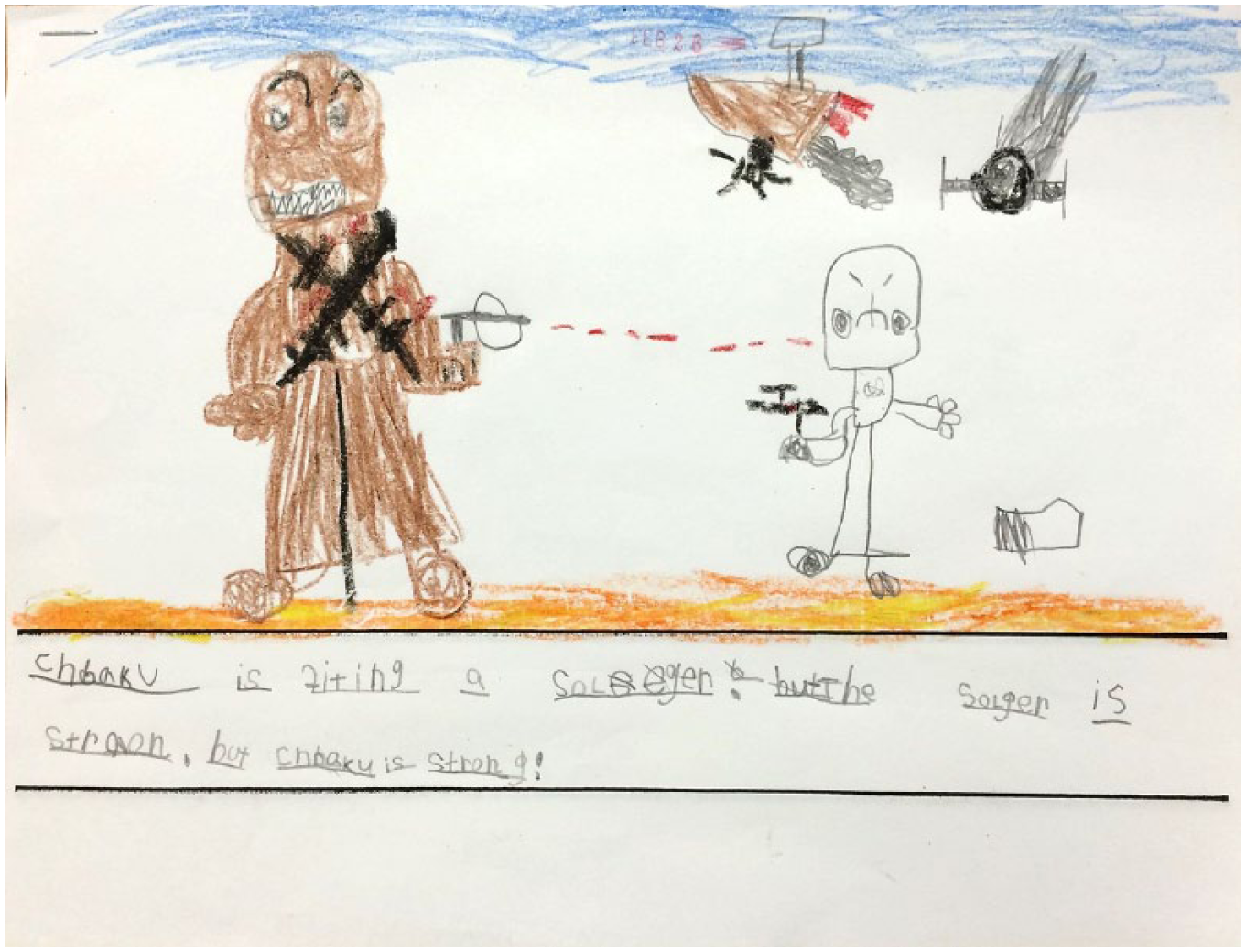
Chewbacca is fighting a soldier.
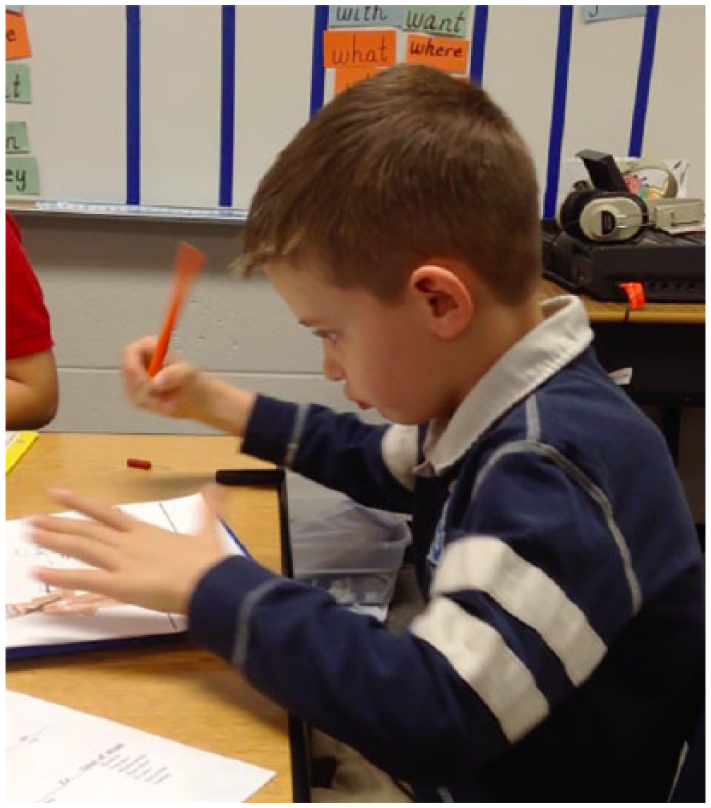
Verbalizing an explosion.
Lionel’s drawing depicts a scene from Star Wars—Chewbacca fighting a Storm Trooper—while above them fly a TIE fighter and what looks like one of Darth Vader’s menacing mother ships. Lionel, like his classmates Jackson and Kayla, talks to his drawings and for them, playing with them like toys. Watching Lionel’s face during a drawing event is like watching theater. Emotions and color sweep across his face. Lionel plays with and through his drawing as if it is a living thing. Ms Walcott notes this as well: Chewbacca’s real to him. In this context, in this story, it’s so real to him that it’s just, I mean, you can look at that illustration he’s doing and the incredible amount of detail. I mean, that character just reached out and grabbed him. (Interview, 16 March 2016)
Lionel’s drawings, like Matteo’s, Heva’s, and Chel’s, span worlds and characters—Chewbacca, Bumblebee, Ninja Turtles, the Hulk, Pokémon—citing narratives that address themes such as loyalty, rebellion, rage, or teamwork, among many others. In the child-driven discourses of Ms Walcott’s class, “monster” is a more likely topic than “hero.” I use the term “monster” loosely, as a reference for the more ambiguous characters from popular culture discussed among peers and appearing spontaneously in drawings alongside more neutral teacher-prompted subjects, such as “My Family” or “Last Weekend.”
2
Wilson (1997) suggests that children are drawn to and draw characters from popular culture as a way of trying on identities and rehearsing ways to deal with conflict. Lionel’s drawing stretches out in many directions, but the most visible, most vivid, is the towering brown creature with teeth. In Lionel’s drawing, Chewbacca is clearly the star, the protagonist, the biggest, baddest dude on the page. His size alone dominates the picture plane; his figure, riddled with blood and bullet holes, possesses a complex ambiguity that is both strong and menacing. Although Lionel does not speak for Chewbacca (perhaps because Chewbacca’s primary speech is Wookie), Chewbacca clearly acts in both offense and defense to Darth Vader and the anonymous Storm Trooper. Lionel’s drawing and the fantasy enacted through play may do two things in this context: (1) satisfy his personal interests while still being perceived as “work” and (2) materialize aspects of strength and struggle. Jones suggests that children need monsters: When we consider children in relation to mass media and pop culture, we tend to define them as consumers, watchers, recipients, victims. But they are also users of that media and culture; they are choosers, interpreters, shapers, fellow players, participants, and story-tellers. Viewing children as passive recipients of the media’s power puts us at odds with the fantasies they’ve chosen, and thus with the children themselves. Viewing them as active users enables us to work with their entertainment—any entertainment—to help them grow. Shooter games, gangsta rap, Pokémon all become tools for parents and teachers to help young people feel stronger, calm their fears, and learn more about themselves. (Jones, 2002: 18–19)
Performing monster materializes fictional characters and characteristics in ways that may be otherwise unavailable to Lionel. His intra-actions with drawing materialize the discourse of monster, both visually and verbally. The embodied production of the emergent drawing, the visual images that unfold, the play and fantasy enacted in dialogue with the drawing all become part of the intra-action. Butler (2004: 217) articulates the role that fantasy plays in performativity: “Fantasy is what allows us to imagine ourselves and others otherwise. Fantasy is what establishes the possible in excess of the real; it points, it points elsewhere, and when it is embodied, it brings elsewhere home.” Here, Butler refers to drag performances in the documentary Paris Is Burning, ways in which individuals push beyond normative materializations of gender discourses, but I see parallels in Lionel’s drawing. Performing monster decenters Lionel’s subjectivity in that (1) it occurs in relation to and intra-actions with the materiality of drawing and drawings and (2) it allows him to access the discourses of strength, power, and opposition within the context of the drawing. He verbalizes as he draws—“Dark Vader!”—indicating the dark, menacing ship headed towards the figures. In this sense, as Lionel intra-acts with the drawing, he moves beyond the everyday subjectivities of school and home. Performing monster via drawing pushes Lionel beyond the expectations of drawing in the writer’s workshop and establishes the possible in excess of the real (Figure 5).
Establishing the possible.
Performing writer
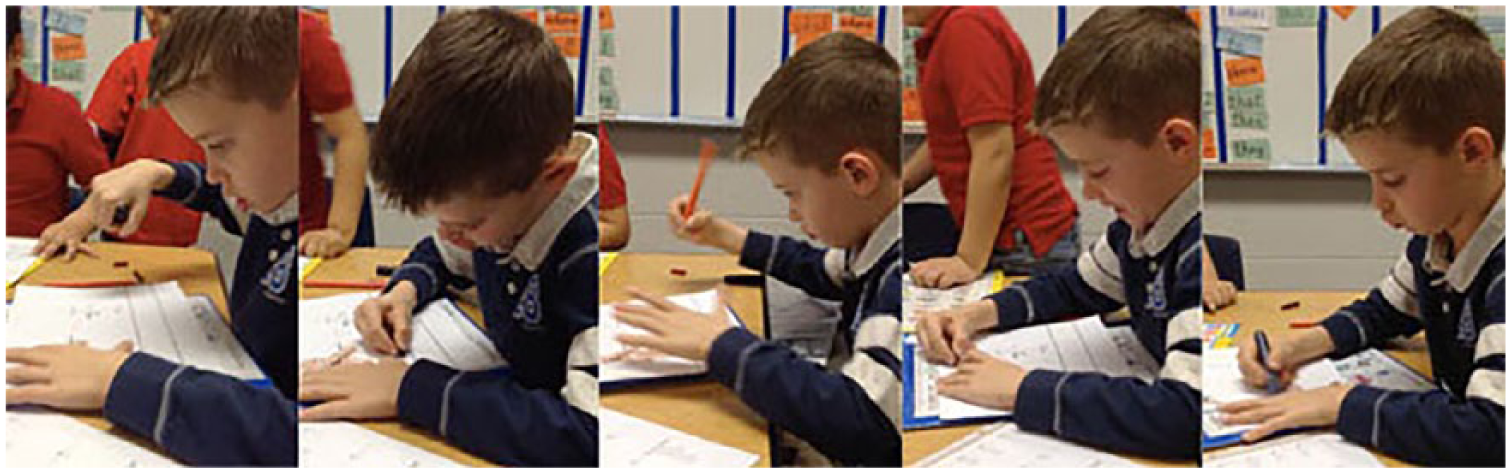
Reluctantly, Lionel puts his drawing aside and pulls out his folder of site words. He sounds out his first word: “Ch … ba … ch … ch … ba … ka … chabaka … chabaka … cha … ba … ba … ba … aaaaa … ba … aaaa. He looks at the camera and then around the camera at me: “Can you please help me spell baa?” I’m not able to ignore a direct request for help. I mouth “Ba … ahh.” He repeats “Ba … aaaaaah,” frowns, touches the pencil to his head, taps it. He writes a letter and looks up, again anxiety etched on his face: “Ch … ba … ka … U? U?” Again, I have a difficult time staying neutral and unengaged, but tell him: “I can’t help you when I’m filming. You can do it.” He tries again: “Cha ba ka … Cha ba ka … Cha ba ka.” Giving up for the moment, he picks up the black crayon and goes back into his drawing, adding definition to the straps on Chewbacca’s ammunition vest. He smiles at the drawing and adds a few red bullet wounds to the fur. He mouths sounds at the drawing—“Ptcha … Ptcha … Ptcha!”—softly pre-verbalizes the story to himself: “Chewbacca is fighting a soldier … Chewbacca is fighting a soldier.” He goes back to the writing, holding the pencil tightly, as close as he can get to the tip: “Sa … ol … jer … sol-jer … sol-jer … Sa … ol … jer … Sa … ol … jer … sa-sa … ol … ja-er.” He claps the syllables, slaps them down his arm the way Ms Walcott has demonstrated in class [Figure 6]. He writes a few letters, stops, and looks at the whiteboard. He gets up and walks down to the end where the G words are taped. Not finding what he’s looking for, he comes back, sits down, starts again. He writes a few letters then stops, puts a finger to his lip and shrugs his shoulders: “I need a eraser.” This is perhaps a stalling tactic. His head begins to fall lower and lower. He throws out a hand, gesturing in silent dialog with himself, with his text, or maybe Ms Walcott [Figure 7]. Finally, he slumps in his chair and again looks around the camera at me: “Can you please help me?” I point to the folder on his table. I’m not sure what sounds he’s looking for, but he sees something that perks him up and he starts again: “Sol-ger, sol-ger, sol-ger, sol-ger.” Jonas, to Lionel’s right, has given up on his own work. He leans on the table, cheek in his palm, watching Lionel struggle. Lionel looks up, sees Jonas watching, and freezes. His face flushed, he puts his head down, face in the crook of his arm. The tips of his ears are red. I can see muscles tensing at the side of his neck [Figure 8]. Jonas frowns, but makes no move to commiserate. It is a tense moment but, within a few seconds, Lionel pulls himself up, pulls his shoulders back, sniffs, and goes back to writing. He whispers the next word: “Strong, strong … Str … oooooooongggg … Str … oooooooongggg.”
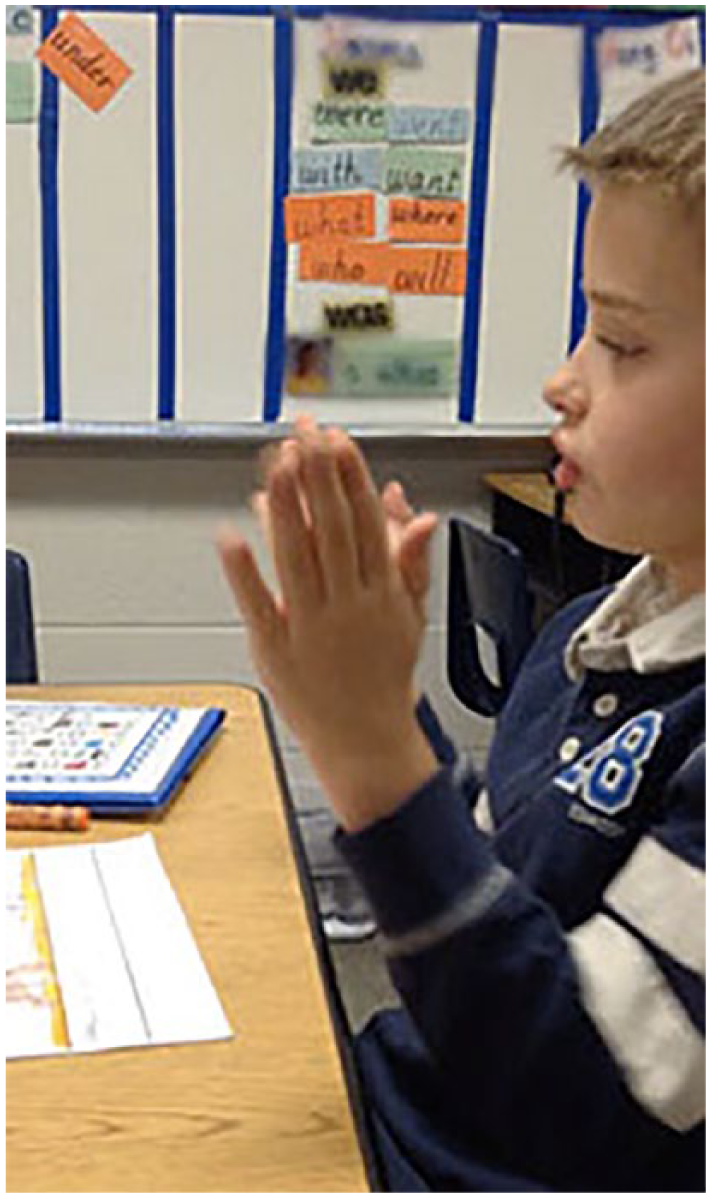
Clapping the syllables.
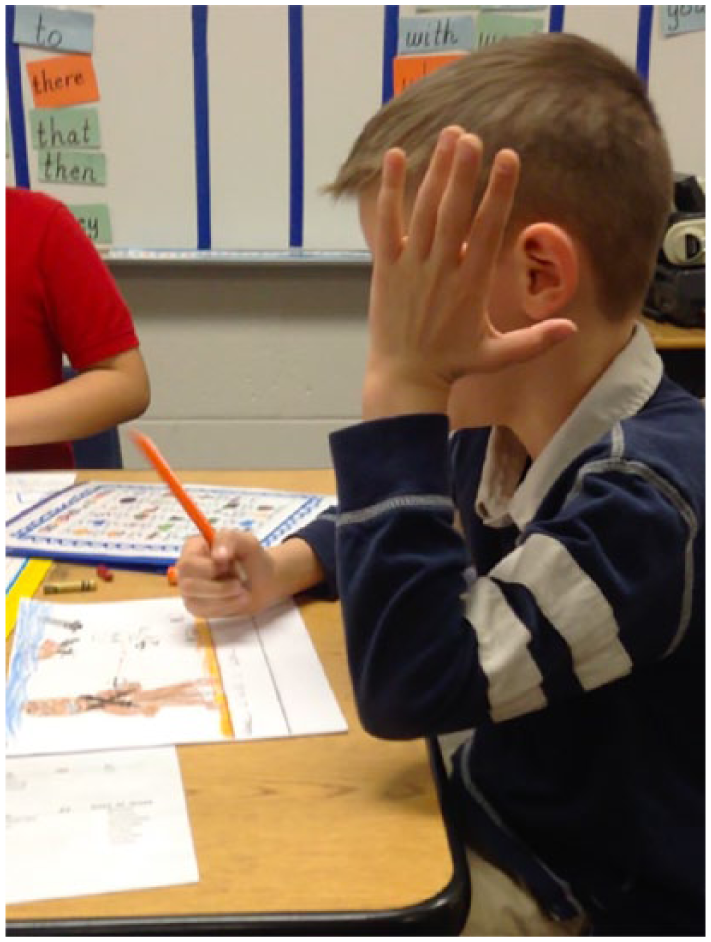
Struggling with writing.
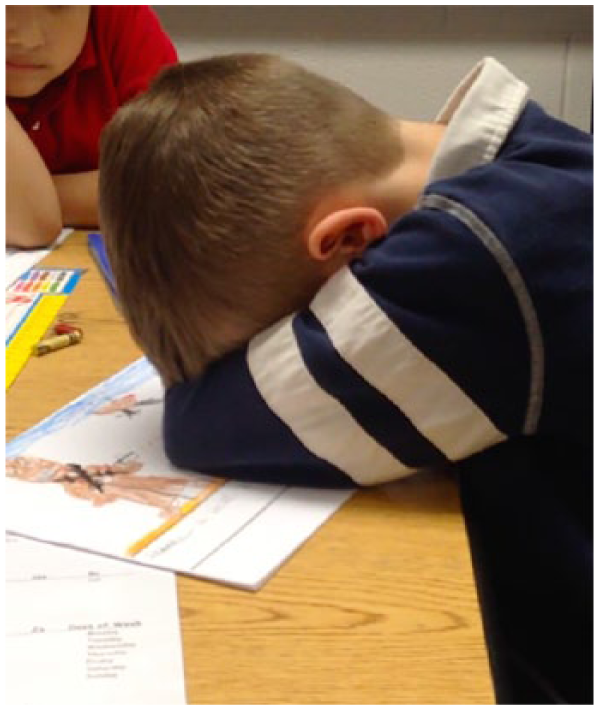
Deactivating the performance.
Lionel is known for his storytelling and knowledge of superheroes. What he is not known for—what he is called out for repeatedly, as in “Lionel, let’s focus on your writing”—is focusing on his writing. Youdell points out that education remains framed by enduring discourses of the “good student”: In such a discursive frame the good student is likely to be marked by qualities, at times in contradiction, of obedience, politeness, eagerness to learn, inquisitiveness, acquiescence to adult authority, restraint, cleanliness, asexuality, helpfulness, friendliness, good sense and common sense, childishness, maturity. (Youdell, 2006: 98)
She suggests that the good student/bad student binary is alive and well but that these meanings shift across contexts. In Ms Walcott’s classroom, the discourses of “good listener,” “good writer,” and “good friend” were the most visible in the daily language used by Ms Walcott, Ms Nanda (the paraprofessional), and the students themselves. As documented in field notes and videos, “writer” was often repeated verbally, described in detail, and discussed throughout the year by both teachers and students, as well as referenced in written texts posted around the classroom. In Ms Walcott’s class, a writer “writes,” “writes more,” “is focused,” “does not talk,” “works independently,” “adds details,” and “uses resources” (Field notes, 15 October and 2 November 2016). Although “monster” was a more popular topic of discussion, especially among table mates Lionel and Matteo, “writer” carried more weight for more children in Ms Walcott’s class. 3 The unceasing repetition of the word “writer” and associated practices is a teaching strategy employed in the workshop model. I suspect that “writer” became valued for official reasons such as teacher or parent approval, unofficial reasons such as approval among more successful peers, or practical reasons such as more unsupervised time during the writer’s workshop. In Lionel’s case, the transition to writer was marked, perhaps because it carried different expectations. The expectations of drawing in Ms Walcott’s class included only that one’s pictures look like something, but the expectations of writing, in the form of quarterly assessments of letter formation, punctuation, capitalization, and spacing, were more rigorous (Field notes, 2 November 2016). Early in the writing period, Lionel appears anxious, rigid, and concerned about drawing the attention of his teacher. He plays the conscientious student and table mate, sitting upright in his chair and making a polite request: “Can someone pass the brown … please?” Halfway through the hour, Lionel loses himself in drawing. The change in his body language is visible. Immersed in the narrative, his limbs relax; he drifts closer to the drawing, talks to it, smiles. When it is time to write, he transitions into the performative body techniques of “writer” learned in circle time and adopted and adapted by peers: clapping the syllables, arm spelling, looking for resources, and repeating sounds over and over.
As Barad (2007: 184) suggests, performativity has material consequences: “In an agential realist account, performativity is understood not as iterative citationality (Butler) but as iterative intra-activity … different material-discursive practices produce different material configurings of the world.” In Lionel’s intra-actions with drawing, the discourses of monster, and the struggle to spell the important terms (“Chewbacca,” “soldier”), to find resources, string sounds and letters together, inscribe them on the page, compose sentences, leave spaces, and use punctuation, Lionel materializes “writer.” Sometimes, he does so with a hint of parody. Twice, he throws his hands out in an exaggerated way as if to say: “I don’t know what I’m doing.” Eventually, the pressure to write, an expectation repeated daily and assessed often, even in kindergarten, gets the better of him and he deactivates the performance.
Other children in the class—Jonas, for example—embody the techniques of “writer” almost like tactics, the daily, sometimes subversive operations of individuals, as a way to engage with work in officially appropriate ways (De Certeau, 1984). To anyone observing, Jonas’s repeated clapping, arm-spelling, and drawn-out enunciation, lasting almost the entire writing period to the point where he gets no drawing or writing done, would appear to be on task. Ms Walcott’s response to Jonas’s work, her repeated questioning—“Did you write that down?”—suggests that she is keenly aware of Jonas’s tactical performance. Unlike Jonas, Lionel seems more susceptible to the lure of fantasy, slipping in and out of official classroom practices and struggling to stay under the radar, attracting Ms Walcott’s attention each time his intra-actions with drawing, alone or with peers, materialize in both gesture and volume. But something else happens in the struggle between competing priorities. In the intra-actions between Lionel, drawing, monster, and writer, the possible emerges in excess of the real, becomes something otherwise, and brings otherwise home.
Discussion and implications
At the end of the hour, Lionel’s class is called to line up for lunch. Only Lionel and Matteo are left at their table. Matteo, realizing this, makes a sound of alarm and twists out of his chair. Lionel looks up, looks at the camera, puts his head back down and keeps working. Ms Walcott responds quickly: “Ms Nanda, can you please bring Lionel with you? He is really focused over there and I don’t want to mess that up.” The rest of the class, lined up at the door with coats and lunch boxes, chatter quietly. Lionel is bent over his work, left hand framing the text as he writes, no longer struggling with spelling, but carefully laying down the final letters. He sits back in his chair and puts his pencil down: “Finished.”
Aspects of this event unfolded in the way they did because of my presence and focus. Researchers and research are the apparatuses that measure, define, and affect the measurement (Barad, 2007). I was present, as were other intra-active elements on that day and throughout the year, in ways I attempt to acknowledge. But Ms Walcott points out that something distinctive happens when the camera is turned on: I’m so happy when you’re here with the camera, because sometimes, well, they get distracted with all the things that are going on, other children that are in the classroom and what’s going on in the classroom, and then they’re focusing on other things and what really comes out to me is that they’re hearing, they’re listening, and they’re pushing themselves, farther than they would if you didn’t have the camera on them. So, it’s not something that they’re performing for the camera; it’s something that’s in them, that they’re bringing out because they want you to see their best. (Interview, 16 March 2016)
Her comment suggests that there is a difference between performance and “self,” that children are agential in pushing that “self” forward, and that a more writerly performance is “their best.” I would argue, as Butler (2004) might, that it is the collection of embodied social performances that makes up subjectivities or “selves,” and that no one is better or any more true than another. But I would also argue, as Barad (2007) might, that children’s performativity moves beyond iteration, that intra-actions produce diffraction patterns, and that diffraction, no matter how subtle, produces difference.
As with other children in the class, Lionel’s intra-actions with drawing and drawings materialized particular popular culture or classroom discourses such as “monster” and “writer.” Others I have documented in this project include “teacher,” “princess,” and “friend” (Rech, 2018a, 2018b). The ways in which children play with and perform these discourses in the classroom carry hints of the ways in which individuals both implicate and are implicated by their historical cultures. If, as Barad (2007: 151) suggests, a post-humanist reading of discursive practices as “material (re)configurings of the world through which the determination of boundaries, properties, and meanings is differently enacted” is considered in the context of education, children’s performances towards local and popular cultural discourses through material encounters become valid, valuable, and productive intra-actions. As Nichols and Campano argue, one of the strengths of a post-human perspective is in its ability to include a multiplicity of elements: it does not require us to abandon our existing practices altogether, but rather provides new dimensions that help better account for the complexities of the classroom. In this way, a material orientation invites us not only to contemplate our interdependence on one another and our environment, but also to imagine its concrete implications for literacy teaching, research, and policy. (Nichols and Campano, 2017: 249)
In Lionel’s case, performing “monster” tangled with the tensions of performing “writer.” Performing writer, citing the speech, tone, actions, and practices of “writer,” emerged as an avenue through which he enacted “writer.” It conjures the intriguing possibility for classroom pedagogy that to perform writer is to become writer. If drawing and drawings were valued in pedagogy as intra-actions which produce different material configurings, if the discursive practices of teaching, learning, and school were conscientiously reconfigured through language, material, and environment to allow for play and performativity towards “writer,” “scientist,” “artist,” “mathematician,” “environmentalist,” “engineer,” and so on, how would that change school and schooling for those who struggle with current expectations? If drawing and drawings were valued as elements of children’s agentic subjectivities, what more could we learn about children and monsters?
For Lionel, as for others such as Matteo, Kayla, and Salma, drawing and drawings are seductive spaces that satisfy the competing interests of children and adults. Some adults, parents, teachers, and administrators will acknowledge this, but if the language of state and national standards after kindergarten is any indication of the predominant attitude towards integrating drawing or material experiences into the curriculum, most will not (Georgia Department of Education, 2015; National Governors Association, 2010). 4 With a growing number of studies showing positive associations between the arts and academic achievement and/or engagement (Brouillette et al., 2014; Brown et al., 2010; Burger and Winner, 2000; Catterall, 2012; Christianakis, 2011; Gardner and Ditmore, 2018; Glynn and Muth, 2008; Hetland and Winner, 2001; Martin et al., 2013; Quillin and Thomas, 2015; Rabkin and Redmond, 2004; Respress and Lutfi, 2006; Schwamborn et al., 2010; Selvester and Steffani, 2012; Sidelnick and Svoboda, 2000; Sousa, 2016; Thomas et al., 2015), a renewal of the dialog on integrating the arts and material experiences, such as drawing, in classrooms is sorely needed.
The complex intra-actions with drawing and drawings I have observed in private and public classrooms, the entangled, meaning-filled visual texts and artifacts posted on the walls of local public schools in which I supervise student teachers, and the evocative and layered collections of ephemera I find in corners and closets in my own home move me to persist in advocating for drawing and other material experiences in the curriculum for both children and teachers. 5 Drawing and drawings move children. As indicated in this study and others, attention to material intra-actions such as drawing makes room for children to enact personal connections with learning that can have far-reaching effects on their attitudes, experiences, and achievement in school. It makes room for both writers and monsters in the classroom. As Lionel writes in his journal: “The soldier is strong but Chewbacca is strong!” (Figure 9).

Chewbacca is strong.
Footnotes
Funding
The author(s) received no financial support for the research, authorship, and/or publication of this article.