



Abstract
Much has been written about the sustained attempts by successive governments to professionalise the early years sector over the past 20 years in England. A feature of these policy interventions has been to focus on creating a graduate workforce to improve academic outcomes for young children. In this article, the authors draw on data from their recent Froebel Trust-funded project, which involved interviews with 33 early years practitioners, to first explore the challenges facing state-maintained early years settings in contrasting geographical contexts in England, including rural, suburban and urban, as they work towards achieving compliance with the recent policy aim of one graduate in each of their settings. Second, the authors use policy enactment theory to inform their analysis of senior staff members’ perceptions of tensions and opportunities created by having a graduate workforce in state-maintained early years settings. Third, the authors tentatively explore how to reconceptualise staff education and training with existing, experienced early years staff that would re-emphasise Froebel-informed approaches to enable practitioners to theorise their practice in a move towards what the authors have termed in this article as ‘developmental professionalism’. The data shows that there is uneven access to higher education in contrasting geographical contexts for those professionals seeking to gain graduate status, and the authors examine the implications of this for early years practitioners and managers attempting to access graduate qualifications.
Background
In 2012, the Nutbrown review of early education and childcare qualifications was published in England. The review identified some key concerns in relation to early years qualifications, including the confusing nature of the credentials, the insubstantive content of National Vocational Qualification (NVQ) Levels 2 and 3,
1
and the uneven professional practice and provision identified across different settings. Nutbrown pointed out that: I am concerned that the current early years qualifications system is not systematically equipping practitioners with the knowledge, skills and understanding they need to give babies and young children high quality experiences. A new long-term vision is needed for the early years workforce, with a reformed system of qualifications to help achieve this. (Nutbrown, 2012: 5)
In response to Nutbrown’s recommendations for a reformed system of qualifications, in September 2014, the first graduate courses leading to Early Years Teacher Status (EYTS) began in universities and schools in England; for the first time, early years educators were able to qualify specifically as early years teachers with EYTS, albeit with ‘a separate set of standards from those for mainstream teachers – meaning that early years teachers do not have Qualified Teaching Status (QTS) and are not on the same pay scale as teachers in schools’ (Crown, 2018). This change in the professional status of early years practitioners signalled an improvement in the pay and working conditions for those who have gained EYTS working in the sector. However, more recently, a survey of professionals revealed that, in practice, ‘just over half of course leaders (58 per cent) reported that students with EYTS have experienced difficulties in gaining graduate-level employment’ (Crown, 2018) due to a shortage of positions available.
The overarching aim of this recent legislative push is towards professionalising the early years workforce by achieving one graduate – initially in every day nursery
2
and Local Education Authority state-maintained early years setting
3
in England, but since revised to one graduate in every Local Education Authority state-maintained early years setting – to improve the quality of provision and to improve outcomes for young children, particularly those from socio-economically disadvantaged backgrounds (Gambaro et al., 2014). As Urban et al. point out: There is consensus that the competences of the workforce are one of the more salient predictors of ECEC [early childhood education and care] quality. Research therefore recommends that ECEC professionals should be trained at Bachelor level (ISCED 5) and international policy documents state that at least 60% of the workforce should be trained at this level. (Urban et al., 2011: 27)
Thus, a central strand of the argument to upskill the early childhood education and care workforce rests on research studies that demonstrate the myriad ways in which highly qualified staff are better placed to improve outcomes for children, especially those from disadvantaged backgrounds (Department for Education, 2017b; Hillman and Williams, 2015: Nutbrown, 2012).
These policy developments resonate with changes in the sector across the Global North and South. Oberhuemer argues that: Driven primarily by demographic, economic and social pressures, awareness of the advantages of a well-resourced system of early childhood education and care (ECEC) is growing, with beneficial effects seen in terms of family and employment policies, education policy and also long-term economic policy.
These impacts are noted across Europe and are the latest in a long history of change in the sector, where debates about the need for qualified professionals to work with young children have persisted for decades (Ritchie, 2015; Urban and Dalli, 2008). Recently, in England, these debates have centred on how to deliver high-quality childcare and education whilst maintaining cost thresholds low enough to allow parents to access the services (Department for Education, 2013; Elwick et al., 2017).
We acknowledge the tensions that exist in terms of what constitutes ‘quality’ in early childhood qualifications and training policy (Elwick et al., 2017). However, the quality of children’s outcomes is related to staffing, with a recent study noting ‘a strong relationship between the level of staff qualifications and the quality of early years education and childcare’ (8). The study suggests that: across all providers, it is specifically graduate leadership that is associated with a narrower gap in measures of quality between those settings located in the most and least deprived areas. This is an important finding, but we do not know nearly enough about whether it is the skills that graduates have developed through their higher education that are playing a part, nor about how the skills of graduates are best deployed in early years settings. (8)
The Nuffield study highlights a key tension in the early years qualifications debate in terms of the impact of graduate qualifications on children and staff in settings. We argue that the contemporary emphasis on qualifications and more regulation in the sector contrasts with the historical lack of legislation in early years education, which was previously the domain of autonomous professionals, trained according to the philosophies of theorists such as Montessori, Steiner and Froebel, and allowed to operate without the pressures of regulation.
This article draws on data collected for a Froebel Trust-funded project entitled ‘Protecting and Extending Froebelian Principles in Practice’, which aimed to identify and recommend policy interventions to protect and extend Froebelian practice, with a particular emphasis on the education and training of practitioners. In this article, we explore the higher education pathways taken by early years practitioners from six settings (see Table 1 for details) with distinctive demographic features – our sample included rural, suburban and urban settings – to understand the compliance challenges they have faced as they strive to meet the early years policy changes (Department for Education, 2017a). In this article, rural settings are defined as located in the countryside in England and have a low population density; suburban settings are defined as those located in the suburbs of an English city; and urban settings are located in a city in England. In this article, we draw on data collected from the five state-maintained settings in our sample and do not report on data from the one private setting as it is not currently subjected to the ‘one graduate in each early years setting’ policy agenda.
Participant details.
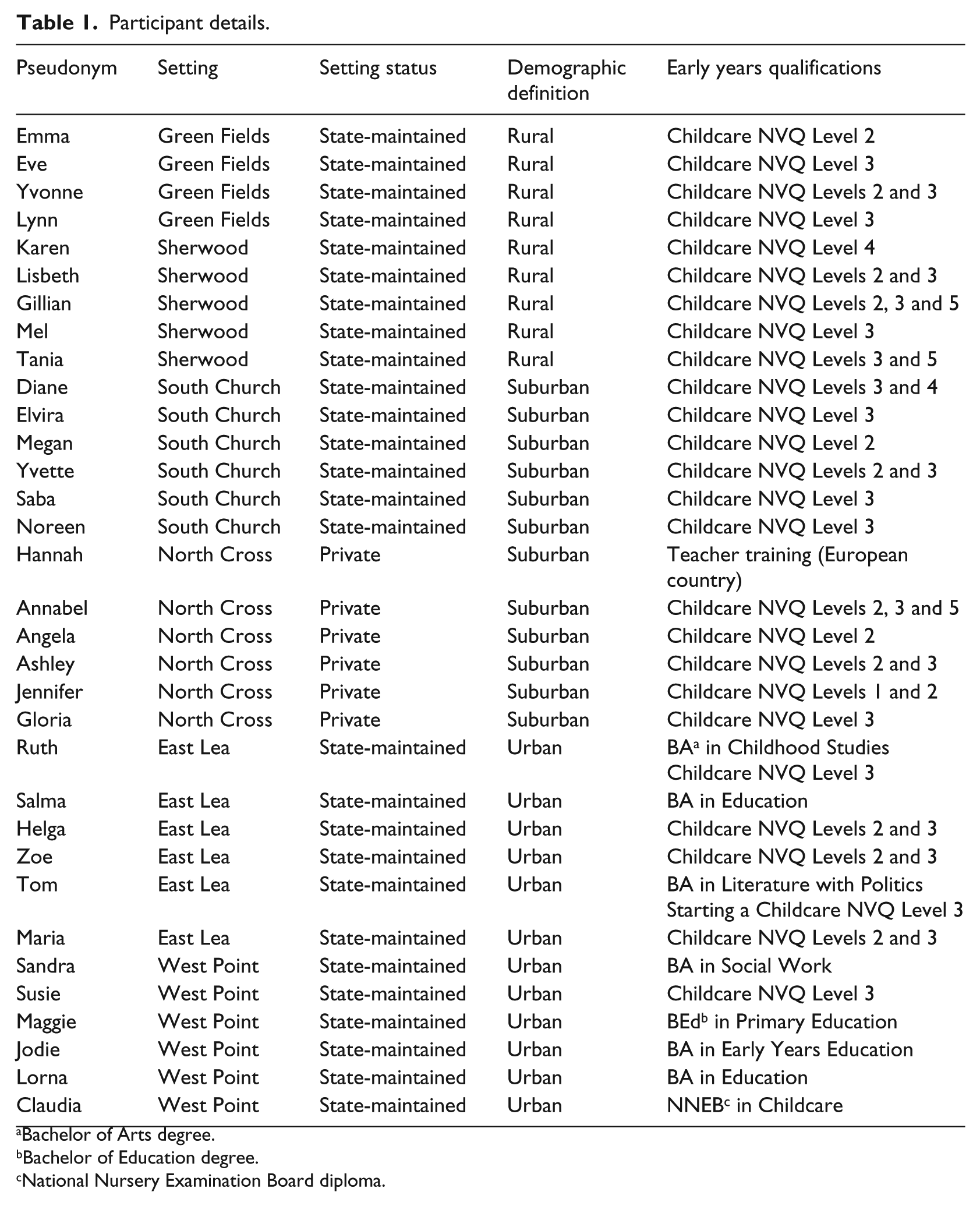
Bachelor of Arts degree.
Bachelor of Education degree.
National Nursery Examination Board diploma.
We argue that our participants’ higher education opportunities, access and experiences are defined by localism, with those in urban areas at a significant advantage when compared with their contemporaries in rural areas. Next, we show how the managers in each setting have experienced both tensions and opportunities by having graduate practitioners working in the settings they manage. We argue that the emphasis on early years educators being pushed to gain graduate status has resulted in a context that emphasises practice driven by statutory requirements to ensure school readiness amongst young children, and a move away from practice informed by Froebel’s ideas, which prioritise child-led approaches to learning in early years settings (Bruce, 2012; Tovey, 2013).
Our project was funded by the Froebel Trust with the specific aim of examining how to enact Froebelian principles in practice as part of the Trust’s strategic objective to raise the profile of Froebel’s work. However, in carrying out the research, we acknowledge the difficulty of enacting the philosophical perspective that encapsulates a Froebelian approach – for example, follow the child’s own interests and provide them with spaces and contexts to learn through play. Our earlier research project with Froebelian-trained practitioners from Froebel College confirmed that a qualification is very different to a philosophical perspective (Ball et al., 2012 ). A philosophical perspective is very complicated to teach and assess. However, in the final section of this article, we begin to speculate on how to work with existing early years staff to re-emphasise Froebel-informed practice as a means to enable practitioners to theorise their practice in a move towards what we have termed in this article as ‘developmental professionalism’. We understand the term ‘developmental professionalism’ to mean a bottom-up rather than top-down approach to the education and training of practitioners working in the early years that could follow Froebel’s advocacy to ‘Begin where the learner is, not where the learner ought to be’ (Bruce, 2011: 30).
A Froebelian approach to the early years
The key features of a Froebelian approach to the early years include respecting children’s own ideas as valuable in their own right (Liebschner, 1991), emphasising the whole child, and linking all aspects of learning through first-hand experiences and play (Tovey, 2013). Froebel believed that children’s self-directed play was an expression of their imagination, creativity and understanding of the world around them. Froebel suggested that symbolic activities, such as art, language, music and dance, all nourish the child’s inner life, as well as providing a means to transform and express understanding (Bruce, 2012). In keeping with this sentiment, Froebel created ‘gifts’ and ‘occupations’. The most well known of the gifts are wooden blocks, which encourage creative play.
Froebel formulated the term ‘kindergarten’, which, according to Weston (2000), can mean a ‘garden of children’ as well as a ‘garden for children’. In the context of the kindergarten, each child was given a plot as their responsibility, as well as being expected to tend larger communal plots (Liebschner, 1991). The aim was for young children to be involved in and knowledgeable about the wider community. A related aim was to immerse children in nature, as ‘children learnt in nature rather than just about nature’ (Tovey, 2016: 65).
In terms of practitioner education, Froebel’s intention was to develop adults’ understanding of young children’s learning. From that basis, and with an attitude of understanding, respect and interest, adults could judge when and how to intervene to support children’s learning. Liebschner (1991: xiii) notes that ‘education, instruction and teaching should in the first instance be passive and watchfully following and not dictatorial and interfering’. Liebschner describes Froebel’s emphasis that adults should observe children, rather than taking an overtly didactic stance, which could undermine children’s autonomy.
The interpretation of Froebel’s approach in contemporary early years practice contrasts with the English government’s agenda, which foregrounds academic development for young children, yet this approach has the potential to offer an alternative, more holistic discourse compared to the narrow conceptualisations of school readiness that currently circulate (Bradbury and Roberts-Holmes, 2017).
Methodology, methods and theoretical framework
The study draws on a qualitative methodology and life history interviews, which provided us with insights into the participants’ worlds through their eyes, giving their meanings and understandings of their experiences (Goodson and Sikes, 2001). We used a qualitative methodology to understand how our participants view their education, professional training, and future higher education and career prospects. The settings and sample were constructed through our professional contacts and we then deployed a snowballing technique to locate additional willing participants.
Over a 13-month period, we carried out life history interviews with 33 early years practitioners from six early years settings with different demographic features. The demographic spread was a central part of the project design and it has highlighted the influence that context has on policy enactment. ‘Localism’ in this article refers to geographical variation. Localism impacts on education policy enactment in distinctive and significant ways, including local demographics (i.e. rates of relative poverty, social-class background and quality of education), access to financial resources and access to qualified teaching staff (e.g. see Ball et al., 2012; Chowdry and Sibieta, 2011). Thus, the design takes account of the situated complexities arising from localism, and the demographic coverage has enabled us to ‘take the local context seriously’ and compare higher education provision and access in different locations (Braun et al., 2011: 585). Table 1 summarises the participants’ qualifications and reveals some interesting patterns related to geographical location.
In each setting, we conducted semi-structured interviews, with each lasting between approximately 45 minutes and 1 hour. The aim was to reveal any ‘shared patterns of experience or interpretation within a group of people who have some characteristic, attribute or experience in common’ (Goodson and Sikes, 2001: 23). The interview questions covered the participants’ early childhood experiences, their early years training pathways, and their professional experiences, principles and approaches to early years practice. All of the interviews were digitally recorded and fully transcribed to allow for thorough, thematic data coding and analysis. The initial coding of the data was informed by Straussian (Lévi-Strauss, 1987; see also Strauss and Corbin, 1990) techniques to enable us to be open to emerging analytical frameworks.
Kvale (1996: 242) contends that achieving validity and reliability in the research process is not down to ‘final verification or product control’; rather, he argues that ‘verification is built into the research process with continual checks on the credibility, plausibility and trustworthiness of the findings’. Through the process of checking, questioning and theorising the data, we engaged in a ‘continual process of validation’ and ensured that this ‘permeated the entire research process’ (Kvale, 1996: 242). The techniques to ensure reliable and valid research included asking open-ended, non-leading questions in the interviews and offering participants the opportunity to review the transcripts to ensure accuracy. We have also shared our data and preliminary analysis at conferences and in seminars to consider the multiplicity of data interpretations. Finally, we worked and reworked the accounts to achieve accurate portrayals (Kirsch, 1999).
The study complies with the ethical protocols set out by the British Educational Research Association’s (2018) revised ethical guidelines, the British Sociological Association’s (2017) ethical guidelines and the University of Roehampton’s ethical guidelines. As the research has involved semi-structured interviews, ethical concerns relating specifically to the process of qualitative interviewing were addressed. These included issues of confidentiality, anonymity in terms of protecting the respondents’ identities and obtaining informed consent. We created a consent form that sets out the conditions of participation in the proposed study, including anonymity of identity, deletion of audio files once fully transcribed, the right to withdraw at any time and the right not to answer questions throughout the research process. Anonymity has been achieved by removing any identifying factors and through the use of pseudonyms.
In this article, we draw on policy enactment theory to understand how our participants are interpreting and enacting the policy goal of achieving one graduate in each early years setting. Policy enactment theory provides a framework for interpreting the translations and enactment of national government policy at a local level (Braun et al., 2011). The central elements of policy enactment theory are interpretations and translations, defined as follows: ‘Interpretation is about strategy, and translation is about tactics, but they are also at times closely interwoven and over-lapping. They work together to enrol or hail subjects and inscribe discourse into practices’ (Braun et al., 2012: 47).
A further strand of policy enactment theory relates to the importance of ‘taking context seriously’ to better understand any localised challenges resulting from national policy, which is often overlooked or underacknowledged by government policymakers. We use policy enactment theory to interpret the situated challenges facing our participants, particularly the managers, as they attempt to further professionalise their practice and workforce respectively, and to consider the specific issues arising from a particular local context.
Professionalising the workforce: the influence of localism
The English government’s recent emphasis on further professionalising the early years workforce through increasing the numbers of graduates working in the sector has, we argue, created equity issues for those seeking to gain qualifications. Our data reveals that local context shapes the access and possibilities available to practitioners seeking to participate in higher education, and our analysis showed that there are significant discrepancies in the local provision available, depending on whether the location is urban, suburban or rural. In the rural locations we visited – Sherwood and Green Fields – all of the practitioners interviewed acknowledged that accessing higher education was a practical geographical challenge. For example, Gillian from rural Sherwood nursery told us: There’s no universities or anything around here. The closest is over 40 miles away, which is where I did the foundation degree. But as far as that, there’s the local college, but I don’t even think that’s a really good advert anymore and, to be honest, my college experience was shocking. I didn’t enjoy any of it. I felt like I went backward from school, back into primary school, and they treated you like children, which isn’t the way it should be … I don’t value the local college in the slightest.
Yvonne (Green Fields) had similar logistical challenges in accessing higher education provision in her local rural area: My mum would have to drive me to another village to get a bus which was very early in the morning … so I had to get the bus at 7 a.m. and then I’d be waiting around for another hour in town before college would start … Either that or there’s this bus service that comes … it’s like ordering a taxi but it’s a bus service … but that’s really temperamental, so it wasn’t until I learnt to drive that I could get there easily, so there were a lot of limitations because of living in such a rural area.
Emma (Green Fields) told us: ‘I got accepted in [name of nearest city] as well but that meant I’d have to leave at half five in the morning to get three buses to get to there, which just isn’t an option for me’. Because of the difficulties associated with getting to the nearest university, Gillian and Emma did not take up their places, and Gillian explained that, as a consequence of this, she has always ‘done training through work’. These examples reflect the everyday challenges facing the practitioners in our study as they attempted to enact the policy goal of having one graduate in every state-maintained early years setting. In order to access high-quality education in rural locations, the participants are required to travel into bigger market towns or cities. For the younger respondents in our sample, this challenge often meant that parents were needed to provide transportation; for the middle-aged respondents, who tended to have multiple caring commitments, time spent on long journeys away from the home, on top of the working week, was not feasible. Thus, we found tensions in the policy enactment related to our participants’ local context, highlighting a gap between policy ideals and the enactment of the policy by our practitioners according to the area where they were living and working.
In contrast, those practitioners seeking higher education in urban locations had lots of choice in terms of accessing qualifications, and localism worked to their advantage. For example, Susie (West Point) told us that, for her, college access was not an issue and the college was ‘five minutes away from home’. Lorna (West Point) similarly told us that she had no issues in finding a graduate degree programme because ‘that’s the thing, isn’t it, about this city … we have such good access to courses’. Jodie (West Point) also had easy access to a good college which was her first choice in terms of the programme of study on offer. Ruth (East Lea) had access to several local universities, selected one and gained a place at a ‘good institution’. All of the participants working in urban early years settings were able to find a choice of college courses to select from, to support their aspirations to gain more qualifications. In our study, those participants who had gained graduate qualifications had all benefitted from living and working in a city.
Our data highlights the tensions created by the local context that practitioners work in, and we identified qualification disparities created by local provision. Furthermore, a number of our participants were young and required parental support to access higher education, or they were middle-aged women who had children or caring commitments for elderly parents. This limited access to higher education was contrasted with our participants in the two urban locales, who had several choices with regard to the institutions and courses they could access. We suggest that this provides a good example of the complexities associated with enacting policy that is top-down and disconnected from the lived realities of practitioners (Urban, 2008, 2018).
Professionalising the workforce: perceptions of graduates in early years settings
A further objective of our research was to understand our participants’ perceptions about graduates working in the early years sector, and we invited them to reflect on their perceptions and, where they existed, experiences of working with graduates and non-graduates to understand any tensions and opportunities created by the current England policy agenda to upskill the early years workforce (Nutbrown, 2012; Urban, 2008). The responses to these questions from almost all of the participants frequently touched on the vocational nature of working with young children, and they identified a tension between graduates in their settings who might be steeped in qualifications but are not always the most effective practitioners when it comes to working with children. So, for example, Sandra (West Point) told us: This profession, it’s a vocation on many levels; it’s something that you go into to give a good element of yourself back – to support the children, to be intuitive, to be flexible, to be warm, affectionate, supportive, not just of the child in their own rights, but for the whole, entire family. Regardless of whether the person has got a Master’s degree or whatever it is, or has got an NVQ Level 2, my view is that where an individual is able to engage in a meaningful way with the children, that is what’s paramount to me … We are always progressing and trying to develop ourselves, and I understand the professionalism the government is looking to develop in this particular area, and I think it’s admirable, don’t get me wrong, but the most important part … It’s not necessarily the degree, but it’s the kind of professional who makes a huge difference in a child’s early years.
Sandra, along with the other four managers of state-maintained settings in our sample, commented that in her experience of working with graduates in her setting, a qualification does not always translate into a professional who is able to provide high-quality education and care for young children by being a warm, supportive and nurturing practitioner who is able to relate to children and their needs (educational, social and developmental).
An associated issue identified by the participants relates to the pay in the sector and the tension of having graduates (particularly in the context of rising graduate debt) working in a historically low-paid sector which, in the past, has been perhaps more about providing pin money for working mothers: If you’re a graduate and you’re being paid £7.50 an hour to work in childcare, which is a very demanding job, so you’re paid £14,000 a year to do it, but you could be paid £25,000–30,000 to do another job. So, unless you really, really love it and your personal circumstances allow you to do it, you’re not going to stay working in the early years. And we’ve lost, I think it’s three members of staff this year that have gone on to university, and they were our brighter, more capable members of staff who could move things forward and were quite inspiring, but they’ve gone because we can’t offer them that level of salary and that career progression as well. (Lisbeth, Sherwood) Well, personally, I’m quite enjoying learning again and being in that environment … You know, after being a mum at home for 10 years, my confidence and everything was … you know, you lose a lot of that self-esteem, that confidence … but … it does seem a little bit irrelevant because it’s a lot of paperwork and it’s a lot of box-ticking and … you know, if you’ve got common sense … of course, you don’t need to have all this paperwork to justify that. I don’t think that actually government understand that these children are the most precious thing in the parents’ life, because even if we are qualified … the job doesn’t pay. You know, it’s not like we get rewarded, payment-wise, for all that qualification. You know, we could earn more if we were working at a Tesco store, so it’s sort of like … it seems a bit bizarre. (Lynn, Green Fields) I think a lot of cons are maybe you will get graduates working in early years who don’t necessarily want to be, but because it’s the only job they can find as a graduate … so maybe just the point where people do it as a sense of a job without any actual passion for what they’re doing … You know, learning something from a book without actually having any natural ability for doing it, so, you know, learning the theories and learning the answers to questions but without being able to smile or engage with … any natural ability to engage with children. (Tom, East Lea)
These concerns raised by Lisbeth, Lynn and Tom around the early years sector, which has been historically constructed as a vocational pathway in the England that is not well paid, highlight the tension between the government’s policy aspirations to professionalise the workforce and the reality on the ground. The issue of providing affordable, high-quality childcare has to be reconciled in some way, yet there are no easy solutions. Almost half of our participants perceived that graduate-education professionals often did not have the desirable attributes needed to work with young children. We encountered a ‘them and us’ discourse in the participants’ perceptions of the more experienced, less educated practitioners and the graduate practitioners.
However, there was acknowledgement from the managers in all of our settings of the benefits of having graduates. So, for example, Lisbeth (Sherwood) explained: Similarly with other early years, really we have issues around language, vocabulary and key concepts … and so you need quality staff. We’ve got an issue in our rural location where we have a very low … historically a low GCSE [General Certificate of Secondary Education] pass rate, so the staff we’re recruiting have a low GCSE pass rate, and particularly around maths and English. So their confidence is very low, they haven’t got the underpinning knowledge, they haven’t got the vocabulary and, if you haven’t got it, you then can’t pass it onto the children that you’re working with.
It is this area of upskilling the sector that government policy attempts to improve and, drawing on Hillman and Williams’ (2015) comprehensive review of the benefits of graduate-education practitioners, we acknowledge the many benefits of this. But we argue here that, in the perceptions of our practitioners, it is complex to create and retain a quality workforce of well-educated and articulate staff, and part of this complexity relates to the pay and working conditions in the sector, which need to be further improved in England if staff retention is to be successful (Hillman and Williams, 2015).
Professionalising the workforce: developmental professionalism
The emphasis on professionalising the sector since Nutbrown’s (2012) review has required settings to ensure that their staff hold the appropriate qualifications. State-maintained settings in rural areas face a particular geographical challenge in accessing high-quality higher education. Our data also raises questions about the kind of professionalism that is needed for quality provision, and reveals an arguably divided workforce in the state-maintained sector between those who are highly qualified staff, or on a trajectory to become highly qualified, and those who are marginalised by a policy context that is perceived by the majority of our practitioners to value credentials over practice.
But perhaps there are other ways to view the professionalisation of early years practitioners that could include those who are not, for a variety of reasons, willing to undertake a degree, to refresh and build on their professional practice. According to Susie (West Point): Maybe it isn’t that they should be graduates; maybe it should be that training is provided in a different way. So, we have inset days, five inset days a year for us, and I know we have some sort of a say on that, and that would be nice because then we could say, ‘Actually, we’d love a refresher on this or a refresher on that’, and maybe that would help … because some people can get stale, so I can see actually the benefits of it is that you can, not really teach, but teach people who are a bit fixated to maybe see outside the box a bit, maybe.
Susie’s suggestion points to a way of working with existing staff who are passionate about working with children to professionalise their practice in line with a developmental understanding of professionalism and government expectations for the sector. Such an approach would need to be constructed in line with respected, theoretically informed approaches to early childhood education, including Froebel’s philosophy.
We contend that if our participants were able to immerse themselves in their setting with theory that fits their practice, rather than through attending a higher education institution, there is a space for reflexive practice that could develop and enhance developmental professionalism. In our other publications from this project (Hoskins and Smedley (accepted); Smedley and Hoskins, 2018), we argue that a lot of the practice discussed in our interviews is Froebelian, even if not overtly identified as such. By raising the theoretical voice and philosophy that encompasses a Froebelian approach, we could enhance the professional status of the many practitioners who we found to be integrated into their community and identified by the managers in all of our state-maintained settings as providing quality care and education to young children. Developmental professionalism is about taking a different, inclusive approach to professionalising the workforce that is more in the control of the practitioners and requires them to take a holistic approach to what it means to be an early years practitioner. Such an approach could enable early years practitioners who are keen to develop and professionalise their practice, but who are unable to access appropriate education and training, to develop a theoretical voice and philosophy to further underpin and inform their practice.
Conclusions
Our data has shown that local context influences early years settings’ possibilities to enact national, top-down government policy agendas. The tensions created for the practitioners and managers working in rural locations attempting to access higher education revealed significant disparities in the opportunities available to them when compared with those working in urban and suburban locations. We found that over half of our sample perceived graduate status in a negative light, pointing to how potentially divisive an issue graduate status is in state-maintained early years settings. Whilst Lisbeth, along with four of the other participants, perceived that there are clear benefits in having graduates in early years settings – for reasons including the quality of the language used with the children, the knowledge of latest effective practice, and ideas about how to motivate and challenge children and staff – we also encountered a number of participants (half of our sample) who could be helped to develop their practice if the narrow policy requirements for the early years in the UK could be challenged to become more inclusive and less prescriptive. Our research findings highlight that the existing key route available for our participants to develop their professional identity is through higher education participation and, for some in rural locales, the options are distinctly limited and involve prohibitively long journeys. Over half of our participants would struggle to get posts if they left their current setting due to the credentialisation of the sector, and this would mean losing experienced practitioners in a sector that is already facing a crisis due to staff shortages in England (Gaunt, 2018).
Our data analysis indicates implications for the early years sector, highlighting the need to reconsider and re-evaluate national policies that pay little attention to the complexities arising from the challenges related to local context.
Footnotes
Acknowledgements
We would like to thank the practitioners who participated in this study and gave generously of their time to share their stories.
Funding
We would like to thank the Froebel Trust for generously funding this research project.
