



Abstract
This article emerged through the author’s involvement with the University of Victoria’s Investigating Quality in Early Learning Environments project in British Columbia. During an eight-month internship, the author had the opportunity to collaborate with community facilitators in the province; participate in monthly learning-circle discussions with educators and researchers; share pedagogical narrations; connect theory to practice explicitly; and think with children’s bodily encounters. This article contributes to broader and deeper discussions about children’s bodies by placing value on reflective thought, decision-making, and action. While unpacking her own tensions of letting go of common assumptions about children’s bodies, the author considers the ethical and political implications of bodily encounters. To do this, she teases out the growing discourse of risky play and describes the value of thinking in moments of not knowing. Then, the author considers how early childhood education might restory the image of children’s bodies through conversations with other educators in a particular setting, while complexifying young bodies during a risky-play scenario of pulling loose boards onto a staircase. Through post-foundational theory, the educators and the author advocate for bodies by contesting the powers of dominant discourse and considering how bodies might search for meaning in the world. By opening space to think differently, by noticing, and by paying deep attention to the corporeal as it explores and generates truths that bring forth creative evolution, the author was taken by surprise to see what lies beyond that which she thought was possible.
Keywords
“Watch out guys, bombs away! We can use it jumping and a ramp.” “And we had two sprained ankles. It can be a ramp and a jump.” On a warm spring day, two bare-footed children’s bodies move carefully in an outside play yard as they work together, contributing high amounts of energy to lifting and positioning loose boards. They carry the boards across the low, grassy yard and together decide to line them up on the steps that lead to the upper floor of the childcare centre. It seems that their intention is to be able to sit on the boards and slide down from the midpoint of the steps to the platform below. They squeal and jump with excitement while speaking about how their bodies might get hurt. I notice how their bodies wriggle with a rippling thrill as they collaborate in ways that freely explore a delicious and intoxicating space of free play. (Field notes, see Figure 1)
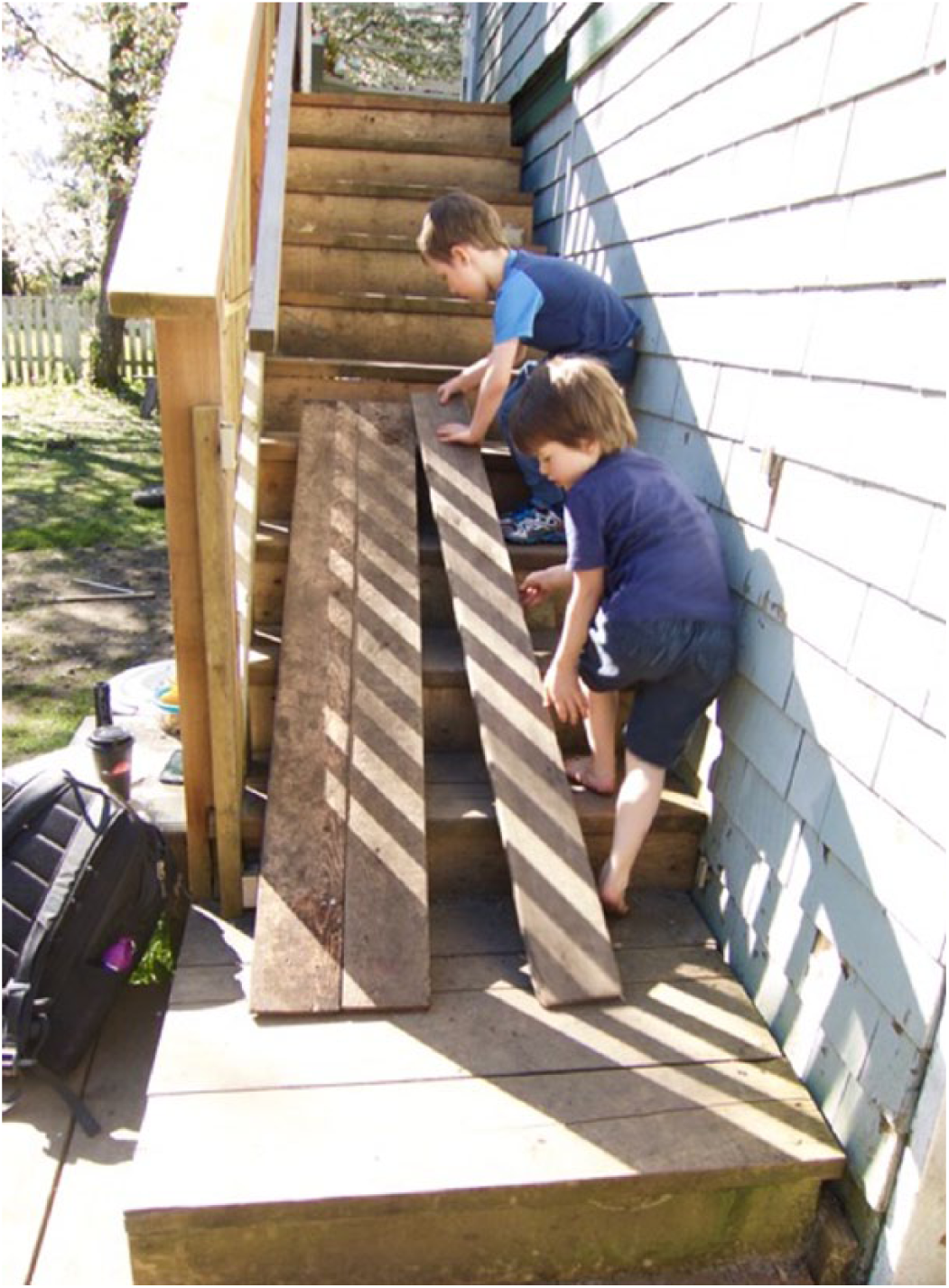
Building a ramp.
As an experienced early childhood educator, graduate student, and new researcher, I captured the above scenario as a momentary fragment during a bodily encounter shared by two children, as seen through my interpretation. This fragment only encompasses a small portion of one visit in a much longer series of play during an eight-month internship in the University of Victoria’s Investigating Quality in Early Learning Environments project (in one of many site visits to a childcare center). This action-research project was designed by Dr Veronica Pacini-Ketchabaw and Dr Alan Pence in the School of Child and Youth Care. The project’s aim was to broaden and deepen discussions on quality in early childhood education at local, regional, national, and international levels (Pence and Pacini-Ketchabaw, 2010, 2012). My role in the project included collaborating with one community facilitator; participating in monthly learning-circle discussions with educators and researchers; reading and reflecting on readings through conversations with educators and other stakeholders; engaging with my own reflective writing that connected theory and practice; and collecting data during site visits at a childcare center.
During my internship, I noticed a shift from what I knew children’s bodies were supposed to do and be to a place of uncertainty about the image of the child’s body. The scenario of loose boards on the staircase brought forward my own reflections, which leaned on Pacini-Ketchabaw et al.’s (2015: xi) ideas of “learning to complexify” early childhood education practices.
This article begins with a fragmented scenario of children’s play that sets a framework for executing the employment of pedagogical narration as a methodology for the purpose of resisting dominant assumptions and opening space for ethical approaches to early childhood education research. I continue by unpacking my own tensions that emerged when choosing to let go of embedded dominant assumptions about children’s bodies during this particular scenario. My aim is to destabilize the discourses operating in regard to the young body. Through collaborative reflection with the educators, I question the regulation of children’s bodies from a Euro-western cultural lens. I use the term “Euro-western” as coming from European settler culture, which differs from other contexts such as Indigenous understandings. I describe a sociohistorical account of regulating children’s bodies through systems of institutionalized power and consider how education has become entrenched in assumptions that construct common images of bodies. Next, I think carefully about the ethical and political implications of valuing social justice for children’s bodies. I describe research within the growing discourse of risky play that values the way risky play enhances bodies’ perception and competence in decision-making. I regard a broader perspective of risk as a material discursive practice in relation to childhood, play, and well-being. The idea of risky play connects with educator tensions of thinking in moments of not knowing that complexify how bodies search for meaning in the world. Then I move to restorying children’s bodily encounters, giving careful consideration to inviting creative thinking, doing, and being that advocates for alternative conceptualizations of children’s bodily encounters. Finally, I reveal the surprises that I discovered during my interpretation of the bodily encounters when loose boards were placed on the staircase.
With the intention of opening alternative stories about the image of children’s bodies in early childhood education, my own transformative experience through the project led me to driving questions that asked how early childhood education might reconceptualize the possibilities of children’s bodily encounters while considering the ethical implications of the field.
Restorying the images of children’s bodies through pedagogical narration
My research methodology uses pedagogical narration, a term used in British Columbia that refers to pedagogical documentation (Hodgins, 2012). Berger (2010) defines these narrations as provocations to think differently and resist universal conceptions of childhood, education, learning, and assessment. In other words, stories of moments during children’s play hold the potential to disrupt constraining discourses by complexifying practice and blurring the boundaries of binary thinking such as child/adult, right/wrong, and theory/practice. This is important because discourses are embedded in government policy such as licensing regulations, which script what bodies can and cannot do and be. Following Hodgins (2012), pedagogical narrations open spaces for dialogue, inviting an ethical approach to early childhood research. My pedagogical narration begins with the scenario above, and through this article I execute this methodology by resisting a single universal story situated in developmental psychology, and welcome an unknown, messy, and complex bodily encounter experienced in early childhood education.
In an effort to challenge past conceptualizations of children’s bodies in the scenario presented above, the educators and I participated in collaborative conversations, first attuning to the children’s bodies. We struggled to listen with a responsibility to make meaning from what was communicated verbally and non-verbally, without preconceived ideas of correctness. The work of open listening, inspired by Davies (2011), required us to shift our common perceptions about children’s bodies to really listen, see, and feel the bodily encounter in the moment, with an open mind. This meant not knowing in advance what knowledges would emerge from the entanglements of the encounter. We found this work to be difficult, and it opened what Deleuze (1994, cited in Davies, 2014a: 28) calls “differentiation” to becoming other than oneself. Davies (2014b: 734) argues that this journey of “an exciting and very demanding path of experimentation … can take us to the edge of the not-yet-known,” and thus begins to trace new pathways. We focused on the way the children’s bodies explored, and how they found meaningful pathways of becoming part of the world.
As I photographed this moment, the educators and I wondered what the families would think if we shared the encounter with them. Since my visits did not intersect with family members, situated knowledge that surely must have been embedded within the sociocultural contexts of each child’s and educator’s family was a limitation to this project. I wondered if a consensus with each family might be reached about how best to care for and educate their child, or would the process only produce conflict through democratic practices that value order? Dahlberg and Moss (2005) unpack this idea by challenging the hierarchical positioning of staff as experts over parents, and suggest forming a partnership of narratives that build local democratic practice. Sharing the encounter of two bodies building a slide on steps through this pedagogical narration provided a format to expose the potentiality of children’s bodies to the families in a public way (Hodgins, 2012; Rinaldi, 2006). The educators and I agreed that by recognizing children’s bodies as capable through public documentation, we could become facilitators of discussions about rules rather than enforcers of rules (Atkinson, 2012). By opening conversations with children, families, communities, and governments through writing this research-project article, we believe that educational communities have the potential to restory bodily images from common status-quo thinking toward new knowledges that work to create courageous and unexpected futures (Rinaldi, 2012).
The pedagogical narration I share highlights a disruption from what Foucault (1987, cited in Jones-Smith, 2016: 511) described as maintaining the powerful influence that often gets storied from dominant discourses in society. Instead, from a position that challenges truth, the educators and I wondered what might be possible if no single story of universal truth existed outside of the experience. By reconceptualizing the image portrayed by these children’s bodies, we noticed the emergence of a different cultural and relational practice. The pedagogical narration can be understood as restorying what has been socially constructed as common through relationships that have shared and confirmed what is assumed and expected across communities (Gergen and Gergen, 2004). The process of restorying can be seen as a desire to think critically about how to reproduce and inherit meaning in early childhood education (Pacini-Ketchabaw et al., 2015). My interpretation sees bodily encounters as affected in ways that wake up a sense of opportunity, compassion for others, and excitement about creating innovative forms of producing something useful, without adult ideas or orders. From a cultural and contextual tradition that communicates enormous potential for the unknown, reimagining ideas that are constrained by what has been considered traditional truths about children’s bodily experiences can open endless possibilities. In this way, playing at the edge of reason can open new stories and worlds of meaning (Gergen and Gergen, 2004).
Unpacking my own tensions while letting go of common assumptions
The encounter I describe above struck me with a curiosity regarding bodies’ capacity to think, create, collaborate, reason, and act in ways that in my past as an early childhood educator I would have shut down because of their potential danger. My previous experience upheld an image of the educator embedded in a technocratic practice that used authority to control the actions of children’s bodies, complying with dominant assumptions about the way bodies are understood. The activity of placing loose boards on stairs would have been stopped because this bodily encounter would conflict with my previous assumptions about what children’s bodies should and should not do or be. Through time spent observing, collaborating, and reflecting within the project, my image of the child’s body transformed from a position of knowing children’s bodies to one of complexifying bodies as unknown and surprising. During the moments in the scenario, I was aware of my urge to stop what I considered dangerous play involving loose boards on a staircase. I felt the tension of going beyond my own comfort level while holding myself back from protecting bare feet from splinters or using my voice to suggest safer activities. I took a deep breath, consciously choosing to move to a place of discomfort, beyond certainty, and embrace the unknown. I did this by holding onto my own curiosity about where this encounter would go.
Opening exploratory space
The intended pedagogy in this particular childcare center was to open exploratory space that invited bodily encounters by offering loose materials and a sense of freedom in decision-making during play. Learning from research that challenges the regulation and control of bodies, I saw what might have been lost if I had intervened with the flow of play during these moments. I noticed the multiple ways of learning that came through these bodies, which helped me to recognize how pedagogy might evolve. Thinking deeply while observing the children’s bodies in these moments shifted my perceptions about the field of early childhood education. For example, I knew I could not possibly have prescribed this scenario of exploratory learning using a pre-packaged teaching activity aimed at putting particular pedagogical intentions into a compartmentalized learning space and expecting children’s bodies to comply. The bodily encounter explored creativity, discovered compassion for others through sharing, created language, and experimented with problem-solving. I saw through the encounter that young bodies could be understood as sites of politics, finding their place in social and cultural contexts, which I describe further in the section about the implications of bodies as ethical and political. These bodies showed great capacity through the immense, urgent energy of unplanned and playful exploration, which could not possibly have been met through planning, regulation, or discipline (Skott-Myhre, 2008).
While reflecting on opening exploratory space, I questioned the need to regulate children’s bodies, looking beyond Euro-western culture’s dominant assumptions in early childhood pedagogy.
The regulation of children’s bodies in early childhood education
My history
My experience in early childhood education has enacted dominant assumptions about how children’s bodies should play. For instance, children’s play has not traditionally included barefoot experimentation with splintered, loose boards on steep structures with potential safety hazards. Stairs were created and understood with the intention of assisting bodies up or down structures, and climbers learn to approach stairs as a life skill (Cesari et al., 2003).
In my experience, making demands on bodies through regulation fits within Euro-western culture’s status-quo thinking. For example, my previous image of the early childhood educator followed the common expectation that children’s bodily encounters looked like standing in line, sitting quietly, and following routines within a schedule. From this discursive cultural perspective, I had learned that educators must ensure that young bodily encounters stay within the confines of compliance through a lens that values safety and regulation (Government of British Columbia, 2008).
However, following the work of MacNaughton (2005), regulating children’s bodies prescribes predictable “truths” in developmental psychology that have real implications for bodies because they work to constrain and dictate the possibilities of what bodies can and cannot do and be. These truths position the image of the early childhood educator as the trusted authority figure who holds the responsibility of producing similar bodies that fit a particular mold in society. For example, when a child’s body acts outside the margins of desired expectation by placing loose boards on a staircase, educators might try to stop children or redirect their play. Questioning my own image as an educator opened new ways of thinking about regulating children’s bodies.
The rise of regulating bodies through a sociohistorical lens
The encounter led me to consider sociohistorical events that shaped educational systems toward what has become a common system of regulating children’s bodies. Burman (2008) notes that the new field of psychology fell in line with meeting the demands of prevailing social anxieties in the late 19th century. For example, the urbanization in England that came through industrialization produced appalling conditions of poor health and poverty. Burman (2008) writes: “The physical state of the general population was a matter of widespread concern … politicians and the emerging social scientists focused their attention on the ‘quality’ of the population” (18). Burman adds that health clinics and the nursery school enabled large numbers of children’s bodies to be observed by skilled experts under “experimental conditions” (20). This surveillance helped to produce an understanding of what has popularly become known in psychology as the “normal child.” The construction of a normal child’s body instilled what has become accepted as good habits, defined by keeping order through critical observation or examination. Drawing attention to bodies that fall outside the norm of following good habits, Sukarieh and Tannock (2015) describe that a century of pathologizing the body in developmental discourse has been viewed as regular practice. By putting forward an image of the child’s body through the negative lens of its potential inability or abnormality, bodies have become deficit categorizations based on scales that measure and compare chronological age with ability (Burman, 2008). Hence, originating from an intention of improving health and poverty, institutions moved toward psychologizing, organizing, pathologizing, and therefore normalizing bodies through various forms of standardization. Continuing with this idea, Burman (2008: 20) suggests that a process of standardization has “set up a reciprocal dependence between the normal and abnormal,” making the abnormal possible. This form of dualistic thinking understands regulation only through oppositional or binary categories, such as acceptable or not acceptable, and ignores the nuances between them. This thinking leads to exclusion, such that one child’s body is desirable while another is not (Dahlberg and Moss, 2005: 26). For example, holding highly productive bodies as the model for educational achievement reinforces that problem bodies, in comparison, do not excel in educational settings. These ideas reinforce negative images of children’s bodies.
Continuing with the historical context of Euro-western institutional systems of power, Dahlberg and Moss (2005) lean on Deleuze’s (1992: 50) description of disciplinary societies that worked as “normalizing machines” for the purpose of keeping disciplinary methods in check. Techniques of disciplinary power grew with the rise of institutions such as factories, barracks, hospitals, and schools, constructing societies of control through governance. Adding the work of Rose (1999), Dahlberg and Moss (2005) explain that the school was a particularly important institution for normalization through regimes of supervision and judgment in relation to norms of scholarly moral behavior. They argue that the preschool can be seen as “an institution where disciplinary power is deployed through a range of knowledges and technologies that form part of a dominant discourse” (52). These knowledges contribute to what has become known as developmentally appropriate practice (National Association, 2009), which works inside a framework of knowing what, how, and when children need to learn. If educators can regulate a child’s body, then developmental theories can be understood as having institutionalized power that shapes children’s bodies (Butler, 1997). In these ways, normativity prescribes and conceptualizes bodies as the “object”—“an agent and instrument that acts and is acted upon by others” (Pacini-Ketchabaw et al., 2015: 53).
These regularities dictate how children’s bodies eat, move, and develop in political and cultural contexts (Millei and Imre, 2015). Considering the framework of dominant thinking, Millei and Cliff (2014) suggest that temporal and spatial controls have become common alongside discipline to monitor children’s bodily encounters to fit the needs that become the norms of society. Therefore, through common historical circumstances of regulation and discipline in educational institutions, the image of the child’s body has emerged as weak, incomplete, innocent, incapable, and in need of adult intervention (Pacini-Ketchabaw et al., 2015). Yet, from an ethical and political perspective, how might educational systems shift from controlling bodies through systems of regulation and discipline toward a more positive image of the child’s bodily experience that advocates thinking and doing differently?
Ethical and political implications of children’s bodies
If the contestations of children’s bodies can be seen as negotiations of unknown creativities in everyday moments, how might contradictions be considered ethical openings for understanding and enhancing meaningful foundations for living? Dahlberg and Moss (2005) consider the specific relationship between ethics and practice, noting the implications of favored approaches through a particular ethical lens, and thinking with Levinas’s notion of the “ethics of an encounter” (13). Such an ethics, they argue, requires a matching political theory of care, to place value at the heart of a “just, pluralistic, democratic society” (123). My interpretation of the child’s body as a political site connects the emergent exploration and act of finding one’s place in the world as a citizen who belongs through meaningful corporeal experiences that provide a good life.
With an incredible responsibility to provide quality care “to the highest standards of ethical practice,” educators in British Columbia are described as having “a significant, enduring impact on children’s lives” (Early Childhood Educators, 2008: 1). Yet I wonder how each educator might interpret these ethical standards differently. For example, what ethical goals of pedagogy might be reached within practice routines that focus on quality through regulation and discipline? How might ethical practice support social justice for children’s bodily encounters? When binary thinking, such as acceptable/not acceptable and safe/at risk, becomes muddled and the script is taken away, how might children’s bodily experience be perceived differently? Is it possible that, without the comfort of binary thinking, some educators might find themselves in a terrifying place of risk?
The growing discourse of risky play
Moving toward reconceptualizing the possibilities of children’s bodily encounters, I have noticed a growing discourse of risky play in early childhood education, which invited me to unpack my own history and consider the relevance of risk, while managing and promoting risk-taking as beneficial for the well-being of children’s bodily encounters (Lester and Russell, 2014). Thinking with Lavrysen et al. (2017), I noticed that inviting risky play in educational contexts had a positive impact for young bodily encounters. Instead of overprotecting young bodies, the educators and I intended to promote risk-taking by considering our own beliefs and attitudes about risk-taking to loosen barriers and encourage positive risk-taking experiences for young bodies. Taking risks while placing loose boards on steps provided an example of an exciting and challenging experimental activity that restoried the image of children’s bodily encounters.
Following Lester and Russell’s (2014: 242) broader perspective, which considers a contemporary understanding of how risk plays out in material discursive practices in relation to childhood play, and well-being, I realized the challenge of inviting risky behavior, because it “turn[s] conventional wisdom on its head in pretty much the same fashion as children do when playing.” My approach to complexify bodily encounters during play multiplies the possibilities between risk and material discursive practices of childhood, and entangles with what might become multiple creativities with play, risk, and moving risky play beyond traditional understandings. By disrupting actions such as the organizing, identifying, measuring, and classifying of children’s bodies, I am reminded that life itself is rarely given attention. To think about risky play differently, I consider arranging the interwoven ideas of relationality, materiality, and performativity to explore worldly connections of bodies through a perspective of emergence. If a body’s life is emergent, there is no fixed, self-contained identity.
Connecting the discourse of risky play with the Investigating Quality in Early Learning Environments project, Atkinson et al. (2017: 21) bring different perspectives to my ideas about what educator risk-taking might look and feel like when “creat[ing] spaces to test ideas, play with understandings, stand back, notice, and wonder what other ways of being and doing are possible.” Thinking with the growing discourse of risky play as beneficial for bodies, the educators and I shared feelings of worry, anxiety, and conflict while observing children’s bodies that engage in risky play. These tensions invited questions about the ethical responsibilities of educators, such as: What is too risky for children’s bodies? What is safe? Are these bodies old enough to develop risk perception? Are they capable of making decisions using risk competence? Where are my feelings of discomfort coming from? Am I enjoying the encounter and, if not, what would it take to bring enjoyment? Who decides what bodies can and cannot do, and how far this exploration should go? What are the tensions among educators? What would the families think of this level of risk? What would licensing regulations say about the encounter? What are the children’s bodies saying? What are the ethics of this encounter?
Adding Lenz Taguchi’s (2008) ideas to my thoughts of children’s bodily encounters brings value in consciously problematizing what educators take for granted, and invites resistance to the dominant thinking that is most available to us. By putting forward the choices made in practice as our responsibility and questioning our role during children’s bodily encounters of risky play, educators have the opportunity to practice an ethic of resistance by disrupting common thinking as a vehicle for negotiating ethically grounded professional choices.
In order to reconceptualize the possibilities of children’s bodily encounters during risky play, I unpacked my own history and its connection to risk-taking and bodily encounters. Then I loosened barriers constrained by dominant thinking and reimagined my responsibility as an educator. This involved complexifying and inviting bodily encounters during play. It meant disrupting the organization and classification of bodies, and attending instead to practices that shine light on the ethical negotiation of life as emergent.
“Thinking in moments of not knowing”
While observing the children’s bodies in the scenario I described earlier, I felt tensions related to the discourse of risky play. While grappling with these uncertainties, I was guided by Berger’s (2015: 130) “thinking in moments of not knowing.” How might the idea of not knowing what a child’s body will or can do, as an inquiry, invite what Loiselle et al. (2012: 188) refer to as “exploration of movement, connection and expansion in and between the lines of power, resistance, desire and possibility in order to offer a departure from linear or reductive methods?” While considering this and other questions that complexify early childhood pedagogies with respect to bodily encounters, below I move to unpack further the idea of working in the space of not knowing.
Possibilities for bodies’ creativity
As I watched the scenario of children’s bodies working with loose boards on the steps, I was astonished at how much I did not know and could not predict about how the scenario would unfold. These young bodies were taking risks that broke through common images of “rendering children passive and needy recipients of expertise” (Lester and Russell, 2014: 241), because they flourished with a sense of creative freedom. This free exploration opened possibilities for bodies that invited social connection, physical and emotional care for each other, and new forms of language. Their bodies connected with grunts, squeals, and high-pitched screams as they tripped and fell, only to pick their bodies up again and move forward. If children’s bodies are understood as resourceful, contradictory workers who push boundaries to the edge of what their bodies are capable of doing, I wonder what might be lost when a body is “under constant surveillance, or at least perceive[s] itself to be” (Millei and Cliff, 2014: 250), within a framework of control?
In pursuing these thoughts, I recognize that these bodies have escaped from what Wright (2009), leaning on Foucault (1977), considers utility, as seen in prisons, barracks, and schools that manage bodies through regularizing routines and habits. Conversely, in this particular childcare center, the children’s bodies seem to find a sense of freedom that invites creativity while flourishing at the edge of what their bodies are capable of knowing, doing, and being. This sense of creative freedom happens through a bodily encounter that breaks free from predictability.
Bodies as searching for meaning in the world
Following Skott-Myhre (2008), it is through the body that humans come to know the world. Although the body’s sensory apparatus allows perception, this does not mean that bodies know the world as it is. Through systems of culturally inscribed experience, social structures and norms are learned in an ever-changing historical environment. Current conditions confirm and replicate bodies. Thus, the body is subject to what has been socially inherited, and it is presented as the site that performs social norms and structures (Skott-Myhre, 2008). Skott-Myhre draws from Butler (1997), noting that beyond sensory experience such as sight and touch, bodies can hold the possibility of resistance when asserting alternate discourses aside from what is considered common. Performative bodies are therefore not determined ontologically or biologically, but produced by cultural processes. When children’s bodies break free from common patterns, such as using loose boards on stairs to make a slide, predictability is also broken. When predictability is broken, generally there is a response from the dominant society to restore the body to a normative baseline of function premised on an essentialized normal body. Unpredictability, seen as a limitation by the dominant society, brings about disciplinary responses such as institutionalization, which has proclaimed these children’s bodies as “radically distinct and inferior to the normative body” (Skott-Myhre, 2008: 62). In this way, the body is produced as an effect of the social through its performances of historical struggles over knowledge and power. Thus, the body’s performances do not arise from within the body, but are the result of the struggle for meaning and structure in society (64).
Skott-Myhre (2008) refers to Spinoza’s (2000) assertion that no one knows what a body can do, while Spinoza defines a body as made up of many composite parts. He argues that each body has structural similarities, such as molecules and organs, but radically differing expressive capacities. In this way, each body is a unique expression of the life force. This force of each body, which is made up of many bodies, resides in its desire to persist in its unique expression of life. When the collision with other bodies is amplified, this desire to persist in a unique expression is given more force. If the powers of the collision and the unique force have a common capacity, creative forces can move forth. If the forces share no commonality, they are toxic and therefore decrease each other’s life force. This view of living matter as expressive of an infinite number of differing capacities is the reason why Spinoza claimed that it is impossible to predict what a body can do. Skott-Myhre (2008: 67), building on Spinoza’s understanding that a body cannot be reduced to any particular set of structures, asserts that the ontology of a child’s body can be perceived as holding an infinite capacity of “expression and force based in new collisions with other bodies it has not encountered yet.” Being and becoming are the same, but are shown at different moments of activity and rest within the larger set of relations that define the unique logic of each body’s constitution by the collectivity of bodies that comprise it. As Skott-Myhre explains it, Spinozist ontology describes the process whereby “life produces itself through the infinitude of expressive capacities found in both the individual body and the infinite collective of bodies that is life at any given moment” (71).
Skott-Myhre (2008) refers to Deleuze and Guattari’s (1987) reference to both individual and communal pathways that lie beyond normality, producing lines of flight, which are found in the creative performance of the body by the body. In this way, the body is the subject of life that produces the space of life by offering a mode of performance and expression that goes beyond questioning. The body cannot know itself until it collides with all of the other bodies in the moment of the act of expression. Bodies that intersect between lines of history, politics, discourse, technology, and geography merge and collide with other bodies in flight through time.
During the bodily encounter with loose boards on the stairs, I felt the expressive language of the body’s performance break apart the logic of the socially constructed body, not by making sense of it, but by challenging the laws of physical sense through a new avenue of time and context (Skott-Myhre, 2008).
Minor politics and the power of children’s bodies
Restorying can free what can feel like a cramped space of care by opening new ideas in pedagogy. Drawing on Rose (1999) concept of minor politics, Dahlberg and Moss (2005: 138) explain the small reworkings of “the ways in which creativity arises out of the situation of human beings engaged in particular relations of force and meaning, and what is made of the possibilities of that location.” By building a slide on the steps, the children’s bodies became the force of power that brought meaning to the activity, as a site of minor politics. Through the activity in the scenario, I saw these bodies reworking Euro-western understandings of normality. While traveling on a journey to unscripted places in their play, their bodies were oblivious to what might have been considered proper, sensible, and normal behavior. They flourished in the encounter during moments of discovering new modes of possibility. Rinaldi (2012) views a child’s body as powerful from the moment of birth, because it is open to the world’s possibilities. If a baby’s body enters the world with openness about what, when, and how ideas emerge, imagine the possibilities of expanding what might be considered normal.
Advocating for alternative perceptions of children’s bodies
With the purpose of advocating for alternative perceptions of children’s bodies, I lean on Hodgins’ (2012: 10) ideas of attending to “complexity, multiplicity, and plurality.” Without pre-packaged learning outcomes based on universal thinking about predictability, images of children’s bodies can be seen as unique and full of variables that highlight complexity. These ideas invite different worlds where multiple possibilities for restorying bodies can come out of each moment. With the potential to open spaces that advocate for new perceptions, encounters with children’s bodies can resist single-mindedness.
With this in mind, there is a multitude of possibilities that contribute to the ontology of early childhood education through the images of children’s bodies. As I observe bodies doing their work through these moments, I continuously question what kind of practice lies beyond the boundaries of taken-for-granted, universalistic, and normalizing ideas and practices (Lenz Taguchi, 2008). Questions that ask what, where, when, why, and how frame thoughts that disrupt powerful discourses and advocate for alternate perceptions of children’s bodies. In this way, perhaps difference can be made to matter (Davies, 2014b).
My surprises
My driving questions in this article ask how early childhood education might reconceptualize the possibilities of children’s bodies, and what the ethical implications of the field are, relating to children’s bodies. By opening possibilities of how loose boards can shift images of young children’s curious, wiggly, and experimental bodies, space emerged for not-yet-known ideas. These moments that complexified bodies unveiled an absurdity within common sense, which is often described as regulation. This article unpacks questions about how my own image of children’s bodies shifted from a place of common, normative systems of education and care, which assumed high levels of controlling and regulating children’s bodies, toward restorying bodies.
When the educators and I asked with curiosity what might emerge for children’s bodies while opening different perceptions about our own images of bodies, I was driven by a longing to go beyond what was known and venture into the unknown. This yearning, described by Moss (2014) as becoming unbound from the determined and experimenting in an open-ended and open-minded way that values difference, links with the feeling of being surprised. My first surprise in the scenario was seeing these young bodies as strong enough to lift boards on their own and capable of moving them to a risky place through a process of play that did not break any bones, create splinters, or bring tears. The activity became an encounter that opened new stories about what children’s bodies can do, think, and be. The second surprise was envisioning change by imagining new possibility that radically pushed the boundaries of normal existence. Beyond rules stating that there should be no boards on staircases, we created a disruption in expectation that led to excited squeals and jumps alongside creative innovation. The children’s bodies in these moments showed me that we were going to a place outside the ordinary by cracking assumptive ideas (Moss, 2007). We found a close connection between contesting dominant discourses, thinking differently, and change. The third surprise was that the children, educators, and I felt wonderfully connected to the world in a way that brought tremendous meaning as a result of the encounter. It was the feeling of exaltation that went beyond what was known as possible.
Footnotes
Declaration of Conflicting Interests
The author(s) declared no potential conflicts of interest with respect to the research, authorship, and/or publication of this article.
Funding
The author(s) received no financial support for the research, authorship, and/or publication of this article.