



Abstract
This article evaluates the concept of infant ‘belonging’, central to several national curricula for early childhood education and care. Here, the authors focus on Australia’s Early Years Learning Framework. Four different meanings attach to ‘belonging’ in the Early Years Learning Framework, the primary being sociopolitical. However, ‘a sense of belonging’ is also proposed as something that should be observable and demonstrable in infants and toddlers – such demonstration being held up as one of the keys to quality outcomes in early childhood education and care. The Early Years Learning Framework endows belonging with two contrasting meanings when applied to infants. The first, the authors call ‘marked belonging’, and it refers to the infant’s exclusion from or inclusion in defined groups of others. The second, the authors provisionally call ‘unmarked’ belonging. Differences between these two meanings of infant belonging are explored by describing two contrasting observational vignettes from video recordings of infants in early childhood education and care. The authors conclude that ‘belonging’ is not a helpful way to refer to, or empirically demonstrate, an infant’s mundane comfort or ‘unmarked’ agentive ease in shared early childhood education and care settings. A better way to conceptualise and research this would be through the prism of infants’ proven capacity to participate in groups.
Introduction
Several current curriculum frameworks for infants and toddlers valorise belonging (see the national curricula of Australia, New Zealand and, less overtly, Greece, the UK and Reggio Emilia schools, as in Italy (Papathedorou, 2010)). This article documents our attempts to provide an empirical knowledge base for these appeals to belonging, especially as they relate to the first year of life (‘infancy’). For expository purposes, we focus on a single framework – Belonging, Being and Becoming: The Early Years Learning Framework for Australia or EYLF (Department of Education, 2009) – from which we draw out some key statements and assumptions about belonging. Our focus is on the ‘learning outcomes’ the EYLF is designed to produce, as these relate to belonging – outcomes that the EYLF tells us are all ‘observable’ (Department of Education, 2009: 19), and hence, presumably, assessable. For this article, we examine the EYLF’s aspiration that children should observably ‘demonstrate a sense of belonging and comfort in their environments’ (26).
The word ‘belonging’ is ‘elastic’, stretching to have several different meanings in curricula like the EYLF (Sumsion and Wong, 2011), and reflecting an ambiguity that is widespread in the literature on belonging (Hagerty et al., 1992; Stratigos et al., 2014). Only one of these meanings – what we call occasion-specific or ‘marked’ belonging – is potentially visible in the behaviour of infants, but not even that captures the desideratum at issue – something that we provisionally label ‘comfort’ or, as discussed later, ‘unmarked’ agentive ease. We introduce and contrast two empirical examples to illustrate one path which empirical investigation might take if a generic belonging-like dimension of quality is to become empirically demonstrable in the care and education of infants and toddlers.
‘Belonging’ in early childhood curricula: the EYLF
We are fortunate to have several lucid accounts from behind the scenes of the conception, writing and rewriting of the EYLF, the first draft of which was significantly changed before the final version was published, due to the ‘risks’ it raised in the eyes of the federal and state Australian governments of the day (Millei and Sumsion, 2011; Sumsion et al., 2009). Sumsion and her colleagues tell us that the term ‘belonging’ was first introduced into the EYLF in conjunction with a transformative political approach to the concept of community: if Australian early childhood education and care (ECEC) settings universally provided an environment in which the very young felt a sense of belonging, this would transform Australian society to be more inclusive and receptive to others. The theme of ‘belonging to communities’ remains in the final EYLF, as in the statement: ‘Children are born belonging to a culture, which is not only influenced by traditional practices, heritage and ancestral knowledge, but also by the experiences, values and beliefs of individual families and communities’ (Department of Education, 2009: 13; Millei and Sumsion, 2011: 79). However, the final report has a less intelligible relation to the ‘politics for transforming society’, which the first draft aspired to embody (Millei and Sumsion, 2011: 75; Stratigos et al., 2014), because this transformative aspiration was sidelined.
‘Belonging to communities’, Millei and Sumsion (2011: 80) tell us, is based in an individual’s ‘associations – centre enrolment or job, kinship, culture, locality or nationality, and learning – with the different communities’. The concept of community, here, ‘has the capacity to collectivise identities in multiple communities’. Millei and Sumsion stress that ‘membership in’ or ‘belonging to’ communities is ‘a structural (familial or institutional) or symbolic’ affair. In this sense, belonging has little subjective relevance to infants because, insofar as it is structural, they will be unaware of which communities they structurally ‘belong’ to. Likewise, with symbolic belonging, infants are by definition preverbal and so, presumably, unaware of any symbolic memberships they may have regarding kinship, culture or nationality.
A second use of ‘community’ in the EYLF is in the phrase ‘learning community’. This is used twice – once applying to educators (Department of Education, 2009: 13) and once to children (15). How an infant might belong, or not belong, to ‘a caring, fair and inclusive learning community’ (p.15) is not stated. One possibility might be that an infant can show s/he belongs to a learning community by learning what s/he is being taught in a given early childhood setting. However, this will be hard to index as ‘all children demonstrate their learning in different ways’ (17).
Thirdly, the EYLF contains six potentially testable developmental claims about belonging: In early childhood … relationships are crucial to a sense of belonging. (7) Belonging is central to being and becoming in that it shapes who children are and who they can become. (7) When children have positive experiences they develop an understanding of themselves as significant and respected, and feel a sense of belonging. (20) In early childhood settings children develop a sense of belonging when they feel accepted, develop attachments and trust those that care for them. (20) Connections and continuity between learning experiences in different settings make learning more meaningful and increase children’s feelings of belonging. (33) Children feel a sense of belonging when their language, interaction styles and ways of communicating are valued. (38)
These usages imply a generic meaning for ‘belonging’, aligning it with such foundational, pan-human requirements for normal psychological development as attachment, grammatical competence or theory of mind. Like them, it applies across ‘different settings’. Like them, ‘it shapes who children are and who they can become’.
Finally, as stated, the EYLF holds that children in early childhood settings can and should observably ‘demonstrate a sense of belonging’ (our emphasis). This is perhaps the most crucial claim for the administration of the EYLF, being the foundation stone for demonstrating the validity, or otherwise, of all its other empirical claims about belonging. Our question is: What needs to be observed for an infant or toddler to demonstrate a sense of belonging? We suggest that there are three obstacles to answering this question: political, semiotic and that of its visibility.
Observing infant belonging: three problems
Political
Judging from the EYLF itself and narratives about its construction, the primary motives for introducing ‘belonging’ into the Australian curriculum for infants and toddlers were political. This is not a wonder, as ‘belonging is, above all, a political process’ (Nagel, 2011: 120). The EYLF’s frequent valorisation of ‘community’ fed such sociopolitical connotations, naming an entity to which people could ‘belong, with certainty and forever’ (Millei and Sumsion, 2011: 71). The political sense of belonging had particular resonance at the time the EYLF was drafted, because the new prime minister of Australia, Kevin Rudd, was then promoting ‘his social democratic vision for the country, based in part on a commitment to equity and community’. In particular, he had just made a famous appeal ‘to redress injustices through building a more inclusive community’. This appeal focused the minds of the EYLF authors on aligning a ‘longing for security and belonging’ with ‘our hopes of experiencing community’. Hence, they proposed their curriculum for young Australian children in group care as one way ‘to reclaim space for democratic politics for a more equitable society’ (Millei and Sumsion, 2011: 71–72).
Millei and Sumsion (2011: 75) poignantly but constructively address the most obvious problem created by the radical ethico-political program that inspired the EYLF’s positing of ‘early childhood settings as sites for politics to “transform society”’ – namely, its vulnerability to the flip-flop, risk-averse revisionism of the governments to which the EYLF’s authors were beholden. But the politics of belonging that inspired the EYLF also endowed it with a second problem, which we will call semiotic – the document constructs belonging as a marked category.
Semiotic
Markedness refers to ‘the asymmetrical and hierarchical relationship between the two poles of any opposition’ (Waugh, 1982: 299). It became a central concept in linguistics in the 1930s: an unmarked signifier such as ‘child’ was said to be linguistically marked with a prefix or suffix to distinguish a subset of referents within the universe of childness: for example, child-ren, child-ish, child-like. Subsequently, markedness gained further significance through the work of anthropologists and feminists (Waugh, 1982). It became apparent that ‘purely’ linguistic patterns of markedness overlapped with and supported cultural and sociopolitical asymmetries and hierarchies. Most notably, the unmarked term ‘man’, which stood for all humankind, had to be linguistically ‘marked’ with the prefix ‘wo’ (wife of) before it could refer to that sociopolitically and culturally subordinate category of ‘man’ – adult females.
Following Stratigos et al. (2014: 178) and others (Yuval-Davis, 2006), we propose that belonging also implies a hierarchy between those who do belong and those who do not: ‘the desire to belong always plac[es] us on the outside, in a place of longing’ (Probyn, 1996: 14). It is in this light that belonging is positioned politically as a ‘marked’ category, an un/obtainable desideratum, in the EYLF. 1 Thus, the EYLF depicts the status quo as insufficiently equitable, creating a need for belonging in those it marginalises. This ‘marked’ conceptualisation is important because it infects the (unsubstantiated) empirical claims about belonging in the document. When discussing play, for example, the EYLF places it in ‘a space for politics and power relations, where children are excluded on the basis of gender, age, size, skin colour, proficiency with English, class, ethnicity, sexuality and more’ (Department of Education, 2009: 8). This makes the educator’s task one of working ‘with children to challenge power assumptions and create play experiences that promote equity, fairness and justice’ (8). In short, it is because Australian communities are not sufficiently inclusive that fostering ‘belonging’ in early childhood is both politically and (hence) pragmatically important. Hence, due to the political markedness (or elusiveness) of belonging, it comes to be assumed that babies intrinsically lack a sense of belonging to begin with, and so must (be encouraged to) develop it: ‘In early childhood settings children develop a sense of belonging when they feel accepted, develop attachments and trust those that care for them’ (20; our emphasis; see also the other examples quoted earlier).
We will argue later that this second assumption intersects with, and is sustained by, mistaken empirical beliefs about the capacities of infants to thrive in groups.
In/visibility
The third problem with references to belonging in the EYLF is that they almost always refer to a subjective quality – mostly to a ‘feeling’ (Department of Education, 2009: 21, 25, 33, 38) or a ‘sense of’ belonging (e.g. Department of Education, 2009: passim; Hagerty et al., 1992; Mahar et al., 2012). Given that infants cannot speak, and so cannot tell us what they feel or sense, expecting observers to demonstrate that infants ‘experience’ (Department of Education, 2009: 7, 9, 25) or ‘feel a sense of belonging’ sounds an impossible ask (Department of Education, 2009: 20; Elwick et al., 2014: 196; Stratigos et al., 2014). Thus, while the first observational vignette can be seen as evidence of a child’s sense of belonging, the ‘marked’ kind of belonging shown by such observations is, we argue, of dubious conceptual value when generically promoting quality childcare.
Illustration 1: the bear cave
Under a rubric of belonging derived from the EYLF, Tina Stratigos (2015) has provided a clear, detailed description of a relevant sequence of events in a family day care home lasting around three minutes, during which a 15-month-old, Peter, was at first excluded from and then included in a group of his peers. Initially, the group were sitting in a ‘bear cave’, named – and, with the help of their educator Cheryl, created from a sheet over ‘a child-sized table’ – by the four other children in the home (three boys and Peter’s sister, all aged three or four). The sheet hung down to the floor on all four sides of the table. Peter had not paid much attention to the bear cave being built, but when its four occupants were given torches and demanded the room lights be switched off, toddler Peter begins to walk across the room towards them before getting down on his knees and attempting to lift the bottom of the sheet. Cheryl, who is standing back and watching says, ‘Look out, Peter’s coming’. She then asks, ‘Is there room in there for Peter too?’ The children immediately reply, ‘No, no, no!’ Peter lets go of the sheet and turns to look at Cheryl momentarily. Cheryl asks, ‘Is there room in there for all of you, or do we need …?’ At the same time as Cheryl questions the children, Peter begins to cry loudly, turns away from Cheryl and lowers his head. ‘Ooooh noooooo’, Cheryl says. (Stratigos, 2015: 43)
The inhabitants of the bear cave continue to reject Peter until Cheryl suggests enlarging it. Cheryl moves off to get another table. As Stratigos relates: At this point Peter is inside the bear cave with the other children. While Cheryl is getting the other table the children continue to wave and discuss their torches and vocalize. Peter laughs intermittently, bouncing up and down. Cheryl returns and makes the bear cave twice its previous size. Peter laughs again. Cheryl looks under the sheet asking, ‘Is he under there? There he is. Can everyone fit now?’ ‘Yeah’, the children chorus. ‘And where are you?’ Cheryl asks. ‘We’re under here’, comes the reply. Cheryl again lifts the sheet saying, ‘Aaah-boo!’ Peter and another child can be seen happily peering out of the bear cave. (45)
It would not be hard to operationalise belonging in a way that would make Stratigos’s vignette a clear instance. For example, we might define belonging as any incident where: (1) a young child tries to move into a space in which a group of other children are playing; (2) members of this group actively prevent the child entering their space; (3) the excluded child shows distress; (4) the excluded child is then permitted by group members to move into the space occupied by the group; (5) the newly included child shows pleasure (shortly) after his or her inclusion; and (6) the included child then plays with other members of the group in the previously contested space.
Stratigos does not propose this kind of operationalisation of what we henceforth call ‘marked belonging’. Instead, she tells us how she initially stopped describing the episode at the point when another child was seen peering out of the bear cave with Peter, giving it a ‘happy ending’ and so presenting a strong image of Peter ‘belonging’. Staged thus, the vignette stood to her as a clear representation of the consummation of an ‘infant’s desire to belong, to be accepted by and have a place within the peer group’. It demonstrated the difficulties and upset that might be experienced by infants if their belonging to the group was contested by older children. It also represented the role that the educator plays in helping infants to achieve their desire to belong. (Stratigos, 2015: 46)
Stratigos’s article then proceeds to deconstruct this vignette as being a too transparent tale that did ‘little to critique the complexities of social life’ (p.47). Accordingly, she lengthens her timeline to include ensuing events, reporting: Peter spends approximately 3.5 minutes in the bear cave with the other four children before leaving voluntarily. Over the next approximately half hour, the children play in and out of the bear cave. [Peter’s three-year-old sister] Ruby decides to make her own bear cave under another table in the room from which she overtly excludes all of the other children. Peter moves around the room, interacting with Cheryl and a variety of toys. Inevitably, however, it seems that Peter’s desire draws him back to the bear caves over and over again. During this time Peter attempts to re-enter the bear-caves nine times … on each of these occasions he is denied access (p.49)
Why did Stratigos initially pick out the three-minute episode her article describes? Because ‘every now and then something would happen that seemed significant or out of the ordinary. This was one of those events’ (p.45). And this drama of ‘marked belonging’ was an unprecedented event: ‘Although I had seen the older children ask for Peter to be moved away from their play before, this was the first time I had seen Peter react to being excluded’ (p.45).
Note that Stratigos had started her observations of Peter when he was eight weeks old (see Press et al., 2011; Sumsion et al., 2011). The bear-cave episode occurred during her eighteenth half-day (four-hour) visit to his family day care home, each visit having produced around 90 minutes of video recording of Peter and his world. Yet, in some 68 hours of observation, around 24 of which had been filmed, this was the first time Stratigos had seen Peter ‘react to being excluded’. What does this mean about Peter’s sense of ‘belonging’ in the preceding year? 2 Was it continuous and unblemished? Was it non-existent? Or is belonging – operationalised in the manner we have illustrated – not a helpful tool for observation when thinking about Peter’s first 14 months of experience in ECEC?
Infants’ capacity for belonging to groups
To the extent that the EYLF uses the term ‘belonging’ in a way that might be applied descriptively to infants (Department of Education, 2009: 3, 26), it invokes belonging ‘to groups’. Might the reason that Stratigos (2015) reports not previously observing Peter react to exclusion from group play among his peers be that infants younger than 15 months are psychically incapable of group membership, and therefore of sensing exclusion from groups?
Attachment theory remains the dominant theory of infants’ social well-being and development. As a result, research into the first year of life has focused almost exclusively on infant–adult dyads, including research that champions ‘innate intersubjectivity’ (Bradley, 2010; Selby and Bradley, 2003; ‘communicative musicality’ provides an exception e.g. Malloch and Trevarthen, 2009). Infants’ relationships with peers, or as members of groups, have attracted far less attention. Indeed, in 2011, Hay et al. published a sweeping review of research on the beginnings of peer relations, concluding that most theories of social development predict that infants and even school-aged children will not interact or form relationships with each other. Such theories focus more on the supposed social limitations of infants (egocentrism, cognitive deficits), and thus the need for the mother–infant relationship to serve as a prototype for all subsequent social relationships (which, by implication, will all be dyadic). This prediction, or assumption, remained untested for three decades.
More recently, several researchers began to examine whether preverbal babies manifest supra-dyadic social interaction or ‘groupness’. Some studies have focused on trios which include both babies and adults (e.g. Fivaz-Depeursinge et al., 2005; McHale et al., 2008; Nadel and Tremblay-Leveau, 1999), while others have focused on the more symmetrical interactions to be observed in all-infant groups. Thus, using a qualitative paradigm, Selby and Bradley showed that nine-month-olds in trios can interact with more than one other peer at once, simultaneously use different channels of communication (e.g. touch, voice, gesture) and develop their own shared meanings during the course of a single group interaction (Bradley and Selby, 2004; Bradley, Selby and Urwin, 2012; Selby and Bradley, 2003). Quantitatively, it has been shown that the gaze behaviour of an eight-month-old in an infant-peer quartet at time B can be predicted from where two or more other group members were previously looking at time A (Bradley and Smithson, 2017), and that babies in trios collectively and efficaciously comfort a distressed group member (Liddle et al., 2015). In short, laboratory research proves that even eight-month-olds are capable of ‘groupness’.
Proof of the supra-dyadic social competence of infants supports recent moves towards practitioners, policymakers and researchers adopting ‘a wider, more dynamic approach to relationships that includes, but extends beyond, that afforded by attachment theory’ to encompass ‘the importance of peer relationships’ and infants’ ‘relationship networks’ in ECEC (e.g. Degotardi and Pearson, 2009: 144, 151).
Unmarked ‘belonging’?
Two glosses the EYLF (Department of Education, 2009: 7, 26) gives for infant belonging are ‘comfort’ and ‘interdependence with others’. 3 Clearly, for ECEC settings, the possibility that young babies can monitor and respond to what two or more other people are simultaneously doing will be crucial to how attuned and comfortable they feel in a particular situation, whether or not they are at home. This possibility raises the question (addressed in the project that produced Illustration 2; Sumsion et al., 2018) of whether young infants’ capacity for groupness can provide a way of observing unmarked ‘belonging’ in an ECEC setting. Such observations would need to focus on sequences of events that did not involve exclusions and inclusions in a self-defined group of others (i.e. ‘marked belonging’). The question such observations would pose, however, is whether any operationalised sense of the term ‘belonging’ could describe such ‘unmarked’ events. Because, to refer to a series of events as both unmarked and observably showing – that is, manifesting certain predefined marks of – ‘belonging’ approaches contradiction (although such a reference might remain politically useful; Millei and Sumsion, 2011).
In order to illustrate this potential contradiction, we present a vignette in which neither the infants and toddlers we have filmed nor we, their observers and interpreters, showed concern about these youngsters not belonging, asking: Does it make sense to describe as ‘belonging’ this ordinary passage of infant life, where there is no discernible distress or concern by or for the babies filmed (from any of the engaged participants, including ourselves; Bradley, Sumsion, Stratigos, et al., 2012)?
Method
Data collection
Illustration 2 is taken from data collected for ‘Babies, ethnographies of belonging in “at risk” communities, and the new compulsory Early Years Learning Framework’ (Sumsion et al., 2018). Ethnographic case studies of four ‘focus’ babies – including give and take with their fellows and surroundings – plus interviews with staff of the ‘baby rooms’ in four ECEC study sites (long daycare centres) were undertaken during 2015 in rural, regional and metropolitan Australia. The sites were selected from areas having one or more sociological risk factors for the marginalisation of children, thus dovetailing with governmental imperatives to address ‘belonging’ (Millei and Sumsion, 2011). Digital videos focused on infants’ movements, gestures, interactions, attention, emotional states, facial expressions and explorations taken at prearranged times (such as arrivals/departures, meal times, routine care, playtime) and/or for specific foci, which varied, for example, from individual characteristics (temperament) through dyadic capacities (attachment), to group sociability, to engagement in peer culture, customs and community. The infants referred to in this article are aged between nine months and two years. The centres and individuals involved are not named (their permission has been gained for Figure 1).
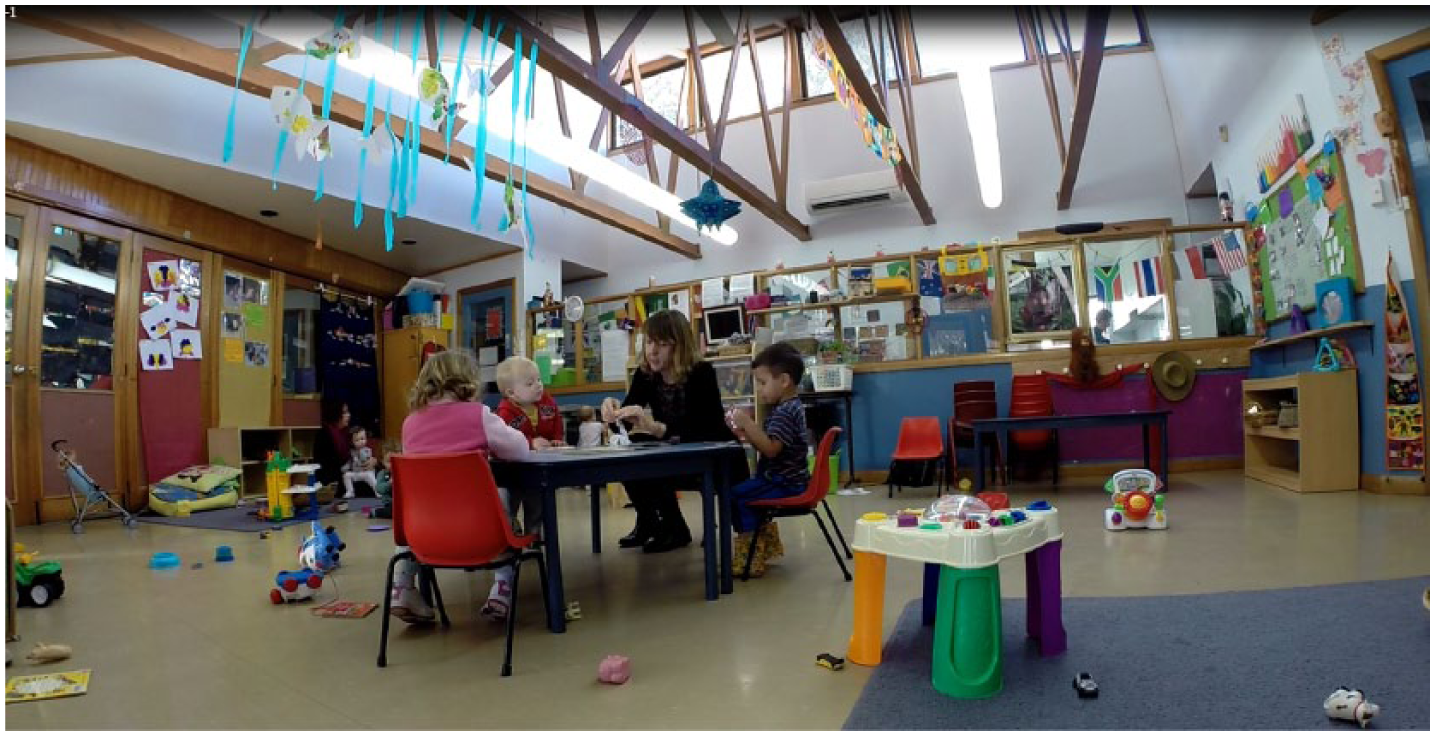
A frame taken from the video of Illustration 2, showing the room and hexagonal table. From left to right, Chloe, Sara, educator (EC1) and George.
Data analysis
The purpose of discussing this illustration is to interrogate how observers attach significance – especially terms like ‘belonging’ – to observations of toddlers and infants in ECEC settings. Our provisional description of the episode we now discuss draws from the first 12 steps of a 14-step protocol: (1) initial viewing of all video data from the centres; (2) inspection of written synopses of research visits to each centre by research assistants; (3) interrogation, as required, of research assistants about their reports; (4) collaborative frame-by-frame viewings of selected portions of the video data; (5) meetings of the research team to discuss events of interest; (6) cross-referencing observations through different theoretical and observational lenses (attachment theory, circle of security, groupness, time-use diary; see Harrison et al., 2014); (7) reprioritisation of events to be micro-analysed for potential theorisation and publication; (8) designation of a data analyst so far unacquainted with the relevant video data (first author); (9) designated analyst conducts micro-analyses of chosen events, including stop frame of key moments; (10) transcription of speech (when audible); (11) provisional attachment of descriptive terms to non-verbal behaviour in the chosen events, especially relating to eye and head movements, speech direction, gestures and touching; (12) pre-finalised description; (13) checking of pre-final description by other team members; (14) finalisation of description.
In Illustration 2, we ‘pause’ the protocol at Step 12 in order to invite readers to join with us in Step 13 to interrogate the difficulties of using the term ‘belonging’ in an unmarked way – to reference what the EYLF calls comfortable interdependence with others. Team discussion (Steps 5–7) had led us to two decisions: first, to focus on videos of toddlers (one to two years) rather than infants (birth to one year), as we sought the strongest possible case for belonging, and deemed toddlers more demonstrative, and so more accessible to interpretation as having a ‘sense of belonging’, than infants, and second, to appoint a consultant observer to seek out an episode which – we are now saying (having arrived at Step 12) – could most successfully be used to illustrate ‘unmarked belonging’.
Illustration 2: an ordinary few minutes
Analysis: Step 12
The video shows a large, airy, light early childhood education room, with toys, decorations and small tables throughout. At a central hexagonal table (sides 50 cms), the boy, George (26 months), sits focused on some task in hand (Figure 1). On his right, at about right angles, is a female childcare educator (EC1), who picks up a standing child, Ava (12 months), from the floor on her left and places the child on the floor to her right, and the child walks off. Sitting on EC1’s right, opposite George, is Sara (18 months), finger to mouth as she watches Chloe (3 years) to her right, who is opposite EC1. Chloe is pulling in her chair to sit at the table. Seated well away from the table is the camera person (a research assistant for the project), who looks at the table and is currently engaged in conversation with EC1.
Chloe pushes herself onto the table, then slides backwards and readjusts her chair to her satisfaction. Sara is watching her. While Sara watches and the conversation lapses with the camera person, EC1 turns to Sara (watching Chloe). She distracts and engages Sara while the camera person, no longer conversing, stands and moves to the camera to adjust it to focus in on the table activities. This procedure is completed, and Chloe walks around the table and Sara towards EC1, who stretches towards Chloe while Sara also focuses and stretches towards Chloe. George remains focused on his activity.
Chloe takes a proffered paper cut-out from EC1 and goes back to her seat, while Sara also gets involved with taking/being interested in the paper cut-outs the adult is handling (Figure 1). Meanwhile, EC1 turns to George and asks, ‘What’s that?’ She engages with him, while Sara wriggles around and Chloe settles into her tasks while also squirming. Once finished with offering help to George, EC1 glances at Chloe, while Sara watches what EC1 does with the paper she is doing something with. She talks to Sara, gaining her attention from her monitoring of both her and Chloe. EC1 responds to her vocalisation, as Sara looks again at Chloe. EC1 is peeling off stickers from cut-outs she has, while Sara sustains her equanimous interest in Chloe.
There are other noises in the room, and we can see along a wall another educator, EC2, on the floor with three children.
George shows EC1 something, while she continues preparing her paper cut-outs. She passes some cut-outs to Chloe, while Sara looks at the camera, then at EC1. Sara then gets off her chair, starting towards the camera. But Chloe drops something, gets off her chair, and Sara joins her in bending down to look under the table too. George looks over at what they are doing. Sara stands and has an interchange with EC1. George gets reabsorbed in his task. Although Sara has an interest in what EC1 has in her hands, EC1 flips it away from her and reaches to give it to Chloe: ‘Here we go’, she says. Sara gets back to exploring, moving towards the camera. Halfway, she stops and looks around. EC1 leaves the table to fetch a stills camera to take a photograph of Chloe, whose task she had been setting up. EC1 focuses with the camera on Chloe. George becomes interested in EC1 and the camera, and attracts her attention by bodily movements and a short verbalisation. EC1 starts focusing on him. Chloe shows some short interest in the EC1–George interaction as EC1 starts to facilitate George’s task.
Soon, Sara returns to her seat at the table. A dish falls to the floor and EC1 picks it up and uses it to engage Sara, so Sara starts to play with it. EC1 engages with George, and Sara leans over to get some paper cut-outs, which EC1 again draws away from her while continuing to talk with George. Something falls near Sara and she looks down at it.
All four in the frame are checking from time to time on each other, their attention drawn by some new activity. Then EC1’s attention is drawn to the child Ava, who she had put down onto the floor earlier, and who is now coming back towards the table.
Chloe leaves the table briefly, then returns to her chair. EC1 talks with George about his task and then to Ava, who is now walking towards her (the group who had been on the floor by the wall have now dispersed; Ava had been with them). Ava is pushing Sara across her chair in order to sit there too. She asks for EC1’s attention, while Chloe also vocalises to EC1, who responds to her.
A third adult, EC2 (who had been on the floor earlier), re-enters the room and approaches the table. She talks to EC1, and Sara vocalises loudly at her.
Analysis: Step 13
A striking aspect of this account is its mundaneness, its ordinariness, even boringness. It lacks the drama of argument or a concerted pursuit of aims, or any obvious nodal or significant moment in any of the characters’ lives. There is what we might colloquially call an ‘unselfconsciousness’ about the group’s activities, whether focused in on individual tasks, watching and wondering about others and their activities, or chatting with someone nearby.
We must here stress that, however great the rigour of our 14-step protocol, any extended description such as that we have just given is a co-production and provisional, as the foci and preoccupations of added describers may differ (Bradley, 1989). For example, a new observer might judge differently the two occasions when EC1 refrained from giving Sara the paper cut-out she reached for – perhaps seeing these as ‘rebuffs’, and hence disruptions to an unmarked, agentive ease. This brings us to the question at issue in this article: Could this seemingly insignificant series of events characterise the desiderata of those trying observationally to identify and so promote belonging in ECEC? Our answer has three steps:
It is probably a truism that there will never be an entirely uncontested description of a roomful of people (such as described here) among different observers, especially when the room includes infants and toddlers – who can, at best, scarcely speak for themselves. Thus, it is possible that Illustration 2 misses some features of the children’s experiences which, had we noticed them, we would judge as evidence that they did not feel that they belonged. However, our description, made in good faith, illustrates that comfort in a group setting, where toddlers and infants are aware of others, does not require any particular (specifically defined) kinds of behaviour or interaction to occur.
Following this line of argument, we move away from a preoccupation with (marked) belonging – that is, with describing processes whereby an individual ‘enters’ a definable group (or community) or is expelled from it (see Illustration 1). Illustration 2 has been chosen as an observation which highlights the question of whether NOT not-belonging (in the marked sense – i.e. being excluded) – which the EYLF glosses as ‘comfort in their environment’ (Department of Education, 2009: 26) – is usefully called ‘belonging’?
To put this the other way round, might there not be a better way than ‘belonging’ to refer to the mundane and unexceptional in ECEC? If so, we could then move away from paradoxically and confusingly marking the unexceptional as (unmarked) belonging. Moreover, if we dropped the term ‘belonging’ to refer to what is, in our provisional description, mundane, curriculum frameworks like the EYLF would no longer be forced to posit (without evidence) children’s belonging as an empirical phenomenon or a developmental need. Group participation would be a better – because more easily defined – framework for research, practice and assessment of ordinary interactions in ECEC settings.
Conclusion
Infants and infancy have been likened to blank slates upon or into which concerned adults project their own theoretical, political and existential preoccupations (Bradley, 1989). Our article shows, from a reading of the EYLF and background documents, how a stress on belonging in a national curriculum for ECEC has fallen prey to this process. With its commendable focus on the widespread political problems of exclusion and disadvantage in Australia, the policy enshrined in the EYLF seeks to ensure, by emphasis on belonging to a community, that exclusion is not experienced in Australians’ earliest, formative years. Yet this political emphasis becomes prescriptive, with ‘a sense of belonging’ being described as something that infants should ‘develop’ and observably experience in ECEC settings.
The sociopolitical genealogy of the concept of ‘belonging’ in the EYLF results in the term having two different meanings when applied to infants. The first meaning revolves around the infant’s inclusion in and exclusion from groups, which we have called ‘marked’ belonging. The second has to do with infants and toddlers feeling at ease – manifesting agentive ‘comfort’ with others in their environment – which we provisionally called ‘unmarked’ belonging. We have presented two detailed observational vignettes to illustrate this distinction, using the second to question the EYLF’s assumption that having or developing a subjective ‘sense of’ or ‘feeling of’ belonging is the best way to conceptualise – and so observe, describe and demonstrate – the common, unexceptional episodes of infants manifesting comfortable, ‘unmarked’ agentive ease in ECEC. A better way to approach infants’ comfort in ECEC would be through the prism of their proven capacity to participate in groups, and in what Degotardi and Pearson (2009: 151) call ‘relationship networks’.
Footnotes
Acknowledgements
We thank the educators, parents and infants for agreeing to help us with our inquiries.
Authors’ Note
Linda J Harrison remains an affiliate at Charles Sturt University, Australia.
Declaration of Conflicting Interests
The author(s) declared no potential conflicts of interest with respect to the research, authorship, and/or publication of this article.
Funding
The author(s) disclosed receipt of the following financial support for the research, authorship, and/or publication of this article: This research was supported by ARC Linkage Grant LP130100067 and Centre Support.