




Abstract
Drawing on case-study data, this inquiry explores the lived experiences of four universal pre-kindergarten teachers to address the question: How do practitioners narratively interpret a local school district policy directive of child autonomy, use their professional capacities to reconstruct the directive to address diverse students’ needs, and then implement or instruct their reconfigurations of autonomy in context-specific ways? By examining the tensions between policy and locally embodied practice, teachers’ voices shed light on professional struggles within large universal pre-kindergarten programs, and offer possibilities for reconceptualizing and enacting policy directives at the community level.
Introduction
The aim of universal pre-kindergarten (UPK) is to provide an equal opportunity for all four-year-old children to access high-quality publicly funded education. UPK is intended to close the so-called “achievement gap” by ensuring that all children are ready for academic learning prior to entering kindergarten on both a cognitive and social level (Barnett, 2011). However, educational initiatives are not neutral but are constructed and circulated as truth (Apple, 2012; Foucault, 1991). Embedded in the UPK policy and curriculum are notions of early child development that assume a universality independent of cultural context, “occurring in a similar pattern in every child, regardless of social and material world he or she is born into” (Urban, 2010: 1). Attempts to implement “one-size-fits-all” initiatives in local, diverse contexts can be challenging for all members of the learning community, including teachers, students, and caregivers (Souto-Manning, 2014: 611).
In the implementation of top-down universal education directives, practitioners are among the members of the school community whose expertise, lived experiences, and struggles with culturally misaligned directives often go unheard. Attention to teachers’ narratives reveals the ways in which educators use their professional capacities to enact and/or resist universal policy directives in their classroom interactions (Osgood, 2006). Because implementing universal policy directives in actual classrooms can be problematic, it is crucial for policymakers, educational administrators, and researchers to interrogate the cultural norms, values, and expectations that undergird these directives alongside practitioner narratives that voice teachers’ lived experiences navigating and implementing UPK policy directives. In order to address this challenge, data from four case studies (Stake, 2010) was used to examine the intersection of one large urban school district’s policy directive of child autonomy and teachers’ classroom implementation of the directive to answer the question: How do four UPK teachers narratively interpret a local school district policy directive of child autonomy, use their professional capacities to reconstruct the directive to address diverse students’ needs, and then implement or instruct their reconfigurations of autonomy in context-specific ways? By examining teachers’ experiences as they navigate “regimes of truth” (Foucault, 1991) that construct the policy directive of autonomy, case-study data sheds light on the struggles of preschool teachers working in large UPK programs and offers possibilities for reconceptualizing and enacting policy directives at the community level.
UPK and autonomy
Unlike federally funded Head Start programs, which offer comprehensive educational services to underserved children and their families, state-funded UPK initiatives offer early academics to all children, regardless of family income. Within the wider context of education reform in the USA, UPK initiatives are viewed as expanding opportunities and “choices” for families (Fuller, 2007). UPK initiatives align with contemporary US education reforms that are based on standards, accountability, and the acquisition of skills that promise to increase a child’s ability to compete in the educational marketplace and, later, in the global workforce (Au and Ferrare, 2015; Spencer, 2014).
Autonomy carries varying and sometimes contradictory expectations for children and teachers regarding rights, responsibilities, and freedoms (Levinson, 1999). As a discourse that constructs social and behavioral expectations for learners, the concept of autonomy in US early childhood education generally implies a quality of self-directedness (Fröbel, 1904) or self-governance (Castle, 2004: 4). In policy and practice, these expectations manifest in a child’s ability to self-regulate and be self-reliant (New York City, 2017a). Intended to position teachers and learners in prescribed ways, autonomy as a policy construct is often “lived out” in ways that can be unpredictable or partial. Top-down initiatives with mandated directives, such as autonomy, may carry cultural expectations that are misaligned with community experiences and local knowledge.
Autonomy is an underlying value in the discourse of early childhood, as evidenced in developmentally appropriate practice (DAP). DAP’s five domains of learning reflect different aspects of autonomy: cognitive (self-regulation of attention); emotional (self-regulation); language (self-reliance in communication of needs and wants); physical (self-regulation of body); and social (self-reliance in communicating with others) (Copple and Bredecamp, 2009). The DAP tenets of autonomy are pervasive and embedded in local early childhood discourse. For example, the New York City Department of Education’s (2017a, 2017c, 2017d) policy documents were developed to “protect developmentally appropriate expectations and practices for all children” (Morell, 2017: 3). DAP has been criticized for promoting “dominant cultural practices as normal, positive, and universally acceptable” (Lubeck, 1994: 160). Early childhood teachers must navigate autonomy as prescribed and normalized by universal discourses such as DAP while implementing strategies to support individual children in local contexts.
Critical analysis of policy and curriculum documents reveals universal narratives that construct the educational directive of childhood autonomy and provide a site of entry to investigate teachers’ navigation and implementation of those narratives (Foucault, 1980). A strong body of early childhood research examines teacher/practitioner engagement with policy directives (Brown, 2015; Fenech and Sumsion, 2007; Osgood, 2006; Urban, 2010). The current “era of early childhood” (Graue et al., 2017) that is fueling interest in UPK policies and practices calls for more research to explore the ways in which teachers navigate and implement UPK directives such as child autonomy in local contexts, particularly where children from diverse backgrounds may be navigating the dominant discourses of schooling for the first time.
Methodology
This inquiry aimed to address the particularization of a single phenomenon—autonomy—in a local context. Therefore, the data was limited to four case studies in a larger school district providing a bounded system (Stake, 2010). In order to address subjectivity and the trustworthiness of the data analysis, the researchers triangulated the data sources (interviews, reflections, and policy documents) within and across cases over time (Stake, 2010), implementing a systematic process for coding (Saldana, 2016).
Context
During the collection of the teacher narratives, New York City’s UPK initiative was in its second year of implementation, with more than 68,500 four-year-olds enrolled. Only 16% of New York City’s UPK classrooms reported having a 90% racially and ethnically homogenous student body (Potter, 2016). UPK classes were full-day (6 hours, 20 minutes) and met for 180 days. Classrooms were housed in a combination of public schools and community-based organizations, such as private nursery schools, community centers, and religious schools. The program was free and open to all four-year-olds living in New York City.
Case selection
Institutional Review Board approval was sought and granted. Four participants were identified through a teacher action research group. The teachers were purposely selected (Merriam, 2009) using the following criteria: (1) they taught in a linguistically and culturally diverse UPK classroom hosted by a community-based organization; (2) they used the Department of Education’s UPK curriculum; (3) they were certified in early childhood education, with at least two years of early childhood teaching experience; and (4) they were “insiders” in their schools’ communities, meaning that they had been residents of the communities in which they were teaching for at least five years.
Participants
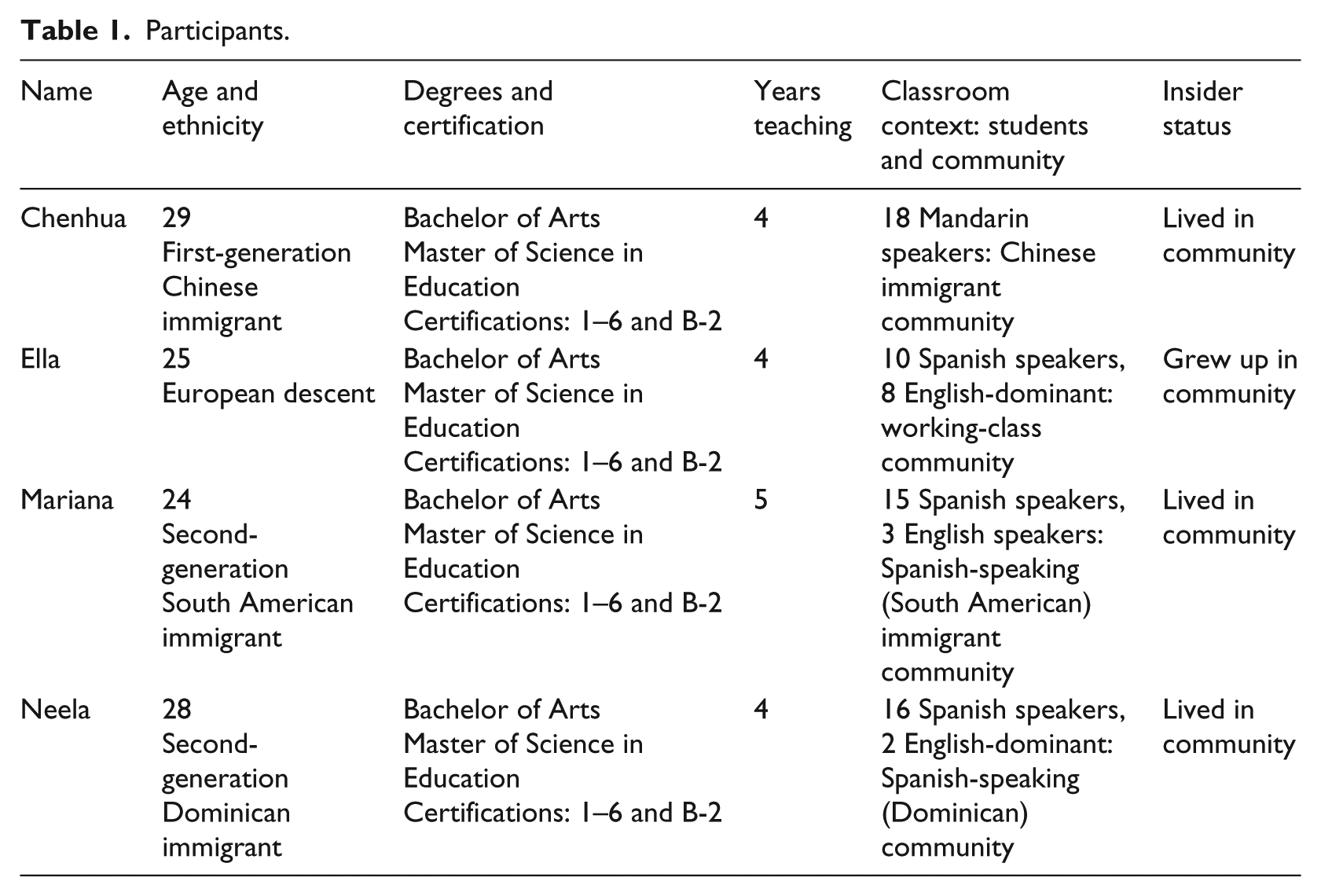
At the time of the study, the four participants—Chenhua, Ella, Mariana, and Neela (all names are pseudonyms)—were teachers in different English-dominant UPK classrooms located in community-based organizations (see Table 1).
Participants.
Data collection
Policy/document sampling
Following the qualitative sampling approach of purposeful or purposive sampling, documents were selected based on their “typicality” as judged by the researchers (Cohen and Manion, 1994: 89). The researchers selected New York City Department of Education policy, curriculum, and curriculum support documents that specifically addressed the UPK educational goal of autonomy and were available to the public via the Department of Education’s website. The sample of documents included the Department of Education’s (2017c) recommended Attendance Chart, Job Chart, Community Expectations Tool, and Feelings Tool. Additionally, documents on discipline, home–school relationships, academic standards/milestones, and social-emotional standards/milestones were collected (Morell, 2017; New York City, 2017a, 2017b, 2017c, 2017d).
Policy/document analysis
First, the researchers collected digital copies of the policy and curriculum documents. Next, each text was coded and analyzed using critical discourse analysis (Gee, 2014) to reveal the understandings of autonomy that undergirded its conceptualization as an educational goal for pre-kindergarten teachers and learners. The researchers focused their analysis on the ways in which social development, emotional development, discipline, and home–school relationships were represented in the documents. Words and phrases that signaled desired performative markers of childhood autonomy, such as self-regulation and self-reliance, were identified and established as codes. The codes thematically revealed culture- and value-specific regimes of truth (Foucault, 1991) that discursively assembled and inscribed universals into and around the educational goal of autonomy. Themes were positioned as discourses that constructed and governed autonomy in the sense that they worked to promote identities, positioned individual teachers and learners, and produced official knowledge, norms, and values (Foucault, 1980: 131). Analysis of the UPK documents aimed to address the following question: What regimes of truth pertaining to cultural norms, values, and classroom expectations are created and revealed by the discourses of autonomy? This line of inquiry uncovered the general “conversation” that organized pre-kindergarten education and thus situated teachers’ narratives of their experiences.
Participant data collection
The four teachers met with the researchers seven times throughout the 2015–2016 school year (October, November, December, February, March, May, and June) and once after the school year had ended. The 60–90-minute interviews were conducted individually with one of the researchers in an office at a university. The interview topics included the following: (1) background information, including demographics and educational experience; (2) curriculum development and implementation, including lesson-plan samples; (3) perspectives on the role of social-emotional development; and (4) experience teaching the curriculum and embodying the policies. The researchers took participant-observation notes (Graue and Walsh, 1998) of the interviews. The participants were also encouraged to keep reflective journals of their practice when not meeting with the researchers. In addition to reflecting on lessons, the curriculum, and interactions with students, the teachers were prompted monthly to answer questions regarding their classroom practice and autonomy in their reflective journals.
Participant data analysis
First, the interview data was transcribed, and then both the interview and reflective journal data was analyzed deductively using thematic dominant values and norms, universal learning outcomes, and normative structures. Using keywords and phrases taken from the Department of Education’s policy and curriculum (such as autonomous, independent, problem-solving, and behavior), latent and manifest themes emerged (Saldana, 2016). Second, the researchers engaged in pattern coding (Saldana, 2016) to identify explanations, definitions, and patterns of how autonomy was organized and developed. The codes included emotions, feelings, aggression, and sharing. Third, the researchers enacted a critical discourse analysis (Gee, 2014) to closely examine (1) the situated identities, (2) recognized or “performed” identities, (3) roles of tools, systems, and context, and (4) characteristic ways of valuing, feeling, interacting, knowing, and believing (Gee, 2014: 58) to uncover how the participants performed their professional identities while engaging in the policy directive of autonomy. The data was then laid out on a timeline, cross-compared, and aligned.
Findings
First, to set the context for the teachers’ lived experiences with the directive of autonomy, the findings present an analysis of the New York City Department of Education’s policy. Next, the findings are organized around three signifiers of navigation and implementation of the policy directive that emerged from teachers’ narratives: interpreting policy meanings, reconstructing autonomy directives in a local context, and instructing autonomy.
Autonomy in policy
The policy documents constructed the autonomous four-year-old as having developed “independence, self-regulation and self-confidence” (New York City, 2017c: 1). “Tools of autonomy in a Pre-K for All classroom” offered “guidelines and best practices” to help teachers “promote children’s independence” (1) through examples of classroom materials—or “tools” (New York City, 2017b). These tools included charts that provide children with “meaningful roles” and display responsibilities for classroom-based jobs, such as Attendance Taker (New York City, 2017c: 4). By moving name cards from the “home” to “school” column on the Attendance Chart, children monitor attendance to demonstrate “awareness of self as individual,” while also behaving in a manner that adheres to the expectations of a classroom community (3). Assumptions of child autonomy were also pervasive in the organization of the Daily Schedule and Weekly Calendar, which promoted “self-regulation and sequencing skills” (6). The Feelings Tool suggested that students “identify, label and explain their feelings as well as respond to the feelings and actions of others” in order to “regulate his/her responses to needs, feelings and events” (8). These tools disciplined learners’ space and time, as well as their bodies, in order to enculturate early learners into the academic “learning environment” (5–6).
Autonomy was not an explicit focus of the 10 interdisciplinary Units of Study (New York City, 2017a). Only the third Unit of Study, “All about Us,” included autonomy development by dedicating one week to emotions using the Feelings Tool: “Children will be able to match how they are feeling from an array of labeled pictures” (New York City, 2017d: 8). One-quarter of the vocabulary words and books recommended in “All about Us” involved the naming of emotions (2017d). In the content structure, all Units of Study included whole-group activities such as morning circle, when attendance is taken and jobs are assigned. Whole-group activities require students to regulate their bodies (by sitting still, not talking to or touching others, and raising their hands to be acknowledged), their minds (by paying attention), and their emotions (by not crying). The curriculum also recommended the use of centers with small-group, child-centric activities, requiring students to practice self-reliance or independence.
Interpreting policy: identifying the gaps
While the four teachers mirrored the policy discourses in their definitions of autonomy, as being independent and in control of one’s emotions, body, and attention, the practitioners’ navigation of the policy uncovered gaps between the policy and their lived experience.
The teachers observed their students’ struggles with autonomy in the policy’s emphasis on center-based learning. Neela wrote: “During free play, Center time and in group work … They struggled to work with their peers” (Reflection, November 2015). Regarding autonomy, Neela stated: “It isn’t clear in the curriculum. We have to read deeply and pull out opportunities for this to happen” (Interview, November 2015). Neela reported teaching “social skills of sharing and impulse control” in the “All about Us” Unit of Study (Interview, December 2015). Ella stated: “I didn’t see how to do this [teach autonomy], not exactly … in the Units of Study” (Interview, November 2015). Ella stated: “Opportunities to create and use meaningful dialogue and interactions to solve problems don’t just happen. A teacher needs to work it into … the classroom environment and schedule” (Reflection, December 2015). Mariana stated: “While the DOE [Department of Education] encouraged social and emotional knowledge, I didn’t know how to do this with English learners. It wasn’t there in the curriculum” (Interview, October, 2015). Mariana explained that autonomy “must be taught to them. They need constant reminders” (Reflection, December 2015). Chenhua stated: “books offered to me [by the Unit of Study] … were so limited” (Interview, October 2015). Chenhua later stated: “I struggled … How do I move my students to the point where they can be self-reliant … it doesn’t explain how … I felt overwhelmed with little direction” (Reflection, November 2015). On encountering struggles with implementing the autonomy directive in their classrooms, the teachers turned to the Units of Study for guidance and found a dearth of official or scripted curriculum supports to fill in the “gaps” that they identified. These gaps opened new spaces for the teachers to use their knowledge of autonomy to address the needs of their local practice. In short, the teachers interpreted an instructional problem in their local contexts and became problem solvers.
Reconstructing autonomy: filling the gaps
The participants interpreted the policy gaps as a space to reconstruct the directive of autonomy. In this section, the teachers identified language and cultural codes that operationalized autonomy as (1) identifying and labeling emotions in self and others, (2) expanding language production, and (3) considering the cultural and familial contexts of their learning communities.
The participants operationalized the directive of autonomy by identifying the behavior norm of identifying and labeling emotions in self and others. Chenhua stated: “If you don’t master those two skills, you will not be able to solve social problems. You will need the teacher’s help all the time” (Interview, February 2016). Neela explained that students “need to understand their emotions and the emotions of others” (Interview, November 2015). For Mariana, “[b]eing able to identify and express feeling and emotions was the foundation of creating an independent learner” (Reflection, October 2015). Ella wrote: “children in the preschool years are still developing their oral language and use it to communicate how they are feeling … Teachers need to be able to provide students with that oral language” (Reflection, November 2015).
Ella and Neela included extending children’s language production as part of autonomy. Ella explained: I needed to be more exact in how I guided my children’s conversations. It was more than just providing vocabulary for feelings. I needed to help them extend their language, flesh out their simple words or phrases into full sentences. (Interview, November 2015)
However, Ella stated: “When I looked at the UPK Units of Study for help, there was no guidance given on how to help children create longer sentences and more complex thinking” (Reflection, October 2015). Neela reflected: “I noticed that my students progressed from using social-emotional vocabulary to a more sophisticated negotiation. I did this through teacher scaffolding during the prescribed curriculum” (Reflection, May 2016). Neela reported that her focus on emotion vocabulary led her students to “problem solving” and “what to do with their feelings in the class with their friends” (Reflection, March 2016). Neela stated that her scaffolded language was not a part of the Units of Study. The participants considered expanding child language production as well as identifying and labeling emotions as a key skill set to build autonomy, which aligned with the unmentioned Feelings Tool ((New York City, 2017a) and the “All about Us” Unit of Study (2017d). This skill set provided the foundation for the teacher-initiated strategies present in the data.
The teachers also reflected on how families and communities affected students’ abilities to perform autonomy in ways that were not congruent with school discourses. Ella wrote: “At home, a lot of the kids don’t get to use that kind of language. Their family doesn’t talk like that” (Reflection, November 2015). Ella made no mention of conducting home observations, and she likely drew on her insider status to infer the experiences of her students. Neela recounted: “The students were crying and screaming … One of the students used physical contact to resolve the issue of sharing a book. They hadn’t used it [language] before—not at school, not at home” (Interview, November 2015). Neela later reported informally reaching out to her students’ families to better understand their home environments (Interview, February 2016). Mariana reported meeting with her students’ parents and asking about home rules, expectations, and behaviors (Interview, December 2015). Chenhua leveraged her knowledge as an insider in her community to connect with the students’ families: “The Chinese families … did not have English either … I tried to establish trust with them, using Mandarin” (Interview, October 2015). Later, Chenhua developed an informal home survey to collect the details of language use at home (Reflection, February 2016). Chenhua stated: “I hoped that my student would be able to name and identify her own emotions and those of others and show empathy, control her strong emotions and solve problems in an acceptable way” (Reflection, May 2016; our emphasis).
The teachers recognized the policy’s assumption that all children, regardless of home environment, should come to school with the basic language of schooling, or Chenhua’s “acceptable way.” Their statements suggest that autonomy was codified in school-based discourse (Gee, 2014) and required the use of socio-emotional language. The teachers sought to understand their students’ home contexts in order to navigate the gap between their students’ behavior and school expectations of autonomy.
Instructing autonomy
In the previous sections, the teachers found the policy directive of autonomy inadequate to meet the needs of their students; operationalized autonomy into a skill set, which was only partially evident in the policy; and identified child deficits by either using their insider knowledge or engaging with parents. In this section, the teachers discussed instructing autonomy by creating and implementing strategies that support their students’ self-regulation and self-reliance.
Initially, Chenhua focused on explicitly teaching emotion vocabulary during read-alouds, using texts recommended in the Unit of Study. She stated: “It’s helping, but I need to do more” (Interview, December 2015). Chenhua added emotion vocabulary to other Unit of Study texts that were not overtly focused on social-emotional skills (Reflection, February 2016). She reported that her “new strategy” allowed her students to have “interactive story discussions” (Reflection, February 2016). Chenhua reported “a successful tool to scaffold her students’ emotional control,” which included scaffolded interactions focused on expressing feelings and “applying their new knowledge to real life social conflicts” (Reflection, March 2016). Chenhua reported that her new strategy of teaching and scaffolding emotion words improved both her students’ ability to express themselves and their behavior (Reflection, May 2016), but only within the bounds of the curriculum of the Unit of Study.
Ella constructed and engaged in a plan to expand student language through open-ended questions during teacher–student interactions. Ella reported modeling and scaffolding patterns of interaction that helped her students become more autonomous: Two students were grabbing their favorite colors from the shared container … I sat next to them and gave them the language, “What do we say when we want a crayon?” and then I would model, “Sammy, could I please use the blue crayon. Can I hear you ask that?” (Reflection, March 2016)
Ella stated: “I need to not only provide the children with language … [to] solve their own problems, but I need to give them time and space to practice that language” (Interview, May 2016). “The children are having conversations independently but most of the vocabulary introduction is happening with me during circle time … it seems to be an overall improvement within the classroom as a whole!” (Reflection, June 2016). Ella reported that her strategy of teacher-centered scaffolding and modeling supported autonomy development.
While Mariana met with her students’ parents to understand home behaviors, the value of home culture appeared to be largely instrumental—a means to shape a child to be school-compliant. She next employed a Work Sampling checklist for social and emotional development (Meisel et al., 2013), also used by the New York City Department of Education. Mariana explained: “Using the checklist, I identified behavior … [next, I was] modeling independence and self-regulation. I also positively reinforced, using a happy tone … Slowly, I scaffolded the children toward … socio-dramatic activities, such as pretend play” (Reflection, February 2016). Mariana excitedly discussed her success: “As soon as I changed my tone, my voice, the students reacted so well. They behaved. They were on task. I even shared it with the parents” (Interview, April 2016). Mariana reported that her strategy of positive reinforcement of social-emotional behaviors successfully supported her students’ self-regulation and independence (Interview, March 2016).
Neela also created a checklist to instruct autonomy. She explained: “I drew on DAP and wrote a checklist for social and emotional behavior appropriate for four-year-olds” (Interview, March 2016). Next, Neela designed and implemented a two-part strategy. First, Neela read a picture book and then helped the students identify a problem in the story and the emotion vocabulary that corresponded to the problem. “Students acted out how to resolve anger, how to get help, how to share, taking turns, and working together” (Interview, February 2016), she explained. Neela used this instructional strategy to identify emotions that might arise during classroom activities, such as sharing a toy in the kitchen center: “I would ask them how they are feeling, and if they say an emotion, I would say to them to look at their peer in the face and say ‘I am upset because.’” Neela reported: “It worked. I scaffolded the interaction and it worked … After a while they were able to work it out on their own” (Reflection, April 2016).
An analysis of the participants’ narratives reflected their experience with reworking the curriculum directive of autonomy to align with the needs of their students. Their actions reflect characteristics of agency in the use of “I” statements, such as “I need to” (Chenhua and Ella), when critiquing their own practice, or “I identified” (Mariana) or “I would ask” (Neela), indicating ownership of their pedagogic choices. A close analysis of the teachers’ attempts to rewrite curriculum directives suggests that teacher agency is a complex phenomenon. While demonstrating signs of agency by identifying a problem and designing and implementing a plan, the teachers also privileged schooling discourse and the norms and values of the Department of Education’s policy. For example, Chenhua implemented her plan within the bounds of the Units of Study curriculum, privileging traditional patterns of interaction for teacher–child around books and activities. Ella appeared to “create time and space” in the Units of Study curriculum for her to add emotion vocabulary, and offered her students (modeled) scripted interactions for negotiating self-regulation. Mariana’s use of a Work Sampling checklist and Neela’s creation of a DAP-inspired checklist reified normative tools (Brown and Lan, 2015; Lubeck, 1998) to achieve their goal. The teachers identified a problem in their practice and created solutions—in their view independent of the policy—but they did this by relying on other dominant discourses such as DAP. The teachers were enmeshed in top-down curriculum directives and reinscribed the universal construct of autonomy in localized practice.
Discussion and implications
The narratives from the four pre-kindergarten teachers revealed the ways in which the participants navigated and implemented the educational directive of child autonomy. Document analysis revealed that policy materials were found to assemble and circulate universalizing notions of autonomy as official goals for UPK schooling. The teachers struggled to implement vague goals of autonomy in diverse communities and sought support from the New York City Department of Education’s UPK policies documents. Their attempts to implement dominant forms of autonomy in diverse contexts revealed “gaps” between the expectations of the Department of Education and the culturally situated needs of students. These “implementation gaps,” as spaces residing between the expectations of the policy and the teachers’ lived practices, proved to be productive by prompting teachers to use their professional capacities to bridge the divide between home and school expectations. Drawing on community funds of knowledge (Moll et al., 2005), the participants attempted to reconstruct autonomy. In the teachers’ lived practices, however, autonomy continued to focus on a skill set of school-based language and emotional regulation. Furthermore, instruction remained grounded in teachers’ professional knowledge of DAP and the Department of Education’s expectations, both of which reflected dominant discourses of autonomy and child development. These discourses functioned as a “regime of truth” (Foucault, 1980) that guided teachers’ desires to operationalize autonomy in their classrooms using tools, checklists, and teacher-centered instruction. Academic skills and English-language proficiency became the focus of the participants’ instruction of autonomy, with students’ home cultures incorporated instrumentally. The implementation gaps in official documents galvanized the teachers to rewrite—yet also reinscribe—normalizing discourses of autonomy in partial and contradictory ways. Such points of implementation present fruitful spaces for future research to examine practitioners’ attempts to negotiate normalizing directives for more equitable outcomes.
Ultimately, the practitioners’ abilities to see possibilities for change (Foucault, 1992), and to act on opportunities to choose which discourses they would adopt, adapt, or ignore, bestowed feelings of authorship and ownership. The teachers added strategies that drew on their professional knowledge of the Units of Study. For example, Ella intentionally modeled and scaffolded students’ language production through open-ended questions, while Neela’s creation of a checklist revealed her affinity for DAP. The practitioners reported feeling empowered by rewriting autonomy, even though their choices also reinscribed universalizing discourses. Their narratives suggest that practitioner agency is multiple and partial, acting at a “micro” level of power rather than being “all or nothing” (Foucault, 1991: 27). This finding comes as no surprise considering that the profession itself is situated within partial and often contradictory discourses. As publicly funded education expands to offer “pre-kindergarten to all,” various stakeholders continue to impose multiple, fragmentary expectations on teachers, schools, and communities (Russell, 2011). In order to close the implementation gaps and provide spaces for equitable learning aligned with local needs, teachers must navigate competing discourses and goals of education policy. The participants in this study appeared to focus exclusively on the Units of Study as their official Department of Education guide for implementing autonomy, while disregarding other readily available Department of Education materials such as Tools of Autonomy. Additionally, the participants made use of DAP without acknowledging it as a governing discourse of the Department of Education’s policy. This selectivity raises a question: When teachers’ lived experiences tend to be marginalized by centralized policymaking (Gozali et al., 2017), how are teachers selecting, valuing, and using specific policy materials? While these case studies offer a glimpse into teachers’ use of policy, future research might examine the ways in which policies are adapted and used by teachers. Continued investigations into the implementation gap may help assuage the tensions surrounding the ways in which educational discourses might afford as well as constrain opportunities for young learners. The current growth of UPK signals an important moment to critically scrutinize both the explicit and implicit discourses that organize educational initiatives.
Conclusion
This inquiry reveals the ways in which teachers struggle to navigate and implement a policy directive by interpreting, reconstructing, and instructing their own knowledge and practices of autonomy to support young learners. Although the implementation of teachers’ insider knowledge was constrained by the UPK discourses and curriculum, lacking a Department of Education “script” for supporting child autonomy opened spaces for the teachers to implement their own mosaic of local supports. Making policy universals “work” required teachers to call on professional knowledge and community knowledge. The implementations of those complex negotiations were expectedly partial and contradictory. By better understanding how policy directives are understood and implemented by UPK teachers, researchers and policymakers will have more knowledge of how to create better curricular supports and professional development for early childhood teachers. By foregrounding teachers’ voices and their struggles with/in discourses of public education reform, this study contributes to the educational research that recognizes the complex negotiations involved in early childhood teaching (Fenech and Sumsion, 2007).
Footnotes
Funding
The authors received no financial support for the research, authorship, and/or publication of this article.