




Abstract
This research examined the critical incidents of 10 United States (US) early childhood student teachers during a three-week university-sponsored international field experience conducted in three urban preschools in Kathmandu, Nepal. The purpose of employing the critical incident technique was to allow the US student teachers to reflect critically on successful and unsuccessful intercultural interactions in an effort to identify cultural assumptions about teaching young children. The approach was used not only to make assumptions visible, but also to make conceptual and behavioral changes based on what was learned from the critical reflection. The student teachers wrote weekly critical incidents, which were then discussed during weekly individual interviews. Three group discussions, a research journal, and field notes were used to triangulate the findings. A qualitative thematic analysis revealed five types of written critical incidents: descriptive, hypothetical, resistive, reflective, and integrative. Illustrative critical incidents are presented to compare and contrast how the international field experience allowed for productive reflection of cultural assumptions for some student teachers while leading to resistance to cultural assumptions for other student teachers. The findings suggest that outcomes vary based on the student teachers’ ability not only to identify their cultural assumptions, but also to challenge their cultural assumptions with actions grounded in ethnorelative reflection when teaching diverse groups of young children in the US and abroad.
Keywords
Being global souls—seeing ourselves as members of a world community, knowing that we share the future with others—requires not only intercultural experiences but also the capacity to engage in the experience transformatively. (Bennett, 2008: 13)
Introduction: context for the study
In the quote above, Bennett (2008) maintains that becoming a global soul requires more than travelling abroad or teaching in another country; it requires a person to engage in a reflective process leading to conceptual and behavioral transformation. According to Mezirow (1991), transformation is a shift in how a person interacts with the world; it is a change in perspective about commonly held assumptions. Transformation is not an everyday occurrence. It typically happens when a person encounters a disorienting event that leads to a significant change in their frame of reference and meaning-construction. With the increase of internationalization in education and more educators traveling abroad to teach, there is a need to prepare early childhood educators to be able to engage in international teaching experiences by means of reflection, open-mindedness, curiosity, and cultural empathy (Cushner and Chang, 2015; Cushner and Mahon, 2002; Hunter, 2008). More importantly, educators should be able to reflect critically on how their own ideological assumptions on teaching practices affect their perceptions and judgements when teaching in a new cultural context or country. Using Brookfield’s (1990, 2005) notion that assumptions are taken-for-granted ideas which shape creation of meaning and finding significance in our lives, this research sets out to examine the critical incidents of 10 United States (US) early childhood student teachers as they taught young children during a three-week university-sponsored field experience at three urban preschools located in Kathmandu, Nepal. The purpose of the project was to explore how a critical incident technique could be used with student teachers as a reflective tool to gain insight and think critically about their cultural assumptions and teaching practices.
This study builds on previous research conducted by the author, wherein the emotional experiences of six white, middle-class US early childhood student teachers were examined as they participated in similar field experiences in two Nepali preschools (Madrid et al., 2016). The findings revealed that the student teachers lacked an in-depth understanding of the cultural nature of the child and of teaching practices. Moreover, emotional reactions to teaching in a majority-world context were related to a discourse of the privileged westerner and marginalized other, grounded in an ethnocentric narrative about what were the correct ways to teach young children. The ethnocentrism of the six teachers led to a lack of critical analysis about how the Nepali practices were inappropriate from a Euro-Western (i.e. dominant culture) perspective. Rather than the international student-teaching internship fostering intercultural understanding and challenging teachers’ assumptions, the experience reinforced the student teachers’ biases and perpetuated their belief that the US early childhood teaching practices were the “right” and “best” way to teach.
Other researchers have also found that international field experiences and/or study abroad can actually reinforce ethnocentrism rather than promote cultural relativism (Cushner, 2004; Cushner and Brislin, 1986; Cushner and Chang, 2015; Hunter, 2008; Pence and Macgillivray, 2008; Willard-Holt, 2001). Cushner and Chang (2015: 166) suggest that “[t]he increased attention and surge in number of students participating in study abroad in general, and student teaching more specifically, does not necessarily mean that significant intercultural learning is occurring.” In her critical ethnography of US teachers in China, Stanley (2013: 30) warned that participant “willingness to question what they already know determines the extent [to] which they either identify received ideas or instead head home with pre-existing notions reinforced and supported with the dubious authority of expert.” International teaching experiences can be more harmful than beneficial if conducted without reflection by students. Experiences may strengthen stereotypes as teachers return to their home country, with real-life experience acting to support their stereotypes. For instance, the student teacher may have an idea about a cultural stereotype stemming from conceptual knowledge before the international experience, but, after the international experience, may have first-hand experiential knowledge to reinforce that stereotype.
With regard to the field of early childhood teacher preparation, an extensive literature search revealed only one recent study of an international student-teaching experience. Bonnett (2015) investigated Canadian pre-service students’ professional and personal transformation during a four-week field experience in Liberia and Costa Rica. The author employed an exploratory qualitative methodology, using reflective journals, emails, and researcher field notes guided by Mezirow’s (1991) theory of transformation. The findings suggested that the international field experience did lead to transformation for the student teachers when combined with reflective journals and a strong support base that allowed face-to-face dialogue with the faculty members. She cautioned, however, that while one of the findings was “increased confidence,” other researchers have found that “increased confidence” could actually be called “inflated confidence.” Inflated confidence is when a student teacher’s perceived intercultural competence is greater than their actual intercultural competence (Bennett, 1993, 2004; Willard-Holt, 2001). Bonnett (2015) further acknowledged that more research is needed in the field of early childhood education to determine whether the findings were limited to the context of Liberia and Costa Rica, or whether they could be applied across other field experiences.
Conceptual framework: critical incident technique
One framework used with teachers to reflect on assumptions and teaching practices has been a critical incident technique (Badia and Becerril, 2016; Brookfield, 1990; Bruster and Peterson, 2013; Byrne, 2001; Carter et al., 2014; Griffin, 2003; Tripp, 1994, 2012). A critical incident is a self-generated written narrative that has a social critique (Bruster and Peterson, 2013; Tripp, 2012). The teacher, not the researcher, determines the classroom events that are considered “critical” and then uses these events to analyze assumptions. Tripp postulates that:
Incidents happen, but critical incidents are produced by the way we look at a situation: a critical incident is an interpretation of the significance of an event. To take something as a critical incident is a value judgment we make, and the basis of the judgment is the significance we attach to the meaning of the incidents. (Tripp, 2012: 8)
According to Tripp (2012) and Pi-Lan et al. (2005), an important aspect of writing a critical incident is to have the teacher unpack the event in order to examine the judgements that are attached to ways of seeing classroom events and practices. The teacher explains the significance of the critical incident and identifies the core values that the incident makes visible. The framework is used not only to make assumptions visible, but also to make cognitive and behavioral changes based on what is learned from the critical reflection. It is not the event itself that is important; it is how the teacher interprets the event, and the resulting actions and reactions based on these insights. Reflective practice and increased professional judgement are the underlying goals of the critical incident technique.
This study sought to build on the research referenced above, but rather than studying student teachers in the USA or in the field of elementary or secondary education, this research examined how the critical incident technique could be utilized with early childhood student teachers during an international field experience. The international field experience added a level of complexity as the student teachers wrote and reflected on successful and/or unsuccessful intercultural interactions in the Nepali classrooms. The research question was: Does using a critical incident technique during an international field experience allow student teachers to identify their cultural assumptions about teaching young children?
Methodology
The data presented here comes from a larger six-month qualitative (Byrne, 2001; Madden, 2010; Spradley, 1980) study using a critical incident technique (Cushner and Brislin, 1996; Pedersen, 1995; Tripp, 2012) with 10 US early childhood student teachers before, during, and after an international field experience at three urban preschools in Kathmandu, Nepal. The central data sources used for this analysis were written critical incidents and individual interviews from the three-week internship. The student teachers used a journal format for the written critical incidents, followed by “member checks” with the researcher in which they could confirm, verify, and discuss the topics of their written critical incidents. The member checks were conducted by the researcher and were separate from class discussions or feedback provided by the course instructor during the experience. Supporting data such as field notes, research journals, group discussions led by the course instructor, and informal discussions with the researcher were used to triangulate the analysis of the written critical incidents and individual interviews. Pseudonyms were used not only for the participants, but also for the school sites in Nepal.
Participants
The group of early childhood educators consisted of 10 US females ranging in age from 20 to 30. Seven of the ten student teachers self-identified as white and middle class/upper-middle class, and the other three identified as one of the following: white and lower class; Asian American and upper class; and Hispanic and upper-middle class. The student teachers, along with the white female researcher and the white female university instructor/project coordinator, worked in Kathmandu to complete an early childhood teaching internship as the capstone experience for their Bachelor’s degree in Elementary Education with a minor in Early Childhood Education from a mid-sized university in the USA that is predominately white. Each student teacher worked full-time for three weeks in a different classroom in one of the following early childhood programs: (1) a play-based high-income school; (2) a school program for low-income children and families; and (3) a Montessori-based high-income school. In order to avoid a potential conflict of interests between the student teachers and the researcher, the author of this article participated exclusively in the research processes and not in the evaluation of the student teachers or assigning grades.
Critical incident technique
The critical incident technique, as used in this research, was a conceptual tool for the student teachers to reflect on intercultural classroom interactions. It was also a methodological tool for the researcher to understand how they responded when teaching young children in a new cultural context. The critical incident technique has been used in a wide range of professions, from the field of nursing (Byrne, 2001) to the field of adult learning (Brookfield, 1990). It has also been employed with study-abroad students to understand culture shock (Pedersen, 1995), as a tool for counselors when working with culturally different clients (Sue and Sue, 2016), and to understand the development of intercultural communication skills (Cushner and Brislin, 1996). The common aspect of the critical incident technique is its use to reflect on professional and cultural assumptions through writing or talking about a specific “event” that holds significance for the person. The research design comprises five stages, where the participant describes a significant event. The stages are displayed in Figure 1. These components are taken from Paul Pedersen’s (1995: 17) book The Five Stages of Cultural Shock: Critical Incidents around the World.
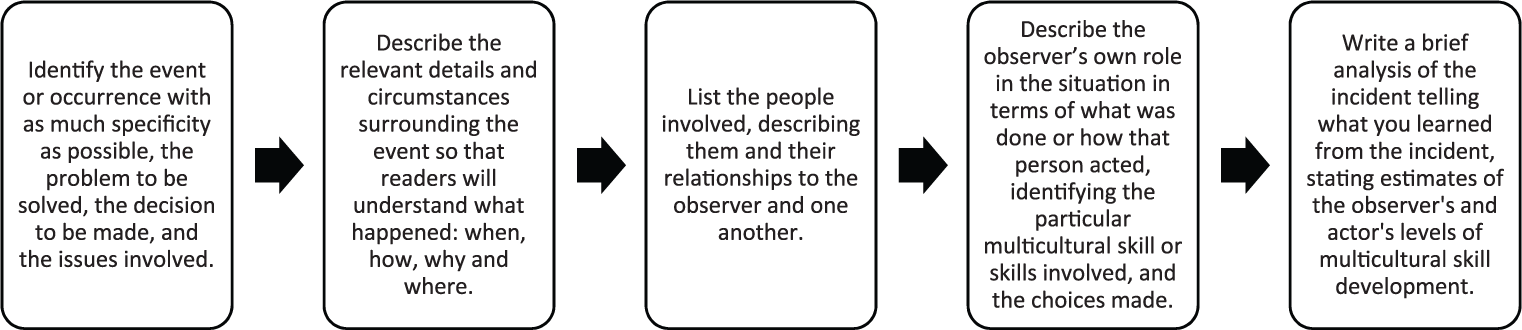
The five stages of the critical incident technique (Pedersen, 1995: 17).
For this study, the student teachers were asked to write about successful and/or unsuccessful intercultural interactions experienced while teaching in the Nepali classrooms, using the five stages outlined in Figure 1.
Group discussions and interviews were added to the design to help the student teachers process their critical incidents. During the three-week field experience in Nepal, each student teacher participated in the following two activities: (1) a weekly 30-minute critical incident individual interview with the researcher, and (2) three 2-hour group discussions facilitated by the course instructor.
Group discussions
The purpose of the weekly group discussions was twofold. First, the group discussions were used to triangulate the data from the written critical incidents and individual interviews, and, second, the course instructor used this time to further support and scaffold the student teachers’ understanding about their critical incidents through dialogue. The student teachers were asked to share their weekly critical incidents in a whole-group discussion. Next, the student teachers would divide into small groups. Because the student teachers were placed at various school sites and had different mentor teachers, the pedagogical goal of these small group discussions was to have the student teachers compare and contrast their experiences with their peers. Another goal was to learn about critical incidents by hearing from their peers—to understand that their peers may have reflected differently on a similar topic of a critical incident (e.g. children being made to eat all their food).
The course instructor used these group discussions to provoke a deeper level of thinking about teaching as a cultural activity with questions such as: Why do you think the Nepali teachers do that? Have you asked your mentor teacher why they use this particular teaching strategy? What have you learned about yourself from this critical incident? Why did that particular aspect of the Nepali classroom upset you? What did that incident illustrate about the image of young children? These are just a few of the dialogic provocations that were used to support the student teachers in their critical reflection. It should also be noted that the entire group spent part of each day together and often ate breakfast and dinner in a common area. Informal conversations occurred frequently, allowing for spontaneous discussions about critical incidents. For example, a student teacher would say, “Guess what critical incident I had today!” or “I am having this issue with a student, what do you think I should do?” These informal conversations were recorded in the field notes.
Site selection
The student teachers in this study came from a predominantly white rural university in the Rocky Mountains region of the US. There was an initiative within the College of Education to find student-teaching placements that exposed student teachers to diverse groups of young children. Kathmandu, Nepal was selected as the country for the international field experience because of the professional connections between the course instructor, the researcher, and the university. The university at which the course instructor and the researcher were employed had a memorandum of understanding with a local university in Kathmandu. During multiple visits over the course of five years, the course instructor and the researcher established relationships with faculty at the university, as well as the directors and teachers of several early care and education centers. These relationships were maintained through mutual collaboration around professional development, implementing other research projects, and providing material support to the early care and education centers.
The course instructor and the researcher had led a similar student-teaching internship two years prior to the project reported in this article (Madrid et al., 2016). Three months prior to the second internship reported here, the researcher spent one month in the Nepali early care and education centers gathering video footage for another research project on culture and curriculum (Madrid Akpovo, et al., 2018; Thapa et al., 2018). This was done in collaboration with the Nepali school owners. Therefore, long-term relationships and in-depth knowledge of the school contexts were the rationale for the site selection (Madden, 2010).
Preparing for and returning from the internship
For four months prior to the international field experience, the group (the researcher, student teachers, and course instructor) met once a month to introduce the student teachers to the critical incident technique, as well as the concept of teaching as a cultural activity. The student teachers practiced writing critical incidents about interpersonal relationships, experiences in college, and teaching young children (Brookfield, 1990). The group also engaged in a book study using the text Preschool in Three Cultures Revisited: China, Japan, and the US (Tobin et al., 2009). In addition to the practice of writing critical incidents, each month the student teachers were asked to read one chapter from the book and to view the accompanying video from the book, which was discussed at the monthly meetings. At the final meeting before leaving for Nepal, the teachers were asked to write a final critical incident based on the Preschool in Three Cultures book and video. In this last meeting, they were also shown a video of the Nepali preschool classrooms where they would conduct their student-teaching internship. The video data showed the daily routines of the children in each of the school sites. The student teachers also engaged in a 30-minute pre-departure individual interview with the researcher in order to build rapport and discuss demographic information.
On their return from the international field experience, the student teachers were asked to reflect on the written critical incidents. The student teachers reported that the critical incidents written in Nepal accurately reflected their experience. For example, in a post-internship reflection, Savanna wrote:
I feel largely unchanged from who I was when I was writing those critical incidents. Maybe this is because I spent a lot of time thinking about these incidents before I wrote them, trying to understand them from different points of view.
All of these pre- and post-internship activities were observed by the researcher and recorded in field notes (Spradley, 1980). The discussion groups and pre-departure interviews were audio-recorded and then indexed to compile a complete body of data.
Critical incident data analysis
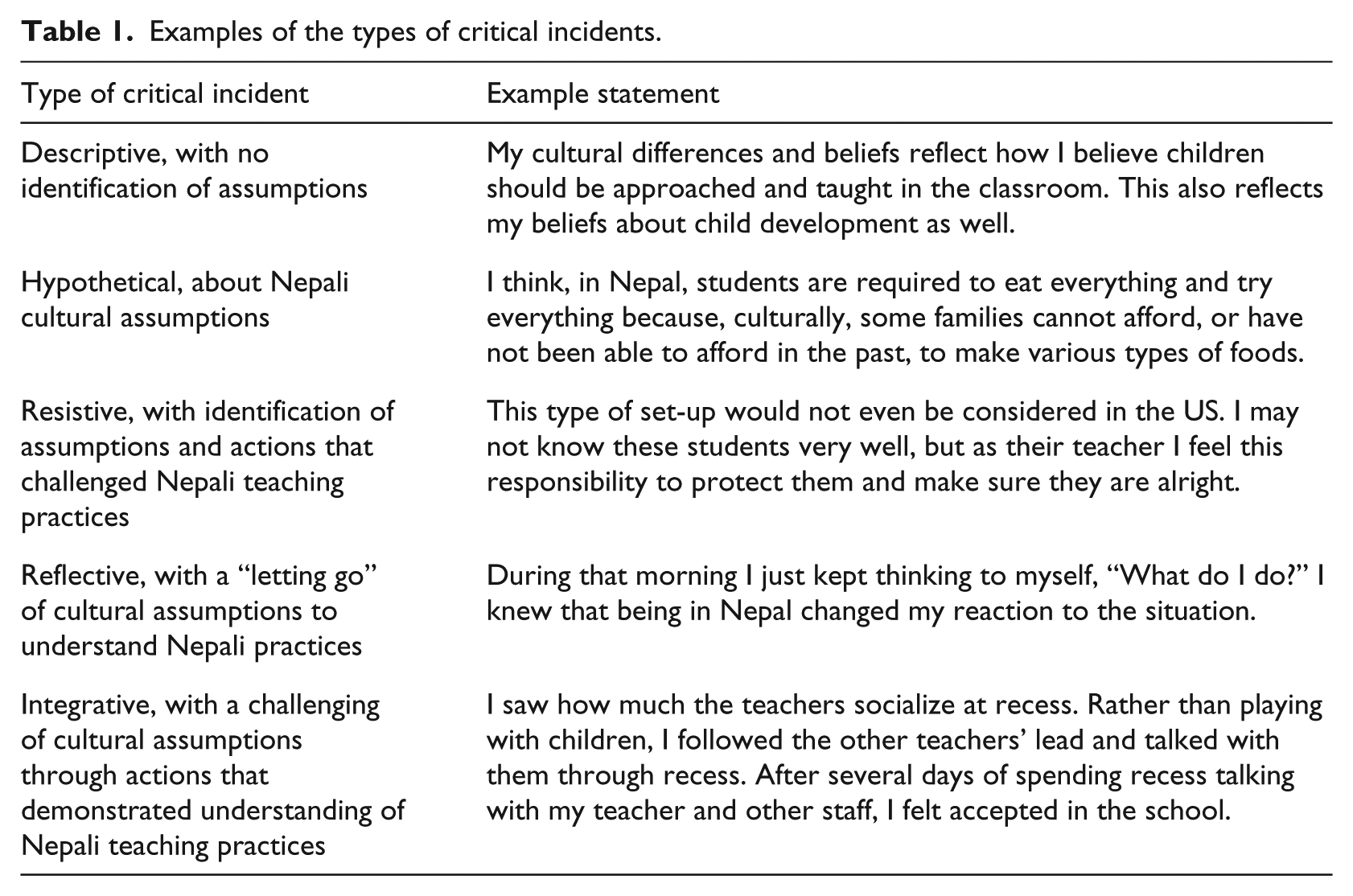
The model for the data analysis was adapted to fit this particular study on the basis of adaptations from the original techniques used by the founder of the critical incident technique (Flanagan, 1954) and a critical incident methodologist (Vianden, 2012). Using an inductive process, the 34 written critical incidents were first categorized based on who took part in the event (teacher, child, student teacher), the subject of the event (food, curriculum, child behaviors, discipline), and assumptions identified by the teacher in self-analysis of the event (e.g. “I don’t think children should be made to eat all their food”). The process of data reduction and complication occurred in the next stage. All of this data was listed in tables and then reduced to common themes/types and triangulated with the other data sources (transcribed interviews and group discussion, field notes, and a research journal). The final step of the analysis examined the types of written critical incidents constructed by the student teachers in order to identify the assumptions held by them. A coding scheme was developed to describe the various types of critical incidents (see Table 1). The analytical process moved from an inductive analysis to a qualitative interpretation of the types of critical incidents and how the critical incident process did or did not allow the student teachers to identify their cultural assumptions.
Examples of the types of critical incidents.
Findings and interpretation
Types of critical incidents
Even though the student teachers were required to write one critical incident per week, some student teachers chose to write more than one, which accounted for the total of 34 written critical incidents (rather than 30). The length of each critical incident was approximately one and a half to three pages. Consistent with Bruster and Peterson’s (2013) findings, variance was found in the level of critical reflection among the 34 critical incidents. The specific types of critical incidents found are an original finding from this data and not a replication from previous studies. A thematic analysis revealed five types of critical incidents that emerged over the course of the three-week field experience (see Table 1).
Shift of critical incidents week by week
A second finding is that the predominant types of critical incidents shifted over the course of the three weeks—that is, the student teachers wrote different types of critical incidents as time passed in the field experience. In the first week of the field experience, only the first two types of critical incidents were written. In the second week, the third and fourth critical incidents occurred, and indicated resistance to, or reflection about, cultural assumptions. Finally, in the last week, the fifth critical incident type—integration of assumptions with actions that were culturally relevant—appeared. Figure 2 illustrates the shift in the types of critical incidents that occurred week by week.
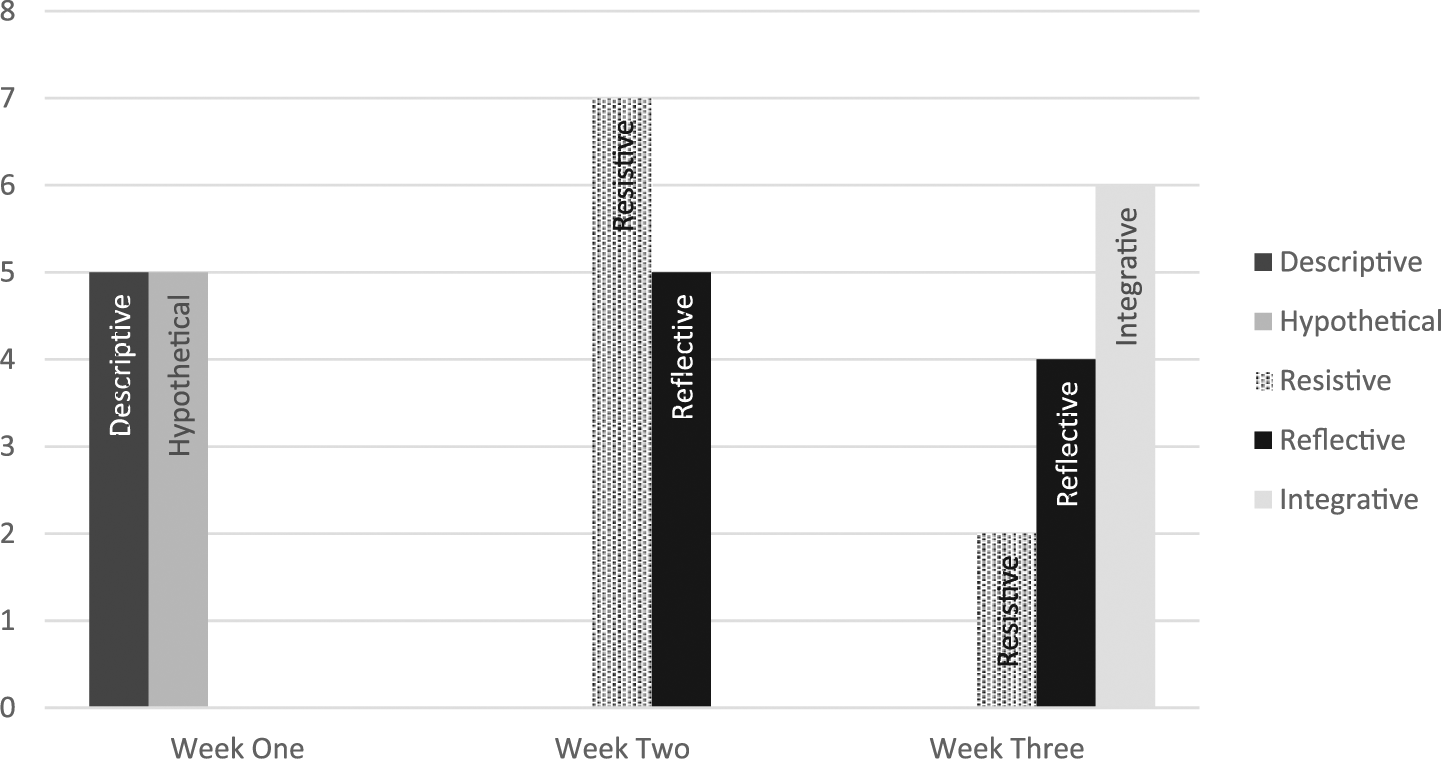
Shift in the types of critical incidents week by week.
Illustration of findings
In the following three sections, illustrative examples are presented to compare and contrast how the critical incident technique allowed for productive reflection on cultural assumptions for some student teachers and for limited reflection on cultural assumptions for other student teachers. Examples are presented to illustrate these two findings (i.e. the type of critical incident and shift over time) from week one to week three of the internship. The findings are presented in this manner, along with Table 1 and Figure 2, to show the complex and nuanced nature of the shifts that occurred during the field experience. These shifts did not simply “happen,” but rather were fostered and supported by the group discussions with the course instructor and peers, critical incident interviews with the researcher, weekly written critical incidents, and daily interactions with mentor teachers in the host community. Due to the length of the written critical incidents, only the salient sections are presented to illustrate the findings. The written critical incidents are supported by other qualitative data (interviews, group discussions, the research journal, and field notes) in order to situate and ground the interpretations in the context of the field experience.
Week one: descriptive and hypothetical critical incidents
During the first week of the internship, the critical incidents written by the student teachers fell into one of two types: descriptive, with no identification of assumptions, or hypothetical about Nepali cultural assumptions. The excerpt below is an example of a critical incident described by Lila. The theme of the critical incident centered on how the Nepali curriculum was not child-centered and how Nepali teachers treated a young boy with “overbearing” actions because he had a learning disability:
My reaction to this incident says a lot about my experience and education in regard to children. The teachers at Lakshmi School in my classroom are experienced and educated as well; however I think that it is extremely different than my experiences and education. I think culture plays a big role in this. My cultural differences and beliefs reflect how I believe children should be approached and taught in the classroom. This also reflects my beliefs about child development as well.
The broad and general nature of the critical incident is made visible when Lila notes: “My cultural differences and beliefs reflect how I believe children should be approached and taught in the classroom” and “[t]his also reflects my beliefs about child development as well.” While these statements demonstrate that she understands the “correct answer” when considering cultural differences, it does not illustrate a deeper level of critical reflection about what these differences are, why these differences are important, and how these differences inform her belief systems about child development and a child-centered curriculum. She also does not attempt to understand the Nepali perspective, as she simply states: “The teachers at Lakshmi School in my classroom are experienced and educated as well; however I think that it is extremely different than my experiences and education.” Tripp argues that for a critical incident to be meaningful, the educator must ask
both what happened and what allowed or caused it to happen, which means we have to describe some of the deeper structures that produce that kind of incident. We have to discover the nature and extent of taken-for-granted attitudes, how they are reproduced, maintained, resisted and overcome. (Tripp, 2012: 15)
The written analysis shows that Lila was aware that the researcher wanted information about how her life experiences and education were influenced by her reaction to the critical incident, but she was unable “to describe some of the deeper structures” that produced her feeling of discomfort with how the teachers interacted with the child. As mentioned in the methods section, the student teachers were required to read Preschool in Three Cultures Revisited: China, Japan, and the US (Tobin et al., 2009), which describes the cultural nature of early childhood education. Lila therefore presumably knew that the “correct” answer would be something along the lines of “I think culture plays a big role in this.” The critical incident, however, lacked deeper reflection about how culture played “a big role” in her experience.
In contrast to Lila’s purely descriptive critical incident, with no identification of assumptions, other student teachers detailed critical incidents containing hypotheses that attempted to identify why cultural differences existed. Savanna wrote:
From this incident I have learned about the cultural differences regarding ideas about food in different countries. In America we do not force children to eat all of their food or to eat something even if they don’t like it. We allow students to serve themselves, choose their own potions, and what types of food they want to eat. I think, in Nepal, students are required to eat everything and try everything because, culturally, some families cannot afford, or have not been able to afford in the past, to make various types of foods. Food is also expensive to make and have, so nothing is wasted.
In this excerpt, Savanna recounts a classroom event in relation to lunchtime routines, along with an emerging rationale for why eating practices may vary in the USA compared to Nepal. She attempts to formulate a reason why Nepali children are required to eat all of their food (because Nepal is a developing country and food is expensive), although she does omit a deeper level of analysis regarding why US children “serve themselves, choose their own potions, and what types of food they want to eat.” In this type of critical incident (hypothetical), the student teachers often left out an analysis of their own cultural assumptions surrounding teaching practice, but did formulate hypothetical reasons for Nepali practices that were different from their own. Cushner and Chang suggest that:
The first stage on the ethnorelative side of the continuum is characterized by the recognition and appreciation of cultural difference in terms of both people’s values and their behavior, understanding that there are viable alternative solutions to the way people organize their life and experience their existence. (Cushner and Chang, 2015: 168)
A movement toward an ethnorelative statement is demonstrated by Savanna because she does not simply state a disagreement with the Nepali eating practices (which many of the student teachers did do over the course of the three weeks), but rather looks for an alternative and viable reason for the cultural difference.
A point to clarify is that the accuracy of Savanna’s hypothesis was not important to the interpretation of the critical incident; the salient aspect was that she shifted from a surface-level general description to formulating an ethnorelative rationale for the critical incident. Rogoff (2003: 17) warns that “[i]nterpreting the activity of other people without regard for their meaning system and goals renders observation meaningless.” Being able to make meaning of intercultural events in the Nepali classrooms was central to the purpose of the international field experience for these US student teachers. Savanna’s hypothetical critical incident was viewed as more developed and meaningful compared to Lila’s descriptive critical incident, because it showed the beginning stage of an ethnorelative identification of Nepali assumptions and goals in relation to eating practices.
Week two: resistive and reflective critical incidents
The critical incident technique employed during this international field experience was a tool for the student teachers not only to reflect on their practices, but also to make culturally relevant changes that were grounded in learning from successful and/or unsuccessful cross-cultural interactions in the Nepali classrooms. Cushner (2007: 36) explains that “[t]ravel and living abroad also affords people the opportunity to experience what happens to their identity when they are no longer in control.” During the first week of the international field experience, many of the student teachers were in a type of “culture shock” and struggled with the question “What is going on here?” as they encountered new experiences in a country where they were “no longer in control.” The unfamiliar classroom context and the contradictions between the US and Nepali practices could account for the two types of critical incidents found in the first week (descriptive, with no identification of assumptions, or hypothetical statements about Nepali practices). The student teachers were in a teaching environment where they were unsure of expectations and about how to make sense of the pedagogies presented to them in Nepali classroom life.
During the second week, however, as the student teachers settled into the new routines and customs, a third type of critical incident appeared—one in which the student teachers demonstrated an active resistance to the Nepali classroom practices (i.e. a resistive critical incident). This was noted in the research journal:
In week two I am seeing a resistance develop in the critical incident interviews. Student teachers talk less about being shocked and more about holding ground with their morals and beliefs about the rights of the child and best practices for young children. Major ideological assumptions are being identified for them. They are being challenged by what they see.
The challenging of deeply held structures and the student teachers’ beliefs about the rights of the child was manifested through actions and reactions as the student teachers began to construct and carry out lessons in their classrooms. Below is a critical incident from Kayla, which demonstrates a resistance to the challenging of her cultural assumptions about children’s creativity.
Kayla had mentioned during an interview that she was bothered by the Nepali teachers’ practice of making children’s artwork uniform and the teachers doing the work for the children, rather than letting the children create work on their own, even if the work was “messy.” In addition, during a group session, several of the student teachers said that it was “weird” and “bothersome” how the Nepali teachers did not let the children color outside of the lines or make any type of craft that did not conform to the teachers’ standards. Given this observation, Kayla was aware that a typical craft lesson would consist of children making uniform artifacts that would be scaffolded by the Nepali teachers to ensure that all of the items were the same. She chose, however, to create a lesson which supported a US curricular value that children’s work should be individual, unique, and different from that of other children:
The teachers were shocked that I was letting the children create an insect however they wanted or creatively. The panic that was in their eyes was very evident and they began to help many of the children make their insects by basically doing it for them. I mentioned a few times to the teachers, “They can create the insects however they like. I don’t mind.” After a bit of time the teachers gave up and started to let the children be creative on their own instead of fixing their insects to have only two eyes, six legs, etc. I assumed that the teachers wouldn’t be shocked by the creative craft that I brought to the classroom. I figured that this was a normal thing in the classroom because everything else we have done at our school is very much like America or the western approach to education. My assumption was wrong and I found that the teachers have a very set way of creating work. This was hard for me to see because I come from a culture and education that pursues creativeness within children and their education and individualized work. … Overall I learned some things from this experience and it was great.
Even though Kayla states that she learned from the experience and “it was great,” there was an underlying resistance by Kayla in constructing an activity that went against the Nepali teachers’ practice. This is illustrated in the critical incident when Kayla wrote: “The panic that was in their eyes was very evident” and “they began to help many of the children make their insects by basically doing it for them.” Moreover, the discomfort of the Nepali teachers did not stop her from continuing with the activity, as she noted: “After a bit of time the teachers gave up.” The important feature in this critical incident is the judgement of the student teacher, which led to the cultural misunderstanding. She privileges a US pedagogy over a Nepali pedagogy by noting that it “was hard for [her] to see” because she comes from a culture that values “creativeness” and “individualized work.” She makes a cultural assumption, based on surface-level information (i.e. that teachers help children with craft lessons), that Nepali teachers do not value creativity or individuality for young children. In the post-critical incident interview, Kayla expressed with concern that the Nepali teachers did not want to learn the “western” way to teach.
When this critical incident is placed in the context of the interview with Kayla, and group discussions about the topic of craft lessons being uniform in Nepal, the salient piece of the critical incident is how Kayla reflected on the event and the resulting cultural discord when she constructed a lesson based on her US values rather than on the local values of the Nepali teachers. This resistive critical incident was not necessarily unproductive, as it made visible to Kayla the tensions that existed; however, it did lack a critical and ethnorelative reflection about how and why this unsuccessful cross-cultural interaction occurred and what she could do differently based on this experience. In fact, using US practices as the basis for the craft lesson rather than attempting to use Nepali practices could be viewed as lacking cultural relevance (Gay, 2010; York, 2003).
In contrast to the resistance displayed in the critical incident above, other student teachers wrote about critical incidents that used ethnorelative reflection to identify and deconstruct their taken-for-granted assumptions about classroom practices. This fourth type of critical incident was labeled as reflective, with a “letting go” of cultural assumptions. For instance, one morning during breakfast, a student teacher named Beth informed the researcher that she “had lots of critical incidents” to write about for the week. She noted that there was an instance when a child told her about being physically disciplined by his father. She was not comfortable with the incident and was unsure about how to handle the situation in a culturally appropriate manner. She then shared the following quote, which she was using to help her through the situation: “Allow that the right solution is already chosen and you will be guided to it effortlessly at the right time. Then let it go. Follow the steps as they appear. You’ll be shown the way.”
Beth confided that she was learning that the best way to deal with disturbing events was to “let go of her cultural expectations.” She also wrote about this event for her critical incident, discussing how “the incident showed me that I value children feeling safe, happy and comfortable at home.” Rather than making a judgement about the event, she examined how her reaction was grounded in her own values, and she further acknowledged that she should consider the Nepali teacher’s perspectives about home and school relationships before confronting the teacher. Beth wrote in her critical incident:
I also struggled because in America I would feel obligated to report an incident like that to the Department of Family Services. During that morning I just kept thinking to myself, “What do I do?” I knew that being in Nepal changed my reaction to the situation. My mentor teacher mentioned one day, during an incident with the child, that “If he is at school everything must be fine at home.” Because of her reaction to previous incidents, in regards to the child’s home life, I decided that mentioning what he told me would not be relevant.
Beth struggled to find the culturally appropriate way to approach the event based on information she had learned from the Nepali teacher. This was an ethnorelative strategy that allowed Beth to cope with an event that revealed her belief system about children’s home and school life. Letting go of her expectations allowed her to be more reflective and less reactive. Cushner posits that:
Students who are affected most as a result of their student teaching are those who engage others as well as the experience, reflect upon what is happening to them, and strive to integrate these new perspectives into their frame of reference. (Cushner, 2007: 33)
More importantly, teachers who demonstrate cultural acceptance show
the ability to interpret phenomena within a cultural context and to analyze complex interactions in culture–contrast terms. Categories of difference are consciously expanded and elaborated, with people understanding that others are “not good or bad, just different.” While people find they may not necessarily agree with all they see practiced within another culture, they can, at least, understand what they witness. (Cushner and Chang, 2015: 169–170)
Beth demonstrated that she was able to use this critical experience not as a mechanism to strengthen ethnocentric beliefs, but rather as a mechanism for reflection on her professional values and the values of her Nepali counterparts. She created a space for a new frame of reference, even when she did not agree with the disorienting experience she witnessed.
It is important to note that the student teachers were not asked to dismiss concerns about the rights of the child. Being critically reflective does not mean discarding global concerns for children’s rights and humane treatment. This incident allowed Beth to reflect on her own values around the rights of the child and consider this issue in a cultural context. The course instructor and researcher supported Beth by asking her to speak with her mentor teacher. Furthermore, the researcher asked the school owner about this incident. The school owner was aware of the situation and concerns about the child’s home life. She made it clear that the school did not condone the physical harm of children. She did, however, confirm that many parents continue to use physical discipline with their children. She further explained that Kathmandu does not have agencies and services for children, as compared to the US. She ended by stating that the rights of children are an important social justice issue that many people in Nepal, such as herself, are fighting to resolve within the country.
Lastly, the issue of children’s rights and harm should not be glossed over and accepted because of “cultural relativism.” Children’s rights in Nepal are a significant issue, which gave rise to multiple in-depth conversations among the student teachers, researcher, and course instructor. The critical incident format provided the student teachers with a safe place to voice their emotional reactions, judgements, and questions about the social, cultural, and political aspects of child protection, harm, and abuse. Many of the student teachers used this time to reflect on their role as advocates for children not only in Nepal, but also in the US.
Week three: integrative critical incidents
Entering the third week, the student teachers had already reported resistive or reflective critical incidents. Week three, however, showed a significant shift in the student teachers’ learning about culturally appropriate ways to interact in the Nepali classrooms. The fifth type of critical incident was called integrative because it challenged assumptions through actions. However, not all of the student teachers made this shift. Four of the ten student teachers continued to write critical incidents that were reflective or resistive.
The difference between the fourth (reflective) and fifth type (integrative) of critical incident was that the reflective type was a cognitive and emotional “letting go,” while the fifth type was action-oriented with culturally relevant practices. Cushner and Chang (2015: 175) note that: “Cognitive gain is one thing—it is somewhat easier to address and to assess.” In the fifth type of critical incident, there was not just a “letting go” of judgement, but also an active transformation of the student teachers’ actions that integrated cultural learning about Nepali teaching practices:
In the beginning, I spent a lot of our outside time playing with children like I would do in the US. I noticed that none of the teachers on the playground were playing with children at all. My teacher explained to me that all teachers are assigned “zones” on the playground to supervise … I saw how much the teachers socialize at recess. Rather than playing with children, I followed the other teachers’ lead and talked with them through recess. After several days of spending recess talking with my teacher and other staff, I felt accepted in the school. Overall, I’ve spent the last three weeks learning how to conform to my school’s expectations of teachers during outside play.
In this excerpt, Kim demonstrates that she integrated what she observed from those in the cultural context as she learned how to conform to her “school’s expectations of teachers during outside play.” She made a conscious decision to change her typical US practice of playing with children and instead socialized with the teachers on the playground. The term integrate is used here to highlight that the critical incident did not describe or question her cultural assumptions; the critical incident displayed a culturally appropriate action-oriented process that led to some type of transformation in teaching practices. Indeed, using this type of reflection led to Kim feeling “accepted in the school,” which is the desired outcome of any international experience (Kinnell, 1990).
The example above is also significant because of the conversations and supporting interview data about the practice of playing with children on the playground. There were several US student teachers who strongly believed that teachers should play with children on the playground. Kim’s observation of her US peers was another factor that led to a shift in her actions:
By the end of my first week, I had witnessed other interns [US student teachers] running and playing with children, and it never went well. Usually, a [Nepali] teacher would yell at one or several of the children about being safe and following rules.
When I interviewed the US student teachers who continued to play with children on the playground, they said that it felt uncomfortable for them not to play with the children. This belief was grounded in a US educational assumption of a child-centered curriculum, as well as children’s play being a vehicle for children’s learning (Bodrova and Leong, 2005, 2007; Bredekamp and Copple, 1997; Johnson et al., 2005). In contrast, the Nepali teachers used this time to socialize with one another, as adult relationships were just as important as relationships with the children. At the end of the internship, Kim had developed a very strong bond with her Nepali mentor teacher. She believed that this was due to her ability to read the cultural landscape and take action that showed respect for the Nepali teachers’ cultural community (Gay, 2010).
While some of the student teachers held onto their assumptions without questioning why the teachers in the Nepali schools did not play with children, Kim’s reflection on her critical incidents placed her “in the shoes” of her Nepali counterparts and challenged her US stereotypes of “best” teaching practices. She informed her judgements with integrative actions that mirrored those of the adults in the school setting, displaying her ability to foster positive intercultural relationships and produce culturally relevant teaching practices (Cushner and Brislin, 1986; Gay, 2010; Gonzalez-Mena, 1992). During a post-internship reflection, Kim was asked to confirm her experience of the critical incident. She wrote: “While I used to think a teacher’s role was solely to meet the needs of students, this CI [critical incident] helped me to realize that collaboration and relationship-building among teachers are also important roles of a teacher.” It did not change her actions as a teacher in the US. She continues to play with children but understands that teachers “have different priorities and socializing behaviors, depending on the culture of their workplace (both the specific school culture and the larger societal norms).”
Concluding remarks
This study identified five types of critical incidents: descriptive, hypothetical, reflective, resistive, and integrative. Moreover, the five types of critical incidents shifted week by week, showing a progressive quality to the critical incidents over the course of the field experience. The critical incident technique identified ethnorelative reflection about cultural assumptions for some of the student teachers, while it exposed surface-level ethnocentric reflections about cultural assumptions for others. For example, six of the ten student teachers developed critical incidents that were integrative, while four continued to write critical incidents that were reflective or resistive.
This research, however, does provide a glimpse of student teachers’ ability to reconstitute cultural “assumptions to make them more inclusive and integrative” (Brookfield, 1990: 177). For example, during the last interview, Laura explored the underlying assumptions that guided teaching in Nepal as compared to the US, and considered how to integrate the two philosophies: “So that’s been a big thing—trying to take what I believe in and somehow integrate it with what they’re doing.” Laura highlights how “integration” was a key to her learning over the course of the experience.
On a practical level, this research illustrates the processes of moving from surface-level reflection to actually challenging cultural assumptions by integrating actions to match the practices of the host country into daily teaching practices. It also made visible ways in which these processes were not emotionally and cognitively comfortable for the student teachers, who encountered disorienting events that disrupted their core values about children’s rights and the role of the teacher. Consistent with past research on critical incidents with elementary and secondary school teachers (Bruster and Peterson, 2013; Tripp, 2012), differences in reflective ability were found. This research added a layer of complexity to the reflective processes as the early childhood student teachers had to adjust to culture shock as they navigated a new country and classroom context within a short time frame (Pedersen, 1995).
Even though the findings illustrated that the international student-teaching field experience was beneficial for most of the US student teachers, future research should examine the alternative methods and techniques available to assist less reflective student teachers in increasing their abilities to engage in reflection. This analysis demonstrated how using a critical incident technique during an international field experience allowed some student teachers to identify their own cultural assumptions about teaching young children, even over the course of just three weeks. It could be that the four student teachers who continued to report reflective or resistive critical incidents might have shifted to reporting integrative critical incidents with more time in the Nepali classrooms. Conversely, the student teachers who reported integrative critical incidents during week three may have shifted to reporting descriptive or resistive critical incidents with more time in the field. The context, type of event, and length of time in the country could shape the student teacher’s ability to reflect critically when using this technique in unfamiliar cultural classroom contexts. As such, it would be useful to examine whether longer international field experiences might result in more advanced ethnorelative types of critical incidents (Pence and Macgillivray, 2008; Willard-Holt, 2001).
Finally, few studies in the field of early childhood teacher preparation have explored the overall impact of student-teaching experiences in countries that are significantly different from the student teachers’ home country (Madrid et al., 2016; Bonnett, 2015). More research is needed in order to determine whether these types of university-supervised field experiences are valuable in promoting understanding about culturally relevant teaching practices for young children, and thus extending and deepening the competencies of novice teachers through supervised intercultural experiences.
Footnotes
Funding
The author received no financial support for the research, authorship, and/or publication of this article.