




Abstract
Examining how young children learn to write is increasingly important as global society moves further towards a knowledge economy, where the production of texts of various kinds is an increasingly ubiquitous practice in everyday life and work. While there has been recent policy and practice focus on children’s writing performance in standardised tests, in this article, the authors focus on what can be learned by listening to children’s voices as they are engaged in ‘draw and talk’ methodologies. While children’s drawings have a material reality, they are also representations of children’s perceptions of their experiences with learning to write. In this article, the authors explore the processes, practices and relationships involved in learning to write, depicted in children’s drawings when they are asked to draw themselves learning to write. The authors identify representations of writing, evident in the children’s drawings focusing the relational, the material and the spatial elements of writing.
Keywords
Introduction
There is a new urgency for examining children’s writing practices and how young children learn to produce texts to communicate using print and digital technologies. As global society moves to a ‘knowledge economy’ (Drucker, 1993) that is built on the primacy of digital communication, Brandt (2015: 3) theorises that there is a ‘turn to writing as a mass daily experience’. Within knowledge economies, writing rather than reading becomes the dominant form of mass literacy as the demand for the ‘manufacturing of services’ such as ‘knowledge, ideas, data, information [and] news’ increases (3). For many, writing has become a daily literate practice, superseding that of reading. However, Australian students currently perform less well in writing than reading on standardised measures of literacy such as the National Assessment Program – Literacy and Numeracy (NAPLAN) (ACARA, 2016). While this gap is evident in early primary years, it widens in later years of schooling. By Year 9, about 83% of Australian students reach the National Minimum Standard in writing, as compared to 93% in reading (ACARA, 2016). Student outcomes are even lower for Indigenous students and those in areas of socio-economic disadvantage where the attainment of the National Minimum Standard in writing is as low as 53% (ACARA, 2016). This gap between reading and writing achievements for those most vulnerable to school failure is of greatest concern.
In addressing this literacy context, we argue for the increasing importance of listening to and gathering children’s perspectives, particularly in early childhood. Children are expert informants about their own lives (Danby and Farrell, 2004), and this requires researchers to develop and implement strategies that can effectively elicit the insights that children offer (Kervin and Mantei, 2016). We assume here that drawing has the potential to capture at least some aspect of children’s perspectives. It is through the act of ‘drawing as they talk’ that children are able to provide insight into their visualisation and understanding of classroom practices. We take drawing as a powerful tool to gather – and hopefully begin to understand – children’s perspectives of specific writing and learning-to-write practices, in various spatial and material contexts. Additionally, we recognise that children’s interpretation of the pedagogical practices deployed in schools may be different from other key stakeholders, including their teachers.
This article explores the use of drawing as a data-collection strategy to engage with young children around the topic of writing and learning to write. We start with an overview of our theoretical framing of the article, which is followed by a brief outline of the research sites and our methodological and analytic tools and perspectives. Finally, we describe children’s perceptions of their experiences of writing, drawing on their representations of the writer, writing collaborations, and the materials and spaces of writing.
Theoretical framing
Drawings are a form of communication. They are interactive (Cox, 2005), visual expressions of ideas (Brooks, 2009) and a mode of meaning-making (Brooks, 2009; Cox, 2005). Kress (1997: 24) suggests that young children use drawings to create stories or narratives which represent or display the people and objects in their story. In utilising the visual mode, children can ‘show’, as well as ‘tell’ of, their experiences, creating a very powerful medium for overcoming any linguistic limitations of children in the early years of schooling (Kress, 2003). Within the process of drawing and the accompanying talk that they may do as they draw, ‘children act energetically, intelligently, perceptively, [and] out of the interest’ to communicate and represent their experiences (Kress, 1997: 113). The choices children intentionally make with marks, colour and other media, coupled with opportunities to talk about these, give insight into how children perceive and participate within activities (Dyson, 2016; Pahl and Rowsell, 2010; Ray, 2010; Kervin and Mantei, 2015). It is their portrayals of writing experiences that we explore in this article.
While acknowledging that representations such as drawings have a ‘material reality’ (Unsworth, 2001), like Cox (2005), we also recognise children’s drawings as representations of their worlds. As such, we acknowledge that drawings are not neutral (Thomson, 2008). So, our analysis of representation focuses on the social act of writing where ‘meanings are constructed and negotiated in a social context’ (Cox, 2005: 123). We focus on the processes and practices of learning to write, depicted in the children’s drawings, as they make meaning of their learning experiences and represent these through their drawings (Kress, 1997). Additionally, we take the perspective that drawings are also ‘representational’ in the sense that they focus on the children as creators of the drawings, which provides insights into their engagement with writing (Kress, 1997).
Our focus is not on the children’s artistic technique (Thomson, 2008) or the visual in/accuracy of the drawings – a perspective that is dominant in stage theories which seek to identify variances in children’s development (e.g. see Kellogg, 1970). That is, rather than children’s drawings being developmentally determined, our perspective incorporates the understanding that ‘[t]he role which children’s drawings play is a constructive one. Through it, children purposefully bring shape and order to their experience, and in so doing, their drawing activity is actively defining reality, rather than passively reflecting a “given” reality’ (Cox, 2005: 124). In this way, we recognise the purposefulness and representational potential of children’s drawings while also privileging the child’s point of view, placing them in control (Cox, 2005).
Such understandings position children’s drawings as tools for exploring the activity that has produced them (Cox, 2005). Therefore, the focus is on the ‘production of knowledge’ rather than uncovering meanings (Foucault, 1972). That is, rather than understanding drawings only as artefacts, we question the purposes of children’s drawings, asking: ‘What are the practices of learning and teaching writing which have produced these drawings?’ and ‘How have the children engaged in the activity of writing and learning to write?’ Our approach foregrounds children’s thoughts and ideas, suggesting that children will draw what they experience (Coates and Coates, 2006; Cox, 2005) rather than only depicting what they know and see (Matthews, 2003) with regard to the processes and pedagogies of writing.
The focus on children’s voices in social research acknowledges children as competent and capable agents in their own lives who have something meaningful to say (Danby and Farrell, 2004; James and Prout, 1999; Thomson, 2008). Fielding (2004: 305) suggests that children are able to speak for themselves and advocate for a ‘dialogic alternative’ in schooling, where educators speak ‘with’ rather than ‘for’ children. We see this as being a useful alternative for researchers as well. Similarly, Cook-Sather (2006) argues that educators should ask and listen to children’s perspectives of their experiences with their learning and schooling as a means of shaping education policy and practice. As such, our methodological perspectives align with participatory approaches where researchers are co-constructors of knowledge with children.
Site information
It is important to understand the context of educational research in that the knowledge and experiences of literacy that children bring to the classroom are constructed within the ‘practices of their everyday lives’ (Kendrick and McKay, 2004: 109) ‘both inside and outside of school’ (Kendrick and McKay, 2002: 47). Our research was conducted in two purposefully selected Australian primary schools, both educating children who are living in communities where poverty affects the daily lives of many. In the selection process, we recognised the need for the provision of opportunities that do not ‘exclude, or privilege certain voices’ (Flutter and Rudduck, 2004: 137) – in particular, those impacted by poverty.
School A is situated in a suburb of a large city in one Australian state. The suburb is part of the urban sprawl that is commonly a feature of Australian cities. A significant proportion of the population living in this location is disadvantaged through poverty. School B is situated in a former hub for heavy industry, near a provincial city in another state of Australia. The area has been significantly impacted by recent changes to the industrial prosperity in surrounding areas. Both schools are co-educational government primary schools. School A is larger, with a consistent student population of just over 500 in 2016, while School B has a student population of just under 180, with a steady drop in enrolments from 2008. In 2016, School A engaged 42 teaching and 36 non-teaching staff, while School B was smaller, with 11 teachers and 5 non-teaching staff (ACARA, 2017).
Both schools have low Index of Community Socio-Educational Advantage (ICSEA) scores. ICSEA ratings are used in Australia to indicate the levels of educational disadvantage of schools and are based on family-background data. Both School A and School B have ICSEA ratings that indicate significant disadvantage. School A has an ICSEA rating of 913, well below the Australian benchmark of 1000, and additionally has 61% of students attending the school in the bottom quartile of scores. School B has a similar ICSEA rating of 918 and 57% of students in the bottom quartile. School A has a steady Indigenous population of 11%, while the number of Indigenous students has increased in School B from 6% in 2008 to 13% in 2016 (ACARA, 2017). The area School A is in has a smaller population of people who were born in Australia (54%), compared to School B, whose community comprises 75% of people who were born in Australia (Australian Bureau of Statistics, 2011). As a result, 51% of the students in School A are from Language Backgrounds Other Than English (LBOTE), a substantial increase from 23% in 2008. However, at 11%, School B has a lower population of LBOTE students (ACARA, 2017). Additionally, in 2016, both schools were below or substantially below the Australian schools’ average in writing in the NAPLAN tests.
Methodological and analytic tools and perspectives
The data reported in this article was collected as part of a larger study which investigates learning to write in the early years of schooling. The research was conducted at the two public schools in two Australian states. As such, we have found it necessary to reconcile the differences in terminology and year levels across the sites. In this paper, we refer to the preparatory year in Queensland and the kindergarten year in New South Wales (Australian Government, 2016) as the Foundation Year. Recent changes have brought the Queensland preparatory year in line in terms of starting age with the New South Wales kindergarten and other Foundation Years across the states as part of reforms related to the implementation of the Australian Curriculum. Changes to legislation have meant that, from 2017, the preparatory year is mandated as the first compulsory year of schooling – a change that reflects the school practices in Queensland over the last few years. Additionally, drawing on the framing by the statutory authority, the Australian Curriculum, Assessment and Reporting Authority, and the New South Wales stage-based approach, we included Foundation to Year 2 in the school from this state and Foundation to Year 3 in Queensland, as this state does not have a tradition of separating children into infants and primary based on cut-offs in terms of what is considered early years of school.
The study was conducted in three parts: (1) a school audit, where we collected data and reported findings to the schools and the teacher; (2) design-based experiments, where teachers and researchers worked together to renew and reform the teaching of writing in their classrooms; and (3) case studies of children as they engaged in learning to write in their classrooms and schools. The survey was part of the school audit about writing. Following a process of informed consent, 217 children from the first three (New South Wales) or four years (Queensland) of schooling were surveyed using an individual-interview technique, giving us a cohort of four- to eight-year-old children. The survey questions were intentionally designed to be broad and open-ended, thereby allowing the children to express their views rather than simply responding to our questions. The task was designed to capture the children’s perspectives of when, where, how and with whom they write. This was a culminating activity, at the end of a series of other questions. The questions were context-specific – for example, children were asked: ‘What do you want your teacher to know about what helps you to learn to write?’
At the end of the survey, the children were invited to draw in response to the prompt: ‘Can you draw a picture of what learning to write looks like to you?’ At times, this statement was not understood by some children, and this was subsequently rephrased into: ‘Can you draw a picture of yourself learning to write or writing?’ Given this, the children may have had insights into what it was that we, as researchers, were interested in, and we are cognisant that perhaps this encouraged the children to respond from a position that was ‘eager to comply’ with our perspectives or requirements. While we indicated previously that listening to children’s talk places them in control, we acknowledge that this process was not neutral. As self-aware researchers (Lather, 1993), we outline our research in this article knowing the potential effects of the questions we asked the children prior to inviting them to draw and talk to us about their learning to write.
The children were invited to sit with the researcher, one on one, at the same desk, in a quiet area in the classroom. The entire survey interview ranged in time from between 5 and 20 minutes, with the last 5–10 minutes being the drawing and talking component of the session; some children were more engaged with this segment than others. Most of the children were quite pleased about being provided with the opportunity to draw, with some children taking great pride in their drawing and demonstrating an eagerness to keep drawing. As the interview approached the 20-minute mark, these children were asked to finalise their drawing. Other children did not seem very keen on drawing and either declined to participate or drew quickly to accommodate the request and get back to their class. The children were given the option of using a range of drawing materials, including coloured pencils, crayons and felt pens, and a piece of A4 or A3 paper. Interestingly, all the children opted for the A4 paper, declining to use the larger size. Additionally, some of the children elected to use only one colour or used a writing pencil or pen to produce their drawings. However, others asked if they could use all the colours, and still others searched intently for the perfect colour before they commenced drawing. Another observation across many of the drawings is that the drawings only occupy a small portion of the whole page, rather than engulfing the entire page. At the end of the interview, the children were asked if we could keep their drawing. Most children agreed to relinquish their drawing to us, but a number of children declined to part with their drawing, in which case it was scanned and the original was then returned to the child. While we advocate that children are entitled to the ownership of their research outputs (Smith, 2011), we were mindful of the potential for this to cause unnecessary emotional turmoil associated with feelings of ‘missing out’ for those children who did not participate on the day.
The analysis in this article focuses only on the archive of drawings created by the children. As such, this article represents our initial ideas about the representations of writing. Subsequent articles will focus on combining the entire survey with the children’s drawings, thereby producing richer narratives of the children’s writing practices and experiences. We pay attention to the children’s representation of the spaces they occupy as writers, along with the tools, texts, resources and people they identify as being involved (Fenwick et al., 2011). Of the 217 children for whom we had consent, 10 declined to participate in the drawing component of the survey. Additionally, another 10 drawings were not able to be ‘recognized clearly and unambiguously’ within the parameters of the task, and therefore were excluded from the number of viable drawings (Willats, 2005: 14). Consequently, our data set comprises 197 drawings. Table 1 identifies the breakdown of the participants. Note that no Year 3 participants were surveyed in School B for the reasons indicated previously – that is, state age differences in school commencement.
Number of drawings: distribution by year level and school.
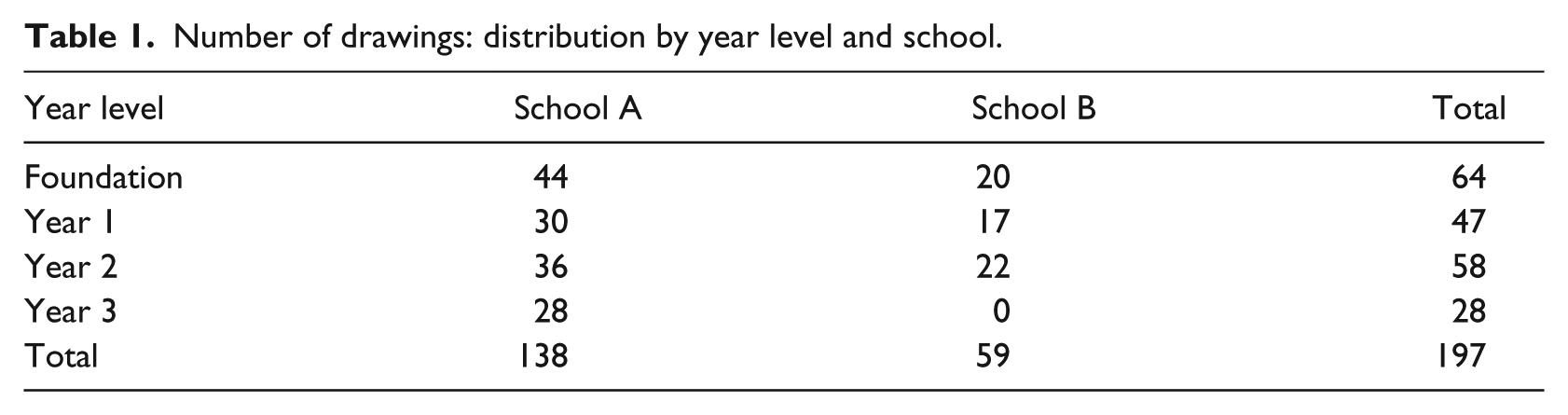
Our data-gathering methods align with our theoretical perspectives about listening to children. As such, we have incorporated the visual research technique of ‘draw and talk’ (Coates and Coates, 2006; Hopperstad, 2010), affording children the opportunity to use non-verbal and verbal modes of communication together (Wright, 2007). While the relationship between narratives and drawing is under-researched (Coates and Coates, 2006) and undervalued (Anning, 2003), visual representations such as drawings provide researchers with alternative ways of understanding literacy learning (Kendrick and McKay, 2004). Cox writes: talk and drawing interact with each other as parallel and mutually transformative processes. Sometimes the talk feeds into the drawing with the verbalised intention being transformed into drawing. Sometimes the drawing feeds into talk: the drawing intention is transformed into talk. Sometimes these processes are apparently concurrent. (Cox, 2005: 123)
The method draws on Kress’s (1997) observation that often the end product – the drawing – is the only element utilised in research, with the researchers assuming the role of the interpreters in the analytic process. When including the associated talk, which was audio-recorded during the drawing process for later analysis, researchers are potentially able to draw richer and deeper understandings of children’s perspectives (Kress, 1997; Kress and Van Leeuwen, 2006). While not presupposing that an absolute ‘truth’ is embedded in a child’s drawing, there is an acknowledgement that images, like other texts, can be interpreted and deconstructed in multiple ways (Thomson, 2008). Therefore, if a child chooses to talk while drawing, there is the potential for drawing to be a ‘constructive process of thinking in action’ (Cox, 2005: 123). Children’s drawings are composed of lines, circular motions and colour, and, through talk, children add meaning to these ‘marks’ as they articulate their ideas and details within the drawing (Kervin and Mantei, 2015). Through drawing and talk, children provide us with important information about their classroom writing experiences from their perspective.
In this instance, the drawings have been analysed using a simple content analysis that focused on frequency counts (Krippendorff, 2013) of the depictions of writing in the visual data. Following an initial first-pass overview of the drawings, coding guidelines were framed using four categories:
representations of the writer engaged with writing (including depictions of the person, their face and facial expressions);
representations of collaborative writing (including evidence of individuals, pairs or groups);
representations of the materials of writing (including depictions of writing tools); and
representations of the spaces of writing (including depictions of setting).
For some of the categories, specific elements or items were identified as subcategories (see Table 2), and these were used to code the children’s drawings. While we generally looked for the observable in the drawings, we were also able to identify what the drawings excluded or ‘concealed, rather than revealed’ (Matthews, 2003: 13).
Coding guidelines for the analysis of the children’s data based on category.
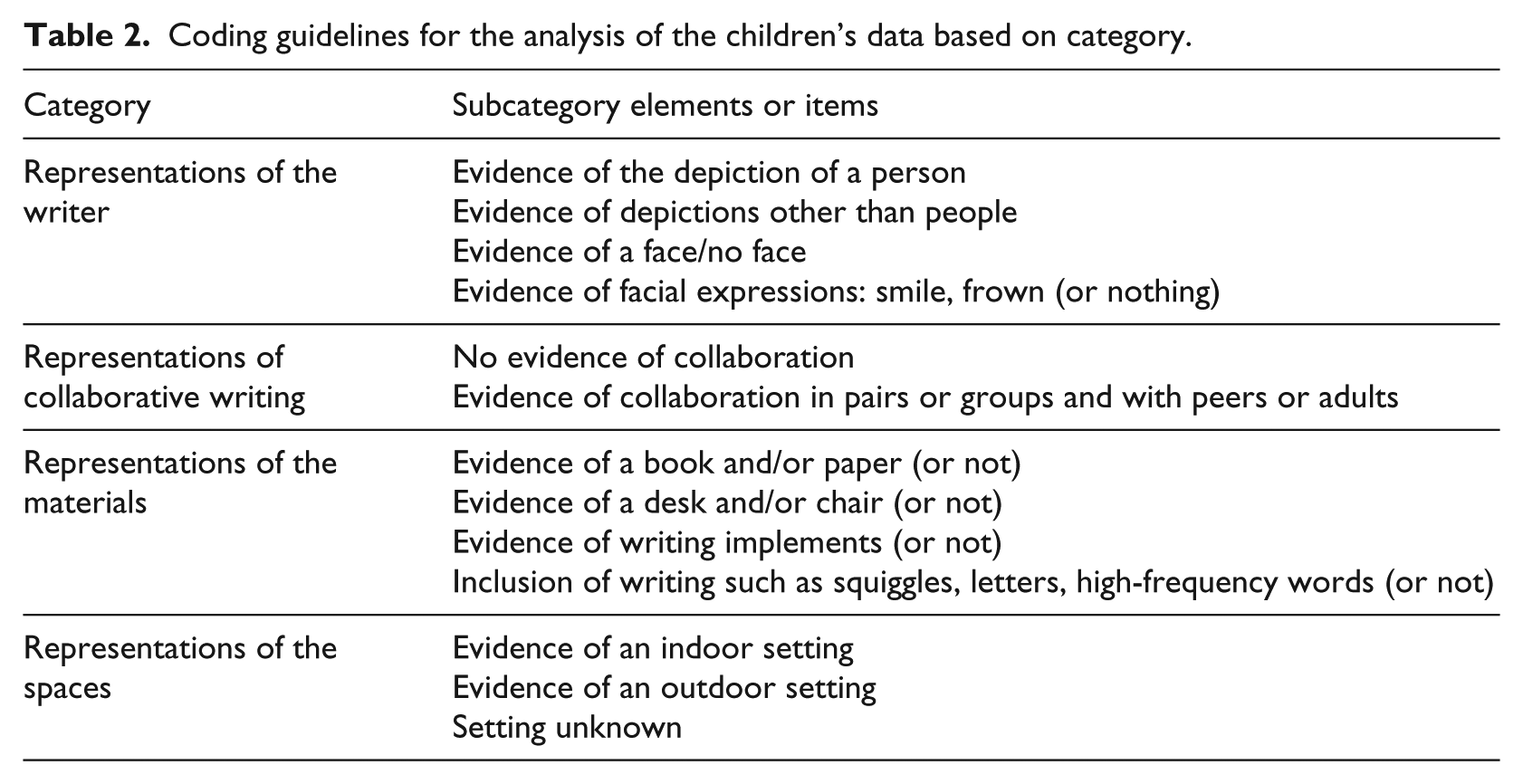
Each time an element from the coding guidelines was identified in the children’s drawings, this was recorded as an ‘instance’. Given that there were multiple elements in the drawings, there is a greater number of instances than participants. The analysis of these drawings included distributions based on both year levels and categories or subcategories. Throughout the data-gathering and analysis process, we were mindful of Kress and Van Leeuwen’s (2006) framework for interpreting visual texts, drawing on the ideational, interpersonal and textual functions identifying ‘What is being represented?’, ‘Who is the audience?’ and ‘How is the drawing composed?’
Finally, the accompanying talk during drawing was audio-recorded and later transcribed to provide elucidations about the children’s perspectives on writing. We should note that not all children spoke while drawing, with some becoming so immersed in the activity that they did not want to talk, while others did not feel comfortable with disclosing elaborations about their drawings (Coates and Coates, 2006). In these instances, we respected the child’s right to abstain from participating in talk. Additionally, at times either during the interview or at the end, the researchers invited the children to talk to them about what they had created.
Representations of writing
The analysis of the representations of writing was framed using four categories – the writer, the collaborations, the materials and the spaces of writing (see Table 2) – which have also been used in this article to report on our initial understandings of the children’s ideas. Across the four categories, there were 1505 instances across the four year levels (n = 197 participants; also see Table 1). The largest number of instances (43%) depicted representations of the materials of writing, followed by 33% that represented the writer. Collaborations during writing were only represented in 12% of the instances and, similarly, the spaces of writing were identified in 12% of instances. At times, in this article, examples of children’s drawings are provided as indicative of the types of representations across the categories and year levels, as well as their accompanying talk. The representations of writing outlined in the following sections identify our initial understandings of the data, and subsequent analysis that incorporates the remainder of the survey is likely to provide additional insights and less tentative trends. In this article, we focus, first, on the relational elements of the subjects who are writing (the writer and collaborations), and, second, on the material and spatial elements of the objects of writing (writing tools and environments).
The writer
Children’s depictions of themselves as writers enable educators to understand how they position themselves and how they themselves construct their literacy identities (Kendrick and McKay, 2002). Often, this is a multilayered, complex and ever-changing process (Compton-Lilly, 2006), but worthwhile pursuing given the potential benefits for understanding how children approach and perceive writing. For example, one child’s personal narrative equated writing with ideas, depicted through the image of a light bulb above his head. After he finished drawing, the researcher asked him to describe his picture. He stated: ‘It’s a picture of me writing, while having some ideas to write’. The child articulated his understandings of the writing process through visual and symbolic references to objects such as a light bulb.
In 95% of the instances across all year levels, the children represented themselves through the inclusion of a person. Usually, when people were included, these were full-bodied representations. However, there were disembodied depictions as well, such as arms or torsos, as seen in the example in Figure 1. The child who drew this picture told us: ‘You write with your hand’. Here, she is suggesting a physical association between a body part and the act of writing.
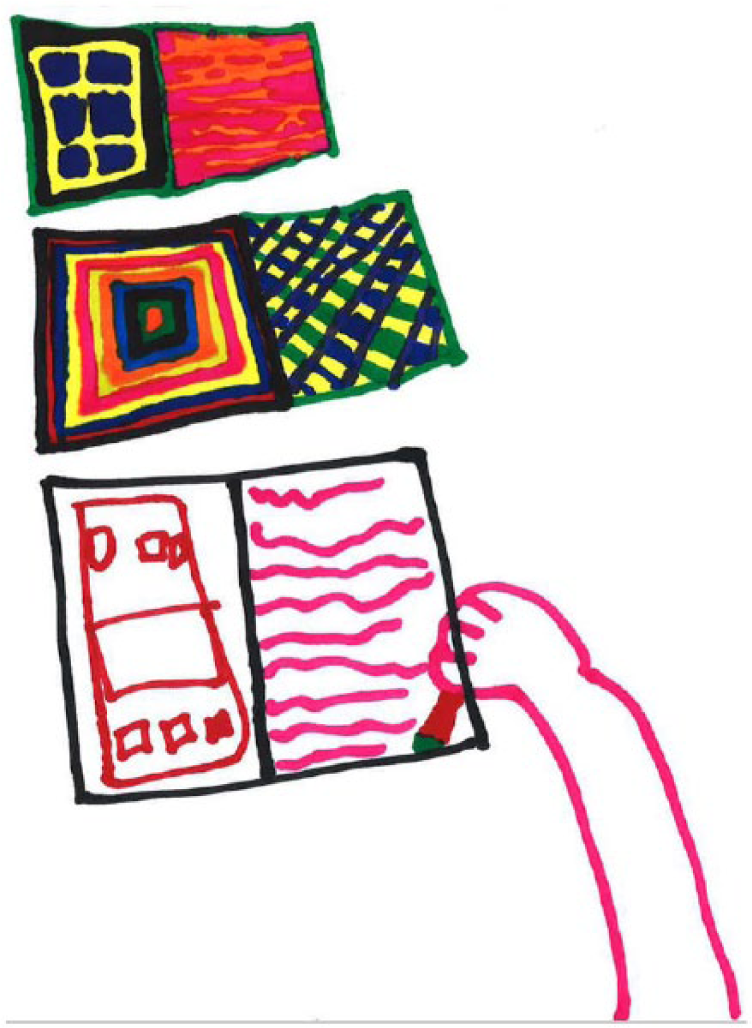
Drawing of a disembodied writer (Year 2).
The detail in the drawings representing the writers varied from stick-figure people to detailed caricatures of the writers. These representations were generally not age-based – that is, drawings of stick-figure writers were found across all year levels. Often, the children included aspects of their physical appearance in the drawings – for example, hair colour, hairstyle, skin tone or clothing preferences. One girl in School A indicated to the researcher: ‘That’s my ponytail’. Interestingly, very rarely were school uniforms worn by the writers in the drawings, even though we see in later sections of this article that the children most frequently associated writing with school.
Compton-Lilly (2006: 60) suggests that ‘literacy and literacy practices are means for performing particular identities’. In addition to the physical characteristics of the writer, the children’s drawings depicted their capacity to experience emotion during the act of writing. Eisner (2002) identifies this as a ‘physiognomic quality’ of drawings, which enables not only the expression of feeling and emotion, but also the ability to evoke these sensations. Therefore, the children disclosed their feelings and attitudes about writing through their facial expressions and the positioning of their bodies in their drawings (Soundy, 2012).
In 32% of instances, the children’s drawings included faces, and 30% of instances included smiles, thereby suggesting emotions of happiness, enjoyment or pleasure when writing. This was reinforced in the children’s talk – for example, a Year 3 student at School A stated: ‘Writing always makes me happy. I always enjoy my writing’. In a negligible number of instances, the children expressed unhappiness or sadness through their drawings. For example, one child drew a frown on his face. When the researcher commented on the frown, the child started colouring in the face. This prompted the researcher to ask if the frown was a mistake, to which the child indicated that it was not an error and that writing made him both happy and sad. Kress and Van Leeuwen (2006) suggest that experiencing confused emotions or shifts in affective and emotional states is common in visual images. The child indicated that he was happy when he understood something, such as being able to spell a word, but tended to get upset when he was not successful. Such situations can potentially affect a child’s perceptions of their capability, as well as their level of confidence, thereby affecting their writing identities. Here, the child’s previous successes and struggles contributed to his identity formation of himself as a writer (Compton-Lilly, 2006).
Collaborative writing
As well as being influenced by their school experiences, children’s writing identities are influenced by and formed within their relationships with others, including their teachers, family members and peers (Compton-Lilly, 2006). Of 184 instances in the drawings that represented writing, across all year levels, 76% depicted this as an individual activity, allowing us to see that children did not typically equate writing with a social activity or collaboration.
When the children did represent writing as a collaborative practice, most instances of collaboration involved children or other people appearing to be adults in a classroom (see Figure 2), with family members or within their peer networks.
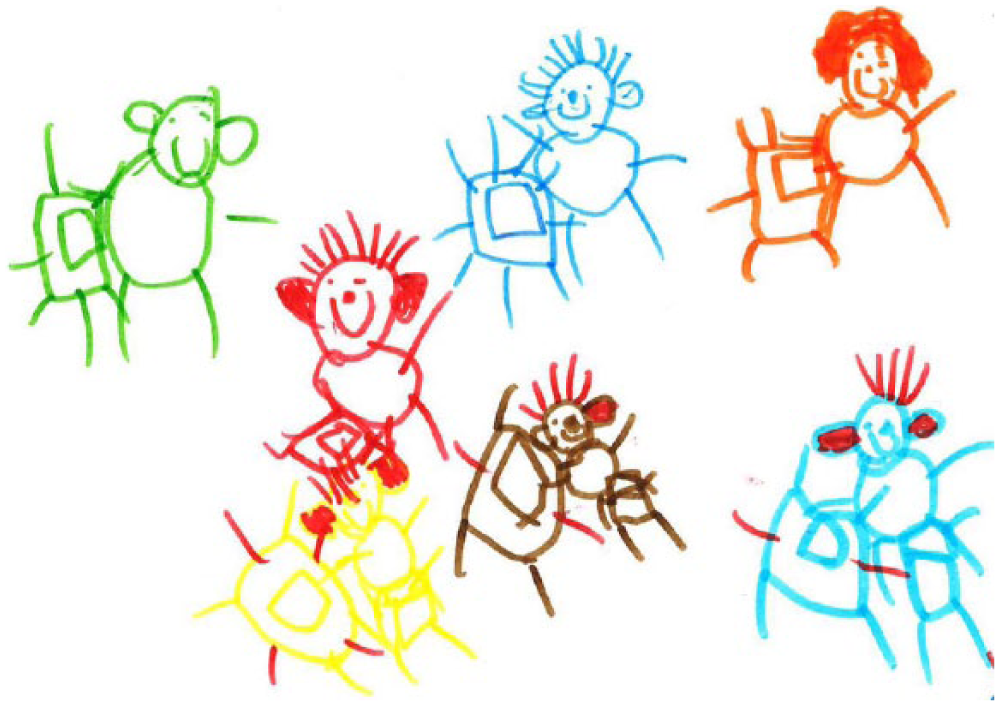
Representing writing in groups (Year 1).
What is interesting about the representation in Figure 2 is that, in the accompanying talk, the child identified the names of her peers who sat nearby in the classroom. However, while the names that were identified did replicate the actual children she was positioned with in the classroom, these children were drawn on individual tables. This was not the desk configuration of her classroom. In other examples, some children also represented writing in pairs with one other person – for example, a member of their class or a sibling. In the case depicted in Figure 3, the child told the researcher that the two figures either side of the children in the drawing were the class teacher and the support teacher. These figures are standing up in this image and located either side of the children. This opens up some interesting notions of the role of adults in children’s learning – an area we intend to explore in future articles.
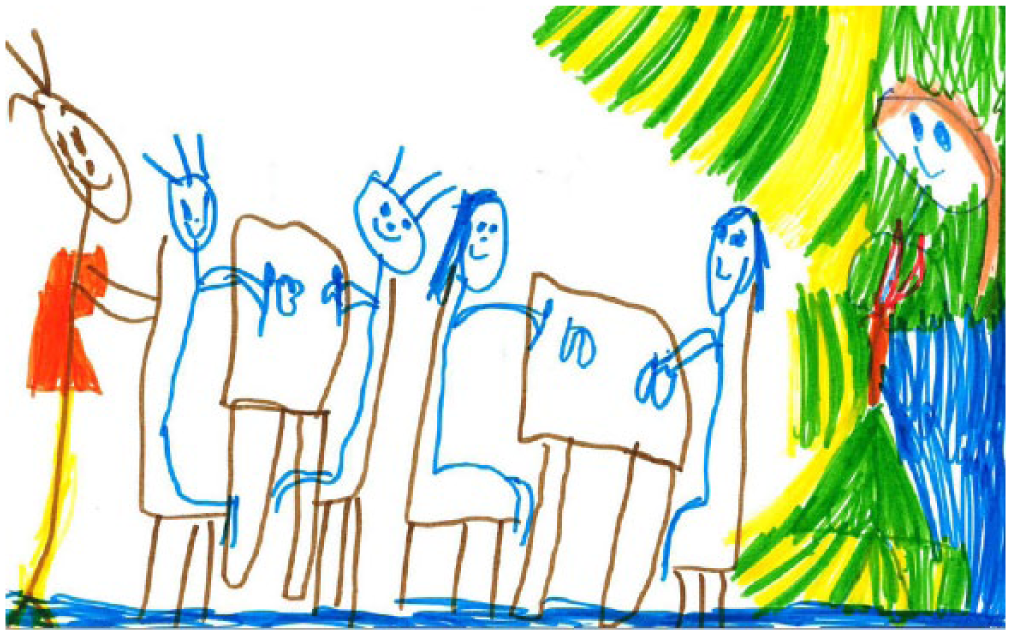
Representing writing in pairs and with teachers (Year 1).
A smaller number of instances also represented some collaborations with family members. In one example, a child identified her mother in her literacy narrative, reinforcing the role that parents and members of the immediate and extended family can play in a child learning to write. Family members are often seen by children as knowledgeable figures in their learning, and as important literacy motivators (Kendrick and McKay, 2004). Many of the children across both schools indicated that family members often helped them with their spelling.
While the children often identified members of their family in their talk, some children labelled their drawings with titles such as ‘Mum’. These labels often occupied a prominent place in the image. Wright (2007: 40) indicates that ‘these techniques serve to anchor the text and to foreground a preferred reading of the visual content’. In so doing, the children placed value on the parental interaction, identifying this writing relationship as having a high degree of importance.
When comparing the examples in Figures 2 and 3 for the visual features the children used in their representations, we also see the prominent use of colour and/or relative size in the composition of the drawing to convey the children’s perceptions of collaborative writing practices. Kress and Van Leeuwen (2006) suggest that, in visual communication, such choices equate to the selection of linguistic structures in language communication. The representation of peers (see Figures 2 and 3) shows a high degree of uniformity. For example, in Figure 2, all the children have the same form – that is, a rounded body and protruding stick-figure arms and legs – with differentiation occurring through the use of colour. Interestingly, the desks are positioned randomly rather than in rows or other structured and uniform spatial configurations, which was a common depiction of the classroom setting. In Figure 3, the representations of the children are also uniform – that is, the writers are seated at their desks and the body forms are plain and represented in the same colour. However, the two adult figures are distinct in that they are standing upright, wearing clothing, drawn in greater and more vivid detail, and larger in relative size to the children. This may symbolically place the teacher figures in a position of authority. Finally, in both images, the figures are drawn in frontal views, smiling and facing the audience. This direct gaze demands engagement with the literacy narrative (Kress and Van Leeuwen, 2006).
While these first two sections on the representations of writing have focused on the subjects in the drawings, the following two sections have a greater focus on the objects and spaces of the children’s representations of writing. Here, we foreground the non-human objects – that is, the tools and spaces children use to enact writing (Fenwick et al., 2011).
Materials of writing
While literacy tools such as pencils, paper and books are used in different ways in different classroom spaces, it is through the engagement with such objects that literacy learning occurs (Anning, 2003). Based on 356 instances, 39% of the children’s drawings included books and/or paper, and 36% included desks and/or chairs, while 25% depicted writing materials such as pencils and/or pens when representing writing. Figure 4 shows a typical example of a child’s representation of the materials of writing: the child is seated on a chair, in front of a desk, holding a pencil, with a book in front of them. Interestingly, when children did not include words in their drawings, they tended to represent words with scribbles (see Figure 5).
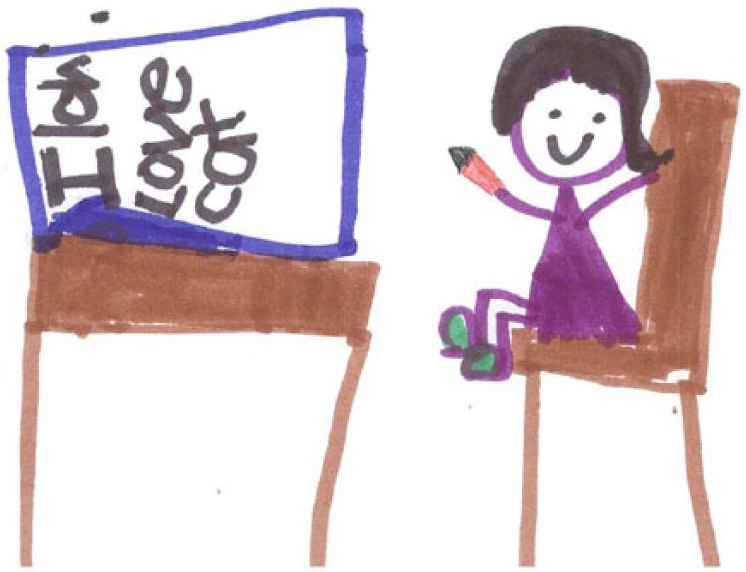
Materials of writing: desks, chairs, pencils and books (Foundation Year).
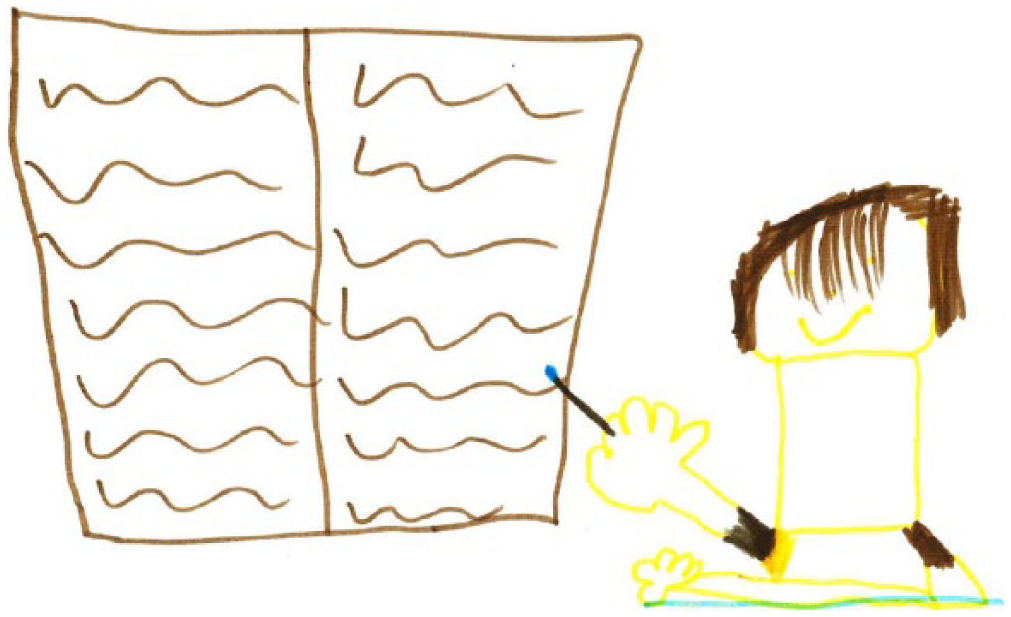
Exaggeration of the book or paper (Year 2).
Often, when desks and chairs were included in the drawings, the children were seated on a chair and in front of a desk. These objects became signifiers of children’s understandings of learning to write – the ‘necessary’ tools for undertaking writing. When the materials of writing were included, these were, at times, in an exaggerated form – for example, in Figure 5, the child has drawn an excessively large book and, in Figure 6, there is a massive desk, both of which miniaturise the children in these drawings.
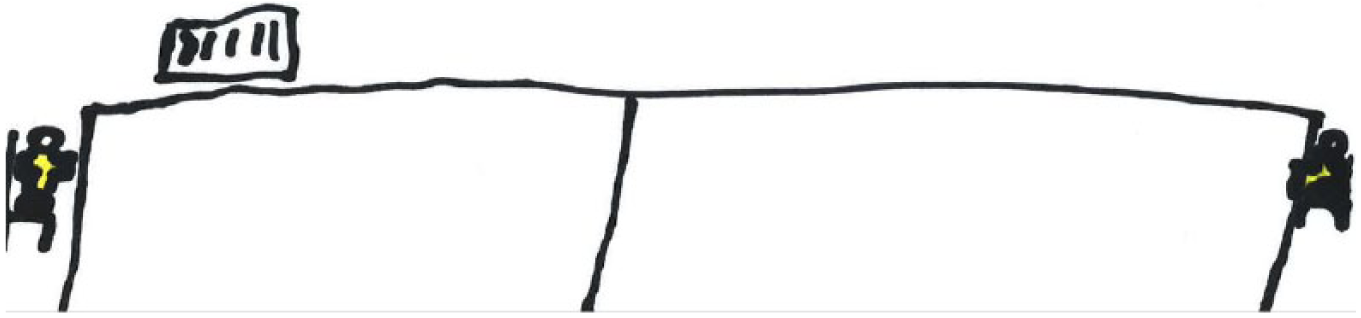
Exaggeration of the desk or table (Year 2).
The child who drew Figure 5 told the researcher that ‘The page is just so big’, while the child who drew Figure 6 alluded to isolation in their writing. As Eisner suggests: How they feel about a particular object, person, or event is reflected in the way they treat it in a drawing. What is important is often exaggerated, what is important is often made more visible, what is important secures a prominence on the paper that confers on it the significance they want to express. (Eisner, 2002: 113)
Here, the significant element of the children’s drawings foregrounding the enormous scale of the writing objects, proportional to the rest of the composition, could be interpreted as the children’s perceptions of the enormity, complexity or isolation associated with writing. Additionally, the children sometimes drew themselves without a chair. One child talked specifically about how he preferred to stand up when writing (see Figure 7).
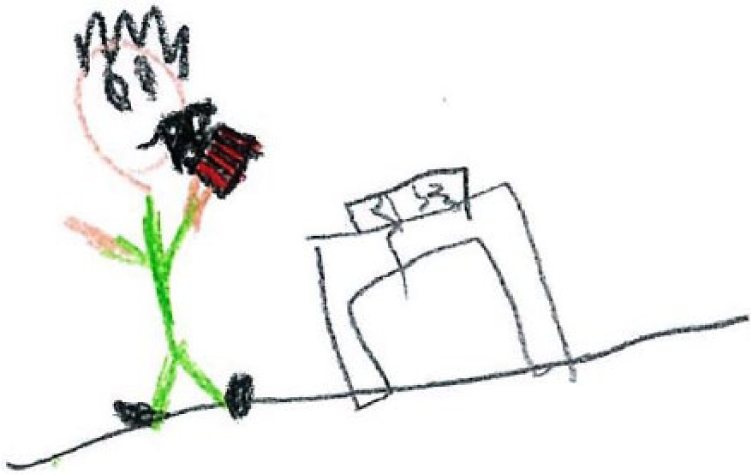
A preference for standing up while writing (Year 1).
An interesting point is that, in more than half the instances, a writing implement was omitted from the drawing. Also of interest is that only one child referred to a computer in his drawing, stating: ‘I use the computer desk at home. … Sometimes I’m lazy and don’t like writing with my hands. … I prefer writing on the computer because it’s easier’.
Based on our observations, what is of interest here is that the children in this study did not equate technology with writing and, in this example, the computer was in the boy’s home, not at school. Similarly, Kendrick and McKay (2004) found that when children represented literacy in the home, there was an increased inclusion of technology in their drawings. Consequently, ensuring that children in the early years of schooling experience more opportunities for writing using various technologies is a challenge for educators.
Spaces of writing
Lefebvre (1991) suggests that the practices of a society, such as those that occur in schools, are revealed through a decoding of the spaces in which they occur. Therefore, in understanding the spaces where the children depicted themselves as writers, we gain a better understanding of their perceptions of learning to write and writing practices. We have already noted the materials that are incorporated within the spaces of writing, and the relational performances of the writers. These are intertwined with the learning spaces, as these are the sites of occurrence. Additionally, there is a reproduction and continuity of these spaces, and the behaviours they produce, through practices (Lefebvre, 1991) such as writing.
Of the 180 instances where the children’s drawings included items that depicted particular spaces, 67% showed that writing mostly took place indoors, while only 8% of instances indicated that writing occurred in outdoor spaces. The settings in the remaining 25% of instances could not be determined. The indoor spaces often included signifiers of a classroom, such as desks in rows or blackboards. While traditional representations of classroom spaces were predominant, there were also examples of spaces that encouraged collaboration and group work (see Figure 8). Additionally, the children also drew or spoke about special writing tables – for example, ‘the blue table’ or ‘the engine table’, which were places where teachers and small groups of students worked on their writing.
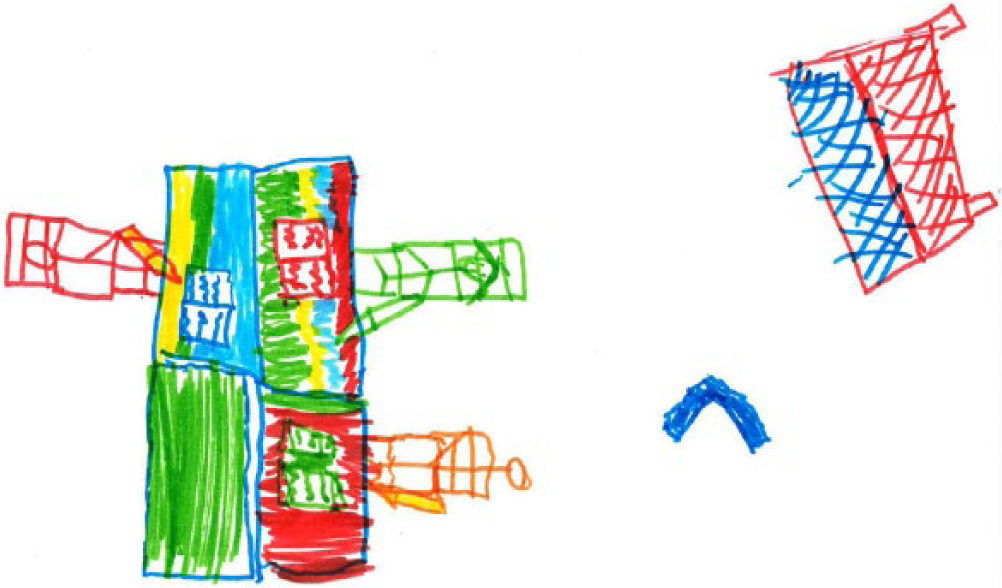
Writing indoors in a classroom (Year 2).
One of the children’s drawings represented her writing in an outdoors scene with her family members. She chose to provide a running commentary of her drawing, identifying each element: This is the desk … This is the chair … This is me; and I have a smile on my face … This is my pencil. Here is the other chair … This is my mum. This is at home. More chairs, more feet … Here is the cabininent [cabinet]. I have to be careful of the cabininent [cabinet]. I bashed my head in the cupboard. I had to go to the doctors to get a stitch. Blood was pouring out in my brain … Here is Robert … His beard … We are outside.
In this example, we see how the subject and the object, the relational and the material, are intertwined with the spatial. Writing is enacted through the people and spaces they occupy. The child’s home is a significant element of her personal narrative (Anning, 2003) about writing and a source of inspiration for her drawing.
Conclusions
In exploring young children’s voices, we positioned the children as competent and expert informants about their own learning. Anning (2003: 32) suggests that, within many institutional contexts, understandings of writing relentlessly tend towards policy-driven school versions of literacy, without children’s views being taken seriously. Therefore, valuing children’s perspectives about learning encourages a respect for children’s identities and interests (Compton-Lilly, 2006), positioning them as experts on their own experiences (Danby and Farrell, 2004). Foregrounding children’s voices by listening to them also works towards ensuring that, as educators and researchers, we are accountable to the children (Tay-Lim and Lim, 2013).
Policy-driven literacy discourses shape and reshape pedagogical discourses and practices in schools. For example, public accounts of poor school performance in standardised measures of literacy such as NAPLAN can lead to increased political intervention and a focus on accountability. This can shape teachers’ and schools’ teaching of literacy and children’s understandings of learning to write. While drawings are communicative semiotic texts, we can also understand children’s drawings to be a product of the practices of literacy teaching – that is, pedagogy as inscription (Luke, 1992). Schools and classrooms are spaces of institutional regulation, producing disciplined subjects and docile bodies (Foucault, 1995). The discursive and material practices of teaching, such as requiring children to sit in their seat while learning to write or not to talk to their peers during writing, or to hold their pencil in a particular way, develop certain understandings in children about writing. In some cases, the children’s drawings represent their compliant understandings of writing, while, in other instances, they challenged and resisted conventional school writing practices.
Across the representations of the practices of writing, whilst there were notable exceptions, the children’s narratives usually portrayed ‘traditional’ understandings of their experiences of writing – that is, that writing is an individual activity, undertaken in a classroom sitting at a desk and on a chair. However, when the children were asked about their drawings, they divulged a plethora of experiences and preferences for the relational, material and spatial elements of writing. In concluding, we focus on some of the children’s preferences in the narratives as a means of foregrounding possibilities for and, at times, gaps in writing practices.
First, we draw on the children’s relational preferences with writing. The writer can be understood as an active participant in the writing process, bringing their ideas and emotions to the mix. The children’s drawings mostly represented writing as an enjoyable activity; however, writing also prompted emotional responses when the children represented themselves as not experiencing success. Additionally, while the children’s writing identities were influenced by their relationships with others, most of the children did not include representations of collaborative writing practices; however, this could be related to how we invited the children to undertake the task in a one-on-one context with a researcher. Those who did depict writing as a collaborative practice placed emphasis on their collaborations with groups, such as their peers, teachers and family. Second, the children’s material and spatial experiences of writing were predominantly represented through desks and chairs in indoor locations, such as their classrooms. At times, their compositions expressed the materials of writing on a scale that miniaturised the writer, evoking the possibility that some children perceive writing is an enormous task. Additionally, through their talk, we gained insights into the varied preferences for writing, such as standing rather than sitting, and using technology rather than pencil and paper.
In analysing the children’s drawings, we identified the children’s experiences with writing as well as their preferred relational, material and spatial contexts for writing. The value here for policymakers and educators rests with addressing these gaps between children’s experiences and preferences and the realities of writing time within school. The starkest finding is the difference between the children’s representations of learning to write and the idea that writing in contemporary times involves people using a range of tools, media and technologies to produce multimodal texts together. It is beyond our scope here to discuss why this might have been the case. We can report that the teachers were extremely interested in the children’s portrayals of their experiences of learning to write, and a number of our collaborating teachers have since begun to experiment with different ways of organising their classrooms and times for writing – a necessary first step in exploiting the affordances of a range of technologies, tools, spaces and resources for children to learn to produce texts.
Footnotes
Acknowledgements
We wish to thank the children and their families, and the teachers and leaders of School A and School B. We also thank Alysha Calleia, Danielle Campbell, Evangeline Manassakis, Laura Pegg, Di Sesay, Chrystal Whiteford and Danica Yates for their assistance.
Funding
The authors disclosed receipt of the following financial support for the research, authorship, and/or publication of this article: The research reported in this article was supported by the Australian Research Council’s Learning to Write in the Early Years Study (DP150101240).