




Abstract
In this colloquium, the author responds artistically to Bone and Blaise’s article ‘An uneasy assemblage: Prisoners, animals, asylum-seeking children and posthuman packaging’, published in Contemporary Issues in Early Childhood in 2015, continuing their trajectory of ‘different kinds of images than those usually seen in an article in an early childhood journal’. Here, I employ the practice of making as an experimental research method to reconsider the relational and ethical issues raised in Bone and Blaise’s primary article.
Introduction
In their article ‘An uneasy assemblage: Prisoners, animals, asylum-seeking children and posthuman packaging’, Bone and Blaise (2015) raise a plethora of ethical issues, including the conceptual ‘packaging’ of individuals in three situations: offshore prisons; refugees immigrating in boats to Australia; and animals in Australia being exported primarily to Indonesia for slaughter. In this artistic response, I engage with the unease of ‘packaging’ specifically in relation to live animal export. ‘Live export refers to the practice of transporting live cattle, goats and sheep from Australia (in this instance) to other countries’ (Bone and Blaise, 2015: 23). My response to Bone and Blaise’s article is to make a paper boat as a way of thinking through their concerns regarding live animal export. Packaging, drawing and assembling are employed to draw relations between making and thinking.
Packaging
Bone and Blaise’s term ‘packaging’ inspires me. The poetry of their use of this term generates an ekphrastic response: suddenly, I want to make a paper boat. Their article invites me to respond creatively because it has multiple, layered meanings, making room for different ways of responding to ideas. ‘Making’ is central to this article as the process of making is my research method, working with materials to help me understand ethical and relational issues surrounding live animal export.
Figuring out how to make a paper boat begins with my own Internet research:
I find a YouTube clip showing small hands confidently making an origami boat (Nakashima, 2010). I try following the competent demonstration. Rewatching the video, I pause, self-conscious that my folds are always half a millimetre out. Will this matter? Firmly pressing over the folds again, I rewatch the presenter doing the same. My fingers are bigger than his, and clumsy (see Figure 1). 1 Eventually, my carefully pressed folds hold as the shape turns inside out, forming a rectangular boat.
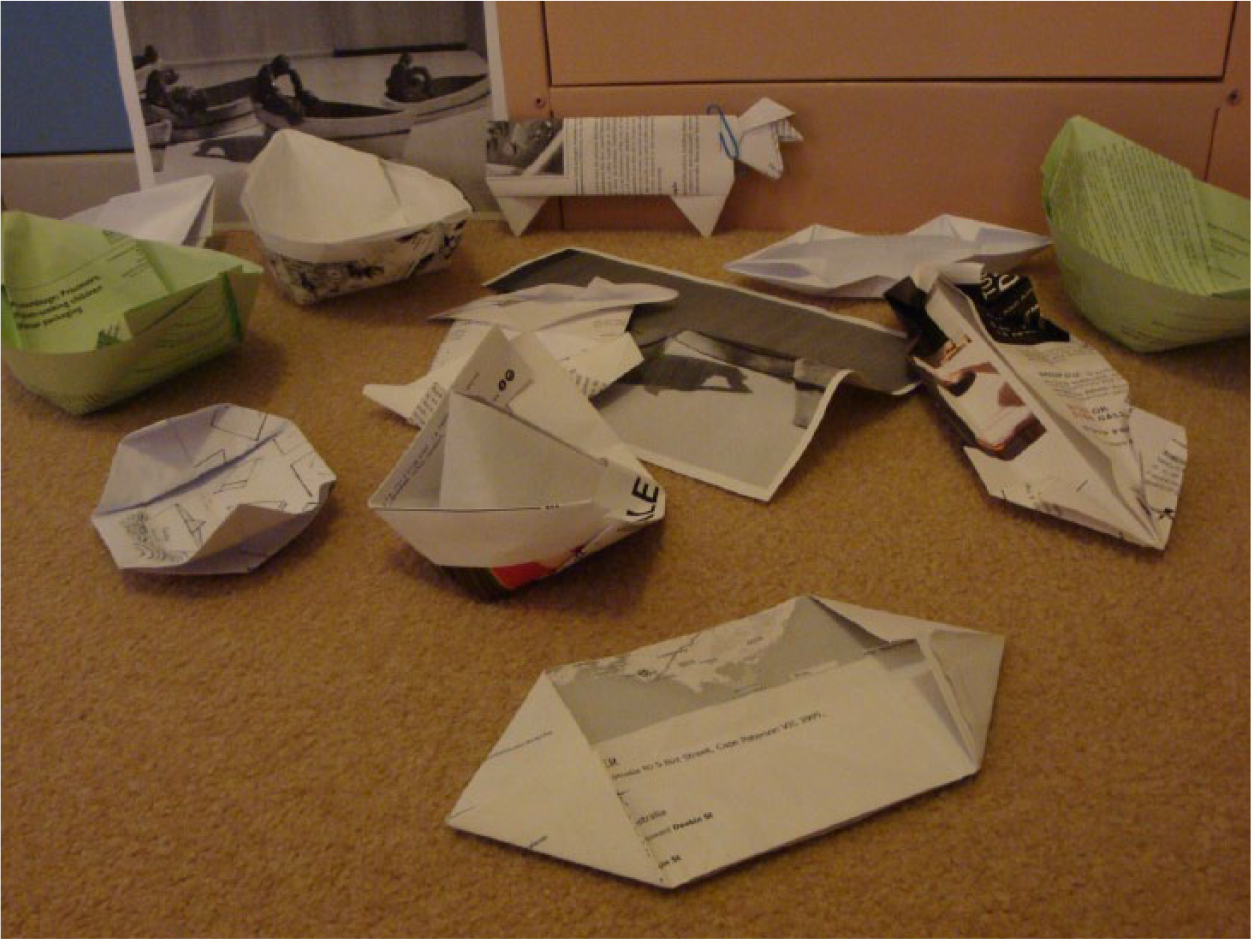
Multiple attempts at folding a paper boat, discarded on the study floor.
Attempting origami is something I have not done for years. In following this child’s YouTube directions, I try something new. Eventually, my hands remember dormant paper-folding skills and the boat unfolds.
By undertaking this paper-folding challenge, I have moved from the ‘unknown to the known’ (Nimkulart, 2012: 2, referring to Sullivan, 2009). This is significant because working from the ‘unknown to the known’ is a form of research where (in this example) making is part of the thinking process. The two activities are not separate, such as thinking up an idea and then representing that idea. Rather, the activity of making is integrated. Employing making as an experimental research method by working iteratively with the materials helps me understand the complex relational issues raised by Bone and Blaise.
Drawing
I want to show the relationship between live animals and meat. Using red and blue carbon paper, I trace the diagram of ‘British beef cuts’ from Bone and Blaise (2015: 28) over the passage about Bill the Brahman (22; see Figure 2). The diagram is traced over several copies of the same passage of text. 2 Then I retrace the shape with scissors, cutting out the figure. One of the lines interrupts the words ‘kicked in the face’ in the text, and the phrase reverberates: so many Bills experience being ‘kicked in the face’. I wonder – can this unnecessary violence be avoided?
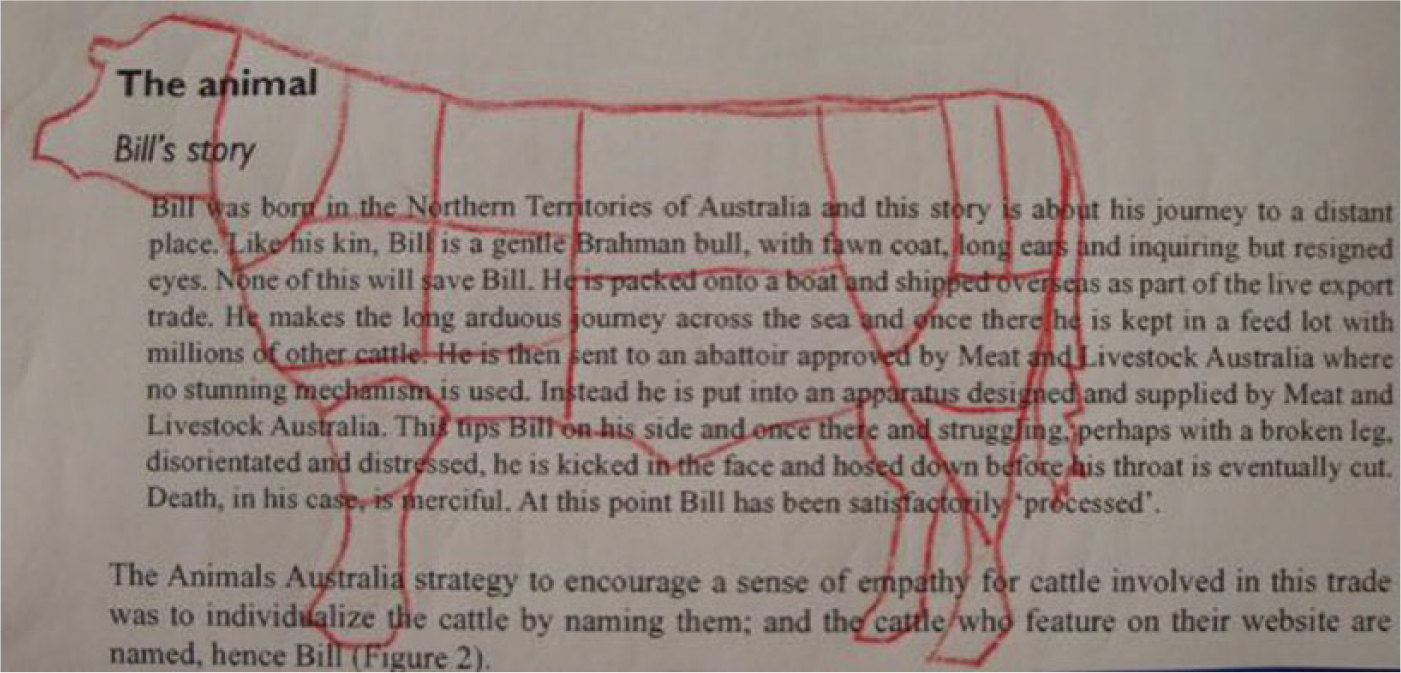
Carbon tracing of cuts of meat over Bill’s story.
Acts of drawing help me understand Bone and Blaise’s article – for example, firstly, by tracing the outline with carbon paper and retracing that line with scissors and, secondly, the scissors are used to draw another line by cutting around Bill’s head. During this process of drawing-with-scissors, I look into Bill’s eyes and form a relationship with him. Ultimately, it is this relationship with his image that causes me to attend to his plight. The content of Bone and Blaise’s written and visual texts communicates powerfully via these material engagements.
By overlaying the diagram of ‘British beef cuts’ on Bill’s text, I blur the binary between prime cuts of beef bred in the southern states of Australia and Brahman beef destined to become mincemeat (Bone and Blaise, 2015: 24). In the next stage of the boat construction, I cut out the diagram and affix Bill’s head to it, thus giving Bill a prime body. These acts undo the privileging of some breeds of cattle over others (see Bone and Blaise, 2015: 28).
Assembling
Next, I begin assembling the boat’s cargo. Photocopies of Bill’s head are attached with tape to the ‘British beef cuts’ diagram already cut out from the passage of Bone and Blaise’s text. Human figures representing the ‘boat people’ (discussed by Bone and Blaise, 2015: 20–21) are also cut out and placed inside the boat. Using a tiny stapler, I crowd as many figures as possible into the origami boat. Like the treatment of Bills overseas, stapling is brutal. Unlike Bill’s boat, the crowding on my boat is limited so that all the animals can see out. It is also possible to see inside the boat so the text on the inside of each figure can be read (see Figure 2). As the humans and animals jostle for space within these limitations, the overcrowding moves up and the boat becomes top-heavy and unstable.
In my response to Bone and Blaise, Bill’s story dominates. By adding figures to the paper boat, I also refer to Bone and Blaise’s (2015: 20) section on immigration where ‘[r]efugees and asylum seekers, including unaccompanied minors (children), who arrive in Australia by sea, are collectively and colloquially known as “boat people”’.
Assembling figures in this boat brings together two of the concepts explored in Bone and Blaise’s article: live animal export and the immigration of refugees on unlawful and unsafe boats. By combining Bone and Blaise’s (2015: 22–23) concerns regarding live animal export from Australia and immigration to Australia on overcrowded boats, I repackage Bone and Blaise’s article by overcrowding my paper boat with both animal and human cargo (see Figure 3).
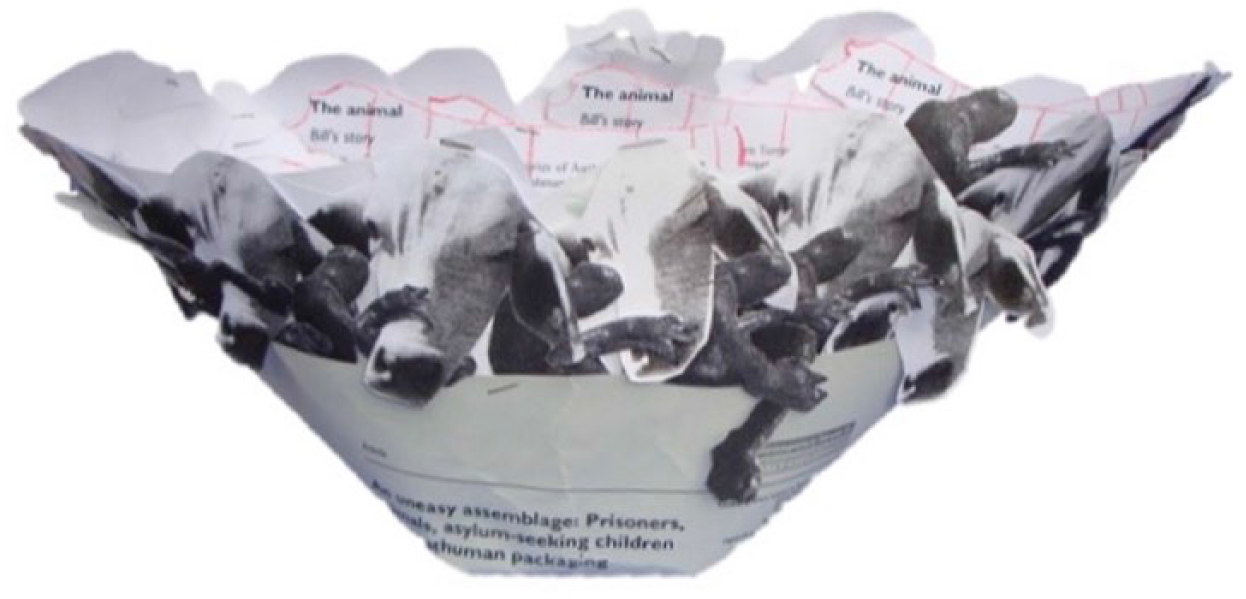
Paper boat overflowing with Bills and figures. 3
Through responding artistically to Bone and Blaise’s article, I relate to their visual and linguistic imagery. My engagement with materials – paper, scissors, staples – deepens my understanding of Bone and Blaise’s relational ethics. In making this paper boat, theories of practice-led research (e.g. Carter, 2004; Dormer, 1994; Nimkulrat, 2012; Sullivan, 2010) are applied to a field of understanding that is not intended to create finished artworks. By adopting making as an experimental research method and physically interacting with the figures in their story, I enter into an emotional and ethical relationship with them.
Conclusion
This colloquium recounts my response to Bone and Blaise’s article, employing making as a thinking strategy to help me understand their ethical concerns. The making method deepens my understanding through the iterative process of thinking with materials. By creating a paper boat, I utilise both conceptual and dialogical making practices, exploring Bone and Blaise’s argument through a dialogue with materials. 4
The experiences felt during that making process (e.g. establishing a relationship with the images of Bill) help me understand the concepts in Bone and Blaise’s article, ultimately convincing me that live animal export of cattle (such as Bill the Brahman) from Australia should be stopped.
Footnotes
Acknowledgements
This research emerged during my doctoral studies. I wish to thank Professor Mindy Blaise for her comments on earlier drafts of this article.
Funding
The author(s) disclosed receipt of the following financial support for the research, authorship, and/or publication of this article: I acknowledge the support of the Australian government through a Research Training Program scholarship.