




Abstract
This article contextualizes the dark sides of play from a cultural-historical perspective using Fraser’s theory of social justice based on the concepts of recognition and redistribution. Through a micro-ethnographic analysis of a kindergarten’s daily life and play situations between 2 five-year-old girls, the article describes the dark play from a societal perspective (increasing economic and, thereby, digital inequalities), institutional perspective (the Norwegian kindergarten’s pedagogy of recognition) and individual perspective (the children’s motives to redistribute (digital) goods). The girls described in the article represent radically different backgrounds, but they attend the same kindergarten located in a disadvantaged neighbourhood in a large city in Norway. Insight into their play and their kindergarten’s daily routines provides knowledge about institutional recognition practices that maintain existing inequalities, as well as the children’s motives, which are anchored in the modus of redistribution. The misrecognized redistribution motives lead to activities of compensation and revenge performed in play situations.
The context(s) of the analysis
This article addresses the dark sides of (digital) play through contextualizing them from a cultural-historical perspective of child development and Nancy Fraser’s theory of social justice. The former perspective outlines children’s play as an activity within certain institutions in a society, with its culture, economy and traditions. In the model of societal conditions for institutional practices (Hedegaard, 1999, 2009), the individual, the institutional and the societal perspectives of an activity are in dialectical relation to each other. This model clarifies the relation between the personal and the political level in reference to children’s activities and behaviour that might be considered problematic. This article describes the societal level using Fraser’s theory of social (in)justice and, in particular, the concepts of recognition and redistribution (Fraser and Honneth, 2003). The concepts are also active in explaining what is happening at the institutional level of the kindergarten and the individual level of the (playing) child (attending the institution).
The article beings with a short description of the cultural and historical perspectives of children’s development, and the presentation of Marianne Hedegaard’s model of societal conditions for institutional practices. This is followed by a description of the social level, with its increasing heterogeneity and class polarization in Norwegian society, which includes an analysis of the diverse social groups that use digital media in different ways. The theoretical framework of recognition and redistribution is presented and includes its exemplifications in Norwegian pedagogical tendencies (which refer to the institutional level of kindergarten practice).
After the methodological perspective is presented, the empirical material is analysed. A multilayered argument based on this analysis is provided – that is, the (Norwegian) policy and pedagogy of recognition ignores the economic and symbolic/digital inequalities that underlie different children’s activities and recognizes them as aspects of cultural identities. Overlooking access to economic and symbolic resources leads to the incomplete recognition of some groups of children in the institutions they attend. This misrecognition leads to a greater need for the redistribution (e.g. of digital goods) that one of the researched children articulates and experiences in play (‘The iPad is mine in the play’). Being reminded of real ownership relations, she is no longer satisfied with redistributing the goods in play, but develops motives for compensation and revenge. These (abusive) activities happen physically on the iPad screen, but they refer to the other child, who is in the same role as the creature on the tablet’s touch screen.
The analysis of a single case contributes a ‘dark’ picture of (digital) play to the field of pedagogy, and shows its dialectics with institutional practices of the kindergarten, as well as with socio-economic inequalities. This raises the necessity for further research, debate and action at all of the levels mentioned.
The model of societal conditions for cultural practice in Norwegian institutions
Following a cultural-historical perspective, Hedegaard is interested in contextualizing ‘the construction of childhood and development within the framework of the institution, the society, and the individual’ (Fleer and Hedegaard, 2010: 151). The model she developed (Figure 1) permits investigating children’s activities as interrelated with ongoing practices in which children participate in social institutions (Fleer and Hedegaard, 2010; Hedegaard, 2009). For instance, children’s activities that could be classified by others as ‘problematic behaviour’ are anchored in Hedegaard’s model in three different perspectives: ‘(a) society’s perspective with traditions that implies values, norms, and discourses about child development; (b) different institutions’ perspectives that include different practices; and (c) children’s perspectives that include their engagements and motivations’ (Hedegaard, 2009: 65).
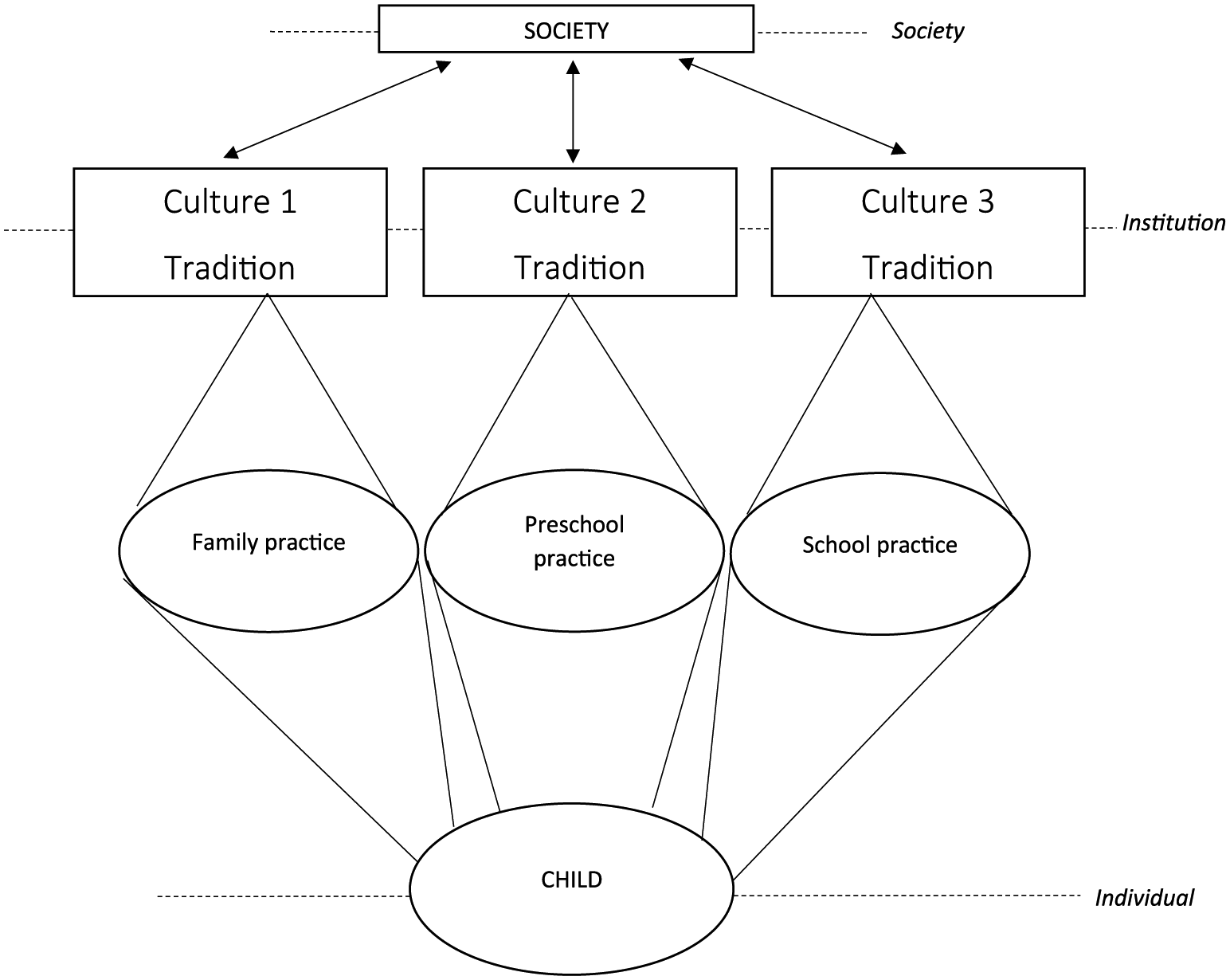
Model of societal conditions for cultural practice / Model of children’s learning and development through participation in institutionalized practice.
Thus, so-called ‘problematic behaviour’ is an activity that arises from children’s engagements and motivations which are rooted in different, sometimes opposing, values that are appreciated by the different institutions the child attends. Hedegaard presents the example of a five-year-old boy, Jens, who changed his behaviour in the kindergarten and did not want to take part in ‘cosy’ kindergarten activities. Influenced by his home environment, he oriented himself towards academic competence and, therefore, ‘wouldn’t appreciate the childish book’ which was offered to him (Hedegaard, 2009: 67).
In this theoretical tool kit, the crisis is a significant concept, and the emergence of a new self-awareness is associated with it (Kravtsova, 2006: 11). ‘Children’s development is marked by crises, which are created when change occurs in the child’s social situation via biological changes, changes in everyday life activities and relations to other persons, or changes in material conditions’ (Hedegaard, 2009: 72). Changes on all these levels influence the child’s orientations and activities; however, not all of the activities are in line with the institutional practices the children are a part of. Jens, from Hedegaard’s article, sees himself as a schoolboy who ‘no longer wants to play or build close relationships with the pedagogue, rather he wishes to participate in school activities’ (Fleer, 2010: 173), even though he is still in kindergarten.
The cultural-theoretical perspective describes crises as stormy, but important in the developmental process: In a very short time, the child changes completely in the basic traits of his personality. Development takes on a stormy, impetuous, and sometimes catastrophic character that resembles a revolutionary course of events in both rate of the changes that are occurring and in the sense of the alterations that are made. (Vygotsky, 1998: 191)
However, this theoretical tool kit also seeks and is supposed ‘to create conditions that lead children through their crises of development and thereby contribute to children’s development of competencies and motives that are appreciated in the activities of the everyday practices that they participate in’ (Hedegaard, 2009: 67–68). Adult assistance is also necessary for the development of an integrated ‘new-self awareness’ (Kravtsova, 2006). The dialectical relation between conditions and human activity is also the core of social class analysis, as well as an important issue in Fraser’s social justice theory.
Society’s perspective
Class differences in egalitarian Norway
Norwegian citizens consider Norway to be a classless, egalitarian society that appreciates cultural and ethnic diversity (Witoszek, 2011). However, socio-economic distinctions are growing. Moreover, they are strongly linked with ethnic and cultural background (Krosnes et al., 2014). Richer, mostly white, (upper-)middle-class neighbourhoods, as well as poorer, culturally diverse areas with more social housing, are establishing themselves in the urban landscapes. Oslo, with its division into the poor East End and the rich West End (Vestel, 2009), is the iconic example of growing socio-economic differences in Norway; however, class-based polarizations are also developing in other cities.
At the same time, the Norwegian welfare state takes excellent care of those who, for many reasons, are not participating in or benefitting from economic growth. Social housing, social benefits and support for children are at the highest levels in the world. Tax rates, which are an expression of social responsibility for weaker citizens, place Norway within the model of the redistribution of material goods. Material responsibility for poorer citizens is supported by a wide array of anti-discrimination practices regarding women and people from minority backgrounds, who, for example, are given priority in employment. ‘At the beginning of the twenty-first century, an achieved utopia of the European Left seems to have emerged in the North. It is embodied in equality, freedom, welfare and justice, and it combines these blessings with immense affluence’ (Witoszek, 2011: 7). Norway has been chosen several times over consecutive years as the best country to live in (United Nations, 2015).
Consequently, people believe that there are no differences among the various social strata. According to Skarpenes and Sakslind (2010: 219): ‘the Norwegian middle class has internalized egalitarian values embedded in Norwegian culture and thus, compared to the British case, more often hesitates to set up boundaries between itself and other classes’. This might be supported by research showing similarities in taste among the same social strata, which, along with comparable incomes, often places people representing the same social strata in one neighbourhood, thus limiting possibilities of encountering distinctions (Jarness, 2014). These seem to occur at the borders between neighbourhoods or when someone choses a place to live for a reason other than economic criteria and/or taste.
The classless illusion is additionally supported by a common egalitarian attitude that is about ‘being good’. Witoszek (2011) detects its origins in the love of nature and collective approaches developed through living in small communities in difficult weather conditions. Norwegians generally want others to feel good around them. This means that many Norwegians hesitate to confront others with difficult issues, and the general tendency is to contact representatives of relevant institutions in order to solve problematic issues with neighbours or workmates.
Digital differences
Inequalities of access to resources and goods also include digital media. Ongoing research on digital distinctions stresses differences in access to digital technologies (Krumsvik, 2008) and in the ways they are used (North et al., 2008). Thus, depending on whether people have or do not have access to different kinds of digital tools, they can be classified as ‘haves’ (who have access) or ‘have-nots’ (who doesn’t have access) (Tapscott, 1998). While with regard to the ways they use them, they can be classified as ‘doers’ or ‘do-nots’ (Tapscott 1998). However, deeper, more elaborate analysis of digital tastes is also available, and this shows, for example, how the preferred digital activities (or digital tastes) correspond to activities and skills required by schools (North et al., 2008).
In Norway, the division between the haves and have-nots is relatively small, especially in the case of youths, who receive a laptop or a grant for one from the state at the age of 16. In the case of young children, access to digital technologies depends much more on the home and parental resources that provide access to various types of technology (or not). Thus, 97% of children from birth to age six have access to a television, while only 23% have access to tablet devices (Guðmundsdóttir and Hardersen, 2012). The time and knowledge resources available determine how tablet devices are used – as either a tool to ‘keep the kids busy’ or as an educational device to explore and marvel together with the child.
Recognition or redistribution, or both
Fraser claims that redistribution and recognition are mostly seen as two types of claims for social justice and dealing with inequalities. While the former seeks ‘a more just distribution of resources and wealth’, the latter’s aim, in its most plausible form, is a difference-friendly world, where assimilation to majority or dominant cultural norms is no longer the price for equal respect. Examples include claims for the recognition of the distinctive perspectives of ethnic, ‘racial,’ and sexual minorities, as well as of gender difference. (Fraser, 2003: 7)
It seems that both of the claims refer to different levels of social practice. Redistribution is situated in the material and economic sphere of society, while recognition places itself on the cultural-political level and opts for so-called identity politics. Both of the perspectives have their blind spots. The recognition perspective acknowledges identities as if they are formed in a socio-economic vacuum and does not refer at all to the fact that global poverty and mass inequalities are growing, while the politics of redistribution ‘disdain[s] the failure of difference-blind economic egalitarianism’ (Garret, 2010: 1522–1523).
According to Fraser, neither recognition nor redistribution is sufficient alone. As the injustices that confront individuals and social groups are anchored in both the economy and culture, the two categories of recognition and redistribution are ‘co-fundamental and mutually irreducible dimensions of justice’ (Fraser and Honneth, 2003: 3). As every social practice is ‘simultaneously economic and cultural, albeit not necessarily in equal proportions’, the eventual solutions in the case of injustice must consider interventions on both levels – economic and cultural – and refer to the logic of both recognition and redistribution.
At the moment, Fraser (2003: 7) observes the rise of the ‘politics of recognition’, which occurs at the expenses of the ‘politics of redistribution’, and fears that preoccupation with the politics of difference and identity might ‘decenter, if not extinguish, claims for egalitarian redistribution’. This is equally important in thinking about changing the world through ‘transformative strategies’ that try to ‘correct unjust outcomes precisely by restructuring the underlying generative framework’ (Fraser, 2003: 74).
The institutional perspective of kindergartens and the Norwegian pedagogy of recognition
In recent decades, the issue of the recognition of the child has been an important aspect of Norwegian kindergarten policy and pedagogy in both research and practice. The importance of recognizing the child as a human being and as an individual is seen as the logical consequence of the ratification of the Convention on the Rights of the Child (United Nations, 1989). Implementing the convention has demanded new ways of meeting and recognizing the child by adults in different social institutions: families, kindergartens and schools (Schultz Jørgensen, 2000).
The child has become an individual with his/her right to his/her own thoughts, meanings and feelings (Bae, 2005, 2006, 2010), and a right to participate (Bae 2010; Grindheim, 2014; Kunnskapsdepartementet, 2006). The recognition of the child’s cultural identity is of no lesser importance (Giæver, 2014; Gjervan et al., 2006; Grieshaber and Miller, 2010). In an increasingly heterogeneous society, the differences children bring to the kindergarten are seen as an enriching contribution to this institution, and thereby to a multi- or intercultural society (Kunnskapsdepartementet, 2011). 1
The practical guidebooks (Palsdottir, 2010) advise teachers and parents to recognize children on the level of feelings and emotions, but not necessarily on the level of action. Adults are supposed to take responsibility for action, but also involve children as much as possible in the decision-making process (Kristoffersen, 1996) and, if this is not possible, recognize all feelings – for example, ‘I understand that you are angry, but it’s freezing, and you have to wear your hat’. This kind of clear communication is supposed to teach children to be able to recognize and articulate their own boundaries in an assertive way – for example, ‘I can see that you are angry but don’t call me stupid’ (Palsdottir, 2010: 62).
How is the Norwegian kindergarten organized?
It is also important to describe how the Norwegian kindergarten is structured. Barnehage is the official name for the educational and care institution for children aged one to six, while compulsory school begins at age six. Norwegian kindergartens are subordinate to the Ministry of Education and Research, and they are attended by 90.5% of all children aged one to five, and 80.7% of children aged one to two (Kunnskapsdepartementet, 2008–2009).
The kindergartens’ work with children is regulated by two main documents: The Kindergarten Act (Kunnskapsdepartementet, 2005) and the Framework Plan for Kindergarten Content and Tasks (Kunnskapsdepartementet, 2011). While most kindergartens are organized in units, the emerging trend refers to ‘bases’ (Aasen, 2012). The kindergarten where the research was performed was organized in the traditional way. It had toddler units for children from birth to age two, big-children units for children aged three to four, and a preschool unit for children aged five to six. The staffing norm requires one adult for every three children in the toddler unit, and one adult per six children in the big-children unit. A typical unit has three adults, among whom one must have a degree in kindergarten pedagogy. This person is the pedagogical leader of the whole team. The other members of the team work as assistants, and there is no qualification requirement for this position. The whole team gathers once a week at a unit meeting to discuss their practices and reflect on how to improve (Aasen, 2012). In accordance with staffing norms, the toddler units usually have 9 children and the big-children units 18. The research was conducted in a preschool unit, with 1 pedagogical leader, 2 assistants and 18 children.
The cultural-historical frame for (digital) play
The cultural-historical theoretical perspective has been used by many generations of scholars (Elkonin, 1978; Fleer, 2010; Kravtsova, 2006; Pramling Samuelsson and Fleer, 2009; Vygotsky, 1966) to discuss the phenomenon of play. The conclusion is that play is difficult to define. A review of the literature on children’s activities by Hutt et al. (1989: 10) reports that ‘some fourteen distinct categories of behavior were identified, all of which, in one or another context, have been labelled as “play”’. ‘This literature suggests that there is no standard definition for play, and that most of the behaviors and activities young children engage in can be termed as play by one theorist or another’ (Fleer, 2009: 2). Moreover, the activities children engage in differ in the various stages of life.
Around the age of three, children start to become involved in so-called ‘pretend play’, which is also referred to as ‘role play’, ‘fantasy play’, ‘imaginative play’, ‘free-flow play’, ‘dramatic play’ or ‘socio-dramatic play’ (Bruce, 1991: 7; Fleer, 2009: 3). Winther-Lindqvist (2014: 91) reports that during ‘role play’, children take on different complementary roles and act them out in ways that are attuned to the theme of play. Further, as children become linguistically sophisticated, their play becomes more fanciful and imaginative as they begin to draw not only on everyday experiences, but also increasingly on cultural resources and stories. However, the content of play is strongly connected to the cultures and societies the children are living in, and it is possible to reconstruct certain patterns across diverse nations.
Schousboe (2013) developed a three-level model, which I will refer to in the further analysis. According to Schousboe, pretend play can be seen through (a) the sphere of imagination, where the created, intersubjective symbolic universe is shared and acted out; (b) the sphere of staging, where it is negotiated; and (c) the sphere of reality, which addresses the literal and physical reality premises that the children relate to, even though their intersubjective world is somewhere else. The eventual digital aspects/artefacts may occur on all three of these levels. The iPad that the researched girls play with is a real object with certain pictures on the screen that can limit and inspire the sphere of imagination (Winther-Lindqvist, 2014), but it is also an object that is the subject of negotiations and teasing.
The phenomenon of teasing is also detected in play activities across different cultures to varying degrees. According to Sutton-Smith (2008: 115), ‘teasing and hazing are more typical for cultures where real initiation rites ensure the difficulty of joining important social groups’. In this context, these phenomena become an important ‘instrument of socialization, instigating shock in the child that he or she must overcome in order to be accepted. Most importantly, play is a useful way to gain a child’s obedience to these cultural codes of behavioral equanimity’ (106). Sutton-Smith describes, however, playful teasing in the relationship between parents and children, and the underlying playful and friendly character of it.
In the case analysed below, there are moments where it is difficult to interpret the teasing as friendly. Nevertheless, the general rules of play do allow for it: we again find that young kids display a freedom to make the world contrary in almost anyway they wish. It seems as if they are waging a war of sheer originality against conventional commonsense and righteousness. … Most adults innocently reviewing this material will probably respond emotionally with disgust or shock or even anger. (Sutton-Smith, 2008: 94)
Although the descriptive research on play is ‘generous’ and open to children overcoming the rules of the adult world, more normative researchers, as well as society, may try to prevent or intervene in this, since ‘being good’ is at stake in the social game.
The Norwegian authorities and some parental organizations have recently distributed several brochures about preventing bullying in kindergartens (Andreassen, 2016; Barne-og Familiedepartamentet, 2008; Lund at al., 2015). In these, bullying refers to the youngest children in these institutions and occurs when a person or a group repeatedly and over time torments and harasses a victim, as well as when the power relations between the involved parties are asymmetrical. Among small children, it can be prevented by adults being aware of each child’s well-being and the interaction patterns in children’s groups (Barne-og Familiedepartamentet, 2008: 3).
Schousboe results (1993) reveal children’s perspective on interaction patterns in play, that refers to: (a) asymmetrical power relations in children’s groups that can block access to the most attractive roles and most desirable artefacts; (b) the children’s need for more adult intervention in play; and (c) the expectation to be recognized and included by peers.
Presentation of the empirical material
Witnessing children’s (dark) play: The methodological perspective and its limits
The research material was gathered at one kindergarten in a large Norwegian city in a neighbourhood that in the local public debate is referred to as ‘disadvantaged’. The kindergarten was visited twice weekly, usually on Mondays and Fridays. The visits started in August 2015 and finished in June 2016. The kindergarten, teachers, children and parents were informed about the ongoing micro-ethnographic (Wolcott, 1990) research project on children’s play in the kindergarten. The main research questions were: ‘When do the children play in the kindergarten?’ and ‘What happens during play?’ As some of the parents objected to the taking of photographs, videos and recordings, only field notes were made.
As I am an educated pedagogue who has worked as a kindergarten teacher, I knew that it would be difficult to be a non-participating observer in a context where I am accustomed to doing things. This is why I choose the role of participant-observer in the field. I interacted with the staff, children and parents. I participated in meals, dressing the children and on trips. I talked to the children, especially when they started a conversation. I initiated some games when the children complained of being bored, and I participated in play when invited.
One of the limitations of my participation was the fact that I was on parental leave, and I had my newborn baby with me in a baby carrier from August to November 2015. Having a baby was a visible sign for the children that the researcher had something to do. Seeing that I was busy with something else, they allowed me to sit on the sofa, watch them and take notes. In November, they started inviting me to play because they saw that: ‘You are sitting so alone, here. Don’t you just want to play with us?’ (Field notes, November). After some time had passed and as the children became used to me without the baby, they were increasingly comfortable with me just sitting, observing and taking notes. There were many signs that they did not feel themselves being observed: ‘Did someone give you a task to write so much? Can you stop now – we want to show you something’ (Field notes, August). So my role as a researcher was overt, but also dynamic when it came to participating in the different practices of the institution. This permitted the gathering of very rich research material.
This article only reports on part of this material – namely, that which refers to the ‘dark-play’ episodes between Ayo and Anna. The occurrence of these situations put me in an even more participative role among the staff, since I was invited to the kindergarten’s unit team meetings in order to reflect on what happened and how we could work on it. The notes I had taken regarding Anna and Ayo were used during these meetings. We discussed what happened between the two girls during the year and what kinds of conditions could have facilitated the development of some of the problematic behaviours. Some of our team reflections are included in the analytical part of this text.
The research material was analysed using a grounded theory approach. The category system, also known as the coding scheme, was developed with regard to the subjects based on conversations on the meta level during kindergarten team meetings. These addressed the levels of society, the institution of the kindergarten, and the children, which reflects the ‘model of societal conditions for cultural practice’ (Hedegaard, 2009: 73) that is rooted in the cultural-historical approach. It also has to be stressed that this approach was the dominant one in the education of the participating kindergarten teacher; these levels of analysis were therefore those where both the participating kindergarten (teacher) and the researcher could meet and discuss their understandings.
Witnessing problematic/dark/abusive play presents great ethical challenges. As a researcher, I found it very interesting to observe how far the children could go ‘into the darkness’ of the play, but as a kindergarten teacher and an adult witnessing abuse, I felt obligated to intervene. This is why I stopped some of the ongoing play episodes, as is reflected in my field notes.
In order to protect the children participating in the research project, all personal details were changed and/or anonymized. This text is about 2 five-year-old girls – Anna and Ayo – who attend a public kindergarten located in a disadvantaged neighbourhood in a Norwegian city. Anna and Ayo represent radically different backgrounds. Anna’s highly educated parents, with a good income, chose the ‘bad neighbourhood’ as their place of residence because ‘it’s cool’. Ayo’s parents are of African background and are refugees in Norway. They were placed in this neighbourhood in social housing. Anna is an only child who experiences a lot of parental presence and care, while Ayo has three siblings, a mother who has started her secondary education, and a father who works long hours as a bus driver.
Both the staff and I agreed that none of us look at a certain situation as that which could lead to dark episodes in play between Anna and Ayo. We read my observation notes together after some of the abusive episodes had happened in order to reconstruct how they developed and what could have been done better. We agreed that, at some points, we (the kindergarten staff and the researcher) as an institution confirmed the socio-economic inequalities and simply did not think that we should refer to the world outside the kindergarten in the sense of increasing economic differences.
We agreed that there were situations in which some differences were signalled, but we did not recognize them. On the other hand, it is important to mention that none of these practices were ‘dangerous’ or clearly unjust, but that the accumulation of these brief episodes of different social powers in an individual child was clearly unjust and got a response.
Origins of dark play in the institution (of recognition)
Inequalities in parental care in the kindergarten
When Ayo and Anna started in the preschool group, they were very happy since they knew each other already. They were not from the same units, but the units they were in collaborated with each other. In the preschool group of five-year-old children, only Anna and Ayo got shelves next to each other, which made them very happy: Monday morning. Anna and Ayo arrive at the kindergarten after the summer holidays for the first time. They realized that this year they have shelves right next to each other. They are happy! ‘Then we can also play when being picked up!’ says Ayo. ‘Yes, we can play even while putting our clothes on,’ says Anna. Anna’s and Ayo’s mothers smile at each other and admit that it will be nice. They point at the wall. There is a picture of Ayo and Anna from four years ago when they were one-year-olds. The mothers look at it and smile. Mother says to Ayo that she has to go to school. She has no more time to stay at the kindergarten; she says ‘Bye, bye’. Mother says to Anna that she has a ‘peaceful morning today’, as she puts it, so she can stay a bit longer. She goes into the unit and chats with the girls while they are eating breakfast. They chat, they laugh. At some point they found out that they both have seen the movie Frozen about Elsa and Anna. They are happy about having this common experience. ‘We can play it afterwards,’ says Ayo. ‘Oh, yes, I want to play Elsa and Anna.’
The fact that Anna’s mother stayed a bit longer was seen by both the staff and the researcher as very positive: Pedagogical leader: It’s so nice of you that you stayed with us on the first day. Not everybody would prioritize that. Anna’s mum: Well, I have only one child, and there’s nothing more important to me. Sometimes I have to travel, and then I’m away from home for a couple of days, but when I’m home I try to spend as much time as I can with her. (Field notes, August 2015)
However, further notes on this kind of episode indicate that Ayo notices this inequality in parental care between her and Anna. In a note from November, it is written that she says that her mum also comes and chats with the girls: Anna’s mum has ‘a peaceful morning’ again and decides to spend some time in the kindergarten with her daughter before she starts her job (that has flexible working hours). The kindergarten assistant offers her a cup of coffee. She accepts. Ayo and Anna look at each other as they both understand that the cup means that she will be here for a couple of minutes more. ‘So we can talk even more,’ says Anna. ‘Yes. My mum also comes here to the kindergarten and talks with us,’ says Ayo. The assistant shakes her head, showing disagreement. Ayo notices and gets angry. ‘Yes, she does, she does!’ The assistant does not say anything and continues with the dishes.
In this note it is apparent that Ayo is starting to compensate for and, in a way, ‘redistributes’ parental care on a fictional level. This is analogous to how children negotiate their roles in play (Schousboe, 1993). She ‘makes the world contrary’ (Sutton-Smith, 2008: 94) and enters the imaginary level of play. Her need for redistribution is nevertheless rejected. The reason for rejection is, in this case, the fact that it is not the truth, but what is true is Ayo’s need for some recognition of the ‘verbal redistribution’ of parental care.
Another time when Anna’s mum visits, Ayo waits until the assistant is gone. She surprises Anna, and her mum nods in response: Anna’s mum is again eating breakfast and chatting with the girls in the morning. This time Ayo waits until the assistant goes away and then says, ‘My mum also comes here to breakfast. She drinks coffee and chats with us. Sometimes she has time’. Anna looks surprised, but her mum is nodding. (Field notes, December)
This gives Ayo the signal that the narrative play around the table will be developed, and it was. The three ended up being different creatures living in the external space.
Recognition and misrecognition of good clothes
The framework for kindergarten tasks and content includes being outside every day in all weather conditions. This requires good clothing. The Norwegian saying that ‘There is no bad weather, only bad clothes’ reflects the general attitude and long tradition of outdoor life, and also indicates the importance of the material good that is outdoor clothing. Kindergartens in Norway expect parents to provide good clothes. The kindergarten Anna and Ayo attend has posted pictures of the best types of clothing. Layers are the key: the first layer should be of merino wool; the second of thick wool or fleece; and the third of waterproof and windproof clothing – and, in case of snow, winter overalls.
In the empirical example below, only Anna’s clothes are recognized as being appropriate. Ayo is in danger of being cold: Anna takes her rain clothes as well as fleece overalls. ‘This is really great stuff for the weather here. Rain clothes and the inner layer of fleece. Ayo, do you have any fleece?’ ‘No,’ says Ayo. ‘Ok … I’m afraid you will be cold today.’ ‘What if we run?’ asks Anna. Ayo doesn’t answer. I can see that what was said was inappropriate. Not only was the child not recognized, but she was also burdened with her parents’ responsibility. I try to fix the situation by saying, ‘I think we have a lot of clothes to borrow in the kindergarten, so if you get cold, I will come with a couple of fleece jackets to choose from’. Ayo looks at me with a half-smile and starts talking to Anna: ‘Yes, I think we will run a lot’. They both laugh. (Field notes, November)
While it is difficult to interpret Ayo’s half-smile, the ‘redistributive’ support of clothes that can be borrowed, which are provided by the kindergarten, made her strong enough to choose to run. The other side of this episode is that it might have occurred out of the best intentions of the staff to recognize Anna. However, recognizing a person by pointing out material things that are unequally distributed in society was not the best choice. This was the conclusion that we (the staff and the researcher) came to in our meetings.
Recognition of enjoyable experiences
The other way whereby the kindergarten staff recognized Anna was by recognizing her experiences from outside the kindergarten, which are, however immaterial, also distributed unequally among the members of different social groups. Anna’s travels and experiences are not unusual in the context of Norway as a whole. The great majority of Norwegians travel to the south in the autumn and take skiing trips in the winter and spring. However, in a kindergarten attended by children of rather lower economic status combined with a refugee background, neither vacations in the south nor skiing in Norwegian ski resorts are common activities.
A note from November documents Anna’s recognition of her vacation to the Canary Islands and her access to another language. When reflecting on this afterwards, we were surprised that none of us thought that Ayo actually speaks two other languages. Her trilingual background was forgotten in the confrontation with the package holiday and superficial contact with Spanish culture: ‘Who is coming here to us today? Is it Anna? The one who was on vacation? Where have you been on vacation, Anna? On Gran Canaria?’ asks the pedagogue. ‘Was it warm there? Or maybe it was cold, like here. Was it cold here, Ayo? Do you remember?’ Ayo confirms it was cold. ‘Was it warm down there, Anna?’ Anna starts talking about how warm and fun it was, and that people down there said ‘buenos dias!’ ‘Oh, so you even learned Spanish,’ says the pedagogue.
The other example refers to Anna’s experience of a weekend in a ski resort. When Ayo says that she was ‘doing nothing’, the pedagogue tries to elevate the experience of ‘doing nothing’: ‘Did you have a nice weekend, Anna?’ ‘Oh, yes, I was skiing all the time. We were in X (ski resort).’ The pedagogue asks Ayo about the weekend as well. Ayo says that she was doing nothing. ‘Were you just relaxing, Ayo?’ Ayo is silent. ‘Well, I must say that I was also doing just nothing!’ says the pedagogue, and laughs. ‘It is the absolute best.’ Ayo smiles and takes Anna to another room to play. (Field notes, January 2016)
The pedagogue tried to recognize the value of ‘doing nothing’, but the following example shows that it probably was not enough for Ayo, who, in this case, also started with an imaginary redistribution. On a fantasy level, she was skiing as well: ‘Where were you on holidays, Anna?’ ‘In Skiresort B. I was skiing.’ ‘Can you ski already?’ ‘Yes, I can,’ she says with joy. ‘I was practising a bit of downhill skiing this time, so I will be even better at cross country with my grandparents at the cabin during Easter.’ ‘Have you ever been skiing, Ayo?’ ‘Me? Of course.’ ‘Where?’ ‘Far from here, you don’t know where it is.’ (Field notes, February)
The ‘you don’t know where it is’ might be also seen as teasing, where Ayo familiarizes herself with further ‘difficulties of joining important social groups’ (Sutton-Smith, 2008: 115), while she simultaneously creates a distinction that puts her in a more powerful position (since it is only she who knows where it is). The appearance of teasing might signal Ayo’s home culture and be an example of verbal ‘fights’ with an older brother, but the fact that she brought it into the kindergarten might show that she start experiencing the institution as an arena where her position is in “danger” and needs to be marked. As she doesn’t receive enough recognition from the staff she does it herself.
Play days: Rules of capitalism enter the public institution
The following empirical examples of play show an increasingly urgent need for redistribution and even revenge, which leads to behaviour that might be described as abusive and violent. The theoretical perspective that is used permits the perception that the problematic behaviour occurred and accelerated after the kindergarten instigated a ‘play day’ on Fridays. The aim of these days was to allow the children to bring their own toys to the kindergarten and thereby learn to respect the private property of others. In the words of the pedagogical leader: Normally we have to share everything; it is ‘our kindergarten’ where everything is everybody’s. I wanted the children to experience private property, learn to take responsibility for their toys, teach them to let others play with them or not, and also to talk about the toys when we have circle time – so that the child’s experiences from home could be recognized in the form of the toys. (Field notes, December)
In Ayo’s case, experience of private property is not one of recognition, but rather a confrontation with the fact of material inequalities between her and Anna. Ayo brings the ‘usual’ toys to the kindergarten – a teddy bear, a doll, a ring. Anna decides to bring an iPad, which garners a lot of attention from all the children. As Ayo plays most often with Anna, she also has the most immediate access to the digital tool, which she also wants to have.
A search for digital redistribution with the use of dark tools
In the field notes on their play, Ayo’s need and search for redistribution is very apparent. She does everything she can to get the iPad and play with it. However, the play they establish is ongoing on both the digital and imaginary levels (as role play usually is (Schousboe, 2013)). It seems that using the tablet guarantees a more powerful position in this particular play. This is the result of Ayo seeing it as a very attractive object. Her motive is to get it. This, once again, could be anchored in the lack of this kind of toy in her daily life and a need to explore. Ayo uses all possible tools, from being nice to teasing and even threats (‘then you are not coming to my birthday party’), to ‘redistribute’ the iPad from Anna to herself: Anna is colouring on her iPad. She’s colouring a picture of Elsa and Anna (characters from Frozen). ‘Can I join you?’ asks Ayo. ‘Yes, but you have to wait until I’m done,’ answers Anna. Ayo asks, ‘OK. Are you done?’ Anna replies, ‘Not yet’. Ayo says, ‘Be done, then. I want to colour as well’. Anna says, ‘Wait’. Ayo threatens, ‘OK, then you are not coming to my birthday party’. Anna says, ‘You are mean, here you go’. (Field notes, January)
Here, Anna seems to have different motives. Having the iPad on a daily basis, she seems to be more focused on finishing her work (colouring) and obeying normal kindergarten rules (waiting for one’s turn). When threatened, she gives the tablet away and extends the ‘colouring play’ onto the imaginary level (‘I’m Elsa’) by using some artefacts. Ayo picks up the tablet and suggests colouring Anna with her favourite colour: While Ayo is colouring, Anna tries on some clothes and scarves, and she says she is Elsa … ‘Wait Elsa,’ says Ayo. ‘I’m colouring you … and you are turquoise!’ Anna (Elsa) dances around. ‘Oh yes!’ she says.
At this moment, their play is interrupted by the assistant, who asks about the ownership of the iPad. Reference to the social distinctions between the haves and have-nots, where Ayo belongs to the have-nots, directly changes her activity in the play.
When redistribution in play is not enough: Revenge as a motive?
Then the assistant comes into the room and asks, ‘Whose iPad is that actually? Ayo, is it yours? If not, have you made sure Anna wants you to play with it?’ ‘We are playing together,’ says Anna. ‘I’m afraid you are getting black,’ says Ayo, who is colouring the picture black. ‘And brown! And UGLY!’ screams Ayo. ‘NO!’ shouts Anna. ‘STOP IT!’
Even though the iPad is in Ayo’s hands during the ongoing play, she knows (she has just been reminded) that it is not her tool in the real world. It seems then that her motive changes from redistribution to revenge. The ‘revenge’ is ongoing on both the imaginary and digital levels of play. Ayo colours the picture of Elsa on the iPad with dark colours. Since Elsa on the iPad is the same one that Anna is playing/being in the role of, it hurts her and she wants to stop the play. The pedagogical leader notices her stop signals: ‘What is going on?’ asks the pedagogical leader. ‘Ayo is saying ugly things about me,’ says Anna. ‘It was just in play, we were playing though.’ ‘But we are allowed to stop the play if you don’t like it, Anna. You can stop the play if you don’t like something in the play. And you, Ayo, you have to listen then. But you can also stop the play if you don’t like something.’
As we discussed at the team meeting, this pedagogical intervention was slightly out of context. The pedagogical leader did not have any idea of how this play had developed or how it was interrupted with the reminder of ownership. The pedagogical leader reacted according to the recognition rules rooted in the dominant psycho-pedagogical discourse, with a focus on the recognition of one’s own boundaries and the assertive ability to say ‘stop’, which must be recognized by the other party. What is not recognized in this intervention is the context of socio-economic inequality or the context of this particular play that developed based on Ayo’s motive to redistribute ‘the goods’ (iPad) in the play and Anna’s agreement to it (even though a threat was made).
This misrecognition of important context does not help Ayo to meet the expectations of the institution when it comes to respectful ways of communication when the girls decide to resume their play: ‘Then it’s me colouring you, OK?’ asks Anna and takes the iPad. ‘You are pink, and yellow, and purple and turquoise!’ She continuous the play. ‘Yes, a lot of turquoise!’ confirms Ayo.
Immediately after this, she implements the ‘waiting for one’s turn’ rule to redistribute the digital tool to herself (‘And now it’s my turn again’), but this does not seem to be her only motive. She articulates the need for redistribution: ‘I don’t like that you have the iPad, so I will have it in the play’. But her actions go further. By reformulating the teacher’s words of ‘[y]ou can stop the play if you don’t like something’ into ‘[i]f we don’t like something in the play, we change it’, she empowers herself to modify Anna’s role into a dinosaur: ‘And now it’s my turn again. If we don’t like something in the play, we change it. I don’t like you being Elsa, so you are now a dinosaur!’ says Ayo, choosing another picture from the colouring app [application]. ‘A dinosaur???’ asks Anna, surprised. ‘Yes, and you are running! Run! And I’m colouring you on my iPad,’ continues Ayo. ‘It’s my iPad,’ says Anna. ‘Not in the play. I don’t like that you have the iPad, so I will have it in the play.’
As mentioned above, owning the tablet in play does not seem to be enough. Ayo’s motive develops in the direction of compensation and revenge. She ‘overcomes the stuffy and bossy [capitalistic] adult world’ (Sutton-Smith, 2008: 94) by converting not only possessions, but also social positions. The resourceful Anna becomes a dinosaur, who has no rights and freedoms to decide about herself and who also enters the field of disgust. Ayo commands the dinosaur to do things Anna does not want to do. The dinosaur is treated cruelly verbally and by changing colours on the screen: ‘But …,’ Anna tries to say something. ‘And no … walk … on your toes’ (Anna goes in circles round Ayo. Ayo is colouring her at the same time that she is commanding her). ‘You are a green dinosaur, and then black, and then orange, and then brown, and grey and farting poop dino-farting-saur!’ (laughter). ‘No! I don’t like it. Stop,’ pleads Anna, who is on the verge of crying.
Ayo does not stop. She threatens Anna that they will not be friends any more. Then Anna starts crying, and I intervene, feeling that I actually should have done something earlier: ‘If we stop playing, I’m not your friend any more.’ ‘I want you to be my friend.’ ‘Then play, you, dinosaur … .’ Anna starts crying. I intervene and refer to what the pedagogical leader said: it’s OK to stop the play when we don’t like something about it. I focus on Anna and try to recognize her feelings (‘I understand you are sad and scared after being threatened that you will lose your friend’). The pedagogical leader heard what I’m doing and she is nodding her head and giving me signs that she is coming to take over the situation.
Initially, the pedagogical intervention was only about recognizing Anna’s hurt feelings, empowering her to defend her own boundaries in a clearly assertive way and to reflect on possible strategies for stopping Ayo’s abusive behaviour. Only after reviewing the field notes on the girls and their friendship did we realize the social and institutional conditions for the dark episodes. This prompted us to reflect on what the children are actually recognized for, as well as the fact that the kindergarten is in a context of increasing economic and social inequalities, and it does not have to confirm them.
One case of dark digital play: What can we learn from it?
The analysis of this particular example of dark play aims to provide insight into the social and institutional contexts and conditions for play that might be defined as dark, problematic or abusive. In this case, the digital tool (a tablet device) symbolizes the diverse resources that are distributed unequally in society. These resources also include parental presence and care, clothes, enjoyable experiences and toys.
As kindergartens are not operating in a sociocultural vacuum, the distinctions that are characteristic of a capitalist society infiltrate them. At the public kindergarten where the research was conducted, two girls with radically different socio-economic backgrounds are experiencing distinctive practices in terms of parental presence and care, as well as the recognition of their experiences outside the kindergarten. The recognition of a middle-class lifestyle (with proper clothes and enjoyable experiences) by the institution of the kindergarten, and especially by the assistants, changed Ayo’s motives and activities in the kindergarten.
Ayo’s use of various teasing, hazing and threatening strategies can be seen as something that she brings from the home culture, but the most interesting aspect is the reasons for doing so. According to Sutton-Smith (2008), teasing is characteristic of cultures in which joining the desirable social group requires effort. In the case of the present analysis, the iPad is the artefact that is the desirable object. Simultaneously, it is also a symbol of the unequal distribution of goods in society and a tool that opened up the possibility for role play in which the redistribution of this particular good was possible. In the play’s ‘sphere of staging’, Ayo used teasing, hazing and even threats in order to redistribute it. Using verbal tools that were not in line with the kindergarten’s rules may suggest that Ayo did not experience the kindergarten environment as helpful in dealing with social inequalities. This ‘loneliness’ in the crisis she experienced led her to develop new self-strategies, but it is difficult to conclude whether she was aware of her new ‘self’ or satisfied with her ways of dealing with the crisis. Probably not, since what she became aware of was that the new self was not appreciated by the kindergarten.
However, the fact that Ayo brings these strategies into the public place of the kindergarten in an egalitarian society signals that not everything is as egalitarian as the majority of Norwegians would like to think. The case of Ayo’s problematic behaviour could be relevant to current debates on bullying in Norway, since it demonstrates that the problem is rooted in socio-economics. Examining this phenomenon from a broader perspective reveals that the latest solution to bullying put forward by the Minister for Education, which is to impose fines on schools and kindergartens that struggle with this issue (Regjeringen, 2016), appears to be a practice aimed at ‘privatizing’ rather than resolving a structural problem.
Nevertheless, by remaining more descriptive and looking at play as an important socializing instrument, I conclude that the reconstructed ‘dark play’ between Ayo and Anna can be seen as ‘a form of play that helps a child deal with being shocked’ (Sutton-Smith, 2008: 109), which both of the girls will surely experience in the future in different ways. From this perspective, the phenomenon raises a set of ethical dilemmas connected with exposing children to such experiences, and also about the shape of the society that has developed in this way.
Conclusions
Increasing social inequalities, combined with the lack of kindergartens teachers’ reflection on the relationship between the institutions and the global challenges that children are affected by, could lead to experiences of crisis in many children. These crises need adult assistance in order to be solved in a developmental way (Fleer, 2010; Fleer and Hedegaard, 2010; Hedegaard, 2009; Kravtsova, 2006).
Considering that Europe is experiencing the largest migration wave in its history, this means that early childhood education in many different countries will encounter children representing radically different family, cultural and economic backgrounds, and access to, for example, digital goods. This necessitates rethinking the aims and the ways of kindergartens’ institutional practices. They could function as agencies for trust and recognition in multicultural contexts (Hansen, 2017; Sadownik, 2017), but this requires professional reflection on the part of the staff, as well as action at the levels of teacher education, the state and international structures. This raises the question of recognition and redistribution policies that, according to Fraser (2000, 2003), must work together in order to provide social justice in terms of varied, but good, childhoods.
Footnotes
Funding
The author(s) received no financial support for the research, authorship, and/or publication of this article.