




Abstract
In his inspirational article titled ‘Bringing politics into the nursery’, Peter Moss argues for early childhood institutions to become places of ‘democratic political practice’. In this article, the authors add to Moss’s call and argue that these institutions are sites of ‘mundane political practice’, containing various attitudinal orientations and ideologies, and including many kinds of purposive activities. Recognizing different dimensions of political life in institutional spaces where children lead their lives requires a differentiation between two types of politics: first, official politics and policies that aim to institute certain ideals in early childhood education and care and, second, everyday politics unfolding in communities that involve people as political subjects from birth until death. When the latter is discussed in early childhood research, if at all, it is rarely identified in political terms, which the authors consider problematic. The lacking recognition of mundane politics denies important aspects of children’s agency, which is prejudicial in itself. Moreover, such ignorance may lead to unintended consequences in democratization processes, like the one suggested by Moss. Imposing political ideals without recognizing children’s existing political agencies carries a risk of interfering with their political lives so that some children may feel misrecognized or find their capacities to act hindered or their activities misunderstood. In order to avoid such outcomes, this article is an argument for research and pedagogies that acknowledge and scaffold children’s political agencies at large.
Keywords
Introduction
Both in his book co-authored with Gunilla Dahlberg, Ethics and Politics in Early Childhood Education (Dahlberg and Moss, 2005), and in his article ‘Bringing politics into the nursery: Early childhood education as a democratic practice’ (Moss, 2007), Peter Moss draws up a programme for early childhood education and care (ECEC) institutions. By laying down a scalar model, ranging from everyday settings to the municipality to the state to international organizations, he hopes to reinvigorate public life by bringing democratic politics to the nursery. In the spirit of international children’s rights, he considers young children as competent citizens and experts in their own lives. The project includes the reimagining of the ECEC institution ‘as a public forum in civil society … the rule of all by all’ (Moss, 2007: 12).
In Moss’s view, democratic practice provides a site of resistance against the neo-liberal and economic ECEC practices that seek to depoliticize life. Thus, his programme is construed as a form of resistance against oppression and injustice, for diversity to flourish in a space of democratic politics free from managerial practices and human technologies that produce predetermined outcomes. The envisaged democratic space is said to offer ‘opportunities for all citizens, younger and older, to participate – be they children or parents, practitioners or politicians, or indeed any other local citizen’ (Moss, 2007: 12).
While we acknowledge the importance of this programme, we wish to remind the reader that institutional spaces of childhood are always inherently political (e.g. see Grindheim, 2014; Mitchell and Elwood, 2013; Skattebol, 2003; Thomas, 2009). Thus, Moss’s (2007: 8) argument needs a recalibration: when ‘money value and calculation, management and technical practice’ enter the nursery as organizational principles, the institutional space is not depoliticized but repoliticized. Similarly, as a certain political agenda is introduced, such as the one Moss proposes, it unavoidably encounters an existing political reality that cannot just be replaced by a new order. We hence see democratization projects as the repoliticization of ECEC from a perspective where politics stands for democracy based on deliberation.
Despite the past decades during which many ECEC institutions have taken on Moss’s political agenda, the recognition of the nursery as a site of political practice is rare in research, pedagogies and practices, as our article will demonstrate. This oversight hinders the very aims of supporting children’s citizenship. The acknowledgement of ongoing political life in nurseries is not noteworthy only for its own sake. As political life forms the premise of all pedagogical activities – a premise that may involve all kinds of power relations and ideological underpinnings not easily compatible with a set democratic agenda (Grindheim, 2014; Skattebol, 2003) – the aims to facilitate children’s empowerment can succeed only if appreciative of all participants’ experienced political realities, including children’s. Taking the ongoing political life as a starting point for repoliticizing ECEC is hence less about agreeing with the ongoing politics than accepting the plurality of political life (Berger, 2015).
The broad conception of politics that we rely on appreciates ‘the political’ as a specific dimension which can be found in all communities and societies where people lead their lives, and where people act individually and collectively in purposive ways (for a detailed description of this approach, see Häkli and Kallio, 2014; Kallio and Häkli, 2017). The political attitudes that we develop, the political awareness that we may express and share, and the political activities that we generate and join in with are based on experiences related to contextual importance. This refers to matters that grow particularly meaningful in people’s everyday lives, be they generally politicized issues (e.g. sexual orientation in most societies today), matters politicized in national communities (e.g. children’s right to hobbies in the Finnish society) or things that gain relevance within smaller communities (e.g. which clothing is considered appropriate in an institutional childhood space). With the concept of mundane politics, we thus do not distinguish between different scalar dimensions (global, state or local), but rather between institutionally established politics/policies and the fluctuating politics unfolding where people live. Moreover, mundane political agencies involve different levels of reflexivity and intentionality. They can lead to explicit manifestations (e.g. refusal to use public toilets based on one’s biological sex), but also appear through implicit gestures (e.g. wearing similar clothes to those one identifies with) or as performative elements (e.g. emphasizing certain identity features). The common denominator is that political agency springs from contextual experiences with matters that appear particularly important to those involved, and is often connected with challenging and uncomfortable situations that invite people to act for or against something.
We begin our article by introducing a conceptual frame for understanding children’s political lives. In relation to this, and after outlining our analytical approach and data, we explore related research recently published in ECEC journals. Our analysis does not only demonstrate the lack of recognition of children’s existing political lives, but also opens up problematic features related to approaches that approximate to what we consider mundane politics without identifying any political dimensions. In conclusion, we propose that we need to bring together different strands of research and connect these with politically oriented childhood studies to politicize ECEC pedagogies further for democratic politics.
Children’s profoundly political lives
Let us begin with two media excerpts that provide examples of the politicized realities in which young children lead their lives and establish subjectivities.
On 6 April 2016, the leading newspaper in Finland reported about a case where the parents of a two-year-old girl were convicted of agitation against an ethnic group (Harju, 2016). Their crime was making a video with their child where she was urged to punch an ape toy while her father kept asking her, ‘What do we do with the refugee?’ and ‘Do we beat them up?, and posting the clip on their Facebook accounts. From there, the video spread to YouTube, where it was watched over 300,000 times prior to its removal. The convicted people had no previous criminal records and they were not diagnosed with mental health problems. They were, rather, ordinary people with a strong political conviction, which they wanted to pass on to their child and manifest publicly.
The second case involves a Finnish politician and non-governmental organization leader, Leo Stranius, who kept a blog titled Ekoisi (Ecodad) from November 2011 to January 2013, which resulted in 101 thematic texts. 1 It focuses on parenting and family life from an ecological perspective, and describes how he and his partner have sought to convey their political convictions to their children in a dedicated and outspoken manner. Text 4, written before their first baby was born, portrays seven principles of childcare, including an emphasis on social relations instead of material goods, veganism, gender sensitivity and freedom of belief. The following texts, drawing from his experiences as a father, discuss how these and other values can be followed in practice with children, in order to direct forcefully their explicit political development from early on.
These rather distinct examples from familial life in Finland portray contexts in which children learn who they are in relation to others, what is right and wrong, how challenging situations ought to be met, where ‘we’ belong and who belongs with ‘us’, and so on. We have purposefully selected cases that portray broadly politicized issues and explicit instructive acts so that we may get quickly to our point: that is, children’s lives are profoundly political, as Coles (1986) proposed 30 years ago. In most families, political attitudes are not conveyed so explicitly; however, this does not mean that they do not exist. Prejudiced attitudes and select lifestyles with ideological subtexts are an integral part of the communal lives where children dwell (see e.g. Kurban and Tobin, 2009; Saltmarsh, 2010; Skattebol, 2003).
Among other places, ECEC settings are not isolated islands of apolitical terrains, as researchers and educators often maintain. Perhaps they are considered as such because they increasingly shift away from ‘real life’, as John Nimmo (2008) explains. In his view, early childhood institutions comprise particular islands, created by protection, where children are often envisaged as incomplete, innocent, vulnerable, invisible and, we would add, apolitical. Set against the protected spaces of ECEC institutions is ‘real life’, which ‘is not necessarily a good, just, exciting, or simple thing. It includes complexity, conflict, inequality and the mundane’ (Nimmo, 2008: 3).
Despite this form of sheltering, ECEC settings mirror different political projects that are prevalent in society, such as ‘particular institutionalised forms of state violence [that] are neither neutral nor invisible in the lives of young children’ (Saltmarsh, 2010: 296). They introduce to children particular political cultures, and principles and values that their performers believe to be righteous (see e.g. Hawkins, 2014; Millei and Imre, 2016). Life in the nursery thus includes various political dimensions, involving both adults and children as particular subjects with different mindsets, ideas, views, wishes and capacities to act. Whether rewarding or oppressive, people may not opt out of the everyday politics emerging in their ECEC communities unless they leave the nursery for good. Yet they can try to influence it from their personal positions and, by so doing, participate actively in what we consider to be ‘mundane political life’.
In our view, political activities are based on attitudes, awareness and activities developed throughout the life course in everyday environments. From the moment of birth, human beings share their lives in private and public communities that may cover great distances with the aid of technologies and mobility. This sharing of life allows people to position themselves and others with/in or against discourses, and with regard to social categories such as gender, class, race, age, (dis)ability, ethnicity and nationality (Kallio, 2014). Following an Arendtian line of thought, people establish social identities from personal stances that they, as unique persons, occupy (Kallio, 2014). This conception of subjectivity does not consider children individualistically as self-sufficient, singular subjects, but rather acknowledges that all people are similar in the sense that each person is different from everyone else (Arendt, 1958: 8; see also Berger, 2015; Noble, 2009). These dimensions of political subjectivity are present in the nursery through the embodied presence and everyday activities of children and adults, just like in any other place where the ongoing, intersubjective processes of socialization and subject formation take place (Kallio, 2014).
Based on this conception, children can hardly be thought of as leading non-political lives in their institutional settings. They perform identities in particular ways to convey how they wish to be encountered as gendered subjects. For instance, children balance between the expectations of their families, peer communities and ECEC institution; they take action in situations where things are going wrong from their perspective; they choose between different practices going on in the nursery to avoid subordination and to gain power; they take sides between different groupings for ethical reasons; and they follow and challenge the nursery rules as it seems beneficial. Yet a strong contestation of seeing children as political beings exists – especially when the above-portrayed approach is taken when considering young children, anxieties feeding on the image of childhood innocence and its incommensurability with politics emerge (Skattebol, 2003). The reception of the first draft of the national curriculum for the early years in Australia provides an illuminating example. The draft curriculum stated that children’s play is political, to which the reaction was: ‘current attempts to force the pre-school to become political are out of control … While I welcome an emphasis on equity, reconciliation, diversity and discrimination in early learning, things are clearly going too far’ (O’Brien, 2009, cited in Sumsion and Grieshaber, 2012: 236). When the draft was released for public consultation, a national moral panic emerged, clearly signalling the unpalatability of considering children and politics together (Sumsion and Grieshaber, 2012).
Children are mostly understood as ‘political subjects “in waiting”’, to use Tracey Skelton’s (2010: 146) expression. However, as Qvortrup (2007: 17) notes, ‘[c]hildhood and politics are inherently connected’, which makes keeping and considering young individuals to be outside this sphere of life a naive aspiration. The most important intersection of childhood and politics, according to Qvortrup, is children being understood as political subjects with reference to rights and citizenship, which, he notes, is also the least identified way of their presence in politics (Qvortrup, 2007). Whereas the United Nations Convention on the Rights of the Child presents an important framework for this, underlining children’s rights to participate in society in various contexts,
2
Qvortrup finds this an incomplete policy line as it limits children’s agency to ‘matters affecting the child’ (United Nations Committee, 2009: (Article 12); see also Kallio, 2016). He sees this limitation as revealing the prevailing situation: In discussions not only of children’s rights but also in general terms about citizenship, researchers and politicians [including the Convention] are leaving us a kind of wilderness, and demonstrating that children have not really been thought about [as political subjects] … The child is simply [considered as] politically immature. (Qvortrup, 2007: 9–10)
Besides being a controversial topic today, considering children and politics is not new. Plato, Rousseau and Napoleon discussed the issue of political education as a need in each society to transmit its values and assumptions, including political loyalty (Coles, 1986). Furthermore, educational scientists from the former socialist bloc – for example, the pedagogical work of Kairov, Krupskaya and Makarenko (Sáska, 2008) from the Soviet Union – considered political education as crucial for their societies. By teaching a practical and collective life – working in socialist factories during the summer, picking fruit for a week during school time, participating in pioneer groups, doing good deeds for the collective, participating in demonstrations, and so on – they focused on developing politically aware socialist individuals (Aydarova et al., 2016). On the other side of the Iron Curtain, from the 1950s to the 1970s, the first major sweep of research to explore children’s political lives focused on political learning as a form of socialization or the learning of norms (Connell, 1987). Pedagogy related to these types of politics and learning, if it was discussed, turned out to be understood as a form of ideological manipulation on both sides.
What the post-war explorations of political learning, the current distancing of children from politics, and considerations about children as apolitical seem to have in common is the rejection of the idea that children are political agents per se. Instead of seeing political subject formation as an intersubjective mundane process vital to human agency, children were and are regarded as political only if manipulated or instructed by adults. This commonality ties in with Connell’s (1987: 215) observation, noting that political socialization research and related pedagogies left out ‘the politics of everyday life’ where children lead their lives. Over the past 30 years, little progress has taken place in this regard. The epistemological reorientation Connell called for has started to be responded to only very recently, in the field of critical childhood and youth studies and related research (e.g. Bartos, 2012; Häkli and Kallio, 2014; Kallio, 2007; Kallio and Häkli, 2011; Marshall, 2013; Millei and Imre, 2016; Mitchell and Elwood, 2013; Qvortrup, 2007; Skelton, 2010; Thomas, 2009). This shift includes rethinking ‘the political’ in children’s everyday life and children as political subjects, rather than a tabula rasa in a political sense. This acknowledgement is what we call for in early childhood research and practice.
In summary, the approach we suggest respects children as political subjects instead of potential future members of political communities. This exceeds the understanding that Moss (2007: 13) proposes – that is, the child as a ‘competent citizen, an expert in her own life, having opinions that are worth listening to and having the right and competence to participate in collective decision-making’. As Moss’s democratic practice begins from recognizing limited notions of politics and policies that adults practise in their professional, administrative and policymaking roles, from our perspective it is essential to note that all people involved in the lives of ECEC settings are political beings and becomings with specific communal backgrounds, intentional aspirations and purposeful agencies. We hence consider all people equally as political subjects with particular attitudes and awareness, possessing various capacities to act based on their personal stances, and argue that this dimension should not be quickly passed over in the attempts to repoliticize ECEC settings for democratic ideals.
Tracing mundane politics in ECEC research
To demonstrate the lack of explicit acknowledgement of children as political subjects in research on early childhood institutions, we have reviewed a sample of journal articles (Table 1). We primarily selected early childhood journals in different geographical regions associated with professional bodies as they have the most direct relations to everyday practices and views about children in institutions, and it is in their scope to bring research to ECEC professionals. We then extended this list with one of the leading and critical international journal, Contemporary Issue in Early Childhood (CIEC).
Political agency in selected early childhood education and care journals.
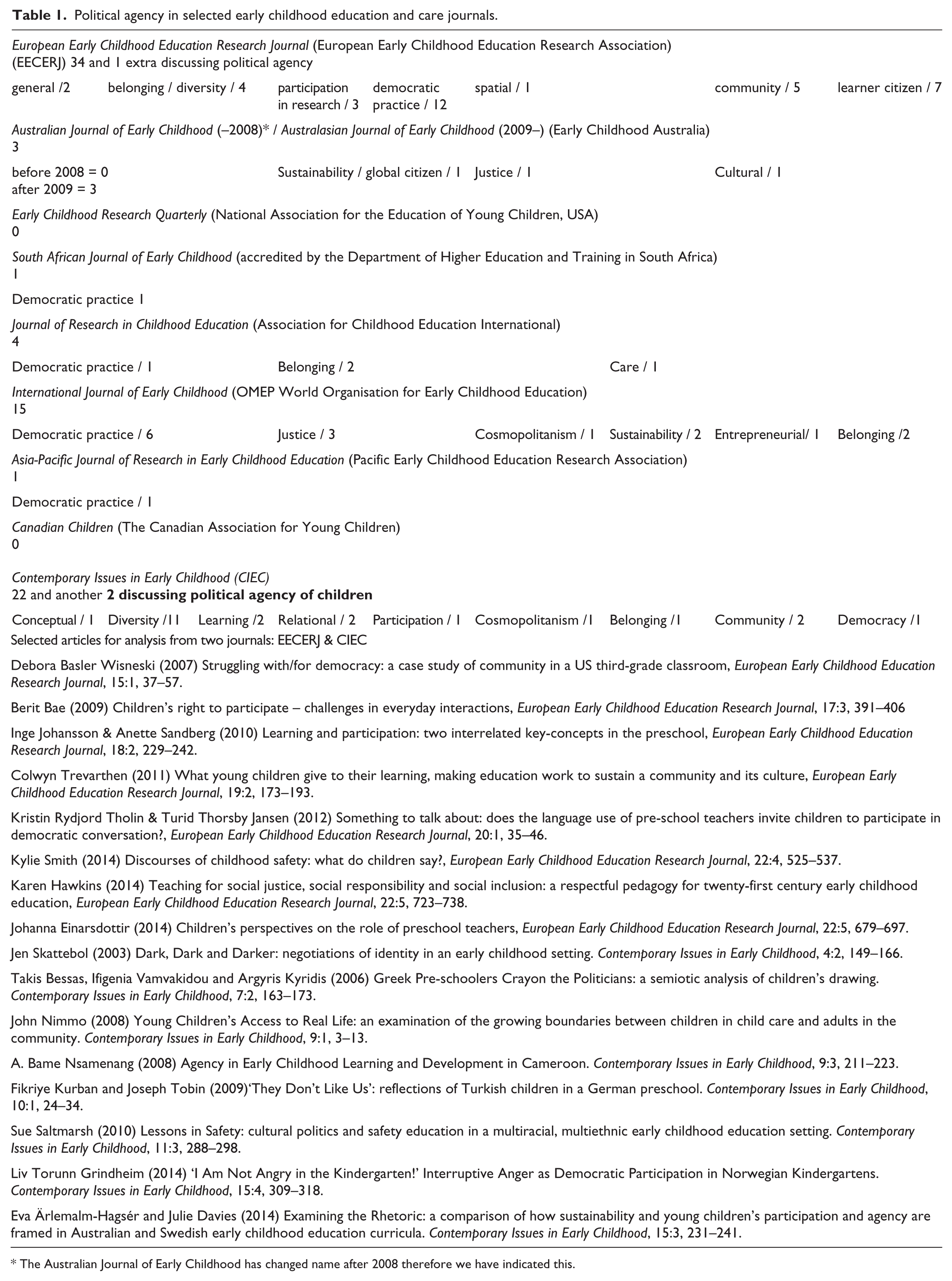
The Australian Journal of Early Childhood has changed name after 2008 therefore we have indicated this.
Our first search focused on the idea of political agency of children with search terms including ‘political agent’, ‘political subject’ and ‘political subjectivity’. These concepts were used only three times, twice in Contemporary Issues in Early Childhood (CIEC) and once in the European Early Childhood Education Research Journal (EECERJ). In ECEC research, children’s political agencies are mostly discussed in relation to citizenship, a theme we found in a greater number of articles. In this second search, we searched for papers discussing children as ‘citizens’ or children’s ‘citizenship’ and included only those articles in our analysis that substantially discussed this issue rather than mentioning these terms in a cursory way. The selected papers displayed in Table 1. portray multiple approaches to citizenship, such as in relation to belonging, diversity, participation, community, democracy, democratic practice, and so on.
From this set of articles, we have selected key texts for our closer analysis from the two journals where discussion and debate around the issue of political subjecthood mainly happens (CIEC and EECERJ, see a list of those on bottom of Table 1). These articles engage with children’s political subjecthood in a substantive manner using different conceptual frames and terminology. While carefully reading these articles, we employed a hermeneutic method (Kinsella, 2006 drawing on Gadamer’s (1996) work) to clarify the interpretive conditions that shape which particular understanding of political subjecthood they take up. These conditions are revealing about the prejudices or theoretical frames authors bring to the interpretive event which then signal their views on political subjecthood. We matched these conditions to the one Kallio has developed in her previous research (Kallio, 2007, 2014, 2016, 2017; Kallio and Häkli, 2011, 2017; Häkli and Kallio, 2014) in order to categorize these views. The dynamism of mundane political learning (or becoming) and acting (or being) lies at the center of this framework outlined below (Figure 1).
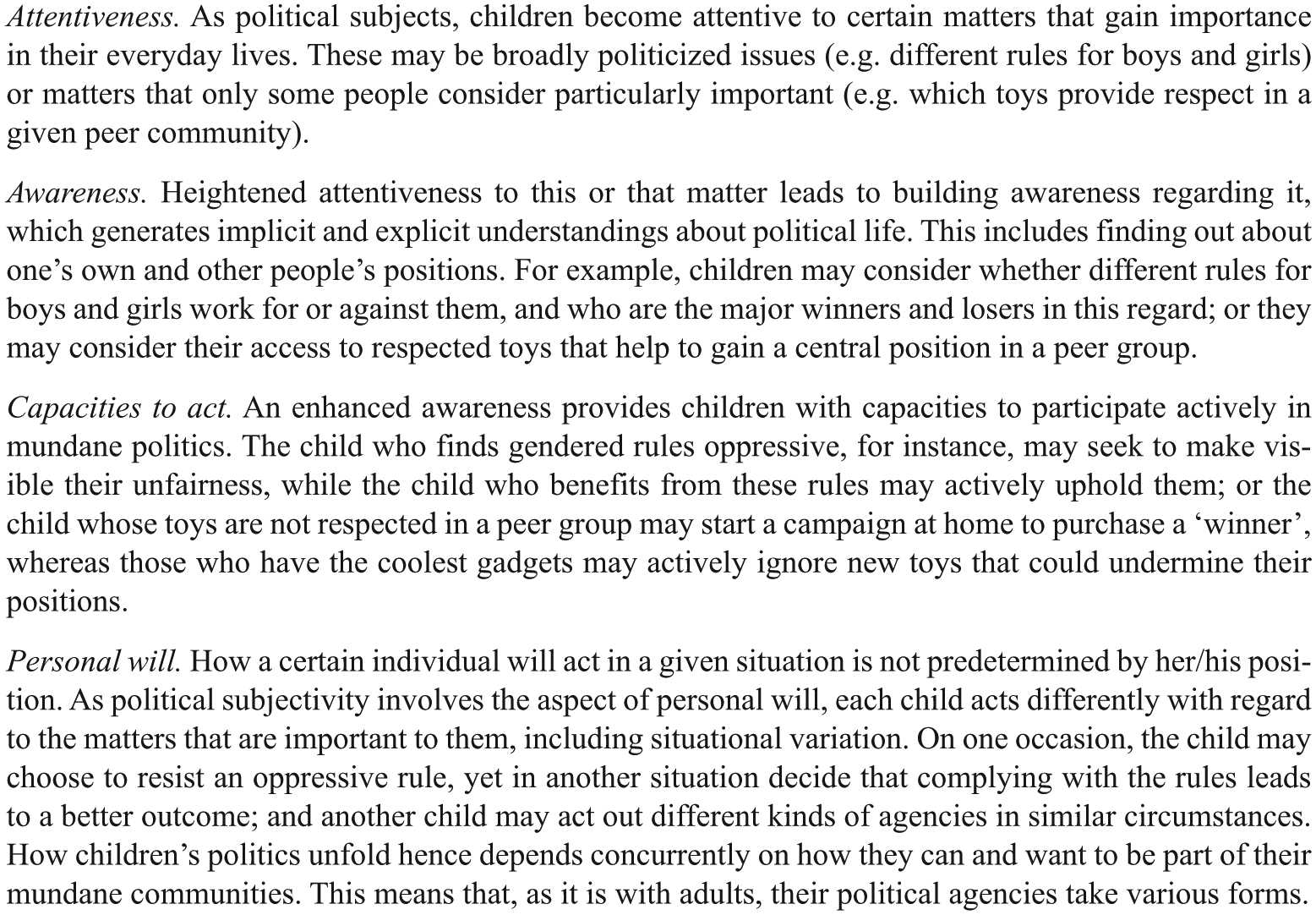
An analytical approach to children’s political agency from Kallio.
Children’s political agency in ECEC research and practice
In one of the most critical texts in ECEC research related to children’s political agency, Jen Skattebol (2003) describes how well-intentioned teaching practices with a political agenda may end up silencing children’s knowledge. Her partly autoethnographical analysis based on data produced with preschool children reveals that attempts to raise awareness about the racial politics of naming, for instance, may not acknowledge children as equal human beings with whom politicized aspects of social and public life can be intergenerationally explored (cf. Kallio, 2017). This empirical finding that, apparently, transformed her approach completely during the research, is exactly the point of our discussion here. If children are not recognized as political subjects in their own right – with attentiveness to issues politicized in their everyday lives, with contextual awareness about these matters with reference to their life situations, and with an acknowledgement of their personal will and capacities to act together with other people for or against issues in their mundane communities– they are not appreciated as political beings but as mere political becomings (cf. Frazer, 2008: 16). 3
The fact that there is a limited discussion on children’s political agency in early childhood research is also identified by Eva Ärlemalm-Hagsér and Julie Davies in their exploration of the Australian and Swedish curriculum frameworks. They conclude that children already have the “capacity to be critical thinkers and active agents of change” though it is less if at all acknowledged in curricula (p. 240). However, while the authors use political agency in the meaning of “participation that makes a difference in the present” they leave open how this difference is understood and by whom. They also evaluate ‘change’ compared to adult-defined desirable outcomes towards sustainability and leave unnoticed children’s mundane acts and wishes that might link with sustainability goals. We find this view particularly problematic in ECEC research and practice because it highlights the importance of intentional pedagogy yet leaving unaddressed a whole array of intuitive politics taking place in the everyday life of nurseries (e.g. Bessas, Vamvakidou and Kyridis, 2006; cf. Bartos, 2012). Let us introduce some exemplary articles where we have identified such risks and, after that, other research where political dimensions of children’s agency are noticed but scantily identified as such.
Deborah Basler Wisneski’s (2007) article makes another case in point regarding our argument. It describes a participatory project where she engaged with an American third grade class with 20 eight-year-old children and their teacher. In presenting “a departure for critical reflection”, she outlines the “classroom community as lived, contextualized experiences” and portrays children’s lives as embedded in specific local and larger societal contexts as well as positioned with reference to social divisions in relation to which children may be subordinated or empowered as active agents of resistance (40–41). This recognition, however, is rare as Bame Nsamenang (2008) addressing the same issue from the African context also argues. Nsamenang (2008) maintains that understanding children as social actors has not received either sympathetic or systematic attention in the early childhood care and development research despite the fact that they are “the hope and bridge of African families, communities and nations to the future” (211) and have important family and economic agencies and responsibilities.
Wisneski’s article goes as far as to identify a ‘problematic’ in that the lived experiences of children and teachers may include complicated elements that challenge and build tensions to their relationships. Even if not described with the same terms, the portrayed theoretical understanding parallels largely our conception of the political realities of ECEC settings. In the second part of her article titled ‘doing democracy’, she however abandons this framework and disregards children’s attentiveness, awareness and personal will (44–52). She tells how the teacher shared with her “how important she felt it was for her to see the children do something special” and how Wisneski herself shared “with her that I too really want the children to have the experience of working together on a big project” (48). Thus, it seems that they have privileged their own awareness, capacities and wills to act to those of children. This happened after the children had expressed concerns with the idea of acting as a ‘good citizen’ if this meant helping individuals they do not know. Some children argued that they are incompetent to act in the mentioned contexts because they are too young. Persistent in their attempt to ‘import’ democracy into the classroom and to familiarize the children with the political world outside of it that they (researcher and teacher) were aware of, the researcher and the teacher decided to push their project through to “support them [children] in an experience that makes them think of others and shows them they too can make a difference even if they are ‘kids’” (48).
Instead of drawing from the children’s contextualized experiences, the ways in which they consider and sympathize with others, their wishes and possibilities they see to engage with others, and acknowledging their activities as citizens in their communities, the project engaged the class with a political world in which the teacher and the researcher lived and had developed attitudes, awareness, and agencies – political worlds where the children felt incompetent and thus could not imagine taking active stances, as portrayed by Wisneski herself. While we commend their approach to show children their competency, we characterize this kind of action that seek to ‘bring politics to the nursery’ as a pedagogy that intentionally disregards existing mundane politics of children’s worlds and, thus, aims at helping children to become political in adult defined political spaces. In the discussed case, children’s acts as good citizens in their lived communities did not legitimate their status for the teacher and researcher as political beings who already exercise democratic acts. It hence implies that good citizenship is about acting for ‘the community’ in general, and with regard to generally politicized issues, rather than for the particular communities that one is familiar with and where one has personal positions, which allows forming opinions and acting based on one’s experiential existence as a political subject. We do not bring up Wisneski’s paper in the meaning of targeting our critique on her work in particular.
Rather, we introduce it as an apt example of a broad stream of ECEC research where political dimensions are taken up in various ways (e.g. Bae, 2009; Tholin and Jansen, 2012; Einoarsdottir, 2014). Scholars in this field frequently discuss policy matters and politics in the meaning of democratic ideals, social justice principles, and practices of rights and belonging. Children’s embeddedness in particular social, cultural, economic, and ideological societies and communities is also often included in theoretical frameworks, involving their positioning with reference to social structures and categories. Concurrently, politicized issues and identities, such as gender equality and acknowledgement of difference, are commonly brought up as important dimensions of children’s institutional lives. In all these approaches, children are acknowledged as competent actors and citizens of today, especially if supported by adults. Yet many of the analyses and the practices described in them overlook children’s existence as political subjects. They rarely ponder how to involve children as persons who, firstly, enter the nursery carrying particular histories that direct their approaches to social and public life; secondly, come from certain life situations that provide them with distinct positions and competences; and thirdly, have personal future orientations related to matters that have grown important to them in their everyday lives. In other word, it is less, if at all, acknowledged in ECEC research and practice that children arrive and participate in nurseries with particular takes on life, on others, and on being together. Instead, their pedagogical and political formation is taken issue with.
Interestingly, these latter questions have been taken up in the more social-psychological strands of ECEC research, where scholars are particularly attuned to the intersubjective development and unfolding of children’s agency and memberships in lived communities and close personal relations. Colwyn Trevarthen’s (1979, 2011) longstanding work provides a fitting example. The theorization of ‘innate intersubjectivity’, centering on the communicative abilities of infants, has led him to explore how “human beings far too young to speak can participate in intimate sharing of purposes, interests and feelings” and thus “attract others’ attention and invite shared learning about actions, objects and about one’s Self, who ‘I’ am” (2011: 180, 182).
Drawing from a discussion with Margaret Donaldson (1992), another influential psychologist who started to draw attention to children’s active stances early on, 4 Trevarthen (2011: 179) links this approach with the idea of human sense, “the understanding of how to live in the human and physical worlds that children normally develop in the first few years of life”. As he continues to explain, this ‘human sense’ is “learned spontaneously in the course of the direct encounters with these worlds that arise daily and unavoidably everywhere, transcending cultural differences” (Trevarthen 2011: 179). Accentuating even further children’s active roles in the meaning making processes by which human societies exist, Trevarthen (2011: 182) notes: “Their knowledge and understanding of the world is part of the activity and curiosity that brings it about, with all the satisfactions and surprises.”
Trevarthen introduces this approach as linked to social, economic and cultural projects present in societies. Yet his lack of consideration of political aspects of human life is illuminative of the missing connections between ECEC, young children’s development, and political theory. As he talks about the intersubjective processes in which children position themselves and others with reference to prevailing identity constructions, the active stances infants take to adopt, resists, and negotiate the social roles expected of them, and how even very young children can express themselves in the purpose of revealing their attitudes and influencing others, he makes no parallels with political subjectivity or agency. Yet those familiar with debates on the political dimensions of humanity can easily spot the resemblance (for these debates, see Häkli and Kallio, 2014; Joronen and Häkli, 2017). Trevarthen’s research resonates strongly with Hannah Arendt’s (1953: 31) political philosophy that portrays the birth of a child as the ultimate starting point and continuation of political life: “With each new birth, a new beginning is born into the world, a new world has potentially come into being.” Following this political philosophical tradition, Iris Berger (2015: 477) emphasizes that central in early childhood education is “recovering the political experience of plurality” that “should not be seen as something that we need to overcome but rather the condition of possibility for newness to come into the world”. Even if she does not consider children’s active political roles in the Arendtian sense, as her focus is on how adults could better meet children in their institutional roles, her explicit argumentation for children’s political subjectivity is a notable exception in the ECEC literature.
Like Wisneski’s paper, we present Trevarthen’s (2011) article as a selected case to point to a more general trend. We have identified a number of theoretically oriented papers as well as skilled empirical analyses where what we consider children’s mundane politics are discussed and explored. For example, Hawkins (2014) takes up critical consciousness, social justice and responsibility, and social inclusion in the framework of ‘respectful pedagogy’, yet using the word politics only in the traditional narrow sense. She does not see her study as about political learning and living, which from a broader political-theoretical perspective seems apparent. Similarly, Smith (2014), drawing from the Foucauldian tradition, talks about how political subjects are constituted in the parental practices of making children’s lives safer and enabling their freer movement in cities without noticing the mundane political aspects of these processes. Overlooking children’s everyday environments in which the exercise and development of certain kinds of political subjectivities are made possible, she considers children’s participation as a policy initiative that respects them as citizens and creates some space for their developing agency that otherwise seems to not exist. These are just a couple of examples of how young children’s lives in general are presented as apolitical no matter how politically relevant the studied situation might be.
In summarizing the major points from our analysis, we wish to begin by underlining that the critique we present is not directed against any particular study or publication. Least do we mean to argue against the attempts to direct attention to the implicitly and explicitly political roles of institutional ECEC actors. Rather, our point is simple. We argue that noticing the political lives that children lead before, during, and after their time in ECEC settings appreciates them as political subjects on par with adults. As we have portrayed, some of the existing ECEC research engage with questions relevant to children’s political subjecthoods and mundane political agencies, yet political dimensions are rarely brought up in this body of work explicitly. If they are being brought up, these political dimensions appear as related to adults’ political worlds. Another body of research takes up generally politicized issues, such as inequalities related to race, gender, and class, and institutionally defined positions and roles, such as citizenship and participation in adult-organized or facilitated activities, but rarely connects these issues and related processes to children’s attentiveness, awareness or will explicitly as they manifest in children’s political worlds. To us it would seem fruitful to bring these explorations together, and to inform the critical pedagogical research that aim to institute particular politics in to nurseries with a better understanding about the mundane politics going on in every institutional childhood setting.
In this way they could together demonstrate that in summary:
1) Human agency is profoundly political from birth. The understanding of and support for people’s political agencies could begin in the lives of nurseries that, in many countries, bring together children from various societal positions. Instead of general citizenship education, democratic ways of living could be explored and fostered together, with respect to the experienced political worlds of the children and the adults involved in the nursery.
2) ECEC settings are inherently political. Children and adults are active players in the mundane politics of ECEC settings and beyond, whether they realize this or not. Politics does not happen merely as part of intentional pedagogies, as prescribed by policies and curricula, or when educators address diversity, children’s rights or equality in their quest to create more just or democratic environments. No one needs to bring politics to nurseries, as Moss (2007) asserts, these settings are always and already political.
3) Pedagogical agendas as political. ECEC professionals could be more aware of the political agendas they mobilize as part of their pedagogies and caring work. We refer to an increased awareness regarding the mundane politics at play (brought together by children and adults’ political worlds – including their political attention, awareness, capacities to act and political will) in the very settings where they work and in which children supposedly are present as active participants, citizens and agents. Policy frameworks that prescribe particular political agendas, academic agendas that mobilize teachers to enact forms of politics, and the agendas that professionals bring to settings are important parts of political pedagogies but they rarely compose the whole political world, and therefore, political pedagogies of a setting. For example, the very absence of considering children as political agents is a political act in itself and most of the time it remains unacknowledged as such.
For ECEC research and pedagogies of mundane politics
This article has set out to propose that, appreciating children as political subjects equal to adults could be a starting principle and part of critical pedagogical attempts to provide children with better means to think and act in their political realities. We admit that this does not make the work of critical professionals or scholars any easier. It requires seeing the political worlds that children and adults conceive of as equally ‘real life’ (cf. Nimmo, 2008). Moreover, our suggestion includes that the supportive measures on children’s political agencies are better based on their experiences, understandings, capacities and wills instead of those of the adults working with them.
This is not to say that the political attitudes and awareness of adults could not have an influence on children’s political agencies. Becoming acquainted with new perspectives has inevitable consequences to how people see their worlds and wish to act in them. Yet, as Skattebol (2003: 163) realized with a child who was going through a critical period in being and becoming political – learning how to be an Australian with reference to gender, race and age – in practicing politics in the nursery adults also need to be open to new knowledge. Adults themselves are like children who enter ECEC settings carrying particular histories and life situations that provide them with distinct societal positions and competences. They also have personal future orientations, including wishes and dreams related to matters that have grown important to them. These may all vary notably between individuals, to the extent that they set against each other. For example, a person whose life centers on football may not appreciate the same things as a person oriented towards nature observation. Also, people coming from religious and atheist homes do probably not share the same values. Mundane political lives and agencies are hence characteristically plural, building on specific grounds and covering broad spheres of life.
The intergenerational explorations of seemingly mundane political issues might challenge the political conceptions of both children and professionals (Millei, 2016). Perhaps even more importantly, children’s experiential knowledge may draw the attention of adults onto some political realities and positions that they had not thought about before. Children may voice racist comments, express disgust regarding other people’s diet, pronounce nationalist sentiments in multicultural settings, perform contrary moral codes and social guidelines to those appreciated in the nursery, or refuse to play with the children who are different from themselves. Such opposing values and their expressions may be challenging to professionals. Supporting children’s agencies in these kinds of situations is not as easy as to guide when their expressions and activities follow the prevailing policy-line and social order. However, acknowledging the existence and identifying such political aspects of everyday worlds in ECEC settings and taking them seriously might help in reconsidering how critical pedagogy is practiced in ECEC. Democracy-driven pedagogical agendas are often based on utopias that resemble poorly the realities where children live. Engaging in such challenging, fluid and unpredictable relationships with children is what requires further research and the development of special pedagogies that we might call here as pedagogies of mundane politics.
Footnotes
Funding
The author(s) received no financial support for the research, authorship, and/or publication of this article.