




Abstract
The past two decades have seen a proliferation of studies investigating, complicating, and reimagining the relationship between second language learning and identity. Yet, with only a handful of exceptions, these studies are limited to adolescent and adult second language learners. In this article, the author proposes that identity research with very young second language learners has been limited both by a tendency to see early second language learning as less problematic than that of older learners and by the conceptualization of identity itself. The author argues that a post-structuralist perspective on identity—or, rather, subjectivity—opens possibilities for research with the youngest students. In order to explore this theoretical potential, the author examines four major studies of identity and young second language learners (kindergarten and Grade 1) to analyze how their authors conceive of identity and what each affords for analysis. These studies support the idea that a post-structural analysis, through its interrogation of the concept of identity, offers possibilities for studies of subjectivity in young children. Yet they also highlight a need to interrogate traditional views of language and of language learning.
In the past two decades, identity has become a widespread topic in academic research. Educational researchers have produced studies connecting identity, curriculum, and learning across grade levels and subjects. This work has shown that classrooms are spaces not only for the production of knowledge, but also for the production of selves—selves that exist at the nexus of gender and race; selves that are seen as particular kinds of peers and friends and people—and that who a student becomes in a classroom is inextricably intertwined with and profoundly impacts how she participates and what she learns (for some notable examples, see Anderson, 2007; Bomer and Laman, 2004; Eckert, 1989; Enciso, 1998; Godley, 2003; Leander, 2002; Orellana, 1999; Wortham, 2006). Parallel to this work, within the field of second language acquisition (SLA), the relationship between identity and second language (L2) learning has been explored, theorized, and complicated to the point that it is now understood as a facet of language learning that cannot be ignored. Researchers have shown the many ways in which identity affects aspects of learning such as input, motivation, and interaction, long the bread and butter of SLA research (Block, 2007a; Kramsch, 2000; Norton, 2000; Pavlenko and Blackledge, 2003). Yet, in all of the work connecting identity to learning, one group that is nearly absent in this L2 research is learners in early childhood (here, ages three to six).
In this article, I argue for identity and language learning as a valid domain for research with very young students. I discuss changing perspectives on identity in language research and suggest that, while not all views of identity enable its study in very young children, a post-structuralist perspective does. This theoretical discussion then serves to frame a review of four major studies of identity and L2 learning in early grades (kindergarten and Grade 1 in the USA/Canada; children aged five to six). Finally, I use these four studies as a foundation for thinking through the possibilities for a post-structural analysis of identity and L2 learning in early childhood.
Where are the studies of identity and L2 learning in early childhood? (And why should there be any?)
“Little kids are like sponges” is an expression that anyone working in early childhood education has likely heard at one time or another. While the saying can refer to children’s general aptitude for learning, when considered in relation to language learning, it reflects the common belief that young children simply “soak up” language. The corollary to this idea is that learning languages gets harder as one gets older, so that it is best to start young. This idea of “the earlier, the better” is a pervasive one and is found in policy materials (e.g. European Commission, n.d.), materials for teachers (e.g. Supporting Dual Language Learners and Their Families, a 2013 special issue of Young Children, the magazine of the National Association for the Education of Young Children), and the multitude of digital resources and applications targeted at parents of young children (for a good example of the logic behind many of these commercial products, see Antonini, 2013). At conferences like Teachers of English to Speakers of Other Languages and the American Association of Applied Linguistics, where, out of hundreds of papers, there is never more than a handful about preschoolers, the under-representation of studies with pre-kindergarten language learners suggests that even those who study L2 teaching and learning may still see young students’ L2 learning as more natural and less problematic than L2 learning by older children and adults. This view may be one reason for the relative dearth of identity and language research with very young learners, despite the explosion of this research with older learners.
Different children, different language learning experiences
Yet, in direct contradiction to the “sponges” view of young children, researchers have found that there can be significant differences in young children’s experiences with and processes of learning a second language. Wong Fillmore’s (1976, 1979) seminal work, for instance, showed that English language learners in early elementary school (five- and six-year-olds) had very different cognitive and social strategies for handling the ambiguity that resulted from gaps in their English knowledge. These coping strategies, combined with the students’ strategies for narrowing those gaps, resulted in more or less progress in English over a year. A later model presented by Wong Fillmore (1991) described how individual traits, like sociability or communicative need, combined with factors in the classroom environment, like activity structures, to produce different outcomes for students in the same classroom. Tabors and Snow (2003) listed motivation, exposure, and personality as factors that have been found to cause variability in how quickly young children move through a developmental sequence of L2 learning. Genishi looked closely at three- to five-year-old students’ English learning in school and found that students’ different paths to English depended on both their “inner clocks”—whether to begin speaking in English right away or to wait and listen—and context, as need and desire to communicate shifted with activities and settings (Genishi and Dyson, 2009). Other empirical work has found that it is important for teachers and peers to be responsive to young English language learners’ interactional preferences and to adapt to those preferences (Clarke, 1999), and that it also makes a difference whether a teacher can speak, or even makes attempts to speak, a child’s first language, and therefore shows esteem for it in the classroom (Gillanders, 2007).
Identity as a factor in language learning
In research with older L2 learners, learner identity has been found to be another significant factor in language learning. In one of the earliest studies of this kind, Norton Peirce (1995; also discussed in Norton, 2000) presented the case of Martina, a Czech speaker living in Canada, who was ashamed of her English and felt inferior when speaking it. Yet, when she drew on her identity as a mother, rather than as an immigrant language learner, she was able to engage in a long telephone conversation with her landlord to make sure that he did not take advantage of her family. Another participant in Norton’s study, Eva, who was from Poland and was embarrassed by a lack of local cultural knowledge (such as Bart Simpson), turned her position of immigrant and illegitimate speaker into a position of “multicultural,” by talking to her co-workers about Europe. For these women, a shift in identities led to a shift in access to conversations that had been closed to them.
In a study of English learners in 7th and 8th grade in California, McKay and Wong (1996) found that students’ opportunities for learning had as much to do with their interests and abilities as with their ability to navigate, take up, and resist possible positions made available by the interaction of (often competing) discourses of colonialism, model minorities, and gender. In their study, a female student who was a quiet and compliant musician—and who thereby embodied the model minority discourse around Asians in the USA—was quickly passed out of English as a Second Language (ESL), despite questionable language skills. Meanwhile, a popular male athlete was kept in ESL because of his grades, but he derived enough social interaction and satisfaction from sports and friends that he resisted the dominant discourses for Asian immigrant students and remained invested in learning spoken (social) rather than written (academic) English.
In The Multilingual Subject, Kramsch (2009) argued that traditional SLA research had focused on language learners as cultural beings (in terms of “intercultural competence” or “intercultural communication”) or psychological beings (as more or less “motivated,” with greater or less “aptitude” and memory), while ignoring speakers’ bodies, emotions, and desires, as well as the role of language not just in shaping the self, but also in making the self possible at all. For Kramsch, explanations of success or failure based on aptitude or motivation could not explain the American man who saw French pronunciation as feminine and thus resisted it, or the college student who saw a German class as a place where she could say things that she could never say in English. Kramsch proposed that we view learners and speakers as subjects—selves that are constituted and maintained through symbolic systems, such as language. In this view, learning a new language, and thus a new symbolic system, affords subject positions that might not have been possible before.
While these authors do not approach identity in exactly the same way, these studies illustrate the influence of identity on why, when, and how language learning is undertaken or resisted, and, conversely, the transformative potential of language learning for one’s identity. Given, that researchers have shown that (1) there are differences in how different young children engage in L2 learning, (2) these differences are related to (at least some) social factors, and (3) identity is an important social factor in L2 learning for older students, it seems that to ignore a possible relationship between identity and L2 learning in early childhood settings would be to miss potentially important insights. Furthermore, ample research has shown that early childhood classrooms are places of significant identity work, particularly around things like gender, race, academic skill, and friendship (e.g. Davies, 1989; Grieshaber and Cannella, 2001; Kyratzis, 1999; MacNaughton, 2000; Madrid, 2013; Månsson, 2011; Skattebol, 2003).
“Identity” in L2 research with young children
Earlier in this article, I suggested that one reason for the dearth of identity and language learning research in early childhood settings might be the common perception of children as naturally good language learners. I now turn to what I see as a second potential reason: the notion of identity itself. Our common-sense idea of identity—“one’s selfsameness and continuity in time” (Erikson, 1994: 22)—originates in the writing of Enlightenment thinkers like Descartes and Locke, who saw humans as sovereign individuals governed by objective and rational minds whose life purposes came from within. Taylor (1989: 178) described this kind of thinking as follows: “Beneath the changing and shifting desires in the unwise soul, and over against the fluctuating fortunes of the external world, our true nature, reason, provides a foundation, unwavering and constant.” In this perspective, a person’s identity is part of an essential and coherent core which grows stronger throughout an individual’s lifetime, but which is relatively fixed and unchanging in nature. It is “a sense of self which gives off the illusion of being anchored in our very being, perennial and independent of interpretation” (Taylor, 1989: 185). This is the definition that allows us to view our lives as one long narrative in which we continue to play the same character.
In the past 20 years, however, as part of what has been called the “social turn” in applied linguistics, researchers have instead begun to think of learners as having identities: multiple ways of seeing oneself, which can be and often are in conflict with one another (Block, 2007b). Sometimes these identities are treated like roles—wife, mother, boss, customer (Norton Peirce, 1995)—while others view them as associations with varying social groups—Latina, woman, Catholic, liberal (Bucholtz and Hall, 2004). Norton (2000: 5) defined these social identities as “how a person understands his or her relationship to the social world, how that relationship is constructed across time and space, and how the person understands possibilities for the future.” These perspectives, which I call multi-identity perspectives, have allowed for several excellent studies about shifting identities in different language contexts (e.g. Block, 2007a; Norton Peirce, 1995; Pavlenko and Blackledge, 2003). Yet, for research with very young children, a multi-identity view remains problematic. Seeing identities as understandings of one’s relationship to the social world begs the questions: How many group affiliations or roles would a preschooler see herself as having? What kind of understanding of possibilities for the future might she have? As Hawkins wrote in her study of kindergartners (discussed further below):
Many empirical claims about older learners are based on interpretations of discourse and narratives produced by the learners, but young children (even in their first language) generally do not yet have the lexical or grammatical repertoire to articulate ideas, feelings, and critical stances in cohesive or easily accessible ways. (Hawkins, 2005: 60)
Although preschoolers certainly do have understandings of their relationships to the social world, because multi-identity perspectives situate a person’s identity within her own views of herself, researching identity in this perspective requires a process of reflexivity and narration on the part of research participants that is, at best, difficult to carry out with a preschooler.
Subjectivities and positionings
There is another family of theoretical perspectives, however, which I propose does render identity able to be studied with young children. Post-structuralist perspectives see identity not as a stable core, nor a cluster of social self-images, but as temporary positionings, constructed moment to moment through language in social interaction. In fact, from post-structuralist perspectives, the word “identity”—which comes from the Latin idem (“same”) and connotes stability and oneness—is no longer even the appropriate term. Weedon (1987, 2004), a feminist post-structuralist, instead used the term “subjectivity.” She wrote: “It is in the process of using language—whether as thought or speech—that we take up positions as speaking and thinking subjects” (Weedon, 2004: 18). She viewed subjectivities as “precarious, contradictory, and in process, constantly being reconstituted in discourse each time we think or speak” (Weedon, 1987: 33).
The idea of discourse is important to Weedon’s notion of subjectivity. She and many other post-structuralists use the word “discourse” with a double meaning. First, discourse (always singular) means language in use, and is the medium with which subjectivities are built. Second, discourses (pluralizable) are larger ways of seeing the world (Bakhtin, 1981), ways of organizing meaning (Pennycook, 1994), structuring principles of society (Weedon, 1987), and systems of power/knowledge (Foucault, 1972). Thus, while subjectivities are always negotiated and enacted in discourse (the medium), the range of subject positions available to be negotiated in the first place is given by discourses (the systems of understanding and of power at work at any time and place). This view of subjectivities as formed in discourse/s—in contrast to the singular, fixed self—opens up “who a person is” to struggle and to change.
In order to understand why subjectivities are sites of struggle, we must contend with the notion that our subjectivities are not always under our control. Davies and Harré (1990) foregrounded this idea by using the term “positioning.” Like Weedon, they took as their departure point the idea that individuals are constituted socially and in discourse/s:
An individual emerges through the processes of social interaction, not as a relatively fixed end product but as one who is constituted and reconstituted through the various discursive practices in which they participate. Accordingly, who one is is always an open question with a shifting answer depending upon the positions made available within one’s own and others’ discursive practices and within those practices, the stories through which we make sense of our own and others’ lives. (Davies and Harré, 1990: 46; original emphasis)
In other words, the positions we take up depend not only on our own intentions and desires, but also on which discursive positions are made available to us both by others and by larger discourses. For instance, in McKay and Wong’s (1996) study, discussed above, the high school students were able to negotiate their subject positions within the school and societal discourses of race and gender, but not to create new discourses or invent positions at will. As Weedon (1987) pointed out, we have agency in negotiating subject positions, but not sovereignty.
How, then, do the ideas of subjectivity and subject positions relate to the notion of “identity” as a coherent self? Weedon (2004: 19) wrote: “Identity is perhaps best understood as a limited and temporary fixing for the individual of a particular mode of subjectivity as apparently what one is.” Thus, a temporary position is imagined to represent a permanent self. In a slightly different take, in her discussion of the ways that SLA researchers have taken up post-structuralist perspectives, Kramsch (2012) described “identity” as a sense of coherence that we construct from repetitions in positioning. Carefully placing “identity” in scare quotes, she wrote: “The many subject positions we take up during our lives sediment to form historical, recognizable patterns that we call ‘identities’” (Kramsch, 2012: 2). For Weedon, then, “identity” is one’s perception that a temporary position is who one is, while, for Kramsch, these perceived “identities” have a basis in repetitions in the ways we are temporarily positioned.
Others have gone one step further in discussing patterns in positioning to explore the idea that these patterns not only affect how we see ourselves, but can also affect later positionings, so that subjectivities might not be negotiated completely anew in each social interaction. Wortham (2006) showed how in one secondary school English classroom, where the students and teacher interacted within the same discourses day after day, what began as temporary subject positions “thickened” into more durable ways of being and being seen in that context. Similarly, in their discussion of ethnographic work on positioning and subjectivity, Holland and Leander (2004) discussed how moment-to-moment positionings can leave traces, in the form of both memories and material artifacts, so that, over time, the possibilities for how one might be positioned can change or narrow. Wortham, Holland, and Leander might say, then, that repetitions of temporary positions can lead to shared social imaginings of who a person “is.”
None of these authors would say that these “sedimentations” or “thickenings” become identities in the traditional sense of “true” unified selves, but that, given enough time and repeated interaction, a person may come to position herself, or others may come to position her, in increasingly stable or predictable ways. Yet, as Wortham and others (e.g. Day, 2002, discussed below) have shown, changes in the discourses circulating in a classroom, or changes in participants in a classroom, can easily destabilize these positionings. While not all of these authors have called their work “post-structuralist,” their approaches to identity show a theoretical alignment with the views presented earlier in this section. Since post-structuralism (or, perhaps, post-structuralisms, since there is not one but many perspectives) is not bounded by a fixed definition, this alignment is more important than the label they apply to their work.
From the approach I have outlined here—of studying subject positions rather than identities—it no longer makes sense to ask whether identity is something that a preschool child “has” or does not yet “have.” Children are positioned and position themselves in various ways through interaction, even before they can speak (see Månsson, 2011). Preschoolers too, then, participate in classroom interactions in which they position themselves, and are positioned by others, as subjects. Furthermore, by locating subject positioning outside of the individual and in interactions, which can be observed and recorded, post-structural perspectives enable the study of this process with even the youngest children, regardless of whether they can reflect on or articulate these positionings.
Studying “identity” and young second language learners
In light of this argument, I now turn to four studies of “identity” and young L2 learners to analyze how each study’s author conceived of “identity” and what these conceptualizations afforded in each author’s analysis. The studies were selected for this review based on two criteria: first, the children in the study were in early childhood, defined here as three to six years old, and, second, the study specifically set out to explore identity in relation to language learning. Searches were carried out in JSTOR, Google Scholar, and Berkeley’s MultiEdPsych tool (which searches 62 databases, including ERIC, PsychInfo, and ProQuest), with no date restrictions. The search terms were: (preschool OR prek OR pre-K OR prekindergarten OR pre-kindergarten OR young OR primary OR nursery OR kindergarten OR elementary) AND (identi* OR subject* OR becom* OR position* OR person* OR self* OR selves) AND (language OR L2 OR “second language” OR “language learn*” OR “language acquisition” OR ESL OR EAL OR SLA OR bilingual OR speaker OR “English as a second language”). The results were then manually sifted through to meet the age and aim criteria of the article. Thus, the many studies that touch on issues of identity, but do not include it in their aims or research questions and thus do not theorize it, are not examined here, nor are studies that link identity to learning in general (e.g. Rymes and Pash, 2001) or that analyze linguistic acts, such as writing, as acts of identity (e.g. Kabuto, 2010) but do not study L2 learning. The studies were also limited to those published in English, simply (if sadly) because that is the author’s only academic language.
The studies
Each of the four studies selected was an ethnographic case (or multiple case) study, in which the findings were triangulated from multiple data sources. The studies and sources are summarized in Table 1.
Four studies of “identity” and young second language learners.
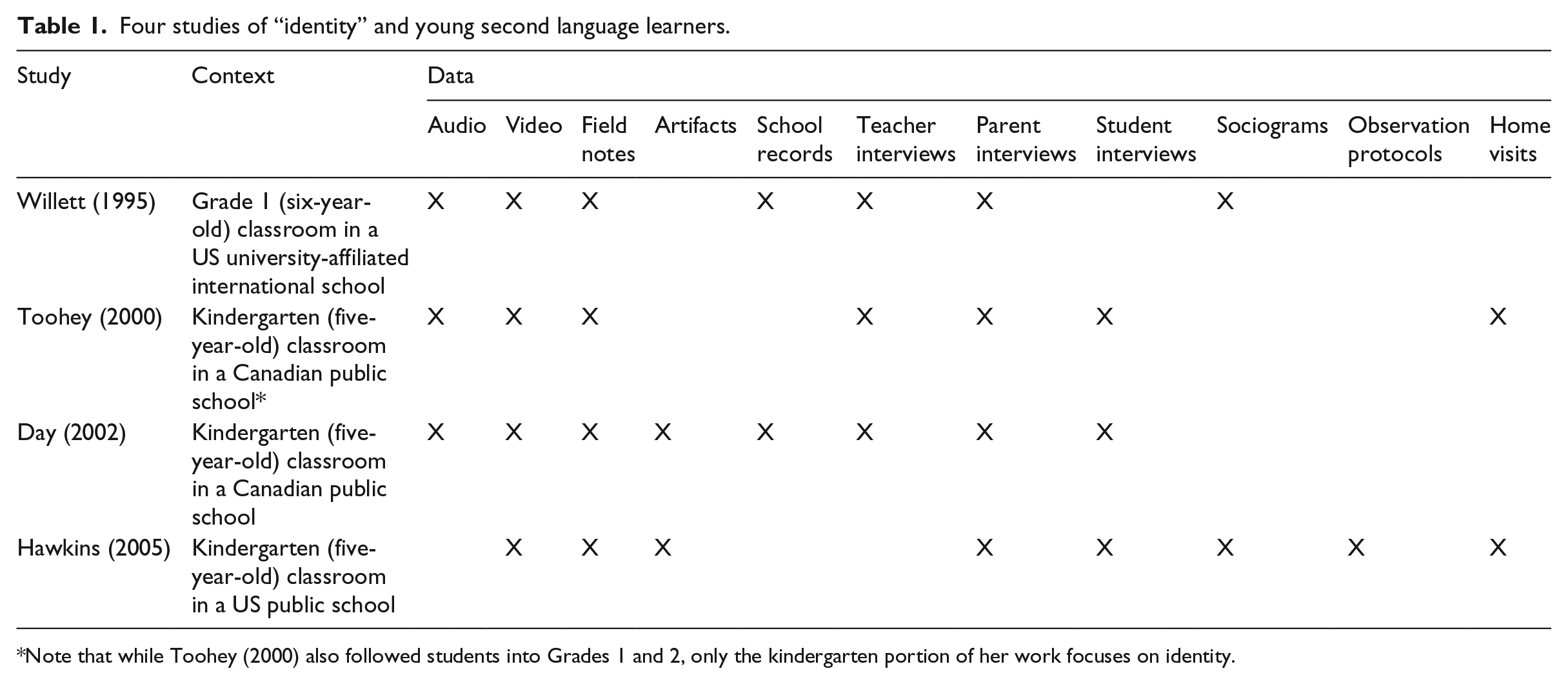
Note that while Toohey (2000) also followed students into Grades 1 and 2, only the kindergarten portion of her work focuses on identity.
In addressing each study, I first summarize the study and the author’s own conclusions, then I outline the author’s theoretical perspective on identity, and finally, I present a critical discussion of the study in light of the theoretical position I have taken in this article thus far. Although writing down any account of human activity necessitates complexity reduction and narrativization, in a summary, detail and complexity are both further reduced. I acknowledge therefore that, in the space allowed here, I likely portray the students in these studies as having subjectivities that are more unitary and stable than those discussed by the authors or those experienced by the students. Despite this, I have tried to maintain enough information to convey the sometimes contentious and contradictory processes through which these subjectivities were constructed.
Study 1: Becoming first graders in an L2
Willett (1995) presented a year-long ethnographic study of a first-grade (six-year-old) classroom at a university school attended mostly by children of students, faculty, and visiting scholars. In this classroom, the teacher arranged students’ desks in a boy-girl-boy-girl pattern, to prevent chatting by the girls and boisterous behavior by the boys. Thus, Xavier, a Mexican-American male focal student, who had befriended other Spanish-speaking boys and participated in their loud behavior, was placed between two girls. The three other focal students (all female) were placed together at the beginning of the year to assist Willett in her research and, having figured out quickly how to keep a low profile, were allowed to sit together for the remainder of the year. The three girls quietly collaborated on classwork by each asking for brief help then combining their collective knowledge, and were thus able to position themselves as highly independent workers—a position that was ratified by the teacher. Additionally, as the only girls permitted to sit next to each other in class, they were positioned as high status by the other female students. Xavier, on the other hand, did not receive assistance from the girls next to him, and therefore needed more help from the teacher and classroom aides. The teacher began to position him as a struggling student, giving him special ESL work to do, rather than regular work. However, success in regular phonics work was a high-status activity in the eyes of the other students, and Xavier’s “demotion” to ESL work also affected his social position in the class. Additionally, the teacher assumed that Xavier’s Mexican father, who was not in academia but worked at the university stables, would not provide at-home language support like the other students’ parents, and she had Xavier pulled out of the class several times a week for ESL lessons. Despite the teacher’s good intentions, Willett argued, this left Xavier feeling lost on his return and deprived him of time for working on English with his peers. Although Xavier continued to have social success on the playground, the teacher only saw him in the classroom and continued to position him as a dependent and needy learner. Although Xavier tried to resist these positionings by refusing to do the special ESL work and by crying before ESL class, these actions were only seen by the teacher as a confirmation of his lack of competence. As a result, the teacher decided that Xavier would continue in ESL in Grade 2, while the three girls were passed out, despite the fact that all four students received the same score on an end-of-year English proficiency test.
In this study, Willett examined identity as part of what she called “the micropolitics of social interaction”:
People not only construct shared understandings in the process of interaction, they also evaluate and contest those understandings as they struggle to further their individual agendas. As people act and react to one another, they also construct social relations (e.g., hierarchical relations), ideologies (e.g., inalienable rights of the individual), and identities (e.g., good student). These constructions both constrain subsequent negotiations and sustain extant relationships of power, solidarity, and social order. Moreover, these interactions are profoundly shaped by the broader political and historical contexts in which they are embedded (e.g., politics of race, gender, class, ethnicity). (Willett, 1995: 475; my emphasis)
Although Willett did not call this a post-structuralist perspective, it shares important elements with such a perspective, emphasizing the importance of understanding identity as constructed over time and through interaction, and as shaped by multiple layers of social/ideological context—from the level of the interaction, to the level of the classroom, to the level of the nation—and on multiple timescales (Lemke, 2002)—from the moment of interaction, to the school year, to the history of race and immigration policy in the USA. Willett used this framework to highlight the multitude of factors—from the arrangement of the room, to Xavier’s gender, to his father’s job—that contributed to Xavier’s classroom positioning as “incompetent” as well as his inability to negotiate a different position and his eventual continued status as “ESL.” Willett’s work also illustrated how repeated positionings can “thicken,” resulting in Xavier’s acts of resistance being interpreted through—and in turn reinforcing—the teacher’s sedimented views of him as a student.
Yet, while Willett included “extant relationships of power, solidarity, and social order” in her framework, she did not analyze these. She mentioned in passing, for example, the teacher’s assumption that Xavier would not get extra help at home, but she did not make explicit why the teacher would assume this, missing a chance to discuss the larger discourses of race, class, and immigration in the USA (“the broader political and historical contexts in which [interactions] are embedded”). Willett’s study, however, illustrates that understanding the possible subject positions of a single student necessitates looking beyond the student himself—in this case, to the classroom, school, and university village. It also necessitates examining positioning as a process that occurs on multiple scales, from the minutiae of interactions, to the activity of a day, to the course of a year, and beyond. Finally, while Willett does not delve into the details of the two language assessments that she mentioned—the end-of-year test and the teacher’s own judgment—Xavier’s and the other students’ outcomes serve to illustrate that being viewed as a successful learner in this classroom had less to do with individual skills and knowledge than with the complex social context in which the students participated.
Study 2: Competence in kindergarten
In a study that followed six ESL students in a Canadian kindergarten (five-year-olds), Toohey (2000: 71) found that becoming a proficient speaker of English involved negotiating identities that would allow “enough access to experienced members of the community of practice and to their mediating means to be able to appropriate those means.” Amy, a petite girl who had gone through kindergarten in Hong Kong before joining the class, came to school with no English, but with a neat and tidy appearance and a wide array of school skills, like sitting still, using scissors, and raising her hand. She was quickly positioned by teachers as academically competent (“for such a little girl”) and by students as a pleasant, quiet, and welcome playmate. Yet her size and quietness also led other students to position and treat her as a “baby” or “pet.” Meanwhile, Harvey, another student from a Chinese family, who was constantly disheveled, with a runny nose and unclear speech, was often excluded from play, but discovered that by taking on a peripheral “helper” role, he could secure permission to join. Toohey argued that participating in different kinds of conversations meant practicing very different kinds of English, and she wondered about the long-term learning effects of always being the “baby” or the “helper.” Toohey also found that being identified as a competent speaker was not only based on language, but also on physical appearance and skill, academic ability, and social and behavioral competence. She (2000: 74) pointed out, however, that linguistic competence and overall competence are really two sides of the same coin: “Learners’ identities have definite and observable effects on what they can do in classrooms, what kinds of positions … they can occupy and therefore how much they can ‘learn.’”
Toohey (2000: 8) theorized identity “not as an essence, but as a positioning … unstable, constructed in particular local interaction, and entailing relationships of power,” and called for a wider interpretation of discursive practices, noting that physical competence, presentation, presence, and action should be considered a part of discourse, especially for children. She distilled the students’ school identity into five aspects—academic competence, physical presentation/competence, behavioral competence, social competence, and linguistic competence—and emphasized their tight connectedness. Toohey also used Foucault’s (1979) work to discuss how ranking practices, like the teacher’s decisions of who to keep in ESL (Harvey) and who to mainstream (Amy), create differences where perhaps there were none, and force teachers to choose “either/or” identities for students, such as competent/incompetent or ESL/mainstream.
In this study, Toohey showed that negotiations of subject position take place even among five-year-olds, and that the results of these negotiations have consequences for the learning of English. Toohey’s addition to the post-structuralist framework—the idea that discourse is bigger than language and includes physical presence as well—is an important contribution, especially for research with young children, who often engage in interactions in which talk is secondary to physical action (for an early discussion of accounting for this in research, see Ochs, 1979). Yet, while Toohey described multiple levels of context—city demographics, district and school policies, focal students’ home environments, the neighborhood, the school, and the classroom—she did not include these in her analysis—a move which might have allowed her to discuss the discursive conditions of possibility (Foucault, 1971) for the subject positions that were available to the students at all.
Study 3: Hari’s story
In a complement to Toohey’s work, Day (2002) followed Hari, an ESL student from a different cohort of students in Toohey’s larger study, during his kindergarten year, in order to examine how identities formed by classroom social relationships affect access to language. She found that different social networks and activities afforded different subject positions for Hari, and that these, in turn, influenced how he could participate. For instance, with the Punjabi speakers, Hari commanded an authoritative subject position; when seated at a table with English-speaking girls, Hari was often positioned as an active, if not authoritative, participant in conversation; while with a group of English-speaking boys, he was frequently ignored or actively subordinated, and was unable to command an audience. During whole-class, teacher-led activities like circle time, the teacher held the floor for Hari, quieting the other children during his turns and responding with positive feedback to his comments. This helped him secure a positive and powerful position at those times. In January of the school year, a new student, Casey, arrived in the classroom and befriended Hari, allowing Hari to take the position of expert on classroom activities and routines. Even after Casey became familiar with the class, he continued to position Hari as expert and helped Hari secure a space for himself among the boys, both physically (saving him a chair at the table or a place on the carpet) and conversationally (amplifying Hari’s words when no one was listening to Hari himself).
In this study, Day’s concept of identity straddled a “multi-identity” perspective and a post-structuralist one. Although Day, drawing on the work of Price (1996), argued that “Norton takes too rational a view of the person and hence falls into contradiction with the radical contingency of personal identity, interests, and desires inherent in poststructuralist thought” (Day, 2002: 18), Day drew on both Norton and Weedon in her work. Yet she used their language in different ways. When Hari was able to position himself in a desirable way, Day (2002) used the language of Norton and a multi-identity perspective: Hari “assumes” (65) or “displays” (63), “takes on a powerful identity” (62), or is “investing in an identity” (46). Yet when Hari was positioned undesirably, Day wrote with the language of post-structuralism: he “is positioned” (70; 85) or “seems to be positioned” (65), or “is constructed” (67). The use of Norton’s language to show Hari’s agency in making alliances, investments, and choices about who to be thus contrasted with the use of Weedon’s language to highlight Hari’s lack of control in his positioning. It implied that when we are able to successfully position ourselves, we are sovereign in this act, and that only when we are not able to do so is identity a negotiation. Despite this, Day showed how the changing social context of interaction afforded changes in possible subject positions for Hari, so that at one moment he might be positioned as worth listening to, while at the next he might be positioned as ignorable and incompetent. She also showed how having “an ally” could radically affect these possibilities. In contrasting the amplification of Hari’s voice by Casey and the teacher with his silencing in activities like table work, Day also highlighted how Hari’s chances to practice English depended greatly on his many different social positions within the classroom.
Study 4: Academic and social identity in kindergarten
Hawkins’ (2005: 59) study focused on the acquisition of English, and of academic discourse in particular, in an American kindergarten to “show how identity work negotiated in classroom interactions can afford or deny access to the language and practices of school.” She found that, for two English learners, Anton and William, the tools students brought with them from their home lives mediated their entry into the classroom. Anton, who was from Peru, spent nearly all of his time outside of school helping his older sister with her homework and playing “school” with her while their mother worked. William, who was from a Korean family who owned a small grocery store, lived a middle-class suburban life of preschool, violin lessons, and swimming lessons. William thus came to school with strong social skills, while Anton came prepared with more academic knowledge. Both boys worked hard to be positioned as successful in the class, and both boys accomplished this by choosing whenever possible to take part only in conversations or activities that highlighted their skills. Because, as Hawkins pointed out, the discourses in which a language learner participates shape what the learner appropriates as his own in English, Anton became a competent speaker of academic English and a high-status student, while remaining less proficient in the social language of the classroom. Conversely, William struggled with English in schoolwork, but excelled in social language, and was positioned as socially successful in the classroom. In interviews, many students selected Anton as someone they would want to do a science project with, but not invite to their houses, while William was selected as a desirable playmate and house guest, but not a good partner for schoolwork.
In this study, Hawkins (2005: 61) viewed identity as “an ever-developing repertoire” of both verbal and non-verbal ways of being within the particular discursive field of school. She viewed this field as an ecology, with each part dynamically affecting other parts. By taking into consideration the “tools” each student brought with him from outside of school and how he utilized them, Hawkins focused more than Day, Toohey, or Willett on the student’s agentive role in positioning himself in the classroom so as to develop that repertoire further. Yet she echoed Weedon (1987) in her acknowledgement that:
It is not enough to make a bid for a certain position or even to appropriately enact a desired identity within a discourse community—one must be recognized and acknowledged as that (kind of) person by others within the community. Additionally, one can be invited or summoned into a particular position within a given community, but that summons can be taken up, resisted, or denied. Thus individuals have agency but not autonomy. (Hawkins, 2005: 61)
Hawkins showed how the focal students used their strengths to position themselves as “a fun guy” and a friend or as a “knower” and a hard worker, while resisting contexts in which they might be positioned as “not knowing” or not socially proficient. Yet she did not reveal the other side of the process, in which others in the discourse community recognized or rejected their bids. Though she wrote that the students “have agency but not autonomy,” she did not show us where this “agency” came into conflict with the agency of others. Hawkins’ work, however, linked students’ different kinds of subject position to access to different kinds of language, problematizing the idea that high social status will lead to increases in language in general. She also usefully foregrounded the need to consider how learners’ histories, resources, and understandings shape negotiations of subject positions, even for kindergartners.
Discussion
This article has proposed that a post-structuralist view of subject positioning is a theoretical framework that is well suited to study subjectivity (“identity”) and very young language learners. It has also proposed that because subject positioning takes place in social interaction, it can be studied even with the youngest students. The four studies reviewed in this article support this argument. While not all claim their perspectives to be “post-structural” (and while each, I believe, could have in some way benefitted from moving nearer to the post-structuralist perspective outlined at the start), each article’s framework shares key elements of a post-structural analysis, allowing the authors to use observation, video, and audio recording to make claims about students’ positioning as occurring through social interaction and as to its relationship to their language learning. Each illustrates that “identity” is not something that the students arrive with on the first day of school, but that children’s subject positions in the classroom depend on interactions between students, teachers, and the environment. The studies show that even when a particular subject position sedimented into something that verged on a more conventional notion of identity, the student’s “identity” was still never as coherent or as permanent as the traditional notion of identity would have it. On the contrary, even relatively stable subject positions could shift with context, activity, and participants: Xavier on the playground was not positioned the same way as Xavier in the classroom; Hari before Casey’s arrival was not the same as Hari after Casey’s arrival; William doing science was positioned very differently from William as a playmate. These four studies therefore illustrate how subject positions can be characterized by both stability and fragmentation. Each study also delves into the conditions of possibility (Foucault, 1971) for these subject positions, highlighting the interaction between societal and classroom discourses, classroom social dynamics and activities, teacher beliefs, and students’ own desires. Each study reviewed in this article therefore supports the potential of a post-structuralist approach to studying subjectivity (“identity”) in young language learners.
Yet these studies also illustrate the challenge of studying something that is “precarious, contradictory, and in process” (Weedon, 1987: 33). While all four studies carefully illustrate the contradictions in and the precariousness of the ways that the focal students were positioned over the year, it is questionable to what extent they were able to show these positionings as “in process” (or whether I have been able to do so in this article). I am not convinced, however, that this is a failure on anyone’s part to be “post-structural enough.” Rather, I see this as a tension emerging from the very acts of carrying out and writing up a study at all. First, as I mentioned earlier, writing serves to fix. Writing marks the end of a process and makes permanent something that, for participants, may have been quite temporary. Beyond writing, however, research studies have start and end points. While the four researchers whose work I have presented here each spent considerable lengths of time in the children’s classrooms, their research projects all ended, while the children moved on to first grade, second grade, high school, and adulthood, and their subjectivities remained in process. I do not mean this as a call for ever greater lengths of longitudinal research, but to raise questions about possible tensions in using post-structural theoretical perspectives with typical methods of conducting and reporting research.
This article has also been concerned with the potential of a post-structuralist approach in studying the relationship between “identity” and L2 learning in young children. Just as the four articles raise important methodological questions, here, the four studies reveal theoretical work still to be done. After having explored students’ subjectivities as neither individual nor given in advance, and as not fixed but negotiated, the studies conclude by linking the students’ subject positions with access to and acquisition of English, and with being seen as more or less successful language learners in the classroom. While these studies treat language learning as a social phenomenon, the concepts of “access,” “acquisition,” and “success” come from a view of language as an already-formed object waiting to be attained, to a greater or lesser degree, by an individual. While a post-structuralist approach may allow us to study “identity” (or, rather, subject positioning) in young learners—a piece of the puzzle that otherwise seemed unstudiable—a post-structuralist approach also obligates us to look for a similar understanding of the other pieces of the puzzle. As McNamara (2012) discussed in his introduction to a special journal issue on post-structuralism in applied linguistics, post-structuralism implores us to look at constructs like “system,” “power,” “learning,” and even the linguistic “sign” in ways that challenge or disrupt long-held ways of seeing and understanding. This means approaching the concept of “language” like these authors have approached “identity”: not as a real object in the world, nor simply as a socially situated phenomenon, but as socially constructed, variable, and multiple.
(A few) constructions of “language”
Perhaps the best-known account of how language works comes from the lectures of Ferdinand de Saussure (1989; originally published in French in 1916), the Swiss linguist who is considered to be the father of modern linguistics. Saussure’s account is a structural one: language is a system made up of signs that stand for things in the world (or, to be more precise, sound-images that stand for concepts of those things). Saussure argued that signs get their meaning both from the relationships of their sound-images to the thing-concepts they stand for and the relationship of signs with other linguistic signs. In this view, therefore, meaning is relatively stable, held in place by both the conventional relation of signs to things (people are used to trees being called “trees”) and by the differences between signs and other signs (a bush is not a “tree” nor a “shrub”). The linguistic system precedes any speaker and no single speaker can change it, making language studiable as a stand-alone and neutral object, outside of its use. This is the view of language on which modern linguistics rests, and while Saussure is often cited for it, it has a much longer history (for an analysis of the deliberate work that went into constructing this view of language, see Bauman and Briggs, 2003).
In the 1960s and 1970s, the French philosopher Jacques Derrida (1978, 1993) built on this work, arguing that Saussure got it half right: While signs do get their meaning in opposition or contrast to other signs, these differences are the only way signs ever come to mean anything. For Derrida, there was no direct relationship between signs and things, so that, out of context, it would be impossible to decide for certain what a sign meant (although, of course, some meanings are more probable than others). For Derrida, there was no neat, neutral system of language, preloaded with meaning and waiting to be deployed; language only came to mean anything in actual use.
If we consider these (admittedly brief) accounts of language in relation to the views of identity presented earlier in this article, it becomes clear that similar ideas apply in both cases. In a structural account, meaning and identity are stable in time and space, so that, for instance, categories like “female” or “Asian American” always mean the same thing and can be used to understand who a person is. In a post-structuralist view, neither meaning nor identity is decidable in the abstract. It cannot be known a priori whether “female” or “Asian American” will have significance in a given context, or if they will mean what a researcher thinks they mean, or how they might play into a negotiation of subject positioning. Thus, a study that seeks to disrupt a view of identity as unitary, stable, and given in advance must also attempt the same for language.
This means disrupting the idea that language “exists” as fixed, stable meanings, waiting to be obtained, and it also means disrupting the idea that language learning is a linear progression of acquisition in which a learner collects words and grammar until she is “proficient.” These views of language and learning cannot explain how Day’s (2002) Hari was proficient in English during circle time, but not during table activities, or why Willett’s (1995) Xavier was a successful English speaker when it came to playing games on the playground, but not during phonics work. Nor can these views account for Hawkins’ (2005) Anton excelling in academic talk, but not social talk, or Toohey’s (2000) Amy learning to speak as “baby,” but not as “mom.” Rather, like subject positioning, language and meaning are multiple, emergent, and negotiated in interaction. “Speaking is always a part of a context of meaning-producing actions, interlocutors, objects, and relations among all these. In other words, language emerges as an embodied and situated activity” (Van Lier, 2002: 146).
So, what would a study that takes this perspective look like?
A post-structuralist study of subject positioning and language learning might begin by examining positioning through social interaction in the classroom, with the seeds planted by the four studies reviewed here. Like Willett’s (1995) study, it would take into consideration multiple scales of context—beyond the classroom to the playground, the home, the church, the grocery store, the city, the nation—and multiple timescales—an interaction, school day, and school year—but also the more enduring discourses around students, schools, and English learners. As Toohey (2000) suggested, the interactions through which subject positioning takes place would be examined as multimodal and embodied. Together, pieces of the four studies’ approaches would enable a careful account of which subject positions are made available by which discourses, on multiple scales, as well as how these positions are taken up locally.
The same approach would then be taken for language. Just as “identity” is theorized in framing each study, “language” too should be theorized. A researcher studying subject positioning and language learning might therefore begin her study by asking: What are the currently circulating discourses of “language” and “language learning”? Which are being taken up in this work? What counts as “learning” in these discourses? What are the conditions of possibility (local and larger) for these ways of understanding and assessing language? Who is a competent/successful learner under these different definitions? In whose interest is it to maintain the current definitions? What other possible ways of understanding competence/success might there be, and who would be made to look competent/successful by them? (For an example of a response to this last question, see Kramsch (2006), and Kramsch and Whiteside (2008) on “symbolic competence.”) The same questions might then be asked of any classroom in which research is taking place. Thus, just as post-structuralist perspectives can allow us to see young children’s subjectivities as shifting and multiple, these perspectives might allow us to see their language learning in similar ways. What counts as successful use of language might, like identity, come to be seen as “precarious, contradictory, and in process” (Weedon, 1987: 33).
Post-structural thinking in an era of accountability
Admittedly, the idea of multiple shifting views of “success” seems incommensurable with how our schools assess, test, and quantify students’ acquisition of knowledge. As Kramsch (2002: 26) wrote: “It remains to be seen how such varied criteria for success can be accommodated within traditionally positivistic structures of education.” It is for this very reason that the classrooms of our youngest learners are appropriate places to start. At a time when standardization and regulation are at an all-time high in kindergarten through Grade 12 education, preschools (at least in some places) are a last hold-out for play, for emergent curricula, and for teacher autonomy. Teachers of preschool may still have the freedom to shape their classroom ecologies, manipulate affordances, and create multiple, malleable successes in ways that teachers of older children may not. By expanding the scope of positioning and language learning research to include our youngest L2 learners, we may find a space where it is possible to “embrace the paradoxes, contradictions, and conflicts inherent in any situation involving semiotic activity, rather than rushing to solve them” (Kramsch, 2002: 22).
Conclusion
In this article, I have proposed that studies of language and identity in early childhood (of which there are few) could be made possible through a post-structuralist approach to identity or, rather, subject positioning. I have used four major studies of language and identity in the early elementary grades to highlight the potential of this approach. I have also suggested that, just as a post-structuralist approach can illuminate the socially constructed and negotiated nature of “who one is,” it can also be used to raise questions about what language “is,” what it means to “learn” a language, and who is a “successful” learner. The questions posed above might provide a starting point for early childhood researchers and educators to begin this work.
Footnotes
Acknowledgements
I would like to thank Claire Kramsch and Laura Sterponi for their feedback on early versions of this article and Kimberly Vinall for her recent and immensely helpful insights. All flaws are, of course, my own doing.
Funding
The author(s) received no financial support for the research, authorship, and/or publication of this article.