




Abstract
This article contributes to the global conversation about generating a ‘vision’ in early childhood education and care policy by reporting on an investigation of influences on politicians’ policy decisions in early childhood education and care in Australia. This article is inspired by the provocations of social and political theorists who question the status quo and how society might be imagined, using policy as a potential method by which to achieve better futures. Guided by this broad agenda, this article reports on an empirical study that sought (1) politician participants’ visions for early childhood education and care policy and (2) early childhood sector representatives’ views on how visionary policy might be generated and, conversely, their perceptions of how visionary policy comes to be impeded. In Australia, an apparent impediment to achieving visionary policy is the perceived fragmentation of the early childhood education and care sector, a policy problem regularly raised in early childhood education and care literature globally and reflected in the findings of the study reported here. Following the work of Sara Ahmed, the authors question the cultural politics of characterizing the early childhood education and care sector as fragmented and how this description might also be inscribed on the surfaces of individual and collective bodies as a totalizing and disciplining strategy. The practice of ‘agonism’ is proposed as a potentially generative conceptual tool for examining the material effects of being characterized as ‘fragmented’, and for reconfiguring political and public spaces.
Keywords
What is the purpose of early childhood education and care [ECEC]? What values and principles should it embody and promote? What is its image of the child, the parent, the early childhood worker, the early childhood service? What are the possibilities of ECEC and what are the dangers? What is our vision of the future? (Moss, 2009: 2; our emphasis) Without a coherent vision, early years systems remain highly fragmented, presenting fundamental challenges for the field. (Cortis and Head, 2008–2009: 7; our emphasis) There is a perception that early – the early childhood field is so fragmented. It’s fragmented in terms of jurisdictions, it’s fragmented in terms of funding, it’s fragmented in terms of legislation, it’s fragmented in terms of perspectives, theoretical perspectives and pedagogical perspectives. And yeah, getting everybody in a room is to find places of common ground. And I think that that’s a good thing, but I actually don’t think it’s as fragmented as we think it is. And I actually think that it’s good to have dissensus. (Early childhood sector participant EC2, Claudia Jean, interview transcript; our emphasis)
Introduction
Globally, politicians and policymakers have become increasingly aware of the short- and long-term benefits of investing in early childhood education and care (ECEC) and, as such, ECEC has become a public policy concern (Organisation for Economic Co-operation and Development, 2012). This growing recognition of the importance of ECEC has led to the development in some countries, such as Aotearoa New Zealand (Mitchell, 2012) and Sweden (Barnekow et al., 2013), of policies that are widely lauded as visionary. Yet the Organisation for Economic Co-operation and Development (OECD, 2012) reports that many nations are still grappling with a range of barriers that hinder the development of visionary policies. While there are many purported barriers to the development of visionary policy, such as limitations to the current research base, a lack of political will, and challenges with ECEC workforce recruitment and retention (Barnekow et al., 2013), ECEC system fragmentation is widely reported as a particularly significant and overarching obstacle to visionary policy (Macfarlane and Lewis, 2012; Moss, 2006; Organisation for Economic Co-operation and Development, 2006; Press, 2007; Urban, 2009). The 2006 OECD Report observed systemic fragmentation to be especially common in countries with liberal market economies, such as Australia, Canada, Ireland, Korea, the Netherlands, the UK and the USA.
In Australia, seemingly influenced by the OECD’s concerns, the Rudd and Gillard Labor governments (2007–2013) embarked on a wide-ranging national ECEC Reform Agenda that was intended to overcome systemic fragmentation (Productivity Agenda Working Group, 2008). Given the disparate state and territory regulations that had existed prior to the Reform Agenda, and a lack of a nationally consistent approach to ECEC policy as highlighted in the 2006 OECD Report, there was considerable acknowledgement, even amongst critics, that the Reform Agenda was to some extent visionary (Sumsion and Grieshaber, 2012). Nevertheless, there remain continuing and widely held perceptions of, and concerns about, fragmentation within the ECEC sector in Australia (Productivity Commission, 2014). Policy changes initiated by then Prime Minister Tony Abbott, (2013–2015) including the reinstatement of the portfolio divide with responsibilities shared between the Department of Human Services and the Department of Education and Training, have reinvigorated discussions about policy vision and fragmentation.
This article seeks to contribute to discussions about vision and fragmentation by challenging accepted wisdom that fragmentation in the ECEC system and of the ECEC sector necessarily impedes the development of visionary policy, and offering an alternative construction of fragmentation as potentially productive. Our argument is grounded in two key sources: (1) findings from an Australian study that, in part, investigated politicians’ vision for ECEC policy and early childhood sector participants’ perceptions of how visionary policy is achieved and impeded, and (2) conceptual resources offered by the political philosopher Chantal Mouffe and the cultural theorist Sara Ahmed.
The article proceeds in four main steps. We begin by explaining what we mean by ‘visionary policy’. We then explain the recent Australian ECEC policy context, elaborate on why the national reforms (2007–present) have been widely considered to be ‘visionary’, and discuss threats to realizing the visionary aspects of the reforms. We then turn, first, to the data from interviews with politicians primarily from the Australian state of New South Wales, but also some federal politicians (and some senior public servants), to report on their visions for ECEC policy, and, second, to data from interviews with both politicians, public servants and early childhood sector participants to examine a reported impediment to visionary policy: the perceived fragmentation of the ECEC sector. Next, we introduce the concept of agonism (Mouffe, 2005) and, following Ahmed (2004), discuss its potential to reframe fragmentation as a potentially productive feature of a radically democratic ECEC sector. As an alternative to the pursuit of consensus and as a means of reconfiguring fragmentation, we make a case for agonism as a productive practice for both local politics and macropolitics. We conclude with implications for ECEC activists and policymakers.
What do we mean by ‘policy vision’?
In this section, we extrapolate from the literature on the interrelated concepts of ‘visionary thinking’, ‘utopianism’, ‘critical thinking’ and ‘critical imagination’ to explain what we mean by ‘visionary policy’. These concepts are oriented to reinventing the future by imagining ‘new modes of human possibility’ (Dahlberg and Moss, 2005: 179). For example, Sumsion (2007: 319) conceptualizes critical thinking as involving ‘envisaging a more just and equitable world; thinking differently as a precursor to acting differently; being willing to conceive of new ways of framing problems; and remaining optimistic about change being possible’. Visionary thinking therefore implies dissatisfaction with the status quo, a desire for something better and an articulation of new possibilities.
Many writers also emphasize that visionary thinking should include a consideration of utility or practicality (Francis and Mills, 2012; Press and Skattebol, 2007). One way that visionary thinking can be pursued and translated in practical terms is through visionary policy. The 2006 OECD report highlighted the importance of nations developing a ‘broad but realistic vision’ for ECEC that forms the core of ECEC policy through a ‘dedicated ministry nominated to translate this vision into reality’ (Organisation for Economic Co-operation and Development, 2006: 48). The OECD used the terms ‘realistic’ and ‘reality’ to emphasize the importance of practicality and utility when devising visionary policy.
Commentators pursuing better ECEC policy often pose broad and complex questions in order to generate visionary thinking, a prerequisite for visionary policy. The quote from Peter Moss which began this article provides an example of the kinds of questions that might provoke and generate visionary policy. The 2006 OECD Report also offers the following series of provocative questions to facilitate the generation of visionary policy:
How does a particular nation or culture view childhood and child-rearing? What are its understandings of family function and gender equality? What are the purposes of early childhood institutions? Are these purposes valid for all ethnic groups in a society? How are quality criteria and outcome goals arrived at? How do societies understand knowledge, learning and care? What power relations and societal visions underlie technical discourses on education and childhood? (Organisation for Economic Co-operation and Development, 2006: 194)
A common feature of the questions commentators are asking in relation to visionary policy is the focus on “collective aspirations” rather than individuals thinking in isolation (CoRe, 2011: 33). In other words, visionary policy requires the involvement of groups of people with the purpose of imagining futures for groups of people. For various groups of people to be involved collectively and to imagine futures collectively, a particular kind of space is needed in order for that visionary thinking to translate into visionary policy. Such spaces, it is argued, ‘enable thought to take place both beside each other and beside ourselves, listening, and keeping open the question of meaning as a subject of debate’ (Dahlberg and Moss, 2005: 179). It is in these particular kinds of spaces, commentators maintain, that new questions may form and other imaginings may crystallize.
The Australian policy context
In Australia in recent years, the ECEC sector has undergone significant policy change as part of a broad suite of national reforms implemented by the previous Labor federal government (2007–2013) under prime ministers Kevin Rudd and Julia Gillard. For the most part, these national reforms were driven by productivity and human capital agendas – a dominant justification for investment in ECEC in many nations (Adamson and Brennan, 2014; Formen and Nuttall, 2014; Stuart, 2013; Tayler, 2011). Nevertheless, the reforms in Australia at that time can be considered visionary, given the challenges of reforming the Australian federated political context (Sumsion and Grieshaber, 2012). The reforms recognized the existing problem of ECEC sector fragmentation in the form of regulatory inconsistencies between state, territory and Commonwealth jurisdictions (Productivity Agenda Working Group, 2008), and were therefore widely welcomed as a substantive improvement on the policies of the previous government (e.g. see Cheeseman and Torr, 2009; Cortis and Head, 2008–2009; Pricewaterhouse Coopers, 2011). The National Quality Framework (NQF) grew out of this new focus on productivity/human capital and ECEC, initially in the form of the NQF discussion paper (Productivity Agenda Working Group, 2008), which was followed by the implementation of unprecedented new national standards, a new national assessment and rating system, and a new national Early Years Learning Framework, all of which were enacted in a new national law – the Children (Education and Care Services) National Law (Australian Government, 2013).
Many professionals and academics have critiqued components of the NQF in a bid to highlight potential or actual limitations, and contribute to policy decision-making concerning future development of the NQF. These professional and academic critiques include: a call for reform of the current funding model (currently subsidies are paid directly to eligible parents/guardians who use NQF-regulated services) to better facilitate meeting the goals of the NQF (Brennan and Adamson, 2014; Tayler, 2011); claims that the standards are not ambitious, falling ‘short of precedents set by ECEC systems overseas’ (Pricewaterhouse Coopers, 2011: 25); the suggestion that the NQF overly relies on cosmetic regulatory reform that bypasses the structural inputs required for high-quality provision (Fenech et al., 2012); and considerations for future iterations of the Early Years Learning Framework, including calls for a more critical focus (e.g. see Millei and Sumsion, 2011; Peers and Fleer, 2014; Sumsion and Barnes, 2010; Sumsion et al., 2009). These critiques and commentary have been intended to improve and strengthen the NQF, rather than undermine it.
The election of the current federal government under Prime Minister Tony Abbott in 2013 caused renewed unease across the ECEC sector. The new government initiated a review of the NQF, as well as scheduling a wider, national Productivity Commission review of the early years sector. The government asserted that the reviews were initiated in a bid to reduce red tape and administrative burdens on operators by means of winding back some components of the NQF (Coalition, 2013). Some of the Productivity Commission’s recommendations published in the final report released publicly in February 2015 (Productivity Commission, 2014) were broadly welcomed by the ECEC sector. For example, retaining the NQF and simplifying the funding system into a single Early Learning and Care subsidy paid directly to the ECEC setting were generally supported. However, recommendations that, if implemented, would potentially undermine quality – such as a lowering of the minimum qualification requirements for staff working with children aged under three – have been widely criticized. There is also disappointment that an increase in overall funding of ECEC was not recommended (for examples of ECEC sector organizational responses to the report, see Early Childhood Australia, 2015; Goodstart Early Learning, 2015; KU Children’s Services, 2015). Hence, the concerns of the current federal government about the NQF – primarily that it is leading to administrative burdens and fee increases – have not necessarily reflected the publicly expressed concerns of ECEC professionals and academics. Rather, the disjunction between the concerns of the ECEC sector and those of the current federal government about the NQF has accentuated the perception of the government that the ECEC sector remains fragmented (Cortis and Head, 2008–2009; Macfarlane and Lewis, 2012; Pricewaterhouse Coopers, 2011).
The study and its methodology
The aim of the study was to investigate influences on politicians’ decision-making for ECEC policy in Australia, including influences on politicians’ visions for ECEC policy.
Participants
A wide cross section of policy actors who had significant involvement in ECEC policy decision-making and/or advocacy/activism at the New South Wales state or federal levels were identified and invited to participate in semi-structured interviews (conducted by the first author). 1 The participants were categorized into two groups: early childhood sector representatives and politicians.
Early childhood sector representatives
A total of 26 invitations were sent to early childhood sector representatives. One person declined and 10 did not respond, leaving 15 people who agreed to be interviewed either in person or by telephone, depending on their location, convenience and time restraints.
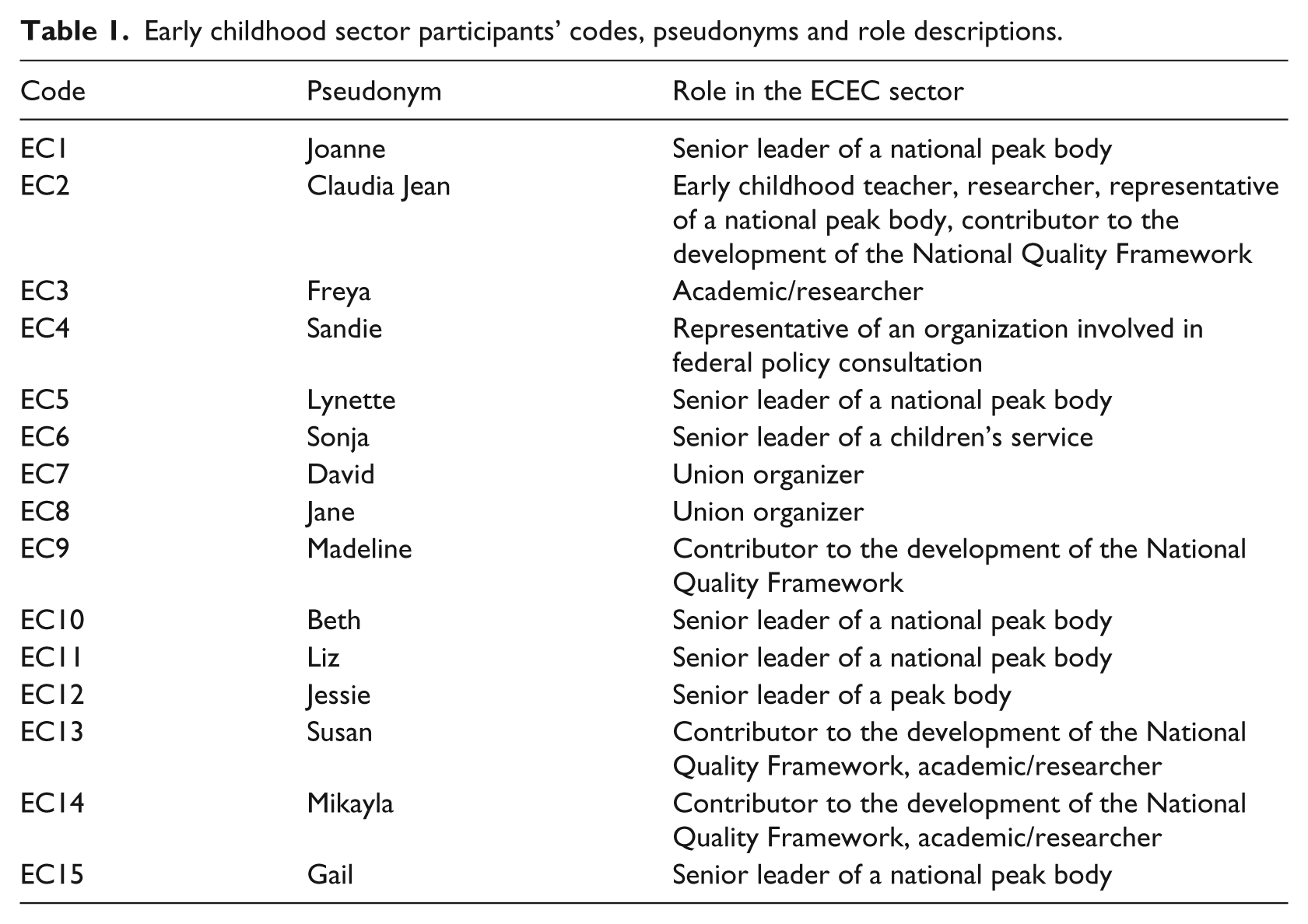
The 15 early childhood participants were representative of a broad cross section of key groups and organizations, including: outside-school-hours care; long day care; preschool; academia/researchers; peak ECEC bodies, such as those supporting children’s service providers or organizations dedicated to advocacy/activism; organizations that were not necessarily ECEC-focused but were involved in ECEC policy as part of their core business; and unions. In addition to their regular roles, some of the participants were directly involved in the development of one or more components of the NQF (i.e. National Quality Standards and the Early Years Learning Framework). All except two participants had been involved in the ECEC sector for more than two decades. Only one participant was a face-to-face teacher in an early years setting at the time the interviews were conducted.
Table 1 indicates the participants’ codes and pseudonyms, and provides a general description of their role in the ECEC sector (note that ‘children’s service’ refers to organizations providing services to children directly, and ‘peak body’ refers to organizations that do not provide direct services to children).
Early childhood sector participants’ codes, pseudonyms and role descriptions.
Politicians
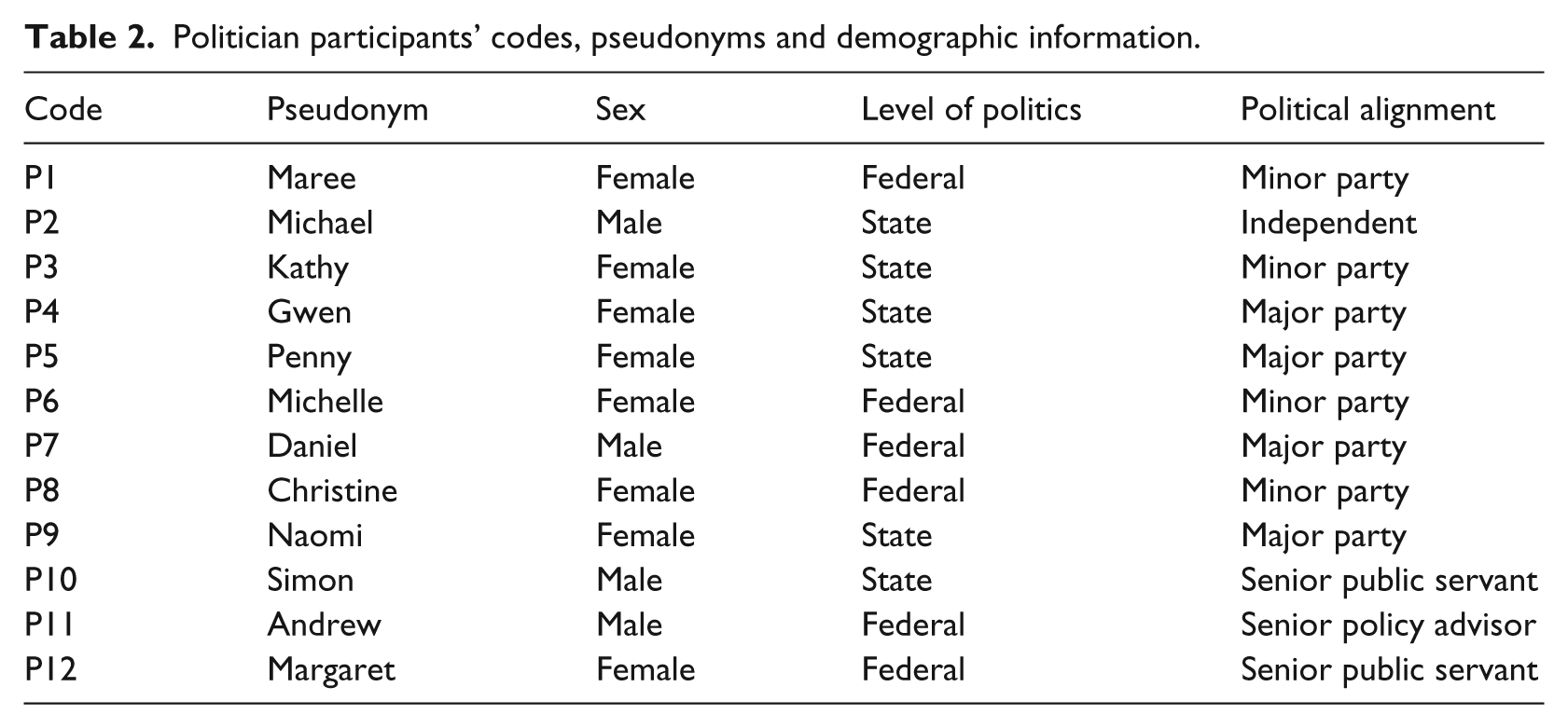
Politicians at the New South Wales state (n = 24) and federal (n = 25) levels were invited to participate in the research if they had experience with ECEC policy and held a current seat in parliament, or had held a seat within the previous five years. Of these 49 politicians, 14 declined and 26 did not respond. In total, nine interviews were conducted with politicians representing the Liberal Party of Australia (n = 2), the Australian Greens (n = 3), the Australian Labor Party (n = 1), the National Party of Australia (n = 1), the Australian Independents (n = 1) and the Australian Democrats (n = 1). One of the politicians was a minister at the time the interviews were conducted. In addition to these politicians, one New South Wales senior public servant and two federal senior public servants were interviewed. The New South Wales senior public servant was interviewed due to the minister at the time requesting that the public servant be interviewed on the minister’s behalf. One of the federal public servants was interviewed due to a networking opportunity and the other federal public servant was invited to participate because of their heavy involvement in federal social policy, particularly in ECEC policy. Table 2 indicates the politicians’ and public servants’ codes, pseudonyms and demographic information.
Politician participants’ codes, pseudonyms and demographic information.
Data generation
All of the interviews were conducted between March 2008 and July 2009. Two of the participants were interviewed together at their request and the remainder of the interviews were conducted individually. The interviews were audiotaped (except for one politician interview at the request of the participant) and transcribed. Each transcript was de-identified and returned to the individual participant for checking. A wide range of interview questions were developed for the semi-structured interviews with the early childhood participants and politician/public servant participants. ‘Policy vision’ was a topic that had been identified by the researchers when the methodology was being generated, and was therefore specifically included in the pool of questions for the interviews, with slight variations for the early childhood participants and the politician/public servant participants.
Specifically, the early childhood participants were asked to comment on their perceptions of the most significant influences on government policy; identify the gains made by early childhood advocates/activists for national ECEC policy; and discuss the barriers, challenges or setbacks to their goals for ECEC policy. These questions provoked discussions about policy vision.
The politician participants were asked directly to comment on their vision for ECEC policy if they had not already discussed the topic during the flow of the interview. Only one of the politicians (P12) opted to not speak on the issue. The politicians were also questioned about what they thought impeded improvements to ECEC policy and the effectiveness of advocate/activist strategies.
Data analysis
The NVIVO software program was used to organize and manage the data, and the functions within the program were utilized to code the data into themes, ideas or concepts. Foucault’s theorizing of power, knowledge and discourse informed the analysis of the data. For example, the analysis of the data involved identifying relations of power, different forms of resistance, the deployment of universal truths, and the construction of sanctioned knowledge (Foucault, 1994). For more detailed descriptions of the data analysis, please refer to earlier reports of the study (Bown, 2013; Bown et al., 2011).
Politicians’ visionary goals and ideas for ECEC policy
A universal system of ECEC and a better funding model
A dominant theme in the politicians’ nominated ‘visions’ for ECEC was the goal of achieving universal access. The participants defined universal access as a highly/fully subsidized ECEC system with equal access to all children across the country. Universal access was nominated by six of the politicians (P2, P3, P5, P6, P7 and P11), who represented major and minor parties and independents. Christine (P8) discussed a slightly different ‘vision’ by arguing for the need for ECEC policy to rely on better planning models when establishing new ECEC settings, believing this would improve access and availability.
Christine also argued for the need for government to have greater involvement in the way funding is used (in Australia, the government funds parents directly via subsidies). The issue of government funding of ECEC was taken up by another two politicians (P1 and P3), who suggested that a different funding model was needed to achieve higher-quality practices in ECEC settings. However, one of these politicians conceded that a return to government grants paid directly to community-based settings (as was the case until the mid-1980s) was a ‘battle lost’ (P1, Maree, interview transcript). Nevertheless, one of the politicians (P6) suggested a return to predominantly community-based provision.
Three politicians (P7, P8 and P11) explicitly argued that their vision for ECEC policy would be to shift the sector into education and frame it politically within those parameters. For example, Andrew argued for the merit of operating all ECEC settings from primary school sites:
I think that a universal system’s very important and I actually think that if, politically, that families trust education – there’s not a lot of questioning about the value of education in schools and I would – I would run the whole early childhood system – I would co-locate it with schools, run them all out of schools, that’s what I’d do. (P11, Andrew, interview transcript)
By connecting ECEC to the education portfolio, it seemed that these politicians were more easily able to justify a vision for universal access, since this is the case for primary and secondary school education. Andrew’s comments above also reflect his perception that parents would be more likely to ‘trust’ the value of ECEC if it were part of the education system, which already benefits from social acceptance. In another Australian study involving ECEC policy ‘elites’ (Cortis and Head, 2008–2009), the participants similarly believed that shifting ECEC to the education portfolio would have a positive effect on societal perceptions of ECEC.
ECEC as a social equalizer
Another particularly dominant theme in the politicians’ discussions of their vision for ECEC policy was the role of ECEC in preventing social disadvantage and inequality, which was discussed by six of the politicians. The politicians’ descriptions of how ECEC would take on this role relied on protection discourses or ‘narratives of salvation’ (Sumsion et al., 2009). Child protection discourses have a long and influential history in ECEC policy in Australia and can be traced back to the early philanthropic movement (Wong, 2006).
Three of the six politicians (P2, P4 and P5) who emphasized the role of ECEC in preventing social disadvantage and inequality linked ECEC with early detection of and intervention in a range of childhood ‘problems’ and/or child protection issues, while the other three politicians (P1, P3 and P6) discussed the role of ECEC in reducing disadvantage by educating children who might otherwise ‘fail’ at school. Politician participant Gwen, after a long discussion of her experience with severe child protection issues, declared:
The vision is to have safe and happy children. That’s what we want. Safe, happy, secure children in loving families, whatever make-up that family constitutes. And we recognize very strongly that families come in all shapes and sizes. At the end of the day, for a child to be loved, happy and secure is what we want – that’s our vision. And if they can be educated as well, on top of that, that’s just extra icing on the cake. (P4, Gwen, interview transcript)
In Gwen’s description, ECEC is positioned as a luxury or secondary concern. Her view contrasts sharply with those politicians discussing, in the previous section, the importance of connecting ECEC to the education sector. While the desire for children to live in safe and happy families is understandable, her vision for children places responsibility for ECEC firmly in the private sphere of the family. Christine (P8) and Andrew (P11) argued that the provision of ECEC is now considered to be an ‘essential service’ and should continue to be framed in this way.
When speaking about ECEC as a social equalizer in the various ways outlined above, the politician participants recounted personal anecdotes that they believed had been influential in their vision for ECEC policy. For example, Maree (P1) recalled a visit to an integrated service in a ‘low socio-economic area’ that had a strong outreach program, particularly to newly arrived African immigrants. Maree described seeing the program in practice as an ‘amazing experience’. Gwen (P4) described the severe child abuse and neglect she had witnessed as a child and during her time as a politician, and used those anecdotes to justify her focus on child protection and safety. In both instances, the anecdotes were personal and compelling experiences that influenced the politicians’ visions for ECEC policy. Even though fixing social problems may be an appealing political strategy, relying on this framework for devising ECEC policy potentially maintains systemic fragmentation. This justification alone for providing early years settings keeps ECEC policy tied to the private needs of the individual family unit (e.g. for socio-economic reasons or for child safety concerns), rather than a universal concern for all children’s early education.
Politicians’ perceptions of barriers to achieving visionary policy
Several of the politicians knew that the commencement of the 2007 National Reforms saw the ECEC portfolio move from the federal Department of Community Services to the federal Department of Education. However, some of the politicians voiced concerns that ECEC policy reform might continue to be hampered due to it straddling the public and private spheres, even though it has be rehoused in the education portfolio. While they recognized this potential barrier, they did not articulate how it could be addressed. They did not refer, for example, to the OECD’s argument that government funding models that pay subsidies directly to parents perpetuate the view that ‘childcare’ is a private commodity to be purchased by the parent-consumer (OECD, 2006). There seemed to be scope for the politicians to learn more about how the current funding model might exacerbate ECEC sector fragmentation and continue to be a potential but significant threat to the success of the reforms.
A disconnect between policy and vision?
While aware of a range of problems and challenges facing ECEC policy, the politicians, on the whole, did not offer specific strategies for addressing current problems or for working towards a grander vision for ECEC policy in Australia, despite the national ECEC reforms that were underway at the time the interviews were conducted. The interviews with the politicians also gave a sense that they perceived ECEC policy to be disconnected from the broader policy framework and their goals and visions for society more generally. We wondered what the reasons for this disconnect could be.
One reason could be the inexperience of the interviewer (the first author). Alternatively, or as well, the limited nature of the politicians’ discussion of ECEC policy vision could have reflected the lack of (current or former) ministers participating in the study. Ministers may have offered a more nuanced perspective on vision in and for ECEC policy. Aside from the research limitations, for political reasons the politician participants may have felt compelled to represent the party line, particularly given the power of the press to distort ideas and thinking (Sumsion et al., 2009).
A further possible explanation, which we are interested in teasing out in more depth here, may be related to the perceived fragmentation of the ECEC sector (in both the literature and the data of the study reported here) and the purported effects of this fragmentation in hampering advocacy/activism efforts aimed at generating effective and visionary policy. Drawing on data from the early childhood and politician participants, the next section problematizes this characterization of the ECEC sector as fragmented as therefore necessarily limiting the possibilities of advocacy/activism.
ECEC systems and fragmentation – and alternative constructions
The word ‘fragmented’ comes from the Latin fragmentum, meaning ‘a piece broken off’, and frangere, meaning ‘to break’ (Harper, 2014). In the literature concerning ECEC fragmentation, the term invariably refers to a lack of a consistent approach to policy and provision across a nation, which is usually caused by regulatory differences between local jurisdictions (such as states or municipalities), a range of service types providing settings and services for the early years (including management and ownership structures), and, as a result, a diversity in the philosophical underpinnings and perspectives of not just ECEC educators, but also researchers/academics, politicians and policymakers, parents/families and wider communities (Organisation for Economic Co-operation and Development, 2006; Press, 2007).
Following the work of Sara Ahmed, we question the cultural politics of characterizing the ECEC sector as ‘fragmented’ and how this description might also be inscribed on the ‘“surfaces” of individual and collective bodies’ (Ahmed, 2004: 1), subsequently impacting on advocate/activist strategies and how politicians are influenced. Rather than accepting ‘fragmented’ as a characterization of individual or collective bodies, we instead examine the processes whereby ‘fragmented’ ‘comes to be seen as a characteristic of some bodies and not others, in the first place’ (Ahmed, 2004: 4). Drawing on the interview data with both the politicians and early childhood participants, we contend that describing the ECEC system as ‘fragmented’ has affected politicians’ perceptions of ECEC sector organizations and individuals, and, equally, that characterizing ECEC organizations and individuals as fragmented has affected early childhood participants’ activist/advocate subjectivities, their views on how politicians are influenced, and their beliefs about improving ECEC policy in the future.
Antagonistic relations and fragmentation
Most of the politician participants acknowledged that systemic fragmentation of the ECEC sector was a result of multiple jurisdictional responsibilities and a lack of a consistent national approach to ECEC policy in Australia. Three of the politician participants (P7, P10 and P12) also explicitly characterized the ECEC sector as fragmented – a distinction we believe is worthy of further analysis. Simon (P10), a senior public servant, summarized his experiences and perceptions of the fragmentation of ECEC organizations as follows:
I think early childhood is, in many ways, more factionalized than any industry I’ve had exposure to … and it’s not just not-for-profit versus commercial, it’s preschool versus long day care, it’s family day care versus centre-based, it’s education-based models – you know, school-based models versus community-based models, it’s Reggio Emilia versus Montessori versus Steiner … I think, ‘Gee, it’s hard to get you guys to agree on what’s the best thing to do’. I don’t think it’s a sector that’s good at pragmatism or trade-offs. And I understand that’s because everyone only wants what’s absolutely the best for the kids and they consider it a non-negotiable. But, when you’ve got finite tools and resources, and you have to think about what’s the best thing to do, what’s the first thing to do, I think it’s still a sector that’s hard to get that agreement on. (P10, Simon, interview transcript)
Simon’s repetition of the word ‘versus’ emphasizes competition and rivalry. His description evokes a sense of constant battle between competing interest groups which cannot agree, compromise or find a practical solution. Margaret (P12) voiced similar sentiments to Simon’s, using descriptions such as ‘disjunction in the voices’ and ‘a lack of national voice’, while Daniel (P7), a long-serving senior federal politician, believed ECEC advocates/activists to be ‘poorly organized’ and ‘splintered’.
All of the early childhood participants agreed that ‘fragmented’ was a common characterization of ECEC sector organizations and individuals. In contrast to the politician participants, only one early childhood participant explicitly argued that this characterization of the ECEC sector was essentially problematic:
No, the sector doesn’t do anything in a coordinated way. No. No … I think the fragmentation of the early childhood field is one of the biggest barriers to moving forward. And the fact that we don’t have strong national leadership. We have got some strong individuals, some really good people, but we don’t have a unified front, no … politicians, ministers get very mixed messages about, you know, what’s important … Look, if the early childhood field got their act together and everybody got in the room together and decided to think about children and not their own patch, it would be a very powerful group. And went to government with the message, or even the messages, it would be a very powerful group. But I think the lack of agreement between early childhood and the lack of relationships between key players is one of the biggest issues … When I was in government, my minister used to say to me, ‘Gail, why can’t they come together and tell me what they want? One bit comes, another bit comes, another bit comes, and they compete with each other. Why can’t they come and say this is the framework we want for early childhood?’ And they don’t do that. And what is that about? Is that about leadership? We don’t have leadership. Is it about, I don’t know, self-interest? I don’t know what it’s about. But the early childhood field just doesn’t – it’s too factional, way too factional. (EC15, Gail, interview transcript)
Simon (P10), Margaret (P12), Daniel (P7) and Gail (EC15) believed that by eradicating ‘fragmentation’ in some way, such as working towards uniform consensus, majority opinion or ‘one voice’, more effective advocacy, easier political decision-making and more visionary policy would result. We question, however, the logic of this assumption. An earlier report from the current study (Bown, 2013) provides an example of early childhood sector advocates/activists reaching a majority consensus on an ECEC policy issue but nevertheless experiencing ongoing rejection from the government. Bown (2013) reported on a case study of a long campaign – primarily from 2002 to 2009 − to change the staff–child ratio for children between birth and two years of age in the state of New South Wales, Australia. The campaign, which aimed to improve the staff–child ratio from 1:5 to 1:4, met with repeated rejection from the New South Wales government – despite the Cross-Sectoral Taskforce (2006), which was established by the government, indicating the viability of a 1:4 ratio in the majority report. 2 The majority report and wider campaign to change the ratio represented strong collaboration across the sector, particularly during the peak of the campaign, when a consortium of over 40 individuals representing organizations across the sector met regularly to collaborate on campaign strategies (Bown, 2013). Despite the significant collaboration of the sector and the clear policy message being communicated to the ministers and advisors, the government retained the 1:5 ratio as advised by the minority report. In this example, despite widespread support and a well-coordinated campaign for a change in the staff–child ratio, it took many years to persuade the government to reduce the staff–child ration to 1:4, as recommended in the majority report.
In order to develop this argument further, we return to Simon’s (P10) delineation of various ECEC identities – ‘preschool versus long day care’, ‘not-for-profit versus commercial’, and so forth. Simon’s argument is predicated on identifying and demarcating contained identities in continual conflict. By identifying an ‘other’, Simon is establishing an ‘exterior’ – or, in other words, ‘we’ can only exist by demarcating ‘they’. In certain conditions, and as suggested by Simon, ‘there is always the possibility that this we/they relation can become antagonistic’ or a relation of friend/enemy (Mouffe, 2005: 15). Antagonism is provoked when ‘they’ is ‘perceived as putting into question the identity of the “we” and as threatening its existence’ (Mouffe, 2005: 16). The problem with antagonistic politics is illustrated in early childhood participant Sandie’s excerpt below:
For many departmental officers that are meant to manage an external group of stakeholders who have a great diversity of viewpoints, this is the most scary part of their jobs. They come in as policy people or contractors, and so managing what they perceive as very scary stakeholders is often not something they’re particularly skilled in … It’s pretty clear that most bureaucrats sort of perceive having to deal with consultation processes around anything that’s, you know, volatile or has media attention as something that they have to manage to try and keep the heat down from for the government. And a lot of policy gets driven on the basis of what can we do to keep things out of the paper. (EC4, Sandie, interview transcript)
Sandie’s description provides an example of an antagonistic political sphere operating under constricting and censored terms. Following Mouffe (2005), enemies, rather than adversaries, operate to minimize ‘risk’ in an environment of fear and suppression. The media plays a role of friend/enemy that is unreliable and unpredictable, posing significant risk to both politicians and stakeholders. Stakeholders are similarly perceived as unwieldy, leading to government-instigated ‘consultation’ processes that instead resemble highly controlled and directed ‘information sessions’, as reported by a majority of the early childhood participants in this study. There is also a tendency in antagonistic political spaces for the we/they relation to be constituted ‘according to moral categories of “good” versus “evil”’, revealing not necessarily an element of morality, but rather a ‘moral register’ (Mouffe, 2005: 75). This moral register converts the we/they to good/evil or friend/enemy such that the purpose of conflict is to eradicate the ‘other’, ironically pursuing and enabling hegemony.
A case for agonistic politics
We propose the project of ‘agonistic politics’, as developed by Mouffe, to interrogate the characterization of ECEC organizations and individuals as fragmented. Agonism is a theory of ‘radical democracy’ which proposes that reconstituting the political could lead to the creation of a ‘vibrant “agonistic” public sphere of contestation where different hegemonic projects can be confronted’ (Mouffe, 2005: 3). Agonism recognizes that conflicting interests and demands will never be fully reconciled, and therefore these various interests should be considered as ‘legitimate adversaries’ (Mouffe, 2005: 120). The relations between ‘legitimate adversaries’ are conceptualized as ‘mutual incitement and struggle; less of a face-to-face confrontation that paralyses both sides than a permanent provocation’ (Foucault, 1994: 342). While we agree with Foucault’s description of relations between legitimate adversaries, it is important to highlight that this struggle or contestation might occur between more than just two sides. Indeed, in an agonistic space of contestation, multiple interests are suspended in an atmosphere of ‘experimentation, research and continuous reflection, critique and argumentation’ (Dahlberg and Moss, 2005: 179), where real confrontation exists ‘under conditions regulated by a set of democratic procedures’ (Mouffe, 2005: 21).
Returning to the characterization of ECEC as ‘fragmented’, a positive/negative binary is produced. Alternatively, reframing ECEC through the concept and practice of agonism allows a suspension of multiple voices moving in tension, where tension is not necessarily negative or positive, but productive. Foucault (1994: 457) argues that ‘it is a matter of making conflicts more visible, of making them more essential than mere clashes of interest or mere institutional blockages’. For instance, Penny (P5) was one of three of the politician participants who perceived multiple voices to be realistic and even essential for policymaking:
[N]ot everybody is going to agree with everybody else. And there are often a number of right answers as well. There’s not just one right answer and the rest are wrong … I think it comes down to available resources in the end. That you’re going to do like a utilitarian approach, the most that you can for the most people that you can do it for … It’s very difficult to … making ethical decisions about policy, about what you’d like to do in the ideal world, is always predicated on how many resources you’ve got to actually do it. (P5, Penny, interview transcript)
Penny suggests that there is not ‘one right answer’ to political problems. She goes on to explain that often, despite the validity of a range of views, decision-making often comes down to a practical decision around resources. Penny concludes that policy decision-making is therefore a political and ethical practice. Dahlberg and Moss (2005: 125), drawing on Derrida, illustrate the connection between ethics and politics by locating ethics ‘in the sphere of undecidability’ and politics ‘in the sphere of the decision’. Taking up the metaphor of the ‘threshold’ as a component of architecture that exists in the middle as a passageway with ‘no function, purpose, or meaning until it is connected to other spaces’ (Jackson and Mazzei, 2013: 264), the relationship between ethics/undecidability and politics/decision-making can be reconfigured as a momentary pause on a threshold, before becoming something other. Agonistically, Penny’s description of doing ‘the most that you can for the most people’ could be understood not as a finite solution to a finite problem, but as a ‘temporary settlement’ on the threshold of being ‘disarticulated and transformed as a result of the agonistic struggle among adversaries’ (Mouffe, 2005: 33). These ideas are reflected in the following excerpt from early childhood participant Claudia Jean:
I do think that if we decided to think about things differently and in an acutely critical way, we could be more influential by engaging dissent. We could be more influential, and this is my positive side, we could be more influential by publicly raising, you know, dissenting perspectives to what’s there. Because they would work very hard to either cover them up or consult or do something. So if there was a wave of dissenting views that begged more for children and more for the people who slave their guts out doing the job, I think that is a possibility for influence. That’s my naïve utopian element of my activist identity coming out. (EC2, Claudia Jean, interview transcript)
The cultural politics of fragmentation: Passion and subjectivity
Even though Claudia Jean (EC2) and other early childhood participants (EC11 and EC12) expressed support for dissenting and/or diverse perspectives in ECEC advocacy/activism as a potentially effective strategy, the experience of early childhood participant Beth (EC10) highlights the cultural politics of the term ‘fragmentation’ and its affect:
[T]here were times when the sector would say to me that I was too dogmatic and too outspoken and that I should – that I shouldn’t be doing that. But I actually thought I was right. So, so I would – they would be – they would see me in a particular view and they would be cross with me sometimes and yell at me sometimes. Ministers do that – they can be quite unpleasant to you and rude to you. But they certainly knew what I stood for. They just thought I was wrong and that I was some crazy ideologue. (EC10, Beth, interview transcript)
Beth’s account directs us to consider how differences are perceived within the ECEC sector and from the outside looking in, but, more importantly, how difference, dissent and debate are treated in political and public spheres. Beth described perceptions of herself as ‘dogmatic’ and ‘outspoken’, leading colleagues and the politicians she interacted with to the conclusion that she was ‘some crazy ideologue’. We will return to the ideas raised in Beth’s excerpt after first presenting an excerpt from politician Simon (P10).
In the following excerpt, Simon discusses the relationship between effective advocacy and passion. His comments were made in the context of discussing the ECEC sector as fragmented (see Simon’s quote earlier), using the example of the contention over appropriate minimum staff–child ratios for children from birth to two years in New South Wales (Bown, 2013). Simon described advocacy/activism efforts to change the staff–child ratio as passionate, but not necessarily strategic:
I have particular views on advocacy not being a good substitute for effective public policy, but compassion not being a good substitute for thinking … You need passion, you absolutely need advocacy, you need advocates to make government feel uncomfortable. You know, if a government is comfortable, somebody’s not doing their job at some level [laughs], whether that’s advocates or community, whatever. So you need people to be pushing the envelope. But it would be more effective if it was sometimes more grounded, more strategic policy instead of a wish list with passion attached to it. (P10, Simon, interview transcript)
The relationship between ideology and passion in Beth’s and Simon’s excerpts is instructive. First, we draw attention to the description of the field of ECEC – predominantly women – as ‘passionate’. The words ‘passion’ and ‘passive’ share the same Latin root word: ‘suffering’ (Ahmed, 2004). This etymology implies, in the case of ‘passion’, lacking rational thought (i.e. suffering the passions) and, in the case of ‘passivity’, a submission to others. In both instances, it implies an undeveloped emotional weakness. Ahmed elaborates:
To be emotional is to have one’s judgement affected: it is to be reactive rather than active, dependent rather than autonomous … Emotions are associated with women, who are represented as ‘closer’ to nature, ruled by appetite, and less able to transcend the body through thought, will and judgement. (Ahmed, 2004: 3)
Agonistic politics, however, recognize the place for passion in a public sphere of confrontation. Mouffe (2005: 30) argues that if debate and disagreement between adversaries is missing or suppressed, ‘passions cannot be given a democratic outlet and the agonistic dynamics of pluralism are hindered’. Political and broader public debate about a vision for ECEC that extends beyond the rhetoric of human capital and women’s workforce participation is mostly absent in Australia. An antagonistic public sphere that restricts and censors ‘passionate’ and complex debate may prevent policymakers and the broader public from engaging with the kinds of questions that Moss (2009) posed in the quote that began this article.
We therefore argue that passions, or passionate politics, sit in a vacuum in an antagonistic political sphere that discredits and immobilizes. In an agonistic political sphere, in contrast, passionate politics are essential and generative, challenging hegemony and suspending tensions. Fragmentation does not necessarily foreclose visionary policy, but rather, in an agonistic sphere, can be transfigured into diversity and difference, suspended and always moving in tension. Passions in an agonistic sphere are instead viewed as ‘various affective forces which are at the origin of collective forms of identifications’ (Mouffe, 2005: 24).
Conclusion
Despite the politicians identifying many of the policy problems ECEC faces through their visions for ECEC, they appeared to have few practical solutions for addressing these problems. Furthermore, it could be argued that their policy visions in many ways likely exacerbated systemic fragmentation. The interviews with the politicians also conveyed a sense that they perceived ECEC policy to be disconnected from the broader policy framework and from their goals and visions for society more generally. This disconnection reflects another kind of fragmentation related to the perception that children’s early years are a private family concern, which is readily traceable through the policy history of ECEC in Australia. At the time of writing, the Australian federal government is deliberating the recommendations of the Productivity Commission’s report (Productivity Commission, 2014). This policy context provides ongoing encouragement that an investigation of influences on politicians’ decision-making, which includes a focus on visionary policy, is a worthwhile pursuit.
Generating policy that does more than tend to superficial problems or reinvent the wheel – that seeks a deeper investment of time and resources to imagine inspiring possibilities – has been, and remains, a difficult pursuit. We assert that while visionary policy generated to address systemic fragmentation is warranted (e.g. Australia’s ECEC policy reforms from 2007 to 2013), the characterization of ECEC sector individuals and organizations as fragmented must be examined with a more critical eye. This characterization has a totalizing and disciplining effect on a sector that could instead be reconfigured in agonistic terms.
The need for this reconfiguring was identified in the interviews with several of the early childhood sector participants, who discussed the possibility of a public platform or ‘space’ through which complex and diverse dialogue could take place, and through which visionary thinking and policy might be generated. The lack of such a space, in conjunction with the widely held belief that the ECEC sector was ‘fragmented’, led the early childhood participants to feel that the extent to which they could influence politicians/policy was somewhat restricted. Through an agonistic reconfiguring, however, the diversity and complexity of the ECEC sector would be essential to a space of contestation. Rather than impede the development of visionary policy, a space of contestation would help to generate visionary policy.
Moreover, while contestation is a vital element, agonism simultaneously allows ‘collective forms of identification around democratic goals’ (Dahlberg and Moss, 2005: 152–153). This means that while the diverse and complex world views of various ECEC sector individuals and organizations are important in an agonistic politics, there may be opportunities to strategically pursue ‘collective forms of identification’ in order to confront hegemony at the political level. Strategies that involve overt forms of political resistance to, for example, the hegemony of human capital and productivity agendas, which, in Australia, continually eclipse any other kinds of justification for investment in ECEC, could be part of a collective strategy. So, too, could industrial action by a large proportion of the sector at strategically chosen times and places to achieve maximum impact and, specifically, to demonstrate that ECEC is intricately connected to the smooth functioning of daily life. Through collective industrial action, the ECEC sector could position itself as a ‘legitimate adversar[y]’ (Mouffe, 2005: 120) to policy that does not adequately address the widely recognized poor working conditions and remuneration of the ECEC workforce. We close with Mouffe’s assertion to ‘abandon the dream of a reconciled world that would have overcome power, sovereignty and hegemony’ (Mouffe, 2005: 130), and instead embrace differences within the ECEC sector and beyond, in order to contest and challenge hegemony, and to imagine ‘new modes of human possibility’ (Dahlberg and Moss, 2005: 179).
Footnotes
Funding
The author(s) received no financial support for the research, authorship, and/or publication of this article.